welcome
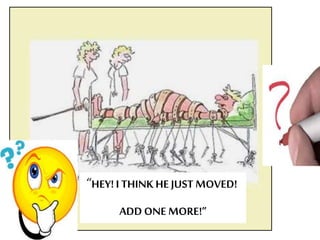
“HEY!I THINK HE JUST MOVED!
ADD ONE MORE!”
Restraints Nurses Responsibility
PRESENTER: LATHIKA.K
2ND YR MSC N
BMCON
Restraints
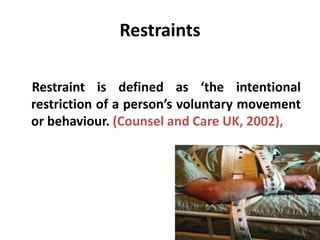
Restraint is defined as ‘the intentional
restriction of a person’s voluntary movement
or behaviour. (Counsel and Care UK, 2002),
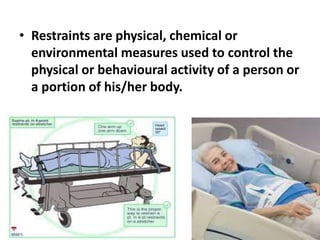
• Restraints are physical, chemical or
environmental measures used to control the
physical or behavioural activity of a person or
a portion of his/her body.
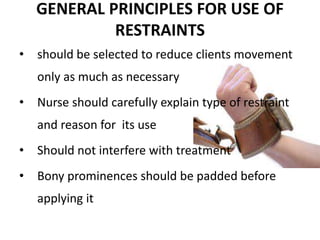
GENERAL PRINCIPLES FOR USE OF
RESTRAINTS
• should be selected to reduce clients movement
only as much as necessary
• Nurse should carefully explain type of restraint
and reason for its use
• Should not interfere with treatment
• Bony prominences should be padded before
applying it
•Should be changed when they become soiled or
damp
•Should be secured away from a clients reach
•Should be able to quickly release the device
•Should be attached to bed frame not to side rails
•Should be removed a minimum of every 2 hrs
•Frequent circulations checks should be performed
when extremity are used
Indications
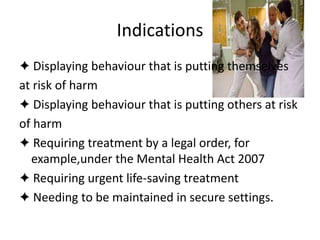
✦ Displaying behaviour that is putting themselves
at risk of harm
✦ Displaying behaviour that is putting others at risk
of harm
✦ Requiring treatment by a legal order, for
example,under the Mental Health Act 2007
✦ Requiring urgent life-saving treatment
✦ Needing to be maintained in secure settings.
All alternatives must be tried before restrainting
• Offer bedpan or bathroom every 2 hours
• Offer fluids and nourishment frequently, keep water within
reach
• Provide divertional activity
• Decrease stimuli and noise
• Provide change of position, up to chair, ambulation
• Have patient wear glasses and/or hearing aides
• Activate bed alarm
Alternatives …………..
• Increase observation
– Ask family to sit with patient
– Alert other staff to be observant
– Move patient to a room near the nurse’s station
• If the patient is interfering with his medical equipment
– Educate frequently not to touch the treatment device
– Place the device out of site if possible
– Cover the device (i.e. wrap I.V. site with Coban or Kerlex)
TYPES OF
RESTRAINTS
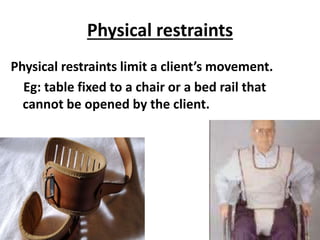
Physical restraints
Physical restraints limit a client’s movement.
Eg: table fixed to a chair or a bed rail that
cannot be opened by the client.
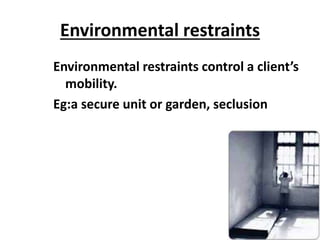
Environmental restraints
Environmental restraints control a client’s
mobility.
Eg:a secure unit or garden, seclusion
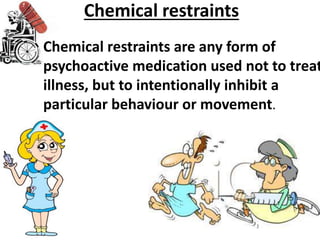
Chemical restraints
Chemical restraints are any form of
psychoactive medication used not to treat
illness, but to intentionally inhibit a
particular behaviour or movement.
TYPES OF PHYSICAL RESTRAINTS
1. Mummy restraint
2. Elbow restraint
3. Extremity restraint
4. Abdominal restraint
5. Jacket restraint
6. Mitten or finger restraint
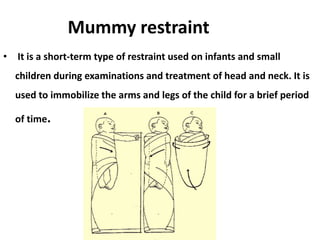
Mummy restraint
• It is a short-term type of restraint used on infants and small
children during examinations and treatment of head and neck. It is
used to immobilize the arms and legs of the child for a brief period
of time.
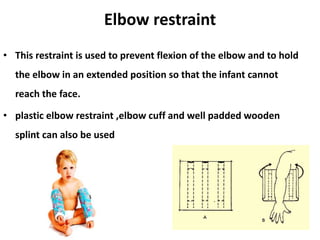
Elbow restraint
• This restraint is used to prevent flexion of the elbow and to hold
the elbow in an extended position so that the infant cannot
reach the face.
• plastic elbow restraint ,elbow cuff and well padded wooden
splint can also be used
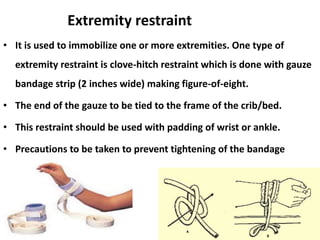
Extremity restraint
• It is used to immobilize one or more extremities. One type of
extremity restraint is clove-hitch restraint which is done with gauze
bandage strip (2 inches wide) making figure-of-eight.
• The end of the gauze to be tied to the frame of the crib/bed.
• This restraint should be used with padding of wrist or ankle.
• Precautions to be taken to prevent tightening of the bandage
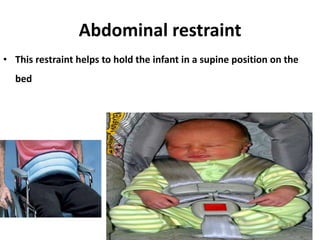
Abdominal restraint
• This restraint helps to hold the infant in a supine position on the
bed
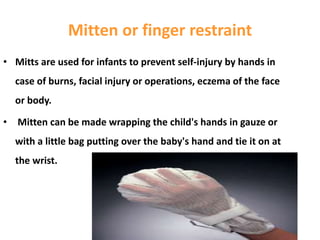
Mitten or finger restraint
• Mitts are used for infants to prevent self-injury by hands in
case of burns, facial injury or operations, eczema of the face
or body.
• Mitten can be made wrapping the child's hands in gauze or
with a little bag putting over the baby's hand and tie it on at
the wrist.
POTENTIAL RISKS AND SIDE EFFECTS OF RESTRAINT USE:
Psychological/Emotional:
 Increased agitation &hostility
 Feelings of humiliation, loss of dignity
 Increased confusion
 Fear
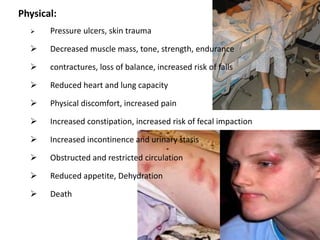
Physical:
 Pressure ulcers, skin trauma
 Decreased muscle mass, tone, strength, endurance
 contractures, loss of balance, increased risk of falls
 Reduced heart and lung capacity
 Physical discomfort, increased pain
 Increased constipation, increased risk of fecal impaction
 Increased incontinence and urinary stasis
 Obstructed and restricted circulation
 Reduced appetite, Dehydration
 Death
Restraint guidelines:
• Doctors order
• Informed consent
• Follow proper technique
• Least restrictive
• Pad boney prominence
• Maintain Good body alignment
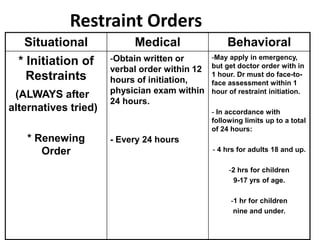
Restraint Orders
Situational Medical Behavioral
* Initiation of
Restraints
(ALWAYS after
alternatives tried)
* Renewing
Order
-Obtain written or
verbal order within 12
hours of initiation,
physician exam within
24 hours.
- Every 24 hours
-May apply in emergency,
but get doctor order with in
1 hour. Dr must do face-to-
face assessment within 1
hour of restraint initiation.
- In accordance with
following limits up to a total
of 24 hours:
- 4 hrs for adults 18 and up.
-2 hrs for children
9-17 yrs of age.
-1 hr for children
nine and under.
NURSES ROLE
Monitor a patient in restraint every 15 minutes for:
• Signs of injury
• Circulation and range of motion
• Comfort
• Readiness for discontinuation of restraint
DOCUMENTATION IN EVERY 2 HOURS FOR:
• Release the patient, turn and position
• Institute a trial of restraint release
• Hydration and nutrition needs
• Elimination needs
• Comfort and repositioning needs
RESPONSIBILITIES OF THE NURSE
 Assess the client’s behaviour and the need for restraint & applies
as a last resort.
 Get written order and obtain consent as per hospital policy
 Must communicates with the client and family members
 complies with institutional policies and guidelines for restraint
 Explain the client the reason for the restraint and cooperation
 Arrange adequate assistance from competent staff before
carrying out the restraint procedure
 Apply the least restrictive, reasonable and appropriate devices
Arrange the client under restraint in a place for easy,close
and regular observation
particular attention to his/her safety, comfort, dignity,
privacy and physical and mental conditions.
attend the client’s biological and psychosocial needs
during restraint at regular intervals.
 reviews the restraint regularly, or according to
institutional policies.
consider the earliest possible discontinuation of restraint.
document the use of restraint for record and
inspection purposes.
Explore interventions, practices and
alternatives to minimize the use of restraint.
Nurse must maintain his/her competence in
the appropriate and effective use of restraint
through continuous education.
31
FACTS
“ Restraints may be used to protect a
patient from a greater risk of harm,
although evidence is lacking to support
the effectiveness of using physical
restraints to prevent treatment
interference.”
32
FACTS
• Studies have repeatedly demonstrated that
there is no increase in serious injuries when
physical restraints are replaced with other less
restrictive safety measures based on the
individual’s specific needs.
• Studies have also demonstrated a dramatic
decrease in behavior problems when
restraints are removed.
RESTRAINTS - NURSES RESPONSIBILITY

RESTRAINTS - NURSES RESPONSIBILITY

  • 1.
  • 2.
    “HEY!I THINK HEJUST MOVED! ADD ONE MORE!”
  • 3.
    Restraints Nurses Responsibility PRESENTER:LATHIKA.K 2ND YR MSC N BMCON
  • 4.
    Restraints Restraint is definedas ‘the intentional restriction of a person’s voluntary movement or behaviour. (Counsel and Care UK, 2002),
  • 5.
    • Restraints arephysical, chemical or environmental measures used to control the physical or behavioural activity of a person or a portion of his/her body.
  • 6.
    GENERAL PRINCIPLES FORUSE OF RESTRAINTS • should be selected to reduce clients movement only as much as necessary • Nurse should carefully explain type of restraint and reason for its use • Should not interfere with treatment • Bony prominences should be padded before applying it
  • 7.
    •Should be changedwhen they become soiled or damp •Should be secured away from a clients reach •Should be able to quickly release the device •Should be attached to bed frame not to side rails •Should be removed a minimum of every 2 hrs •Frequent circulations checks should be performed when extremity are used
  • 8.
    Indications ✦ Displaying behaviourthat is putting themselves at risk of harm ✦ Displaying behaviour that is putting others at risk of harm ✦ Requiring treatment by a legal order, for example,under the Mental Health Act 2007 ✦ Requiring urgent life-saving treatment ✦ Needing to be maintained in secure settings.
  • 9.
    All alternatives mustbe tried before restrainting • Offer bedpan or bathroom every 2 hours • Offer fluids and nourishment frequently, keep water within reach • Provide divertional activity • Decrease stimuli and noise • Provide change of position, up to chair, ambulation • Have patient wear glasses and/or hearing aides • Activate bed alarm
  • 10.
    Alternatives ………….. • Increaseobservation – Ask family to sit with patient – Alert other staff to be observant – Move patient to a room near the nurse’s station • If the patient is interfering with his medical equipment – Educate frequently not to touch the treatment device – Place the device out of site if possible – Cover the device (i.e. wrap I.V. site with Coban or Kerlex)
  • 11.
  • 12.
    Physical restraints Physical restraintslimit a client’s movement. Eg: table fixed to a chair or a bed rail that cannot be opened by the client.
  • 13.
    Environmental restraints Environmental restraintscontrol a client’s mobility. Eg:a secure unit or garden, seclusion
  • 14.
    Chemical restraints Chemical restraintsare any form of psychoactive medication used not to treat illness, but to intentionally inhibit a particular behaviour or movement.
  • 15.
    TYPES OF PHYSICALRESTRAINTS 1. Mummy restraint 2. Elbow restraint 3. Extremity restraint 4. Abdominal restraint 5. Jacket restraint 6. Mitten or finger restraint
  • 16.
    Mummy restraint • Itis a short-term type of restraint used on infants and small children during examinations and treatment of head and neck. It is used to immobilize the arms and legs of the child for a brief period of time.
  • 17.
    Elbow restraint • Thisrestraint is used to prevent flexion of the elbow and to hold the elbow in an extended position so that the infant cannot reach the face. • plastic elbow restraint ,elbow cuff and well padded wooden splint can also be used
  • 18.
    Extremity restraint • Itis used to immobilize one or more extremities. One type of extremity restraint is clove-hitch restraint which is done with gauze bandage strip (2 inches wide) making figure-of-eight. • The end of the gauze to be tied to the frame of the crib/bed. • This restraint should be used with padding of wrist or ankle. • Precautions to be taken to prevent tightening of the bandage
  • 19.
    Abdominal restraint • Thisrestraint helps to hold the infant in a supine position on the bed
  • 20.
    Mitten or fingerrestraint • Mitts are used for infants to prevent self-injury by hands in case of burns, facial injury or operations, eczema of the face or body. • Mitten can be made wrapping the child's hands in gauze or with a little bag putting over the baby's hand and tie it on at the wrist.
  • 21.
    POTENTIAL RISKS ANDSIDE EFFECTS OF RESTRAINT USE: Psychological/Emotional:  Increased agitation &hostility  Feelings of humiliation, loss of dignity  Increased confusion  Fear
  • 22.
    Physical:  Pressure ulcers,skin trauma  Decreased muscle mass, tone, strength, endurance  contractures, loss of balance, increased risk of falls  Reduced heart and lung capacity  Physical discomfort, increased pain  Increased constipation, increased risk of fecal impaction  Increased incontinence and urinary stasis  Obstructed and restricted circulation  Reduced appetite, Dehydration  Death
  • 23.
    Restraint guidelines: • Doctorsorder • Informed consent • Follow proper technique • Least restrictive • Pad boney prominence • Maintain Good body alignment
  • 24.
    Restraint Orders Situational MedicalBehavioral * Initiation of Restraints (ALWAYS after alternatives tried) * Renewing Order -Obtain written or verbal order within 12 hours of initiation, physician exam within 24 hours. - Every 24 hours -May apply in emergency, but get doctor order with in 1 hour. Dr must do face-to- face assessment within 1 hour of restraint initiation. - In accordance with following limits up to a total of 24 hours: - 4 hrs for adults 18 and up. -2 hrs for children 9-17 yrs of age. -1 hr for children nine and under.
  • 25.
  • 26.
    Monitor a patientin restraint every 15 minutes for: • Signs of injury • Circulation and range of motion • Comfort • Readiness for discontinuation of restraint
  • 27.
    DOCUMENTATION IN EVERY2 HOURS FOR: • Release the patient, turn and position • Institute a trial of restraint release • Hydration and nutrition needs • Elimination needs • Comfort and repositioning needs
  • 28.
    RESPONSIBILITIES OF THENURSE  Assess the client’s behaviour and the need for restraint & applies as a last resort.  Get written order and obtain consent as per hospital policy  Must communicates with the client and family members  complies with institutional policies and guidelines for restraint  Explain the client the reason for the restraint and cooperation  Arrange adequate assistance from competent staff before carrying out the restraint procedure  Apply the least restrictive, reasonable and appropriate devices
  • 29.
    Arrange the clientunder restraint in a place for easy,close and regular observation particular attention to his/her safety, comfort, dignity, privacy and physical and mental conditions. attend the client’s biological and psychosocial needs during restraint at regular intervals.  reviews the restraint regularly, or according to institutional policies. consider the earliest possible discontinuation of restraint.
  • 30.
    document the useof restraint for record and inspection purposes. Explore interventions, practices and alternatives to minimize the use of restraint. Nurse must maintain his/her competence in the appropriate and effective use of restraint through continuous education.
  • 31.
    31 FACTS “ Restraints maybe used to protect a patient from a greater risk of harm, although evidence is lacking to support the effectiveness of using physical restraints to prevent treatment interference.”
  • 32.
    32 FACTS • Studies haverepeatedly demonstrated that there is no increase in serious injuries when physical restraints are replaced with other less restrictive safety measures based on the individual’s specific needs. • Studies have also demonstrated a dramatic decrease in behavior problems when restraints are removed.