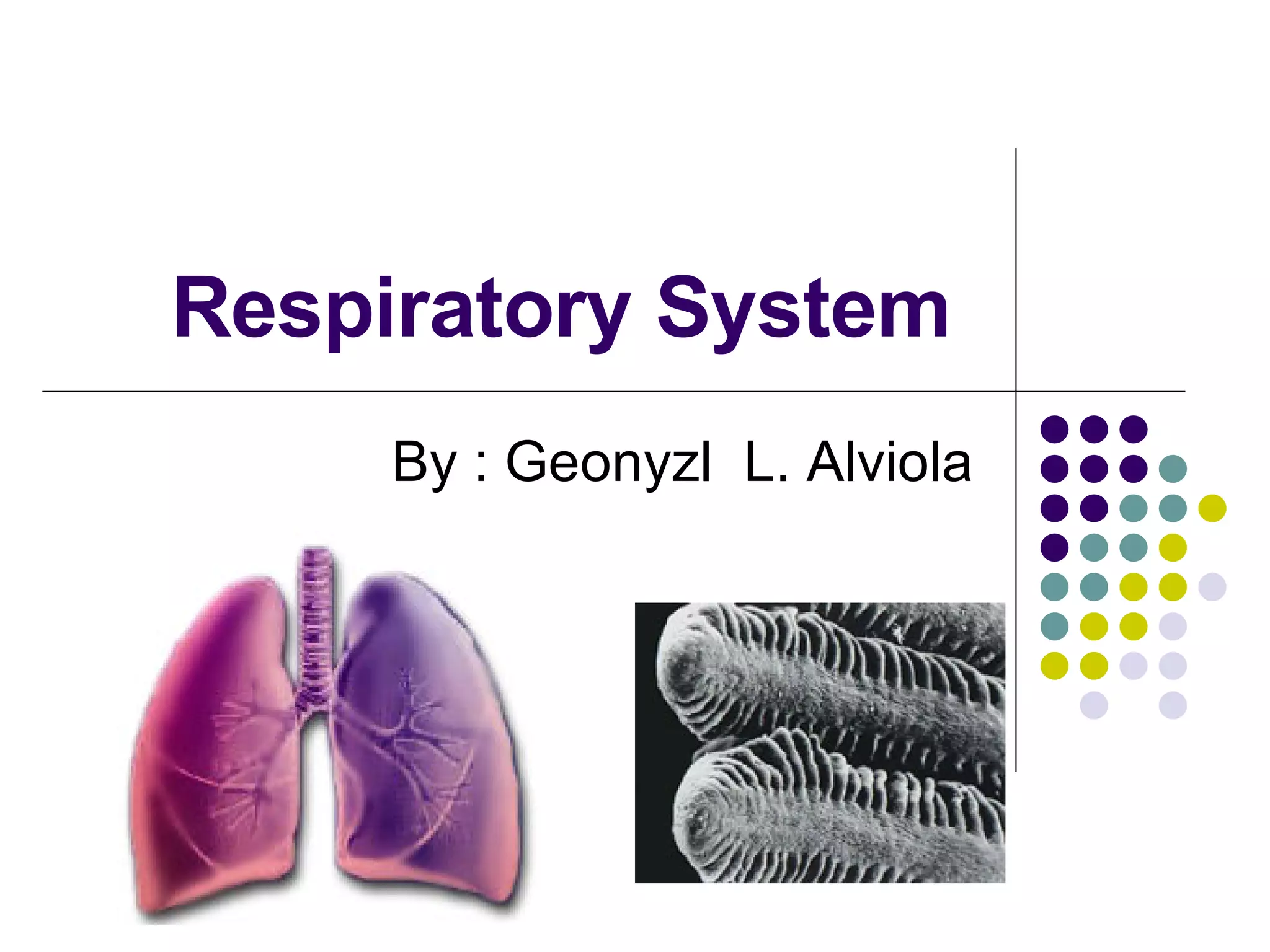
Respiratory System  By : Geonyzl  L. Alviola
Respiration is the process of obtaining oxygen from the external environment & eliminating CO2.   =  External respiration  - oxygen and carbon dioxide exchanged between the external environment & the body cells   =  Internal respiration  - cells use oxygen for ATP production (& produce carbon dioxide in the process)
Adaptations for external respiration      1 - Primary organs in adult vertebrates are external &  internal gills, swim bladders or lungs, skin, & the buccopharyngeal mucosa       2 - Less common respiratory devices include filamentous outgrowths of the posterior trunk & thigh (African hairy frog), lining of the cloaca, & lining of esophagus
 
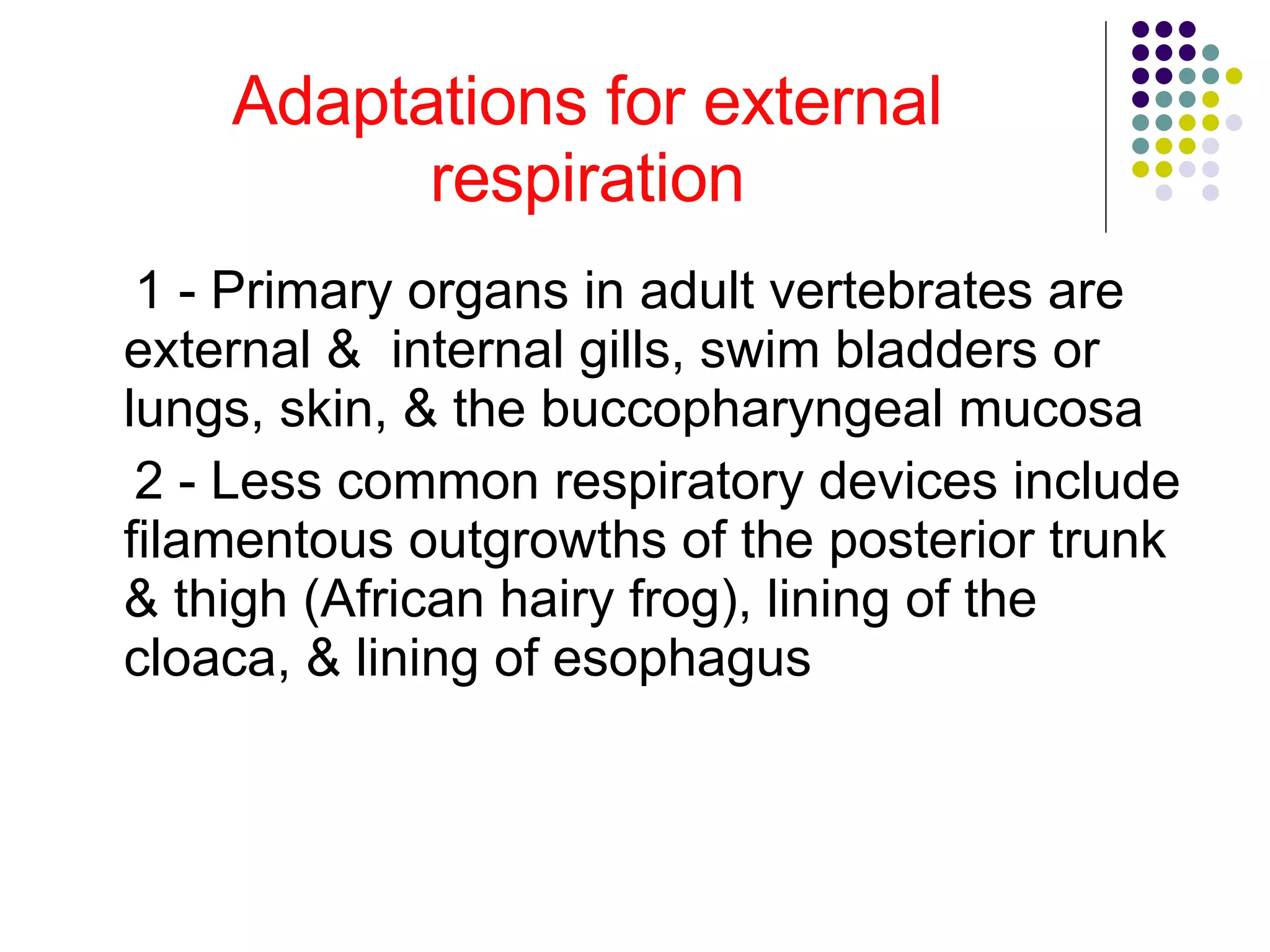
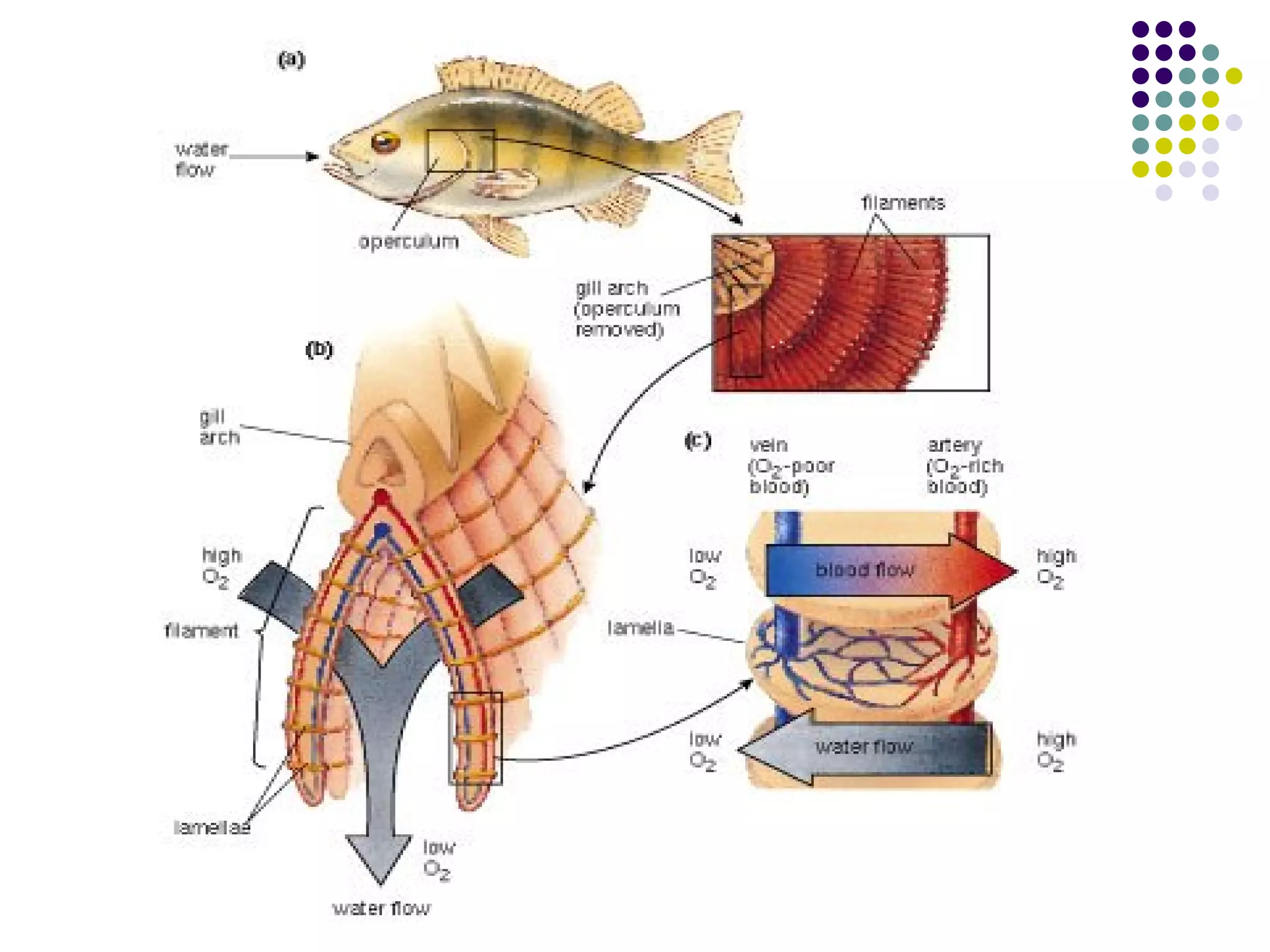
Gills (see  Respiration in Fishes ) Adult fish have a pair of gills. Each gill is covered by a boney lid (removed from the picture). A fish draws in water by closing the lid over its gills and opening its mouth. When the fish closes its mouth and opens the gill lid the water is forced out and over the respiratory surfaces of the gill filaments.    


Due to the low concentration of oxygen in water, the gills must be as efficient as possible in order to extract oxygen.  The gills consist of bony or cartilaginous arches which hold pairs of gill filaments.  Each gill filament consists of an upper and lower surface covered with minute ridges known as  lamellae .
 
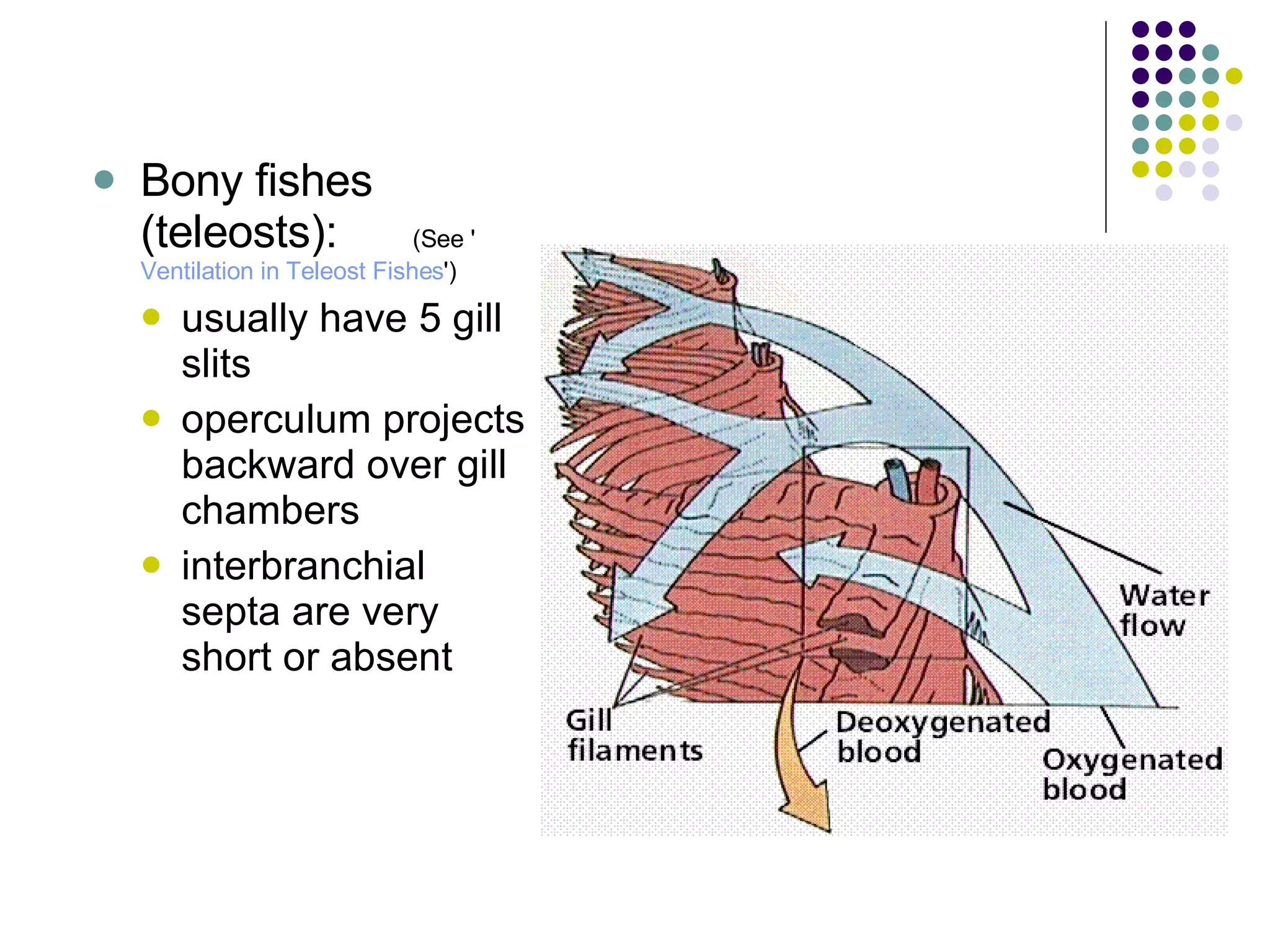
Bony fishes (teleosts):       (See ' Ventilation in  Teleost  Fishes ')  usually have 5 gill slits  operculum projects backward over gill chambers  interbranchial septa are very short or absent
These lamellae are made of extremely thin membranes (1 cell thick) and are the primary sites of gas exchange. Water flows across the gill filaments and oxygen is removed and passes into the blood by diffusion. To increase the efficiency of oxygen uptake a countercurrent method is used (the same principle as used in force air furnaces); blood flows through the lamellae in a direction opposite to the water flow through the gill filaments. Countercurrent flow insures a steady oxygen
5 ‘naked’ gill slits  Anterior & posterior walls of the 1st 4 gill chambers have a gill surface (demibranch). Posterior wall of last (5th) chamber has no demibranch.  Interbranchial septum lies between 2 demibranchs of a gill arch  Gill rakers protrude from gill cartilage & ‘guard’ entrance into gill chamber  2 demibranchs + septum & associated cartilage, blood vessels, muscles, & nerves = holobranch  Cartilaginous fishes:
Agnathans:  6 - 15 pairs of gill pouches  pouches connected to pharynx by afferent branchial (or gill) ducts & to exterior by efferent branchial (or gill) ducts
 
 
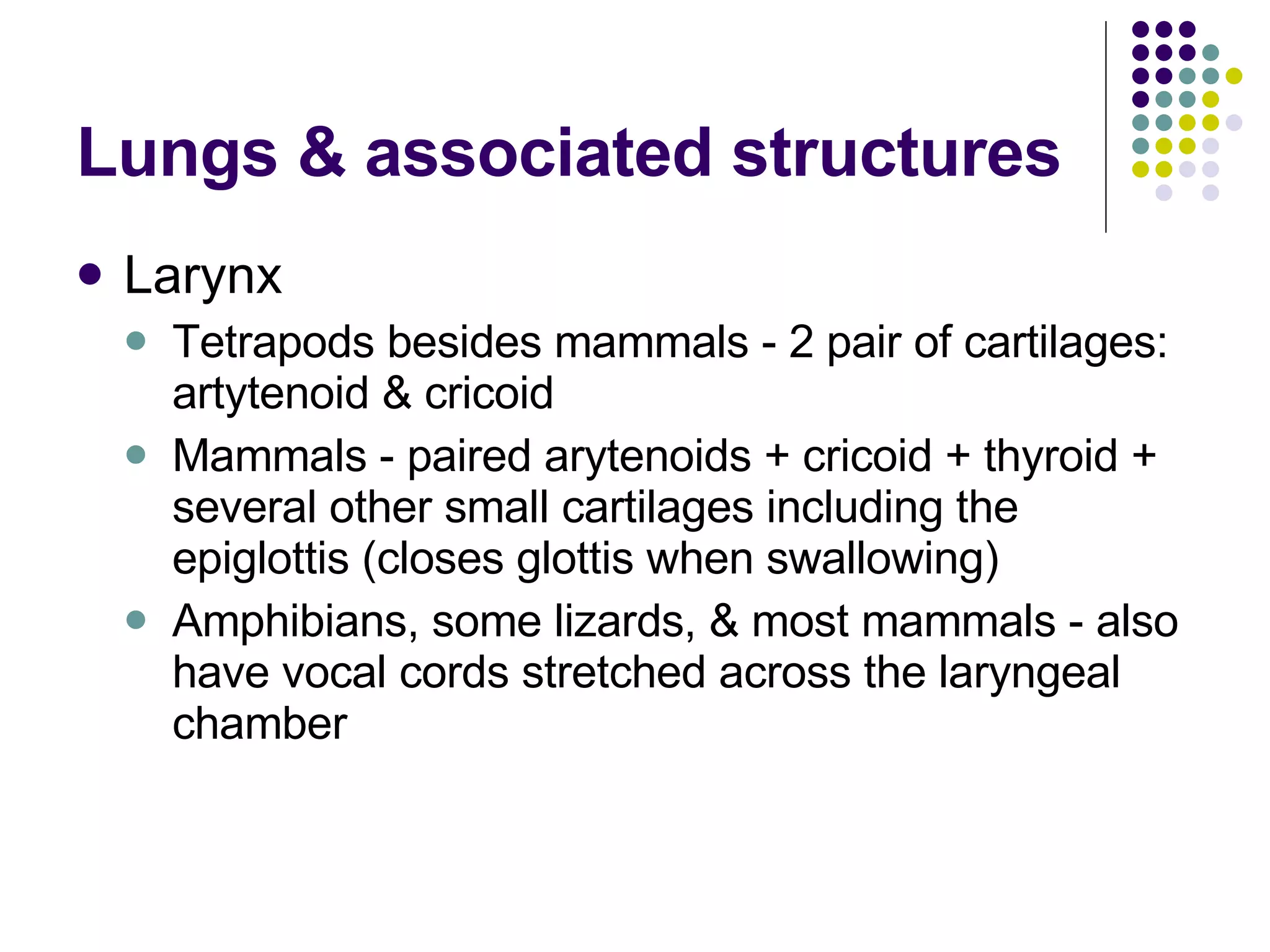
The respiratory system of sharks is markedly different from that of bony fishes. Where bony fishes usually have five gilled arches and only one external gill opening, sharks may have as many as seven openings, but the most common number is five.     Also, where the gill arches of bony fishes are protected by an opercle, or plate, the gills of sharks are not.
Sharks generally inhale most of the necessary water through their mouths, but they are also able to inhale water by way of spiracles, which are opening located close to the gills. When resting, sharks propel water over their gills using the muscles of their jaws and pharynx. Oxygen from the incoming water is absorbed into the blood system by way of the gill filaments. Water exits through the gill slits .(Davies, 1964).
Respiratory organs: Cutaneous respiration  respiration through the skin can take place in air, water, or both  most important among amphibians (especially the family Plethodontidae)  Female  P. shermani  (Red-legged Salamander) from North Carolina 
  Larval gills:  External gills  outgrowths from the external surface of 1 or more gill arches  found in lungfish & amphibians  Filamentous extensions of internal gills  project through gill slits  occur in early stages of development of elasmobranchs  Internal gills - hidden behind larval operculum of late anuran tadpoles
 
- most vertebrates develop an outpocketing of pharynx or esophagus that becomes one or a pair of sacs (swim bladders or lungs) filled with gases derived directly or indirectly from the atmosphere. Similarities between swim bladders & lungs indicate they are the same organs.  Swim bladder & origin of lungs
Vertebrates without swim bladders or lungs include cyclostomes, cartilaginous fish, and a few teleosts (e.g., flounders and other bottom-dwellers).
Swim bladders: may be paired or unpaired (seen previous slide)  have, during development, a pneumatic duct that usually connects to the esophagus. The duct remains open (physostomous) in bowfins and lungfish, but closes off (physoclistous) in most teleosts.  serve primarily as a hydrostatic organ (regulating a fish's specific gravity)  gain gas by way of a 'red body' (or red gland); gas is reabsorbed via the oval body on posterior part of bladder
May also play important roles : hearing  - some freshwater teleosts (e.g., catfish, goldfish, & carp) 'hear' by way of pressure waves transmitted via the swim bladder and small bones called Weberian ossicles (see diagram below)  sound production  - muscles attached to the swim bladder contract to move air between 'sub-chambers' of the bladder. The resulting vibration creates sound in fish such as croakers,  grunters , &  midshipman fish .  respiration -  the swim bladder of  lungfish  has number subdivisions or septa (to increase surface area) & oxygen and carbon dioxide is exchanged between the bladder & the blood
Lungs & associated structures  Larynx  Tetrapods besides mammals - 2 pair of cartilages: artytenoid & cricoid  Mammals - paired arytenoids + cricoid + thyroid + several other small cartilages including the epiglottis (closes glottis when swallowing)  Amphibians, some lizards, & most mammals - also have vocal cords stretched across the laryngeal chamber
 
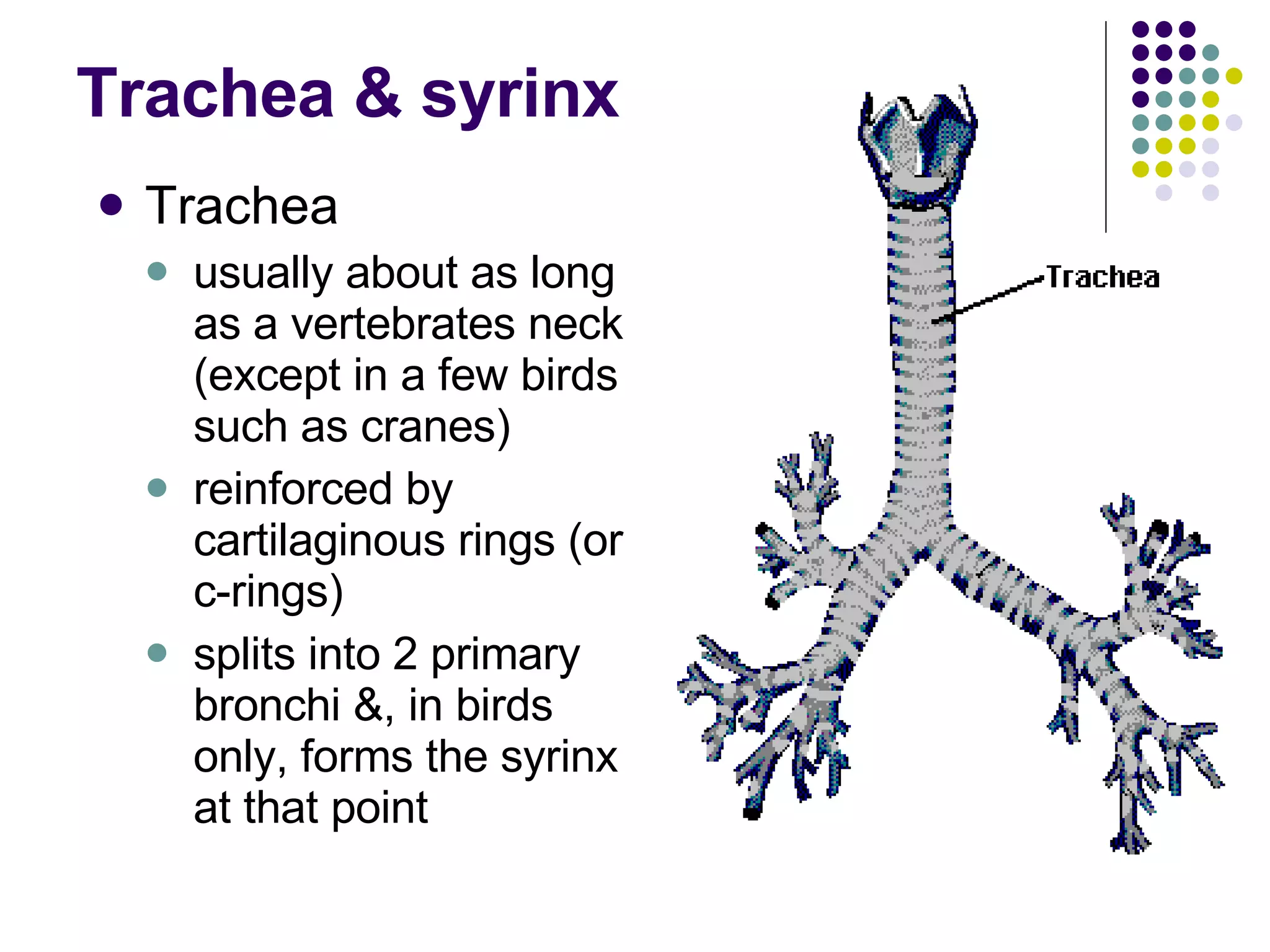
Trachea & syrinx Trachea  usually about as long as a vertebrates neck (except in a few birds such as cranes)  reinforced by cartilaginous rings (or c-rings)  splits into 2 primary bronchi &, in birds only, forms the syrinx at that point
Found  in songbirds
Lungs  Amphibian lungs  2 simple sacs  internal lining may be smooth or have simple sacculations or pockets  air exchanged via positive-pressure ventilation
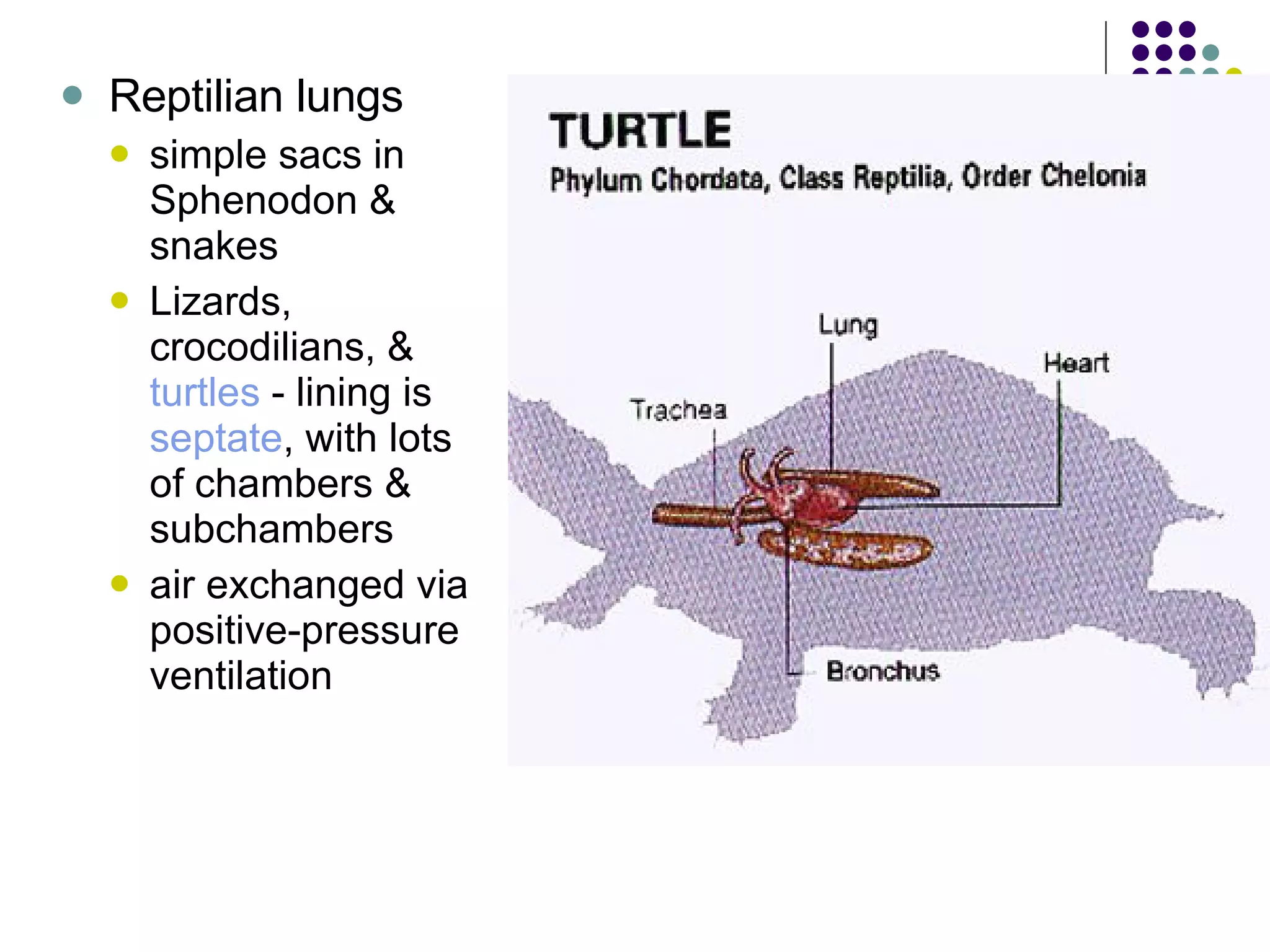
Reptilian lungs  simple sacs in Sphenodon & snakes  Lizards, crocodilians, &  turtles  - lining is  septate , with lots of chambers & subchambers  air exchanged via positive-pressure ventilation
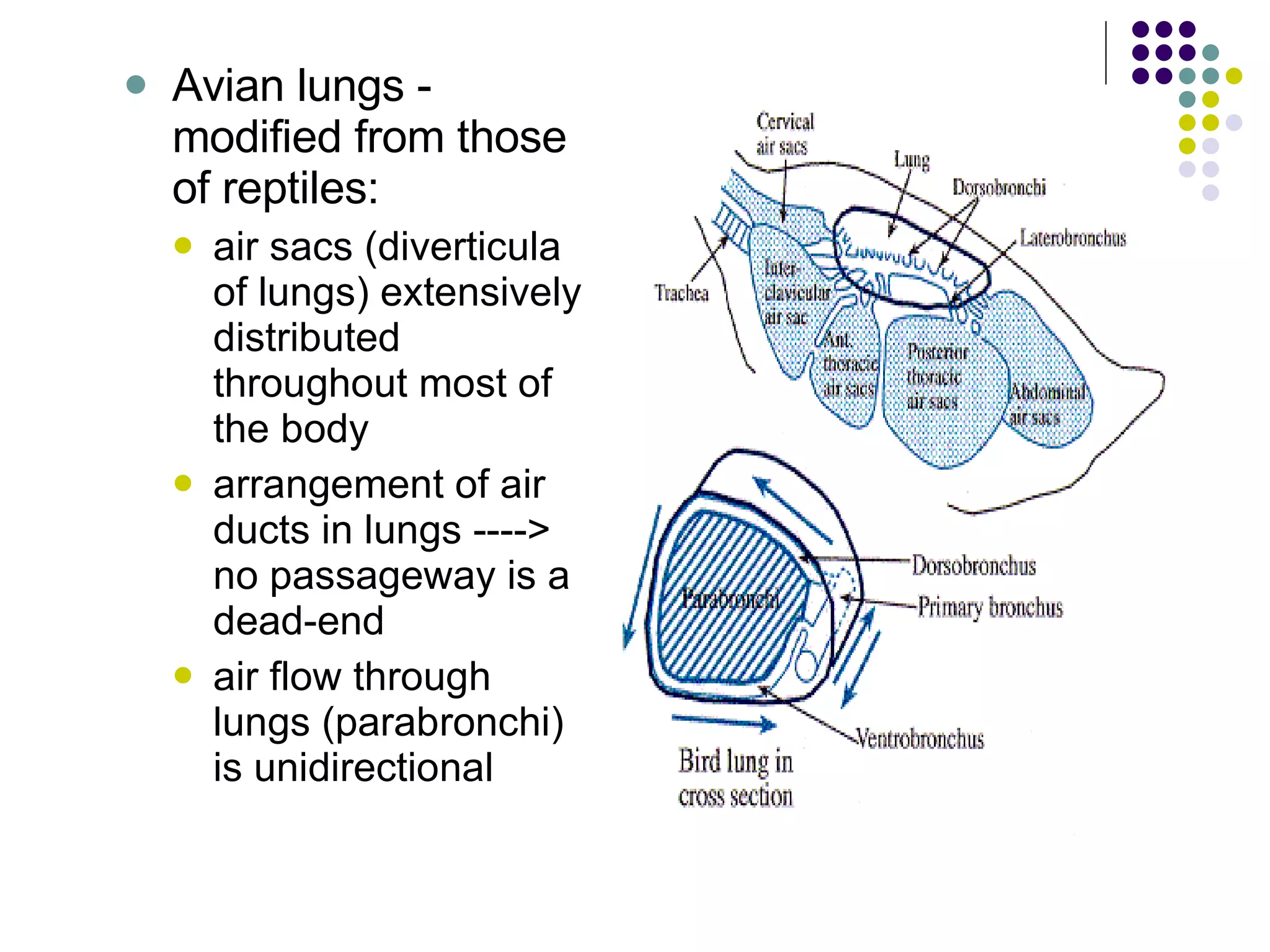
Avian lungs - modified from those of reptiles:  air sacs (diverticula of lungs) extensively distributed throughout most of the body  arrangement of air ducts in lungs ----> no passageway is a dead-end  air flow through lungs (parabronchi) is unidirectional
Mammalian lungs:  multichambered & usually divided into lobes  air flow is bidirectional:  air exchanged via negative pressure ventilation, with pressures changing due to  contraction & relaxation of diaphragm &  intercostal  muscles
The End

Respiratory System

  • 1.
    Respiratory System By : Geonyzl L. Alviola
  • 2.
    Respiration is theprocess of obtaining oxygen from the external environment & eliminating CO2. = External respiration - oxygen and carbon dioxide exchanged between the external environment & the body cells = Internal respiration - cells use oxygen for ATP production (& produce carbon dioxide in the process)
  • 3.
    Adaptations for externalrespiration     1 - Primary organs in adult vertebrates are external &  internal gills, swim bladders or lungs, skin, & the buccopharyngeal mucosa     2 - Less common respiratory devices include filamentous outgrowths of the posterior trunk & thigh (African hairy frog), lining of the cloaca, & lining of esophagus
  • 4.
  • 5.
    Gills (see Respiration in Fishes ) Adult fish have a pair of gills. Each gill is covered by a boney lid (removed from the picture). A fish draws in water by closing the lid over its gills and opening its mouth. When the fish closes its mouth and opens the gill lid the water is forced out and over the respiratory surfaces of the gill filaments.    
  • 6.
  • 7.
  • 8.
  • 9.
    Due to thelow concentration of oxygen in water, the gills must be as efficient as possible in order to extract oxygen. The gills consist of bony or cartilaginous arches which hold pairs of gill filaments. Each gill filament consists of an upper and lower surface covered with minute ridges known as lamellae .
  • 10.
  • 11.
    Bony fishes (teleosts):      (See ' Ventilation in Teleost Fishes ') usually have 5 gill slits operculum projects backward over gill chambers interbranchial septa are very short or absent
  • 12.
    These lamellae aremade of extremely thin membranes (1 cell thick) and are the primary sites of gas exchange. Water flows across the gill filaments and oxygen is removed and passes into the blood by diffusion. To increase the efficiency of oxygen uptake a countercurrent method is used (the same principle as used in force air furnaces); blood flows through the lamellae in a direction opposite to the water flow through the gill filaments. Countercurrent flow insures a steady oxygen
  • 13.
    5 ‘naked’ gillslits Anterior & posterior walls of the 1st 4 gill chambers have a gill surface (demibranch). Posterior wall of last (5th) chamber has no demibranch. Interbranchial septum lies between 2 demibranchs of a gill arch Gill rakers protrude from gill cartilage & ‘guard’ entrance into gill chamber 2 demibranchs + septum & associated cartilage, blood vessels, muscles, & nerves = holobranch Cartilaginous fishes:
  • 14.
    Agnathans: 6- 15 pairs of gill pouches pouches connected to pharynx by afferent branchial (or gill) ducts & to exterior by efferent branchial (or gill) ducts
  • 15.
  • 16.
  • 17.
    The respiratory systemof sharks is markedly different from that of bony fishes. Where bony fishes usually have five gilled arches and only one external gill opening, sharks may have as many as seven openings, but the most common number is five. Also, where the gill arches of bony fishes are protected by an opercle, or plate, the gills of sharks are not.
  • 18.
    Sharks generally inhalemost of the necessary water through their mouths, but they are also able to inhale water by way of spiracles, which are opening located close to the gills. When resting, sharks propel water over their gills using the muscles of their jaws and pharynx. Oxygen from the incoming water is absorbed into the blood system by way of the gill filaments. Water exits through the gill slits .(Davies, 1964).
  • 19.
    Respiratory organs: Cutaneousrespiration respiration through the skin can take place in air, water, or both most important among amphibians (especially the family Plethodontidae) Female P. shermani (Red-legged Salamander) from North Carolina 
  • 20.
      Larval gills: External gills outgrowths from the external surface of 1 or more gill arches found in lungfish & amphibians Filamentous extensions of internal gills project through gill slits occur in early stages of development of elasmobranchs Internal gills - hidden behind larval operculum of late anuran tadpoles
  • 21.
  • 22.
    - most vertebratesdevelop an outpocketing of pharynx or esophagus that becomes one or a pair of sacs (swim bladders or lungs) filled with gases derived directly or indirectly from the atmosphere. Similarities between swim bladders & lungs indicate they are the same organs. Swim bladder & origin of lungs
  • 23.
    Vertebrates without swimbladders or lungs include cyclostomes, cartilaginous fish, and a few teleosts (e.g., flounders and other bottom-dwellers).
  • 24.
    Swim bladders: maybe paired or unpaired (seen previous slide) have, during development, a pneumatic duct that usually connects to the esophagus. The duct remains open (physostomous) in bowfins and lungfish, but closes off (physoclistous) in most teleosts. serve primarily as a hydrostatic organ (regulating a fish's specific gravity) gain gas by way of a 'red body' (or red gland); gas is reabsorbed via the oval body on posterior part of bladder
  • 25.
    May also playimportant roles : hearing - some freshwater teleosts (e.g., catfish, goldfish, & carp) 'hear' by way of pressure waves transmitted via the swim bladder and small bones called Weberian ossicles (see diagram below) sound production - muscles attached to the swim bladder contract to move air between 'sub-chambers' of the bladder. The resulting vibration creates sound in fish such as croakers, grunters , & midshipman fish . respiration - the swim bladder of lungfish has number subdivisions or septa (to increase surface area) & oxygen and carbon dioxide is exchanged between the bladder & the blood
  • 26.
    Lungs & associatedstructures Larynx Tetrapods besides mammals - 2 pair of cartilages: artytenoid & cricoid Mammals - paired arytenoids + cricoid + thyroid + several other small cartilages including the epiglottis (closes glottis when swallowing) Amphibians, some lizards, & most mammals - also have vocal cords stretched across the laryngeal chamber
  • 27.
  • 28.
    Trachea & syrinxTrachea usually about as long as a vertebrates neck (except in a few birds such as cranes) reinforced by cartilaginous rings (or c-rings) splits into 2 primary bronchi &, in birds only, forms the syrinx at that point
  • 29.
    Found insongbirds
  • 30.
    Lungs Amphibianlungs 2 simple sacs internal lining may be smooth or have simple sacculations or pockets air exchanged via positive-pressure ventilation
  • 31.
    Reptilian lungs simple sacs in Sphenodon & snakes Lizards, crocodilians, & turtles - lining is septate , with lots of chambers & subchambers air exchanged via positive-pressure ventilation
  • 32.
    Avian lungs -modified from those of reptiles: air sacs (diverticula of lungs) extensively distributed throughout most of the body arrangement of air ducts in lungs ----> no passageway is a dead-end air flow through lungs (parabronchi) is unidirectional
  • 33.
    Mammalian lungs: multichambered & usually divided into lobes air flow is bidirectional: air exchanged via negative pressure ventilation, with pressures changing due to contraction & relaxation of diaphragm & intercostal muscles
  • 34.