Introduction to the
    Ressource              Arnulf Christl

     Oriented       http://www.metaspatial.net

    Architecture
Download
                  ...this slide set and other stuff at:
                        http://arnulf.us/Publications
           On slide share the next slide links to the 
                      YouTube video. 
             Please fast forward to ~ minute 26

Download: http://arnulf.us/publications/resource­oriented­future_arnulf­christl.odp (pdf)
See also article on: Introduction to Semantic Web Technology and Geodata (pdf)
YouTube video: http://www.youtube.com/watch?v=DDIeR_JLO_o&feature=player_detailpage#t=1637s 
SmartKorea 2011, Seoul, Korea           Arnulf Christl                                   2 / 45
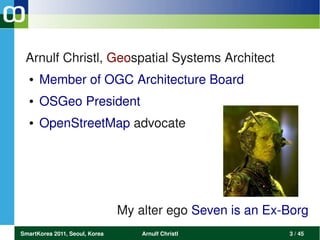
Arnulf Christl, Geospatial Systems Architect
  ●   Member of OGC Architecture Board 
  ●   OSGeo President
  ●   OpenStreetMap advocate


                                My alter ego Seven is an Ex­Borg
SmartKorea 2011, Seoul, Korea       Arnulf Christl          3 / 45
Introduction
     ●   Hypes
          ●   SDI, SOA, SOAP, ESB, ROA, RESTful
     ●   Architecture Models: RM­ODP View Points
     ●   The components of the ROA 
     ●   The Internet and the Web 
     ●   RESTful, REST, Linked Open Data, ROA
     ●   ...and how it all might come together

SmartKorea 2011, Seoul, Korea      Arnulf Christl   4 / 45
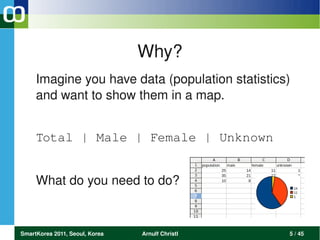
Why?
     Imagine you have data (population statistics) 
     and want to show them in a map. 


     Total | Male | Female | Unknown


     What do you need to do?


SmartKorea 2011, Seoul, Korea   Arnulf Christl    5 / 45
ETL, process, present
●   Get the spatial data somewhere (hopefully)
●   Download it (or > use a service)
●   Transform it to your system (or > interoperate)
●   Process your data to fit with the spatial data
●   Configure your system (cartography, etc.)
●   Present


SmartKorea 2011, Seoul, Korea   Arnulf Christl       6 / 45
Then the spatial data changes!

                         What do you need to do?


                        Go back and over again...


                                                 Awww, Snap!
SmartKorea 2011, Seoul, Korea   Arnulf Christl           7 / 45
But let's Imagine that...
  every geometry has a URL...
                    ...and you simply link your data to it.


  ...and if anything changes you are            
                              automagically notified. 


                                Sounds like Alice in Wonderland?
SmartKorea 2011, Seoul, Korea       Arnulf Christl           8 / 45
Hypes
 Geospatial Data Infrastructure
  ●   The core idea goes back to the 90ies of the last 
      Millennium (no ubiquitous Internet yet)
  ●   Paradigm change from desktop to 
      client­server architectures
         (...before that it was called the Mainframe,       
                             now we call it the Cloud...)     

SmartKorea 2011, Seoul, Korea   Arnulf Christl           9 / 45
Hypes
 Service Oriented Architecture (SOA)
  ●   Fairly loose concept, lots of room for  
      interpretation
  ●   Software­centric (!)
  ●   Single Point of Access (one single URL)
  ●   OGC Standards WMS, WFS


SmartKorea 2011, Seoul, Korea   Arnulf Christl   10 / 45
Hypes
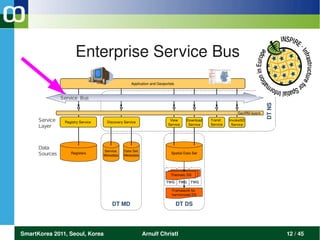
 Enterprise Service Bus 
  ●   Buzzword
  ●   Many proprietary / closed solutions
  ●   High potential for Vendor­Lock­In
  ●   Came to some fame in the geospatial domain 
      because of early INSPIRE


SmartKorea 2011, Seoul, Korea   Arnulf Christl   11 / 45
Enterprise Service Bus 


SmartKorea 2011, Seoul, Korea   Arnulf Christl   12 / 45
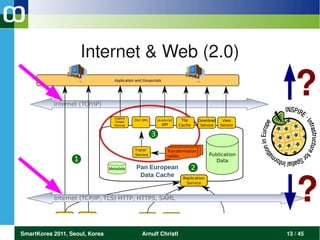
Internet & Web (2.0)

                                                    ?

                                                    ?
SmartKorea 2011, Seoul, Korea   Arnulf Christl   13 / 45
Hypes
 SOAP
  ●   Just a similarity of name with "SOA"
  ●   Basics: Remote Procedure Call & Messaging
  ●   Message­oriented
  ●   Client requires description (WSDL)
  ●   Technology­ and Service­centric
  ●   W3C Standard (several of them, and dying out)
SmartKorea 2011, Seoul, Korea   Arnulf Christl   14 / 45
Hypes
 RESTful
  ●   Core idea: Everything is the representation of a 
      resource 
  ●   Data (not technology) centric
  ●   Web­centric: Implements HTTP correctly
  ●   No official encoded standard (yet – but 
      increasing usage all the same)
  ●   Optimized scalable
SmartKorea 2011, Seoul, Korea   Arnulf Christl    15 / 45
IT­Architectures
 RM­ODP
  ●   Refrence Model – Open Distributed Computing
  ●   Model to describe software architectures
  ●   Developed in the mid 90s (US DoD)
  ●   ISO Standard
  ●   Applicable in enterprise systems (B.I.G.)
  ●   Separation in so called "View Points"
SmartKorea 2011, Seoul, Korea   Arnulf Christl    16 / 45
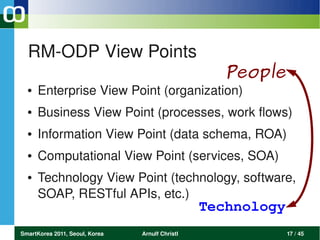
RM­ODP View Points
                                                    People
  ●   Enterprise View Point (organization)
  ●   Business View Point (processes, work flows)
  ●   Information View Point (data schema, ROA)
  ●   Computational View Point (services, SOA)
  ●   Technology View Point (technology, software, 
      SOAP, RESTful APIs, etc.)
                                                 Technology
SmartKorea 2011, Seoul, Korea   Arnulf Christl                17 / 45
Basics of the ROA I.
  ●   The Resource Orientied Architecture (ROA) is 
      an information modell. 
  ●   It is not a distinct technology... 
  ●   ...but Web technology (HTTP + URLs) are 
      currently the best fit 
  ●   The ROA describes conditions in which the 
      Web works optimally.

SmartKorea 2011, Seoul, Korea   Arnulf Christl     18 / 45
Basics of the ROA II.
  ●   All data is designed in resources. 
  ●   Data can be delivered in different ways. 
  ●   Each delivery is simply a different  
      representation of the same resource 
  ●   The representation is the form of the content
  ●   The separation of form and content is crucial. 
      Immeasurably important! 
      (We do have heard this before: think HTML and CSS)

SmartKorea 2011, Seoul, Korea   Arnulf Christl             19 / 45
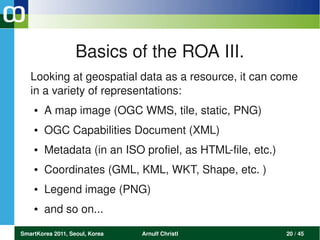
Basics of the ROA III.
   Looking at geospatial data as a resource, it can come 
   in a variety of representations: 
    ●   A map image (OGC WMS, tile, static, PNG)
    ●   OGC Capabilities Document (XML)
    ●   Metadata (in an ISO profiel, as HTML­file, etc.) 
    ●   Coordinates (GML, KML, WKT, Shape, etc. )
    ●   Legend image (PNG)
    ●   and so on...

SmartKorea 2011, Seoul, Korea   Arnulf Christl              20 / 45
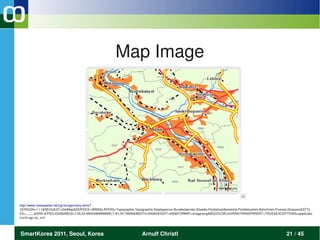
Map Image


http://www.metaspatial.net/cgi­bin/germany­wms? 
VERSION=1.1.1&REQUEST=GetMap&SERVICE=WMS&LAYERS=Topographie,Topographie,Staatsgrenze,Bundeslaender,Staedte,Postleitzahlbereiche,Postleitzahlen,Bahnlinien,Fluesse,Strassen&STYL
ES=,,,,,,,,,&SRS=EPSG:4326&BBOX=7.05,50.69004999999999,7.161,50.78995&WIDTH=500&HEIGHT=450&FORMAT=image/png&BGCOLOR=0xffffff&TRANSPARENT=TRUE&EXCEPTIONS=applicatio
n/vnd.ogc.se_xml 


SmartKorea 2011, Seoul, Korea                                            Arnulf Christl                                                                        21 / 45
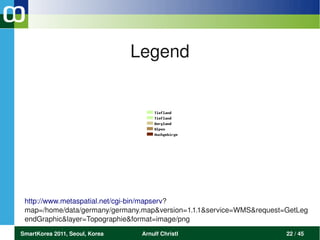
Legend


 http://www.metaspatial.net/cgi­bin/mapserv? 
 map=/home/data/germany/germany.map&version=1.1.1&service=WMS&request=GetLeg
 endGraphic&layer=Topographie&format=image/png
SmartKorea 2011, Seoul, Korea    Arnulf Christl                       22 / 45
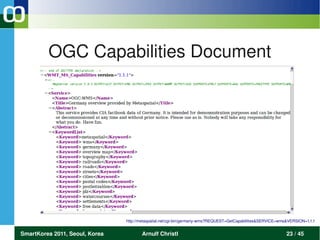
OGC Capabilities Document


                                http://metaspatial.net/cgi­bin/germany­wms?REQUEST=GetCapabilities&SERVICE=wms&VERSION=1.1.1


SmartKorea 2011, Seoul, Korea          Arnulf Christl                                                         23 / 45
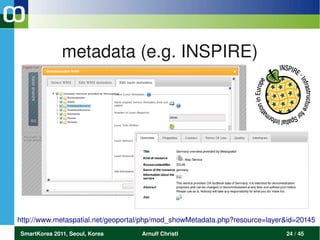
metadata (e.g. INSPIRE)


http://www.metaspatial.net/geoportal/php/mod_showMetadata.php?resource=layer&id=20145 
SmartKorea 2011, Seoul, Korea      Arnulf Christl                            24 / 45
Raw Geospatial Data (yummy)
<?xml version='1.0' encoding="ISO­8859­1" ?>  
<wfs:~FeatureCollection  
   xmlns:wfs="!http://www.opengis.net/wfs"  
    <gml:featureMember>  
      <Postleitzahlbereiche>  
        <gml:polygonProperty>  
          <gml:Polygon srsName="epsg:31467">  
           <gml:outerBoundaryIs>  
                <gml:LinearRing>  
                      <gml:coordinates>  
                           3365496.566430,5624978.448441 
                           3365521.124423,5625013.908323  
                           3365458.518013,5624832.944095   
                           [...]
                           3365502.496403,5624908.664231   
                           3365531.735324,5624963.958282   
                           3365496.566430,5624978.448441   
                      </gml:coordinates>  
                </gml:~LinearRing>  
           </gml:outerBoundaryIs>  
          </gml:Polygon>  
        </gml:polygonProperty>  
        <gid>3695</gid>  
        <oid>15223704</oid>  
        <plz99>53111</plz99>  
        <item_plz>53111</item_plz>  
      </Postleitzahlbereiche>  
    </gml:featureMember>  
</wfs:FeatureCollection>
</pre>
                                                              http://arnulf.us/PLZ#Download 
SmartKorea 2011, Seoul, Korea                Arnulf Christl                        25 / 45
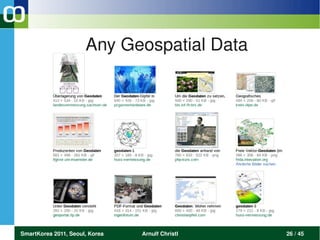
Any Geospatial Data


SmartKorea 2011, Seoul, Korea   Arnulf Christl   26 / 45
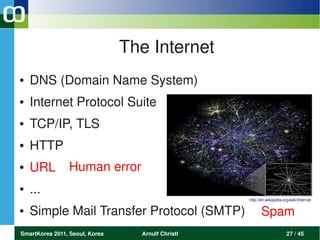
The Internet
●   DNS (Domain Name System)
●   Internet Protocol Suite
●   TCP/IP, TLS
●   HTTP
●   URL         Human error
●   ...
                                                   http://en.wikipedia.org/wiki/Internet

●   Simple Mail Transfer Protocol (SMTP)                  Spam
SmartKorea 2011, Seoul, Korea     Arnulf Christl                         27 / 45
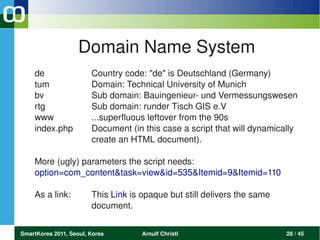
Domain Name System
    de                  Country code: "de" is Deutschland (Germany)
    tum                 Domain: Technical University of Munich
    bv                  Sub domain: Bauingenieur­ und Vermessungswesen
    rtg                 Sub domain: runder Tisch GIS e.V
    www                 ...superfluous leftover from the 90s 
    index.php           Document (in this case a script that will dynamically
                        create an HTML document).

    More (ugly) parameters the script needs: 
    option=com_content&task=view&id=535&Itemid=9&Itemid=110

    As a link:          This Link is opaque but still delivers the same 
                        document.


SmartKorea 2011, Seoul, Korea        Arnulf Christl                        28 / 45
Web sites 
                         can have different 
                          adresses (URL)


SmartKorea 2011, Seoul, Korea   Arnulf Christl   29 / 45
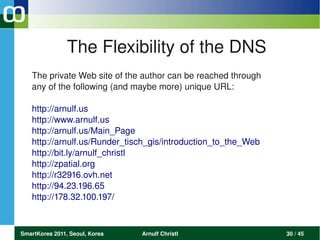
The Flexibility of the DNS
   The private Web site of the author can be reached through 
   any of the following (and maybe more) unique URL: 

   http://arnulf.us 
   http://www.arnulf.us 
   http://arnulf.us/Main_Page 
   http://arnulf.us/Runder_tisch_gis/introduction_to_the_Web 
   http://bit.ly/arnulf_christl 
   http://zpatial.org 
   http://r32916.ovh.net 
   http://94.23.196.65 
   http://178.32.100.197/ 


SmartKorea 2011, Seoul, Korea   Arnulf Christl                  30 / 45
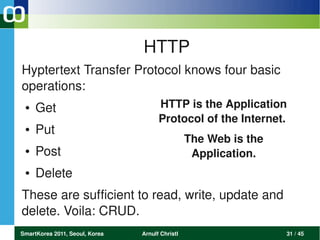
HTTP
Hyptertext Transfer Protocol knows four basic 
operations: 
 ●   Get                              HTTP is the Application 
                                      Protocol of the Internet. 
 ●   Put
                                                 The Web is the 
 ●   Post                                         Application.
 ●   Delete
These are sufficient to read, write, update and 
delete. Voila: CRUD. 
SmartKorea 2011, Seoul, Korea   Arnulf Christl                     31 / 45
The Web is: Documents
   <html xmlns="http://www.w3.org/1999/xhtml" xml:lang="de­de" lang="de­de">
       <head>
           <meta http­equiv="content­type" content="text/html; charset=utf­8" />
           <meta name="robots" content="index, follow" />
           <meta name="description" content="Die Seite informiert über die 
                 Studienangebote, die Forschungseinrichtungen und Organisation 
                 der Fakultät für Bauingenieur­ und Vermessungswesen der 
                 Technischen Universität München" />
           <style type="text/css" style="display:none"> […] </style>
       </head>
       <body>
           <a href="http://www.tum.de"><img src="http://.../tum_logo.gif"
                  alt="TUM" width="227" height="117" /></a>
           [...]
           Willkommen an der Fakultät für Bauingenieur­ und Vermessungswesen
           [...]
       </body>
                                                                     http://www.bv.tum.de/ 
   </html>
SmartKorea 2011, Seoul, Korea        Arnulf Christl                               32 / 45
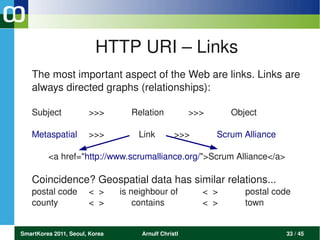
HTTP URI – Links
   The most important aspect of the Web are links. Links are 
   always directed graphs (relationships):

   Subject             >>>         Relation            >>>      Object

   Metaspatial         >>>            Link        >>>        Scrum Alliance

         <a href="http://www.scrumalliance.org/">Scrum Alliance</a>

   Coincidence? Geospatial data has similar relations...
   postal code         <  >      is neighbour of         <  >      postal code
   county              <  >          contains            <  >      town


SmartKorea 2011, Seoul, Korea         Arnulf Christl                          33 / 45
Resource Description Framework
   The RDF (Resource Description Framework) format 
   (which is a standard) implements these directed relations 
   in so called triples. 

      ●   Geospatial data can be transformed into RDF 
          notation. But this does not help much (yet).
           
      ●   More interesting (right now) is the association of 
          spatial data with other data using RDF. 


SmartKorea 2011, Seoul, Korea   Arnulf Christl                  34 / 45
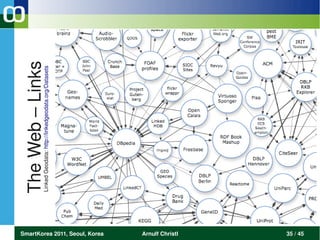
The Web – Links
                                Linked Geodata: http://linkedgeodata.org/Datasets


SmartKorea 2011, Seoul, Korea
Arnulf Christl
35 / 45
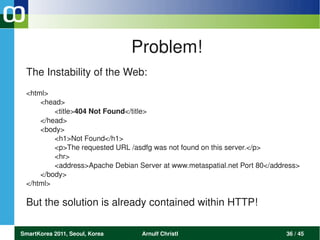
Problem!
 The Instability of the Web: 
 <html>
     <head>
         <title>404 Not Found</title>
     </head>
     <body>
         <h1>Not Found</h1>
         <p>The requested URL /asdfg was not found on this server.</p>
         <hr>
         <address>Apache Debian Server at www.metaspatial.net Port 80</address>
     </body>
 </html>

 But the solution is already contained within HTTP!

SmartKorea 2011, Seoul, Korea     Arnulf Christl                           36 / 45
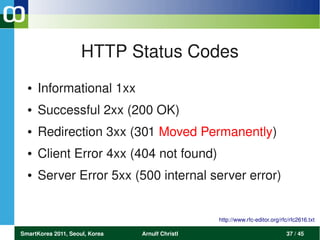
HTTP Status Codes
  ●   Informational 1xx 
  ●   Successful 2xx (200 OK)
  ●   Redirection 3xx (301 Moved Permanently)
  ●   Client Error 4xx (404 not found)
  ●   Server Error 5xx (500 internal server error)


                                                 http://www.rfc­editor.org/rfc/rfc2616.txt

SmartKorea 2011, Seoul, Korea   Arnulf Christl                               37 / 45
Web 2.0 Concepts
●   Technology: REST­architectures allows simple, 
    flexible creation, update and searching of data.
●   Process: Updating metadata can be automatized 
    using GeoRSS.
●   Content: Data belongs in open buckets so that 
    ontologies can grow on them.
●   Ontologies are creaed by communities actually 
    using things (tagging, rating: "+1 and like")

SmartKorea 2011, Seoul, Korea   Arnulf Christl   38 / 45
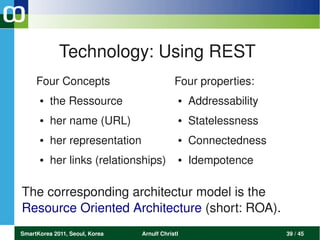
Technology: Using REST 
     Four Concepts                          Four properties:
      ●   the Ressource                      ●   Addressability
      ●   her name (URL)                     ●   Statelessness
      ●   her representation                 ●   Connectedness
      ●   her links (relationships)          ●   Idempotence

The corresponding architectur model is the 
Resource Oriented Architecture (short: ROA).
SmartKorea 2011, Seoul, Korea   Arnulf Christl                    39 / 45
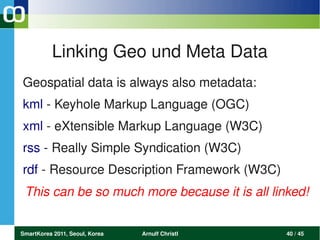
Linking Geo und Meta Data
Geospatial data is always also metadata:
kml ­ Keyhole Markup Language (OGC)
xml ­ eXtensible Markup Language (W3C)
rss ­ Really Simple Syndication (W3C)
rdf ­ Resource Description Framework (W3C)
 This can be so much more because it is all linked!


SmartKorea 2011, Seoul, Korea   Arnulf Christl   40 / 45
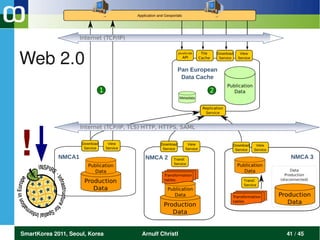
Web 2.0


!

SmartKorea 2011, Seoul, Korea   Arnulf Christl   41 / 45
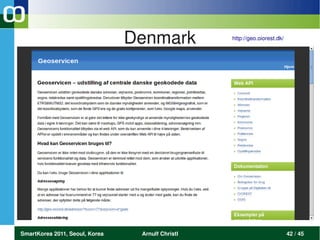
Denmark           http://geo.oiorest.dk/


SmartKorea 2011, Seoul, Korea    Arnulf Christl                            42 / 45
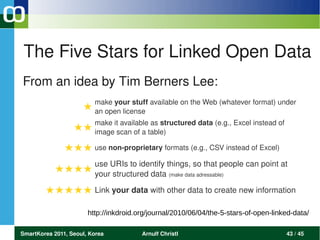
The Five Stars for Linked Open Data
From an idea by Tim Berners Lee: 
                         make your stuff available on the Web (whatever format) under 
                     ★   an open license
                         make it available as structured data (e.g., Excel instead of 
                  ★★     image scan of a table)

               ★★★ use non­proprietary formats (e.g., CSV instead of Excel)
                         use URIs to identify things, so that people can point at 
           ★★★★ your structured data (make data adressable)

        ★★★★★ Link your data with other data to create new information

                       http://inkdroid.org/journal/2010/06/04/the-5-stars-of-open-linked-data/

SmartKorea 2011, Seoul, Korea           Arnulf Christl                                   43 / 45
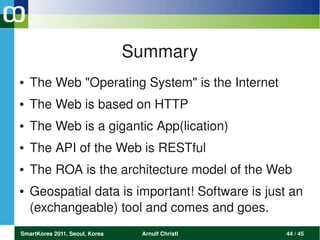
Summary
●   The Web "Operating System" is the Internet
●   The Web is based on HTTP
●   The Web is a gigantic App(lication)
●   The API of the Web is RESTful
●   The ROA is the architecture model of the Web
●   Geospatial data is important! Software is just an 
    (exchangeable) tool and comes and goes. 
SmartKorea 2011, Seoul, Korea    Arnulf Christl   44 / 45
Many thanks for 
            your patience!
                                                                                            September 2012
                                                                                                  Beijing, China

                                                                                  The annual Conference on
                                                                                Free and Open Source Software
                                                                                        for Geospatial


    Dieser Foliensatz darf zu jedem Zweck und
    kopiert, weiterverwendet und verändert
    werden. Siehe auch: Copystraight.
    Copyright: Arnulf Christl 2010

Download:  Foliensatz:    http://arnulf.us/publications/resource­oriented­future_arnulf­christl.odp (pdf)
           Artikel:       http://arnulf.us/publications/Introduction_to_Semantic_Web_Technology_and_Geodata_v4.odt (pdf)    45 / 45

Resource Oriented Future for Geospatial Data

  • 1.
    Introduction to the Ressource Arnulf Christl Oriented http://www.metaspatial.net Architecture
  • 2.
    Download ...this slide set and other stuff at: http://arnulf.us/Publications On slide share the next slide links to the  YouTube video.  Please fast forward to ~ minute 26 Download: http://arnulf.us/publications/resource­oriented­future_arnulf­christl.odp (pdf) See also article on: Introduction to Semantic Web Technology and Geodata (pdf) YouTube video: http://www.youtube.com/watch?v=DDIeR_JLO_o&feature=player_detailpage#t=1637s  SmartKorea 2011, Seoul, Korea Arnulf Christl 2 / 45
  • 3.
    Arnulf Christl, Geospatial Systems Architect ● Member of OGC Architecture Board  ● OSGeo President ● OpenStreetMap advocate My alter ego Seven is an Ex­Borg SmartKorea 2011, Seoul, Korea Arnulf Christl 3 / 45
  • 4.
    Introduction ● Hypes ● SDI, SOA, SOAP, ESB, ROA, RESTful ● Architecture Models: RM­ODP View Points ● The components of the ROA  ● The Internet and the Web  ● RESTful, REST, Linked Open Data, ROA ● ...and how it all might come together SmartKorea 2011, Seoul, Korea Arnulf Christl 4 / 45
  • 5.
    Why? Imagine you have data (population statistics)  and want to show them in a map.  Total | Male | Female | Unknown What do you need to do? SmartKorea 2011, Seoul, Korea Arnulf Christl 5 / 45
  • 6.
    ETL, process, present ● Get the spatial data somewhere (hopefully) ● Download it (or > use a service) ● Transform it to your system (or > interoperate) ● Process your data to fit with the spatial data ● Configure your system (cartography, etc.) ● Present SmartKorea 2011, Seoul, Korea Arnulf Christl 6 / 45
  • 7.
    Then the spatial data changes! What do you need to do? Go back and over again... Awww, Snap! SmartKorea 2011, Seoul, Korea Arnulf Christl 7 / 45
  • 8.
    But let's Imagine that... every geometry has a URL...                   ...and you simply link your data to it. ...and if anything changes you are                                         automagically notified.  Sounds like Alice in Wonderland? SmartKorea 2011, Seoul, Korea Arnulf Christl 8 / 45
  • 9.
    Hypes Geospatial Data Infrastructure ● The core idea goes back to the 90ies of the last  Millennium (no ubiquitous Internet yet) ● Paradigm change from desktop to  client­server architectures (...before that it was called the Mainframe,        now we call it the Cloud...)      SmartKorea 2011, Seoul, Korea Arnulf Christl 9 / 45
  • 10.
    Hypes Service Oriented Architecture (SOA) ● Fairly loose concept, lots of room for   interpretation ● Software­centric (!) ● Single Point of Access (one single URL) ● OGC Standards WMS, WFS SmartKorea 2011, Seoul, Korea Arnulf Christl 10 / 45
  • 11.
    Hypes Enterprise Service Bus  ● Buzzword ● Many proprietary / closed solutions ● High potential for Vendor­Lock­In ● Came to some fame in the geospatial domain  because of early INSPIRE SmartKorea 2011, Seoul, Korea Arnulf Christl 11 / 45
  • 12.
  • 13.
    Internet & Web (2.0) ? ? SmartKorea 2011, Seoul, Korea Arnulf Christl 13 / 45
  • 14.
    Hypes SOAP ● Just a similarity of name with "SOA" ● Basics: Remote Procedure Call & Messaging ● Message­oriented ● Client requires description (WSDL) ● Technology­ and Service­centric ● W3C Standard (several of them, and dying out) SmartKorea 2011, Seoul, Korea Arnulf Christl 14 / 45
  • 15.
    Hypes RESTful ● Core idea: Everything is the representation of a  resource  ● Data (not technology) centric ● Web­centric: Implements HTTP correctly ● No official encoded standard (yet – but  increasing usage all the same) ● Optimized scalable SmartKorea 2011, Seoul, Korea Arnulf Christl 15 / 45
  • 16.
    IT­Architectures RM­ODP ● Refrence Model – Open Distributed Computing ● Model to describe software architectures ● Developed in the mid 90s (US DoD) ● ISO Standard ● Applicable in enterprise systems (B.I.G.) ● Separation in so called "View Points" SmartKorea 2011, Seoul, Korea Arnulf Christl 16 / 45
  • 17.
    RM­ODP View Points People ● Enterprise View Point (organization) ● Business View Point (processes, work flows) ● Information View Point (data schema, ROA) ● Computational View Point (services, SOA) ● Technology View Point (technology, software,  SOAP, RESTful APIs, etc.) Technology SmartKorea 2011, Seoul, Korea Arnulf Christl 17 / 45
  • 18.
    Basics of the ROA I. ● The Resource Orientied Architecture (ROA) is  an information modell.  ● It is not a distinct technology...  ● ...but Web technology (HTTP + URLs) are  currently the best fit  ● The ROA describes conditions in which the  Web works optimally. SmartKorea 2011, Seoul, Korea Arnulf Christl 18 / 45
  • 19.
    Basics of the ROA II. ● All data is designed in resources.  ● Data can be delivered in different ways.  ● Each delivery is simply a different   representation of the same resource  ● The representation is the form of the content ● The separation of form and content is crucial.  Immeasurably important!  (We do have heard this before: think HTML and CSS) SmartKorea 2011, Seoul, Korea Arnulf Christl 19 / 45
  • 20.
    Basics of the ROA III. Looking at geospatial data as a resource, it can come  in a variety of representations:  ● A map image (OGC WMS, tile, static, PNG) ● OGC Capabilities Document (XML) ● Metadata (in an ISO profiel, as HTML­file, etc.)  ● Coordinates (GML, KML, WKT, Shape, etc. ) ● Legend image (PNG) ● and so on... SmartKorea 2011, Seoul, Korea Arnulf Christl 20 / 45
  • 21.
  • 22.
    Legend http://www.metaspatial.net/cgi­bin/mapserv?  map=/home/data/germany/germany.map&version=1.1.1&service=WMS&request=GetLeg endGraphic&layer=Topographie&format=image/png SmartKorea 2011, Seoul, Korea Arnulf Christl 22 / 45
  • 23.
    OGC Capabilities Document http://metaspatial.net/cgi­bin/germany­wms?REQUEST=GetCapabilities&SERVICE=wms&VERSION=1.1.1 SmartKorea 2011, Seoul, Korea Arnulf Christl 23 / 45
  • 24.
  • 25.
    Raw Geospatial Data (yummy) <?xml version='1.0' encoding="ISO­8859­1" ?>   <wfs:~FeatureCollection      xmlns:wfs="!http://www.opengis.net/wfs"       <gml:featureMember>         <Postleitzahlbereiche>           <gml:polygonProperty>             <gml:Polygon srsName="epsg:31467">              <gml:outerBoundaryIs>              <gml:LinearRing>              <gml:coordinates>              3365496.566430,5624978.448441             3365521.124423,5625013.908323              3365458.518013,5624832.944095    [...]            3365502.496403,5624908.664231               3365531.735324,5624963.958282               3365496.566430,5624978.448441               </gml:coordinates>              </gml:~LinearRing>              </gml:outerBoundaryIs>             </gml:Polygon>           </gml:polygonProperty>           <gid>3695</gid>           <oid>15223704</oid>           <plz99>53111</plz99>           <item_plz>53111</item_plz>         </Postleitzahlbereiche>       </gml:featureMember>   </wfs:FeatureCollection> </pre> http://arnulf.us/PLZ#Download  SmartKorea 2011, Seoul, Korea Arnulf Christl 25 / 45
  • 26.
  • 27.
    The Internet ● DNS (Domain Name System) ● Internet Protocol Suite ● TCP/IP, TLS ● HTTP ● URL Human error ● ... http://en.wikipedia.org/wiki/Internet ● Simple Mail Transfer Protocol (SMTP) Spam SmartKorea 2011, Seoul, Korea Arnulf Christl 27 / 45
  • 28.
    Domain Name System de  Country code: "de" is Deutschland (Germany) tum  Domain: Technical University of Munich bv  Sub domain: Bauingenieur­ und Vermessungswesen rtg  Sub domain: runder Tisch GIS e.V www  ...superfluous leftover from the 90s  index.php Document (in this case a script that will dynamically create an HTML document). More (ugly) parameters the script needs:  option=com_content&task=view&id=535&Itemid=9&Itemid=110 As a link:  This Link is opaque but still delivers the same  document. SmartKorea 2011, Seoul, Korea Arnulf Christl 28 / 45
  • 29.
    Web sites  can have different  adresses (URL) SmartKorea 2011, Seoul, Korea Arnulf Christl 29 / 45
  • 30.
    The Flexibility of the DNS The private Web site of the author can be reached through  any of the following (and maybe more) unique URL:  http://arnulf.us  http://www.arnulf.us  http://arnulf.us/Main_Page  http://arnulf.us/Runder_tisch_gis/introduction_to_the_Web  http://bit.ly/arnulf_christl  http://zpatial.org  http://r32916.ovh.net  http://94.23.196.65  http://178.32.100.197/  SmartKorea 2011, Seoul, Korea Arnulf Christl 30 / 45
  • 31.
    HTTP Hyptertext Transfer Protocol knows four basic  operations:  ● Get HTTP is the Application  Protocol of the Internet.  ● Put The Web is the  ● Post Application. ● Delete These are sufficient to read, write, update and  delete. Voila: CRUD.  SmartKorea 2011, Seoul, Korea Arnulf Christl 31 / 45
  • 32.
    The Web is: Documents <html xmlns="http://www.w3.org/1999/xhtml" xml:lang="de­de" lang="de­de"> <head> <meta http­equiv="content­type" content="text/html; charset=utf­8" /> <meta name="robots" content="index, follow" /> <meta name="description" content="Die Seite informiert über die  Studienangebote, die Forschungseinrichtungen und Organisation  der Fakultät für Bauingenieur­ und Vermessungswesen der  Technischen Universität München" /> <style type="text/css" style="display:none"> […] </style> </head> <body> <a href="http://www.tum.de"><img src="http://.../tum_logo.gif"  alt="TUM" width="227" height="117" /></a> [...] Willkommen an der Fakultät für Bauingenieur­ und Vermessungswesen [...] </body> http://www.bv.tum.de/  </html> SmartKorea 2011, Seoul, Korea Arnulf Christl 32 / 45
  • 33.
    HTTP URI – Links The most important aspect of the Web are links. Links are  always directed graphs (relationships): Subject >>> Relation >>> Object Metaspatial >>>    Link >>> Scrum Alliance <a href="http://www.scrumalliance.org/">Scrum Alliance</a> Coincidence? Geospatial data has similar relations... postal code  <  >  is neighbour of  <  > postal code county <  > contains <  > town SmartKorea 2011, Seoul, Korea Arnulf Christl 33 / 45
  • 34.
    Resource Description Framework The RDF (Resource Description Framework) format  (which is a standard) implements these directed relations  in so called triples.  ● Geospatial data can be transformed into RDF  notation. But this does not help much (yet).   ● More interesting (right now) is the association of  spatial data with other data using RDF.  SmartKorea 2011, Seoul, Korea Arnulf Christl 34 / 45
  • 35.
    The Web – Links Linked Geodata: http://linkedgeodata.org/Datasets SmartKorea 2011, Seoul, Korea Arnulf Christl 35 / 45
  • 36.
    Problem! The Instability of the Web:  <html> <head> <title>404 Not Found</title> </head> <body> <h1>Not Found</h1> <p>The requested URL /asdfg was not found on this server.</p> <hr> <address>Apache Debian Server at www.metaspatial.net Port 80</address> </body> </html> But the solution is already contained within HTTP! SmartKorea 2011, Seoul, Korea Arnulf Christl 36 / 45
  • 37.
    HTTP Status Codes ● Informational 1xx  ● Successful 2xx (200 OK) ● Redirection 3xx (301 Moved Permanently) ● Client Error 4xx (404 not found) ● Server Error 5xx (500 internal server error) http://www.rfc­editor.org/rfc/rfc2616.txt SmartKorea 2011, Seoul, Korea Arnulf Christl 37 / 45
  • 38.
    Web 2.0 Concepts ● Technology: REST­architectures allows simple,  flexible creation, update and searching of data. ● Process: Updating metadata can be automatized  using GeoRSS. ● Content: Data belongs in open buckets so that  ontologies can grow on them. ● Ontologies are creaed by communities actually  using things (tagging, rating: "+1 and like") SmartKorea 2011, Seoul, Korea Arnulf Christl 38 / 45
  • 39.
    Technology: Using REST  Four Concepts Four properties: ● the Ressource ● Addressability ● her name (URL) ● Statelessness ● her representation ● Connectedness ● her links (relationships) ● Idempotence The corresponding architectur model is the  Resource Oriented Architecture (short: ROA). SmartKorea 2011, Seoul, Korea Arnulf Christl 39 / 45
  • 40.
  • 41.
  • 42.
    Denmark http://geo.oiorest.dk/ SmartKorea 2011, Seoul, Korea Arnulf Christl 42 / 45
  • 43.
    The Five Stars for Linked Open Data From an idea by Tim Berners Lee:  make your stuff available on the Web (whatever format) under  ★ an open license make it available as structured data (e.g., Excel instead of  ★★ image scan of a table) ★★★ use non­proprietary formats (e.g., CSV instead of Excel) use URIs to identify things, so that people can point at  ★★★★ your structured data (make data adressable) ★★★★★ Link your data with other data to create new information http://inkdroid.org/journal/2010/06/04/the-5-stars-of-open-linked-data/ SmartKorea 2011, Seoul, Korea Arnulf Christl 43 / 45
  • 44.
    Summary ● The Web "Operating System" is the Internet ● The Web is based on HTTP ● The Web is a gigantic App(lication) ● The API of the Web is RESTful ● The ROA is the architecture model of the Web ● Geospatial data is important! Software is just an  (exchangeable) tool and comes and goes.  SmartKorea 2011, Seoul, Korea Arnulf Christl 44 / 45
  • 45.
    Many thanks for  your patience! September 2012 Beijing, China The annual Conference on Free and Open Source Software for Geospatial Dieser Foliensatz darf zu jedem Zweck und kopiert, weiterverwendet und verändert werden. Siehe auch: Copystraight. Copyright: Arnulf Christl 2010 Download:  Foliensatz:  http://arnulf.us/publications/resource­oriented­future_arnulf­christl.odp (pdf) Artikel:  http://arnulf.us/publications/Introduction_to_Semantic_Web_Technology_and_Geodata_v4.odt (pdf)  45 / 45