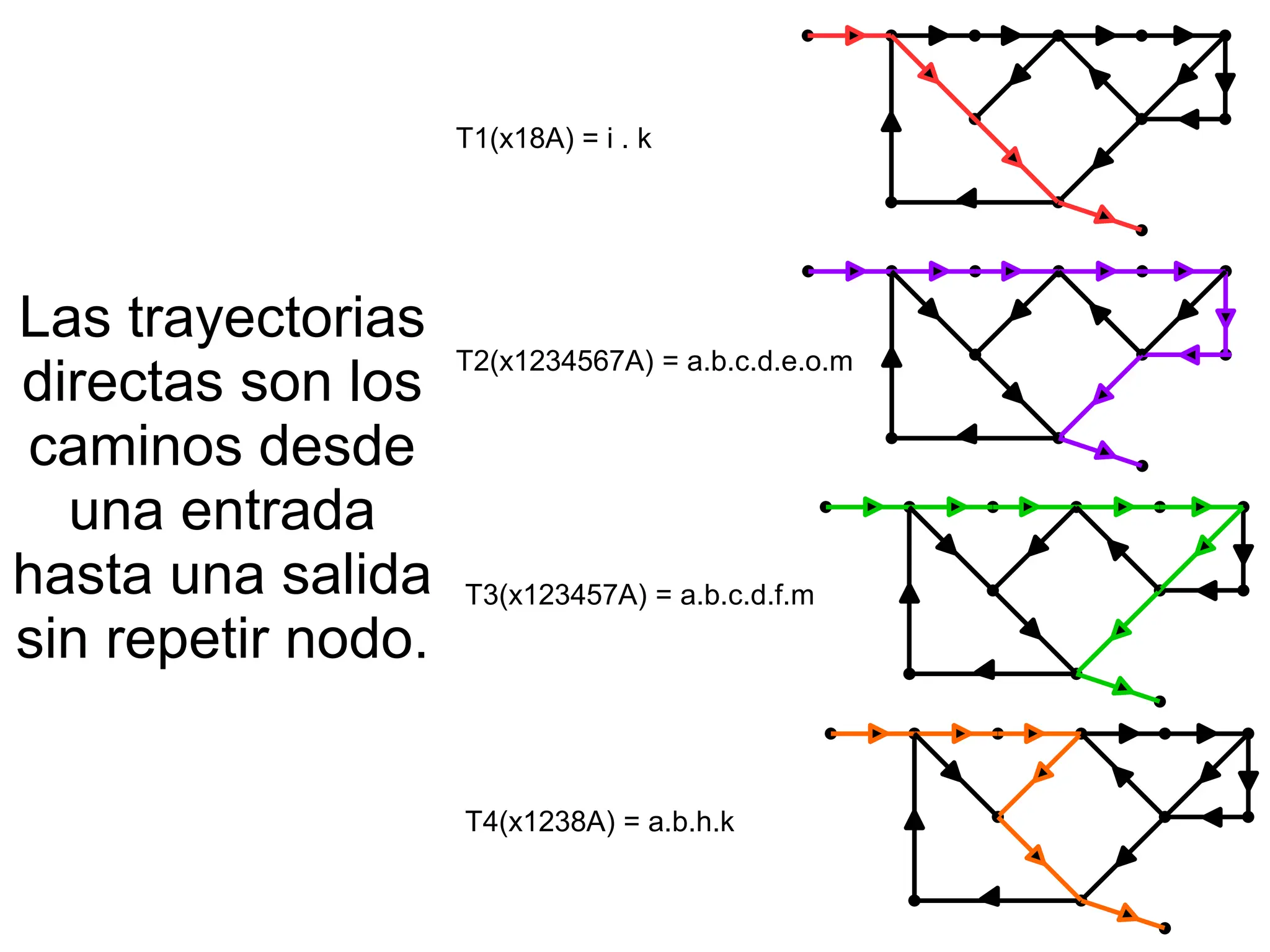
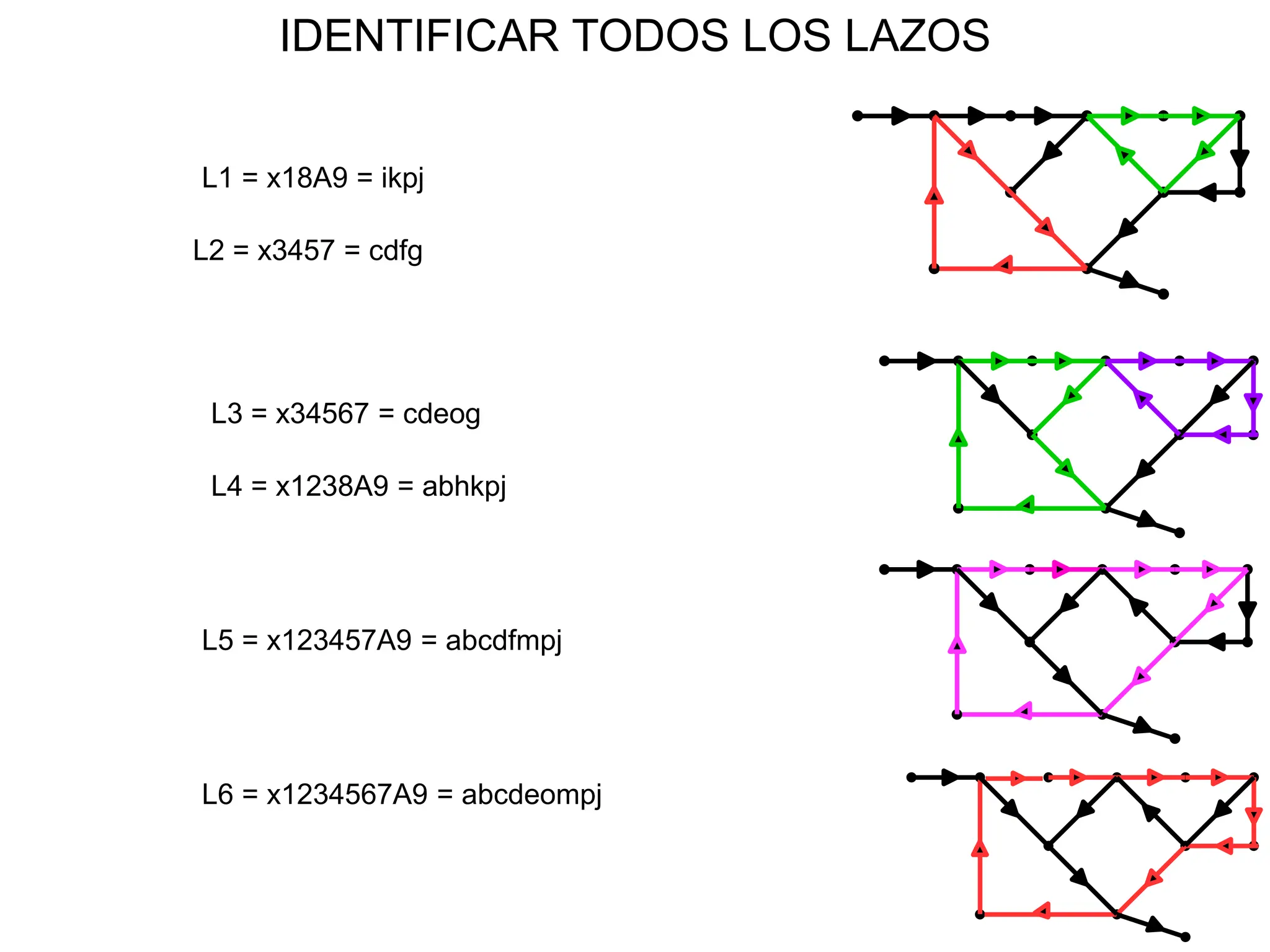
The document describes applying the Mason's rule method to calculate the transfer function Tt of a network with multiple loops. It identifies 6 loops (L1-L6) in the network and calculates the terms needed for the Tt formula, including the individual path functions (T1-T4), the Δi values, and the ΔT denominator term. It then applies the Tt formula to calculate the overall transfer function of the network.
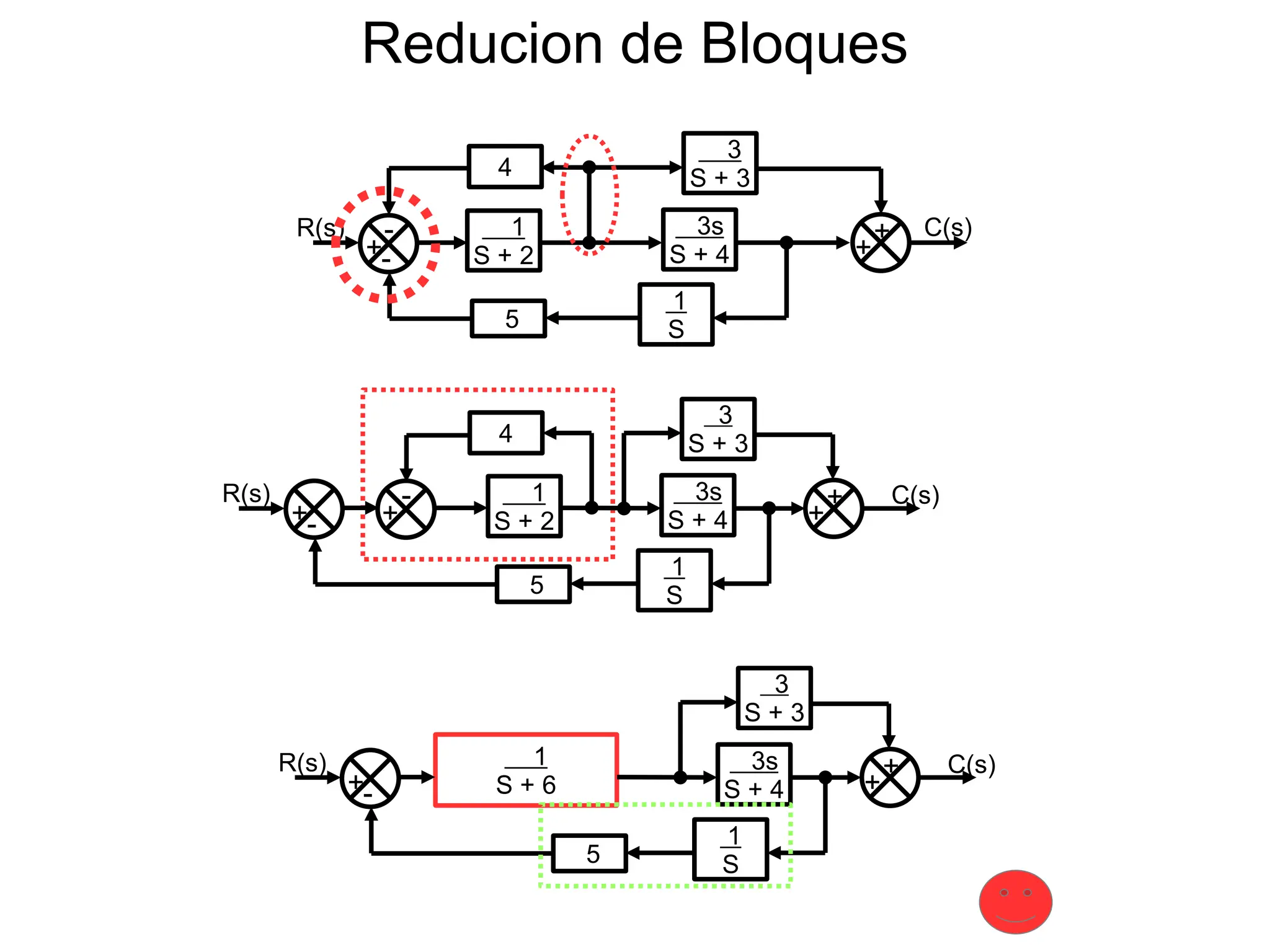
![1
S + 6
3s
S + 4
3
S + 3
5
S
+
+
-
+
R(s) C(s)
1
S + 6
3s
S + 4
3
S + 3
5
S
+
+
-
+
R(s) C(s)
s+4
3s
1
S + 6
3s
S + 4
3
S + 3
5
S
+
+
-
+
R(s) C(s)
s+4
3s
1
(s+6)(s+4)
5
S
+
+
-
+
R(s) C(s)
(s+4)
s(s+3)
3s
(s+6)(s+4) + 15
s(s+3)+ (s+4)
[s(s+3)]
R(s) C(s)
3s (s+3) +3 (s+4)
[(s+6)(s+4) +15](s+3)
R(s) C(s)](https://image.slidesharecdn.com/resoluciondiagramas-240202213922-489d0c3b/75/Resolucion-diagrama-diagrama-Diagramas-ppt-2-2048.jpg)
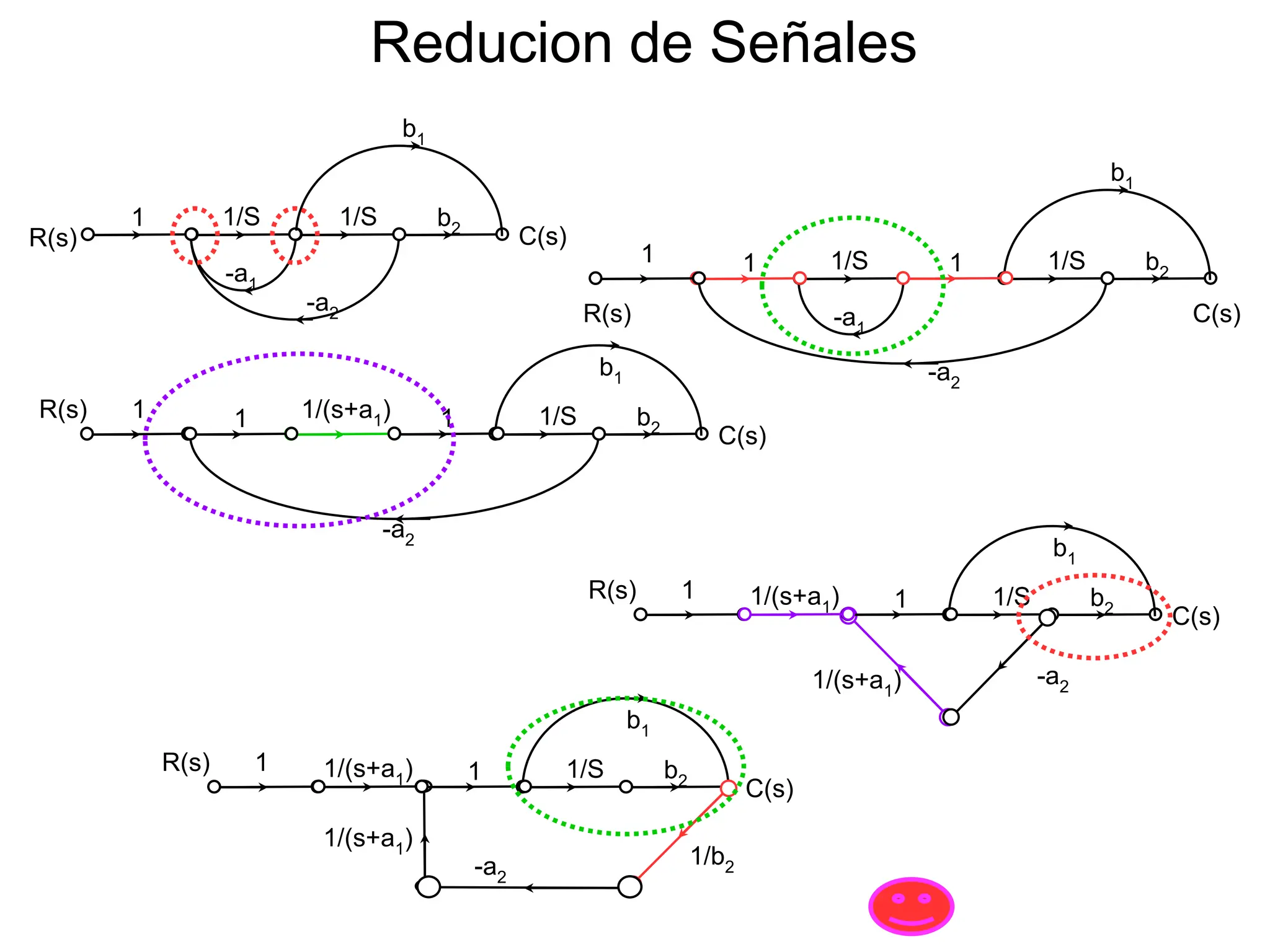
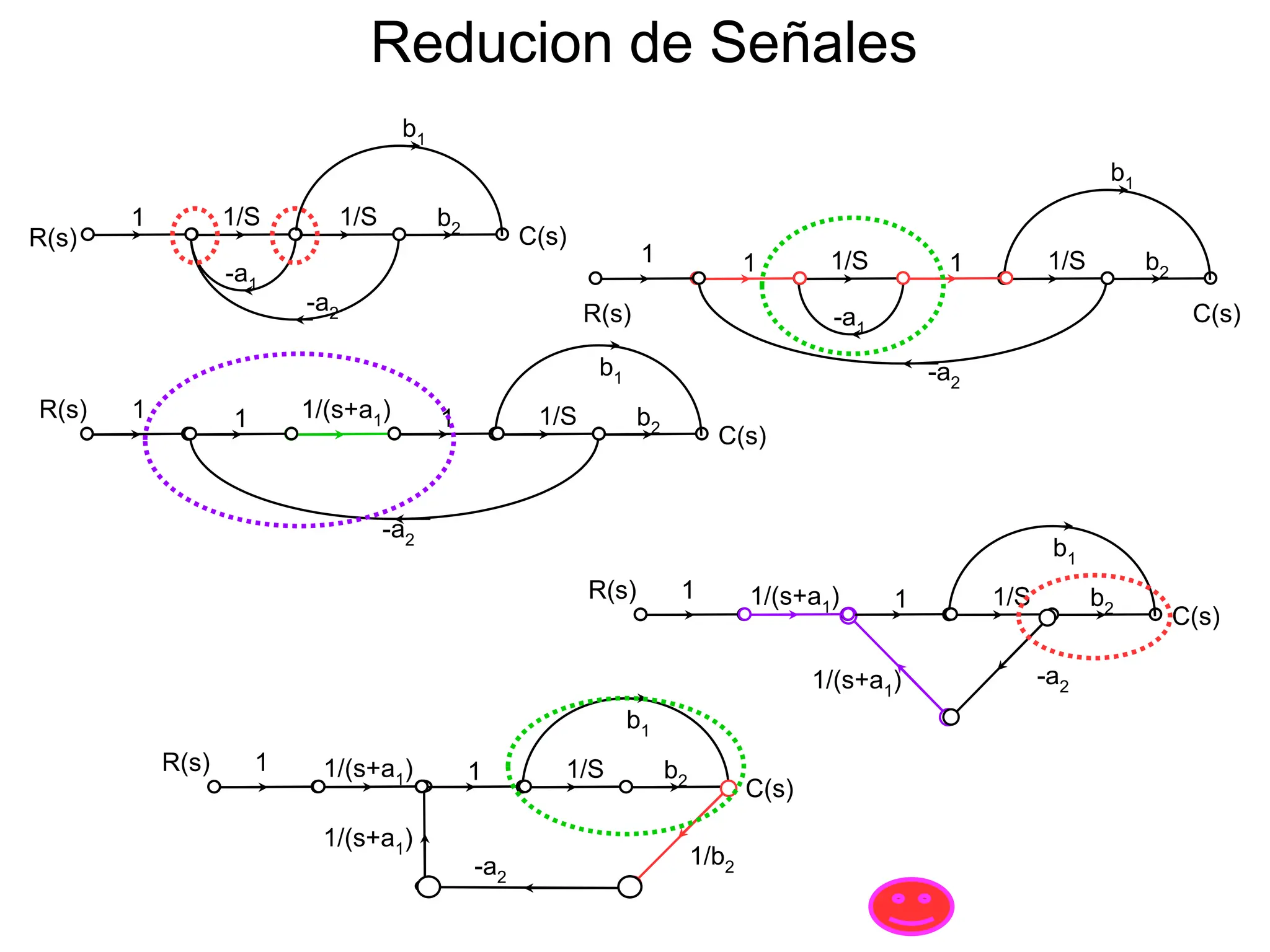
![1/(s+a1) b1+1/(sb2 )
1
-a2
R(s)
C(s)
1
1/(s+a1)
1/b2
1/(s+a1)
R(s)
1 G1 1
C(s
)
1/(s+a1)
R(s) C(s)
1 b1+1/(sb2 )
1
-a2(1/b2)[1/(s+a)]
G1=
b1+
1
sb2
1+ [b1 +
1
sb2
][
a2
b2 (s+ a1)
]
Gs
R(s)
1 1
C(s
)
Gs=
1
(s+ a1)
b1+
1
sb2
1+ [b1 +
1
sb2
][
a2
b2 (s+ a1)
]
Gs=
1
(s+ a1)
[(b1 sb2)+ 1]/sb2
1+ [
(b1 sb2)+ 1
sb2
][
a2
b2 (s+ a1)
]
Gs=
(b1 sb2)+ 1
(sb2)(s+ a1)+ [(b1 sb2)+ 1][
a2
b2
]](https://image.slidesharecdn.com/resoluciondiagramas-240202213922-489d0c3b/75/Resolucion-diagrama-diagrama-Diagramas-ppt-5-2048.jpg)
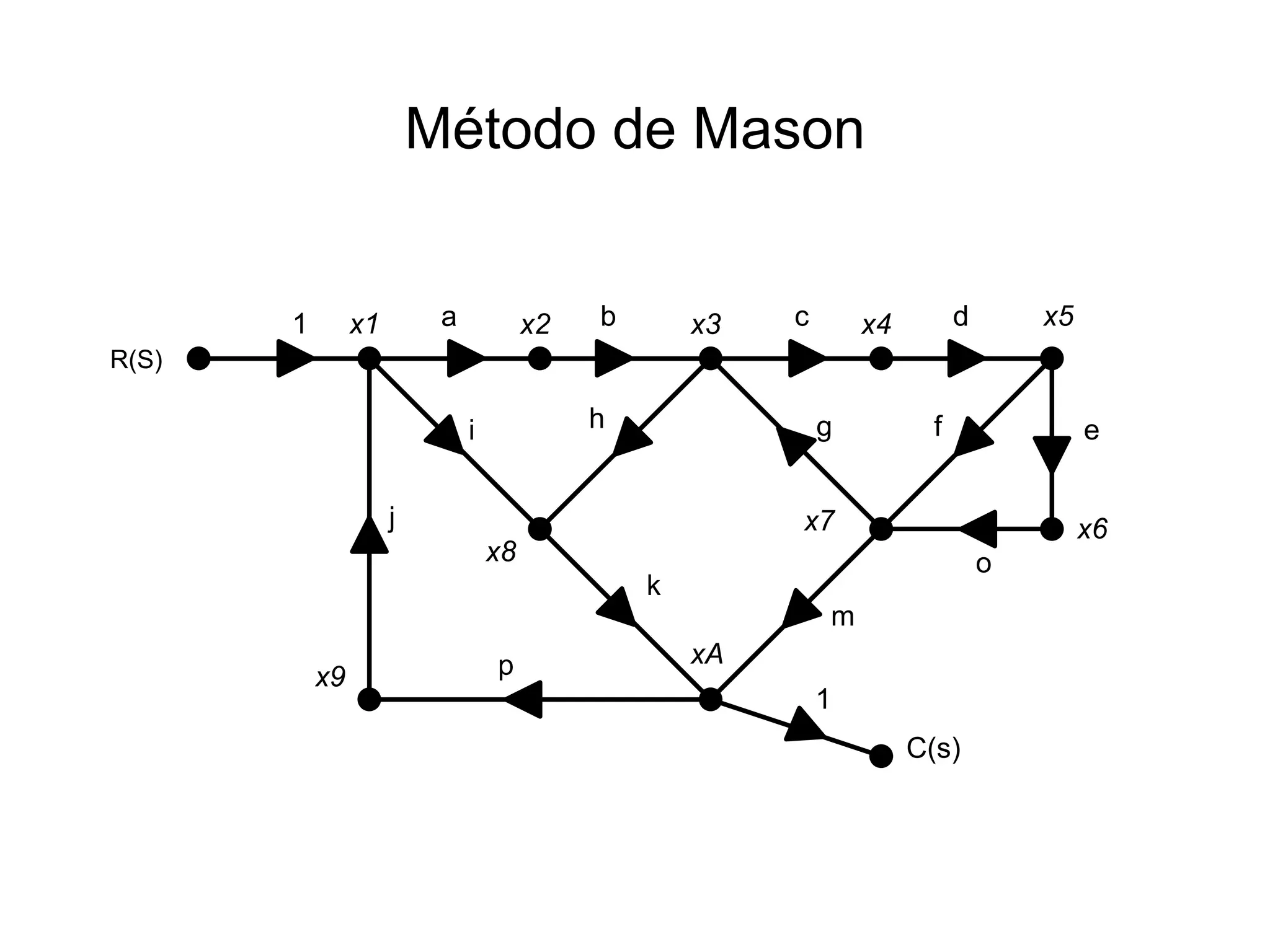
![Con esos datos la formula es:
Tt=
∑
i
Ti .△i
△T
△T= 1− ∑
a
La+ ∑
a,b
La .Lb− ∑
a,b,c
La .Lb .Lc+ ....
∑
a
La= L1+ L2+ L3+ L4+ L5+ L6
∑
a,b
La .Lb= L1 .L2+ L1 .L3= abhkpj.cdfg+ abhkpj.cdeog
∑
a
La= abhkpj+ cdeog+ cdfg+ ikpj+ abcdfmpj+ abcdeompj
∑
a,b,c
La .Lb .Lc= no hay grupos de 3 lazos disjuntos
△T= 1− [abhkpj+ cdeog+ cdfg+ ikpj+ abcdfmpj+ abcdeompj]+
+ [abhkpj.cdfg+ abhkpj.cdeog]](https://image.slidesharecdn.com/resoluciondiagramas-240202213922-489d0c3b/75/Resolucion-diagrama-diagrama-Diagramas-ppt-9-2048.jpg)
![ΔT= 1 - [abhkpj + cdeog + cdfg + ikpj + abcdfmpj + abcdeompj] + [abhkpj . cdfg + abhkpj . cdeog]
ΔT= 1 - [abhkpj + cdeog + cdfg + ikpj + abcdfmpj + abcdeompj] + [abhkpj . cdfg + abhkpj . cdeog]
Δ1 = ΔT – todo elemento de T1
T1 = i . k
Δ1= 1 - cdeog - cdfg
ΔT= 1 - [abhkpj + cdeog + cdfg + ikpj + abcdfmpj + abcdeompj] + [abhkpj . cdfg + abhkpj . cdeog]
T2 = a.b.c.d.e.o.m Δ2 = ΔT – todo elemento de T2
Δ2= 1
T3 = a.b.c.d.f.m Δ3 = ΔT – todo elemento de T3
ΔT= 1 - [abhkpj + cdeog + cdfg + ikpj + abcdfmpj + abcdeompj] + [abhkpj . cdfg + abhkpj . cdeog]
Δ3= 1
T4 = a.b.h.k Δ4 = ΔT – todo elemento de T4
ΔT= 1 - [abhkpj + cdeog + cdfg + ikpj + abcdfmpj + abcdeompj] + [abhkpj . cdfg + abhkpj . cdeog]
Δ4= 1](https://image.slidesharecdn.com/resoluciondiagramas-240202213922-489d0c3b/75/Resolucion-diagrama-diagrama-Diagramas-ppt-10-2048.jpg)
![Tt=
∑
i
Ti .△i
△T
Tt = (T1. Δ1 + T2. Δ2 + T3. Δ3 + T4. Δ4) / Δ
T
Tt=
(ik)(1− cdeog− cdfg) + abcdeom+ abcdfm + abhk
1− [abhkpj+ cdeog+ cdfg+ ikpj+ abcdfmpj+ abcdeompj]+ [abhkpj.cdfg+ abhkpj.cdeog]
ΔT = 1 - [ L1 + L2 + L3 + L4 + L5 + L6 ] + [L1.L2 + L1.L3]](https://image.slidesharecdn.com/resoluciondiagramas-240202213922-489d0c3b/75/Resolucion-diagrama-diagrama-Diagramas-ppt-11-2048.jpg)


![[DSC Europe 25] Dragan Vucic - Building the Learning Organization - How AI Tr...](https://cdn.slidesharecdn.com/ss_thumbnails/8brigo2sbu6qur6gxrra-7-251205085715-6ae07d24-thumbnail.jpg?width=640&height=640&fit=bounds)


![[DSC Europe 25] Marko Krstic - Understanding the AI Threat Landscape - Risks,...](https://cdn.slidesharecdn.com/ss_thumbnails/tiyim1ins5jvbrvzpzla-2-251209104645-c69d3553-thumbnail.jpg?width=640&height=640&fit=bounds)


![[DSC Europe 25] Dragana Ilic - AI for Big Data in Astronomy.pptx](https://cdn.slidesharecdn.com/ss_thumbnails/8palya86qaatvjhva1ms-2-dragana-ilic-ai-ilic-251208151906-652b819c-thumbnail.jpg?width=640&height=640&fit=bounds)


![[DSC Europe 25] Nikola Rajovic - Hardware Technologies Under the Hood: RISC-V...](https://cdn.slidesharecdn.com/ss_thumbnails/o2gptrmtoyqndgoshwgq-dsc2025-tenstorrent-rajovic-251205090438-814685f5-thumbnail.jpg?width=640&height=640&fit=bounds)
![[DSC Europe 25] Sara Polak - The Ancient Operating System: What Archaeology T...](https://cdn.slidesharecdn.com/ss_thumbnails/3vch2p6tttdnwhsgazoz-3-sara-polak-smart-cities-251208152532-64404202-thumbnail.jpg?width=640&height=640&fit=bounds)
![[DSC Europe 25] Vid Stimac - Policy Parsimony: Between Oversimplifying and Ov...](https://cdn.slidesharecdn.com/ss_thumbnails/eqlepagzqp2rhg3gbluh-dsc-stimac-251120-251205090438-059e7f54-thumbnail.jpg?width=640&height=640&fit=bounds)
![[DSC Europe 25] Vladimir Jelic - The AI-Driven Security Shift From Reactive D...](https://cdn.slidesharecdn.com/ss_thumbnails/6g5gj25mtjwayniqem1t-6-251209104645-7a5a5fc6-thumbnail.jpg?width=640&height=640&fit=bounds)

![[DSC Europe 25] Kaja Kandare - LLM as a judge.pptx](https://cdn.slidesharecdn.com/ss_thumbnails/arxyccaxsdsd1ba99wjw-7-251212104007-2b4e3f64-thumbnail.jpg?width=640&height=640&fit=bounds)
![[DSC Europe 25] Branko Dzakula - From Defense to Attack: How AI Redefines Cyb...](https://cdn.slidesharecdn.com/ss_thumbnails/80bdzdxpr3ky2g0qvyk9-8-251211083048-ce5fc1ee-thumbnail.jpg?width=640&height=640&fit=bounds)
