RESINS – General
Consideration
Prepared by :Prepared by :
Mrs. Amruta P. Sonawane,Mrs. Amruta P. Sonawane,
Assistant Professor,Assistant Professor,
Gokhale Education Society,Gokhale Education Society,
Sir Dr. M. S. Gosavi College of Pharmaceutical Education & Research,Sir Dr. M. S. Gosavi College of Pharmaceutical Education & Research,
Nasik - 422005Nasik - 422005
 Resin is produced naturally by many plants as a self-
defense & healing mechanism.
 Resins have a hydrocarbon base, & often contain terpenes,
which gives them a sharp odour
 These are amorphous mixtures of essential oils,
oxygenated products of terpenes & carboxylic acids found
as exudation from the trunk of various trees.
 They are hard, transparent or translucent solids, semi-
solids or liquid substances containing large number of
carbon atoms.
 On heating they soften and finally melt.
 Resins burn with a characteristic, smoky flame.
 They are insoluble in water & petroleum ether but dissolve
more or less completely in alcohol, chloroform and ether
 Chemically, resins are complex mixtures of resin acids, resin
alcohols (resinols), resin phenols (resinotannols), esters &
chemically inert compounds known as resenes
 Resins are often associated with volatile oils (oleoresins), with
gums (gum-resins) or with oil and gum (oleo-gum-resins)
 Resins may also be combined in a glycosidal manner with
sugars.
 These are normally produced either in
schizogenous (Eucalyptus) or in
schizolysigenous (Gossypium species)
 ducts or in cavities and regarded as end
products of metabolism
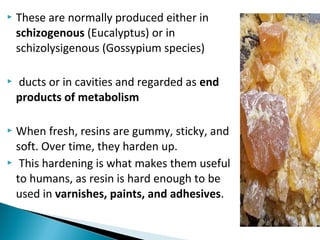
 When fresh, resins are gummy, sticky, and
soft. Over time, they harden up.
 This hardening is what makes them useful
to humans, as resin is hard enough to be
used in varnishes, paints, and adhesives.
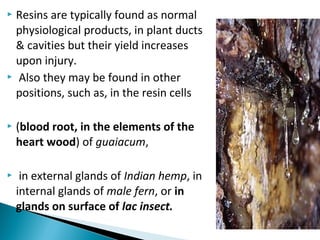
 Resins are typically found as normal
physiological products, in plant ducts
& cavities but their yield increases
upon injury.
 Also they may be found in other
positions, such as, in the resin cells
 (blood root, in the elements of the
heart wood) of guaiacum,
 in external glands of Indian hemp, in
internal glands of male fern, or in
glands on surface of lac insect.
 Resins are classified in three different ways:
1. Taxonomical classification, i.e. according to botanical
origin, e.g. Berberidaceae resins
2. Classification according to predominating chemical
constituent;
e.g. acid resins, resene resins, glycosidal resins; etc
3. Resins may be classified according to the portion of the
main constituents of the resin or resin combination;
Balsams –
e.g. resins, oleoresins, oleogumresins
They are mainly classified according their botanical origin
 Coniferous Resin: Eg. Colophony, sandarac
 BerBeridaceae Resins: Eg. Podophyllum
 Zygophyllaceae resin: Eg. Guaiacum.
They are classified on the basis of specific chemical
constituents
1. Resin acids : Eg. Colophony, Copaiba.
2. Resin alcohols : Eg. Asafoetida, Benzoin, Storax,
Balsam of tolu.
3. Resenes : Mastic, Myrrh, Bdellium, Dammar.
4. Resin esters : Dragon’s blood, Benzoin.
5. Resin phenols : Tolu balsam, Balsam of peru
6. Glucoresins.
 The resin acids essentially contain a large portion of
carboxylic acid and phenol
 They are occur in free state or respective ester, they form
soap like solution called resinates
 The abeitic acid & commiphoric acid present in colophony
and myrrh respectively are examples of resin acids.
 Eg. Colophony, Abietic acid, Copaivic acid, Guaiaconic
acid, etc.
 Resin alcohols are complex alcohol having higher
molecular weight. Like resin acids they are found as free
alcohols or as esters of benzoic, salicylic, and cinnamic
acids.
 They are insoluble in aqueous alkali solution but are
soluble in alcohol and ether resinols are present in
benzoin as benzoresinol and in storax as storesinol
They are of two types
◦ Resinotannols: Eg. Alocresinotannol, Ammoresinotannol,
Toluresinotallol
◦ Resinols: Eg. Benzoresinol, Storesinol, Gurjuresinol
 These are complex natural substances without any
chemical property.
 They are inert chemically. They neither form any salt nor
they get hydrolysed.
 These are oxygenated compounds but are not affected by
alkalies or acids.
 They are immune to oxydising agents, variant climatic
condition (a fact which essentially attribute the resins
containing them one of the major plus point for the
manufacture of varnishes)
 Eg. Fluavil, masticoresene, dracoresenes.
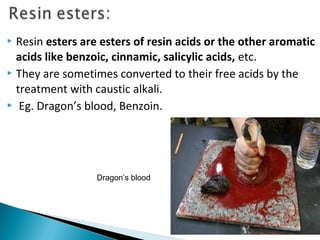
 Resin esters are esters of resin acids or the other aromatic
acids like benzoic, cinnamic, salicylic acids, etc.
 They are sometimes converted to their free acids by the
treatment with caustic alkali.
 Eg. Dragon’s blood, Benzoin.
Dragon’s blood
 Resin phenols or resinotannols are also high molecular
weight compounds which occur in free states or as esters
 Due to phenolic group they form phenoxoids and become
soluble in alkali solution, however they are insoluble in
water but dissolve in alcohol and ether
 Resinotannols gives a positive reaction with ferric chloride
 The resinotannols are found in balsam of peru as
peruresinotannol, in Tolu balsam as toluresinotannol & in
Benzoin as siaresinotannol.
Resins sometimes gets combined with sugars by
glycosylation and produce Glycoresins. Glycoresins can
be hydrolised by acidify hydrolysis to the glycone and
glycone.
 Accordingly other composition based on association of n
with gums and/or volatile oils is given below:
1. Oleoresins: Eg. Ginger, Copaiba, Turpentine.
2. Gum resins: Eg. Ammoniacum.
3. Oleogum resins: Eg. Asafoetida, Myrrh.
4. Balsams: balsam of Peru, balsam of Tolu, Benzoin, Storax
 By extraction with alcohol and precipitation with
water. Eg. Jalap, Podophyllum, Ipomoea, etc.
 By distillation for separation of oil. Eg. Copaiba,
Colophony, etc.
 By heating the plant part. Eg. Guaiacum, etc.
 As a plant exudate by incisions. Eg. Myrrh,
Asafoetida, Balsams, etc.
 By collecting fossil resins. Eg. Copal, Kauri, etc.
 By processing the encrustations. Eg. Shellac, etc.
 Balsams are resinous mixtures that contain large
proportions of cinnamic acid, benzoic acid or both
or esters of these acids.
 Balsams containing small amount of free acids are
partially soluble in hot water, should be reserved
for such substances as balsam of Peru, balsam of
Tolu & storax, which contain a high proportion of
aromatic balsamic acids.
 Two general classes of resinous substances are recognized
and this classification is based on the method used in
preparing them:
1. Natural resins, occur as exudates from plants, produced
normally or as result of pathogenic conditions, as for
example deep cuts in the wood of the plant e.g. turpentine.
2. Prepared resins; are obtained by different methods.
 The drug containing resins is powdered and extracted with
alcohol till exhaustion.
 The concentrated alcoholic extract is either evaporated, or
poured into water and the precipitated resin is collected,
washed and carefully dried.
 In the preparation of oleoresins; ether or acetone having
lower boiling point are used.
-The volatile oil portion is removed through distillation.
 When the resin occurs associated with gum (gum-resins),
the resin is extracted with alcohol leaving the gum
insoluble.
 Synthetic resins are materials with similar properties to
natural resins—viscous liquids capable of hardening. They
are typically manufactured by esterification or soaping of
organic compounds
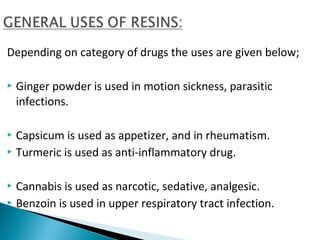
Depending on category of drugs the uses are given below;
 Ginger powder is used in motion sickness, parasitic
infections.
 Capsicum is used as appetizer, and in rheumatism.
 Turmeric is used as anti-inflammatory drug.
 Cannabis is used as narcotic, sedative, analgesic.
 Benzoin is used in upper respiratory tract infection.
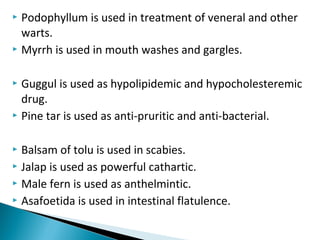
 Podophyllum is used in treatment of veneral and other
warts.
 Myrrh is used in mouth washes and gargles.
 Guggul is used as hypolipidemic and hypocholesteremic
drug.
 Pine tar is used as anti-pruritic and anti-bacterial.
 Balsam of tolu is used in scabies.
 Jalap is used as powerful cathartic.
 Male fern is used as anthelmintic.
 Asafoetida is used in intestinal flatulence.
Identification tests:
Dissolve 0.1 gm of powdered drug in 10 ml acetic
anhydride in a dry test tube. Add a drop of conc. sulphuric
acid to the cold solution. Purple colour appears which quickly
changes to dark violet on standing.
Dissolve powdered drug in petroleum ether. To 5 ml of
filtrate, add 10 ml of dilute solution of copper acetate.
Petroleum ether layer develops green colour

Resins - General Consideration

  • 1.
    RESINS – General Consideration Preparedby :Prepared by : Mrs. Amruta P. Sonawane,Mrs. Amruta P. Sonawane, Assistant Professor,Assistant Professor, Gokhale Education Society,Gokhale Education Society, Sir Dr. M. S. Gosavi College of Pharmaceutical Education & Research,Sir Dr. M. S. Gosavi College of Pharmaceutical Education & Research, Nasik - 422005Nasik - 422005
  • 2.
     Resin isproduced naturally by many plants as a self- defense & healing mechanism.  Resins have a hydrocarbon base, & often contain terpenes, which gives them a sharp odour  These are amorphous mixtures of essential oils, oxygenated products of terpenes & carboxylic acids found as exudation from the trunk of various trees.  They are hard, transparent or translucent solids, semi- solids or liquid substances containing large number of carbon atoms.  On heating they soften and finally melt.  Resins burn with a characteristic, smoky flame.
  • 3.
     They areinsoluble in water & petroleum ether but dissolve more or less completely in alcohol, chloroform and ether  Chemically, resins are complex mixtures of resin acids, resin alcohols (resinols), resin phenols (resinotannols), esters & chemically inert compounds known as resenes  Resins are often associated with volatile oils (oleoresins), with gums (gum-resins) or with oil and gum (oleo-gum-resins)  Resins may also be combined in a glycosidal manner with sugars.
  • 4.
     These arenormally produced either in schizogenous (Eucalyptus) or in schizolysigenous (Gossypium species)  ducts or in cavities and regarded as end products of metabolism  When fresh, resins are gummy, sticky, and soft. Over time, they harden up.  This hardening is what makes them useful to humans, as resin is hard enough to be used in varnishes, paints, and adhesives.
  • 5.
     Resins aretypically found as normal physiological products, in plant ducts & cavities but their yield increases upon injury.  Also they may be found in other positions, such as, in the resin cells  (blood root, in the elements of the heart wood) of guaiacum,  in external glands of Indian hemp, in internal glands of male fern, or in glands on surface of lac insect.
  • 6.
     Resins areclassified in three different ways: 1. Taxonomical classification, i.e. according to botanical origin, e.g. Berberidaceae resins 2. Classification according to predominating chemical constituent; e.g. acid resins, resene resins, glycosidal resins; etc 3. Resins may be classified according to the portion of the main constituents of the resin or resin combination; Balsams – e.g. resins, oleoresins, oleogumresins
  • 7.
    They are mainlyclassified according their botanical origin  Coniferous Resin: Eg. Colophony, sandarac  BerBeridaceae Resins: Eg. Podophyllum  Zygophyllaceae resin: Eg. Guaiacum.
  • 8.
    They are classifiedon the basis of specific chemical constituents 1. Resin acids : Eg. Colophony, Copaiba. 2. Resin alcohols : Eg. Asafoetida, Benzoin, Storax, Balsam of tolu. 3. Resenes : Mastic, Myrrh, Bdellium, Dammar. 4. Resin esters : Dragon’s blood, Benzoin. 5. Resin phenols : Tolu balsam, Balsam of peru 6. Glucoresins.
  • 9.
     The resinacids essentially contain a large portion of carboxylic acid and phenol  They are occur in free state or respective ester, they form soap like solution called resinates  The abeitic acid & commiphoric acid present in colophony and myrrh respectively are examples of resin acids.  Eg. Colophony, Abietic acid, Copaivic acid, Guaiaconic acid, etc.
  • 10.
     Resin alcoholsare complex alcohol having higher molecular weight. Like resin acids they are found as free alcohols or as esters of benzoic, salicylic, and cinnamic acids.  They are insoluble in aqueous alkali solution but are soluble in alcohol and ether resinols are present in benzoin as benzoresinol and in storax as storesinol They are of two types ◦ Resinotannols: Eg. Alocresinotannol, Ammoresinotannol, Toluresinotallol ◦ Resinols: Eg. Benzoresinol, Storesinol, Gurjuresinol
  • 11.
     These arecomplex natural substances without any chemical property.  They are inert chemically. They neither form any salt nor they get hydrolysed.  These are oxygenated compounds but are not affected by alkalies or acids.  They are immune to oxydising agents, variant climatic condition (a fact which essentially attribute the resins containing them one of the major plus point for the manufacture of varnishes)  Eg. Fluavil, masticoresene, dracoresenes.
  • 12.
     Resin estersare esters of resin acids or the other aromatic acids like benzoic, cinnamic, salicylic acids, etc.  They are sometimes converted to their free acids by the treatment with caustic alkali.  Eg. Dragon’s blood, Benzoin. Dragon’s blood
  • 13.
     Resin phenolsor resinotannols are also high molecular weight compounds which occur in free states or as esters  Due to phenolic group they form phenoxoids and become soluble in alkali solution, however they are insoluble in water but dissolve in alcohol and ether  Resinotannols gives a positive reaction with ferric chloride  The resinotannols are found in balsam of peru as peruresinotannol, in Tolu balsam as toluresinotannol & in Benzoin as siaresinotannol.
  • 14.
    Resins sometimes getscombined with sugars by glycosylation and produce Glycoresins. Glycoresins can be hydrolised by acidify hydrolysis to the glycone and glycone.  Accordingly other composition based on association of n with gums and/or volatile oils is given below: 1. Oleoresins: Eg. Ginger, Copaiba, Turpentine. 2. Gum resins: Eg. Ammoniacum. 3. Oleogum resins: Eg. Asafoetida, Myrrh. 4. Balsams: balsam of Peru, balsam of Tolu, Benzoin, Storax
  • 15.
     By extractionwith alcohol and precipitation with water. Eg. Jalap, Podophyllum, Ipomoea, etc.  By distillation for separation of oil. Eg. Copaiba, Colophony, etc.  By heating the plant part. Eg. Guaiacum, etc.  As a plant exudate by incisions. Eg. Myrrh, Asafoetida, Balsams, etc.  By collecting fossil resins. Eg. Copal, Kauri, etc.  By processing the encrustations. Eg. Shellac, etc.
  • 17.
     Balsams areresinous mixtures that contain large proportions of cinnamic acid, benzoic acid or both or esters of these acids.  Balsams containing small amount of free acids are partially soluble in hot water, should be reserved for such substances as balsam of Peru, balsam of Tolu & storax, which contain a high proportion of aromatic balsamic acids.
  • 18.
     Two generalclasses of resinous substances are recognized and this classification is based on the method used in preparing them: 1. Natural resins, occur as exudates from plants, produced normally or as result of pathogenic conditions, as for example deep cuts in the wood of the plant e.g. turpentine.
  • 19.
    2. Prepared resins;are obtained by different methods.  The drug containing resins is powdered and extracted with alcohol till exhaustion.  The concentrated alcoholic extract is either evaporated, or poured into water and the precipitated resin is collected, washed and carefully dried.  In the preparation of oleoresins; ether or acetone having lower boiling point are used. -The volatile oil portion is removed through distillation.  When the resin occurs associated with gum (gum-resins), the resin is extracted with alcohol leaving the gum insoluble.
  • 20.
     Synthetic resinsare materials with similar properties to natural resins—viscous liquids capable of hardening. They are typically manufactured by esterification or soaping of organic compounds
  • 21.
    Depending on categoryof drugs the uses are given below;  Ginger powder is used in motion sickness, parasitic infections.  Capsicum is used as appetizer, and in rheumatism.  Turmeric is used as anti-inflammatory drug.  Cannabis is used as narcotic, sedative, analgesic.  Benzoin is used in upper respiratory tract infection.
  • 22.
     Podophyllum isused in treatment of veneral and other warts.  Myrrh is used in mouth washes and gargles.  Guggul is used as hypolipidemic and hypocholesteremic drug.  Pine tar is used as anti-pruritic and anti-bacterial.  Balsam of tolu is used in scabies.  Jalap is used as powerful cathartic.  Male fern is used as anthelmintic.  Asafoetida is used in intestinal flatulence.
  • 23.
    Identification tests: Dissolve 0.1gm of powdered drug in 10 ml acetic anhydride in a dry test tube. Add a drop of conc. sulphuric acid to the cold solution. Purple colour appears which quickly changes to dark violet on standing. Dissolve powdered drug in petroleum ether. To 5 ml of filtrate, add 10 ml of dilute solution of copper acetate. Petroleum ether layer develops green colour