Resilience of Complex Adaptive and Evolving Infrastructure
Systems
Dr. Shima Beigi
Faculty of Engineering
University of Bristol
Bifurcation of Thoughts: What Is Resilience And What It Is Not
Natural Systems
➢ Persistence of Relationships, Absorption of Shocks
(Holling 1973)
➢ Qualitative property that changes throughout
ecosystem dynamics (Holling 2001)
➢ Reorganization while undergoing change
➢ Retention of Structure, Function, Feedback and
Identity
➢ Avoiding Critical Transitions, Probability of
Extinction
➢ Adaptation (Walker et al 2004; Holling and Gunderson
2002)
➢ Transformability of Social and Ecological Systems
(Walker et al 2004; 2006; Walker and Salt 2006; Walker and
Salt 2012; Marten Scheffer 2009)
Infrastructure Systems
➢ Continuity of Function (MCEER Publications 2003-2011)
➢ Rapid Recovery (We have not built for recovery in
first place!)
➢ Bouncing Back (Direction?)
➢ Tolerable Level of Loss (How to Measure?)
➢ Climate Proof Systems (Like Wearing a Jacket?)
➢ Adaptation (Are We Now in a Desirable State?)
➢ Evolution of Socio-Technical Systems and Their
Transition (Pim and Kemp 1998, Smith and Stirling 2008,
Bollinger et al 2012, Zhao et al 2012)
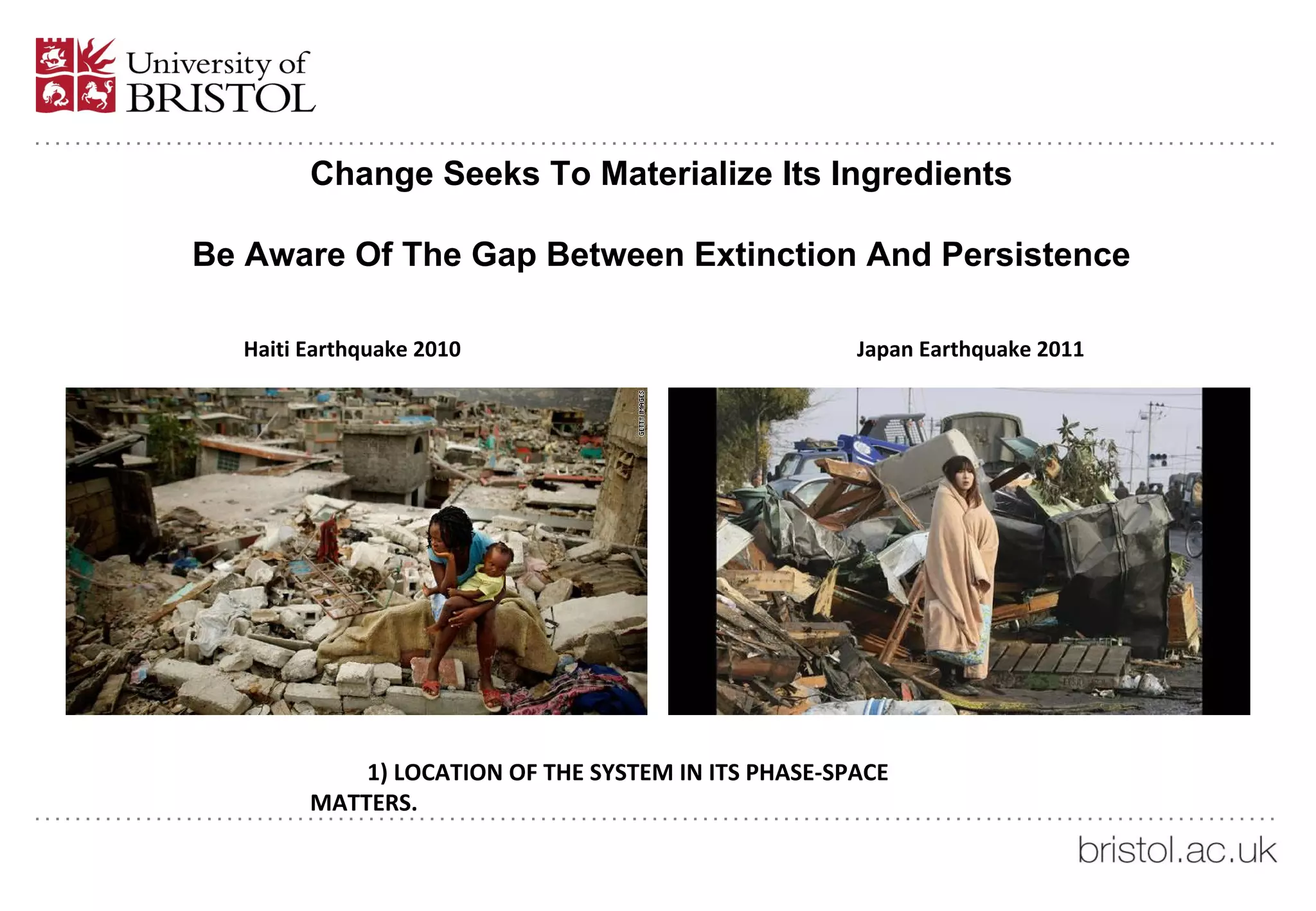
Change Seeks To Materialize Its Ingredients
Be Aware Of The Gap Between Extinction And Persistence
Haiti Earthquake 2010 Japan Earthquake 2011
1) LOCATION OF THE SYSTEM IN ITS PHASE-SPACE
MATTERS.
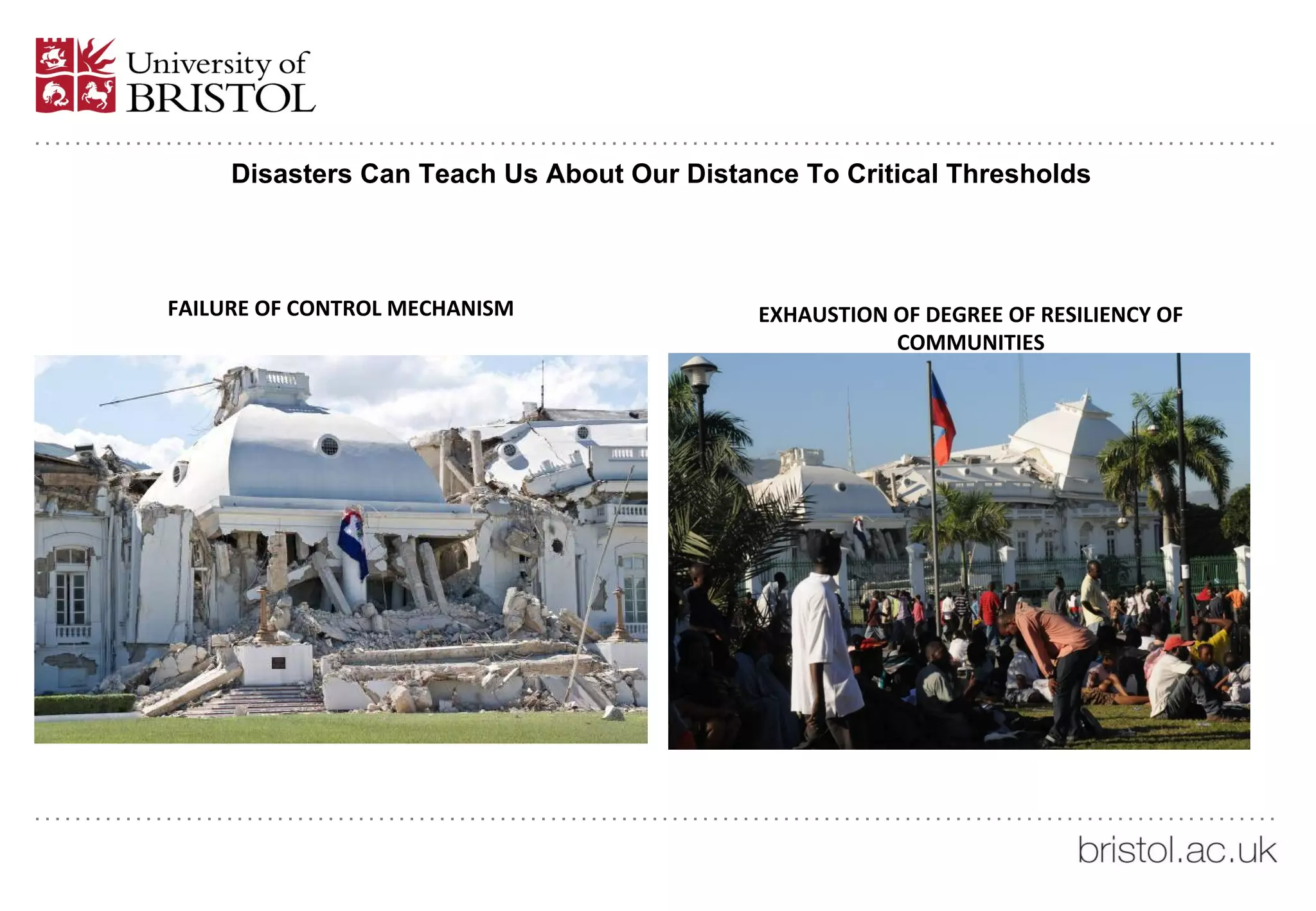
Disasters Can Teach Us About Our Distance To Critical Thresholds
FAILURE OF CONTROL MECHANISM EXHAUSTION OF DEGREE OF RESILIENCY OF
COMMUNITIES
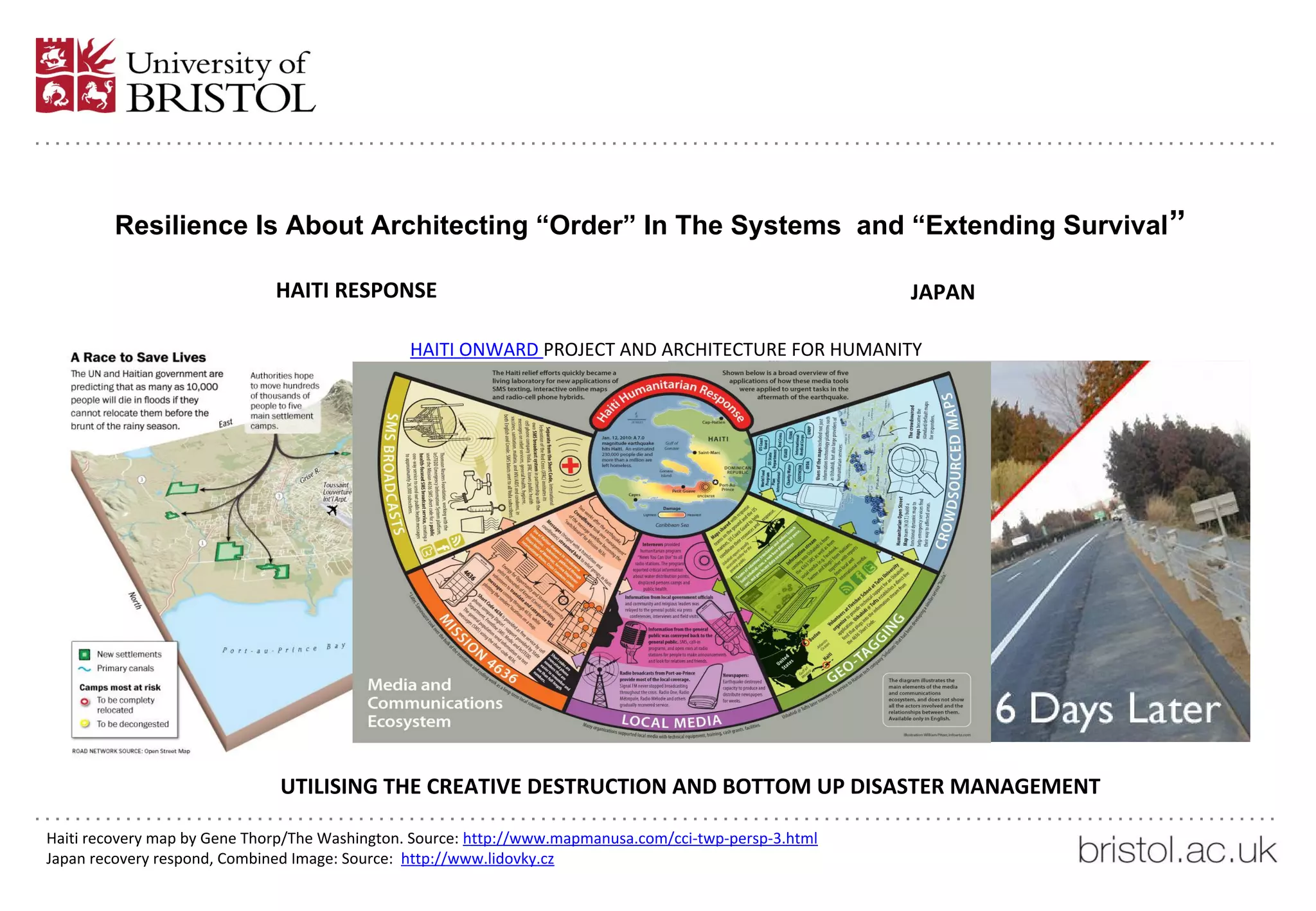
Resilience Is About Architecting “Order” In The Systems and “Extending Survival”
HAITI RESPONSE JAPAN
HAITI ONWARD PROJECT AND ARCHITECTURE FOR HUMANITY
UTILISING THE CREATIVE DESTRUCTION AND BOTTOM UP DISASTER MANAGEMENT
Haiti recovery map by Gene Thorp/The Washington. Source: http://www.mapmanusa.com/cci-twp-persp-3.html
Japan recovery respond, Combined Image: Source: http://www.lidovky.cz
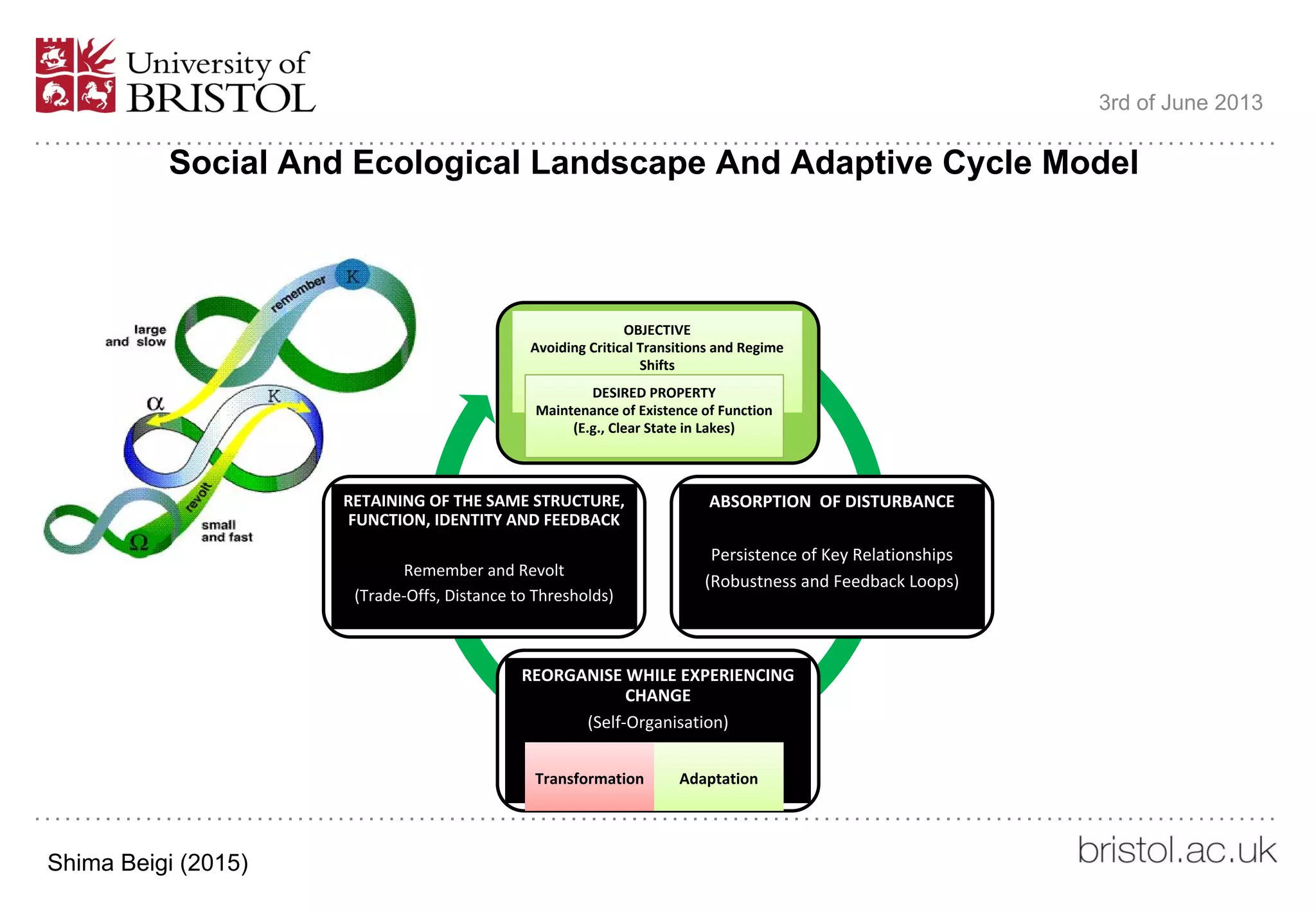
Social And Ecological Landscape And Adaptive Cycle Model
3rd of June 2013
ABSORPTION OF DISTURBANCE
Persistence of Key Relationships
(Robustness and Feedback Loops)
REORGANISE WHILE EXPERIENCING
CHANGE
(Self-Organisation)
RETAINING OF THE SAME STRUCTURE,
FUNCTION, IDENTITY AND FEEDBACK
Remember and Revolt
(Trade-Offs, Distance to Thresholds)
OBJECTIVE
Avoiding Critical Transitions and Regime
Shifts
DESIRED PROPERTY
Maintenance of Existence of Function
(E.g., Clear State in Lakes)
Transformation Adaptation
Shima Beigi (2015)
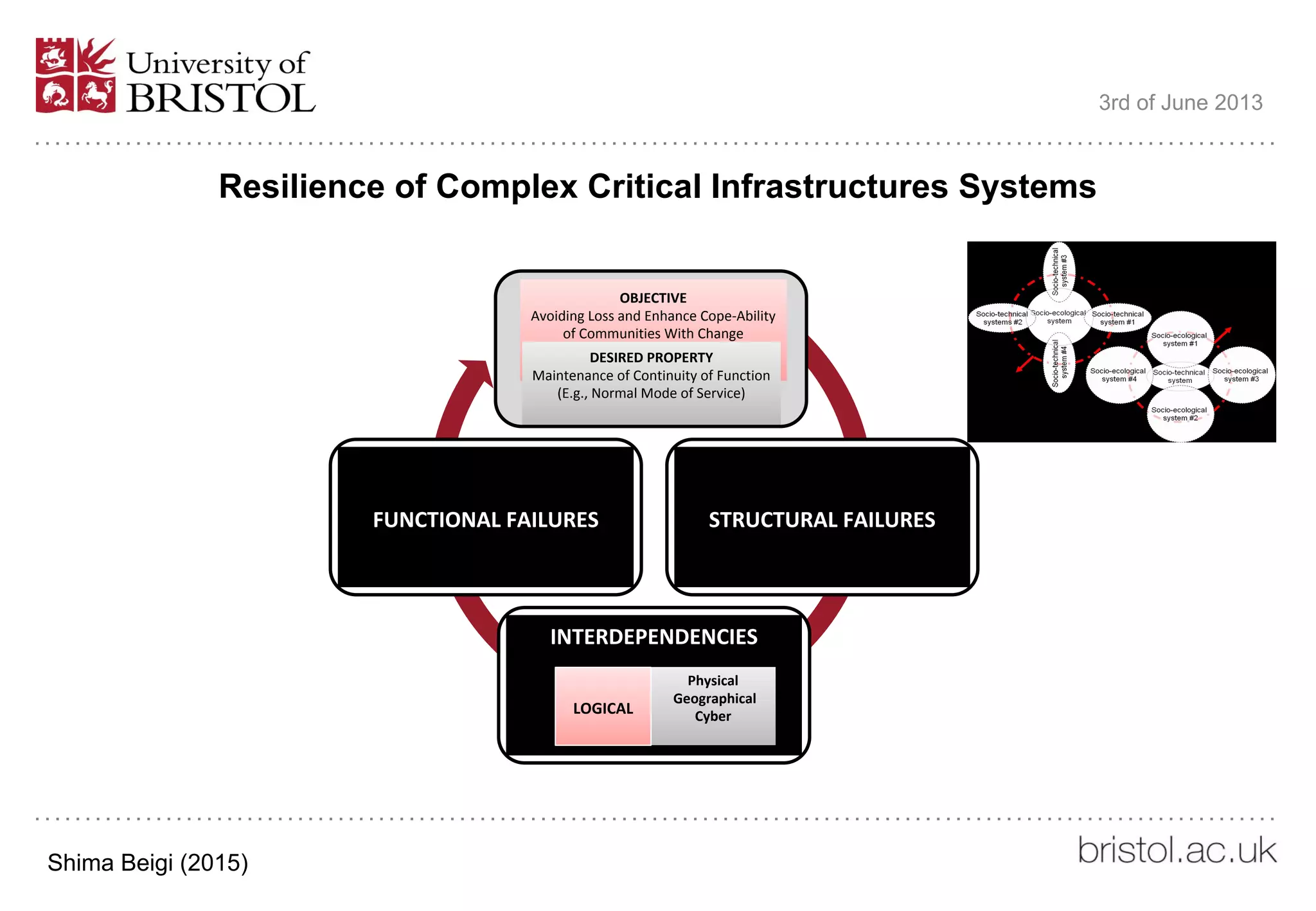
Resilience of Complex Critical Infrastructures Systems
3rd of June 2013
STRUCTURAL FAILURES
INTERDEPENDENCIES
FUNCTIONAL FAILURES
Physical
Geographical
CyberLOGICAL
OBJECTIVE
Avoiding Loss and Enhance Cope-Ability
of Communities With Change
DESIRED PROPERTY
Maintenance of Continuity of Function
(E.g., Normal Mode of Service)
Shima Beigi (2015)
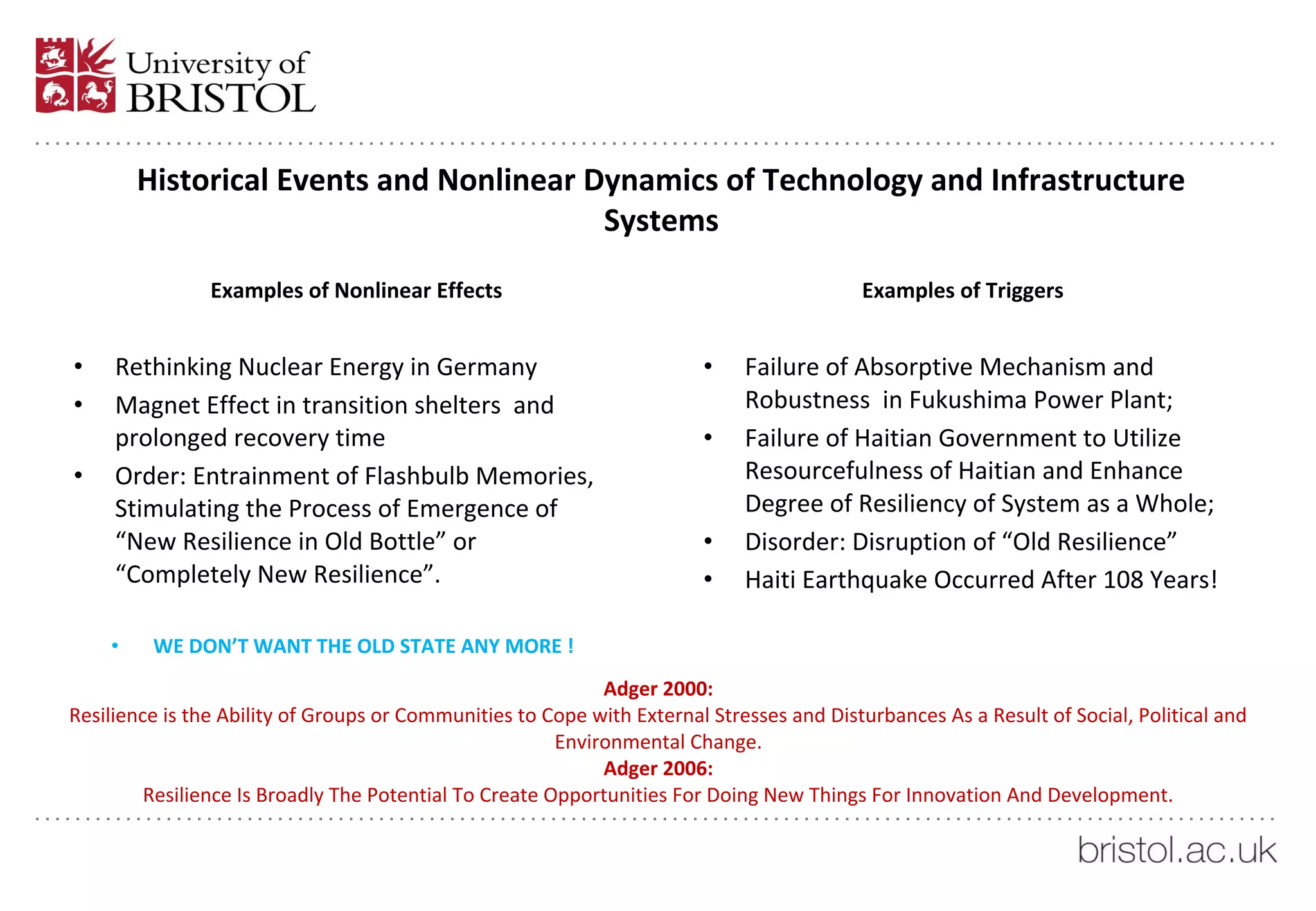
Historical Events and Nonlinear Dynamics of Technology and Infrastructure
Systems
Examples of Nonlinear Effects
• Rethinking Nuclear Energy in Germany
• Magnet Effect in transition shelters and
prolonged recovery time
• Order: Entrainment of Flashbulb Memories,
Stimulating the Process of Emergence of
“New Resilience in Old Bottle” or
“Completely New Resilience”.
• WE DON’T WANT THE OLD STATE ANY MORE !
Examples of Triggers
• Failure of Absorptive Mechanism and
Robustness in Fukushima Power Plant;
• Failure of Haitian Government to Utilize
Resourcefulness of Haitian and Enhance
Degree of Resiliency of System as a Whole;
• Disorder: Disruption of “Old Resilience”
• Haiti Earthquake Occurred After 108 Years!
Adger 2000:
Resilience is the Ability of Groups or Communities to Cope with External Stresses and Disturbances As a Result of Social, Political and
Environmental Change.
Adger 2006:
Resilience Is Broadly The Potential To Create Opportunities For Doing New Things For Innovation And Development.
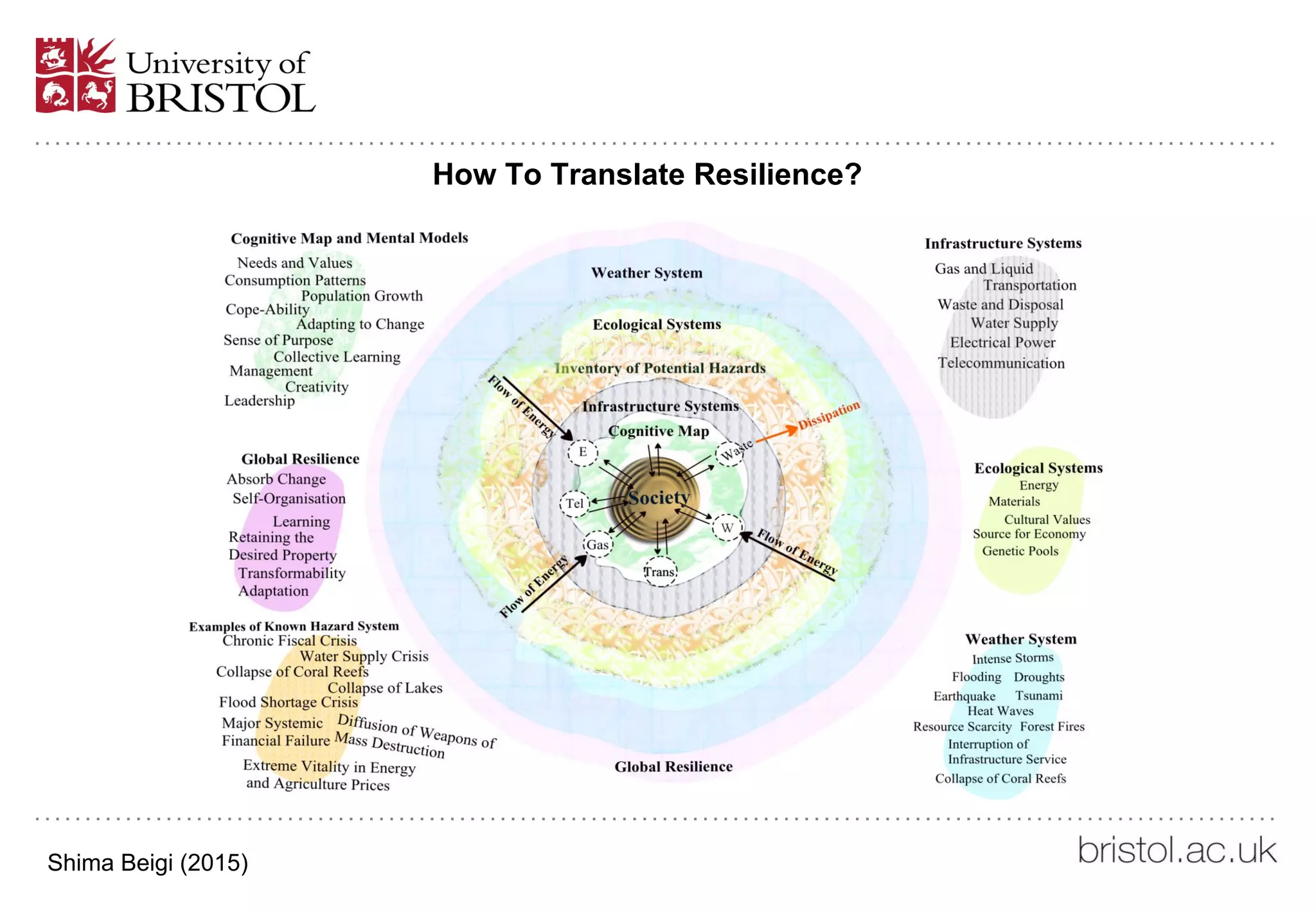
How To Translate Resilience?
Shima Beigi (2015)
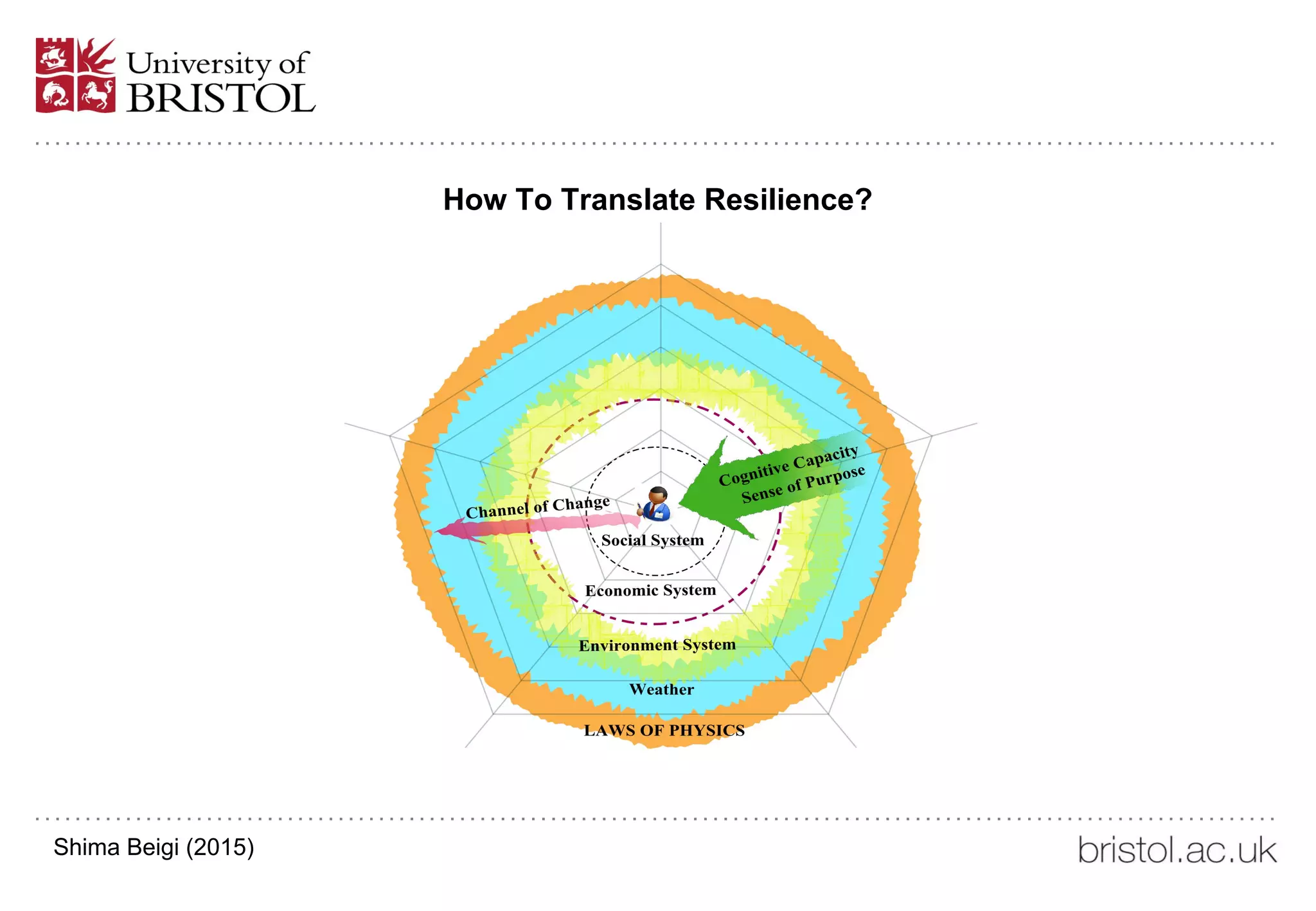
How To Translate Resilience?
Shima Beigi (2015)
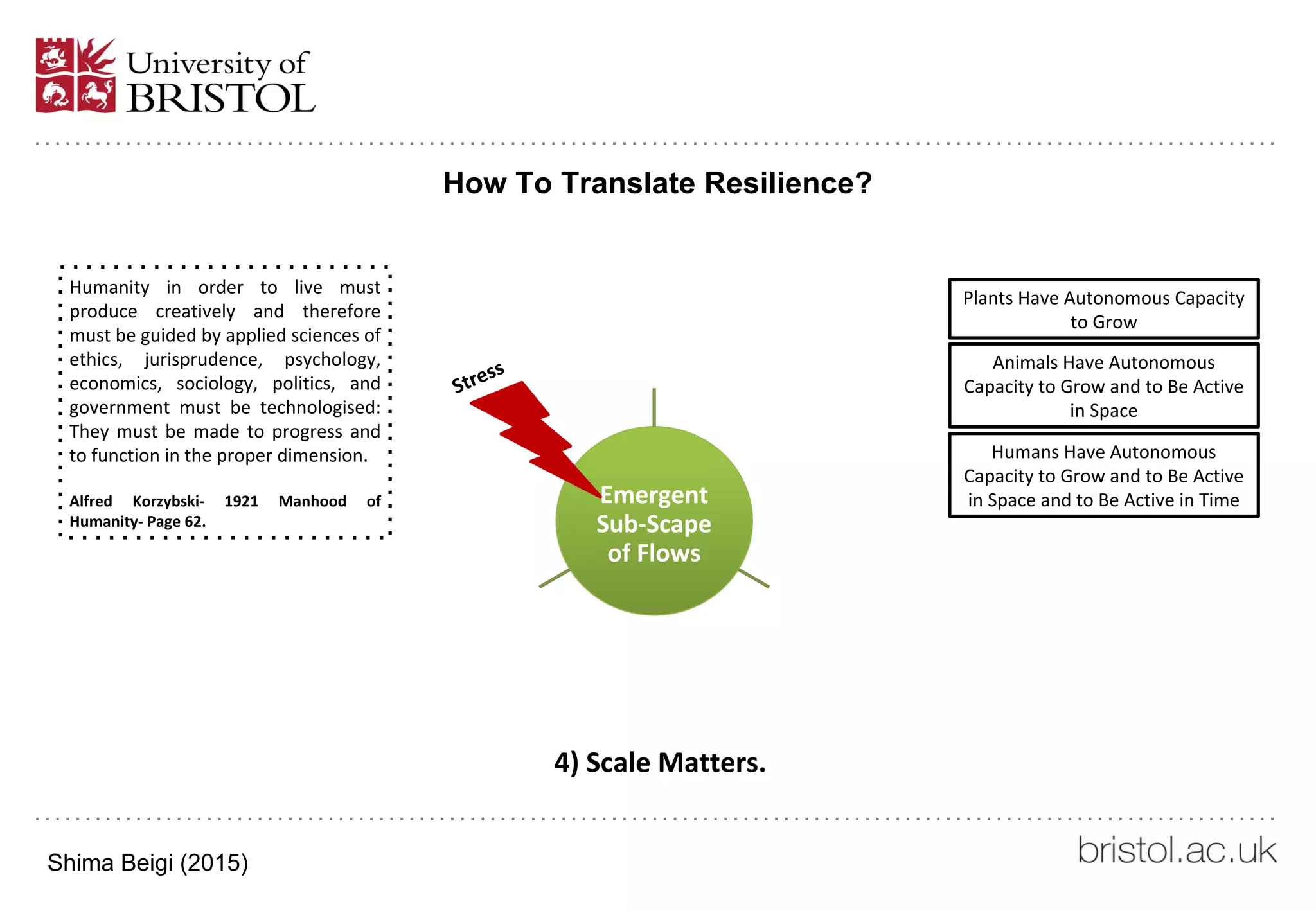
How To Translate Resilience?
Emergent
Sub-Scape
of Flows
Space
(Animals)
(Human)
Resources
(Plants)
(Human)
Time
(Human)
Humans Have Autonomous
Capacity to Grow and to Be Active
in Space and to Be Active in Time
Animals Have Autonomous
Capacity to Grow and to Be Active
in Space
Plants Have Autonomous Capacity
to Grow
Stress
Humanity in order to live must
produce creatively and therefore
must be guided by applied sciences of
ethics, jurisprudence, psychology,
economics, sociology, politics, and
government must be technologised:
They must be made to progress and
to function in the proper dimension.
Alfred Korzybski- 1921 Manhood of
Humanity- Page 62.
4) Scale Matters.
Shima Beigi (2015)
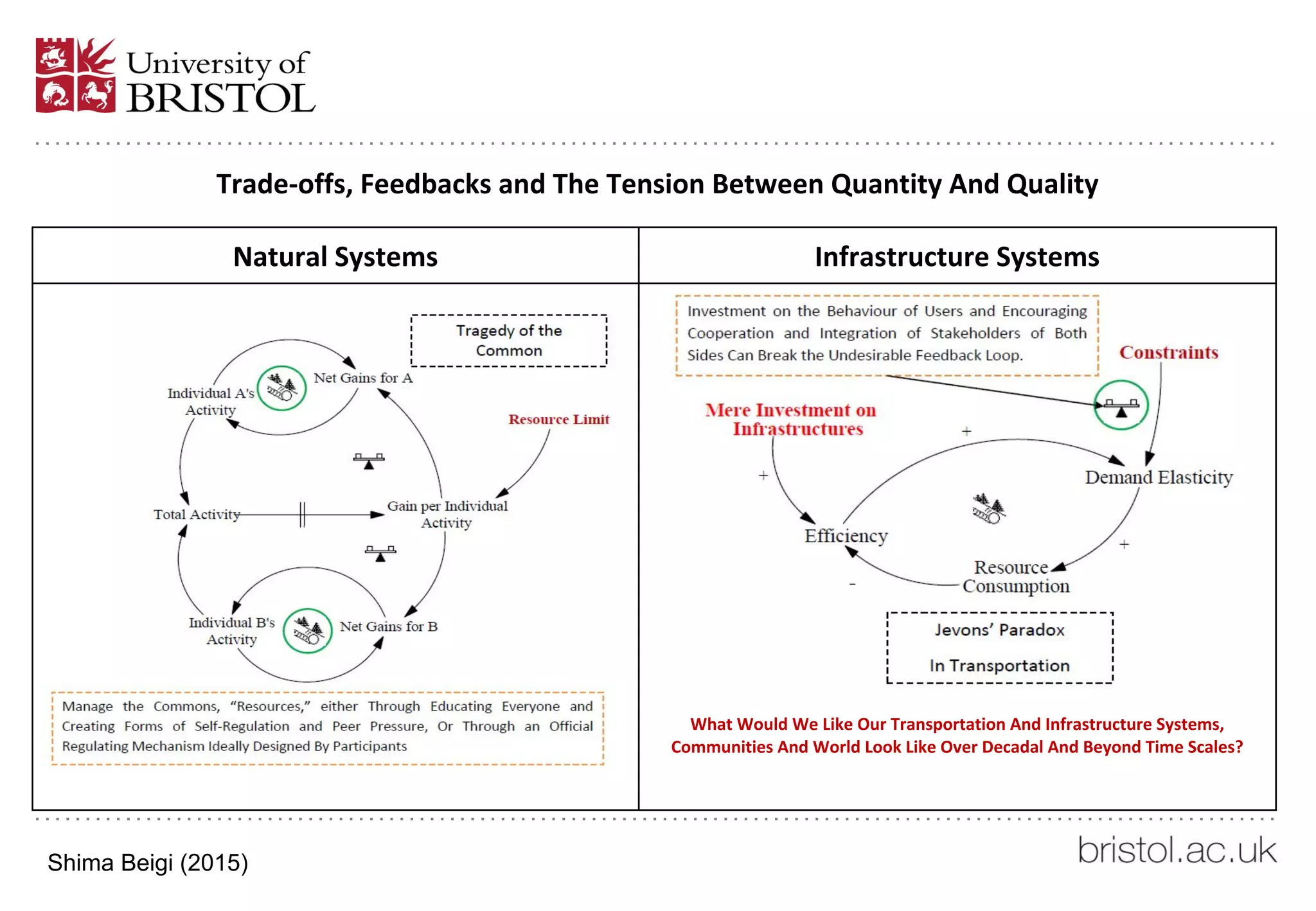
Trade-offs, Feedbacks and The Tension Between Quantity And Quality
Natural Systems Infrastructure Systems
What Would We Like Our Transportation And Infrastructure Systems,
Communities And World Look Like Over Decadal And Beyond Time Scales?
Shima Beigi (2015)
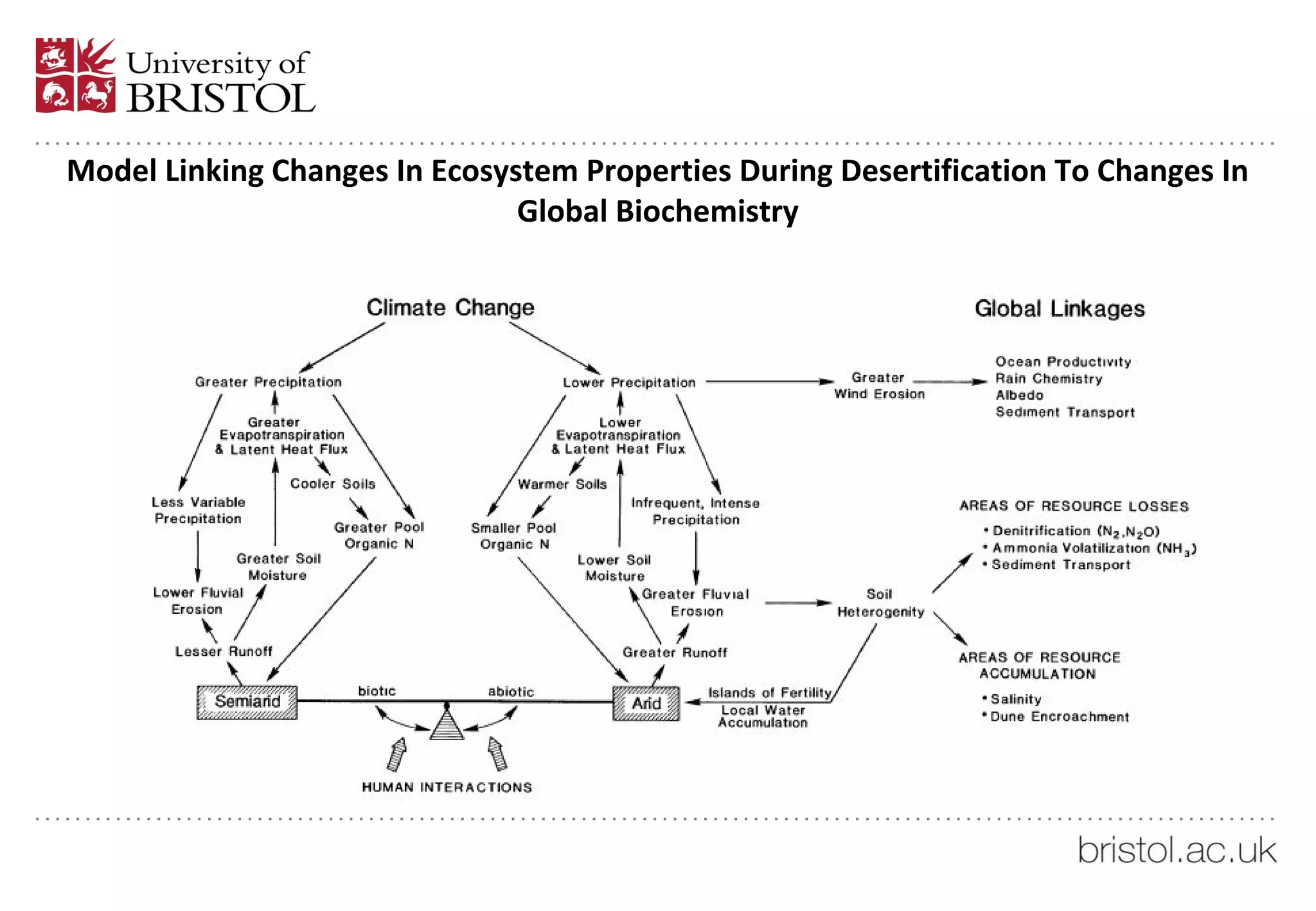
Model Linking Changes In Ecosystem Properties During Desertification To Changes In
Global Biochemistry
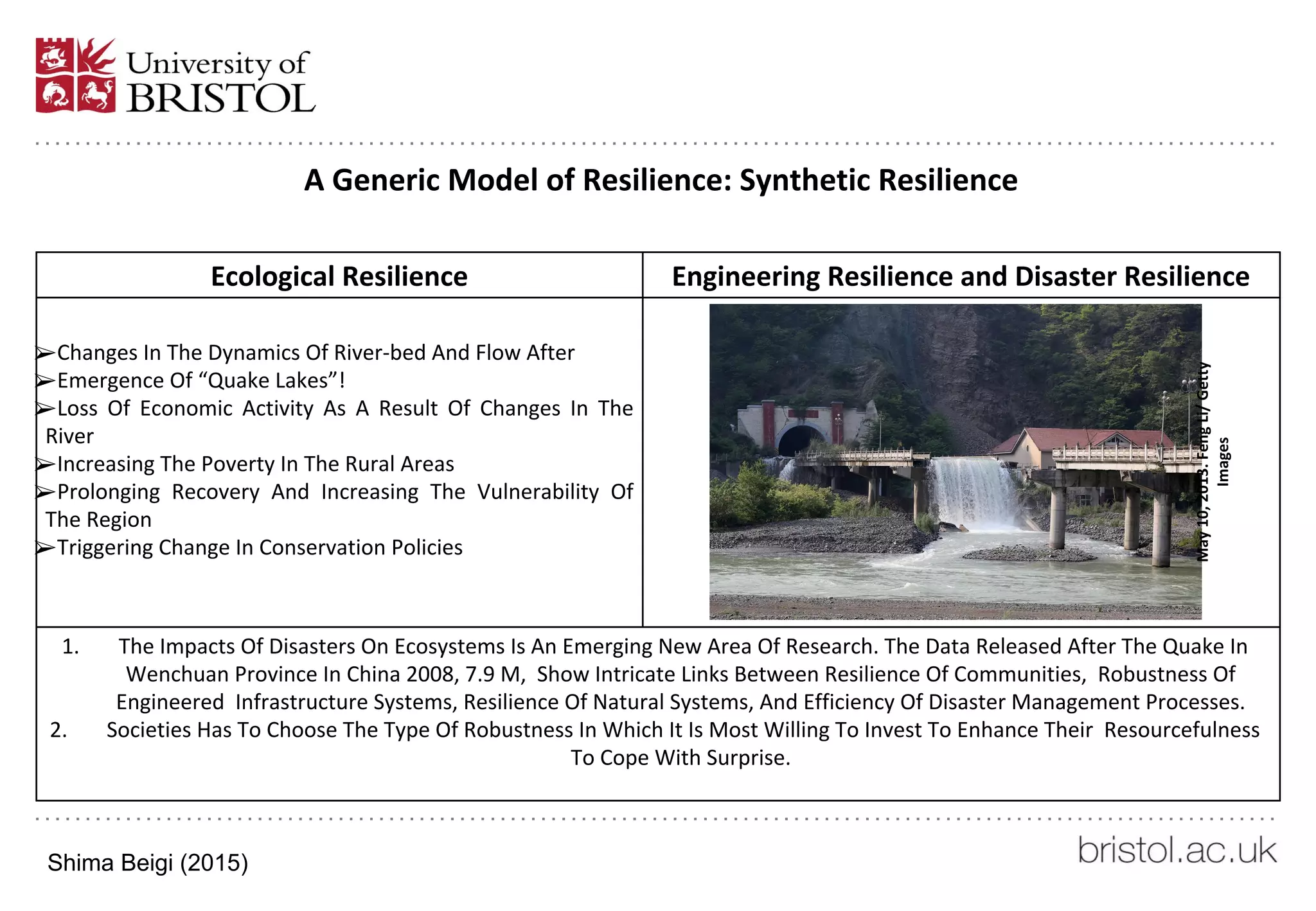
A Generic Model of Resilience: Synthetic Resilience
Ecological Resilience Engineering Resilience and Disaster Resilience
➢Changes In The Dynamics Of River-bed And Flow After
➢Emergence Of “Quake Lakes”!
➢Loss Of Economic Activity As A Result Of Changes In The
River
➢Increasing The Poverty In The Rural Areas
➢Prolonging Recovery And Increasing The Vulnerability Of
The Region
➢Triggering Change In Conservation Policies
1. The Impacts Of Disasters On Ecosystems Is An Emerging New Area Of Research. The Data Released After The Quake In
Wenchuan Province In China 2008, 7.9 M, Show Intricate Links Between Resilience Of Communities, Robustness Of
Engineered Infrastructure Systems, Resilience Of Natural Systems, And Efficiency Of Disaster Management Processes.
2. Societies Has To Choose The Type Of Robustness In Which It Is Most Willing To Invest To Enhance Their Resourcefulness
To Cope With Surprise.
May10,2013.FengLi/Getty
Images
Shima Beigi (2015)
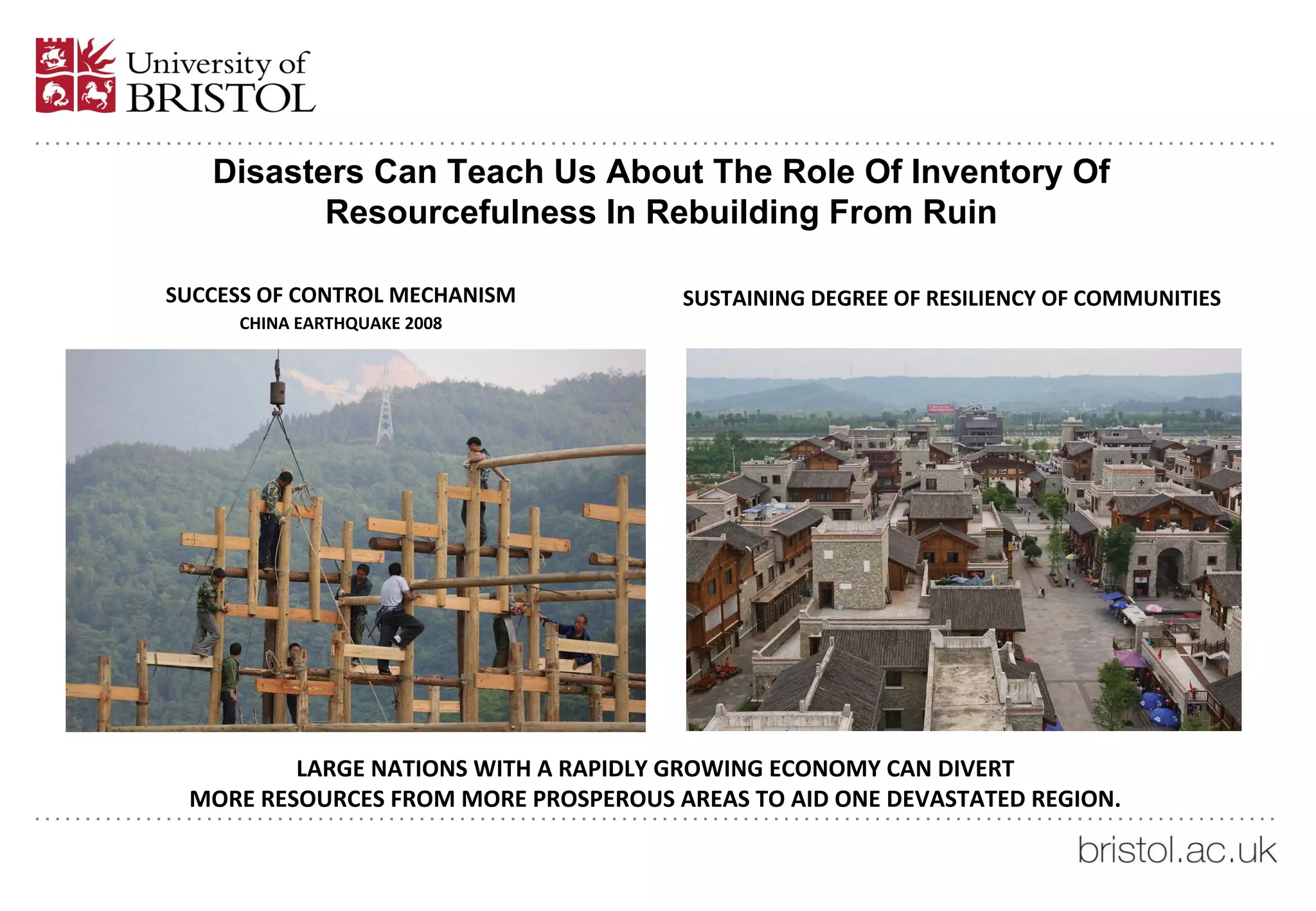
Disasters Can Teach Us About The Role Of Inventory Of
Resourcefulness In Rebuilding From Ruin
SUCCESS OF CONTROL MECHANISM
CHINA EARTHQUAKE 2008
SUSTAINING DEGREE OF RESILIENCY OF COMMUNITIES
LARGE NATIONS WITH A RAPIDLY GROWING ECONOMY CAN DIVERT
MORE RESOURCES FROM MORE PROSPEROUS AREAS TO AID ONE DEVASTATED REGION.
References
1. Allan Taylor, Sichuan Earthquake: Five Years Later, 2013, http://www.theatlantic.com/infocus/2013/05/sichuan-earthquake-five-years-later/100513/
2. Alfred Korzybski (1921), Manhood of Humanity: The Science and Art of Human Engineering- New York- Pages 240
3. Austin Ramzy, Haiti and China: A Tale of Two Earthquakes, 2010, Time Magazine, www.time.com/time/world/article/0,8599,1954644,00.html
4. Bellwood, D.R., et al., Confronting the coral reef crisis. Nature, 2004. 429(6994): p. 827-833.
5. Bruneau, M., S. E. Chang, et al. (2003). "A framework to quantitatively assess and enhance the seismic resilience of communities." Earthquake Spectra 19(4): 733-752.
6. Dai, L., D. Vorselen, et al. (2012). "Generic Indicators for Loss of Resilience Before a Tipping Point Leading to Population Collapse." Science 336(6085): 1175-1177.
7. Dai, L., K. S. Korolev, et al. (2013). "Slower recovery in space before collapse of connected populations." Nature 496(7445): 355-+.
8. Dienstbier, R.A., Arousal and Physiological Toughness - Implications for Mental and Physical Health. Psychological Review, 1989. 96(1): p. 84-100.
9. Grimm, V. and S. F. Railsback (2005). Why Individual-based Modelling and Ecology? Individual-based Modelling and Ecology Princeton University Press Princeton University Press 20.
10. Haiti recovery map by Gene Thorp/The Washington. http://www.mapmanusa.com/cci-twp-persp-3.html
11. Holling, C. S. (1973). "Resilience and Stability of Ecological Systems " Annual Review of Ecology and Systematics 4: 1-23.
12. Japan recovery respond, Combined Image: http://www.lidovky.cz
13. Japan: Yomiuri Shimbun /AFP/Getty Images
14. Lance., H., Gunderson., et al. (2002). Sustainability and Panarchies. Panarchy: Understanding Transformations In Human And Natural Systems. Washington DC, Island Press: 63-100.
15. Mileti, D. S. (2001). "Disasters by design." Facing Our Future: Hurricane Floyd and Recovery in the Coastal Plain: 127-139.
16. Moberg, F. and C. Folke, Ecological goods and services of coral reef ecosystems. Ecological Economics, 1999. 29(2): p. 215-233.
17. Ostrom, E. (2004). "Panarchy: understanding transformations in human and natural systems." Ecological Economics 49(4): 488-491.
18. Petak, W. J. (2002). "Earthquake resilience through mitigation: a system approach." International Institute for Applied Systems Analysis.
19. Peter J. Mumby, Alan Hastings & Helen J. Edwards (2007), Thresholds and the resilience of Caribbean coral reefs, Nature 450, 98-101- doi:10.1038/nature06252
20. Pimm, S. L. (1984). "The Complexity and Stability of Ecosystems." Nature 307(5949): 321-326.
21. Sheffi, Y. (2005). "Supply Chain Strategies: Building a Resilient Supply Chain " Harvard Business Review 1(8): 1-14.
22. Schrödinger, E. (1944). Order, Disorder and Entropy. What is Life? . Dublin Institute for Advanced Studies at Trinity College: 31.
23. The World Band, http://blogs.worldbank.org/latinamerica/haiti-top-five-wishes-for-2013
24. Thomas P. Hughes , The Evolution of Large Technological Systems - The Social Construction of Technology, MIT Press , 2012. Chapter 1
25. W. Neil Adger, Social and ecological resilience: are they related? Progress in Human Geography, 2000. 24(3):p. 347–364
26. Walker, B., C. S. Holling, et al. (2004). "Resilience, adaptability and transformability in social-ecological systems." Ecology and Society 9(2).
27. Walker, B., L. Gunderson, et al. (2006). "A handful of heuristics and some propositions for understanding resilience in social-ecological systems." Ecology and Society 11(1).
28. Schluter, M. and C. Pahl-Wostl, Mechanisms of resilience in common-pool resource management systems: an agent-based model of water use in a river basin. Ecology and Society, 2007. 12(2).
3rd of June 2013

Resilience of complex adaptive and evolving infrastructure systems

  • 1.
    Resilience of ComplexAdaptive and Evolving Infrastructure Systems Dr. Shima Beigi Faculty of Engineering University of Bristol
  • 2.
    Bifurcation of Thoughts:What Is Resilience And What It Is Not Natural Systems ➢ Persistence of Relationships, Absorption of Shocks (Holling 1973) ➢ Qualitative property that changes throughout ecosystem dynamics (Holling 2001) ➢ Reorganization while undergoing change ➢ Retention of Structure, Function, Feedback and Identity ➢ Avoiding Critical Transitions, Probability of Extinction ➢ Adaptation (Walker et al 2004; Holling and Gunderson 2002) ➢ Transformability of Social and Ecological Systems (Walker et al 2004; 2006; Walker and Salt 2006; Walker and Salt 2012; Marten Scheffer 2009) Infrastructure Systems ➢ Continuity of Function (MCEER Publications 2003-2011) ➢ Rapid Recovery (We have not built for recovery in first place!) ➢ Bouncing Back (Direction?) ➢ Tolerable Level of Loss (How to Measure?) ➢ Climate Proof Systems (Like Wearing a Jacket?) ➢ Adaptation (Are We Now in a Desirable State?) ➢ Evolution of Socio-Technical Systems and Their Transition (Pim and Kemp 1998, Smith and Stirling 2008, Bollinger et al 2012, Zhao et al 2012)
  • 3.
    Change Seeks ToMaterialize Its Ingredients Be Aware Of The Gap Between Extinction And Persistence Haiti Earthquake 2010 Japan Earthquake 2011 1) LOCATION OF THE SYSTEM IN ITS PHASE-SPACE MATTERS.
  • 4.
    Disasters Can TeachUs About Our Distance To Critical Thresholds FAILURE OF CONTROL MECHANISM EXHAUSTION OF DEGREE OF RESILIENCY OF COMMUNITIES
  • 5.
    Resilience Is AboutArchitecting “Order” In The Systems and “Extending Survival” HAITI RESPONSE JAPAN HAITI ONWARD PROJECT AND ARCHITECTURE FOR HUMANITY UTILISING THE CREATIVE DESTRUCTION AND BOTTOM UP DISASTER MANAGEMENT Haiti recovery map by Gene Thorp/The Washington. Source: http://www.mapmanusa.com/cci-twp-persp-3.html Japan recovery respond, Combined Image: Source: http://www.lidovky.cz
  • 6.
    Social And EcologicalLandscape And Adaptive Cycle Model 3rd of June 2013 ABSORPTION OF DISTURBANCE Persistence of Key Relationships (Robustness and Feedback Loops) REORGANISE WHILE EXPERIENCING CHANGE (Self-Organisation) RETAINING OF THE SAME STRUCTURE, FUNCTION, IDENTITY AND FEEDBACK Remember and Revolt (Trade-Offs, Distance to Thresholds) OBJECTIVE Avoiding Critical Transitions and Regime Shifts DESIRED PROPERTY Maintenance of Existence of Function (E.g., Clear State in Lakes) Transformation Adaptation Shima Beigi (2015)
  • 7.
    Resilience of ComplexCritical Infrastructures Systems 3rd of June 2013 STRUCTURAL FAILURES INTERDEPENDENCIES FUNCTIONAL FAILURES Physical Geographical CyberLOGICAL OBJECTIVE Avoiding Loss and Enhance Cope-Ability of Communities With Change DESIRED PROPERTY Maintenance of Continuity of Function (E.g., Normal Mode of Service) Shima Beigi (2015)
  • 8.
    Historical Events andNonlinear Dynamics of Technology and Infrastructure Systems Examples of Nonlinear Effects • Rethinking Nuclear Energy in Germany • Magnet Effect in transition shelters and prolonged recovery time • Order: Entrainment of Flashbulb Memories, Stimulating the Process of Emergence of “New Resilience in Old Bottle” or “Completely New Resilience”. • WE DON’T WANT THE OLD STATE ANY MORE ! Examples of Triggers • Failure of Absorptive Mechanism and Robustness in Fukushima Power Plant; • Failure of Haitian Government to Utilize Resourcefulness of Haitian and Enhance Degree of Resiliency of System as a Whole; • Disorder: Disruption of “Old Resilience” • Haiti Earthquake Occurred After 108 Years! Adger 2000: Resilience is the Ability of Groups or Communities to Cope with External Stresses and Disturbances As a Result of Social, Political and Environmental Change. Adger 2006: Resilience Is Broadly The Potential To Create Opportunities For Doing New Things For Innovation And Development.
  • 9.
    How To TranslateResilience? Shima Beigi (2015)
  • 10.
    How To TranslateResilience? Shima Beigi (2015)
  • 11.
    How To TranslateResilience? Emergent Sub-Scape of Flows Space (Animals) (Human) Resources (Plants) (Human) Time (Human) Humans Have Autonomous Capacity to Grow and to Be Active in Space and to Be Active in Time Animals Have Autonomous Capacity to Grow and to Be Active in Space Plants Have Autonomous Capacity to Grow Stress Humanity in order to live must produce creatively and therefore must be guided by applied sciences of ethics, jurisprudence, psychology, economics, sociology, politics, and government must be technologised: They must be made to progress and to function in the proper dimension. Alfred Korzybski- 1921 Manhood of Humanity- Page 62. 4) Scale Matters. Shima Beigi (2015)
  • 12.
    Trade-offs, Feedbacks andThe Tension Between Quantity And Quality Natural Systems Infrastructure Systems What Would We Like Our Transportation And Infrastructure Systems, Communities And World Look Like Over Decadal And Beyond Time Scales? Shima Beigi (2015)
  • 13.
    Model Linking ChangesIn Ecosystem Properties During Desertification To Changes In Global Biochemistry
  • 14.
    A Generic Modelof Resilience: Synthetic Resilience Ecological Resilience Engineering Resilience and Disaster Resilience ➢Changes In The Dynamics Of River-bed And Flow After ➢Emergence Of “Quake Lakes”! ➢Loss Of Economic Activity As A Result Of Changes In The River ➢Increasing The Poverty In The Rural Areas ➢Prolonging Recovery And Increasing The Vulnerability Of The Region ➢Triggering Change In Conservation Policies 1. The Impacts Of Disasters On Ecosystems Is An Emerging New Area Of Research. The Data Released After The Quake In Wenchuan Province In China 2008, 7.9 M, Show Intricate Links Between Resilience Of Communities, Robustness Of Engineered Infrastructure Systems, Resilience Of Natural Systems, And Efficiency Of Disaster Management Processes. 2. Societies Has To Choose The Type Of Robustness In Which It Is Most Willing To Invest To Enhance Their Resourcefulness To Cope With Surprise. May10,2013.FengLi/Getty Images Shima Beigi (2015)
  • 15.
    Disasters Can TeachUs About The Role Of Inventory Of Resourcefulness In Rebuilding From Ruin SUCCESS OF CONTROL MECHANISM CHINA EARTHQUAKE 2008 SUSTAINING DEGREE OF RESILIENCY OF COMMUNITIES LARGE NATIONS WITH A RAPIDLY GROWING ECONOMY CAN DIVERT MORE RESOURCES FROM MORE PROSPEROUS AREAS TO AID ONE DEVASTATED REGION.
  • 16.
    References 1. Allan Taylor,Sichuan Earthquake: Five Years Later, 2013, http://www.theatlantic.com/infocus/2013/05/sichuan-earthquake-five-years-later/100513/ 2. Alfred Korzybski (1921), Manhood of Humanity: The Science and Art of Human Engineering- New York- Pages 240 3. Austin Ramzy, Haiti and China: A Tale of Two Earthquakes, 2010, Time Magazine, www.time.com/time/world/article/0,8599,1954644,00.html 4. Bellwood, D.R., et al., Confronting the coral reef crisis. Nature, 2004. 429(6994): p. 827-833. 5. Bruneau, M., S. E. Chang, et al. (2003). "A framework to quantitatively assess and enhance the seismic resilience of communities." Earthquake Spectra 19(4): 733-752. 6. Dai, L., D. Vorselen, et al. (2012). "Generic Indicators for Loss of Resilience Before a Tipping Point Leading to Population Collapse." Science 336(6085): 1175-1177. 7. Dai, L., K. S. Korolev, et al. (2013). "Slower recovery in space before collapse of connected populations." Nature 496(7445): 355-+. 8. Dienstbier, R.A., Arousal and Physiological Toughness - Implications for Mental and Physical Health. Psychological Review, 1989. 96(1): p. 84-100. 9. Grimm, V. and S. F. Railsback (2005). Why Individual-based Modelling and Ecology? Individual-based Modelling and Ecology Princeton University Press Princeton University Press 20. 10. Haiti recovery map by Gene Thorp/The Washington. http://www.mapmanusa.com/cci-twp-persp-3.html 11. Holling, C. S. (1973). "Resilience and Stability of Ecological Systems " Annual Review of Ecology and Systematics 4: 1-23. 12. Japan recovery respond, Combined Image: http://www.lidovky.cz 13. Japan: Yomiuri Shimbun /AFP/Getty Images 14. Lance., H., Gunderson., et al. (2002). Sustainability and Panarchies. Panarchy: Understanding Transformations In Human And Natural Systems. Washington DC, Island Press: 63-100. 15. Mileti, D. S. (2001). "Disasters by design." Facing Our Future: Hurricane Floyd and Recovery in the Coastal Plain: 127-139. 16. Moberg, F. and C. Folke, Ecological goods and services of coral reef ecosystems. Ecological Economics, 1999. 29(2): p. 215-233. 17. Ostrom, E. (2004). "Panarchy: understanding transformations in human and natural systems." Ecological Economics 49(4): 488-491. 18. Petak, W. J. (2002). "Earthquake resilience through mitigation: a system approach." International Institute for Applied Systems Analysis. 19. Peter J. Mumby, Alan Hastings & Helen J. Edwards (2007), Thresholds and the resilience of Caribbean coral reefs, Nature 450, 98-101- doi:10.1038/nature06252 20. Pimm, S. L. (1984). "The Complexity and Stability of Ecosystems." Nature 307(5949): 321-326. 21. Sheffi, Y. (2005). "Supply Chain Strategies: Building a Resilient Supply Chain " Harvard Business Review 1(8): 1-14. 22. Schrödinger, E. (1944). Order, Disorder and Entropy. What is Life? . Dublin Institute for Advanced Studies at Trinity College: 31. 23. The World Band, http://blogs.worldbank.org/latinamerica/haiti-top-five-wishes-for-2013 24. Thomas P. Hughes , The Evolution of Large Technological Systems - The Social Construction of Technology, MIT Press , 2012. Chapter 1 25. W. Neil Adger, Social and ecological resilience: are they related? Progress in Human Geography, 2000. 24(3):p. 347–364 26. Walker, B., C. S. Holling, et al. (2004). "Resilience, adaptability and transformability in social-ecological systems." Ecology and Society 9(2). 27. Walker, B., L. Gunderson, et al. (2006). "A handful of heuristics and some propositions for understanding resilience in social-ecological systems." Ecology and Society 11(1). 28. Schluter, M. and C. Pahl-Wostl, Mechanisms of resilience in common-pool resource management systems: an agent-based model of water use in a river basin. Ecology and Society, 2007. 12(2). 3rd of June 2013