MSc. Business Informatics
Research Presentation
Robert Bradbury
The Development of Software Project Management
Methods in support of Agile adoption in Organisations
Informatics Research Centre,
Henley Business School
23 March 2011
Assumptions
●PRINCE 2
●Agile adoption is increasing – nature of use
is changing from standalone projects to
corporate programmes
●Organisations still need to capture proven
project factors ?
●Model developed to ensure a repeatable
process
Robert Bradbury
Slide 1 Robert Bradbury
Challenges
for
Stakeholders
Stage vs. Time driven
- Nerur, RadhaKanta
Mahapatra, Mangalaraj, 2005
Slide 2 Robert Bradbury
Key Findings from Research
●K. Richards, 2007 still using stage-driven development
●Need for a balance between extreme methodologies to
effectively reflect projects
“strong processes can help a firm improve quality and
productivity …, potential trade-offs exist with respect to
creativity and innovation”.
- Cusumano et al., 2009
Slide 3 Robert Bradbury
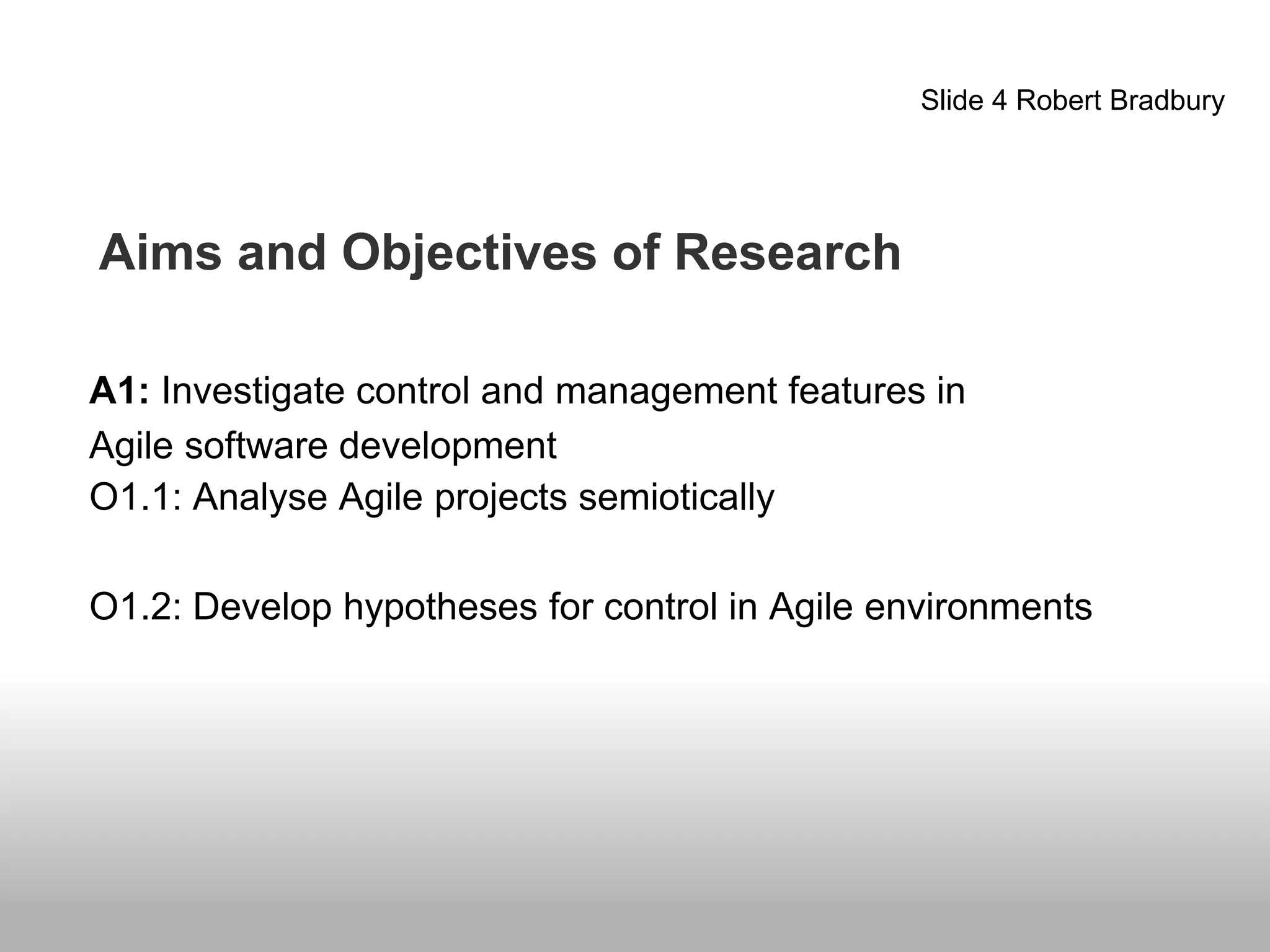
Slide 4 Robert Bradbury
Aims and Objectives of Research
A1: Investigate control and management features in
Agile software development
O1.1: Analyse Agile projects semiotically
O1.2: Develop hypotheses for control in Agile environments
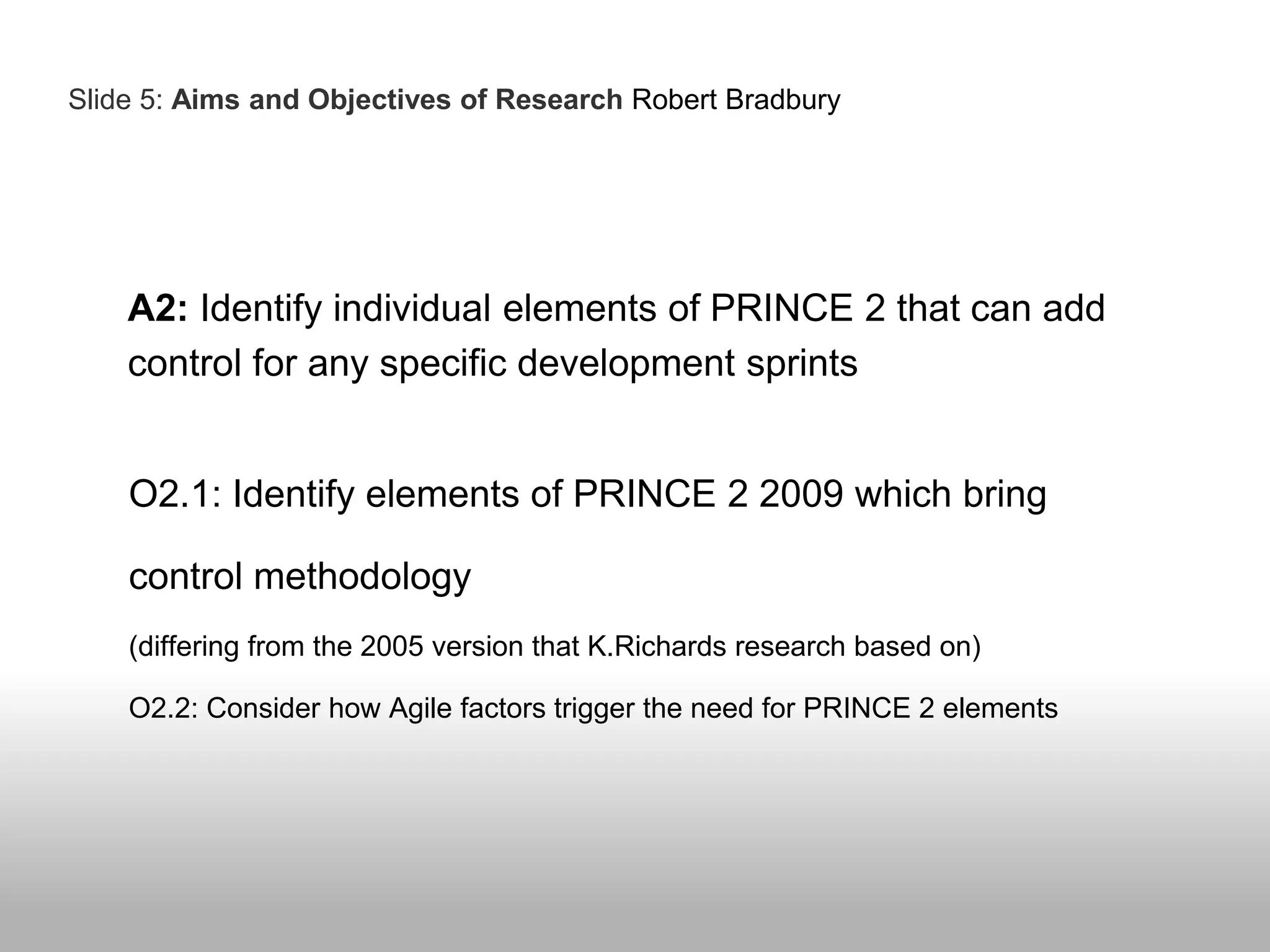
A2: Identify individual elements of PRINCE 2 that can add
control for any specific development sprints
O2.1: Identify elements of PRINCE 2 2009 which bring
control methodology
(differing from the 2005 version that K.Richards research based on)
O2.2: Consider how Agile factors trigger the need for PRINCE 2 elements
Slide 5: Aims and Objectives of Research Robert Bradbury
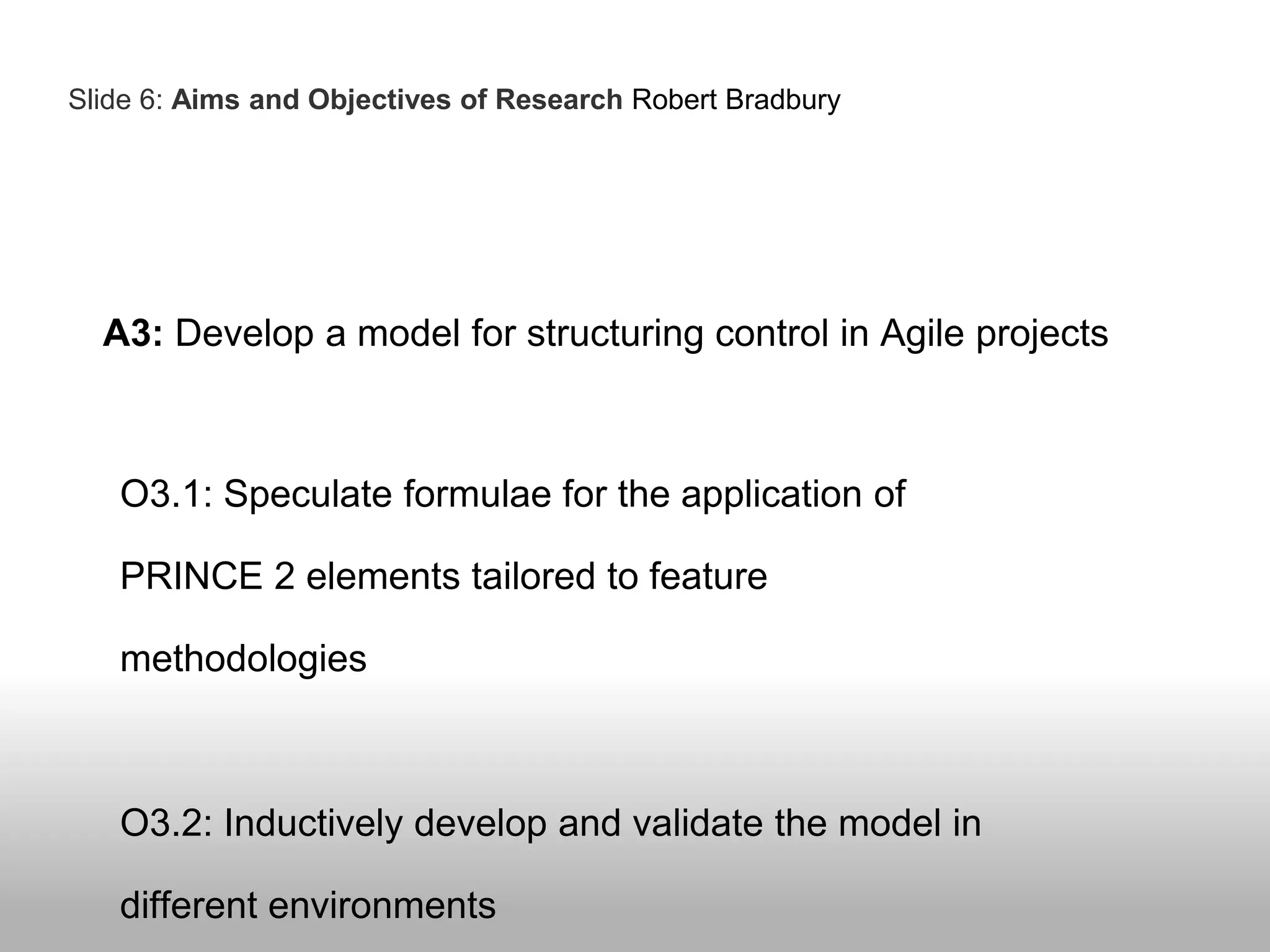
A3: Develop a model for structuring control in Agile projects
O3.1: Speculate formulae for the application of
PRINCE 2 elements tailored to feature
methodologies
O3.2: Inductively develop and validate the model in
different environments
Slide 6: Aims and Objectives of Research Robert Bradbury
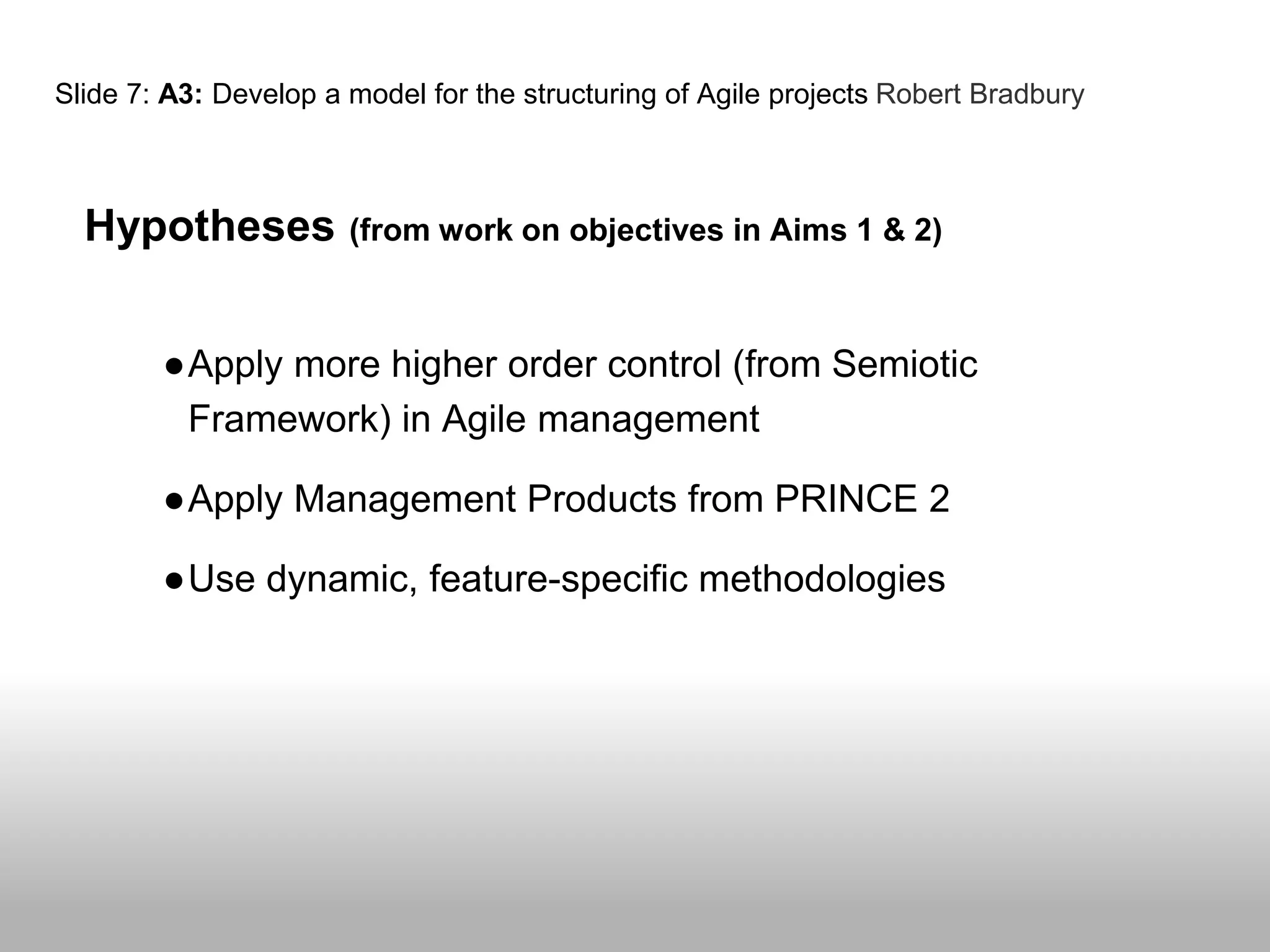
Slide 7: A3: Develop a model for the structuring of Agile projects Robert Bradbury
Hypotheses (from work on objectives in Aims 1 & 2)
●Apply more higher order control (from Semiotic
Framework) in Agile management
●Apply Management Products from PRINCE 2
●Use dynamic, feature-specific methodologies
Model Screenshots
Slide 8: A3: Develop a model for the structuring of Agile projects Robert Bradbury
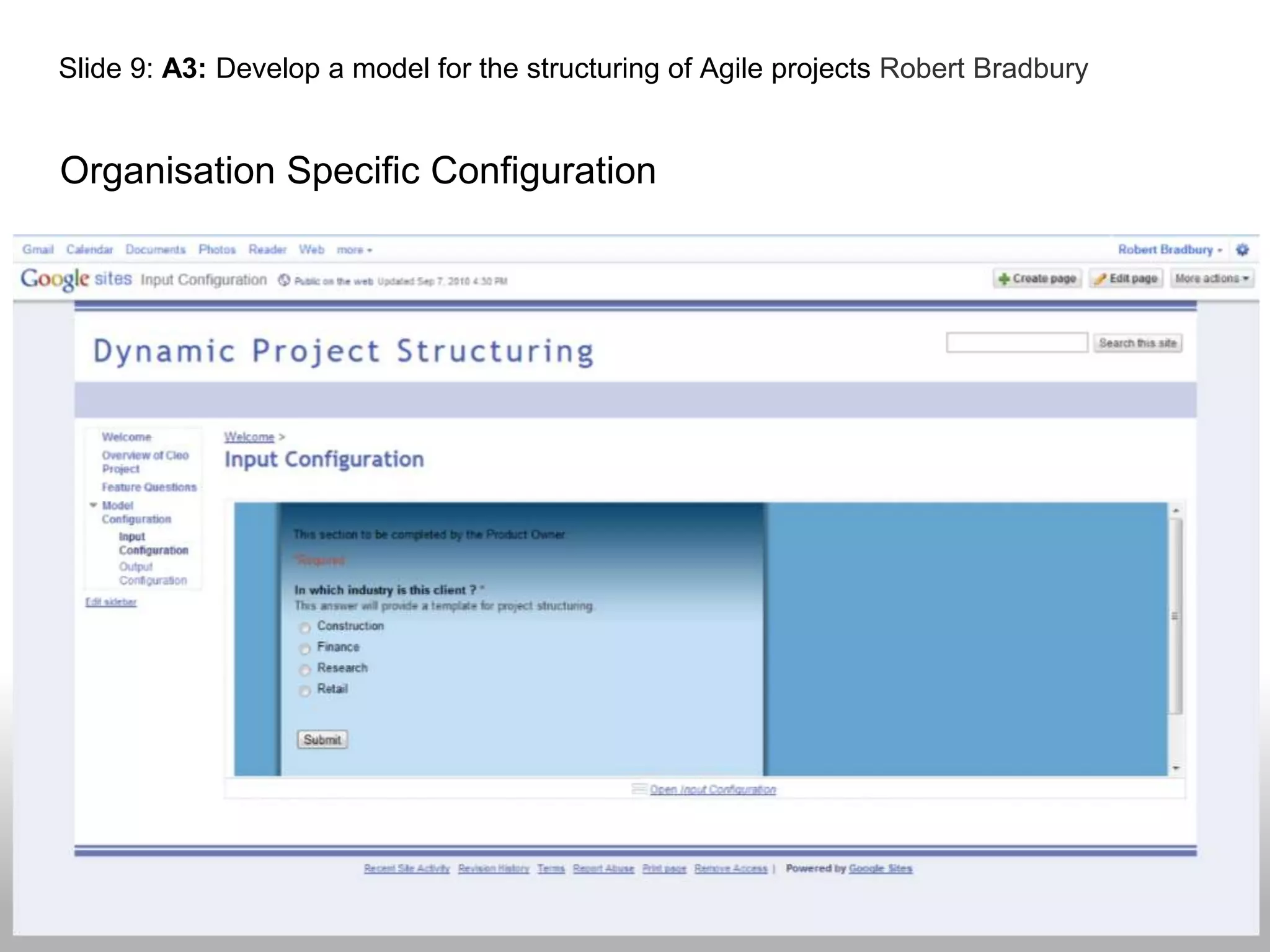
Slide 9: A3: Develop a model for the structuring of Agile projects Robert Bradbury
Organisation Specific Configuration
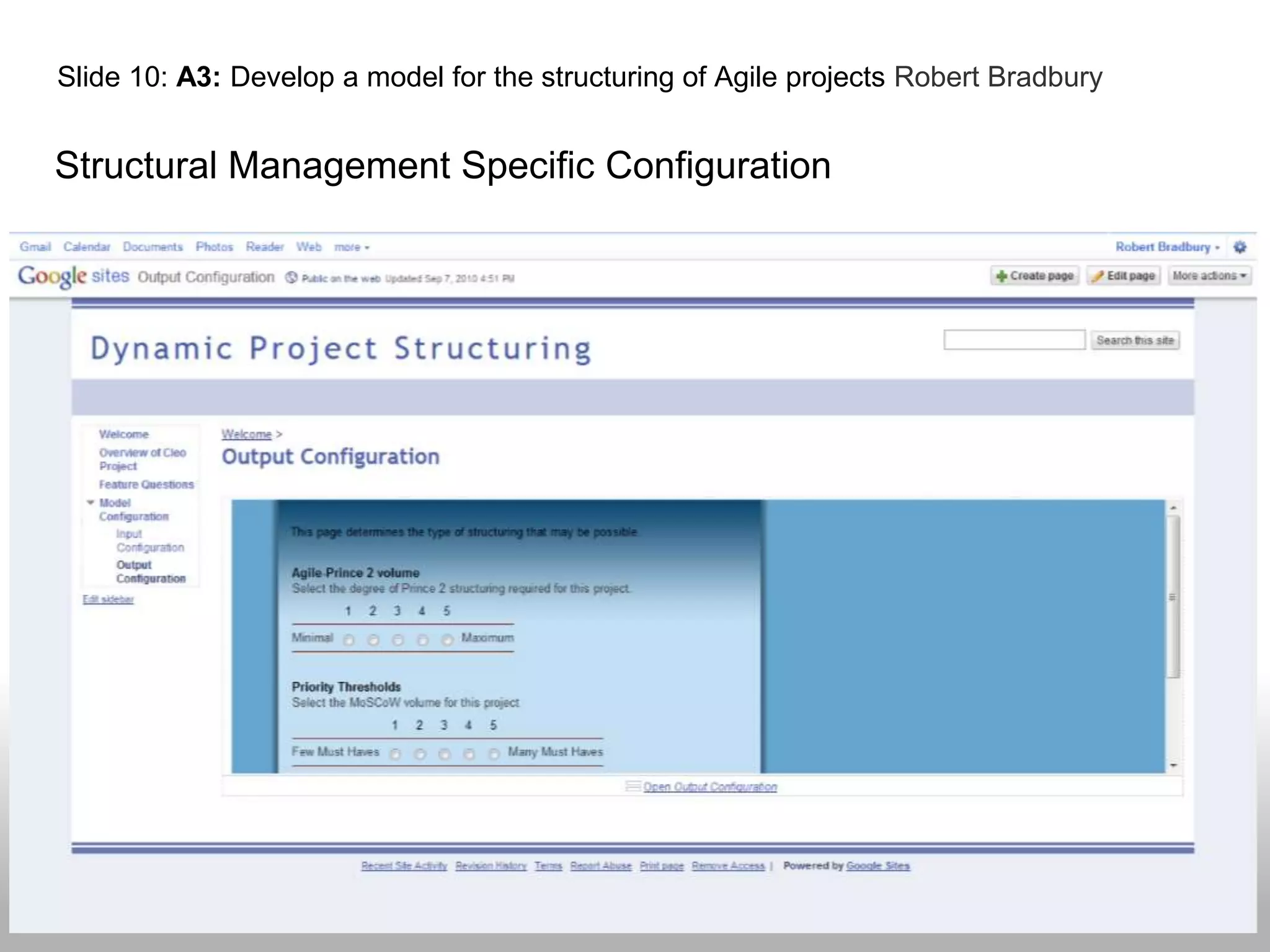
Slide 10: A3: Develop a model for the structuring of Agile projects Robert Bradbury
Structural Management Specific Configuration
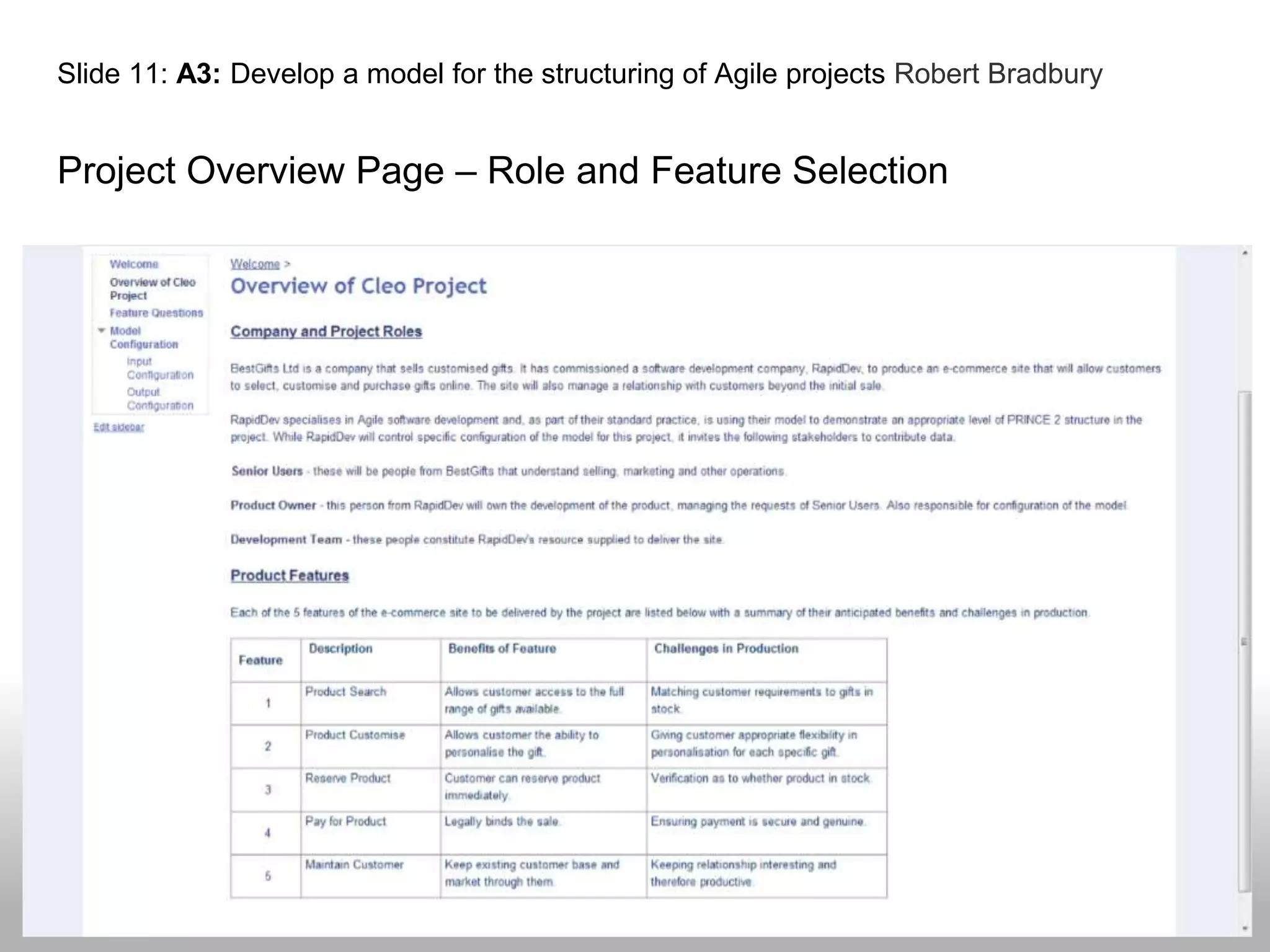
Slide 11: A3: Develop a model for the structuring of Agile projects Robert Bradbury
Project Overview Page – Role and Feature Selection
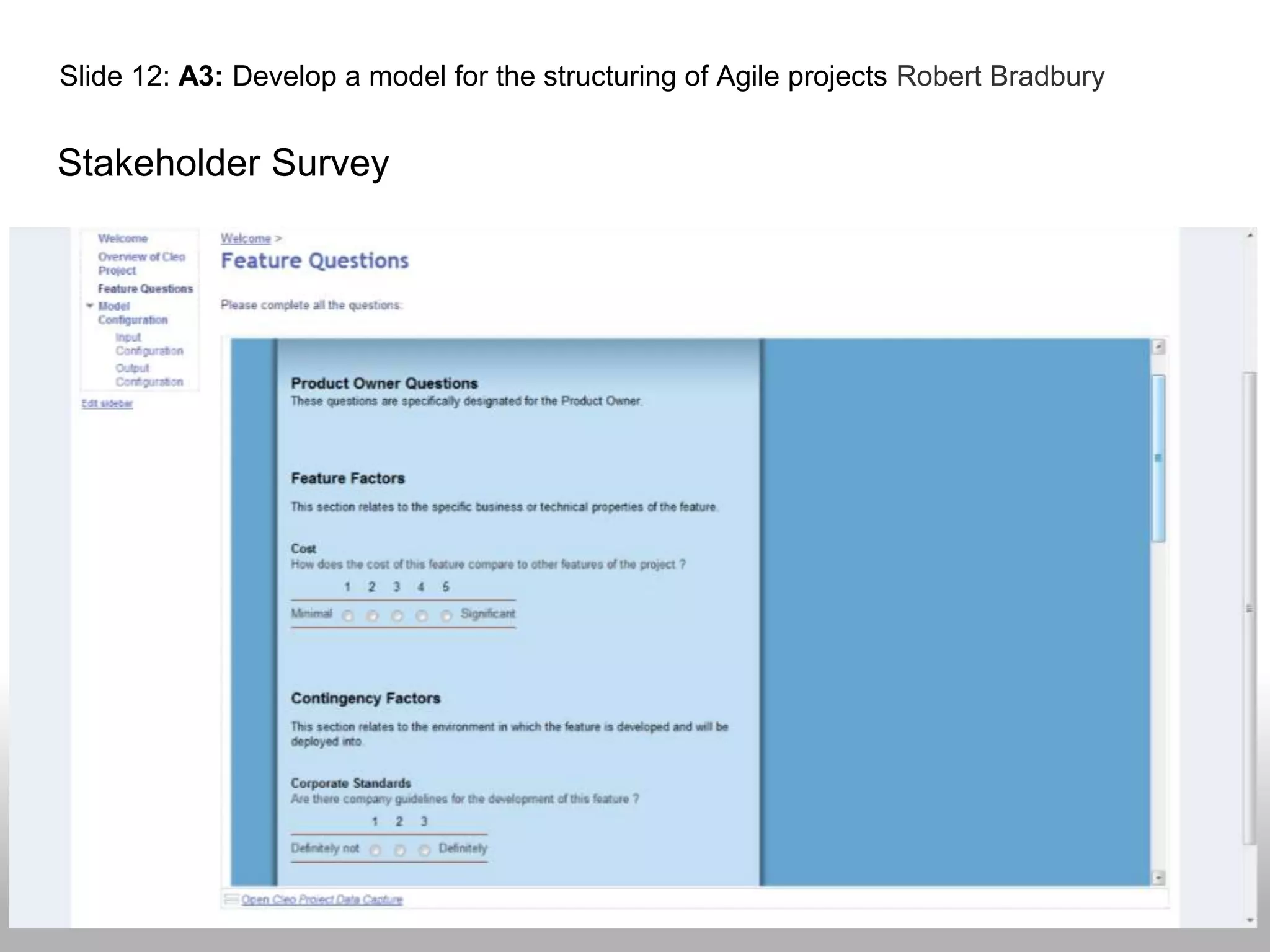
Slide 12: A3: Develop a model for the structuring of Agile projects Robert Bradbury
Stakeholder Survey
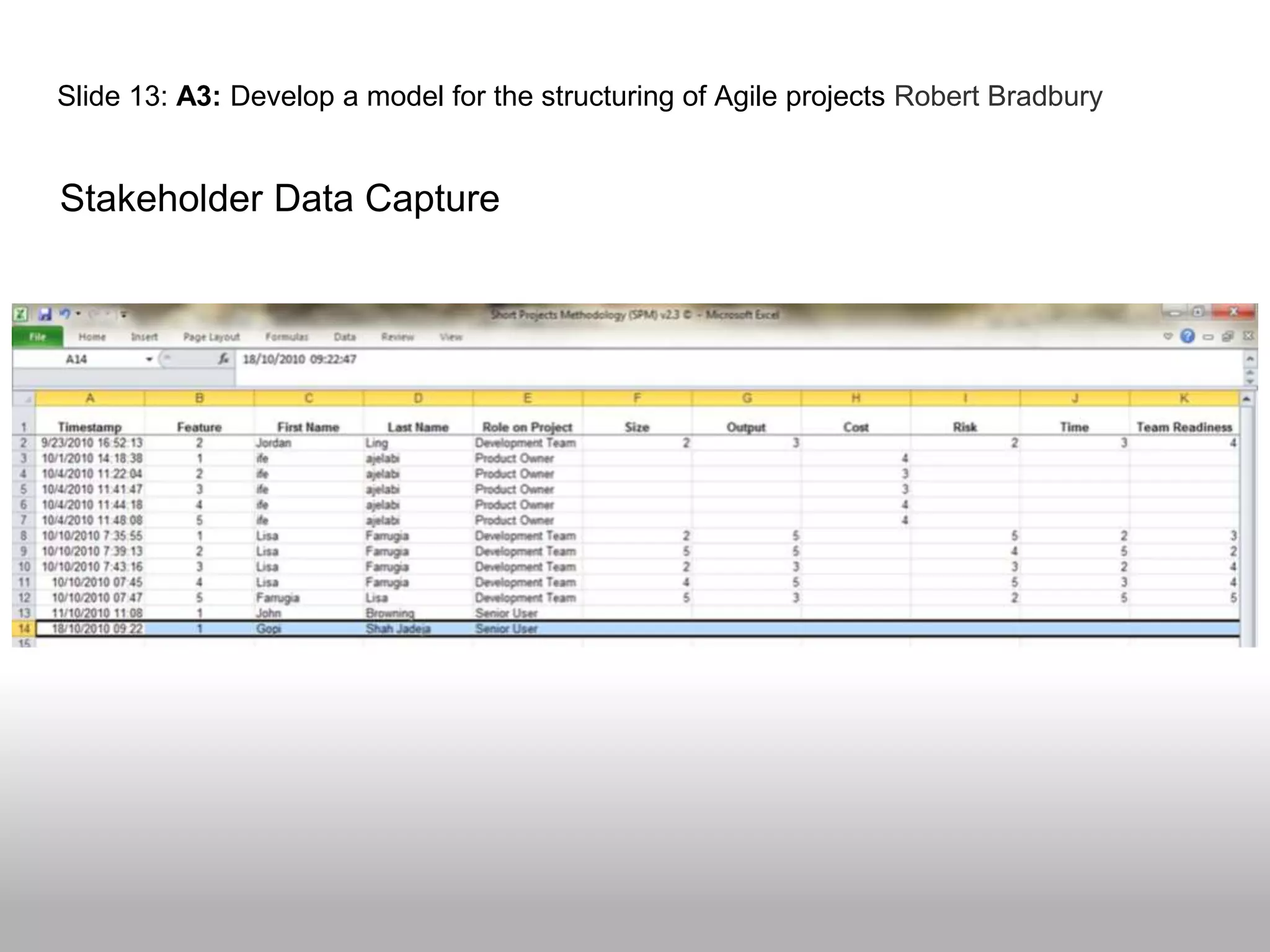
Slide 13: A3: Develop a model for the structuring of Agile projects Robert Bradbury
Stakeholder Data Capture
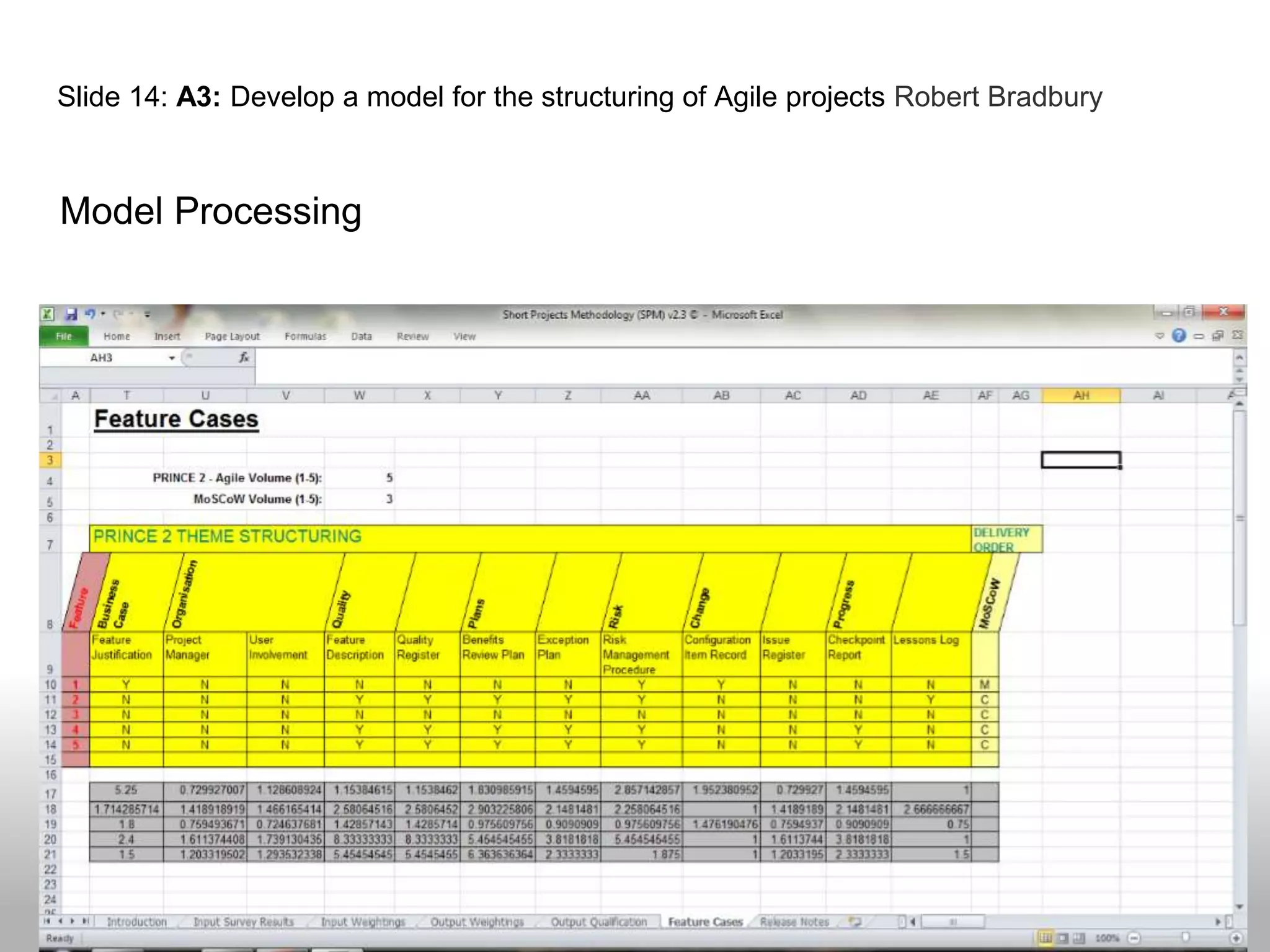
Slide 14: A3: Develop a model for the structuring of Agile projects Robert Bradbury
Model Processing
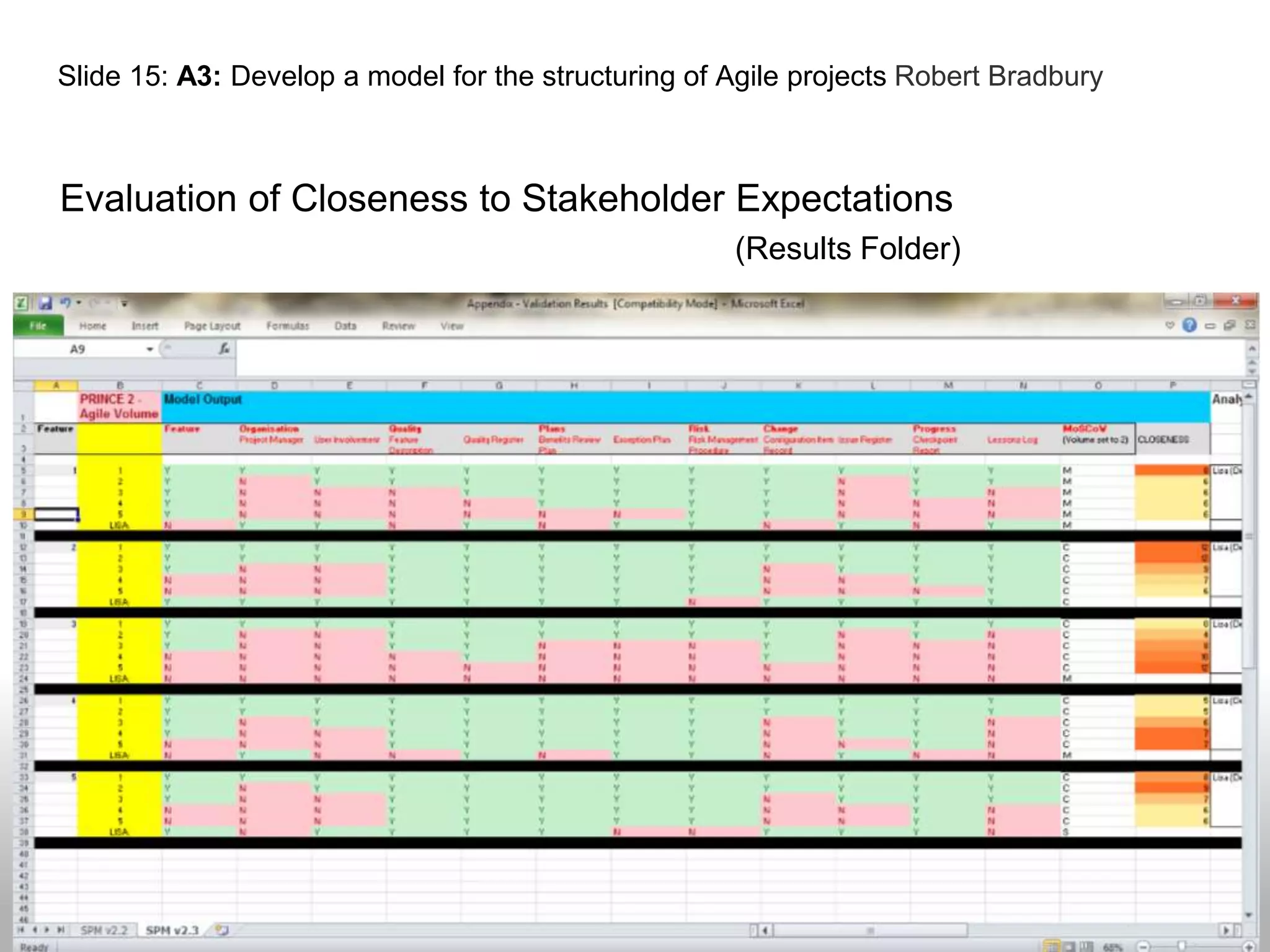
Slide 15: A3: Develop a model for the structuring of Agile projects Robert Bradbury
Evaluation of Closeness to Stakeholder Expectations
(Results Folder)
Evaluation
Slide 16 Robert Bradbury
A1: Investigate control in software project management
A2: Identify elements of PRINCE 2 that can add control
A3: Develop a model for structuring control in Agile projects
Thank You
&
Questions
Robert Bradbury
Robert.Bradbury@Zephyros-Consulting.co
Slide 17 Robert Bradbury

Research Presentation (MSc. Business Informatics) Short Version v

  • 1.
    MSc. Business Informatics ResearchPresentation Robert Bradbury The Development of Software Project Management Methods in support of Agile adoption in Organisations Informatics Research Centre, Henley Business School 23 March 2011
  • 2.
    Assumptions ●PRINCE 2 ●Agile adoptionis increasing – nature of use is changing from standalone projects to corporate programmes ●Organisations still need to capture proven project factors ? ●Model developed to ensure a repeatable process
  • 3.
    Robert Bradbury Slide 1Robert Bradbury
  • 4.
    Challenges for Stakeholders Stage vs. Timedriven - Nerur, RadhaKanta Mahapatra, Mangalaraj, 2005 Slide 2 Robert Bradbury
  • 5.
    Key Findings fromResearch ●K. Richards, 2007 still using stage-driven development ●Need for a balance between extreme methodologies to effectively reflect projects “strong processes can help a firm improve quality and productivity …, potential trade-offs exist with respect to creativity and innovation”. - Cusumano et al., 2009 Slide 3 Robert Bradbury
  • 6.
    Slide 4 RobertBradbury Aims and Objectives of Research A1: Investigate control and management features in Agile software development O1.1: Analyse Agile projects semiotically O1.2: Develop hypotheses for control in Agile environments
  • 7.
    A2: Identify individualelements of PRINCE 2 that can add control for any specific development sprints O2.1: Identify elements of PRINCE 2 2009 which bring control methodology (differing from the 2005 version that K.Richards research based on) O2.2: Consider how Agile factors trigger the need for PRINCE 2 elements Slide 5: Aims and Objectives of Research Robert Bradbury
  • 8.
    A3: Develop amodel for structuring control in Agile projects O3.1: Speculate formulae for the application of PRINCE 2 elements tailored to feature methodologies O3.2: Inductively develop and validate the model in different environments Slide 6: Aims and Objectives of Research Robert Bradbury
  • 9.
    Slide 7: A3:Develop a model for the structuring of Agile projects Robert Bradbury Hypotheses (from work on objectives in Aims 1 & 2) ●Apply more higher order control (from Semiotic Framework) in Agile management ●Apply Management Products from PRINCE 2 ●Use dynamic, feature-specific methodologies
  • 10.
    Model Screenshots Slide 8:A3: Develop a model for the structuring of Agile projects Robert Bradbury
  • 11.
    Slide 9: A3:Develop a model for the structuring of Agile projects Robert Bradbury Organisation Specific Configuration
  • 12.
    Slide 10: A3:Develop a model for the structuring of Agile projects Robert Bradbury Structural Management Specific Configuration
  • 13.
    Slide 11: A3:Develop a model for the structuring of Agile projects Robert Bradbury Project Overview Page – Role and Feature Selection
  • 14.
    Slide 12: A3:Develop a model for the structuring of Agile projects Robert Bradbury Stakeholder Survey
  • 15.
    Slide 13: A3:Develop a model for the structuring of Agile projects Robert Bradbury Stakeholder Data Capture
  • 16.
    Slide 14: A3:Develop a model for the structuring of Agile projects Robert Bradbury Model Processing
  • 17.
    Slide 15: A3:Develop a model for the structuring of Agile projects Robert Bradbury Evaluation of Closeness to Stakeholder Expectations (Results Folder)
  • 18.
    Evaluation Slide 16 RobertBradbury A1: Investigate control in software project management A2: Identify elements of PRINCE 2 that can add control A3: Develop a model for structuring control in Agile projects
  • 19.

Editor's Notes

  • #2 Time: 3 min Introduce myself: Professional in the project management of system implementations Strategic goal: Enabling organisational change Currently working on a change programme with Tesco.com adopting Agile Discuss title / subject of research => Short session so please defer questions to the end.
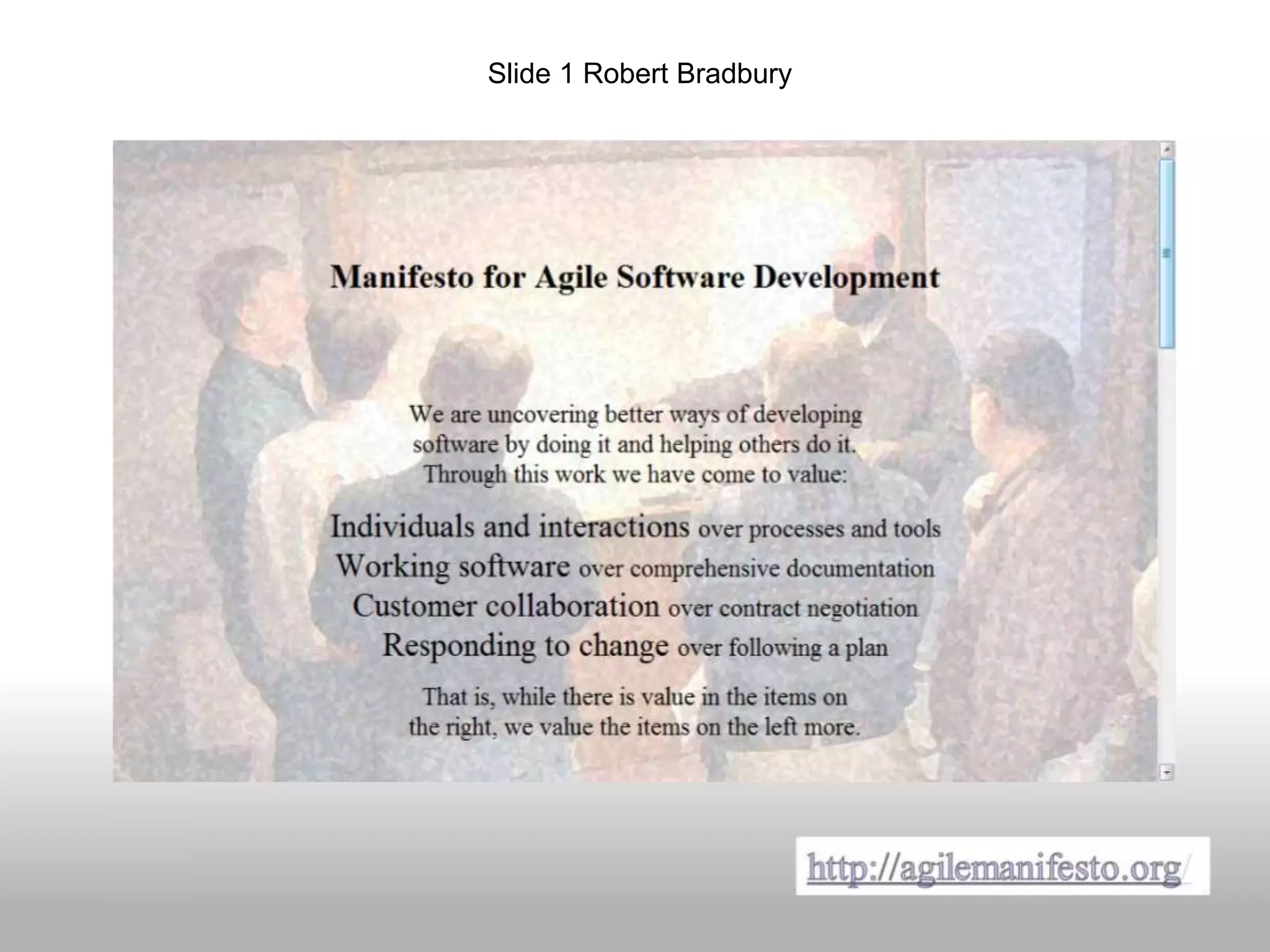
  • #4 Context: Summary slide from the Agile Manifesto – a developer’s view of software project management. Started with small single projects and low level developers. Had to scale up, but the methodology has not evolved accordingly. This research is addressing this deficiency as Agile reaches a state of entropy. Manifesto suggests left over right. The manifesto acknowledges the need for the right. Agile suggests that ‘just enough’ is required both in the products and project delivery. Learn and refactor. establishing: a development ‘pulse’ – regular delivery to the market in collaboration with business exploration over prediction Adoption of Agile = catalyst for fundamental changes within the organisation's culture, processes and productivity
  • #5 Challenges for inward-looking stakeholders during this organisational change: Stakeholders include end-users, business sponsors, programme managers, developers and technical support Fundamental change is stage-driven (traditional PM) development to time-boxed (Agile) development. Consequently: Stakeholders fear loss of control. Tension damages stakeholder relationships. Symptoms are discussed in a number of papers, including Nerur.
  • #6 K. Richards, 2007 dovetails methodologies. Still stage-driven development, using Agile practices at the Managing Product level of PRINCE 2 Many papers discuss need for a ‘balance’: Cusumano et al., 2009 describes: “strong processes can help a firm improve quality and productivity …, potential trade-offs exist with respect to creativity and innovation”. Rehman A. and Rashid H., 2007 suggest: “To make the most of established methodologies and frameworks, a combine/mix approach is required to get the best results”
  • #7 Time: 1 min A1: Investigate control in software project management O1.1: Use principles of semiosis in analysis O1.2: Develop hypotheses for management of control in Agile environments
  • #8 A2: Identify elements of PRINCE 2 that could add control structures O2.1: Review PRINCE 2 2009 (differing from the 2005 version that K.Richards research based on)
  • #9  A3: Develop a model for the structuring of Agile projects O3.1:  The model will implement control, aiding efficiency without stifling creativity Use Agile principles to develop model. Learn and evolve / enhance model.
  • #10 Higher order units (from Semiotic Framework) including: semantics including “stakeholder meanings” pragmatics such as “benefits” and “market adoption” using semantic measurements through stakeholder feedback. PRINCE 2 2009 has developed from PRINCE 2 2005 in capture of pragmatic project factors, but no evidence of this in Agile Management Products from PRINCE 2 2009 are the most readily applicable structural controls that can be applied Bolt-together methods to develop feature specific methodologies
  • #18 Show folder of results. Audio of validation session ?
  • #19 Review against objectives of each aim: A1: Investigate control in software project management O1.1: Use principles of semiosis in analysis O1.2: Develop hypotheses for management of control in Agile environments A2: Identify elements of PRINCE 2 that could add control structures O2.1: Review PRINCE 2 2009 (differing from the 2005 version that K.Richards research based on) A3: Develop a model for the structuring of Agile projects Validate further and in other management environments Develop database and qualification formulas