RESEARCH
                   METHODOLOGY
                 (Business Research Methods)

                                        Week 3


29 August 2005       MBA III (Research Methodology)   Course Instructor: Dr. Aurangzeb Z. Khan   1
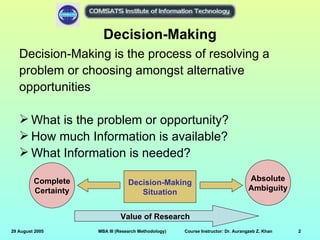
Decision-Making
   Decision-Making is the process of resolving a
   problem or choosing amongst alternative
   opportunities

    What is the problem or opportunity?
    How much Information is available?
    What Information is needed?

         Complete                                                                  Absolute
                                  Decision-Making
         Certainty                                                                 Ambiguity
                                     Situation


                              Value of Research
29 August 2005       MBA III (Research Methodology)   Course Instructor: Dr. Aurangzeb Z. Khan   2
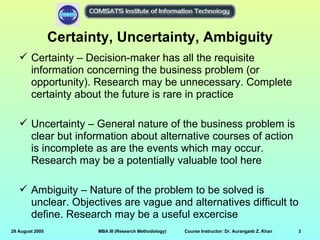
Certainty, Uncertainty, Ambiguity
    Certainty – Decision-maker has all the requisite
     information concerning the business problem (or
     opportunity). Research may be unnecessary. Complete
     certainty about the future is rare in practice

    Uncertainty – General nature of the business problem is
     clear but information about alternative courses of action
     is incomplete as are the events which may occur.
     Research may be a potentially valuable tool here

    Ambiguity – Nature of the problem to be solved is
     unclear. Objectives are vague and alternatives difficult to
     define. Research may be a useful excercise
29 August 2005          MBA III (Research Methodology)   Course Instructor: Dr. Aurangzeb Z. Khan   3
Types of Research
   Exploratory Research:

   • undertaken with the aim of clarifying ambiguous problems
   • general problems usually known but not sufficiently
     understood
   • the purpose is to get more information, not to uncover
     specific courses of action (subsequent research)

   Determining a specific course of action to follow is not a
   purpose of exploratory research!

   Example: Child-Care support programme for employees
29 August 2005      MBA III (Research Methodology)   Course Instructor: Dr. Aurangzeb Z. Khan   4
Types of Research
   Descriptive Research:

   • undertaken with the aim of determining the characteristics
     of a population or phenomenon
   • Previous knowledge of problem exists
   • High degree of precision or accuracy required

   Examples:
   Who are the main consumers of organic foods?
   How many students read the prescribed course literature?
   Where do most holiday-makers travelling overseas go?
   When do petrol stations tend to raise their prices?
29 August 2005     MBA III (Research Methodology)   Course Instructor: Dr. Aurangzeb Z. Khan   5
Types of Research
   Causal Research:

   • undertaken with the aim of identifying cause and effect
     relationships amongst variables
   • are normally preceeded by exploratory and descriptive
     research studies
   • Often difficult to determine because of the influence of
     other variables (concommitant Variation and the presence
     of other hidden variables)

   Example: Higher ice-cream consumption causes more
   people to drown (indicative of a causal relationship (?))
29 August 2005      MBA III (Research Methodology)   Course Instructor: Dr. Aurangzeb Z. Khan   6
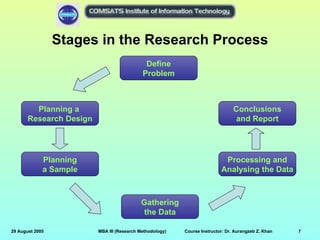
Stages in the Research Process
                                             Define
                                            Problem


         Planning a                                                             Conclusions
       Research Design                                                           and Report


             Planning                                                      Processing and
             a Sample                                                     Analysing the Data


                                           Gathering
                                           the Data

29 August 2005           MBA III (Research Methodology)   Course Instructor: Dr. Aurangzeb Z. Khan   7
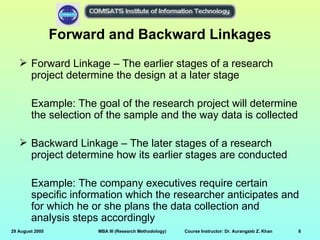
Forward and Backward Linkages
    Forward Linkage – The earlier stages of a research
     project determine the design at a later stage

        Example: The goal of the research project will determine
        the selection of the sample and the way data is collected

    Backward Linkage – The later stages of a research
     project determine how its earlier stages are conducted

        Example: The company executives require certain
        specific information which the researcher anticipates and
        for which he or she plans the data collection and
        analysis steps accordingly
29 August 2005         MBA III (Research Methodology)   Course Instructor: Dr. Aurangzeb Z. Khan   8
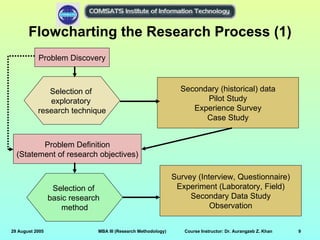
Flowcharting the Research Process (1)
           Problem Discovery


              Selection of                                       Secondary (historical) data
              exploratory                                              Pilot Study
           research technique                                       Experience Survey
                                                                       Case Study


         Problem Definition
  (Statement of research objectives)

                                                               Survey (Interview, Questionnaire)
                  Selection of                                  Experiment (Laboratory, Field)
                 basic research                                     Secondary Data Study
                     method                                               Observation


29 August 2005                MBA III (Research Methodology)      Course Instructor: Dr. Aurangzeb Z. Khan   9
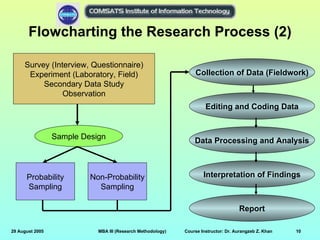
Flowcharting the Research Process (2)

     Survey (Interview, Questionnaire)
      Experiment (Laboratory, Field)                             Collection of Data (Fieldwork)
          Secondary Data Study
                Observation
                                                                      Editing and Coding Data


                 Sample Design                                   Data Processing and Analysis


      Probability         Non-Probability                            Interpretation of Findings
      Sampling              Sampling

                                                                                     Report

29 August 2005              MBA III (Research Methodology)   Course Instructor: Dr. Aurangzeb Z. Khan   10
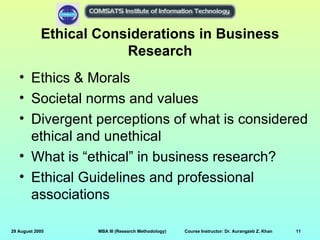
Ethical Considerations in Business
                        Research
   • Ethics & Morals
   • Societal norms and values
   • Divergent perceptions of what is considered
     ethical and unethical
   • What is “ethical” in business research?
   • Ethical Guidelines and professional
     associations

29 August 2005      MBA III (Research Methodology)   Course Instructor: Dr. Aurangzeb Z. Khan   11
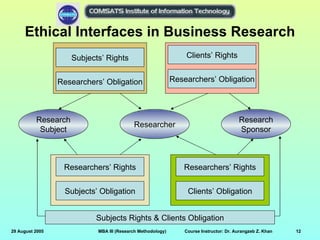
Ethical Interfaces in Business Research
                     Subjects’ Rights                            Clients’ Rights


                 Researchers’ Obligation                     Researchers’ Obligation


          Research                                                                       Research
                                           Researcher
           Subject                                                                       Sponsor


                  Researchers’ Rights                           Researchers’ Rights


                  Subjects’ Obligation                            Clients’ Obligation


                           Subjects Rights & Clients Obligation
29 August 2005              MBA III (Research Methodology)       Course Instructor: Dr. Aurangzeb Z. Khan   12
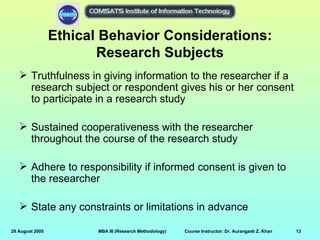
Ethical Behavior Considerations:
                        Research Subjects
    Truthfulness in giving information to the researcher if a
     research subject or respondent gives his or her consent
     to participate in a research study

    Sustained cooperativeness with the researcher
     throughout the course of the research study

    Adhere to responsibility if informed consent is given to
     the researcher

    State any constraints or limitations in advance

29 August 2005          MBA III (Research Methodology)   Course Instructor: Dr. Aurangzeb Z. Khan   13
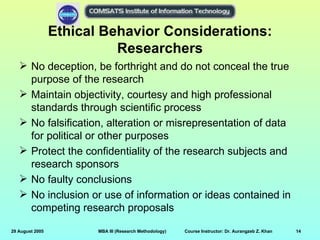
Ethical Behavior Considerations:
                           Researchers
    No deception, be forthright and do not conceal the true
     purpose of the research
    Maintain objectivity, courtesy and high professional
     standards through scientific process
    No falsification, alteration or misrepresentation of data
     for political or other purposes
    Protect the confidentiality of the research subjects and
     research sponsors
    No faulty conclusions
    No inclusion or use of information or ideas contained in
     competing research proposals

29 August 2005          MBA III (Research Methodology)   Course Instructor: Dr. Aurangzeb Z. Khan   14
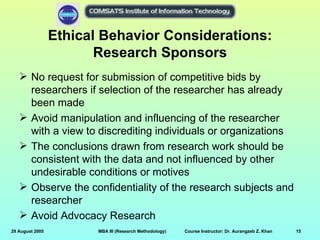
Ethical Behavior Considerations:
                        Research Sponsors
    No request for submission of competitive bids by
     researchers if selection of the researcher has already
     been made
    Avoid manipulation and influencing of the researcher
     with a view to discrediting individuals or organizations
    The conclusions drawn from research work should be
     consistent with the data and not influenced by other
     undesirable conditions or motives
    Observe the confidentiality of the research subjects and
     researcher
    Avoid Advocacy Research
29 August 2005          MBA III (Research Methodology)   Course Instructor: Dr. Aurangzeb Z. Khan   15
The Menace of Plagiarism

          Please read the CIIT Academic Honesty
         Policy compiled by Mr. Laeeq-ur-Rehman
         Khan which is distributed in this class as a
                      separate sheet

      ZERO TOLERANCE (and ZERO MARKS)
       for cheating and plagiarism at COMSATS
           Institute of Information Technology!

29 August 2005      MBA III (Research Methodology)   Course Instructor: Dr. Aurangzeb Z. Khan   16

Research methodology week03

  • 1.
    RESEARCH METHODOLOGY (Business Research Methods) Week 3 29 August 2005 MBA III (Research Methodology) Course Instructor: Dr. Aurangzeb Z. Khan 1
  • 2.
    Decision-Making Decision-Making is the process of resolving a problem or choosing amongst alternative opportunities  What is the problem or opportunity?  How much Information is available?  What Information is needed? Complete Absolute Decision-Making Certainty Ambiguity Situation Value of Research 29 August 2005 MBA III (Research Methodology) Course Instructor: Dr. Aurangzeb Z. Khan 2
  • 3.
    Certainty, Uncertainty, Ambiguity  Certainty – Decision-maker has all the requisite information concerning the business problem (or opportunity). Research may be unnecessary. Complete certainty about the future is rare in practice  Uncertainty – General nature of the business problem is clear but information about alternative courses of action is incomplete as are the events which may occur. Research may be a potentially valuable tool here  Ambiguity – Nature of the problem to be solved is unclear. Objectives are vague and alternatives difficult to define. Research may be a useful excercise 29 August 2005 MBA III (Research Methodology) Course Instructor: Dr. Aurangzeb Z. Khan 3
  • 4.
    Types of Research Exploratory Research: • undertaken with the aim of clarifying ambiguous problems • general problems usually known but not sufficiently understood • the purpose is to get more information, not to uncover specific courses of action (subsequent research) Determining a specific course of action to follow is not a purpose of exploratory research! Example: Child-Care support programme for employees 29 August 2005 MBA III (Research Methodology) Course Instructor: Dr. Aurangzeb Z. Khan 4
  • 5.
    Types of Research Descriptive Research: • undertaken with the aim of determining the characteristics of a population or phenomenon • Previous knowledge of problem exists • High degree of precision or accuracy required Examples: Who are the main consumers of organic foods? How many students read the prescribed course literature? Where do most holiday-makers travelling overseas go? When do petrol stations tend to raise their prices? 29 August 2005 MBA III (Research Methodology) Course Instructor: Dr. Aurangzeb Z. Khan 5
  • 6.
    Types of Research Causal Research: • undertaken with the aim of identifying cause and effect relationships amongst variables • are normally preceeded by exploratory and descriptive research studies • Often difficult to determine because of the influence of other variables (concommitant Variation and the presence of other hidden variables) Example: Higher ice-cream consumption causes more people to drown (indicative of a causal relationship (?)) 29 August 2005 MBA III (Research Methodology) Course Instructor: Dr. Aurangzeb Z. Khan 6
  • 7.
    Stages in theResearch Process Define Problem Planning a Conclusions Research Design and Report Planning Processing and a Sample Analysing the Data Gathering the Data 29 August 2005 MBA III (Research Methodology) Course Instructor: Dr. Aurangzeb Z. Khan 7
  • 8.
    Forward and BackwardLinkages  Forward Linkage – The earlier stages of a research project determine the design at a later stage Example: The goal of the research project will determine the selection of the sample and the way data is collected  Backward Linkage – The later stages of a research project determine how its earlier stages are conducted Example: The company executives require certain specific information which the researcher anticipates and for which he or she plans the data collection and analysis steps accordingly 29 August 2005 MBA III (Research Methodology) Course Instructor: Dr. Aurangzeb Z. Khan 8
  • 9.
    Flowcharting the ResearchProcess (1) Problem Discovery Selection of Secondary (historical) data exploratory Pilot Study research technique Experience Survey Case Study Problem Definition (Statement of research objectives) Survey (Interview, Questionnaire) Selection of Experiment (Laboratory, Field) basic research Secondary Data Study method Observation 29 August 2005 MBA III (Research Methodology) Course Instructor: Dr. Aurangzeb Z. Khan 9
  • 10.
    Flowcharting the ResearchProcess (2) Survey (Interview, Questionnaire) Experiment (Laboratory, Field) Collection of Data (Fieldwork) Secondary Data Study Observation Editing and Coding Data Sample Design Data Processing and Analysis Probability Non-Probability Interpretation of Findings Sampling Sampling Report 29 August 2005 MBA III (Research Methodology) Course Instructor: Dr. Aurangzeb Z. Khan 10
  • 11.
    Ethical Considerations inBusiness Research • Ethics & Morals • Societal norms and values • Divergent perceptions of what is considered ethical and unethical • What is “ethical” in business research? • Ethical Guidelines and professional associations 29 August 2005 MBA III (Research Methodology) Course Instructor: Dr. Aurangzeb Z. Khan 11
  • 12.
    Ethical Interfaces inBusiness Research Subjects’ Rights Clients’ Rights Researchers’ Obligation Researchers’ Obligation Research Research Researcher Subject Sponsor Researchers’ Rights Researchers’ Rights Subjects’ Obligation Clients’ Obligation Subjects Rights & Clients Obligation 29 August 2005 MBA III (Research Methodology) Course Instructor: Dr. Aurangzeb Z. Khan 12
  • 13.
    Ethical Behavior Considerations: Research Subjects  Truthfulness in giving information to the researcher if a research subject or respondent gives his or her consent to participate in a research study  Sustained cooperativeness with the researcher throughout the course of the research study  Adhere to responsibility if informed consent is given to the researcher  State any constraints or limitations in advance 29 August 2005 MBA III (Research Methodology) Course Instructor: Dr. Aurangzeb Z. Khan 13
  • 14.
    Ethical Behavior Considerations: Researchers  No deception, be forthright and do not conceal the true purpose of the research  Maintain objectivity, courtesy and high professional standards through scientific process  No falsification, alteration or misrepresentation of data for political or other purposes  Protect the confidentiality of the research subjects and research sponsors  No faulty conclusions  No inclusion or use of information or ideas contained in competing research proposals 29 August 2005 MBA III (Research Methodology) Course Instructor: Dr. Aurangzeb Z. Khan 14
  • 15.
    Ethical Behavior Considerations: Research Sponsors  No request for submission of competitive bids by researchers if selection of the researcher has already been made  Avoid manipulation and influencing of the researcher with a view to discrediting individuals or organizations  The conclusions drawn from research work should be consistent with the data and not influenced by other undesirable conditions or motives  Observe the confidentiality of the research subjects and researcher  Avoid Advocacy Research 29 August 2005 MBA III (Research Methodology) Course Instructor: Dr. Aurangzeb Z. Khan 15
  • 16.
    The Menace ofPlagiarism Please read the CIIT Academic Honesty Policy compiled by Mr. Laeeq-ur-Rehman Khan which is distributed in this class as a separate sheet ZERO TOLERANCE (and ZERO MARKS) for cheating and plagiarism at COMSATS Institute of Information Technology! 29 August 2005 MBA III (Research Methodology) Course Instructor: Dr. Aurangzeb Z. Khan 16