TECHNICAL REPORTS
Technical report is a written account of a scientific or technical project that has been accomplished. It is
submitted to the authorities after the completion of the project, laying out details about the methods
undertaken, equipments and material used and the cost involved in the project. A report also mentions
how successful the project has been, its advantages and disadvantages. It lays out certain
recommendations for further improvement in the projects of similar kind. In every organization, reports
have to be prepared and submitted as written records of all substantial happenings.
Importance of Reports
● Serve as reference records for future.
● Help improvisation and innovation.
● Facilitate analysis and evaluation
● Facilitate systematic organizational communication.
● Facilitate problem solving.
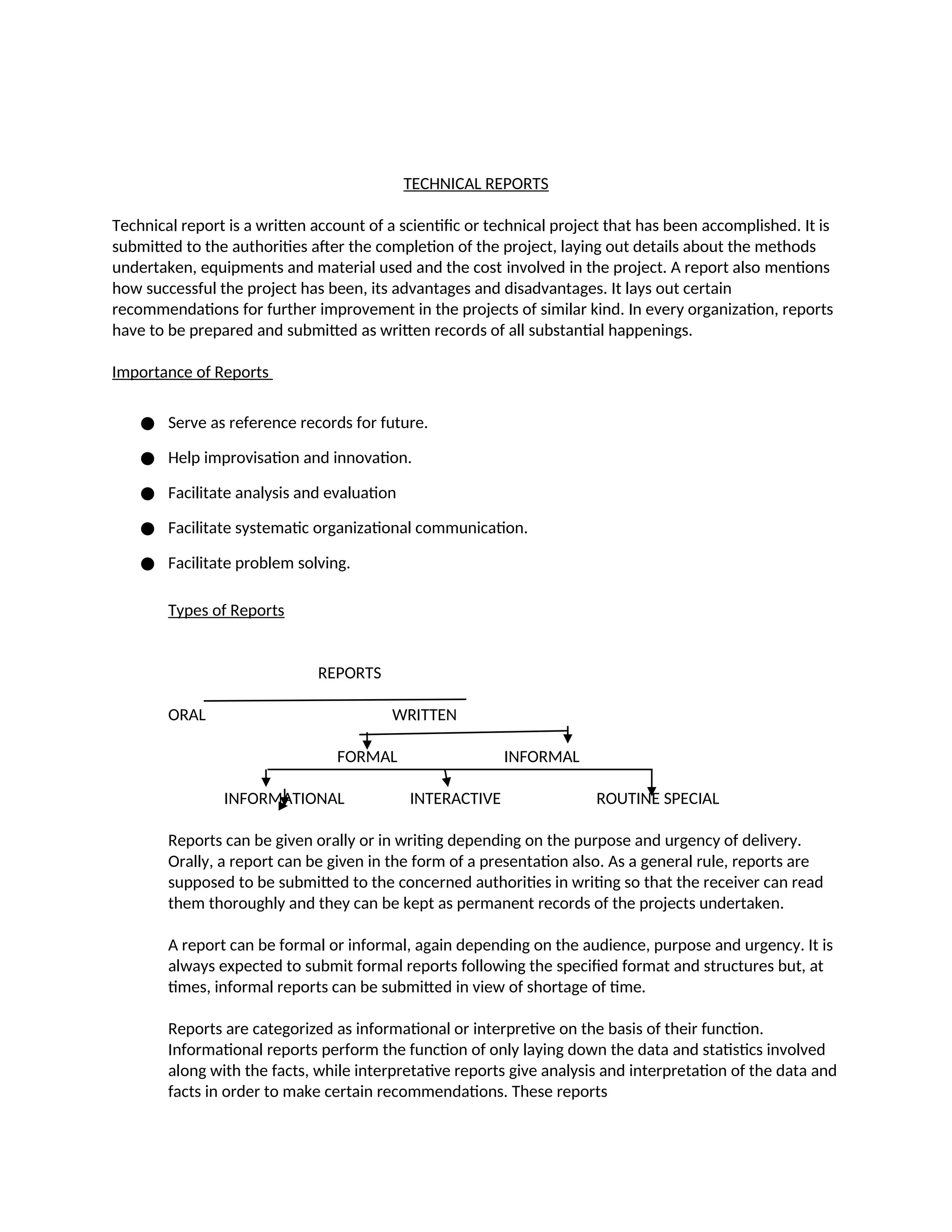
Types of Reports
REPORTS
ORAL WRITTEN
FORMAL INFORMAL
INFORMATIONAL INTERACTIVE ROUTINE SPECIAL
Reports can be given orally or in writing depending on the purpose and urgency of delivery.
Orally, a report can be given in the form of a presentation also. As a general rule, reports are
supposed to be submitted to the concerned authorities in writing so that the receiver can read
them thoroughly and they can be kept as permanent records of the projects undertaken.
A report can be formal or informal, again depending on the audience, purpose and urgency. It is
always expected to submit formal reports following the specified format and structures but, at
times, informal reports can be submitted in view of shortage of time.
Reports are categorized as informational or interpretive on the basis of their function.
Informational reports perform the function of only laying down the data and statistics involved
along with the facts, while interpretative reports give analysis and interpretation of the data and
facts in order to make certain recommendations. These reports
can hence, be termed as recommendatory or analytical reports as well.
Routine reports are the reports that are submitted at regular intervals as a routine. They might
be termed as daily reports, weekly reports, fortnightly reports, monthly reports, term reports or
annual reports.
Special reports are meant to be submitted for specific purpose in order to record the
proceedings taking place on special occasions or to record the procedure involved in a special
project.
Report Writing: Format
Report can be written in four different kinds of formats, depending on the audience and
purpose of report writing:
1) Printed Format
2) Letter Format
3) Memo Format
4) Manuscript format
Printed format of report writing can be seen right from school or college reports to
customer survey reports. Such reports involve filling of printed format that lays down
specific areas to be reported. The content of the report is based on the discretion of the
organization rather than the sender. The sender has to fill in whatever is required or
solicited by the institution or organization.
Letter format involves submission of reports in the form of a letter. The sender is supposed
to record the procedures and analyses along with recommendations and address it to the
specific receiver to whom it has to be submitted. It has to be signed off by the sender at the
end.
Memorandum format is the shortened form of manuscript format. At times, lengthy reports
are not required to be submitted in order to minimize documentation work. In such cases,
memo format of report writing is used where only the procedures, analysis and
recommendations are recorded for the reference of the receiver.
Manuscript format is the lengthiest version of report writing. In this format the procedure is
recorded in detail along with the analysis and recommendations. It is prepared under
various headings and sub headings. Report writing in manuscript format can range from a
paragraph to any length, depending on the contents.
Essentials of Report Writing
Accuracy: The first basic requisite of report writing is accuracy of content and language. All
the data and statistics put into the reports must be accurately mentioned in order to avoid
discrepancies.
Clarity: The purpose and content of reports should be clear to the reader. It must clearly
state the procedure involved, analysis and recommendations. There has to be clarity of
language, content and structure.
Completeness: A report must be complete in all terms. It must contain all headings and
subheadings. All details must be complete with complete numerical statistics and data.
Brevity: In the technical world, nobody has spare time to go through lengthy writings. The focus
is on information. It is hence recommended to keep the descriptions brief and up to the mark.
Maximum amount of information should be put into minimum number of words.
Reader-Oriented: A good report is always reader -oriented. It is meant to facilitate the reader
with whatever information is acquired by him. A good report must always answer all the
possible queries the reader might have regarding the project.
Objectivity of recommendation: Every report contains certain recommendation. Hence,
whatever equipment or material or organization is mentioned, it should not be mentioned with
any selfish motives in mind. It shouldn’t involve any profit making motives of the writer.
Recommendations should rather be made in the interest of the organization.
Simple and direct language: The focus in report -writing always remains on the information. It is
not required to put it into high flown language as that would create disturbance in the
understanding process. The language used should be simple and direct.
Specific format: It is essential to write the report in the specific format prescribed for writing
reports. The format might vary according to the purpose and audience but the headings and
sub-headings must be dealt with properly.
Graphical Representations: A technical report must always lay down information in the form of
graphs. charts ,tables and diagrams. Such graphical representations makes it easy for the
reader to understand the information at a glance.
Structure of reports
● Title
● Acknowledgement
● Letter of Transmittal
● Table of Contents
● Abstract/ Executive Summary
● Introduction
● Methodology
● Findings
● Conclusion
● Recommendations
● Appendix
● References and Bibliography
Title: A report must begin with an appropriate title that clearly states the topic on which the
project is based. It must also contain the name, designation and organization of the sender as
well as the receiver. The date of submission of report is mentioned at the bottom.
Acknowledgements: In order to prepare a report, one has to go through certain text from
various sources. In case a library or an institution has been visited, a note of thanks must be paid
to them. While undertaking the project, if certain experiments have been conducted, gratitude
must be paid to the
organization that facilitates the experimentation. Acknowledgement is, hence a thanks note
given to all organizations and people who have assisted in the project or in the preparation of
the report.
Letter of Transmittal: There is always a sender and a receiver in report writing. Letter of
transmittal is the letter written by the writer to the person who is authorized to collect the
report. It lays down the purpose, process and analysis of the project in short.
Table of Contents: A detailed report might contain a number of papers. Table of contents lays
down the list of headings and sub-headings that constitute the reports along with sequence
numbers and page numbers.
Abstract / Executive Summary: The summarized form of the actual report is called abstract. It is written
to give a quick overview of the report at a glance in case one doesn’t have time to go through it
completely.
Executive Summary is generally lengthier than the abstract. It lays down the methodology,
findings and recommendations with graphical representations as graph, charts tables etc.
Introduction : The introduction to the main report gives a brief account of the purpose of writing
the report and states how it has been
Conclusion
5
---------------
5
---------------
5
Recommendation
6
Appendix
7
Reference
8
Bibliography
TABLE OF CONTENTS
Acknowledgement III
Letter of Transmittal IV
Abstract V
Introduction
1
---------------
1
---------------
2
Findings
3
----------------------
3
----------------
4
A
REPORT
ON
SUBMITTED TO
SUBMITTED BY
DATE
useful in growth and enhancement of future similar projects as well. It lays down the success and
advantages of the project that is described in the report.
Methodology: This part gives details about the step by step procedure followed in the
implementation of the project. This is the most important part of the report so it must be
written with accurate details.
Findings: After mentioning the methodology, step-by-step, it is essential to lay down the
findings and analysis of the project undertaken. These findings help to analyze not only the
project in consideration but also serve as guidelines for the future project of same kind.
Conclusion: This is the final part of the report that states the utility of the project in the present
scenarios and also for future projects. It sums up the report with concluding comments on
advantages and disadvantages of the project.
Recommendations: This is a substantial part of the report that states recommendations for
further projects of the same kind. Once the project undertaken is analyzed, its advantages and
disadvantages are studied, it becomes easy to make recommendations to be applied in future.
In case the report deals with a survey which has to be followed by an action plan, the
recommendations would be regarding the implementation of the plan of action.
Appendix: Appendix comprises of short notes on certain references made in the main body of
the report. They are put right under appendix so that the continuity of writing is not disturbed
because of avoidable details. In case the reader wishes to know more about the reference
point, one can go to the appendix and read details about them.
References and Bibliography: References means a list of books from where facts, figures and
information are cited in the report. Whenever anything is picked from a book, it has to be
mentioned along with the name of the book and page numbers. Bibliography is the list of
books that have been consulted while writing the report or in the
Implementation of the project. The sources might be books, journals, magazines or internet. In case of
internet, the website must be mentioned in the bibliography.
SAMPLE TECHNICAL REPORT
Memorandum Format
REPORT ON
SETTING UP OF LANGUAGE LABS
Submitted To: The Vice-Chancellor
ABC University, New Delhi
Submitted BY: HOD, English Department
ABC University, New Delhi
Date : March 10, 2013
Introduction : In accordance with the technical project submitted regarding the setting up of
language labs in the English Department, two labs -Digital and Interactive, have been set up within the
mentioned time duration.
Findings: The labs have got functional and are found to be highly beneficial to the students in grasping
the basics of English Language. The softwares installed in the labs are catering well to the language
requirements of students of different levels.
Conclusion: The language lab has been successfully set up with effective instructional materials. They
would go a long way in enhancing the quality of education imparted by the university.
Recommendations: The labs have presently been set up with a capacity of 50 students at a time. It is
however recommended that the capacity be raised to 100 in future for better output from the students.
This would increase their frequency of attending the lab classes, hence enhancing their language skills
better and faster.

Report writing for Graduation level students

  • 1.
    TECHNICAL REPORTS Technical reportis a written account of a scientific or technical project that has been accomplished. It is submitted to the authorities after the completion of the project, laying out details about the methods undertaken, equipments and material used and the cost involved in the project. A report also mentions how successful the project has been, its advantages and disadvantages. It lays out certain recommendations for further improvement in the projects of similar kind. In every organization, reports have to be prepared and submitted as written records of all substantial happenings. Importance of Reports ● Serve as reference records for future. ● Help improvisation and innovation. ● Facilitate analysis and evaluation ● Facilitate systematic organizational communication. ● Facilitate problem solving. Types of Reports REPORTS ORAL WRITTEN FORMAL INFORMAL INFORMATIONAL INTERACTIVE ROUTINE SPECIAL Reports can be given orally or in writing depending on the purpose and urgency of delivery. Orally, a report can be given in the form of a presentation also. As a general rule, reports are supposed to be submitted to the concerned authorities in writing so that the receiver can read them thoroughly and they can be kept as permanent records of the projects undertaken. A report can be formal or informal, again depending on the audience, purpose and urgency. It is always expected to submit formal reports following the specified format and structures but, at times, informal reports can be submitted in view of shortage of time. Reports are categorized as informational or interpretive on the basis of their function. Informational reports perform the function of only laying down the data and statistics involved along with the facts, while interpretative reports give analysis and interpretation of the data and facts in order to make certain recommendations. These reports
  • 2.
    can hence, betermed as recommendatory or analytical reports as well. Routine reports are the reports that are submitted at regular intervals as a routine. They might be termed as daily reports, weekly reports, fortnightly reports, monthly reports, term reports or annual reports. Special reports are meant to be submitted for specific purpose in order to record the proceedings taking place on special occasions or to record the procedure involved in a special project. Report Writing: Format Report can be written in four different kinds of formats, depending on the audience and purpose of report writing: 1) Printed Format 2) Letter Format 3) Memo Format 4) Manuscript format Printed format of report writing can be seen right from school or college reports to customer survey reports. Such reports involve filling of printed format that lays down specific areas to be reported. The content of the report is based on the discretion of the organization rather than the sender. The sender has to fill in whatever is required or solicited by the institution or organization. Letter format involves submission of reports in the form of a letter. The sender is supposed to record the procedures and analyses along with recommendations and address it to the specific receiver to whom it has to be submitted. It has to be signed off by the sender at the end. Memorandum format is the shortened form of manuscript format. At times, lengthy reports are not required to be submitted in order to minimize documentation work. In such cases, memo format of report writing is used where only the procedures, analysis and recommendations are recorded for the reference of the receiver. Manuscript format is the lengthiest version of report writing. In this format the procedure is recorded in detail along with the analysis and recommendations. It is prepared under various headings and sub headings. Report writing in manuscript format can range from a paragraph to any length, depending on the contents. Essentials of Report Writing Accuracy: The first basic requisite of report writing is accuracy of content and language. All the data and statistics put into the reports must be accurately mentioned in order to avoid discrepancies.
  • 3.
    Clarity: The purposeand content of reports should be clear to the reader. It must clearly state the procedure involved, analysis and recommendations. There has to be clarity of language, content and structure. Completeness: A report must be complete in all terms. It must contain all headings and subheadings. All details must be complete with complete numerical statistics and data. Brevity: In the technical world, nobody has spare time to go through lengthy writings. The focus is on information. It is hence recommended to keep the descriptions brief and up to the mark. Maximum amount of information should be put into minimum number of words. Reader-Oriented: A good report is always reader -oriented. It is meant to facilitate the reader with whatever information is acquired by him. A good report must always answer all the possible queries the reader might have regarding the project. Objectivity of recommendation: Every report contains certain recommendation. Hence, whatever equipment or material or organization is mentioned, it should not be mentioned with any selfish motives in mind. It shouldn’t involve any profit making motives of the writer. Recommendations should rather be made in the interest of the organization. Simple and direct language: The focus in report -writing always remains on the information. It is not required to put it into high flown language as that would create disturbance in the understanding process. The language used should be simple and direct. Specific format: It is essential to write the report in the specific format prescribed for writing reports. The format might vary according to the purpose and audience but the headings and sub-headings must be dealt with properly. Graphical Representations: A technical report must always lay down information in the form of graphs. charts ,tables and diagrams. Such graphical representations makes it easy for the reader to understand the information at a glance. Structure of reports ● Title ● Acknowledgement ● Letter of Transmittal ● Table of Contents ● Abstract/ Executive Summary ● Introduction ● Methodology ● Findings
  • 4.
    ● Conclusion ● Recommendations ●Appendix ● References and Bibliography Title: A report must begin with an appropriate title that clearly states the topic on which the project is based. It must also contain the name, designation and organization of the sender as well as the receiver. The date of submission of report is mentioned at the bottom. Acknowledgements: In order to prepare a report, one has to go through certain text from various sources. In case a library or an institution has been visited, a note of thanks must be paid to them. While undertaking the project, if certain experiments have been conducted, gratitude must be paid to the organization that facilitates the experimentation. Acknowledgement is, hence a thanks note given to all organizations and people who have assisted in the project or in the preparation of the report. Letter of Transmittal: There is always a sender and a receiver in report writing. Letter of transmittal is the letter written by the writer to the person who is authorized to collect the report. It lays down the purpose, process and analysis of the project in short. Table of Contents: A detailed report might contain a number of papers. Table of contents lays down the list of headings and sub-headings that constitute the reports along with sequence numbers and page numbers. Abstract / Executive Summary: The summarized form of the actual report is called abstract. It is written to give a quick overview of the report at a glance in case one doesn’t have time to go through it completely. Executive Summary is generally lengthier than the abstract. It lays down the methodology, findings and recommendations with graphical representations as graph, charts tables etc. Introduction : The introduction to the main report gives a brief account of the purpose of writing the report and states how it has been Conclusion 5 --------------- 5 --------------- 5 Recommendation 6 Appendix 7 Reference 8 Bibliography TABLE OF CONTENTS Acknowledgement III Letter of Transmittal IV Abstract V Introduction 1 --------------- 1 --------------- 2 Findings 3 ---------------------- 3 ---------------- 4 A REPORT ON SUBMITTED TO SUBMITTED BY DATE
  • 5.
    useful in growthand enhancement of future similar projects as well. It lays down the success and advantages of the project that is described in the report. Methodology: This part gives details about the step by step procedure followed in the implementation of the project. This is the most important part of the report so it must be written with accurate details. Findings: After mentioning the methodology, step-by-step, it is essential to lay down the findings and analysis of the project undertaken. These findings help to analyze not only the project in consideration but also serve as guidelines for the future project of same kind. Conclusion: This is the final part of the report that states the utility of the project in the present scenarios and also for future projects. It sums up the report with concluding comments on advantages and disadvantages of the project. Recommendations: This is a substantial part of the report that states recommendations for further projects of the same kind. Once the project undertaken is analyzed, its advantages and disadvantages are studied, it becomes easy to make recommendations to be applied in future. In case the report deals with a survey which has to be followed by an action plan, the recommendations would be regarding the implementation of the plan of action. Appendix: Appendix comprises of short notes on certain references made in the main body of the report. They are put right under appendix so that the continuity of writing is not disturbed because of avoidable details. In case the reader wishes to know more about the reference point, one can go to the appendix and read details about them. References and Bibliography: References means a list of books from where facts, figures and information are cited in the report. Whenever anything is picked from a book, it has to be mentioned along with the name of the book and page numbers. Bibliography is the list of books that have been consulted while writing the report or in the Implementation of the project. The sources might be books, journals, magazines or internet. In case of internet, the website must be mentioned in the bibliography. SAMPLE TECHNICAL REPORT Memorandum Format REPORT ON SETTING UP OF LANGUAGE LABS Submitted To: The Vice-Chancellor ABC University, New Delhi Submitted BY: HOD, English Department ABC University, New Delhi Date : March 10, 2013
  • 6.
    Introduction : Inaccordance with the technical project submitted regarding the setting up of language labs in the English Department, two labs -Digital and Interactive, have been set up within the mentioned time duration. Findings: The labs have got functional and are found to be highly beneficial to the students in grasping the basics of English Language. The softwares installed in the labs are catering well to the language requirements of students of different levels. Conclusion: The language lab has been successfully set up with effective instructional materials. They would go a long way in enhancing the quality of education imparted by the university. Recommendations: The labs have presently been set up with a capacity of 50 students at a time. It is however recommended that the capacity be raised to 100 in future for better output from the students. This would increase their frequency of attending the lab classes, hence enhancing their language skills better and faster.