REPLICATION
IN THE WILD
Ensar Basri Kahveci
REPLICATION
- Putting a data set into multiple nodes.
- Each replica has a full copy.
- A few reasons for replication:
- Performance
- Availability and fault tolerance
- Mostly used with partitioning.
NOTHING FOR FREE!
- Very easy to do when the data is immutable.
- Problems start when we have multiple copies
of the data and we want to update them.
- Two main difficulties
- Handling updates
- Handling failures
The dangers of replication and a solution
- Gray et al. [1] classify replication models by 2
parameters:
- Where to make updates: primary copy or update
anywhere
- When to make updates: eagerly or lazily
WHERE: PRIMARY COPY
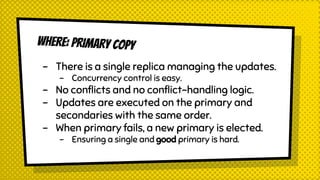
- There is a single replica managing the updates.
- Concurrency control is easy.
- No conflicts and no conflict-handling logic.
- Updates are executed on the primary and
secondaries with the same order.
- When primary fails, a new primary is elected.
- Ensuring a single and good primary is hard.
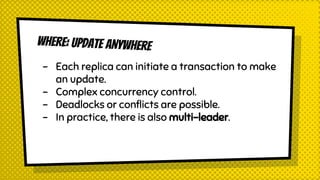
WHERE: UPDATE ANYWHERE
- Each replica can initiate a transaction to make
an update.
- Complex concurrency control.
- Deadlocks or conflicts are possible.
- In practice, there is also multi-leader.
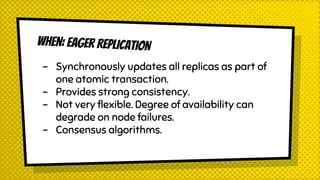
WHEN: EAGER REPLICATION
- Synchronously updates all replicas as part of
one atomic transaction.
- Provides strong consistency.
- Not very flexible. Degree of availability can
degrade on node failures.
- Consensus algorithms.
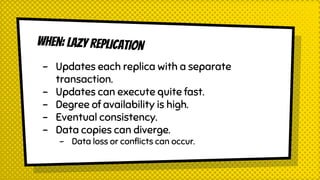
WHEN: LAZY REPLICATION
- Updates each replica with a separate
transaction.
- Updates can execute quite fast.
- Degree of availability is high.
- Eventual consistency.
- Data copies can diverge.
- Data loss or conflicts can occur.
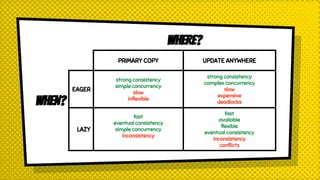
WHERE?
WHEN?
PRIMARY COPY UPDATE ANYWHERE
EAGER
strong consistency
simple concurrency
slow
inflexible
strong consistency
complex concurrency
slow
expensive
deadlocks
LAZY
fast
eventual consistency
simple concurrency
inconsistency
fast
available
flexible
eventual consistency
inconsistency
conflicts
WHERE?
WHEN?
PRIMARY COPY UPDATE ANYWHERE
EAGER
Multi Paxos [5]
etcd and Consul (RAFT) [6]
Zookeeper (Zab) [7]
Kafka
Paxos [5]
Hazelcast Cluster State Change [12]
LAZY
Hazelcast
MongoDB
ElasticSearch
Redis
Dynamo [4]
Cassandra
Riak
PRIMARY COPY + EAGER REPLICATION
- When the primary fails, secondaries are
guaranteed to be up to date.
- Raft, Kafka etc.
- Majority approach can be used.
- In Kafka, in-sync-replica set is maintained. [11]
- Secondaries can be used for reads.
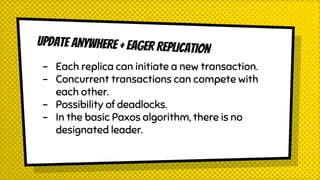
UPDATE ANYWHERE + EAGER REPLICATION
- Each replica can initiate a new transaction.
- Concurrent transactions can compete with
each other.
- Possibility of deadlocks.
- In the basic Paxos algorithm, there is no
designated leader.
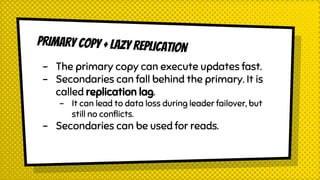
PRIMARy COPY + LAZY REPLICATION
- The primary copy can execute updates fast.
- Secondaries can fall behind the primary. It is
called replication lag.
- It can lead to data loss during leader failover, but
still no conflicts.
- Secondaries can be used for reads.
UPDATE ANYWHERE + LAZY REPLICATION
- Dynamo-style [4] highly available databases.
- Quorums
- Concurrent updates are first-class citizens.
- Possibility of conflicts
- Avoiding, discarding, detecting & resolving conflicts
- Eventual convergence
- Write repair, read repair and anti-entropy
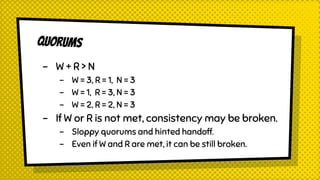
QUORUMS
- W + R > N
- W = 3, R = 1, N = 3
- W = 1, R = 3, N = 3
- W = 2, R = 2, N = 3
- If W or R is not met, consistency may be broken.
- Sloppy quorums and hinted handoff.
- Even if W and R are met, it can be still broken.
Conflict-free replicated data types (CRDTS)
- Special data types that achieve strong
eventual consistency and monotonicity [2]
- No conflicts
- Merge function has 3 properties:
- Commutative: A + B = B + A
- Associative: A + (B + C) = (A + B) + C
- Idempotent: f(f(x)) = f(x)
- Riak Data Types [3]
DISCARDING CONFLICTS: LAST WRITE WINS
- When 2 updates are concurrent, define an
arbitrary order among them.
- i.e., pretend that one of them is more recent.
- Attach a timestamp to each write.
- Cassandra uses physical timestamps [8], [9]
DETECTING CONFLICTS: VECTOR CLOCKS
- In Dynamo paper [4], each update is done
against a particular version of a data entry.
- Multiple versions of a data entry can exist together.
- Vector clocks [10] are used to track causality.
- The system can determine the authoritative version:
syntactic reconciliation
- The system cannot reconcile multiple versions:
semantic reconciliation
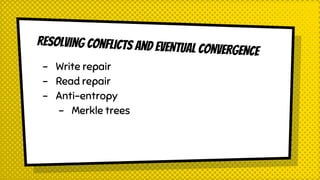
Resolving conflicts and EVENTUAL CONVERGENCE
- Write repair
- Read repair
- Anti-entropy
- Merkle trees
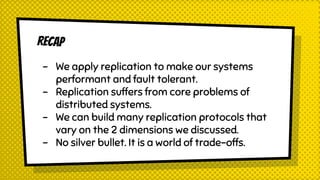
Recap
- We apply replication to make our systems
performant and fault tolerant.
- Replication suffers from core problems of
distributed systems.
- We can build many replication protocols that
vary on the 2 dimensions we discussed.
- No silver bullet. It is a world of trade-offs.
REFerences
[1] Gray, Jim, et al. "The dangers of replication and a solution." ACM SIGMOD Record 25.2 (1996): 173-182.
[2] Shapiro, Marc, et al. "Conflict-free replicated data types." Symposium on Self-Stabilizing Systems. Springer, Berlin, Heidelberg, 2011.
[3] http://docs.basho.com/riak/kv/2.2.0/learn/concepts/crdts/
[4] DeCandia, Giuseppe, et al. "Dynamo: amazon's highly available key-value store." ACM SIGOPS operating systems review 41.6 (2007): 205-220.
[5] Lamport, Leslie. "Paxos made simple." ACM Sigact News 32.4 (2001): 18-25.
[6] Ongaro, Diego, and John K. Ousterhout. "In Search of an Understandable Consensus Algorithm." USENIX Annual Technical Conference. 2014.
[7] Hunt, Patrick, et al. "ZooKeeper: Wait-free Coordination for Internet-scale Systems." USENIX annual technical conference. Vol. 8. 2010.
[8] http://www.datastax.com/dev/blog/why-cassandra-doesnt-need-vector-clocks
[9] https://aphyr.com/posts/299-the-trouble-with-timestamps
[10] Raynal, Michel, and Mukesh Singhal. "Logical time: Capturing causality in distributed systems." Computer 29.2 (1996): 49-56.
[11] http://kafka.apache.org/documentation.html#replication
[12] http://docs.hazelcast.org/docs/latest/manual/html-single/index.html#managing-cluster-and-member-states
THANKS!Any questions?

Replication in the Wild

  • 1.
  • 2.
    REPLICATION - Putting adata set into multiple nodes. - Each replica has a full copy. - A few reasons for replication: - Performance - Availability and fault tolerance - Mostly used with partitioning.
  • 3.
    NOTHING FOR FREE! -Very easy to do when the data is immutable. - Problems start when we have multiple copies of the data and we want to update them. - Two main difficulties - Handling updates - Handling failures
  • 4.
    The dangers ofreplication and a solution - Gray et al. [1] classify replication models by 2 parameters: - Where to make updates: primary copy or update anywhere - When to make updates: eagerly or lazily
  • 5.
    WHERE: PRIMARY COPY -There is a single replica managing the updates. - Concurrency control is easy. - No conflicts and no conflict-handling logic. - Updates are executed on the primary and secondaries with the same order. - When primary fails, a new primary is elected. - Ensuring a single and good primary is hard.
  • 6.
    WHERE: UPDATE ANYWHERE -Each replica can initiate a transaction to make an update. - Complex concurrency control. - Deadlocks or conflicts are possible. - In practice, there is also multi-leader.
  • 7.
    WHEN: EAGER REPLICATION -Synchronously updates all replicas as part of one atomic transaction. - Provides strong consistency. - Not very flexible. Degree of availability can degrade on node failures. - Consensus algorithms.
  • 8.
    WHEN: LAZY REPLICATION -Updates each replica with a separate transaction. - Updates can execute quite fast. - Degree of availability is high. - Eventual consistency. - Data copies can diverge. - Data loss or conflicts can occur.
  • 9.
    WHERE? WHEN? PRIMARY COPY UPDATEANYWHERE EAGER strong consistency simple concurrency slow inflexible strong consistency complex concurrency slow expensive deadlocks LAZY fast eventual consistency simple concurrency inconsistency fast available flexible eventual consistency inconsistency conflicts
  • 10.
    WHERE? WHEN? PRIMARY COPY UPDATEANYWHERE EAGER Multi Paxos [5] etcd and Consul (RAFT) [6] Zookeeper (Zab) [7] Kafka Paxos [5] Hazelcast Cluster State Change [12] LAZY Hazelcast MongoDB ElasticSearch Redis Dynamo [4] Cassandra Riak
  • 11.
    PRIMARY COPY +EAGER REPLICATION - When the primary fails, secondaries are guaranteed to be up to date. - Raft, Kafka etc. - Majority approach can be used. - In Kafka, in-sync-replica set is maintained. [11] - Secondaries can be used for reads.
  • 12.
    UPDATE ANYWHERE +EAGER REPLICATION - Each replica can initiate a new transaction. - Concurrent transactions can compete with each other. - Possibility of deadlocks. - In the basic Paxos algorithm, there is no designated leader.
  • 13.
    PRIMARy COPY +LAZY REPLICATION - The primary copy can execute updates fast. - Secondaries can fall behind the primary. It is called replication lag. - It can lead to data loss during leader failover, but still no conflicts. - Secondaries can be used for reads.
  • 14.
    UPDATE ANYWHERE +LAZY REPLICATION - Dynamo-style [4] highly available databases. - Quorums - Concurrent updates are first-class citizens. - Possibility of conflicts - Avoiding, discarding, detecting & resolving conflicts - Eventual convergence - Write repair, read repair and anti-entropy
  • 15.
    QUORUMS - W +R > N - W = 3, R = 1, N = 3 - W = 1, R = 3, N = 3 - W = 2, R = 2, N = 3 - If W or R is not met, consistency may be broken. - Sloppy quorums and hinted handoff. - Even if W and R are met, it can be still broken.
  • 16.
    Conflict-free replicated datatypes (CRDTS) - Special data types that achieve strong eventual consistency and monotonicity [2] - No conflicts - Merge function has 3 properties: - Commutative: A + B = B + A - Associative: A + (B + C) = (A + B) + C - Idempotent: f(f(x)) = f(x) - Riak Data Types [3]
  • 17.
    DISCARDING CONFLICTS: LASTWRITE WINS - When 2 updates are concurrent, define an arbitrary order among them. - i.e., pretend that one of them is more recent. - Attach a timestamp to each write. - Cassandra uses physical timestamps [8], [9]
  • 18.
    DETECTING CONFLICTS: VECTORCLOCKS - In Dynamo paper [4], each update is done against a particular version of a data entry. - Multiple versions of a data entry can exist together. - Vector clocks [10] are used to track causality. - The system can determine the authoritative version: syntactic reconciliation - The system cannot reconcile multiple versions: semantic reconciliation
  • 19.
    Resolving conflicts andEVENTUAL CONVERGENCE - Write repair - Read repair - Anti-entropy - Merkle trees
  • 20.
    Recap - We applyreplication to make our systems performant and fault tolerant. - Replication suffers from core problems of distributed systems. - We can build many replication protocols that vary on the 2 dimensions we discussed. - No silver bullet. It is a world of trade-offs.
  • 21.
    REFerences [1] Gray, Jim,et al. "The dangers of replication and a solution." ACM SIGMOD Record 25.2 (1996): 173-182. [2] Shapiro, Marc, et al. "Conflict-free replicated data types." Symposium on Self-Stabilizing Systems. Springer, Berlin, Heidelberg, 2011. [3] http://docs.basho.com/riak/kv/2.2.0/learn/concepts/crdts/ [4] DeCandia, Giuseppe, et al. "Dynamo: amazon's highly available key-value store." ACM SIGOPS operating systems review 41.6 (2007): 205-220. [5] Lamport, Leslie. "Paxos made simple." ACM Sigact News 32.4 (2001): 18-25. [6] Ongaro, Diego, and John K. Ousterhout. "In Search of an Understandable Consensus Algorithm." USENIX Annual Technical Conference. 2014. [7] Hunt, Patrick, et al. "ZooKeeper: Wait-free Coordination for Internet-scale Systems." USENIX annual technical conference. Vol. 8. 2010. [8] http://www.datastax.com/dev/blog/why-cassandra-doesnt-need-vector-clocks [9] https://aphyr.com/posts/299-the-trouble-with-timestamps [10] Raynal, Michel, and Mukesh Singhal. "Logical time: Capturing causality in distributed systems." Computer 29.2 (1996): 49-56. [11] http://kafka.apache.org/documentation.html#replication [12] http://docs.hazelcast.org/docs/latest/manual/html-single/index.html#managing-cluster-and-member-states
  • 22.