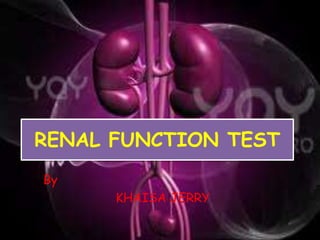
RENAL FUNCTION TEST
By

KHAISA JERRY
Objectives
 To detect possible renal damage
 Assessment of its severity.
 To observe the progress of renal
disease
 To monitor the safe and effective

use of drugs which are excreted
in the urine
Causes of kidney functional disorders
• Pre-renal e.g.
decreased
intravascular
volume
• Renal e.g. acute
tubular necrosis
• Postrenal e.g.
ureteral
obstruction
TEST of Renal Function Test
• Urine examination
• Tests of excretory functions

• Creatinine clearance test
• Estimation of BUN and serum creatinine
levels
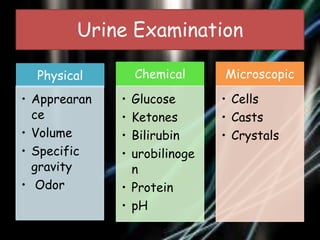
Urine Examination
Chemical

Physical
• Apprearan
ce
• Volume
• Specific
gravity
• Odor

•
•
•
•

Glucose
Ketones
Bilirubin
urobilinoge
n
• Protein
• pH

Microscopic
• Cells
• Casts
• Crystals
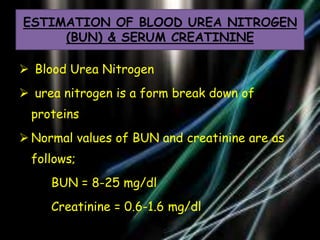
ESTIMATION OF BLOOD UREA NITROGEN
(BUN) & SERUM CREATININE
 Blood Urea Nitrogen

 urea nitrogen is a form break down of
proteins
 Normal values of BUN and creatinine are as
follows;
BUN = 8-25 mg/dl
Creatinine = 0.6-1.6 mg/dl
ESTIMATION OF BLOOD UREA NITROGEN
(BUN) & SERUM CREATININE
The estimation is most useful for the assessment of the
severity and progress of renal failure in;
1. Acute tubular necrosis
2. Acute glomerulonephritis
3. Chronic renal disease
4. Post-renal obstruction
Decrease in BUN level may be caused by;
1. Low protein diet
2. Liver damage
3. Dialysis
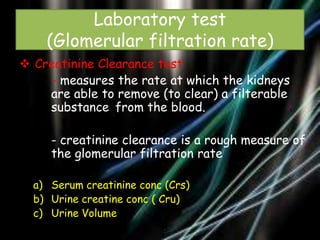
Laboratory test
(Glomerular filtration rate)
 Creatinine Clearance test
- measures the rate at which the kidneys
are able to remove (to clear) a filterable
substance from the blood.

- creatinine clearance is a rough measure of
the glomerular filtration rate
a) Serum creatinine conc (Crs)
b) Urine creatine conc ( Cru)
c) Urine Volume
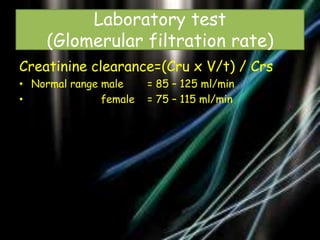
Laboratory test
(Glomerular filtration rate)
Creatinine clearance=(Cru x V/t) / Crs
• Normal range male
•
female

= 85 – 125 ml/min
= 75 – 115 ml/min
Laboratory test
(Glomerular filtration rate)
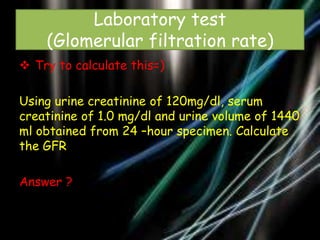
 Try to calculate this=)
Using urine creatinine of 120mg/dl, serum
creatinine of 1.0 mg/dl and urine volume of 1440
ml obtained from 24 –hour specimen. Calculate
the GFR
Answer ?
Laboratory test
(Glomerular filtration rate)
Formula;
Creatinine clearance
= (Cru x V/t) / Crs
= [120mg/dl x 1440ml / (24H x 60min)]
1.0mg/dl
=120 x 1440ml / 1440min
1.0
=120ml/min
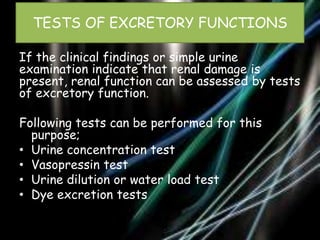
TESTS OF EXCRETORY FUNCTIONS
If the clinical findings or simple urine
examination indicate that renal damage is
present, renal function can be assessed by tests
of excretory function.
Following tests can be performed for this
purpose;
• Urine concentration test
• Vasopressin test
• Urine dilution or water load test
• Dye excretion tests
Renal function test

Renal function test

  • 1.
  • 2.
    Objectives  To detectpossible renal damage  Assessment of its severity.  To observe the progress of renal disease  To monitor the safe and effective use of drugs which are excreted in the urine
  • 3.
    Causes of kidneyfunctional disorders • Pre-renal e.g. decreased intravascular volume • Renal e.g. acute tubular necrosis • Postrenal e.g. ureteral obstruction
  • 4.
    TEST of RenalFunction Test • Urine examination • Tests of excretory functions • Creatinine clearance test • Estimation of BUN and serum creatinine levels
  • 5.
    Urine Examination Chemical Physical • Apprearan ce •Volume • Specific gravity • Odor • • • • Glucose Ketones Bilirubin urobilinoge n • Protein • pH Microscopic • Cells • Casts • Crystals
  • 6.
    ESTIMATION OF BLOODUREA NITROGEN (BUN) & SERUM CREATININE  Blood Urea Nitrogen  urea nitrogen is a form break down of proteins  Normal values of BUN and creatinine are as follows; BUN = 8-25 mg/dl Creatinine = 0.6-1.6 mg/dl
  • 7.
    ESTIMATION OF BLOODUREA NITROGEN (BUN) & SERUM CREATININE The estimation is most useful for the assessment of the severity and progress of renal failure in; 1. Acute tubular necrosis 2. Acute glomerulonephritis 3. Chronic renal disease 4. Post-renal obstruction Decrease in BUN level may be caused by; 1. Low protein diet 2. Liver damage 3. Dialysis
  • 8.
    Laboratory test (Glomerular filtrationrate)  Creatinine Clearance test - measures the rate at which the kidneys are able to remove (to clear) a filterable substance from the blood. - creatinine clearance is a rough measure of the glomerular filtration rate a) Serum creatinine conc (Crs) b) Urine creatine conc ( Cru) c) Urine Volume
  • 9.
    Laboratory test (Glomerular filtrationrate) Creatinine clearance=(Cru x V/t) / Crs • Normal range male • female = 85 – 125 ml/min = 75 – 115 ml/min
  • 10.
    Laboratory test (Glomerular filtrationrate)  Try to calculate this=) Using urine creatinine of 120mg/dl, serum creatinine of 1.0 mg/dl and urine volume of 1440 ml obtained from 24 –hour specimen. Calculate the GFR Answer ?
  • 11.
    Laboratory test (Glomerular filtrationrate) Formula; Creatinine clearance = (Cru x V/t) / Crs = [120mg/dl x 1440ml / (24H x 60min)] 1.0mg/dl =120 x 1440ml / 1440min 1.0 =120ml/min
  • 12.
    TESTS OF EXCRETORYFUNCTIONS If the clinical findings or simple urine examination indicate that renal damage is present, renal function can be assessed by tests of excretory function. Following tests can be performed for this purpose; • Urine concentration test • Vasopressin test • Urine dilution or water load test • Dye excretion tests