RELEVANCE OF ISO MANAGEMENT
SYSTEMS CERTIFICATION
By
Standards Organisation of Nigeria
Management Systems Certification Directorate
(SONMSC)
TABLE OF
CONTENT
WHAT IS A MANAGEMENT SYSTEM
ISO MANAGEMENT SYSTEMS CERTIFICATION
BENEFITS OF ISO MANAGEMENT SYSTEMS CERTIFICATION
WHY US SON-MSC AS YOUR CERTIFICATION BODY
SON-MSCS CERTIFICATION PROCEDURE
POLICY ON CERTIFICATION/AUDIT CHARGES (FEES)
WHAT WE EXPECT FROM NIMASA
QUESTIONS AND ANSWER SESSION
CONTACT DETAILS
WHAT IS ISO MANAGEMENT SYSTEM ?
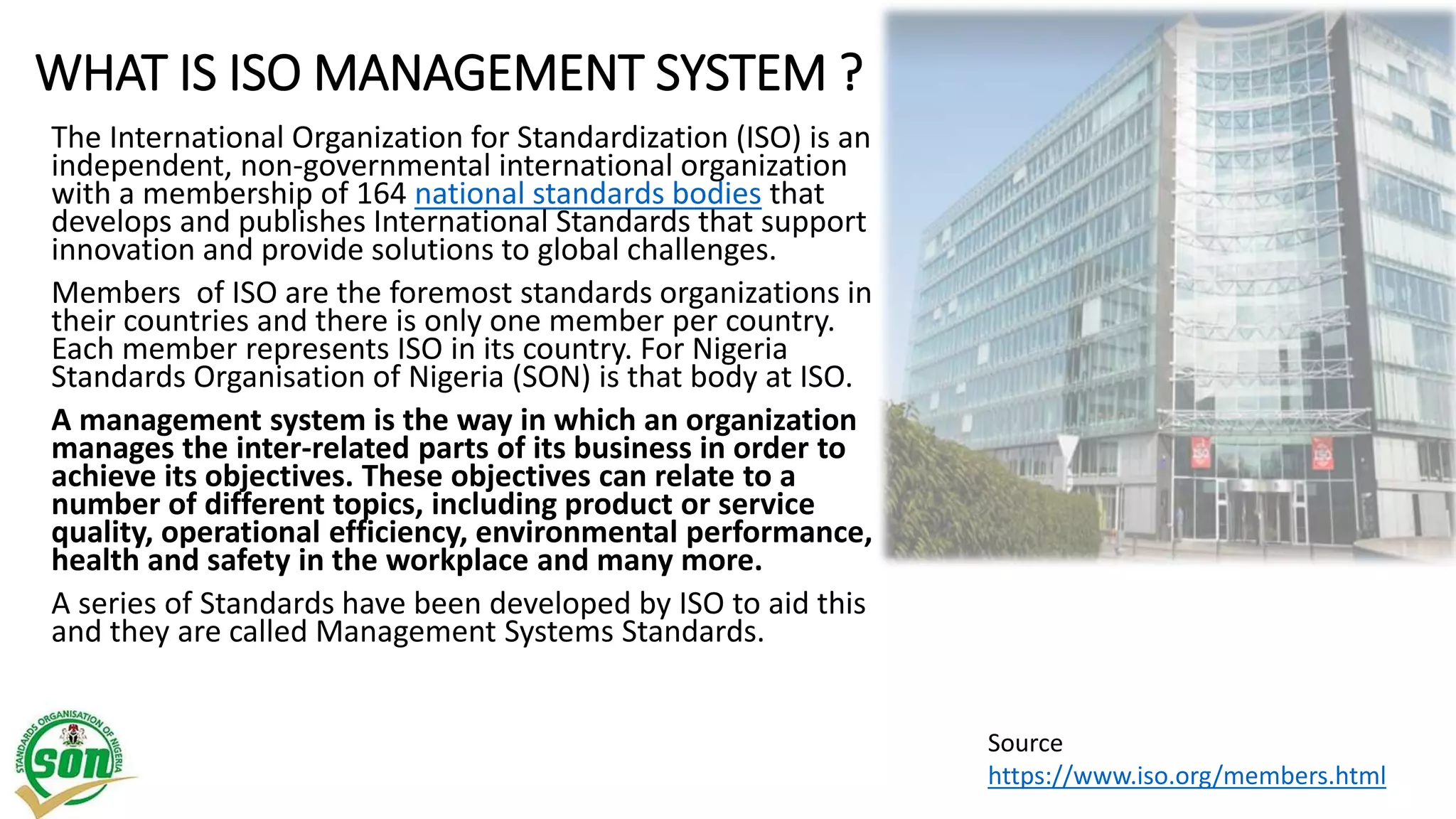
The International Organization for Standardization (ISO) is an
independent, non-governmental international organization
with a membership of 164 national standards bodies that
develops and publishes International Standards that support
innovation and provide solutions to global challenges.
Members of ISO are the foremost standards organizations in
their countries and there is only one member per country.
Each member represents ISO in its country. For Nigeria
Standards Organisation of Nigeria (SON) is that body at ISO.
A management system is the way in which an organization
manages the inter-related parts of its business in order to
achieve its objectives. These objectives can relate to a
number of different topics, including product or service
quality, operational efficiency, environmental performance,
health and safety in the workplace and many more.
A series of Standards have been developed by ISO to aid this
and they are called Management Systems Standards.
Source
https://www.iso.org/members.html
APPLICABILITY OF MANAGEMENT
SYSTEM IN ORGANISATION
• For some organizations, especially smaller ones, the
Management System may simply mean having strong
leadership from the business owner, providing a clear
definition of what is expected from each individual
employee and how they contribute to the
organization’s overall objectives, without the need for
extensive documentation. More complex businesses
operating, for example, in highly regulated sectors,
may need extensive documentation and controls in
order to fulfil their legal obligations and meet their
organizational objectives.
• MSS are the result of consensus among international
experts with expertise in global management,
leadership strategies, and efficient and effective
processes and practices. MSS standards can be
implemented by any organization, large or small
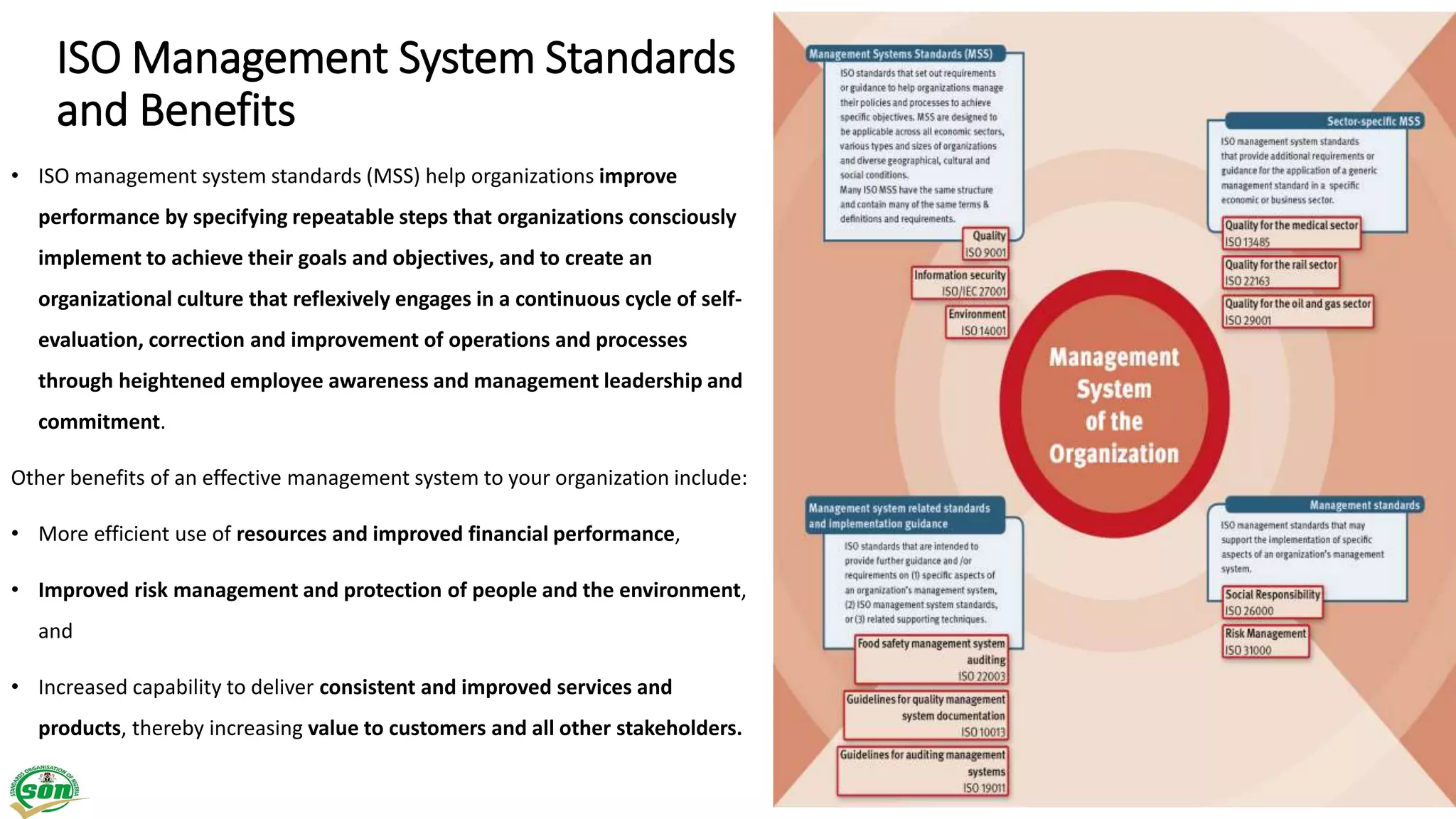
ISO Management System Standards
and Benefits
• ISO management system standards (MSS) help organizations improve
performance by specifying repeatable steps that organizations consciously
implement to achieve their goals and objectives, and to create an
organizational culture that reflexively engages in a continuous cycle of self-
evaluation, correction and improvement of operations and processes
through heightened employee awareness and management leadership and
commitment.
Other benefits of an effective management system to your organization include:
• More efficient use of resources and improved financial performance,
• Improved risk management and protection of people and the environment,
and
• Increased capability to deliver consistent and improved services and
products, thereby increasing value to customers and all other stakeholders.
MANAGEMENT SYSTEM AUDIT
• An audit is a systematic Systematic, independent and documented
process for obtaining audit evidence and evaluating it objectively to
determine the extent to which audit criteria are fulfilled
• Audits are a vital part of the management system approach as they
enable the company or organization to check how far their
achievements meet their objectives and show conformity to the
standard.
• In order to help the auditing related to management system standards,
ISO has released ISO 19011 (Guidelines for auditing management
systems) providing specific guidance on internal and external
management system audits.
SECTOR CATEGORIZATION OF ISO MANAGEMENT
SYSTEM STANDARDS
• Quality
• Industry
• Safety and Security
• General management
• Health and Medical
• Environment and Energy
• Information Technology
• Services
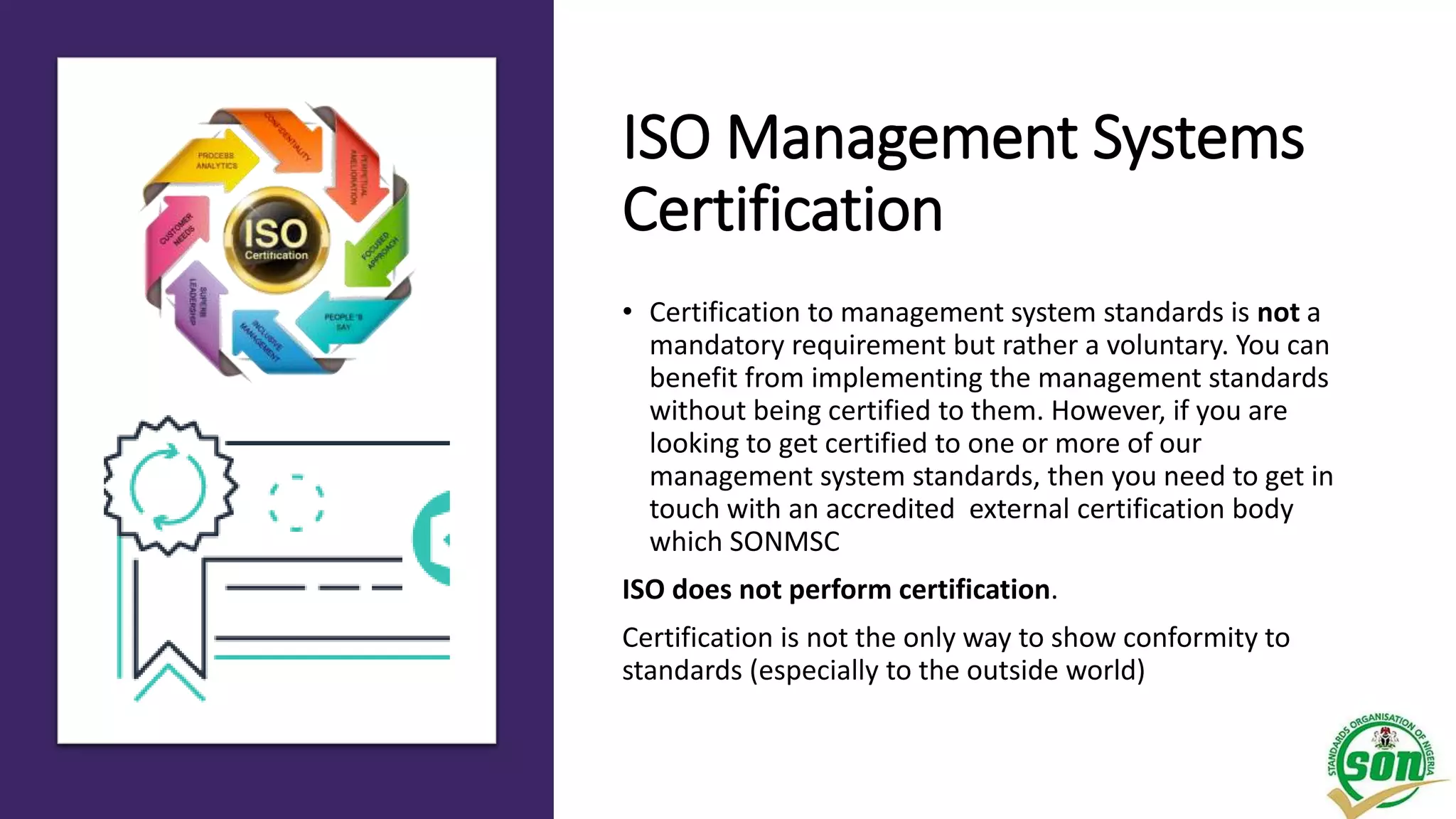
ISO Management Systems
Certification
• Certification to management system standards is not a
mandatory requirement but rather a voluntary. You can
benefit from implementing the management standards
without being certified to them. However, if you are
looking to get certified to one or more of our
management system standards, then you need to get in
touch with an accredited external certification body
which SONMSC
ISO does not perform certification.
Certification is not the only way to show conformity to
standards (especially to the outside world)
BENEFITS OF ISO MANAGEMENT SYSTEMS
CERTIFICATION
ISO Management System Certification provides the following
advantages to your Organisation:
• Improved company image
• Independent and unbiased check of conformity
• Provides competitive advantage
• Indication of an effective Management System
• National/International recognition
• Compliance with customer requirements specifying
certification
REASONS WHY YOU SHOULD CHOOSE SON
AS YOUR CERTIFICATION BODY
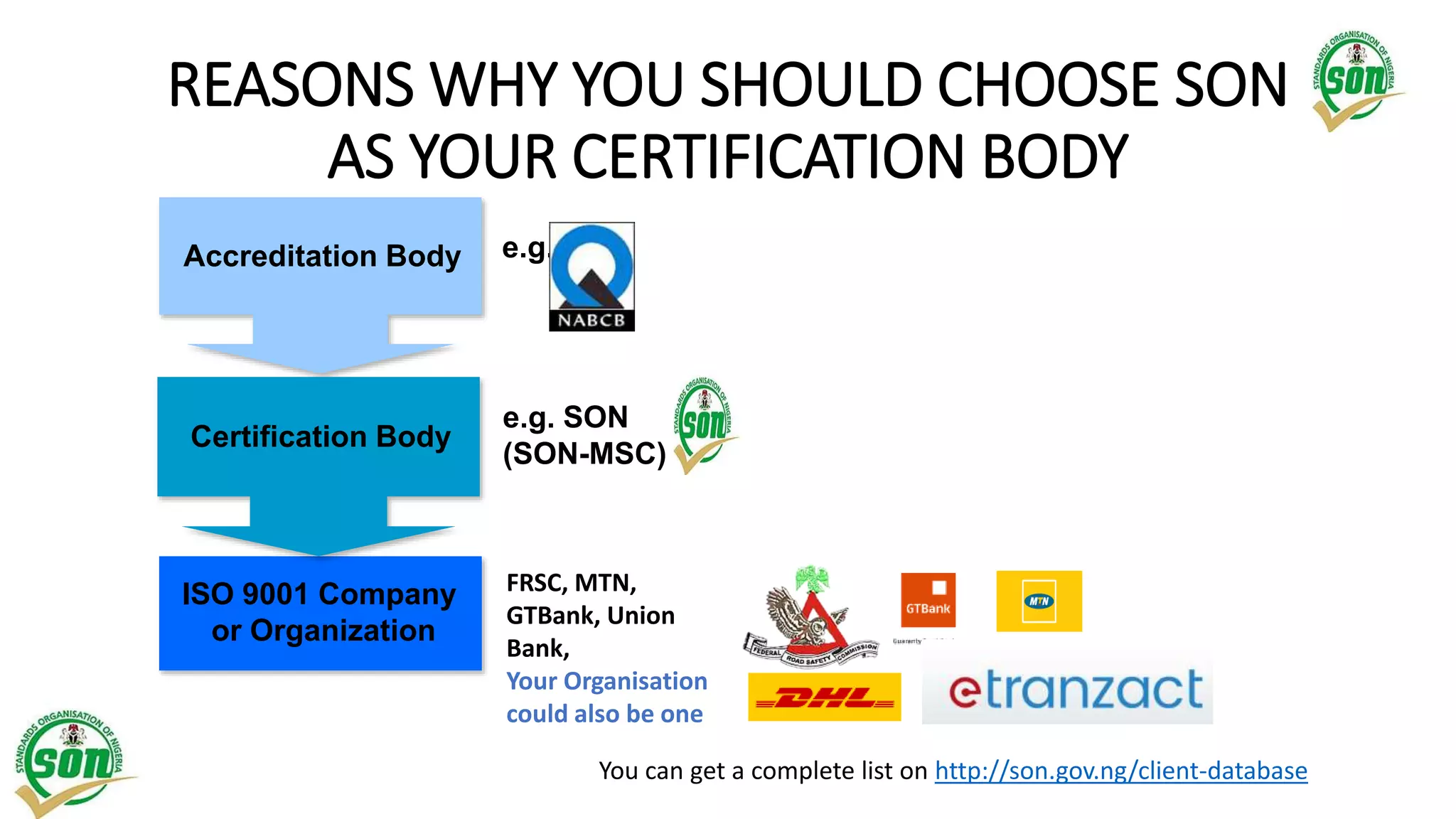
Accreditation Body
Certification Body
ISO 9001 Company
or Organization
e.g.
e.g. SON
(SON-MSC),
FRSC, MTN,
GTBank, Union
Bank,
Your Organisation
could also be one
You can get a complete list on http://son.gov.ng/client-database
REASONS WHY YOU SHOULD CHOOSE
SON AS YOUR CERTIFICATION
BODY?
A question that answers the above caption is “Why does SON have the
highest number of certified company in Nigeria?”. The answers lies in
the fact that:
• SON has the largest pool of competent Management system auditors
in Nigeria and the whole of Africa and the world.
• SON Management auditors are professionals and not outsourced or
contract staff (they are full time staff)
• SON has her certification body accredited to one of the worlds
“meanest” accreditation body (NABCB India)
• SON boasts of highly competent client management personnel
• SON Certification is recognized Globally due to her accreditation
• SON Certification is not profit driven but Government driven to
achieve national Development
SON-MSC CERTIFICATION PROCESS
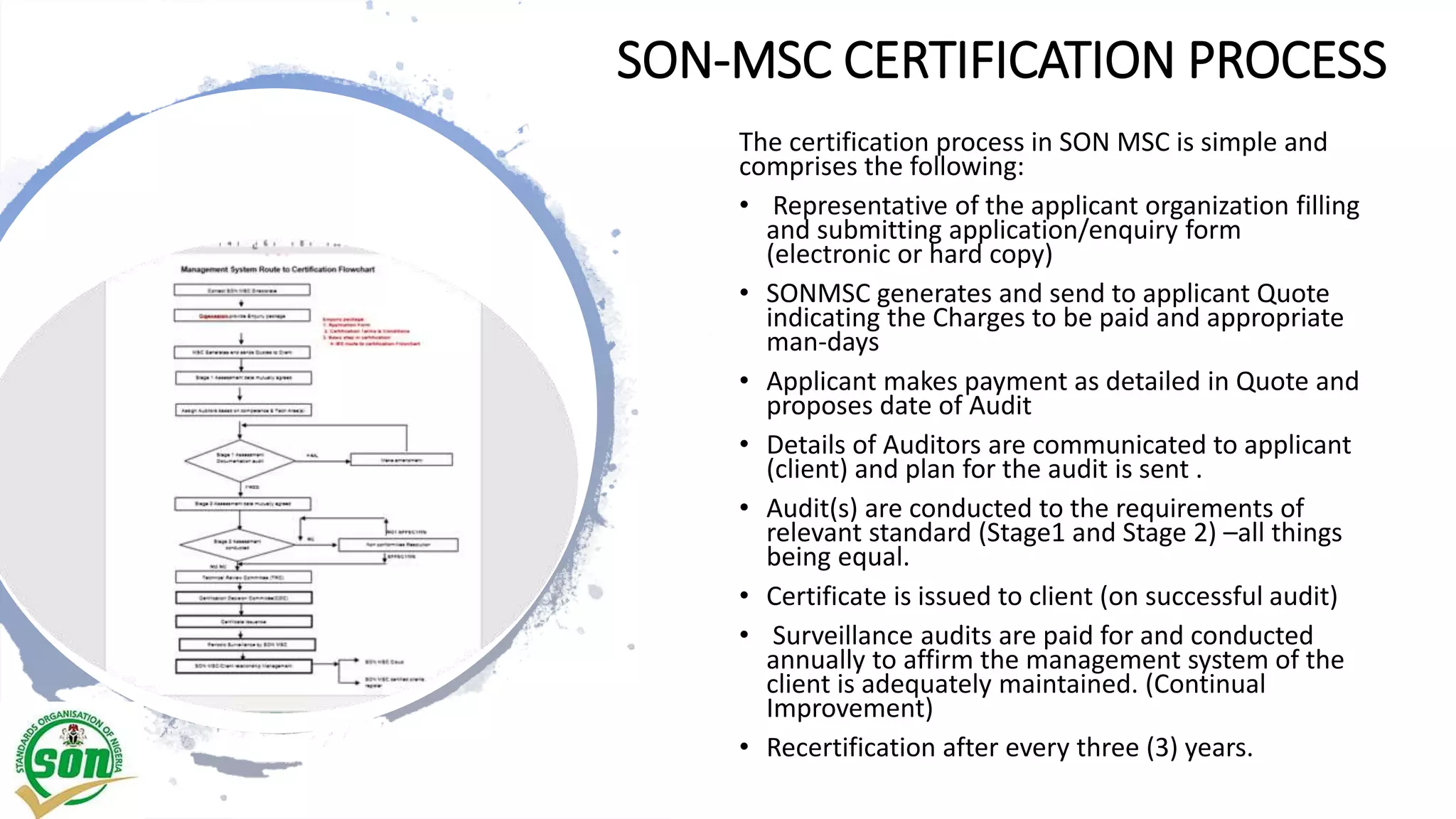
The certification process in SON MSC is simple and
comprises the following:
• Representative of the applicant organization filling
and submitting application/enquiry form
(electronic or hard copy)
• SONMSC generates and send to applicant Quote
indicating the Charges to be paid and appropriate
man-days
• Applicant makes payment as detailed in Quote and
proposes date of Audit
• Details of Auditors are communicated to applicant
(client) and plan for the audit is sent .
• Audit(s) are conducted to the requirements of
relevant standard (Stage1 and Stage 2) –all things
being equal.
• Certificate is issued to client (on successful audit)
• Surveillance audits are paid for and conducted
annually to affirm the management system of the
client is adequately maintained. (Continual
Improvement)
• Recertification after every three (3) years.
POLICY ON CERTIFICATION/AUDIT CHARGES (FEES)
Audit fees are based on auditor time (man-days) which is calculated based on the requirements in International Accreditation Forum (IAF)
document: IAF MD5 (Mandatory document for the determination of audit time of QMS and EMS audits) and ISO/TS 22003 (Food safety
management systems – requirements for bodies providing audit and certification of food safety management systems).
Consideration is also made to ISO 17023 (Guidelines for determining the duration of management system certification audits).
Individual quotes are prepared for each Client and the notification sent to the Client in advance using Demand Note Federal Government.
• SON MSC does not charge for Application Fees. Application is free
Audit fees (charged at the SONMSC prevailing rate) shall be invoiced before each certification stage as these depend on the duration of the
activity.
One extra day shall be charged for audit preparation and reporting.
• All payment for audit charge are to be made upfront into the SONs Central Bank Account through the Remita Platform in favour of :
Beneficiary: Standards Organisation of Nigeria
Account Name: Central Bank of Nigeria
Account Number: 022 200 200 100
GIFMIS Code: 1000013724
Purpose of Payment: Management Systems Certification
Payment are to be made within 30 days before scheduled audit date.
Failure to pay charges as per agreed terms may result in revocation of certification.
WHAT IS EXPECTED FROM NIMASA
As a regulator we expect NIMASA to;
• implement relevant Management Systems (Quality; ISO 9001,
Environmental; IS0 14001, Occupational Health and Safety; ISO 45001
etc) in the organisation
• be exemplary and get certified to the Management System Standards
most relevant
• Advocate for Maritime related companies and service providers to be
Certified to relevant ISO Management System Standards.
• Continual Improvement
QUESTIONS AND ANSWER SESSION
Contact Details
• You can contact Standards Organisation of Nigeria's Management Systems
Certification Directorate (SONMSC) via
www.son.gov.ng
Toll-Free 08002255766
Or visit
SON Operational Headquarters,
13/14, Victoria Arobieke Street,
Off Admiralty Way, Lekki Phase 1,
Lekki Peninsula Scheme,
Lagos State.
Tel: 01 270 8247, 0815 939 0771

Relevance of iso management systems certification

  • 1.
    RELEVANCE OF ISOMANAGEMENT SYSTEMS CERTIFICATION By Standards Organisation of Nigeria Management Systems Certification Directorate (SONMSC)
  • 2.
    TABLE OF CONTENT WHAT ISA MANAGEMENT SYSTEM ISO MANAGEMENT SYSTEMS CERTIFICATION BENEFITS OF ISO MANAGEMENT SYSTEMS CERTIFICATION WHY US SON-MSC AS YOUR CERTIFICATION BODY SON-MSCS CERTIFICATION PROCEDURE POLICY ON CERTIFICATION/AUDIT CHARGES (FEES) WHAT WE EXPECT FROM NIMASA QUESTIONS AND ANSWER SESSION CONTACT DETAILS
  • 3.
    WHAT IS ISOMANAGEMENT SYSTEM ? The International Organization for Standardization (ISO) is an independent, non-governmental international organization with a membership of 164 national standards bodies that develops and publishes International Standards that support innovation and provide solutions to global challenges. Members of ISO are the foremost standards organizations in their countries and there is only one member per country. Each member represents ISO in its country. For Nigeria Standards Organisation of Nigeria (SON) is that body at ISO. A management system is the way in which an organization manages the inter-related parts of its business in order to achieve its objectives. These objectives can relate to a number of different topics, including product or service quality, operational efficiency, environmental performance, health and safety in the workplace and many more. A series of Standards have been developed by ISO to aid this and they are called Management Systems Standards. Source https://www.iso.org/members.html
  • 4.
    APPLICABILITY OF MANAGEMENT SYSTEMIN ORGANISATION • For some organizations, especially smaller ones, the Management System may simply mean having strong leadership from the business owner, providing a clear definition of what is expected from each individual employee and how they contribute to the organization’s overall objectives, without the need for extensive documentation. More complex businesses operating, for example, in highly regulated sectors, may need extensive documentation and controls in order to fulfil their legal obligations and meet their organizational objectives. • MSS are the result of consensus among international experts with expertise in global management, leadership strategies, and efficient and effective processes and practices. MSS standards can be implemented by any organization, large or small
  • 5.
    ISO Management SystemStandards and Benefits • ISO management system standards (MSS) help organizations improve performance by specifying repeatable steps that organizations consciously implement to achieve their goals and objectives, and to create an organizational culture that reflexively engages in a continuous cycle of self- evaluation, correction and improvement of operations and processes through heightened employee awareness and management leadership and commitment. Other benefits of an effective management system to your organization include: • More efficient use of resources and improved financial performance, • Improved risk management and protection of people and the environment, and • Increased capability to deliver consistent and improved services and products, thereby increasing value to customers and all other stakeholders.
  • 6.
    MANAGEMENT SYSTEM AUDIT •An audit is a systematic Systematic, independent and documented process for obtaining audit evidence and evaluating it objectively to determine the extent to which audit criteria are fulfilled • Audits are a vital part of the management system approach as they enable the company or organization to check how far their achievements meet their objectives and show conformity to the standard. • In order to help the auditing related to management system standards, ISO has released ISO 19011 (Guidelines for auditing management systems) providing specific guidance on internal and external management system audits.
  • 7.
    SECTOR CATEGORIZATION OFISO MANAGEMENT SYSTEM STANDARDS • Quality • Industry • Safety and Security • General management • Health and Medical • Environment and Energy • Information Technology • Services
  • 8.
    ISO Management Systems Certification •Certification to management system standards is not a mandatory requirement but rather a voluntary. You can benefit from implementing the management standards without being certified to them. However, if you are looking to get certified to one or more of our management system standards, then you need to get in touch with an accredited external certification body which SONMSC ISO does not perform certification. Certification is not the only way to show conformity to standards (especially to the outside world)
  • 9.
    BENEFITS OF ISOMANAGEMENT SYSTEMS CERTIFICATION ISO Management System Certification provides the following advantages to your Organisation: • Improved company image • Independent and unbiased check of conformity • Provides competitive advantage • Indication of an effective Management System • National/International recognition • Compliance with customer requirements specifying certification
  • 10.
    REASONS WHY YOUSHOULD CHOOSE SON AS YOUR CERTIFICATION BODY Accreditation Body Certification Body ISO 9001 Company or Organization e.g. e.g. SON (SON-MSC), FRSC, MTN, GTBank, Union Bank, Your Organisation could also be one You can get a complete list on http://son.gov.ng/client-database
  • 11.
    REASONS WHY YOUSHOULD CHOOSE SON AS YOUR CERTIFICATION BODY? A question that answers the above caption is “Why does SON have the highest number of certified company in Nigeria?”. The answers lies in the fact that: • SON has the largest pool of competent Management system auditors in Nigeria and the whole of Africa and the world. • SON Management auditors are professionals and not outsourced or contract staff (they are full time staff) • SON has her certification body accredited to one of the worlds “meanest” accreditation body (NABCB India) • SON boasts of highly competent client management personnel • SON Certification is recognized Globally due to her accreditation • SON Certification is not profit driven but Government driven to achieve national Development
  • 12.
    SON-MSC CERTIFICATION PROCESS Thecertification process in SON MSC is simple and comprises the following: • Representative of the applicant organization filling and submitting application/enquiry form (electronic or hard copy) • SONMSC generates and send to applicant Quote indicating the Charges to be paid and appropriate man-days • Applicant makes payment as detailed in Quote and proposes date of Audit • Details of Auditors are communicated to applicant (client) and plan for the audit is sent . • Audit(s) are conducted to the requirements of relevant standard (Stage1 and Stage 2) –all things being equal. • Certificate is issued to client (on successful audit) • Surveillance audits are paid for and conducted annually to affirm the management system of the client is adequately maintained. (Continual Improvement) • Recertification after every three (3) years.
  • 13.
    POLICY ON CERTIFICATION/AUDITCHARGES (FEES) Audit fees are based on auditor time (man-days) which is calculated based on the requirements in International Accreditation Forum (IAF) document: IAF MD5 (Mandatory document for the determination of audit time of QMS and EMS audits) and ISO/TS 22003 (Food safety management systems – requirements for bodies providing audit and certification of food safety management systems). Consideration is also made to ISO 17023 (Guidelines for determining the duration of management system certification audits). Individual quotes are prepared for each Client and the notification sent to the Client in advance using Demand Note Federal Government. • SON MSC does not charge for Application Fees. Application is free Audit fees (charged at the SONMSC prevailing rate) shall be invoiced before each certification stage as these depend on the duration of the activity. One extra day shall be charged for audit preparation and reporting. • All payment for audit charge are to be made upfront into the SONs Central Bank Account through the Remita Platform in favour of : Beneficiary: Standards Organisation of Nigeria Account Name: Central Bank of Nigeria Account Number: 022 200 200 100 GIFMIS Code: 1000013724 Purpose of Payment: Management Systems Certification Payment are to be made within 30 days before scheduled audit date. Failure to pay charges as per agreed terms may result in revocation of certification.
  • 14.
    WHAT IS EXPECTEDFROM NIMASA As a regulator we expect NIMASA to; • implement relevant Management Systems (Quality; ISO 9001, Environmental; IS0 14001, Occupational Health and Safety; ISO 45001 etc) in the organisation • be exemplary and get certified to the Management System Standards most relevant • Advocate for Maritime related companies and service providers to be Certified to relevant ISO Management System Standards. • Continual Improvement
  • 15.
  • 16.
    Contact Details • Youcan contact Standards Organisation of Nigeria's Management Systems Certification Directorate (SONMSC) via www.son.gov.ng Toll-Free 08002255766 Or visit SON Operational Headquarters, 13/14, Victoria Arobieke Street, Off Admiralty Way, Lekki Phase 1, Lekki Peninsula Scheme, Lagos State. Tel: 01 270 8247, 0815 939 0771