LANDSCAPE DESIGN
Re-imagining Tinkune as a Multi- functional entity
Submitted By –
Aaisha Manandhar (70001)
Binisha Gurung (70011)
Manisha Shrestha (70021)
Pooja Bazimaya (70025)
Ruchika Shakya (70037)
Project description
Landscape design is about transforming a neglected piece of land
into beautiful retreat while minimizing the impact human
activities have on the plants and the environment in your yard. It
is neither art nor science, but art and science; it fuses
environmental design with biological and cultural ecology. It aims
to do more than to produce places for safe, healthful, and
pleasant use, it lies at the intersection of personal and collective
experiences of nature. The true value of landscape design lies
beyond aesthetic improvements. As the global consciousness
about the preservation of the environment is rising, the
importance of landscape architecture is also going upwards very
fast.
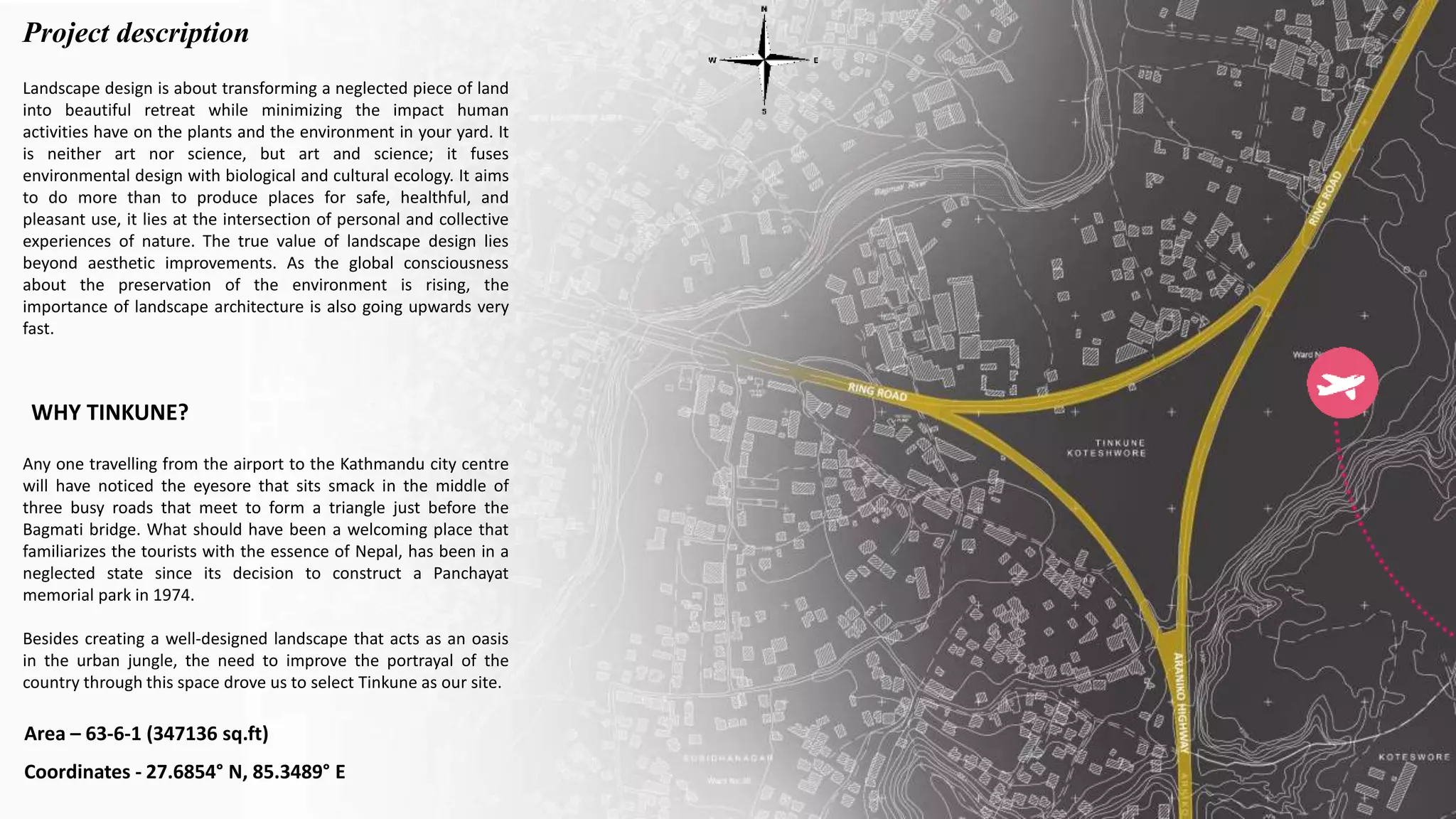
Any one travelling from the airport to the Kathmandu city centre
will have noticed the eyesore that sits smack in the middle of
three busy roads that meet to form a triangle just before the
Bagmati bridge. What should have been a welcoming place that
familiarizes the tourists with the essence of Nepal, has been in a
neglected state since its decision to construct a Panchayat
memorial park in 1974.
Besides creating a well-designed landscape that acts as an oasis
in the urban jungle, the need to improve the portrayal of the
country through this space drove us to select Tinkune as our site.
WHY TINKUNE?
Area – 63-6-1 (347136 sq.ft)
Coordinates - 27.6854° N, 85.3489° E
SITE information
PRESENT ISSUES)
Unmanaged disposal of
waste in certain parts of
the site. This acts as an
eyesore that smacks to
every person that passes
by.
There was no level
difference or buffering
between the footpath and
the site. This can can
create risk of accidents
The site is centrally
located. Hence, has no
visual obstructions.
It is a heavy traffic road
and acts as a junction
for Araniko higway and
ring road.
Connectivity) Visual Linkage
Site used as parking for
bus parking
Zebra crossings for
pedestrian entry
Schools and commercial
development
NEARBY WATER BODIES
THREAT
• THE SITE ITSELF IS A STRENGTH
• ACCESSIBLE BY WIDE ROADS
• SITUATED IN THE CORE CENTRE OF
THE CITY
• CAN PROVIDE FIRST IMPRESSION
TO THE TOURISTS
• CLOSE PROXIMITY TO AIRPORT
• ABUNDANT FLAT LAND WITH NO
VIEW CONSTRAINTS
• NO OBSTRUCTIONS FOR SOLAR
GAIN
• NOISE POLLUTION DUE TO TRAFFIC AND
NEAR AIRPORT
• AIR POLLUTION (SMOG, DUST)
• NO PROPER GREEN SPACE
• VIBRATIONS FROM THE TRAFFIC AND
AIRPLANES
• DESIGNING ANY STRUCTURE NEAR AN
AIRPORT COMES WITH DESIGN
CONSTRAINTS.
• TO CREATE A LANDMARK
• A UNIQUE DESIGN TO REPRESENT OUR
COUNTRY.
• CAN ACT AS A BREATHING SPACE TO THE
SURROUNDING URBAN HUB
• CAN ACT AS A MULTIFUNCTIONAL ENTITY
ADRESSING THE VARIED NEEDS OF THE
SURROUNDING SETTLEMENTS.
• SUSTAINABILITY CAN BE ACHIEVED WITH
THE MAXIMUN USE OF NATURAL
SOURCES.
WIND DIRECTION
OPPORTUNITYWEAKNESSSTRENGTH
• REQUIRE HUGE BUFFERING FROM THE
STREETS CAUSING LOSS OF VALUABLE
LAND.
• ANY NEW DESIGN CAN CREATE A LOT OF
CONTROVERSIES ON GOVERNMENT
LEVEL.
• INTRODUCTION OF ACTIVITES SUCH AS
NIGHT CONCERTS CAN CAUSE.
DISTURBANCE TO THE AIRPLANES
• PRONE TO ACCIDENTS BECAUSE IT IS
SURROUNDED BY BUSY ROADS ON ALL
SIDES.
PROXIMITY TO AIRPORTWELL ACCESSIBLE TO CITY NETWORKWELL CONNECTION TO FACILITIESTRAFFIC FLOW
SUN PATH WINTERSUN PATH SUMMER
CONCEPT
The identity of Nepal, that is its unique triangular flag has been used as a design inspiration. The essence of the flag can be seen in
various elements of the design like the in the foot bridge.
Design approach
Use of plants, earth berms, pervious materials
to overcome the existing smog and noise
problems.
A place that gives positive portrayal
of the country to the tourists
through its well designed space.
A concept of green foot bridge to
connect two points through the park
passing through various park
activities that can create a unique
experience to the pedestrian.
Considerations for pedestrian and
universal accessibility, like use of
footpath, ramps.
Ramp
Pathway
A place for people of all age group,
children, young and senior people.
As it is one of the large open space in the area,
the place can be used for emergency shelters in
case of disaster, therefore a provision of
disaster management office.
A concept of enabling garden to
indulge people in landscape.
ZONING
masterplan
AIRPORT
Pedestrian path of 2m width to
accommodate pedestrians.
Plaza with water elements to
create a welcoming and calming
effect as one enters.
Entry
Entry
Green Foot Bridge connecting
two parts. The bridge is
accommodated with seating and
hence can be used as deck. Use
of ramp. Office areas as
information centre, disaster
management office below the
bridge.
Childrens’ Play Area centrally
located so that it creates a lively
environment and also easy to
supervise.
Parking(also for bus).
Great Lawn for exercise and
yogas.
Amphitheatre that can be
used as for performance,
outdoor movie nights with
water fountain as a backdrop.
Nursery.
Buffer of 5m width as the area
is surrounded by roads from all
side. For sound and pollution
buffer.
Enabling garden – a
semipublic space where
people interested can indulge
in landscaping.
Landmark that welcomes the
visitors of Nepal.
Water body separating active
and passive space. Use of
stepping stones.
b
CONCEPTUAL 3DS
ENTRY GATE AT PEDESTRIAN PLAZA. CONCEPT: NATIONAL FLAG
SEATINGS AND LIGHTING AT PLAZA
CONCEPT: GESTURE OF HANDS DOING NAMASTEY NEAR THE ENTRY
WATER BODIES AT VISUAL AXIX FROM ENTRY WITH CHAUTARA
b
CONCEPTUAL 3DS
GREEN FOOT BRIDGE. WEEKLY MARKETS UNDER BRIDGE
CHILDREN PARK WITH RUBBERIZED ASPHALT FOR PAVING
AMPHITHEATRE VISUALLY LINKED FROM THE BRIDGE
OUTDOOR EATING AREAS AND VENDORS
CONCEPTUAL 3DS
COVERED PATHWAY CONNECTING ACTIVE AND PASSIVE ZONE
GREAT LAWN USED FOR EXERCISE
NURSERY
ENGAGING GARDEN TARGETED FOR OLDER PEOPLE ( NATIVE PLANTS)
Source : vegetativethoughts.wordpress.com
OVERALL CONCEPTUAL 3D
SUSTAINAIBILITY
APPROACHES
Stone paving
done in the plaza
area
Wood plastic
composites used as
flooring material on
the foot bridge
Rubberized asphalt
used in children play
area and enabling
garden hardscape
Permeable paving used
in hardscape areas for
groundwater recharge
Section
Brigde level 16’Ground Lvl 0
hardscape Detail
Landscape design intent
• Flowering plants create an atmosphere inviting bees and
various species of butterflies
• Dense foliage and fruit bearing trees invite other small living
beings such as birds, squirrels, etc.
• Use culturally significant plants and trees. Eg: peepal bot,
banyan tree, amala, tulsi.
• Fragnant plants: chameli, etc.
Flowering plants
Whilst the landscape concept has been designed to assist with the
perception of arrival by defining edges and physical boundaries,
plant selection has been used to establish a distinctive environment
and provide a contemporary street front and identity to the site.
Plants have been selected to create a sustainable environment with
rapid plant establishment through massed under planting of trees.
Trees selected are considered to be appropriate in maintaining
visibility for pedestrians and vehicles with clear trunk maintained to
a height of two metres once established.
Seasonal change is introduced with a line of small flowering plants.
Large landscape areas act as storm water collection points with
gaps in the kerbing to allow run off into these areas.
Overall the soft landscaping has been used to create a visually
permeable landscape, designed to accommodate vehicular and
pedestrian traffic movement within a heavily under planted,
environment. The planting palette continues the same strategy
throughout the site and is considered to be appropriate in
maintaining visibility for pedestrians and vehicles.
FLOWER PALETTE
AIRPORT
Outer layer of Blue
mimosa trees
planted to give a
beautified outlook in
the street scape.
Mature size:
10-15m (h) x 7-
10m(w)
Entry
Inner layer of
Hackberry tree, an
exotic plant with
European origin,
smog clearing tree
with thick foliage.
Mature size:
20-25m tall
Dubo Grass used in
lawn areas.
Hedges of Dhupi tree
(Cryptomeria) used to
establish privacy and
segregation.
Mature size: 5–10 m(h)
Peepal tree used in
similar concept to
traditional chautari.
Mature size: 30m
Shorter hedges of
Corokia bronze king
used to segregate
different functional
spaces.
Mature size: 2m
Near the airport side
Lophostemon confertus
an exotic plant with
Australian origin, for
noise and vibration
absorbtion.
Mature size:
8-15m(h) x 6-15m(w)
Softscape Detail
“ARCHITECTS CANNOT FORCE PEOPLE TO CONNECT, IT CAN ONLY PLAN THE
CROSSING POINTS, REMOVE BARRIERS AND MAKE THE MEETING PLACES USEFUL AND
ATTRACTIVE.” - DENISE SCOTT
THANK YOU.
References
Architectural Landscape Design Blog. [Online] [Cited: March 6, 2018.] https://www.aldmn.com/importance-of-landscape-design.
Chapman, M. 2013. PROPOSED SUPERMARKET NEW WORLD HOWICK - Landscape Plan Design Intent & Plant Palette. April 22, 2013.
The Tinkune mess. [Online] Nepal times. [Cited: February 2018, 25.] nepalitimes.com/news.php?id=11229.

Reimagining Tinkune

  • 1.
    LANDSCAPE DESIGN Re-imagining Tinkuneas a Multi- functional entity Submitted By – Aaisha Manandhar (70001) Binisha Gurung (70011) Manisha Shrestha (70021) Pooja Bazimaya (70025) Ruchika Shakya (70037)
  • 2.
    Project description Landscape designis about transforming a neglected piece of land into beautiful retreat while minimizing the impact human activities have on the plants and the environment in your yard. It is neither art nor science, but art and science; it fuses environmental design with biological and cultural ecology. It aims to do more than to produce places for safe, healthful, and pleasant use, it lies at the intersection of personal and collective experiences of nature. The true value of landscape design lies beyond aesthetic improvements. As the global consciousness about the preservation of the environment is rising, the importance of landscape architecture is also going upwards very fast. Any one travelling from the airport to the Kathmandu city centre will have noticed the eyesore that sits smack in the middle of three busy roads that meet to form a triangle just before the Bagmati bridge. What should have been a welcoming place that familiarizes the tourists with the essence of Nepal, has been in a neglected state since its decision to construct a Panchayat memorial park in 1974. Besides creating a well-designed landscape that acts as an oasis in the urban jungle, the need to improve the portrayal of the country through this space drove us to select Tinkune as our site. WHY TINKUNE? Area – 63-6-1 (347136 sq.ft) Coordinates - 27.6854° N, 85.3489° E
  • 3.
    SITE information PRESENT ISSUES) Unmanageddisposal of waste in certain parts of the site. This acts as an eyesore that smacks to every person that passes by. There was no level difference or buffering between the footpath and the site. This can can create risk of accidents The site is centrally located. Hence, has no visual obstructions. It is a heavy traffic road and acts as a junction for Araniko higway and ring road. Connectivity) Visual Linkage Site used as parking for bus parking Zebra crossings for pedestrian entry Schools and commercial development
  • 4.
    NEARBY WATER BODIES THREAT •THE SITE ITSELF IS A STRENGTH • ACCESSIBLE BY WIDE ROADS • SITUATED IN THE CORE CENTRE OF THE CITY • CAN PROVIDE FIRST IMPRESSION TO THE TOURISTS • CLOSE PROXIMITY TO AIRPORT • ABUNDANT FLAT LAND WITH NO VIEW CONSTRAINTS • NO OBSTRUCTIONS FOR SOLAR GAIN • NOISE POLLUTION DUE TO TRAFFIC AND NEAR AIRPORT • AIR POLLUTION (SMOG, DUST) • NO PROPER GREEN SPACE • VIBRATIONS FROM THE TRAFFIC AND AIRPLANES • DESIGNING ANY STRUCTURE NEAR AN AIRPORT COMES WITH DESIGN CONSTRAINTS. • TO CREATE A LANDMARK • A UNIQUE DESIGN TO REPRESENT OUR COUNTRY. • CAN ACT AS A BREATHING SPACE TO THE SURROUNDING URBAN HUB • CAN ACT AS A MULTIFUNCTIONAL ENTITY ADRESSING THE VARIED NEEDS OF THE SURROUNDING SETTLEMENTS. • SUSTAINABILITY CAN BE ACHIEVED WITH THE MAXIMUN USE OF NATURAL SOURCES. WIND DIRECTION OPPORTUNITYWEAKNESSSTRENGTH • REQUIRE HUGE BUFFERING FROM THE STREETS CAUSING LOSS OF VALUABLE LAND. • ANY NEW DESIGN CAN CREATE A LOT OF CONTROVERSIES ON GOVERNMENT LEVEL. • INTRODUCTION OF ACTIVITES SUCH AS NIGHT CONCERTS CAN CAUSE. DISTURBANCE TO THE AIRPLANES • PRONE TO ACCIDENTS BECAUSE IT IS SURROUNDED BY BUSY ROADS ON ALL SIDES. PROXIMITY TO AIRPORTWELL ACCESSIBLE TO CITY NETWORKWELL CONNECTION TO FACILITIESTRAFFIC FLOW SUN PATH WINTERSUN PATH SUMMER
  • 5.
    CONCEPT The identity ofNepal, that is its unique triangular flag has been used as a design inspiration. The essence of the flag can be seen in various elements of the design like the in the foot bridge. Design approach Use of plants, earth berms, pervious materials to overcome the existing smog and noise problems. A place that gives positive portrayal of the country to the tourists through its well designed space. A concept of green foot bridge to connect two points through the park passing through various park activities that can create a unique experience to the pedestrian. Considerations for pedestrian and universal accessibility, like use of footpath, ramps. Ramp Pathway A place for people of all age group, children, young and senior people. As it is one of the large open space in the area, the place can be used for emergency shelters in case of disaster, therefore a provision of disaster management office. A concept of enabling garden to indulge people in landscape.
  • 6.
  • 7.
    masterplan AIRPORT Pedestrian path of2m width to accommodate pedestrians. Plaza with water elements to create a welcoming and calming effect as one enters. Entry Entry Green Foot Bridge connecting two parts. The bridge is accommodated with seating and hence can be used as deck. Use of ramp. Office areas as information centre, disaster management office below the bridge. Childrens’ Play Area centrally located so that it creates a lively environment and also easy to supervise. Parking(also for bus). Great Lawn for exercise and yogas. Amphitheatre that can be used as for performance, outdoor movie nights with water fountain as a backdrop. Nursery. Buffer of 5m width as the area is surrounded by roads from all side. For sound and pollution buffer. Enabling garden – a semipublic space where people interested can indulge in landscaping. Landmark that welcomes the visitors of Nepal. Water body separating active and passive space. Use of stepping stones.
  • 8.
    b CONCEPTUAL 3DS ENTRY GATEAT PEDESTRIAN PLAZA. CONCEPT: NATIONAL FLAG SEATINGS AND LIGHTING AT PLAZA CONCEPT: GESTURE OF HANDS DOING NAMASTEY NEAR THE ENTRY WATER BODIES AT VISUAL AXIX FROM ENTRY WITH CHAUTARA
  • 9.
    b CONCEPTUAL 3DS GREEN FOOTBRIDGE. WEEKLY MARKETS UNDER BRIDGE CHILDREN PARK WITH RUBBERIZED ASPHALT FOR PAVING AMPHITHEATRE VISUALLY LINKED FROM THE BRIDGE OUTDOOR EATING AREAS AND VENDORS
  • 10.
    CONCEPTUAL 3DS COVERED PATHWAYCONNECTING ACTIVE AND PASSIVE ZONE GREAT LAWN USED FOR EXERCISE NURSERY ENGAGING GARDEN TARGETED FOR OLDER PEOPLE ( NATIVE PLANTS)
  • 11.
    Source : vegetativethoughts.wordpress.com OVERALLCONCEPTUAL 3D SUSTAINAIBILITY APPROACHES Stone paving done in the plaza area Wood plastic composites used as flooring material on the foot bridge Rubberized asphalt used in children play area and enabling garden hardscape Permeable paving used in hardscape areas for groundwater recharge Section Brigde level 16’Ground Lvl 0 hardscape Detail
  • 12.
    Landscape design intent •Flowering plants create an atmosphere inviting bees and various species of butterflies • Dense foliage and fruit bearing trees invite other small living beings such as birds, squirrels, etc. • Use culturally significant plants and trees. Eg: peepal bot, banyan tree, amala, tulsi. • Fragnant plants: chameli, etc. Flowering plants Whilst the landscape concept has been designed to assist with the perception of arrival by defining edges and physical boundaries, plant selection has been used to establish a distinctive environment and provide a contemporary street front and identity to the site. Plants have been selected to create a sustainable environment with rapid plant establishment through massed under planting of trees. Trees selected are considered to be appropriate in maintaining visibility for pedestrians and vehicles with clear trunk maintained to a height of two metres once established. Seasonal change is introduced with a line of small flowering plants. Large landscape areas act as storm water collection points with gaps in the kerbing to allow run off into these areas. Overall the soft landscaping has been used to create a visually permeable landscape, designed to accommodate vehicular and pedestrian traffic movement within a heavily under planted, environment. The planting palette continues the same strategy throughout the site and is considered to be appropriate in maintaining visibility for pedestrians and vehicles. FLOWER PALETTE
  • 13.
    AIRPORT Outer layer ofBlue mimosa trees planted to give a beautified outlook in the street scape. Mature size: 10-15m (h) x 7- 10m(w) Entry Inner layer of Hackberry tree, an exotic plant with European origin, smog clearing tree with thick foliage. Mature size: 20-25m tall Dubo Grass used in lawn areas. Hedges of Dhupi tree (Cryptomeria) used to establish privacy and segregation. Mature size: 5–10 m(h) Peepal tree used in similar concept to traditional chautari. Mature size: 30m Shorter hedges of Corokia bronze king used to segregate different functional spaces. Mature size: 2m Near the airport side Lophostemon confertus an exotic plant with Australian origin, for noise and vibration absorbtion. Mature size: 8-15m(h) x 6-15m(w) Softscape Detail
  • 14.
    “ARCHITECTS CANNOT FORCEPEOPLE TO CONNECT, IT CAN ONLY PLAN THE CROSSING POINTS, REMOVE BARRIERS AND MAKE THE MEETING PLACES USEFUL AND ATTRACTIVE.” - DENISE SCOTT THANK YOU.
  • 15.
    References Architectural Landscape DesignBlog. [Online] [Cited: March 6, 2018.] https://www.aldmn.com/importance-of-landscape-design. Chapman, M. 2013. PROPOSED SUPERMARKET NEW WORLD HOWICK - Landscape Plan Design Intent & Plant Palette. April 22, 2013. The Tinkune mess. [Online] Nepal times. [Cited: February 2018, 25.] nepalitimes.com/news.php?id=11229.