Reframing Languages:
Short films for MFL
Mark Reid
BFI Education
Mark.reid@bfi.org.uk
www.bfi.org.uk
AbouttheBFI..
archive and library
cinematheque
festivals
film production and
distribution
publishing
And BFI Education
from Reframing Literacy…
• EYFS - KS3
• 61 LAs
• 7 DVDs
• Research and evaluation
(Moving Literacy On, Marsh
and Bearne)
• Big impacts on literacy
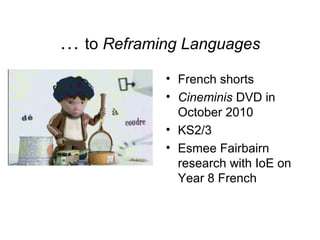
… to Reframing Languages
• French shorts
• Cineminis DVD in
October 2010
• KS2/3
• Esmee Fairbairn
research with IoE on
Year 8 French
… to Screening Languages
(2013-15)
• 6 schools/ 12
teachers
• Hounslow,
Barking&Dagenham
, Lambeth
• Year 8
• French and Spanish
• 20 schools/ 30
teachers
• 5 LAs, Teaching
School Alliances,
academy chains
• KS3
• French, Spanish,
German, Mandarin
Year 1 Year 2
Why film?
Why film?
• ‘Comprehensible input’ and ‘forms of
life’
• Culturally rich language context
• Engagement for children
Why shorts?
• New to children
• Manageability
• High quality - cinematic
Shorts pedagogy
• ‘Tell Me’ grids - in target language
• Hiding and revealing
• Stopping and starting
character setting
Story
Qu’est-ce qu’il
se passe
Mood
ambience
Qui? Ou? Quand?
‘Tell Me’ grids
Aidan Chambers/ CLPE
(Hide the screen and play the DVD, Mark)
puzzles patterns
surprises predictions
Value for teachers
• Develops new pedagogical knowledge and
approaches
• Develops their knowledge of and confidence in
exploring film as a cultural medium
• Changes their expectations of pupils in terms of
attainment
• Enables them to integrate more effectively cultural
awareness into their teaching
• Confidence to take risks - experimentation
• Imagination and originality
• Motivation and professional development
Value for pupils
• Improves motivation towards learning another
language
• Improves attainment in listening, speaking, reading
and writing
• Develops cultural knowledge and interest in film as a
cultural form
• Encourages them to continue learning a language at
Key Stage 4
Speaking skills
during viewing
• Learners report phrases with or without
help of teacher/sub-title e.g. on poster
or PP
• ‘Predictive speech’ - what is he/she
going to say/do?
• Learner originated questions
• Descriptions and summaries while the
film is running (no sound)
Speaking skills
after viewing
• Discussion of film – likes/dislikes re
characters, aspects of film
• Information gap activities and role play
• Storyboard - continuing the story, alternative
endings
• Guessing games: describing
characters/events
• Re-sequencing mixed-up stills from film,
relating correct sequence
Writing
•Storyboarding
•Sub-titles
•Prediction
•Alternative ending
http://screeninglanguages.wordpress.com
Film resources for MFL
• Kirikou et la Sorciere (1998, Fr, West African, BFI
films; dir Michel Ocelot); also Azur and Azmar/ The
Prince’s Quest by same director
• BFI shorts: Starting Stories 1&2 and Story Shorts
1&2
• Cine-minis DVD
• DVD of Courts Metrages: Courts de Recre and
Enfantillages, Institut Francais -
celine.cordier@diplomatie.gouv.fr
• ALL yahoo group on using film via Helen Myers
• BFI Southbank and Sheffield Showroom cinema days
on using film with MFL at KS2-KS5
• http://screeninglanguages.wordpress.com
Le Cinema, cent ans de
jeunesse
A film programme around camera
movement
Cinematheque Francaise/ BFI
Le cinema, cent ans de jeunesse
• Since 1995; 100th anniversary of cinema
• Annual film-making programme
• Exercises, film viewing, final ‘film essai’
• Aspect of film language - light; composition;
colour; camera movement
• 2010/11 ‘On/ Offscreen’
• 25 workshops: France, Spain, Portugal, Italy,
England
Shape of the programme
• Training in Paris in October/ November
• Exercises carried out November - February
• Review of exercises in March
• Final films ready end May; Paris screening in June;
London in July
• 1 or 2 hours a week workshops; optionally after
school or in curriculum (BTEC and GCSE)
• Viewing as well as making (2xDVDs of clips)
• Optional student mentors via AimHigher
Resources and support
• Training - 2 or 3 days
• 2 DVDs of clips - extensive ‘typologie’
with for eg 15 variations on camera movement
• Mentors - AimHigher
• Blog:
http://100ans.cinematheque.fr/100ans20092010/
• And BFI blog: http://markreid1895.wordpress.com
2009/ 2010
• Why move the camera?
Pourquoi bouge le camera?
• How many types of camera movement
are there?
Types of camera movement
• Describing character:
– Sequences of characters
– Establishing one character
– Following
– showing impuslive movement
• Describing space:
– Travelling
– Panoramic
– changing spaces
– ubiquity
Types of camera movement..
• Centring
• Decentring
• Poetic
• Motifs - stairs
character
mood
setting camera
Camera movement
• The Shining (Kubrick, 1980)
• Everyone Says I Love You (Allen, 1996)
• Project 1(Forbes, 2009)
• Elephant (van Sant, 2003)
• July (Omirbaev, 1988)
Camera movement project
• Exercise 1
a travelling shot taken from a vehicle, less
than a minute long, maybe with a mobile phone
• Exercise 2
a static shot of a moving object
a moving shot of a static object
a static shot of a static object
a moving shot of a moving object
Camera movement
programme.. Cont’d
• Exercise 3
Subject A moves towards subject B, looking
agitated. He/she continues past subject B and meets
subject C, while subject B moves away in the
opposite direction. Less than 5 minutes long
• Final Film
A person is filmed coming to a sudden
realisation; the emotional impact of the realisation is
communicated by shots from a moving camera
Exercises trailer
http://100ans.cinematheque.fr/100ans20092010/?p=639
Some films we made earlier..
London Nautical
• Vision
• Disappear
• Betrayal
• The Job Thief
Lambeth Academy
• Rough and Tumble/
The worst day of my
life
Wandsworth CLC
• Almost
Montrer/ cacher
BFI/ Cinematheque programme
2010/11
‘le secret’
enigma
mysteryFilming the back
Offscreen/ onscreen
ellipsis
censorship
Hiding in the frame
Actors concealing emotion
Threat of the invisible
Dramatic irony
Shadows/ light
• Not showing implies something is being denied, something is lacking
and needs to be filled
• Long shots deepen the element of mystery
• Impact of filming specific characters with their backs turned, denying
the audience its view
• The illicitness of a distorted, muffled, overheard conversation, a half
closed door. Balance of foreground / background interest
• Surprise element/comedic value of a disembodied voice and the
consequences of an “off” action coming into view
• Showing without showing – sound only, shrouding action with curtain,
shadows, limb of a body
• Momentum and interest is maintained by strategically obscuring the
naked body with objects
• One ‘running commentary’ scene replaces another that you ‘should’ be
seeing
• Fly-on-the-wall style filming, ‘hidden’ camera filming of the everyday, we
are privy to the apparent mundaneness of going up and down the stairs
continually following the back of a character. Heavy door denies
grandma the view of her grandchild, the gender of whom she rejects
Some notes from Paris..
• Camera void of ceiling is filled with sound and characters’ faces
come to fill the void in closeup. Only glimpses of the birds, lots
of clamourous sound (The Birds)
• Use of abstract sound and light to evoke mystery. “Off” action
with the subsequent evidence of an unseen act of violence.
Symbol of the bristling cat instead of “the thing” itself (Cat
People)
• Obscuring of actors’ faces arouses doubt and uncertainty as to
motivation
• Doubt and the evocation of the surreal through use of fog and
mysteriously positioned bull (Amarcord)
• Shading in black and white, lighting, semi-darkness – fear of
having one’s suspicions confirmed – semi-concealed monster,
the hole in the bag. You want him to reveal himself but you don’t
want to look. Horror genre. (Elephant Man)
• Ellipses. Murder action replaced by landscapes. Making the
audience wait for the result. The long sweeping preamble before
the dramatic revelation: ‘Rosemary’s Baby’ & ‘To Die For’
• Sound characterises a space, what you don’t hear is significant,
sound can cut out to signify enclosed space
Cinema, cent ans de jeunesse 2010/2011
Workshop Brief ‘Montrer/ Cacher’
Introductory exercises
Individual exercise (can be done at home)
Make a portrait out of different facets of someone you know well:
both/either between 3-6 photographs or filmed as a series of short
shots (total 2 minutes duration). Each photo or shot should show
only a partial characteristic of the person – both physically and
from their personality (a part of the body; a familiar object, a shot
from behind, use of light and shadow; blurring the image; different
scales within the shot..). At the end, the person mustn’t be
identifiable, but overall is evoked, suggested..
Collective exercises
1 Film an action completely in close-up (total duration
no more than 3 minutes and 8 shots maximum).
Indicative story line: ‘Person A moves from space into
another adjacent space, then gives something to
Person B. You choose what is given (a codeword; a
kiss; a curse; a gift; a warning) and which spaces you
use.
2 Film a complete short scene (maximum 3 minutes)
where someone in shot reacts against something or
someone outside the shot, which we never see but
know of through sound, light, reaction shots and the
direction of the gaze, or a reflection
The film essai (8 minutes maximum)
Indicative scenario: Two secrets, of which one is revealed, the
other withheld.
The main rule, which shouldn’t be given to the students until after
they have scripted their scenario:
Once the scenario has been written, students have to choose one
of the key scenes that will not be shown. The scene should still
play an important role in the story, but won’t be filmed, just
suggested (through an ellipsis, or use of offscreen sound,
reflections, camera movement which hides or reveals, or a
substitution of action in the edit)
blogs
https://markreid1895.wordpress.com/
http://100ans.cinematheque.fr/100ans200
92010/
Exercise from Lambeth
Films cited
Cat People (USA, Jacques Tourneur, 1942)
The Circle (Iran, Jafar Panahi, 2000)
He Dies at the End (Damian McCarthy, Youtube, added
2008)
Elephant Man (David Lynch, 1982)
After Tomorrow (Emma Sullivan, 2009)
Virus (Simon Hynd, 2002)
Moonfleet (USA, Fritz Lang, 1955)
Creature from the Black Lagoon (USA, Jack
Arnold,1954)

Reframing Languages

  • 1.
    Reframing Languages: Short filmsfor MFL Mark Reid BFI Education Mark.reid@bfi.org.uk www.bfi.org.uk
  • 2.
  • 3.
  • 4.
    from Reframing Literacy… •EYFS - KS3 • 61 LAs • 7 DVDs • Research and evaluation (Moving Literacy On, Marsh and Bearne) • Big impacts on literacy
  • 5.
    … to ReframingLanguages • French shorts • Cineminis DVD in October 2010 • KS2/3 • Esmee Fairbairn research with IoE on Year 8 French
  • 6.
    … to ScreeningLanguages (2013-15) • 6 schools/ 12 teachers • Hounslow, Barking&Dagenham , Lambeth • Year 8 • French and Spanish • 20 schools/ 30 teachers • 5 LAs, Teaching School Alliances, academy chains • KS3 • French, Spanish, German, Mandarin Year 1 Year 2
  • 7.
  • 8.
    Why film? • ‘Comprehensibleinput’ and ‘forms of life’ • Culturally rich language context • Engagement for children
  • 9.
    Why shorts? • Newto children • Manageability • High quality - cinematic
  • 10.
    Shorts pedagogy • ‘TellMe’ grids - in target language • Hiding and revealing • Stopping and starting
  • 11.
    character setting Story Qu’est-ce qu’il sepasse Mood ambience Qui? Ou? Quand? ‘Tell Me’ grids Aidan Chambers/ CLPE
  • 12.
    (Hide the screenand play the DVD, Mark)
  • 13.
  • 14.
    Value for teachers •Develops new pedagogical knowledge and approaches • Develops their knowledge of and confidence in exploring film as a cultural medium • Changes their expectations of pupils in terms of attainment • Enables them to integrate more effectively cultural awareness into their teaching • Confidence to take risks - experimentation • Imagination and originality • Motivation and professional development
  • 15.
    Value for pupils •Improves motivation towards learning another language • Improves attainment in listening, speaking, reading and writing • Develops cultural knowledge and interest in film as a cultural form • Encourages them to continue learning a language at Key Stage 4
  • 16.
    Speaking skills during viewing •Learners report phrases with or without help of teacher/sub-title e.g. on poster or PP • ‘Predictive speech’ - what is he/she going to say/do? • Learner originated questions • Descriptions and summaries while the film is running (no sound)
  • 17.
    Speaking skills after viewing •Discussion of film – likes/dislikes re characters, aspects of film • Information gap activities and role play • Storyboard - continuing the story, alternative endings • Guessing games: describing characters/events • Re-sequencing mixed-up stills from film, relating correct sequence
  • 18.
  • 19.
  • 20.
    Film resources forMFL • Kirikou et la Sorciere (1998, Fr, West African, BFI films; dir Michel Ocelot); also Azur and Azmar/ The Prince’s Quest by same director • BFI shorts: Starting Stories 1&2 and Story Shorts 1&2 • Cine-minis DVD • DVD of Courts Metrages: Courts de Recre and Enfantillages, Institut Francais - celine.cordier@diplomatie.gouv.fr • ALL yahoo group on using film via Helen Myers • BFI Southbank and Sheffield Showroom cinema days on using film with MFL at KS2-KS5 • http://screeninglanguages.wordpress.com
  • 22.
    Le Cinema, centans de jeunesse A film programme around camera movement Cinematheque Francaise/ BFI
  • 23.
    Le cinema, centans de jeunesse • Since 1995; 100th anniversary of cinema • Annual film-making programme • Exercises, film viewing, final ‘film essai’ • Aspect of film language - light; composition; colour; camera movement • 2010/11 ‘On/ Offscreen’ • 25 workshops: France, Spain, Portugal, Italy, England
  • 24.
    Shape of theprogramme • Training in Paris in October/ November • Exercises carried out November - February • Review of exercises in March • Final films ready end May; Paris screening in June; London in July • 1 or 2 hours a week workshops; optionally after school or in curriculum (BTEC and GCSE) • Viewing as well as making (2xDVDs of clips) • Optional student mentors via AimHigher
  • 25.
    Resources and support •Training - 2 or 3 days • 2 DVDs of clips - extensive ‘typologie’ with for eg 15 variations on camera movement • Mentors - AimHigher • Blog: http://100ans.cinematheque.fr/100ans20092010/ • And BFI blog: http://markreid1895.wordpress.com
  • 26.
    2009/ 2010 • Whymove the camera? Pourquoi bouge le camera? • How many types of camera movement are there?
  • 27.
    Types of cameramovement • Describing character: – Sequences of characters – Establishing one character – Following – showing impuslive movement • Describing space: – Travelling – Panoramic – changing spaces – ubiquity
  • 28.
    Types of cameramovement.. • Centring • Decentring • Poetic • Motifs - stairs
  • 29.
  • 31.
    Camera movement • TheShining (Kubrick, 1980) • Everyone Says I Love You (Allen, 1996) • Project 1(Forbes, 2009) • Elephant (van Sant, 2003) • July (Omirbaev, 1988)
  • 32.
    Camera movement project •Exercise 1 a travelling shot taken from a vehicle, less than a minute long, maybe with a mobile phone • Exercise 2 a static shot of a moving object a moving shot of a static object a static shot of a static object a moving shot of a moving object
  • 33.
    Camera movement programme.. Cont’d •Exercise 3 Subject A moves towards subject B, looking agitated. He/she continues past subject B and meets subject C, while subject B moves away in the opposite direction. Less than 5 minutes long • Final Film A person is filmed coming to a sudden realisation; the emotional impact of the realisation is communicated by shots from a moving camera
  • 34.
  • 35.
    Some films wemade earlier.. London Nautical • Vision • Disappear • Betrayal • The Job Thief Lambeth Academy • Rough and Tumble/ The worst day of my life Wandsworth CLC • Almost
  • 36.
  • 37.
    ‘le secret’ enigma mysteryFilming theback Offscreen/ onscreen ellipsis censorship Hiding in the frame Actors concealing emotion Threat of the invisible Dramatic irony Shadows/ light
  • 38.
    • Not showingimplies something is being denied, something is lacking and needs to be filled • Long shots deepen the element of mystery • Impact of filming specific characters with their backs turned, denying the audience its view • The illicitness of a distorted, muffled, overheard conversation, a half closed door. Balance of foreground / background interest • Surprise element/comedic value of a disembodied voice and the consequences of an “off” action coming into view • Showing without showing – sound only, shrouding action with curtain, shadows, limb of a body • Momentum and interest is maintained by strategically obscuring the naked body with objects • One ‘running commentary’ scene replaces another that you ‘should’ be seeing • Fly-on-the-wall style filming, ‘hidden’ camera filming of the everyday, we are privy to the apparent mundaneness of going up and down the stairs continually following the back of a character. Heavy door denies grandma the view of her grandchild, the gender of whom she rejects Some notes from Paris..
  • 39.
    • Camera voidof ceiling is filled with sound and characters’ faces come to fill the void in closeup. Only glimpses of the birds, lots of clamourous sound (The Birds) • Use of abstract sound and light to evoke mystery. “Off” action with the subsequent evidence of an unseen act of violence. Symbol of the bristling cat instead of “the thing” itself (Cat People) • Obscuring of actors’ faces arouses doubt and uncertainty as to motivation • Doubt and the evocation of the surreal through use of fog and mysteriously positioned bull (Amarcord) • Shading in black and white, lighting, semi-darkness – fear of having one’s suspicions confirmed – semi-concealed monster, the hole in the bag. You want him to reveal himself but you don’t want to look. Horror genre. (Elephant Man) • Ellipses. Murder action replaced by landscapes. Making the audience wait for the result. The long sweeping preamble before the dramatic revelation: ‘Rosemary’s Baby’ & ‘To Die For’ • Sound characterises a space, what you don’t hear is significant, sound can cut out to signify enclosed space
  • 40.
    Cinema, cent ansde jeunesse 2010/2011 Workshop Brief ‘Montrer/ Cacher’ Introductory exercises Individual exercise (can be done at home) Make a portrait out of different facets of someone you know well: both/either between 3-6 photographs or filmed as a series of short shots (total 2 minutes duration). Each photo or shot should show only a partial characteristic of the person – both physically and from their personality (a part of the body; a familiar object, a shot from behind, use of light and shadow; blurring the image; different scales within the shot..). At the end, the person mustn’t be identifiable, but overall is evoked, suggested..
  • 41.
    Collective exercises 1 Filman action completely in close-up (total duration no more than 3 minutes and 8 shots maximum). Indicative story line: ‘Person A moves from space into another adjacent space, then gives something to Person B. You choose what is given (a codeword; a kiss; a curse; a gift; a warning) and which spaces you use. 2 Film a complete short scene (maximum 3 minutes) where someone in shot reacts against something or someone outside the shot, which we never see but know of through sound, light, reaction shots and the direction of the gaze, or a reflection
  • 42.
    The film essai(8 minutes maximum) Indicative scenario: Two secrets, of which one is revealed, the other withheld. The main rule, which shouldn’t be given to the students until after they have scripted their scenario: Once the scenario has been written, students have to choose one of the key scenes that will not be shown. The scene should still play an important role in the story, but won’t be filmed, just suggested (through an ellipsis, or use of offscreen sound, reflections, camera movement which hides or reveals, or a substitution of action in the edit)
  • 43.
  • 44.
  • 45.
    Films cited Cat People(USA, Jacques Tourneur, 1942) The Circle (Iran, Jafar Panahi, 2000) He Dies at the End (Damian McCarthy, Youtube, added 2008) Elephant Man (David Lynch, 1982) After Tomorrow (Emma Sullivan, 2009) Virus (Simon Hynd, 2002) Moonfleet (USA, Fritz Lang, 1955) Creature from the Black Lagoon (USA, Jack Arnold,1954)