ReflectionReflection
What is reflection?What is reflection?
Is it important? Why?Is it important? Why?
When & how was the lastWhen & how was the last
time you reflected ontime you reflected on
something?something?
The reflective processThe reflective process
 What do you think the reflectiveWhat do you think the reflective
process involves?process involves?
 Can you pinpoint any stages withinCan you pinpoint any stages within
the process?the process?
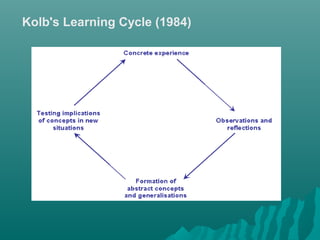
Kolb's Learning Cycle (1984)
Models of reflection:Models of reflection:
Seem to be based around the one ideaSeem to be based around the one idea
ofof
 looking at something,looking at something,
 thinking about why it is as it is, andthinking about why it is as it is, and
 deciding what to do next time.deciding what to do next time.
The models oftenThe models often
 Have a cyclical approachHave a cyclical approach
 Ask questionsAsk questions
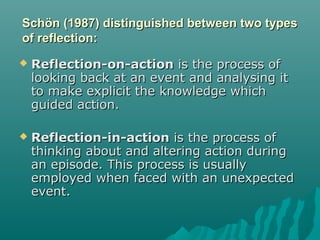
Schön (1987) distinguished between two typesSchön (1987) distinguished between two types
of reflection:of reflection:
 Reflection-on-actionReflection-on-action is the process ofis the process of
looking back at an event and analysing itlooking back at an event and analysing it
to make explicit the knowledge whichto make explicit the knowledge which
guided action.guided action.
 Reflection-in-actionReflection-in-action is the process ofis the process of
thinking about and altering action duringthinking about and altering action during
an episode. This process is usuallyan episode. This process is usually
employed when faced with an unexpectedemployed when faced with an unexpected
event.event.
Meichenbaum (1995, cited in Kinsella, 2006, p279),Meichenbaum (1995, cited in Kinsella, 2006, p279),
describes the constructivist perspective as:describes the constructivist perspective as:
‘founded on the idea that humans
actively construct their personal realities
and create their own representational
models of the world’
So what does this mean for teachers?
Schön (1987, cited in Kinsella, 2006, p284)
writes of professional practitioners:
Through countless acts of attention and inattention, naming,
sensemaking, boundary setting, and control, they make and
maintain the worlds matched to their professional knowledge
and know-how. They are in transaction with their practice worlds,
framing the problems that arise in practice situations and shaping
the situations to fit the frames, framing their roles and constructing
practice situations to make their role-frames operational.
They have, in short, particular, professional ways of seeing their
world and a way of constructing and maintaining the world as
they see it. When practitioners respond to the indeterminate zones
of practice by holding a reflective conversation with the materials
of their situations, they remake a part of their practice world and
thereby reveal the usually tacit processes of worldmaking that
underlie all of their practice. (Schön, 1987, p. 36)
Schön notes that debates in professional practice often
involve conflicting frames in which practitioners pay
attention to different facts and make different sense of
the facts they notice.
Through acts of naming and framing, the practitioner
selects things for attention and organizes them, guided
by an appreciation of the situation that gives it
coherence and sets a direction for action
In this way the worlds of professional practice are
made and remade.
(Kinsella, 2006)
Because the unique case falls outside the
categories of existing theory or technique, the
practitioner cannot treat it as an instrumental
problem to be solved by applying one of the rules in
her store of professional knowledge. The case is not
‘in the book’. If she is to deal with it competently,
she must do so by a kind of improvisation, inventing
and testing in the situation strategies of her own
devising. (Schön, 1987, cited in Kinsella, 2006)
Individual practitioners are seen as
constructing viable worlds of their own
making.
ModelsModels
 Gibbs, 1998Gibbs, 1998
 RaceRace
 Reflection continuumReflection continuum
 John’s model, 1992John’s model, 1992
 Carper’s model, 1992Carper’s model, 1992
 The Johari Window (Luft and Ingham,The Johari Window (Luft and Ingham,
1955)1955)
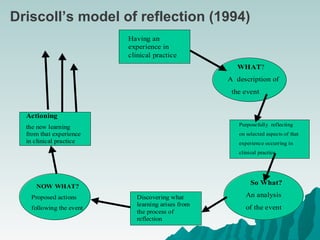
 Driscoll’s model of reflection, 1994Driscoll’s model of reflection, 1994
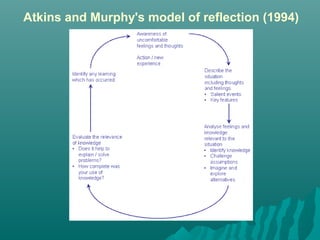
 Atkins and Murphy, 1994Atkins and Murphy, 1994
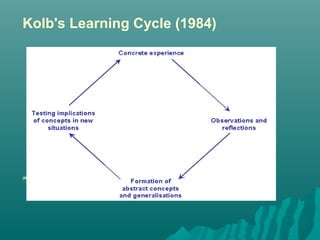
Kolb's Learning Cycle (1984)
(Kolb 1984)
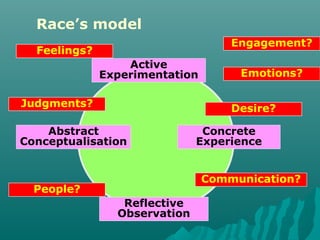
Race’s model
Active
Experimentation
Concrete
Experience
Reflective
Observation
Abstract
Conceptualisation
Feelings?
Emotions?
People?
Communication?
Judgments? Desire?
Engagement?
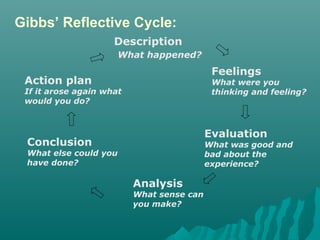
Gibbs’ Reflective Cycle:
Action plan
If it arose again what
would you do?
Description
What happened?
Feelings
What were you
thinking and feeling?
Evaluation
What was good and
bad about the
experience?
Analysis
What sense can
you make?
Conclusion
What else could you
have done?
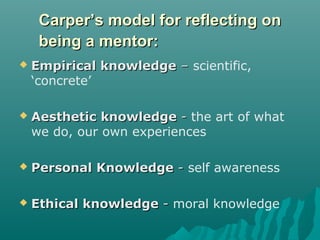
Carper’s model for reflecting onCarper’s model for reflecting on
being a mentor:being a mentor:
 Empirical knowledgeEmpirical knowledge –– scientific,
‘concrete’
 Aesthetic knowledgeAesthetic knowledge -- the art of what
we do, our own experiences
 Personal KnowledgePersonal Knowledge -- self awareness
 Ethical knowledgeEthical knowledge -- moral knowledge
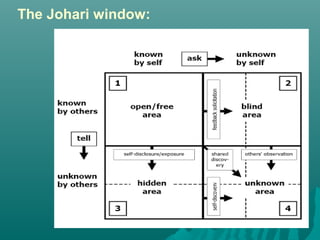
The Johari window:
Having an
experience in
clinical practice
Purposefully reflecting
on selected aspects of that
experience occurring in
clinical practice
So What?
An analysis
of the event
Discovering what
learning arises from
the process of
reflection
NOW WHAT?
Proposed actions
following the event
Actioning
the new learning
from that experience
in clinical practice
WHAT?
A description of
the event
Driscoll’s model of reflection (1994)
Atkins and Murphy's model of reflection (1994)


Further reading
•Bolton, G. (2005) Reflective Practice Writing and
Professional Development, 2nd edn, London: Sage 
Publications.
•Ghaye, A. and Ghaye, K. (1998) Teaching and Learning
through Critical Reflective Practice, London: David Fulton 
Publishers Ltd.
•Moon, J. (2004) A Handbook of Reflective and
Experiential Learning: Theory and Practice, London: 
Routledge Falmer 
•Robson, J. (2006) Teacher Professionalism in Further and
Higher Education, London: Routledge

Reflective practice

  • 1.
    ReflectionReflection What is reflection?Whatis reflection? Is it important? Why?Is it important? Why? When & how was the lastWhen & how was the last time you reflected ontime you reflected on something?something?
  • 2.
    The reflective processThereflective process  What do you think the reflectiveWhat do you think the reflective process involves?process involves?  Can you pinpoint any stages withinCan you pinpoint any stages within the process?the process?
  • 3.
  • 4.
    Models of reflection:Modelsof reflection: Seem to be based around the one ideaSeem to be based around the one idea ofof  looking at something,looking at something,  thinking about why it is as it is, andthinking about why it is as it is, and  deciding what to do next time.deciding what to do next time. The models oftenThe models often  Have a cyclical approachHave a cyclical approach  Ask questionsAsk questions
  • 5.
    Schön (1987) distinguishedbetween two typesSchön (1987) distinguished between two types of reflection:of reflection:  Reflection-on-actionReflection-on-action is the process ofis the process of looking back at an event and analysing itlooking back at an event and analysing it to make explicit the knowledge whichto make explicit the knowledge which guided action.guided action.  Reflection-in-actionReflection-in-action is the process ofis the process of thinking about and altering action duringthinking about and altering action during an episode. This process is usuallyan episode. This process is usually employed when faced with an unexpectedemployed when faced with an unexpected event.event.
  • 6.
    Meichenbaum (1995, citedin Kinsella, 2006, p279),Meichenbaum (1995, cited in Kinsella, 2006, p279), describes the constructivist perspective as:describes the constructivist perspective as: ‘founded on the idea that humans actively construct their personal realities and create their own representational models of the world’ So what does this mean for teachers?
  • 7.
    Schön (1987, citedin Kinsella, 2006, p284) writes of professional practitioners: Through countless acts of attention and inattention, naming, sensemaking, boundary setting, and control, they make and maintain the worlds matched to their professional knowledge and know-how. They are in transaction with their practice worlds, framing the problems that arise in practice situations and shaping the situations to fit the frames, framing their roles and constructing practice situations to make their role-frames operational. They have, in short, particular, professional ways of seeing their world and a way of constructing and maintaining the world as they see it. When practitioners respond to the indeterminate zones of practice by holding a reflective conversation with the materials of their situations, they remake a part of their practice world and thereby reveal the usually tacit processes of worldmaking that underlie all of their practice. (Schön, 1987, p. 36)
  • 8.
    Schön notes thatdebates in professional practice often involve conflicting frames in which practitioners pay attention to different facts and make different sense of the facts they notice. Through acts of naming and framing, the practitioner selects things for attention and organizes them, guided by an appreciation of the situation that gives it coherence and sets a direction for action In this way the worlds of professional practice are made and remade. (Kinsella, 2006)
  • 9.
    Because the uniquecase falls outside the categories of existing theory or technique, the practitioner cannot treat it as an instrumental problem to be solved by applying one of the rules in her store of professional knowledge. The case is not ‘in the book’. If she is to deal with it competently, she must do so by a kind of improvisation, inventing and testing in the situation strategies of her own devising. (Schön, 1987, cited in Kinsella, 2006) Individual practitioners are seen as constructing viable worlds of their own making.
  • 10.
    ModelsModels  Gibbs, 1998Gibbs,1998  RaceRace  Reflection continuumReflection continuum  John’s model, 1992John’s model, 1992  Carper’s model, 1992Carper’s model, 1992  The Johari Window (Luft and Ingham,The Johari Window (Luft and Ingham, 1955)1955)  Driscoll’s model of reflection, 1994Driscoll’s model of reflection, 1994  Atkins and Murphy, 1994Atkins and Murphy, 1994
  • 11.
    Kolb's Learning Cycle(1984) (Kolb 1984)
  • 12.
  • 13.
    Gibbs’ Reflective Cycle: Actionplan If it arose again what would you do? Description What happened? Feelings What were you thinking and feeling? Evaluation What was good and bad about the experience? Analysis What sense can you make? Conclusion What else could you have done?
  • 14.
    Carper’s model forreflecting onCarper’s model for reflecting on being a mentor:being a mentor:  Empirical knowledgeEmpirical knowledge –– scientific, ‘concrete’  Aesthetic knowledgeAesthetic knowledge -- the art of what we do, our own experiences  Personal KnowledgePersonal Knowledge -- self awareness  Ethical knowledgeEthical knowledge -- moral knowledge
  • 15.
  • 16.
    Having an experience in clinicalpractice Purposefully reflecting on selected aspects of that experience occurring in clinical practice So What? An analysis of the event Discovering what learning arises from the process of reflection NOW WHAT? Proposed actions following the event Actioning the new learning from that experience in clinical practice WHAT? A description of the event Driscoll’s model of reflection (1994)
  • 17.
    Atkins and Murphy'smodel of reflection (1994)                                                                                                                                                                                                                                                                                                                                                                                       
  • 18.
    Further reading •Bolton, G. (2005) Reflective PracticeWriting and Professional Development, 2nd edn, London: Sage  Publications. •Ghaye, A. and Ghaye, K. (1998) Teaching and Learning through Critical Reflective Practice, London: David Fulton  Publishers Ltd. •Moon, J. (2004) A Handbook of Reflective and Experiential Learning: Theory and Practice, London:  Routledge Falmer  •Robson, J. (2006) Teacher Professionalism in Further and Higher Education, London: Routledge