Reference Interviews: You don’t
have to learn it (all) again
Yongtao Lin, MLIS
yolin@ucalgary.ca
Phone: 403-521-3285
Librarian, Tom Baker Cancer Centre
In Scope & Out of Scope
• What is a reference
interview (RI)
• When is a RI necessary
• Why is a RI important
• Strategies for successful
RI
• RI in virtual
environments
• How to create an
inviting environment
(attitudes,
approachability and
interest)
• Reference Service
Policies and Procedures
• Technology to facilitate
and enhance RI
What is a Reference Interview (RI)?
• RI is a type of interviews
• RI is not about “answering questions”
• RI is query negotiation, giving and receiving
information, advice, instruction, or getting
feedback, or following up
Source: Ross, C.S., Nilsen, K., & Radford, M. (2009). Conducting the reference
interview. 2 ed. New York: Neal-Schuman Publishers, Inc.
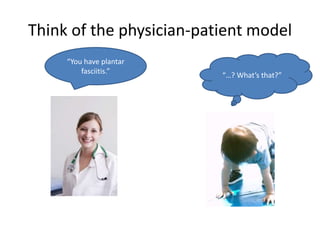
Think of the physician-patient model
“My foot
hurts..”
“What part of
your foot?”
Think of the physician-patient model
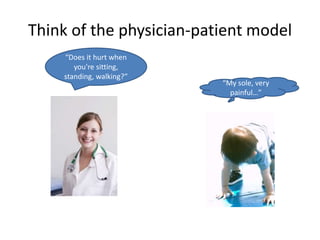
“My sole, very
painful…”
“Does it hurt when
you're sitting,
standing, walking?”
Think of the physician-patient model
“It hurts when I get
up in the morning,
but goes away as I
walk.”
“All the time or just
sometimes? Worse
at some point?”
Think of the physician-patient model
“…? What’s that?”
“You have plantar
fasciitis.”
Information needed
• Question, problem (“You said you want information about
Preadmission clinic practice?”)
• Past experience (“Have you done the search yourself?”)
• Context (“Can you tell me more about the topic?”)
• Purpose (“What will you use information for?”)
• Scope (“How much detail do you need?”)
• Currency (“How recent does the information need to be?”)
• Preference (“What format would you like the information
in?”)
• Expectations (“When do you need the information by?”)
Do our patrons know what they want?
Please respond to the poll:
How often do you see/hear when they request
articles, they actually need a literature search?
- Never
- Sometimes
- Always
Do our patrons express their information needs
clearly and completely in their initial question?
Please respond to the poll:
How often do you see/hear the terms of “best
practices” or “best evidence” from our patrons?
- Never
- Sometimes
- Always
Do we make ourselves understood?
Please type in the chat box:
Think of a library term that is commonly used by
you but doesn’t make any sense to the patron?
Source: Hutcherson, N. (2004). Library jargon: Student recognition of terms
and concepts commonly used by librarians in the classroom. College and
Research Libraries, 65 (4):349-354.
Reference Interviews in Virtual
Environments
• [Patron]: Good morning.
• [Library Staff]: Hello!
• [Library Staff]: How can I help you?
• [Patron]: the annals of pharmacotherapy, pharmacotherapy, u.s.
Pharmacist.
• [Patron]: did you get my request?
• [Library Staff]: All I have at this end is: the annals of
pharmacotherapy, pharmacotherapy, u.s. Pharmacist.
• [Library Staff]: If you have a citation for a specific article, please let
me know.
• [Patron]: i do not have a specific citation. i am looking at journals
we used to receive and if they are available on line we will not order
them.
• [Library Staff]: I can certainly check to see what's available.
Barriers and Strategies
Please type in the whiteboard:
Barriers Strategies
Some of the strategies you may have
said…
• The First Thirty Seconds
• Proactive, long term relationship building
• Asking specific questions related to the topic
(age, sex, intervention, outcomes…)
• Listening, paraphrasing, asking open ended
questions
• Following up
Source: Knoer, S. (2011). Reference interview today (E-book). Libraries
Unlimited.
Text-based Strategies
• Use your in-person reference experience as a
compass
• Short sentences or with only a few words at a time
• Become familiar with common abbreviation
• Can add personal touch
• Consider using more than text to communicate
• Learn available resource options beforehand
• Hurry (just kidding)
• Relax (yes, really) 
On the phone…
• Switch to phone from chat or email
• An email to follow up after chat or telephone
• Comfortable making referrals to other formats
• Ask clarifying questions
• Explain what you are doing (check online…)
• Write it down
• Indicate the source of the answer
• Follow up – “Did this completely answer your
question?”
Email continues to be popular
• Find out what real question is before trying to
answering it
• Always include a follow-up question
• Pick up a phone to clarify
Role Playing - Patron and library staff
• Patron: Need 3
volunteers!!
• Library staff: Be your
best!
1. I’d like to do some lit
searching on Multiple
Sclerosis (MS).
2. How do I narrow
down my search – I
had 1,400 results?
3. How do I keep up with
the literature?
Transferrable Skills
• Set the stage
• Ask, clarify, explain and follow up
• Make referrals
Thank you
• Questions?
• Please consider posting in Discussion Boards!
• Please pick up a search from the queue today
and negotiate a timeline!

Reference interviews

  • 1.
    Reference Interviews: Youdon’t have to learn it (all) again Yongtao Lin, MLIS yolin@ucalgary.ca Phone: 403-521-3285 Librarian, Tom Baker Cancer Centre
  • 2.
    In Scope &Out of Scope • What is a reference interview (RI) • When is a RI necessary • Why is a RI important • Strategies for successful RI • RI in virtual environments • How to create an inviting environment (attitudes, approachability and interest) • Reference Service Policies and Procedures • Technology to facilitate and enhance RI
  • 3.
    What is aReference Interview (RI)? • RI is a type of interviews • RI is not about “answering questions” • RI is query negotiation, giving and receiving information, advice, instruction, or getting feedback, or following up Source: Ross, C.S., Nilsen, K., & Radford, M. (2009). Conducting the reference interview. 2 ed. New York: Neal-Schuman Publishers, Inc.
  • 4.
    Think of thephysician-patient model “My foot hurts..” “What part of your foot?”
  • 5.
    Think of thephysician-patient model “My sole, very painful…” “Does it hurt when you're sitting, standing, walking?”
  • 6.
    Think of thephysician-patient model “It hurts when I get up in the morning, but goes away as I walk.” “All the time or just sometimes? Worse at some point?”
  • 7.
    Think of thephysician-patient model “…? What’s that?” “You have plantar fasciitis.”
  • 8.
    Information needed • Question,problem (“You said you want information about Preadmission clinic practice?”) • Past experience (“Have you done the search yourself?”) • Context (“Can you tell me more about the topic?”) • Purpose (“What will you use information for?”) • Scope (“How much detail do you need?”) • Currency (“How recent does the information need to be?”) • Preference (“What format would you like the information in?”) • Expectations (“When do you need the information by?”)
  • 9.
    Do our patronsknow what they want? Please respond to the poll: How often do you see/hear when they request articles, they actually need a literature search? - Never - Sometimes - Always
  • 10.
    Do our patronsexpress their information needs clearly and completely in their initial question? Please respond to the poll: How often do you see/hear the terms of “best practices” or “best evidence” from our patrons? - Never - Sometimes - Always
  • 11.
    Do we makeourselves understood? Please type in the chat box: Think of a library term that is commonly used by you but doesn’t make any sense to the patron? Source: Hutcherson, N. (2004). Library jargon: Student recognition of terms and concepts commonly used by librarians in the classroom. College and Research Libraries, 65 (4):349-354.
  • 12.
    Reference Interviews inVirtual Environments • [Patron]: Good morning. • [Library Staff]: Hello! • [Library Staff]: How can I help you? • [Patron]: the annals of pharmacotherapy, pharmacotherapy, u.s. Pharmacist. • [Patron]: did you get my request? • [Library Staff]: All I have at this end is: the annals of pharmacotherapy, pharmacotherapy, u.s. Pharmacist. • [Library Staff]: If you have a citation for a specific article, please let me know. • [Patron]: i do not have a specific citation. i am looking at journals we used to receive and if they are available on line we will not order them. • [Library Staff]: I can certainly check to see what's available.
  • 13.
    Barriers and Strategies Pleasetype in the whiteboard: Barriers Strategies
  • 14.
    Some of thestrategies you may have said… • The First Thirty Seconds • Proactive, long term relationship building • Asking specific questions related to the topic (age, sex, intervention, outcomes…) • Listening, paraphrasing, asking open ended questions • Following up Source: Knoer, S. (2011). Reference interview today (E-book). Libraries Unlimited.
  • 15.
    Text-based Strategies • Useyour in-person reference experience as a compass • Short sentences or with only a few words at a time • Become familiar with common abbreviation • Can add personal touch • Consider using more than text to communicate • Learn available resource options beforehand • Hurry (just kidding) • Relax (yes, really) 
  • 16.
    On the phone… •Switch to phone from chat or email • An email to follow up after chat or telephone • Comfortable making referrals to other formats • Ask clarifying questions • Explain what you are doing (check online…) • Write it down • Indicate the source of the answer • Follow up – “Did this completely answer your question?”
  • 17.
    Email continues tobe popular • Find out what real question is before trying to answering it • Always include a follow-up question • Pick up a phone to clarify
  • 18.
    Role Playing -Patron and library staff • Patron: Need 3 volunteers!! • Library staff: Be your best! 1. I’d like to do some lit searching on Multiple Sclerosis (MS). 2. How do I narrow down my search – I had 1,400 results? 3. How do I keep up with the literature?
  • 19.
    Transferrable Skills • Setthe stage • Ask, clarify, explain and follow up • Make referrals
  • 20.
    Thank you • Questions? •Please consider posting in Discussion Boards! • Please pick up a search from the queue today and negotiate a timeline!

Editor's Notes

  • #9 Preadmission clinic practice seems to be changing internationally are there any articles or research that is looking at advancing pre-admission the consolidation approach & potentially offsite from the acute care hospital Likely the past 5 years 5 days is a reasonable timeline..
  • #10 When is a RI necessary and why is it important?
  • #12 Copyright, database, reference service, abstract, boolean logic, bibliography, control vocabulary, descriptor, MeSH, journal, ILL, proxy
  • #13 RI is even more important in virtual environments where there are no verbal cues (2007 Radford, Connaway, random sample of 581 chat questions, using a reference interview boosted accuracy considerably and was present in 84% of the 141 correct answers
  • #14 What are the barriers of conducting effective reference interviews and what strategies you think would work to overcome them? Chat: speed, urgency, nonverbal cues Technology difficulty Time pressure
  • #15 Place is right Available and listening Contact has been made Topic (in general) understood
  • #16 RI is often absent in Virtual Reference transactions, a few studies reported between 32 and 55.5% of the time and research show poorer results for the RI as well. A variety of communication technique can facilitate the online reference interview. One suggestion was communicating in short sentences or within only a few words at a time Can add personal touch by using same level of emoticons, graphical representations…, and by introducing yourself and addressing patrons by name Consider using more than text to communicate (videos and images, or other multimedia content Relax – sit back and take time to respond/search/follow up, and communicate with the patron about what you are doing
  • #17 When the question is presented originally using email or chat, patrons may find it easier sometimes to switch to the telephone to complete the negotiation of a complex question. The reverse may also happen, an interaction starts as a phone call may end with an email that summaries or delivers the information. “Let me transfer you to ….” “If you would leave your number, I’ll find out abut that program and call you back in an hour…” Telephone reference has traditionally focused on ready-reference questions with answers that don’t take long over the phone. Again you can’t see users or rely on visual cues and can’t use the physical setting by showing patrons resources Clarify questions such as “ How may I help you? “What information would you like on that” “What aspect of X are you interested in?” “How would you like the information delivered to you?”
  • #18 Convenience from the users end, comfortable for some users, less transcription errors, more time for thought and reflection But again no visual and auditory cues, problems in interpreting the tone of an email exchange, no apparent view on user category RI skills apply just as much in the digital environment as they do in face to face encounters Always include follow up questions – if this answer isn’t helpful, please email us again”. Keep back and forth messaging to a minimum
  • #20 With nonverbal and verbal attending skills