By
D.SARAVANAMURTHY
M.E 1ST YEAR
 Construction Project Management (CM) is a
professional service that uses specialized, project
management techniques to oversee the planning,
design, and construction of a project, from its
beginning to its end. The purpose of CM is to
control a project's time, cost and quality.
 Large construction projects are inherently
complex and dynamic.
 However, most of them do not achieve much
success.
 A properly defined and managed scope leads
to delivering quality project in agreed cost
and within specified schedules to the stake-
holders.
 In many construction projects project
managers and contractors find difficulties like
poor planning of project, poor material,
labour shortages, increased cost of material,
delays in deliveries, wastage of material, over
budgeting, unexpected weather changes,
lapse in management and control, loss of
material, poor communication etc.
 This results into cost and time overruns,
conflicts in project.
 Due to cost reduction techniques
cost of project is managed
so that contractor does not
suffer losses while carrying
different activities of projects.
 Fixed Costs:-
Fixed costs are those that do not change
throughout the life-cycle of a project. For
example, if construction of road is there, the
excavators and bulldozers are fixed costs. For
software development projects, the physical
development space and development
computers are fixed costs to the project.
 Direct Costs :-
Direct costs are expenses that come out
of the project budget directly. For example, if
outsourc ing some of the development work,
the developers are expected to put in a
specific amount of time, which is then billed
for. The developer salaries are direct costs.
 Sunk Costs :-
Sunk costs are those that have been
incurred in a project, but have not produced
value towards the project’s objectives.
 1) Similar Construction Projects:
For the construction estimate, the best
reference will be similar construction
projects. The final cost of those similar
projects can give the idea for the new
construction project cost calculation. The
final cost of past project needs to be factored
with current construction cost indices.
Construction Material Costs:
Construction material cost consists of
material cost, shipping charges and taxes
applicable if any. So, it is important consider
all these variations while calculating
construction material cost.
Labor Wage Rates:
Labor wages varies place to place. So,
local wage rate should be considered in
calculation. If the project has to be started
after several months of estimating the project
cost, the probable variation in wage rates has
to be considered in the calculation.
 Construction Site Conditions:
Project site conditions can increase
construction costs. Site conditions such as
poor soil conditions, wetlands, contaminated
materials, conflicting utilities environmentally
sensitivity area, ground water, river or stream
crossings, heavy traffic, buried storage tanks,
archaeological sites, endangered species
habitat and similar existing conditions etc.
can increase the project cost during
construction phase if these variations are not
considered during estimation.
 Inflation Factor:
A construction project can continue for
years before completion. During the
construction period, the cost of materials,
tools, labors, equipments etc. may vary from
time to time. This variation in the prices
should be considered during cost estimation
process.
Project Schedule:
Duration of construction project is affects
the cost.
 Increase in project duration can increase the
construction project cost due to increase in
indirect costs, while reduction in construction
cost also increases the project cost due to
increase in direct costs.
 Therefore, construction project schedules
also need to be considered during project
cost estimation.
Reputation of Engineer:
If a contractor is comfortable working with
a particular engineer, or engineering firm, the
project runs smoother and therefore is more
cost-effective
 Size and Type of Construction Project:
For a large construction project, there can
be high demand for workforce. For such a
requirements, local workmen may not be
sufficient and workmen from different
regions need be called. These may incur extra
costs such projects and also for the type of
construction project where specialized
workforce is required.
 Location of Construction:
When a location of construction project is
far away from available resources, it increases
the project cost. Cost of transportation for
workmen, equipments, materials, tools etc.
increases with distance and adds to the
project cost.
 There are various cost effective techniques of
construction. Lots of them are also energy
efficient and easily adoptable.
 Since India is a developing country, the
economy haves importance There is a need
for the adoption of strong, durable,
environment friendly, ecologically
appropriate, energy efficient and yet cost
effective materials and appropriate
technologies in construction.
In construction project reduction in cost
can be achieved by some of the following
techniques:
a) Value Engineering
b) Material Management
c) Budgetary Control
d) Cost optimization Techniques
e) Cost Reduction Techniques at site
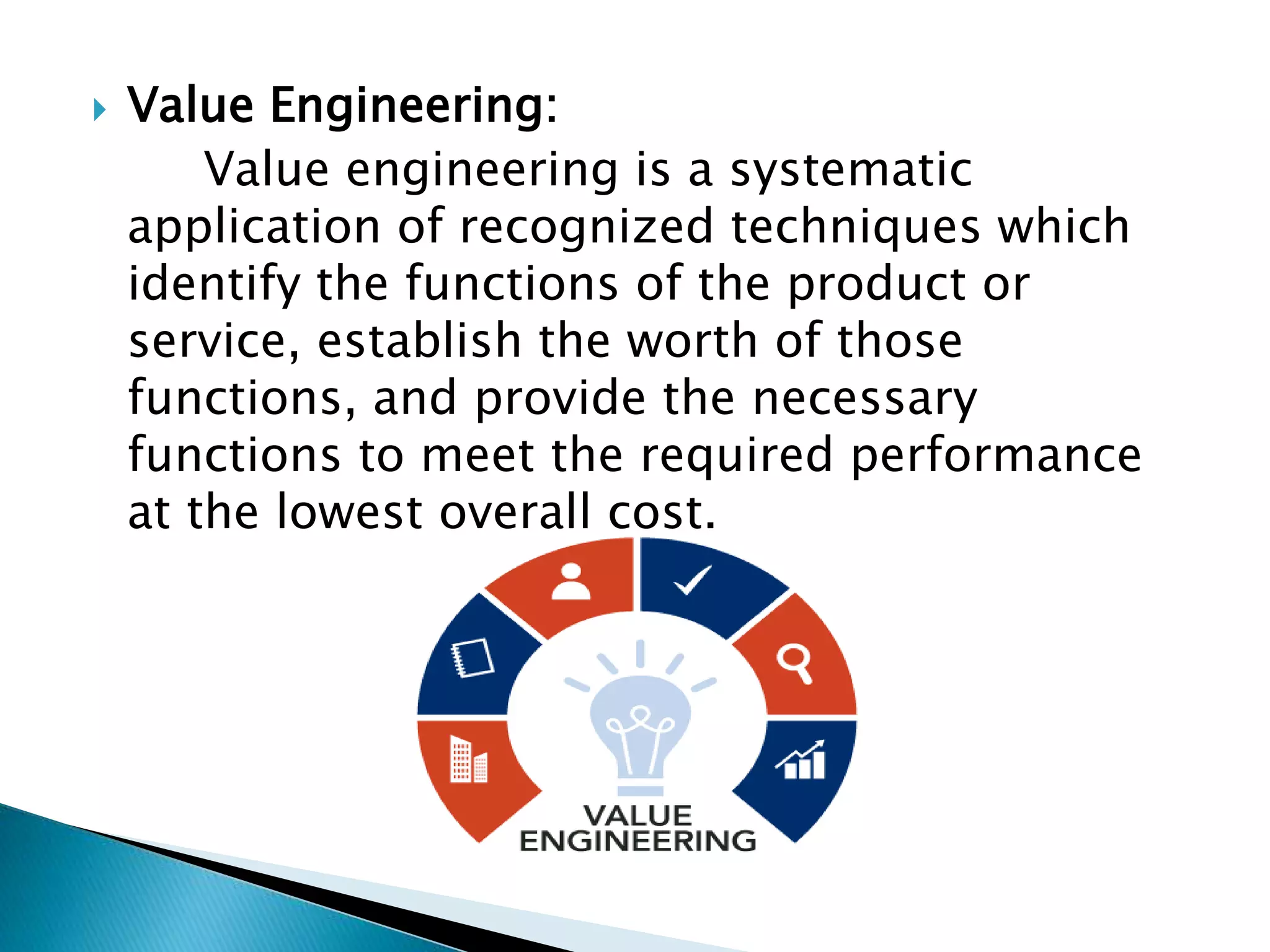
 Value Engineering:
Value engineering is a systematic
application of recognized techniques which
identify the functions of the product or
service, establish the worth of those
functions, and provide the necessary
functions to meet the required performance
at the lowest overall cost.
 Application of Value Engineering(VE) to
construction projects is a solution which
emphasis the function of project which helps
to team to make final choice and which
results in cost effective design for project.
Material Management:
 To manage productivity and cost efficiency
material management is essential.
 It contributes the major portion of expenses
in construction projects.
 Controlling procurement, carrying cost can
reduce total project cost and complete the
project in a fast track method. ABC (Always
Better Control) is the tool to identify those
material.
 By resource leveling, smoothing usage can be
brought to optimum refined level so that
much storage cost can be eliminated.
Economic Order Quantity (EOQ) is arrived,
then sensitivity of material is checked using
what –if analysis. Then effect of project is
checked to find optimum solution. This
optimizes total project cost.
 Budgetary Control:
 For cost control on a project, the construction
plan and the associated cash flow estimates
can provide the baseline reference for
subsequent project monitoring and control.
 For schedules, progress on individual
activities and the achievement of milestone
completions can be compared with the
project schedule to monitor the progress of
activities
 Overruns in particular cost categories signal
the possibility of problems and give an
indication of exactly what problems are being
encountered.
 The PERT and CPM techniques bar chart,
Gantt chart relate to time and shows how to
accelerate the project for the lowest possible
cost.
 Cost Reduction Techniques at site:
 Contractor uses schedule to monitor the
progress of the work which is related to cost.
Inspection of work is done and comparison
with budget is made.
 Meetings held to review the progress of work
provides motivation to all workers and stake
holders to improve their performance.
 Documentation of all activities or record
keeping is important to enable detection of
deviation from the set standards.
 Quantification of work, and comparing cost
with bill quantities helps to evaluate the work
and to check the progress of work.
 It was discussed that using cost reduction
techniques by multidisciplinary team, value
and economy are improved through study of
alternative design concepts, material and
construction methods without compromising
functional requirement and quality.
 Cost effective construction techniques,
material and different management strategies
during the execution of project plays
important role in saving time as well as cost
of construction.
 Thus, cost reduction techniques assures best
cost, value will be obtained over life cycle of
the building or structure.
Reduction of cost in construction

Reduction of cost in construction

  • 1.
  • 2.
     Construction ProjectManagement (CM) is a professional service that uses specialized, project management techniques to oversee the planning, design, and construction of a project, from its beginning to its end. The purpose of CM is to control a project's time, cost and quality.
  • 3.
     Large constructionprojects are inherently complex and dynamic.  However, most of them do not achieve much success.  A properly defined and managed scope leads to delivering quality project in agreed cost and within specified schedules to the stake- holders.
  • 4.
     In manyconstruction projects project managers and contractors find difficulties like poor planning of project, poor material, labour shortages, increased cost of material, delays in deliveries, wastage of material, over budgeting, unexpected weather changes, lapse in management and control, loss of material, poor communication etc.  This results into cost and time overruns, conflicts in project.
  • 5.
     Due tocost reduction techniques cost of project is managed so that contractor does not suffer losses while carrying different activities of projects.
  • 6.
     Fixed Costs:- Fixedcosts are those that do not change throughout the life-cycle of a project. For example, if construction of road is there, the excavators and bulldozers are fixed costs. For software development projects, the physical development space and development computers are fixed costs to the project.
  • 7.
     Direct Costs:- Direct costs are expenses that come out of the project budget directly. For example, if outsourc ing some of the development work, the developers are expected to put in a specific amount of time, which is then billed for. The developer salaries are direct costs.  Sunk Costs :- Sunk costs are those that have been incurred in a project, but have not produced value towards the project’s objectives.
  • 8.
     1) SimilarConstruction Projects: For the construction estimate, the best reference will be similar construction projects. The final cost of those similar projects can give the idea for the new construction project cost calculation. The final cost of past project needs to be factored with current construction cost indices.
  • 9.
    Construction Material Costs: Constructionmaterial cost consists of material cost, shipping charges and taxes applicable if any. So, it is important consider all these variations while calculating construction material cost. Labor Wage Rates: Labor wages varies place to place. So, local wage rate should be considered in calculation. If the project has to be started after several months of estimating the project cost, the probable variation in wage rates has to be considered in the calculation.
  • 10.
     Construction SiteConditions: Project site conditions can increase construction costs. Site conditions such as poor soil conditions, wetlands, contaminated materials, conflicting utilities environmentally sensitivity area, ground water, river or stream crossings, heavy traffic, buried storage tanks, archaeological sites, endangered species habitat and similar existing conditions etc. can increase the project cost during construction phase if these variations are not considered during estimation.
  • 11.
     Inflation Factor: Aconstruction project can continue for years before completion. During the construction period, the cost of materials, tools, labors, equipments etc. may vary from time to time. This variation in the prices should be considered during cost estimation process. Project Schedule: Duration of construction project is affects the cost.
  • 12.
     Increase inproject duration can increase the construction project cost due to increase in indirect costs, while reduction in construction cost also increases the project cost due to increase in direct costs.  Therefore, construction project schedules also need to be considered during project cost estimation. Reputation of Engineer: If a contractor is comfortable working with a particular engineer, or engineering firm, the project runs smoother and therefore is more cost-effective
  • 13.
     Size andType of Construction Project: For a large construction project, there can be high demand for workforce. For such a requirements, local workmen may not be sufficient and workmen from different regions need be called. These may incur extra costs such projects and also for the type of construction project where specialized workforce is required.
  • 14.
     Location ofConstruction: When a location of construction project is far away from available resources, it increases the project cost. Cost of transportation for workmen, equipments, materials, tools etc. increases with distance and adds to the project cost.
  • 15.
     There arevarious cost effective techniques of construction. Lots of them are also energy efficient and easily adoptable.  Since India is a developing country, the economy haves importance There is a need for the adoption of strong, durable, environment friendly, ecologically appropriate, energy efficient and yet cost effective materials and appropriate technologies in construction.
  • 16.
    In construction projectreduction in cost can be achieved by some of the following techniques: a) Value Engineering b) Material Management c) Budgetary Control d) Cost optimization Techniques e) Cost Reduction Techniques at site
  • 17.
     Value Engineering: Valueengineering is a systematic application of recognized techniques which identify the functions of the product or service, establish the worth of those functions, and provide the necessary functions to meet the required performance at the lowest overall cost.
  • 18.
     Application ofValue Engineering(VE) to construction projects is a solution which emphasis the function of project which helps to team to make final choice and which results in cost effective design for project. Material Management:  To manage productivity and cost efficiency material management is essential.  It contributes the major portion of expenses in construction projects.
  • 19.
     Controlling procurement,carrying cost can reduce total project cost and complete the project in a fast track method. ABC (Always Better Control) is the tool to identify those material.  By resource leveling, smoothing usage can be brought to optimum refined level so that much storage cost can be eliminated. Economic Order Quantity (EOQ) is arrived, then sensitivity of material is checked using what –if analysis. Then effect of project is checked to find optimum solution. This optimizes total project cost.
  • 20.
     Budgetary Control: For cost control on a project, the construction plan and the associated cash flow estimates can provide the baseline reference for subsequent project monitoring and control.  For schedules, progress on individual activities and the achievement of milestone completions can be compared with the project schedule to monitor the progress of activities
  • 21.
     Overruns inparticular cost categories signal the possibility of problems and give an indication of exactly what problems are being encountered.  The PERT and CPM techniques bar chart, Gantt chart relate to time and shows how to accelerate the project for the lowest possible cost.
  • 22.
     Cost ReductionTechniques at site:  Contractor uses schedule to monitor the progress of the work which is related to cost. Inspection of work is done and comparison with budget is made.  Meetings held to review the progress of work provides motivation to all workers and stake holders to improve their performance.
  • 23.
     Documentation ofall activities or record keeping is important to enable detection of deviation from the set standards.  Quantification of work, and comparing cost with bill quantities helps to evaluate the work and to check the progress of work.
  • 24.
     It wasdiscussed that using cost reduction techniques by multidisciplinary team, value and economy are improved through study of alternative design concepts, material and construction methods without compromising functional requirement and quality.  Cost effective construction techniques, material and different management strategies during the execution of project plays important role in saving time as well as cost of construction.
  • 25.
     Thus, costreduction techniques assures best cost, value will be obtained over life cycle of the building or structure.