Introduction
                                                                 Introduction
•   A commercial Linux distribution
•   The birth of commercialization in Linux.
•   “RedHat Commercial Linux”
•   First version of RedHat : November 3, 1994
•   2003 :
    – “RedHat Commercial Linux” - > “RedHat Enterprise Linux”.


RedHat |   2
• Marc Ewing creates his own distribution(1994)
• Why the name “RedHat”?


                                                          History
                                                          History
• Milestones:
   – Partnership with IBM
   – Used in all enterprise level, known as the best in
     its kind
   – Revenue : $ 652.6 million


RedHat |   3
• RedHat Enterprise Linux contains more than
  1200 components.
• These are the work of over 5 years of develop-
  ment.
• Wide range of functionalities are covered.


                                                   Features
                                                   Features
RedHat |   4
• Some features such as:
   – Virtualization
   – Kernal & Performance
   – Packaging
   – Security


                            Features
                            Features
   – Networking


RedHat |   5
Virtualization
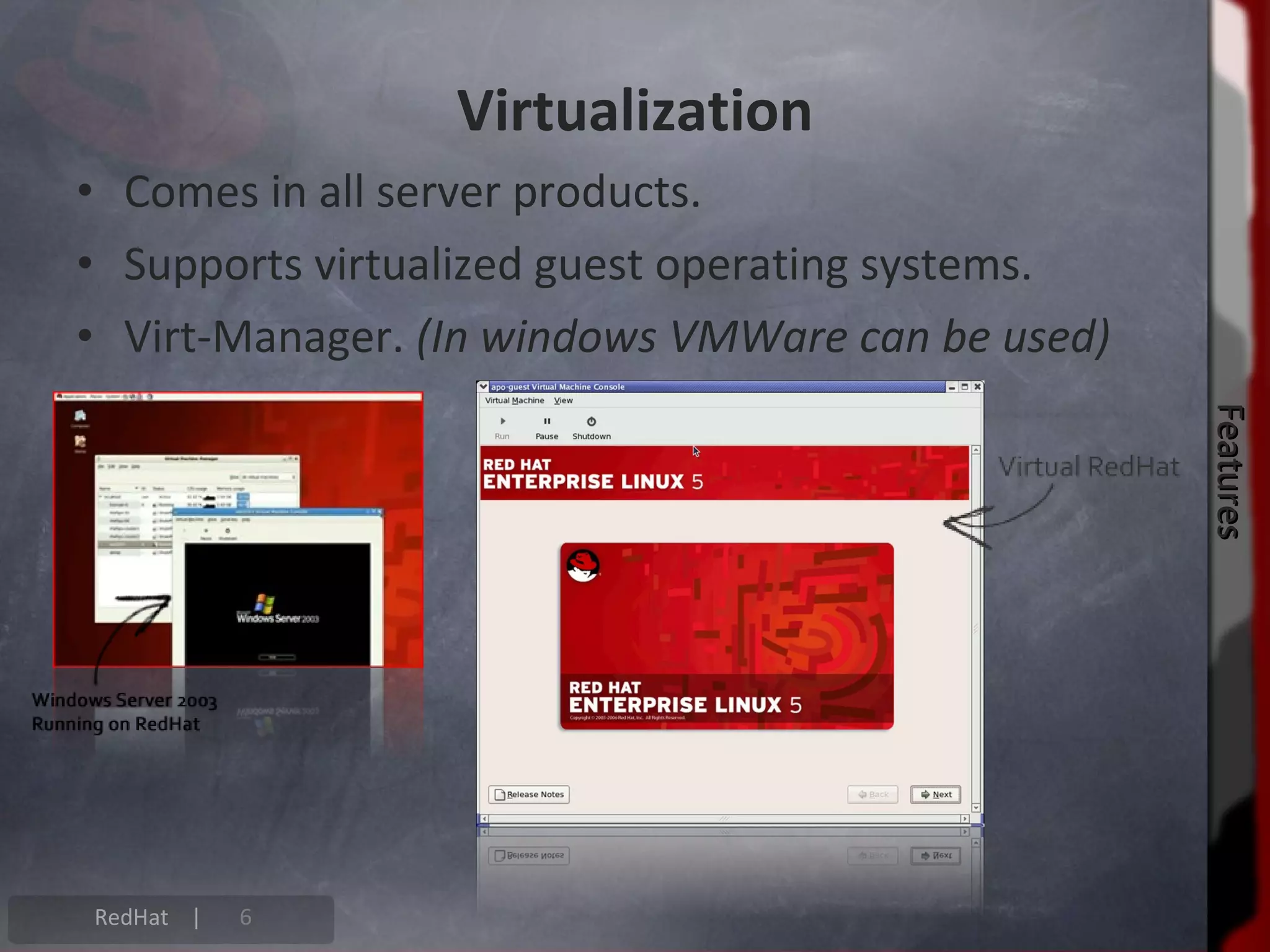
• Comes in all server products.
• Supports virtualized guest operating systems.
• Virt-Manager. (In windows VMWare can be used)


                                                  Features
                                                  Features
RedHat |   6
Kernal & Performance
• RedHat is based on linux kernal 2.6.18
• Support for multi core processors.


                                           Features
                                           Features
RedHat |   7
Kernal & Performance
• Symmetric multi-processing support.


                                        Features
                                        Features
• Network accelerator technology.

RedHat |   8
Packaging
• Server:
   – RedHat Enterprise Linux Advance platform
   – RedHat Enterprise Linux (stand alone)


• Desktops:


                                                         Features
                                                         Features
   – RedHat Enterprise Linux Desktop (RedHat Desktop)
   – RedHat Enterprise Linux Desktop with workstation.


RedHat |   9
Security
• Multi-Level Security and targeted policies for all
  services.
• Integrated directory and security capabilities.


                                                       Features
                                                       Features
• Internet security enhancements and improved
  performance.
• Real time monitoring and auditing.
RedHat |   10
Network
• Latest ip v6 is supported.
• File printing.
• Active Directory intergration (both windows and
  unix)


                                                    Features
                                                    Features
RedHat |   11
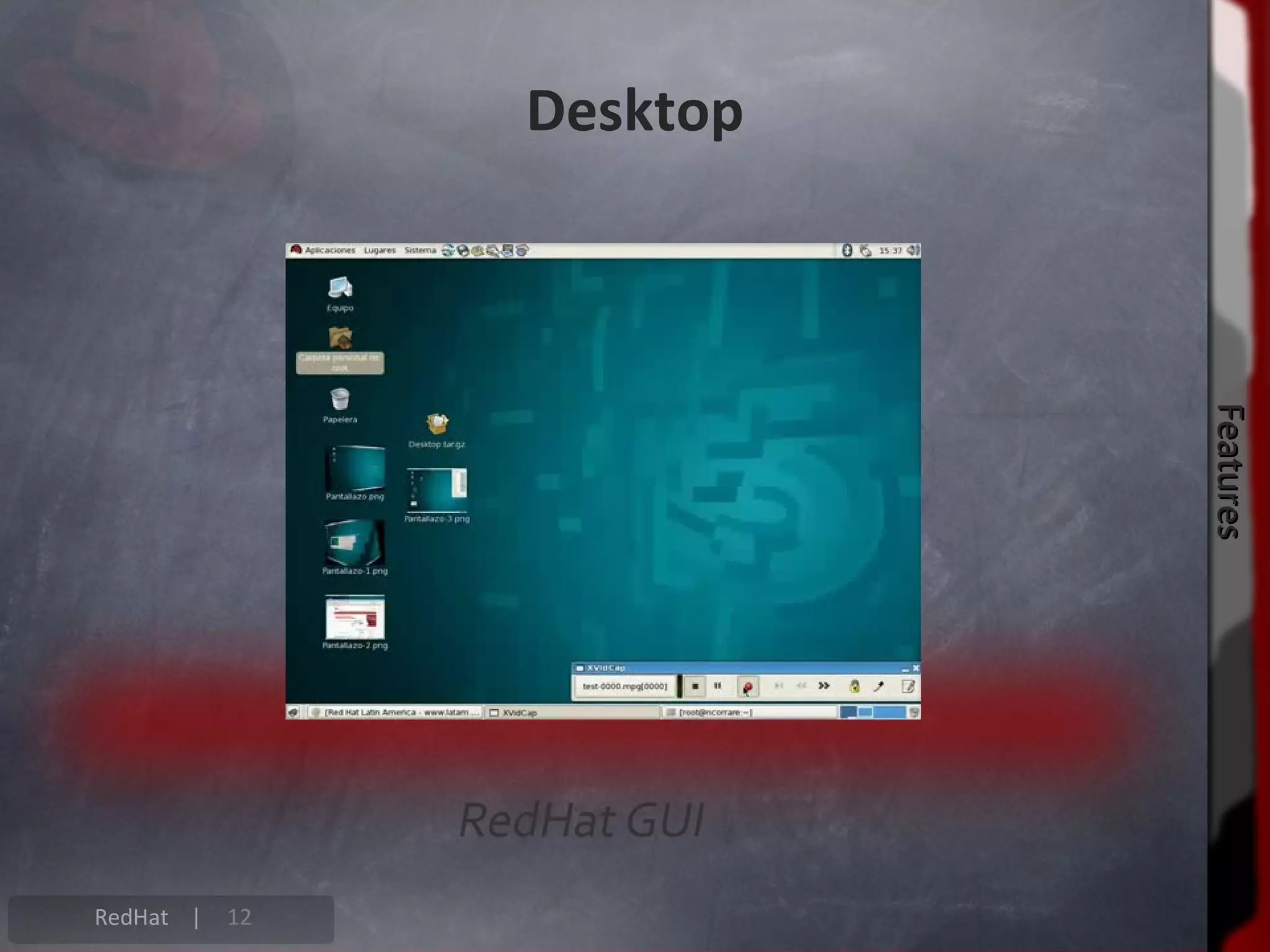
Desktop


                          Features
                          Features
RedHat |   12
Desktop
• Desktop enhancements include configuration tools,
  applications, and laptop support.
• Foundational Stateless Linux features (X Window).
• Integrated Multimedia support.


                                                      Features
                                                      Features
• Enhanced graphics using fading and transparency
  etc.


RedHat |   13
•     First version was considered as codename “ZOOT”.
•     RHEL 2.1 AS “Pensacola”
•     RHEL 2.1 AS “Panama”
•     RHEL 3 was codenamed as “Taroon”
•     RHEL 4 was “Nahtan”
•     And currently RHEL 5 is codename “Tikanga”

Although these were the codenames lots of version of


                                                         Version
                                                         Version
  red hat was produced as stable and beta versions.


    RedHat |   14
• Eliminate barriers: As redhat is not a closed sourced
  operating system. So administrators and users are
  able to enhance the OS.
• Eliminate economic barriers: RedHat updates ever
  18-24 months, it comes with one time license only.
  There for customers doesn’t have to pay for each
  and every update.
• Open source ecosystem: It can deploy wide range of
  hardware support , which makes it the worlds largest
  open source ecosystem.


                                                          Cons/Advantages
                                                          Cons/Advantages
• Implementation: RedHat can be implemented using
  many methods. ie. As a stond alone os and as a
  virtual os

RedHat |   15
Conclution
• RedHat linux is flexible operating system.
• It can be customized to enterprise needs.
• Incredibly amazing GUI.
• Uses enhanced security, networking and Kernal
  performance.
• Cost effective.
• Can be implemented easily.


    RedHat |   16
Forget about the blues, go with the red


RedHat |   17
RedHat Linux

RedHat Linux

  • 2.
    Introduction Introduction • A commercial Linux distribution • The birth of commercialization in Linux. • “RedHat Commercial Linux” • First version of RedHat : November 3, 1994 • 2003 : – “RedHat Commercial Linux” - > “RedHat Enterprise Linux”. RedHat | 2
  • 3.
    • Marc Ewingcreates his own distribution(1994) • Why the name “RedHat”? History History • Milestones: – Partnership with IBM – Used in all enterprise level, known as the best in its kind – Revenue : $ 652.6 million RedHat | 3
  • 4.
    • RedHat EnterpriseLinux contains more than 1200 components. • These are the work of over 5 years of develop- ment. • Wide range of functionalities are covered. Features Features RedHat | 4
  • 5.
    • Some featuressuch as: – Virtualization – Kernal & Performance – Packaging – Security Features Features – Networking RedHat | 5
  • 6.
    Virtualization • Comes inall server products. • Supports virtualized guest operating systems. • Virt-Manager. (In windows VMWare can be used) Features Features RedHat | 6
  • 7.
    Kernal & Performance •RedHat is based on linux kernal 2.6.18 • Support for multi core processors. Features Features RedHat | 7
  • 8.
    Kernal & Performance •Symmetric multi-processing support. Features Features • Network accelerator technology. RedHat | 8
  • 9.
    Packaging • Server: – RedHat Enterprise Linux Advance platform – RedHat Enterprise Linux (stand alone) • Desktops: Features Features – RedHat Enterprise Linux Desktop (RedHat Desktop) – RedHat Enterprise Linux Desktop with workstation. RedHat | 9
  • 10.
    Security • Multi-Level Securityand targeted policies for all services. • Integrated directory and security capabilities. Features Features • Internet security enhancements and improved performance. • Real time monitoring and auditing. RedHat | 10
  • 11.
    Network • Latest ipv6 is supported. • File printing. • Active Directory intergration (both windows and unix) Features Features RedHat | 11
  • 12.
    Desktop Features Features RedHat | 12
  • 13.
    Desktop • Desktop enhancementsinclude configuration tools, applications, and laptop support. • Foundational Stateless Linux features (X Window). • Integrated Multimedia support. Features Features • Enhanced graphics using fading and transparency etc. RedHat | 13
  • 14.
    First version was considered as codename “ZOOT”. • RHEL 2.1 AS “Pensacola” • RHEL 2.1 AS “Panama” • RHEL 3 was codenamed as “Taroon” • RHEL 4 was “Nahtan” • And currently RHEL 5 is codename “Tikanga” Although these were the codenames lots of version of Version Version red hat was produced as stable and beta versions. RedHat | 14
  • 15.
    • Eliminate barriers:As redhat is not a closed sourced operating system. So administrators and users are able to enhance the OS. • Eliminate economic barriers: RedHat updates ever 18-24 months, it comes with one time license only. There for customers doesn’t have to pay for each and every update. • Open source ecosystem: It can deploy wide range of hardware support , which makes it the worlds largest open source ecosystem. Cons/Advantages Cons/Advantages • Implementation: RedHat can be implemented using many methods. ie. As a stond alone os and as a virtual os RedHat | 15
  • 16.
    Conclution • RedHat linuxis flexible operating system. • It can be customized to enterprise needs. • Incredibly amazing GUI. • Uses enhanced security, networking and Kernal performance. • Cost effective. • Can be implemented easily. RedHat | 16
  • 17.
    Forget about theblues, go with the red RedHat | 17