Red Team Testing Explained
How Simulated Cyber Attacks Strengthen Your Security Posture
DefenceRabbit
What is Red Team Testing?
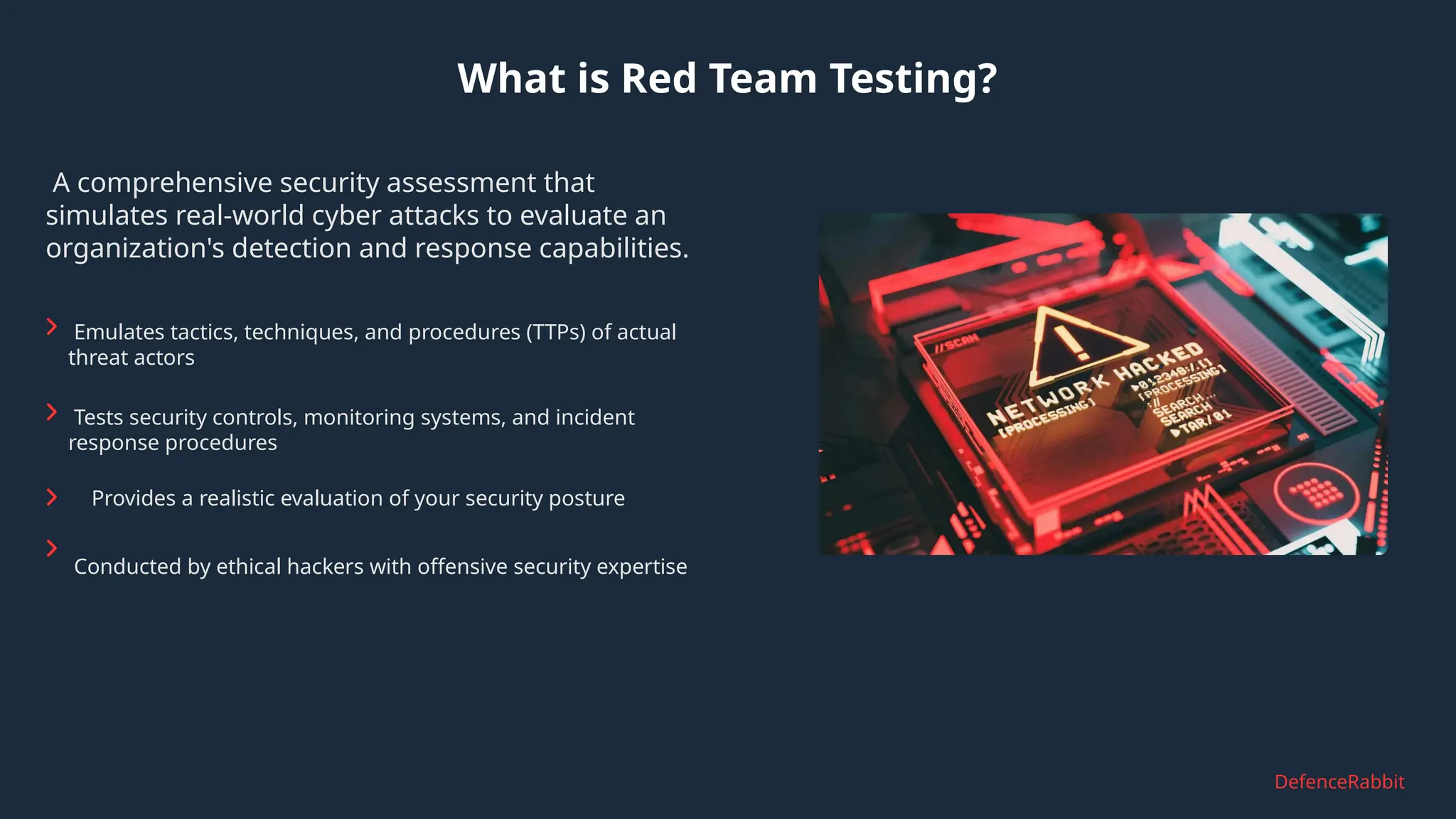
A comprehensive security assessment that
simulates real-world cyber attacks to evaluate an
organization's detection and response capabilities.
Emulates tactics, techniques, and procedures (TTPs) of actual
threat actors
Tests security controls, monitoring systems, and incident
response procedures
Provides a realistic evaluation of your security posture
Conducted by ethical hackers with offensive security expertise
DefenceRabbit
Red Team vs. Penetration Testing
Understanding the differences between these two security assessment approaches is crucial for selecting the right
evaluation for your organization's needs.
Aspect Red Team Penetration Testing
Scope Broad, entire organization Focused, specific systems
Goal Test detection & response Find vulnerabilities
Knowledge Black box (no prior info) Often white/gray box
Duration Weeks to months Days to weeks
Compare Red Team vs Penetration Testing in detail
DefenceRabbit
The Goal: Real-World Attack Simulation
Red Team exercises aim to simulate realistic cyber
threats through adversary emulation, providing a
true test of your security controls under real-world
conditions.
Mimics sophisticated threat actors targeting your industry
Uses the same tactics, techniques, and procedures (TTPs) as
real attackers
Operates covertly to test detection capabilities
Provides actionable insights on security gaps
Validates your security investments and controls
DefenceRabbit
Common Attack Methods
Red Teams employ various techniques to simulate real-world threat actors, testing your organization's security from
multiple angles.
Social Engineering
Phishing emails, vishing calls, and impersonation to manipulate
employees into revealing sensitive information.
Physical Security Breaches
Testing facility access controls, tailgating prevention, and physical
security measures.
Network Exploitation
Identifying and exploiting network vulnerabilities to gain unauthorized
access.
Lateral Movement
Moving through the network after initial compromise to access critical
assets and escalate privileges.
DefenceRabbit
Key Benefits of Red Team Testing
Uncover Hidden Vulnerabilities
Identify security gaps that traditional assessments might miss through
realistic attack scenarios.
Test Detection & Response
Evaluate how effectively your security team identifies, responds to, and
mitigates active threats.
Strengthen Security Posture
Gain a comprehensive understanding of your organization's security
strengths and weaknesses.
Train Security Personnel
Provide hands-on experience for your security team in responding to
realistic attack scenarios.
DefenceRabbit
Why Invest in Red Team Exercises?
Red Team exercises provide unique value that
traditional security assessments cannot deliver.
Proactive Defense: Identify and fix weaknesses before
real attackers exploit them
Team Readiness: Train your security team under
realistic pressure scenarios
ROI Justification: Demonstrate security investment
value to leadership
Compliance: Meet regulatory requirements with
evidence of security testing
DefenceRabbit
The Red Team Process
A typical Red Team engagement follows a structured methodology that mirrors how real threat actors operate.
1 Reconnaissance
Gathering intelligence on the target organization through open-source
research, social media, and public records.
2 Initial Compromise
Gaining initial access through phishing, exploiting vulnerabilities, or social
engineering techniques.
3 Persistence & Escalation
Establishing persistent access and escalating privileges to move deeper into
the network.
4 Lateral Movement
Moving across the network to access additional systems and sensitive data.
5 Reporting & Remediation
Documenting findings, providing actionable recommendations, and
supporting remediation efforts.
Choosing the Right Partner
Not all Red Team providers are created equal. When selecting a partner for your Red Team engagement, consider these
key factors:
Experience & Expertise
Look for teams with proven experience in your industry and with
your specific technologies.
Methodology & Approach
Ensure they follow a structured methodology that aligns with
industry frameworks like MITRE ATT&CK.
Reporting Quality
Reports should be clear, actionable, and provide both executive
summaries and technical details.
Post-Engagement Support
The best partners offer remediation guidance and are available for
follow-up questions.
DefenceRabbit
Take the Next Step
Strengthen your security posture with a professional
Red Team assessment that identifies vulnerabilities
before real attackers do.
Gain actionable insights into your security gaps
Test your detection and response capabilities
Validate your security investments
Receive expert remediation guidance
Red Team Testing service
Get in touch with our cybersecurity experts
DefenceRabbit

Red Team Testing: Real Attack Simulation

  • 1.
    Red Team TestingExplained How Simulated Cyber Attacks Strengthen Your Security Posture DefenceRabbit
  • 2.
    What is RedTeam Testing? A comprehensive security assessment that simulates real-world cyber attacks to evaluate an organization's detection and response capabilities. Emulates tactics, techniques, and procedures (TTPs) of actual threat actors Tests security controls, monitoring systems, and incident response procedures Provides a realistic evaluation of your security posture Conducted by ethical hackers with offensive security expertise DefenceRabbit
  • 3.
    Red Team vs.Penetration Testing Understanding the differences between these two security assessment approaches is crucial for selecting the right evaluation for your organization's needs. Aspect Red Team Penetration Testing Scope Broad, entire organization Focused, specific systems Goal Test detection & response Find vulnerabilities Knowledge Black box (no prior info) Often white/gray box Duration Weeks to months Days to weeks Compare Red Team vs Penetration Testing in detail DefenceRabbit
  • 4.
    The Goal: Real-WorldAttack Simulation Red Team exercises aim to simulate realistic cyber threats through adversary emulation, providing a true test of your security controls under real-world conditions. Mimics sophisticated threat actors targeting your industry Uses the same tactics, techniques, and procedures (TTPs) as real attackers Operates covertly to test detection capabilities Provides actionable insights on security gaps Validates your security investments and controls DefenceRabbit
  • 5.
    Common Attack Methods RedTeams employ various techniques to simulate real-world threat actors, testing your organization's security from multiple angles. Social Engineering Phishing emails, vishing calls, and impersonation to manipulate employees into revealing sensitive information. Physical Security Breaches Testing facility access controls, tailgating prevention, and physical security measures. Network Exploitation Identifying and exploiting network vulnerabilities to gain unauthorized access. Lateral Movement Moving through the network after initial compromise to access critical assets and escalate privileges. DefenceRabbit
  • 6.
    Key Benefits ofRed Team Testing Uncover Hidden Vulnerabilities Identify security gaps that traditional assessments might miss through realistic attack scenarios. Test Detection & Response Evaluate how effectively your security team identifies, responds to, and mitigates active threats. Strengthen Security Posture Gain a comprehensive understanding of your organization's security strengths and weaknesses. Train Security Personnel Provide hands-on experience for your security team in responding to realistic attack scenarios. DefenceRabbit
  • 7.
    Why Invest inRed Team Exercises? Red Team exercises provide unique value that traditional security assessments cannot deliver. Proactive Defense: Identify and fix weaknesses before real attackers exploit them Team Readiness: Train your security team under realistic pressure scenarios ROI Justification: Demonstrate security investment value to leadership Compliance: Meet regulatory requirements with evidence of security testing DefenceRabbit
  • 8.
    The Red TeamProcess A typical Red Team engagement follows a structured methodology that mirrors how real threat actors operate. 1 Reconnaissance Gathering intelligence on the target organization through open-source research, social media, and public records. 2 Initial Compromise Gaining initial access through phishing, exploiting vulnerabilities, or social engineering techniques. 3 Persistence & Escalation Establishing persistent access and escalating privileges to move deeper into the network. 4 Lateral Movement Moving across the network to access additional systems and sensitive data. 5 Reporting & Remediation Documenting findings, providing actionable recommendations, and supporting remediation efforts.
  • 9.
    Choosing the RightPartner Not all Red Team providers are created equal. When selecting a partner for your Red Team engagement, consider these key factors: Experience & Expertise Look for teams with proven experience in your industry and with your specific technologies. Methodology & Approach Ensure they follow a structured methodology that aligns with industry frameworks like MITRE ATT&CK. Reporting Quality Reports should be clear, actionable, and provide both executive summaries and technical details. Post-Engagement Support The best partners offer remediation guidance and are available for follow-up questions. DefenceRabbit
  • 10.
    Take the NextStep Strengthen your security posture with a professional Red Team assessment that identifies vulnerabilities before real attackers do. Gain actionable insights into your security gaps Test your detection and response capabilities Validate your security investments Receive expert remediation guidance Red Team Testing service Get in touch with our cybersecurity experts DefenceRabbit