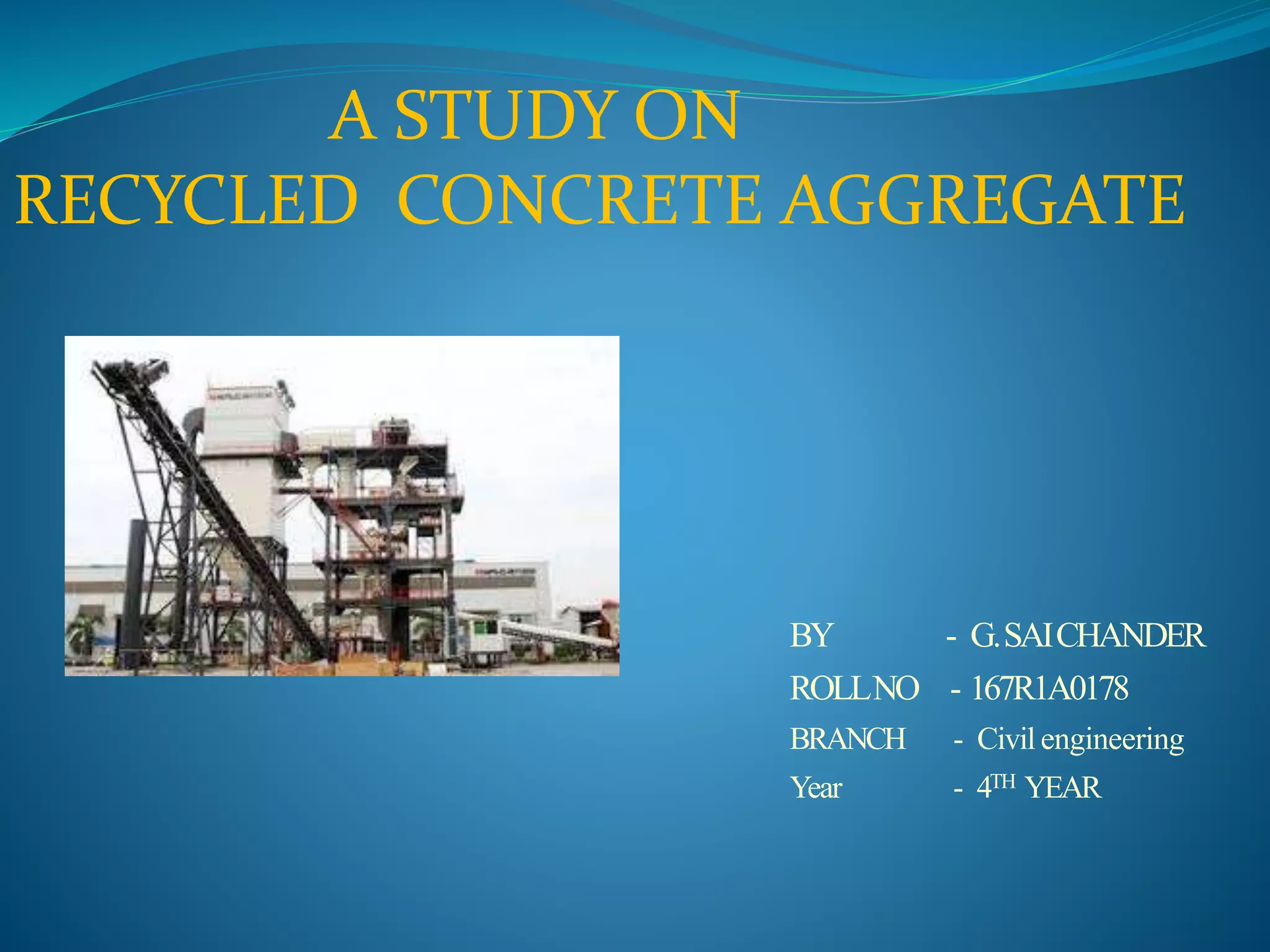
A STUDY ON
RECYCLED CONCRETE AGGREGATE
BY - G.SAICHANDER
ROLLNO - 167R1A0178
BRANCH - Civil engineering
Year - 4TH YEAR
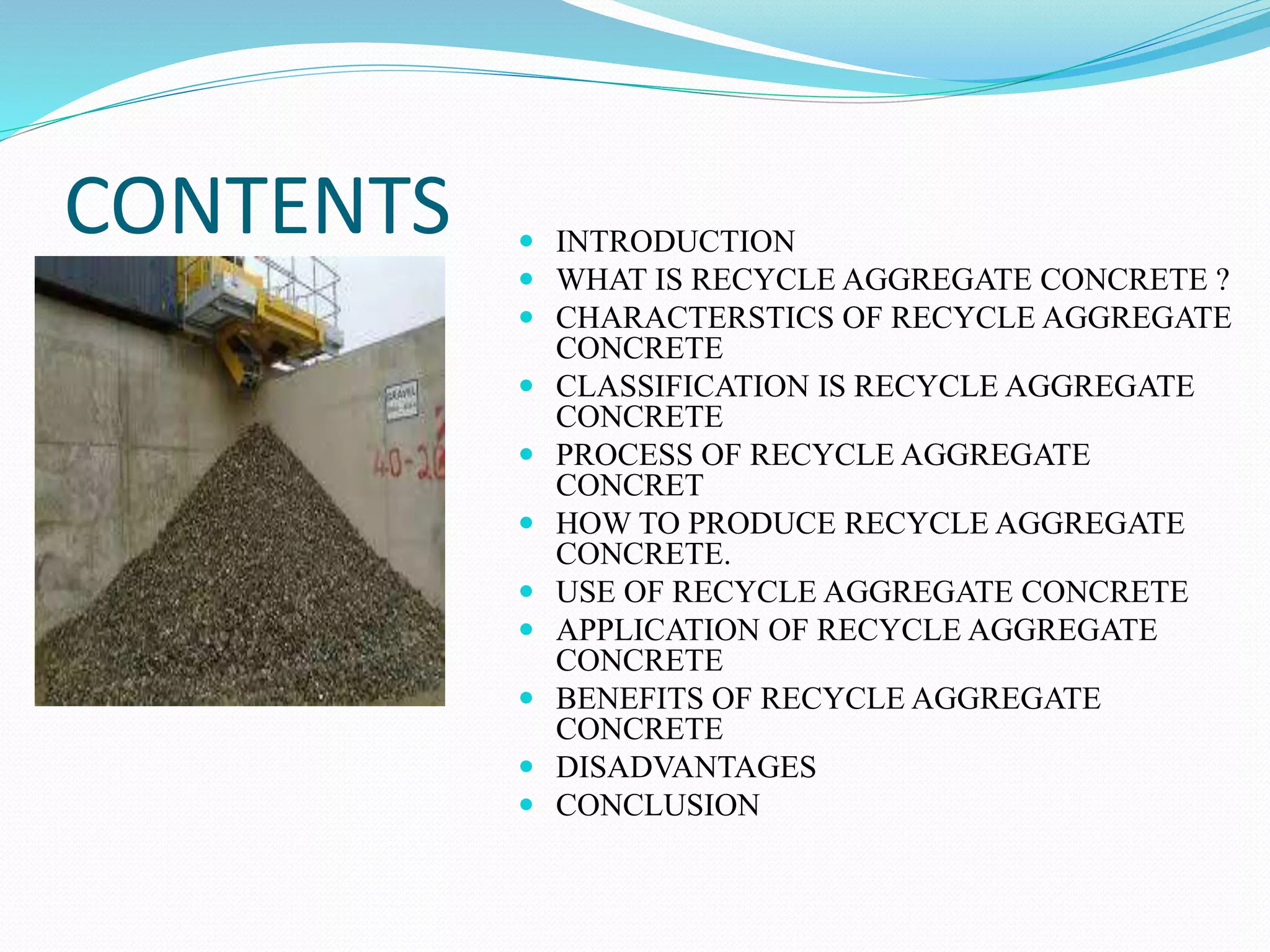
CONTENTS  INTRODUCTION
 WHAT IS RECYCLE AGGREGATE CONCRETE ?
 CHARACTERSTICS OF RECYCLE AGGREGATE
CONCRETE
 CLASSIFICATION IS RECYCLE AGGREGATE
CONCRETE
 PROCESS OF RECYCLE AGGREGATE
CONCRET
 HOW TO PRODUCE RECYCLE AGGREGATE
CONCRETE.
 USE OF RECYCLE AGGREGATE CONCRETE
 APPLICATION OF RECYCLE AGGREGATE
CONCRETE
 BENEFITS OF RECYCLE AGGREGATE
CONCRETE
 DISADVANTAGES
 CONCLUSION
INTRODUCTION
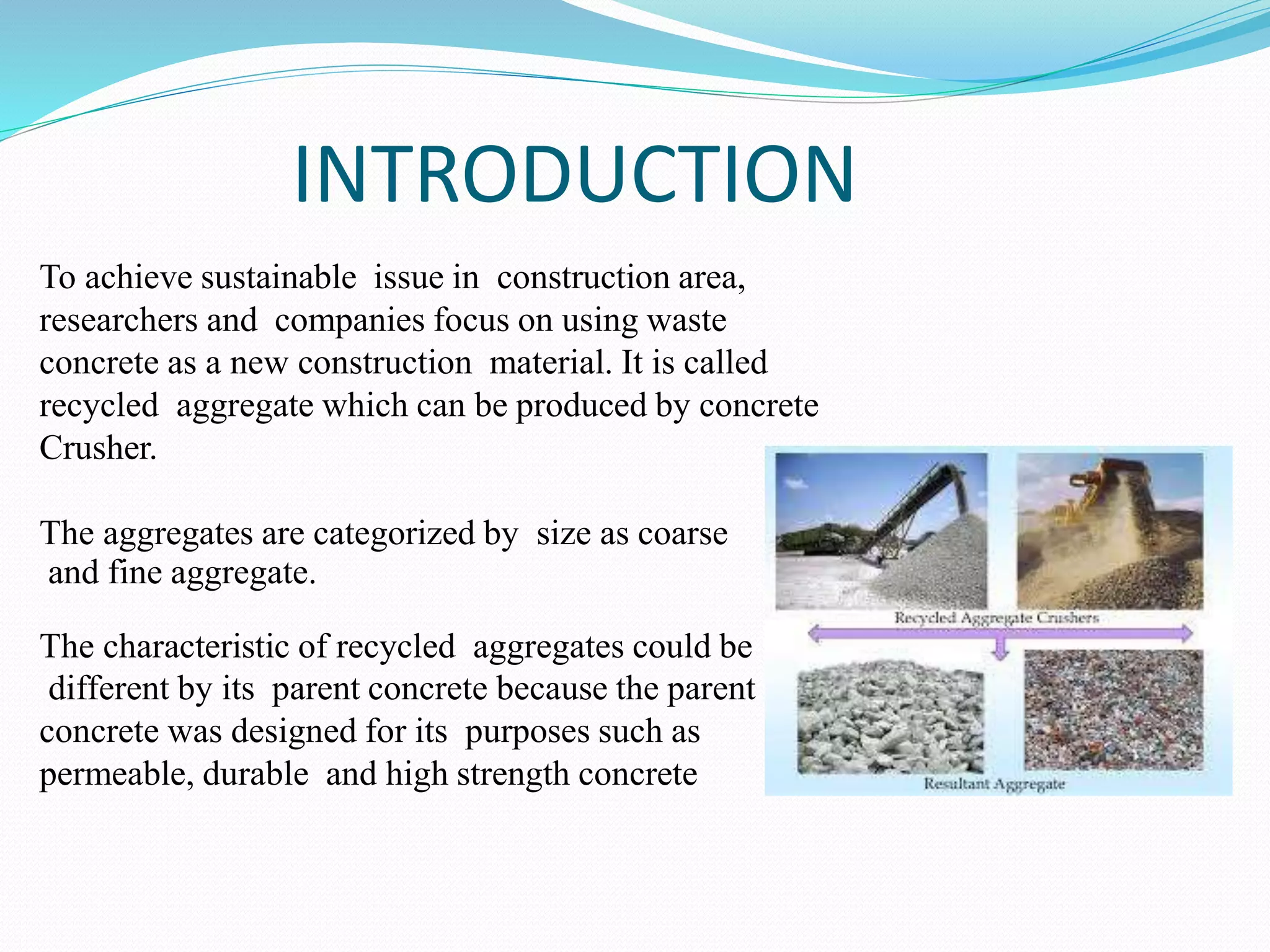
To achieve sustainable issue in construction area,
researchers and companies focus on using waste
concrete as a new construction material. It is called
recycled aggregate which can be produced by concrete
Crusher.
The aggregates are categorized by size as coarse
and fine aggregate.
The characteristic of recycled aggregates could be
different by its parent concrete because the parent
concrete was designed for its purposes such as
permeable, durable and high strength concrete
What Is Recycle aggregateconcrete?
 Its alower density , elastic modulus, strength and a
higher water absorptioncapacity.
 recycled aggregate hasaproportional mortar which
attached to aggregate, it gives ahigher porosity and a
lower strength to RACthan the normal concrete.
 In addition, since recycled aggregates require amore
amount of water than natural aggregate, shrinkage
issuecould be aproblematic to useRACin practically.
CHARACTERSTICS OF RECYCLE
AGGREGATE CONCRETE
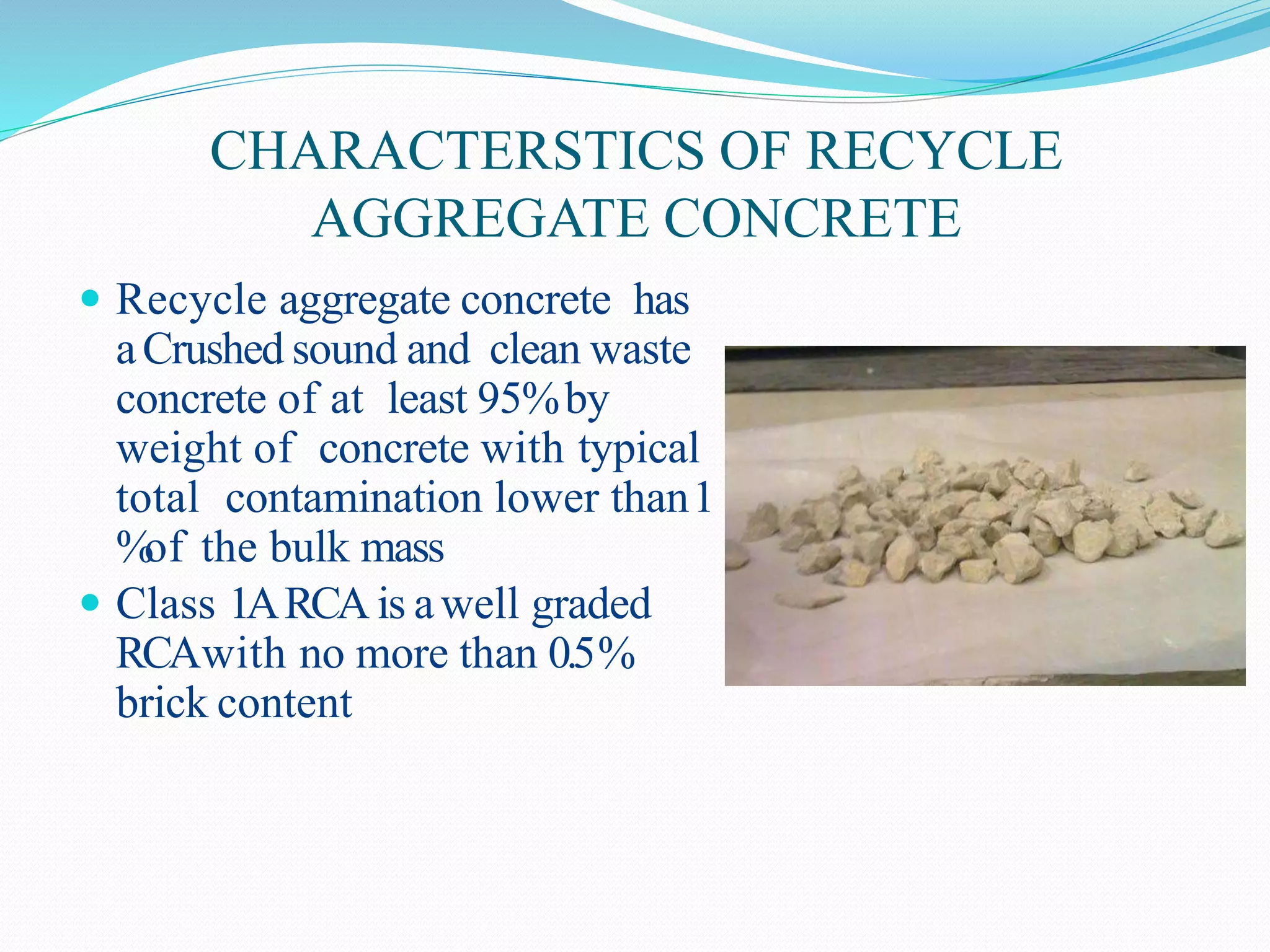
 Recycle aggregate concrete has
aCrushed sound and clean waste
concrete of at least 95%by
weight of concrete with typical
total contamination lower than1
%of the bulk mass
 Class 1ARCA is awell graded
RCAwith no more than 0.5%
brick content
CLASSIFICATION IS RECYCLE AGGREGATE
CONCRETE
 Material composition is the basis for
classification of recycled concrete
aggregate in twomain types-
1) Crushedconcrete
2) Mixed material
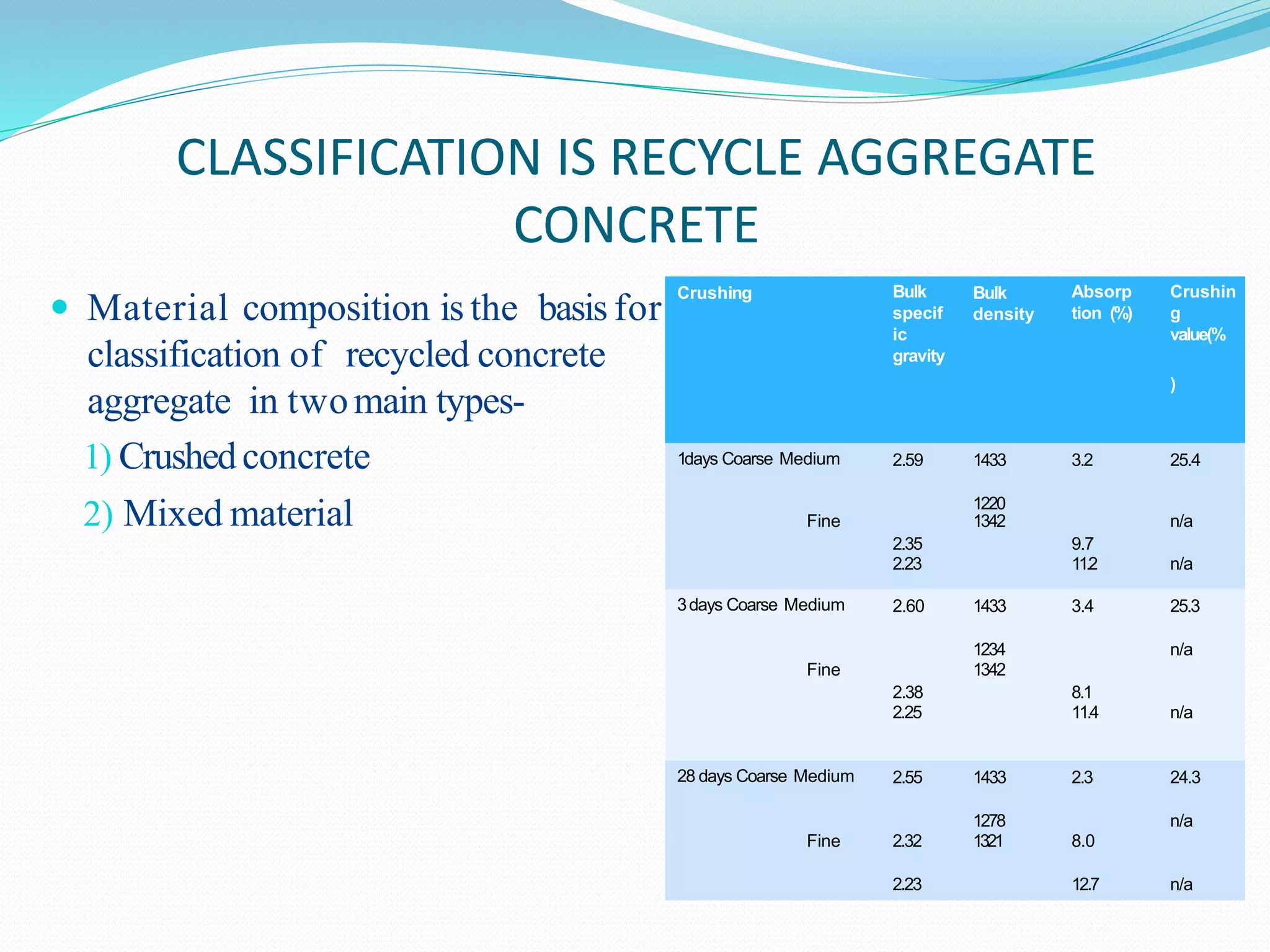
Crushing Bulk
specif
ic
gravity
Bulk
density
Absorp
tion (%)
Crushin
g
value(%
)
1days Coarse Medium 2.59 1433
1220
3.2 25.4
Fine
2.35
1342
9.7
n/a
2.23 11.2 n/a
3days Coarse Medium 2.60 1433
1234
3.4 25.3
n/a
Fine
2.38
1342
8.1
2.25 11.4 n/a
28 days Coarse Medium 2.55 1433
1278
2.3 24.3
n/a
Fine 2.32 1321 8.0
2.23 12.7 n/a
1. Crushed concrete: This materials generallyresulted in
increased water demand and decreased workability.
2. Mixed concrete: Mixed concrete remain plastic for a
short time. Thisproperties are important because they
affect the quality and in place cost of the hardened
concrete
PROCESS OF RECYCLE AGGREGATE CONCRETE
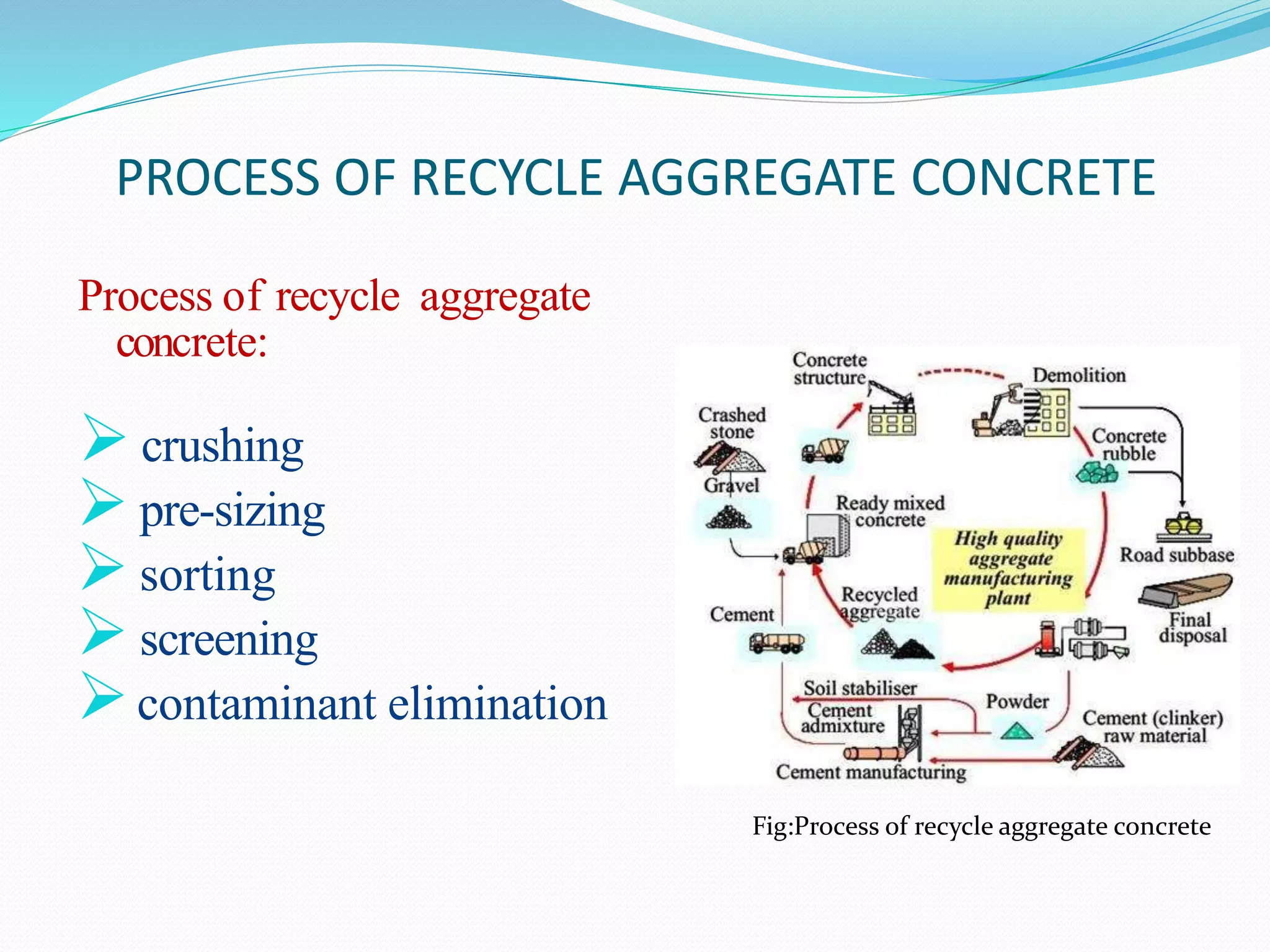
Process of recycle aggregate
concrete:
crushing
pre-sizing
sorting
screening
contaminant elimination
Fig:Process of recycle aggregate concrete
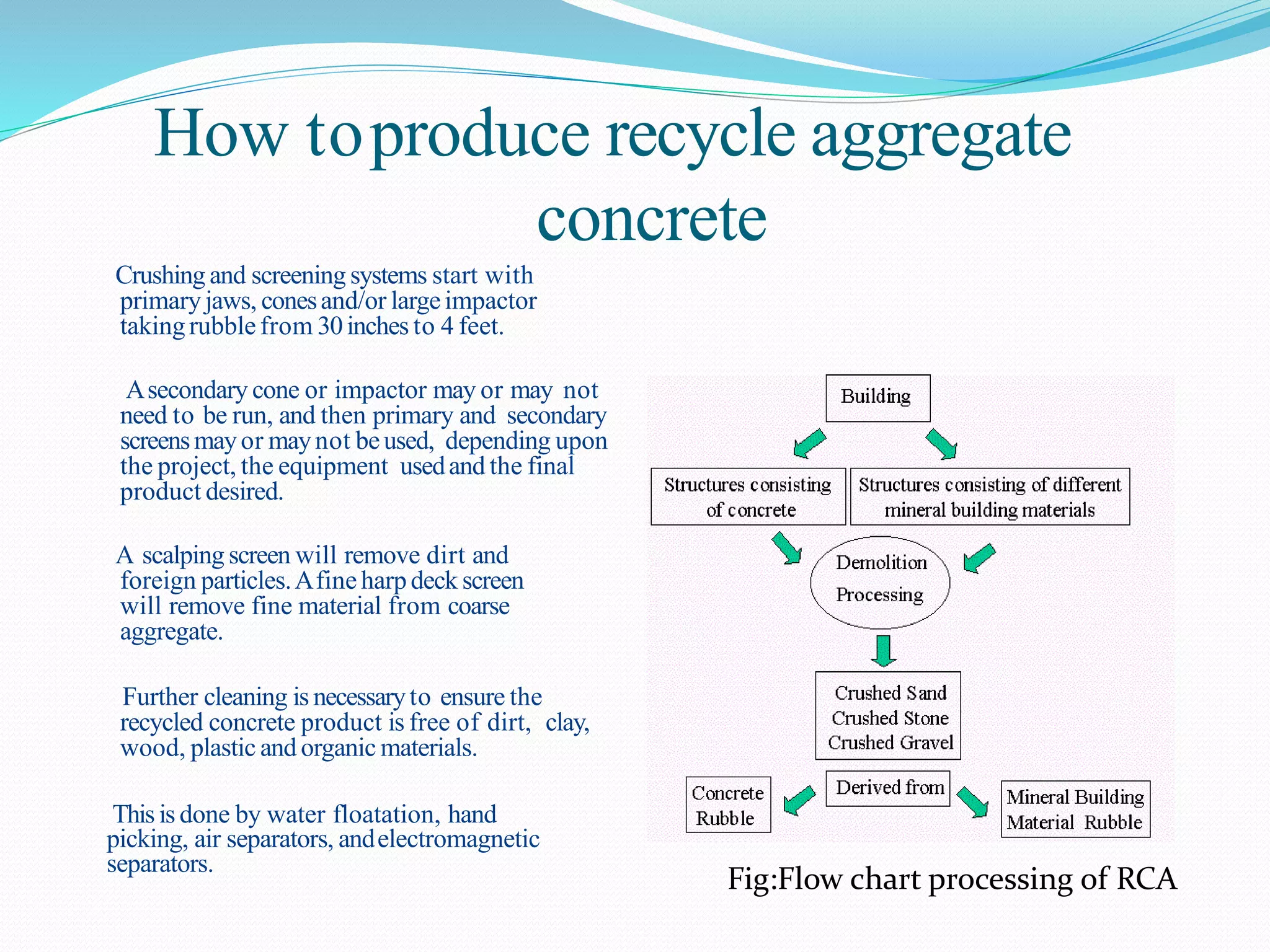
How toproduce recycle aggregate
concrete
Crushing and screening systems start with
primaryjaws, conesand/or largeimpactor
takingrubblefrom 30inches to 4 feet.
Asecondary cone or impactor may or may not
need to be run, and then primary and secondary
screensmayor maynot beused, depending upon
the project, the equipment usedand the final
product desired.
A scalping screen will remove dirt and
foreign particles.Afine harpdeck screen
will remove fine material from coarse
aggregate.
Further cleaning is necessaryto ensure the
recycled concrete product is free of dirt, clay,
wood, plastic and organic materials.
Thisis done by water floatation, hand
picking, air separators, andelectromagnetic
separators.
Fig:Flow chart processing of RCA
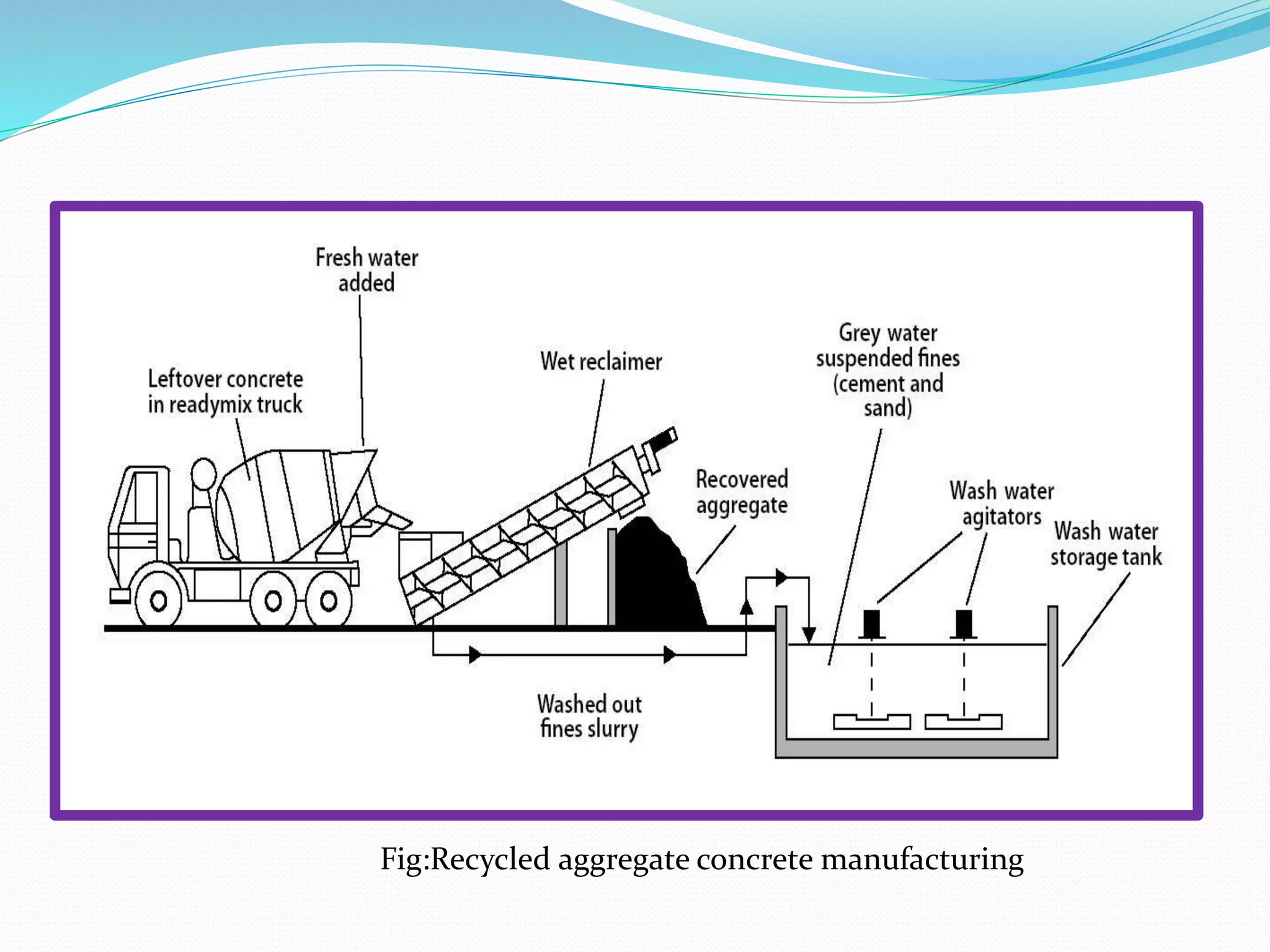
Fig:Recycled aggregate concrete manufacturing
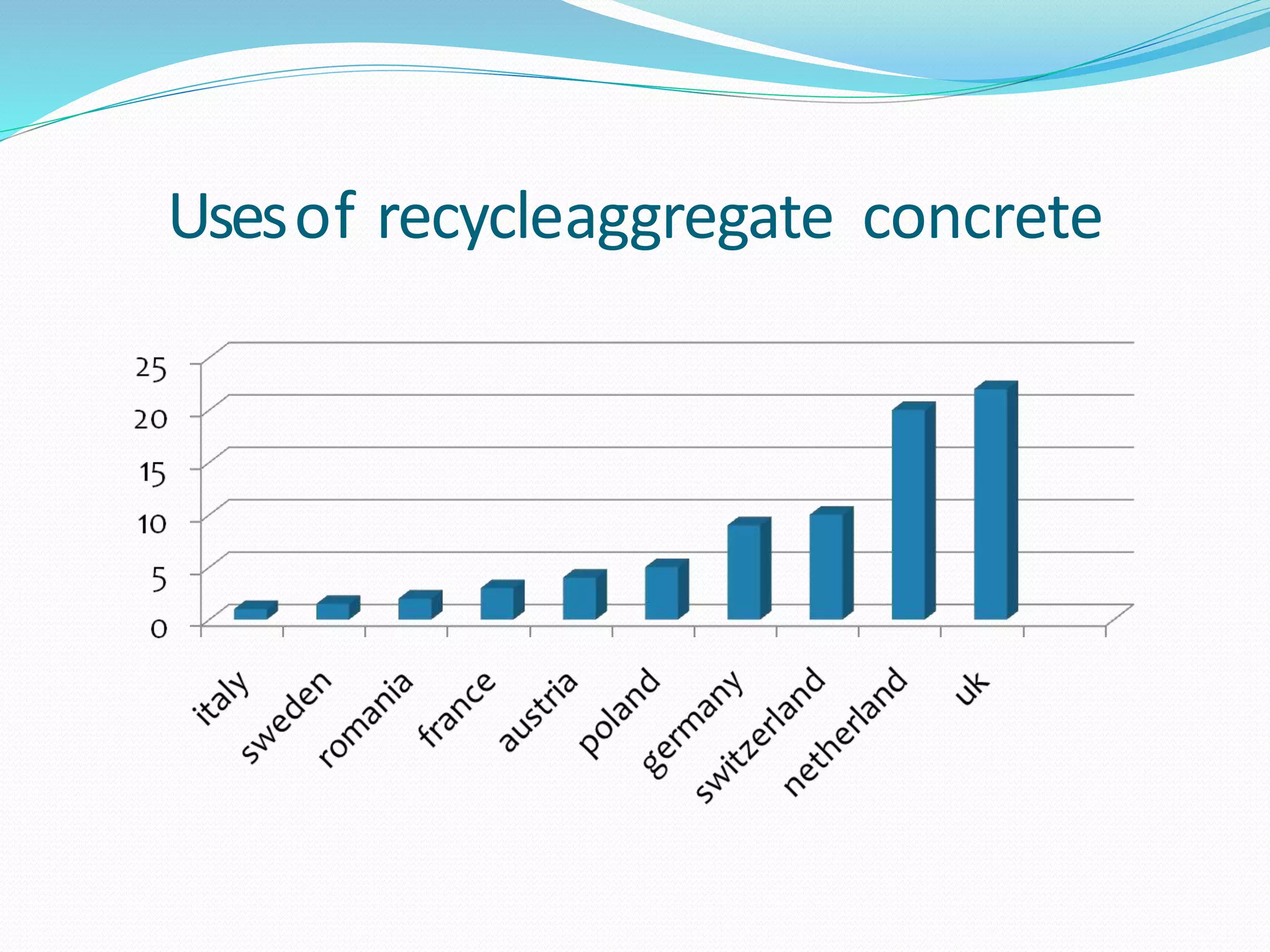
Usesof recycleaggregate concrete
Making ConcretemoreGreen
In aworld that isincreasinglyemphasizing on sustainable
construction practices; recycled aggregateshaveamajor role
to play.
Recycledconcrete isin fact recognizedby the LEEDGreenBuilding
Rating Systemin its point system.
 Credit 4 (Materials and Resources)points out that “specify a
minimum of 25%of building materials that contain in aggregate a
minimum weighted averageof 20%post-consumer recycled content
material, OR,a minimum weighted average of 40%post-industrial
recycled contentmaterial.”
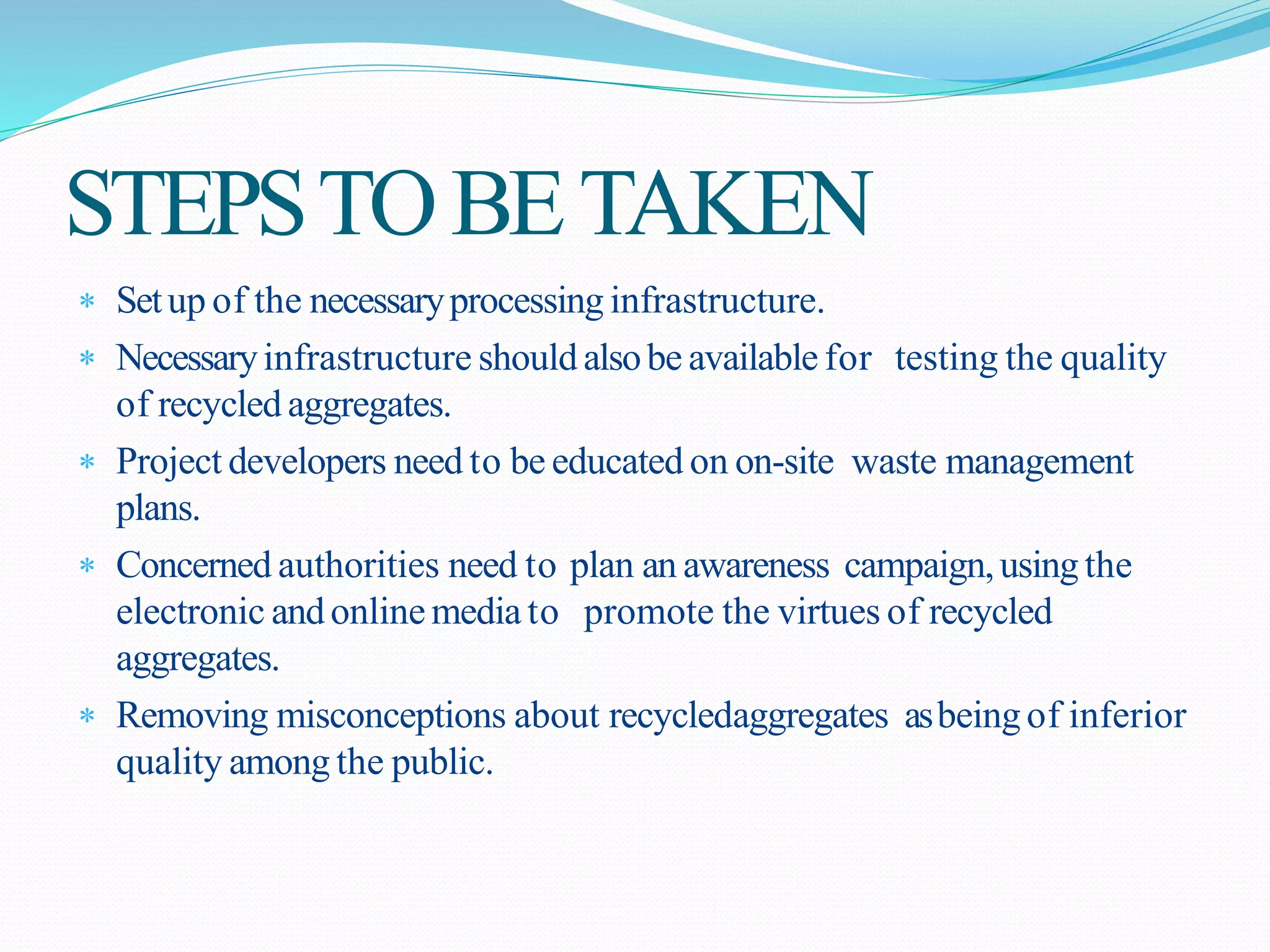
STEPSTOBETAKEN
 Setup of the necessaryprocessing infrastructure.
 Necessaryinfrastructure shouldalsobe available for testing the quality
of recycled aggregates.
 Project developers need to be educated on on-site waste management
plans.
 Concerned authorities need to plan an awareness campaign,using the
electronic andonlinemedia to promote the virtues of recycled
aggregates.
 Removing misconceptions about recycledaggregates asbeing of inferior
quality among the public.
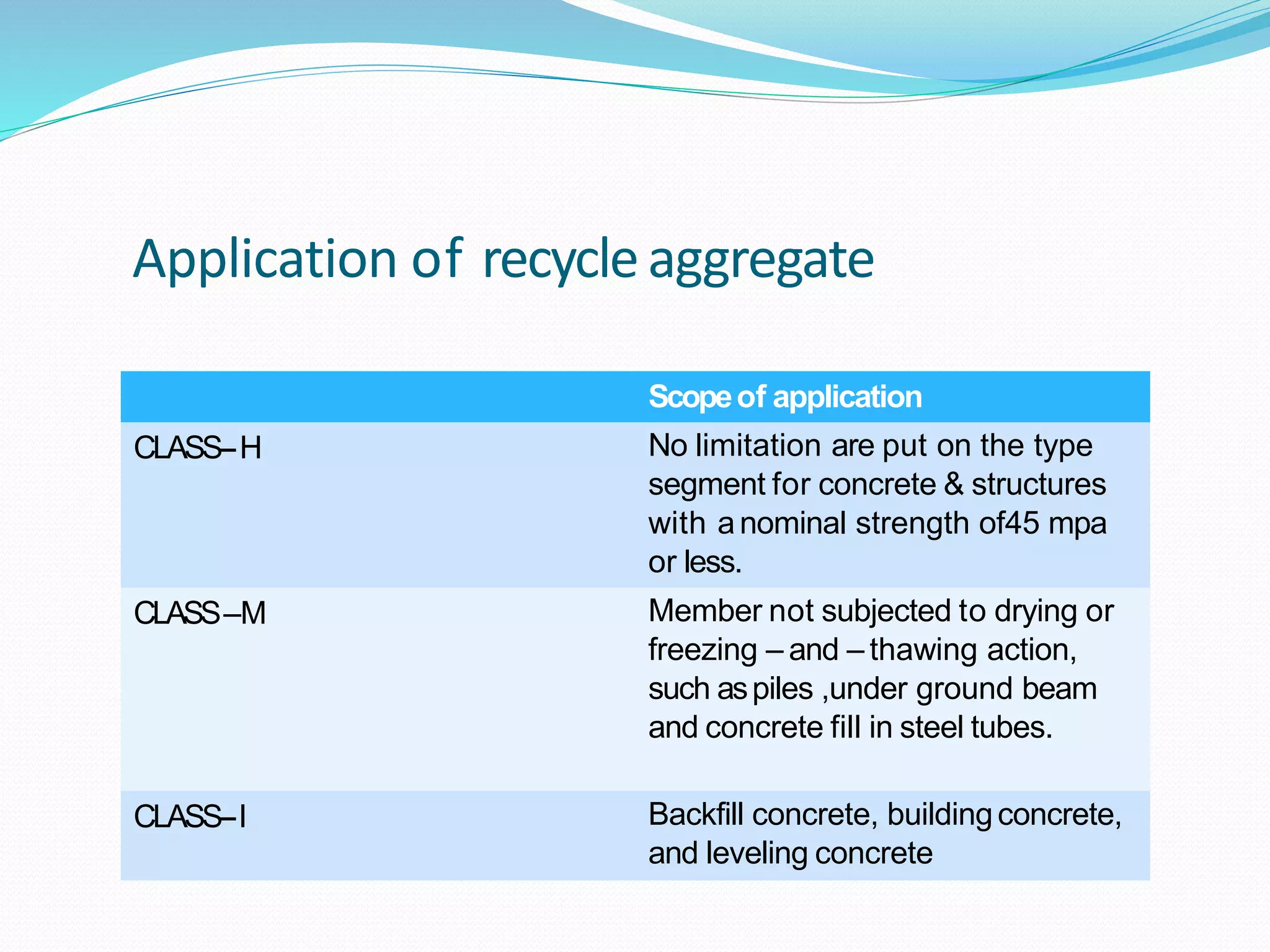
Scopeof application
CLASS--H No limitation are put on the type
segment for concrete & structures
with anominal strength of45 mpa
or less.
CLASS–M Member not subjected to drying or
freezing – and – thawing action,
such aspiles ,under ground beam
and concrete fill in steel tubes.
CLASS--l Backfill concrete, buildingconcrete,
and leveling concrete
Application of recycleaggregate
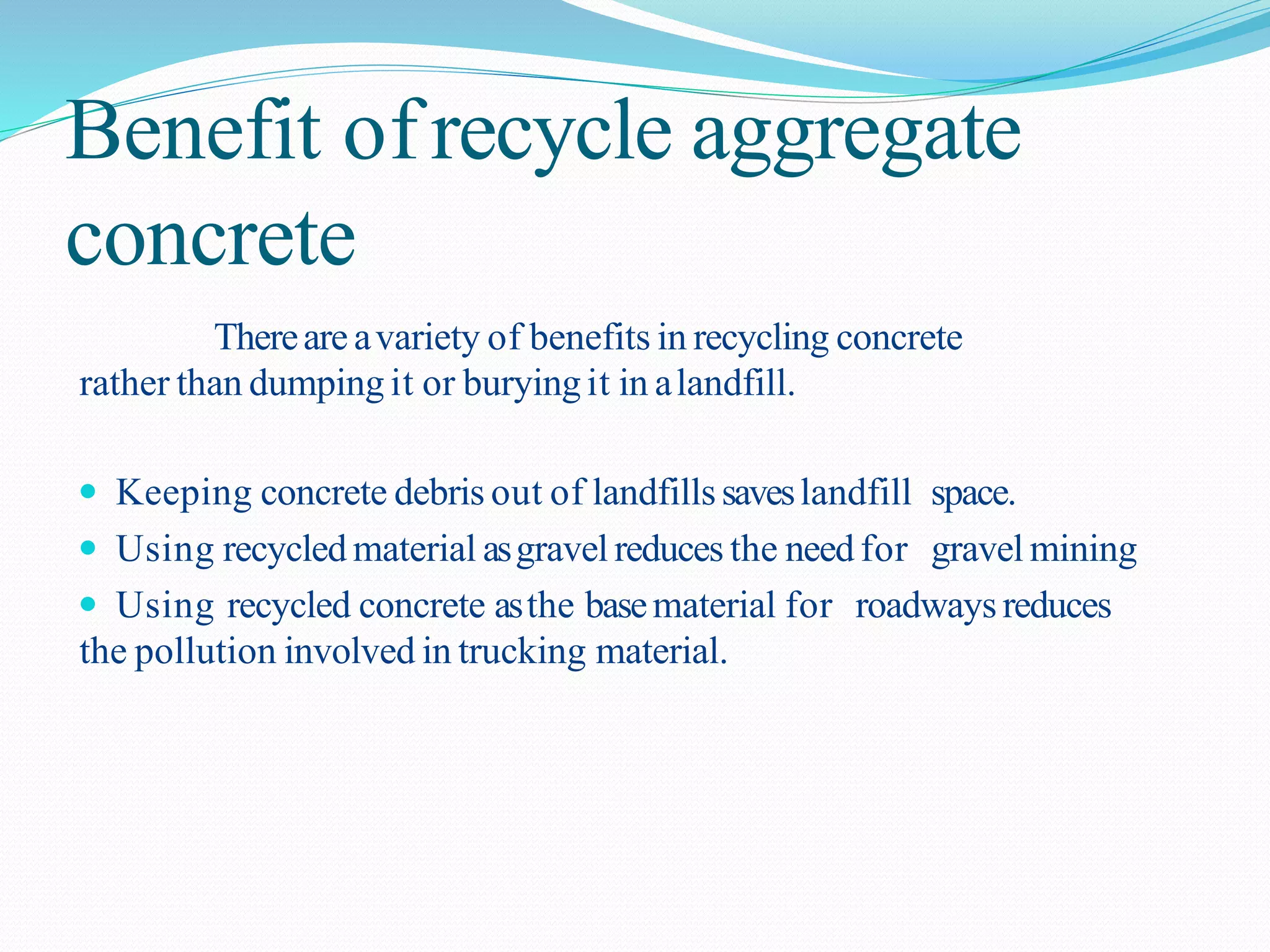
Benefit ofrecycle aggregate
concrete
Thereare avariety of benefits in recycling concrete
rather than dumping it or burying it in alandfill.
 Keeping concrete debris out of landfillssaveslandfill space.
 Using recycled material asgravel reduces the need for gravel mining
 Using recycled concrete asthe basematerial for roadwaysreduces
the pollution involved in trucking material.
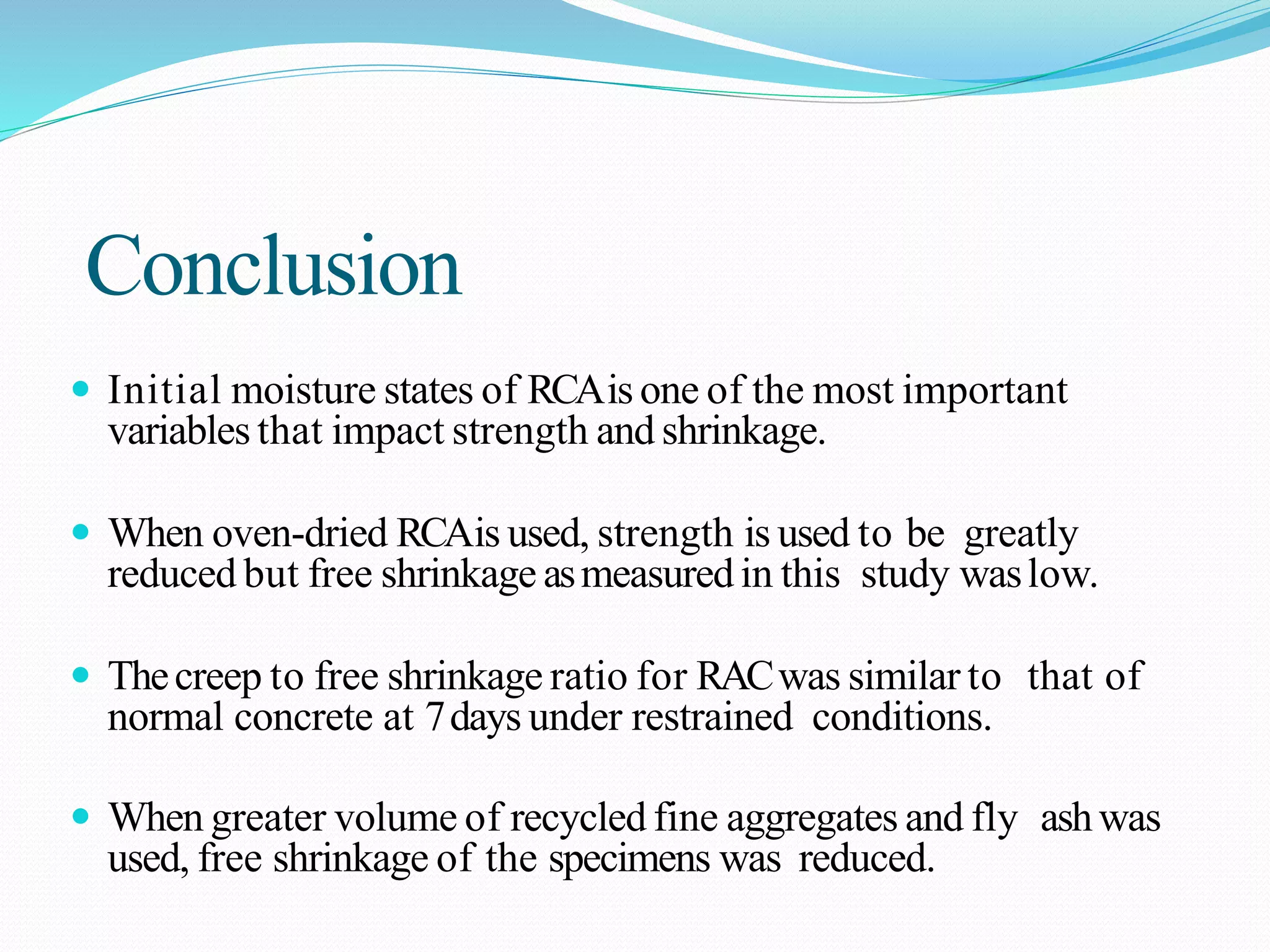
Conclusion
 Initial moisture states of RCAis one of the most important
variables that impact strength and shrinkage.
 When oven-dried RCAis used, strength is used to be greatly
reduced but free shrinkage asmeasured in this study waslow.
 Thecreep to free shrinkage ratio for RACwas similar to that of
normal concrete at 7days under restrained conditions.
 When greater volume of recycled fine aggregates and fly ashwas
used, free shrinkage of the specimens was reduced.
Theuse of recycled aggregate hasbeen found to be better than that
of virgin aggregates for certain applications. For example, the
physical properties of recycled aggregates make them ideally suited
for road baseand sub-base.Thisis becauseof their physical
properties which means lesscement is required making them suited
for sub-baseuse. Thisis in addition to the cost benefits accrued by
developers in theprocess.
References
 KK Sagoe –Crentsil, T Brown, AH Taylor - Cement
and concrete research, 2001 - Elsevier
https://www.sciencedirect.com/science/article/pii/S0
008884600004762
 By the reference of slideshare website.
 Google ,wikipedia and different types of journals
Any queries ?
Thanking you

recycled aggregate concrete

  • 1.
    A STUDY ON RECYCLEDCONCRETE AGGREGATE BY - G.SAICHANDER ROLLNO - 167R1A0178 BRANCH - Civil engineering Year - 4TH YEAR
  • 2.
    CONTENTS  INTRODUCTION WHAT IS RECYCLE AGGREGATE CONCRETE ?  CHARACTERSTICS OF RECYCLE AGGREGATE CONCRETE  CLASSIFICATION IS RECYCLE AGGREGATE CONCRETE  PROCESS OF RECYCLE AGGREGATE CONCRET  HOW TO PRODUCE RECYCLE AGGREGATE CONCRETE.  USE OF RECYCLE AGGREGATE CONCRETE  APPLICATION OF RECYCLE AGGREGATE CONCRETE  BENEFITS OF RECYCLE AGGREGATE CONCRETE  DISADVANTAGES  CONCLUSION
  • 3.
    INTRODUCTION To achieve sustainableissue in construction area, researchers and companies focus on using waste concrete as a new construction material. It is called recycled aggregate which can be produced by concrete Crusher. The aggregates are categorized by size as coarse and fine aggregate. The characteristic of recycled aggregates could be different by its parent concrete because the parent concrete was designed for its purposes such as permeable, durable and high strength concrete
  • 4.
    What Is Recycleaggregateconcrete?  Its alower density , elastic modulus, strength and a higher water absorptioncapacity.  recycled aggregate hasaproportional mortar which attached to aggregate, it gives ahigher porosity and a lower strength to RACthan the normal concrete.  In addition, since recycled aggregates require amore amount of water than natural aggregate, shrinkage issuecould be aproblematic to useRACin practically.
  • 5.
    CHARACTERSTICS OF RECYCLE AGGREGATECONCRETE  Recycle aggregate concrete has aCrushed sound and clean waste concrete of at least 95%by weight of concrete with typical total contamination lower than1 %of the bulk mass  Class 1ARCA is awell graded RCAwith no more than 0.5% brick content
  • 6.
    CLASSIFICATION IS RECYCLEAGGREGATE CONCRETE  Material composition is the basis for classification of recycled concrete aggregate in twomain types- 1) Crushedconcrete 2) Mixed material Crushing Bulk specif ic gravity Bulk density Absorp tion (%) Crushin g value(% ) 1days Coarse Medium 2.59 1433 1220 3.2 25.4 Fine 2.35 1342 9.7 n/a 2.23 11.2 n/a 3days Coarse Medium 2.60 1433 1234 3.4 25.3 n/a Fine 2.38 1342 8.1 2.25 11.4 n/a 28 days Coarse Medium 2.55 1433 1278 2.3 24.3 n/a Fine 2.32 1321 8.0 2.23 12.7 n/a
  • 7.
    1. Crushed concrete:This materials generallyresulted in increased water demand and decreased workability. 2. Mixed concrete: Mixed concrete remain plastic for a short time. Thisproperties are important because they affect the quality and in place cost of the hardened concrete
  • 8.
    PROCESS OF RECYCLEAGGREGATE CONCRETE Process of recycle aggregate concrete: crushing pre-sizing sorting screening contaminant elimination Fig:Process of recycle aggregate concrete
  • 9.
    How toproduce recycleaggregate concrete Crushing and screening systems start with primaryjaws, conesand/or largeimpactor takingrubblefrom 30inches to 4 feet. Asecondary cone or impactor may or may not need to be run, and then primary and secondary screensmayor maynot beused, depending upon the project, the equipment usedand the final product desired. A scalping screen will remove dirt and foreign particles.Afine harpdeck screen will remove fine material from coarse aggregate. Further cleaning is necessaryto ensure the recycled concrete product is free of dirt, clay, wood, plastic and organic materials. Thisis done by water floatation, hand picking, air separators, andelectromagnetic separators. Fig:Flow chart processing of RCA
  • 10.
  • 11.
  • 12.
    Making ConcretemoreGreen In aworldthat isincreasinglyemphasizing on sustainable construction practices; recycled aggregateshaveamajor role to play. Recycledconcrete isin fact recognizedby the LEEDGreenBuilding Rating Systemin its point system.  Credit 4 (Materials and Resources)points out that “specify a minimum of 25%of building materials that contain in aggregate a minimum weighted averageof 20%post-consumer recycled content material, OR,a minimum weighted average of 40%post-industrial recycled contentmaterial.”
  • 13.
    STEPSTOBETAKEN  Setup ofthe necessaryprocessing infrastructure.  Necessaryinfrastructure shouldalsobe available for testing the quality of recycled aggregates.  Project developers need to be educated on on-site waste management plans.  Concerned authorities need to plan an awareness campaign,using the electronic andonlinemedia to promote the virtues of recycled aggregates.  Removing misconceptions about recycledaggregates asbeing of inferior quality among the public.
  • 14.
    Scopeof application CLASS--H Nolimitation are put on the type segment for concrete & structures with anominal strength of45 mpa or less. CLASS–M Member not subjected to drying or freezing – and – thawing action, such aspiles ,under ground beam and concrete fill in steel tubes. CLASS--l Backfill concrete, buildingconcrete, and leveling concrete Application of recycleaggregate
  • 15.
    Benefit ofrecycle aggregate concrete Thereareavariety of benefits in recycling concrete rather than dumping it or burying it in alandfill.  Keeping concrete debris out of landfillssaveslandfill space.  Using recycled material asgravel reduces the need for gravel mining  Using recycled concrete asthe basematerial for roadwaysreduces the pollution involved in trucking material.
  • 16.
    Conclusion  Initial moisturestates of RCAis one of the most important variables that impact strength and shrinkage.  When oven-dried RCAis used, strength is used to be greatly reduced but free shrinkage asmeasured in this study waslow.  Thecreep to free shrinkage ratio for RACwas similar to that of normal concrete at 7days under restrained conditions.  When greater volume of recycled fine aggregates and fly ashwas used, free shrinkage of the specimens was reduced.
  • 17.
    Theuse of recycledaggregate hasbeen found to be better than that of virgin aggregates for certain applications. For example, the physical properties of recycled aggregates make them ideally suited for road baseand sub-base.Thisis becauseof their physical properties which means lesscement is required making them suited for sub-baseuse. Thisis in addition to the cost benefits accrued by developers in theprocess.
  • 18.
    References  KK Sagoe–Crentsil, T Brown, AH Taylor - Cement and concrete research, 2001 - Elsevier https://www.sciencedirect.com/science/article/pii/S0 008884600004762  By the reference of slideshare website.  Google ,wikipedia and different types of journals
  • 19.
  • 20.