Recursion


         Kasun Ranga Wijeweera
     (Email: krw19870829@gmail.com)
Department of Statistics and Computer Science
             Faculty of Science
         University of Peradeniya
What is Recursion?
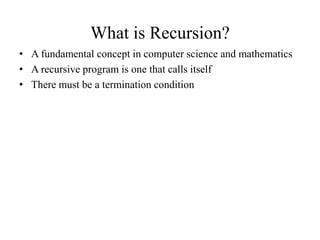
• A fundamental concept in computer science and mathematics
• A recursive program is one that calls itself
• There must be a termination condition
Recurrences
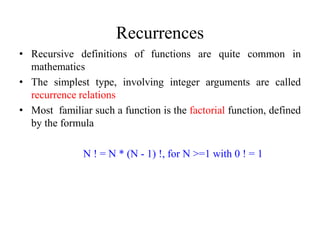
• Recursive definitions of functions are quite common in
  mathematics
• The simplest type, involving integer arguments are called
  recurrence relations
• Most familiar such a function is the factorial function, defined
  by the formula

              N ! = N * (N - 1) !, for N >=1 with 0 ! = 1
Recurrences
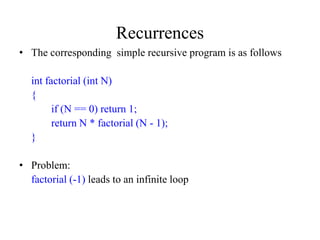
• The corresponding simple recursive program is as follows

  int factorial (int N)
  {
        if (N == 0) return 1;
        return N * factorial (N - 1);
  }

• Problem:
  factorial (-1) leads to an infinite loop
Recurrences
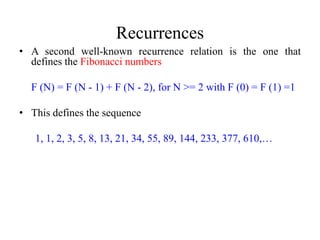
• A second well-known recurrence relation is the one that
  defines the Fibonacci numbers

  F (N) = F (N - 1) + F (N - 2), for N >= 2 with F (0) = F (1) =1

• This defines the sequence

   1, 1, 2, 3, 5, 8, 13, 21, 34, 55, 89, 144, 233, 377, 610,…
Recurrences
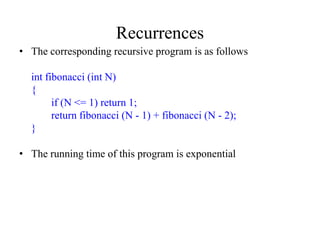
• The corresponding recursive program is as follows

  int fibonacci (int N)
  {
        if (N <= 1) return 1;
        return fibonacci (N - 1) + fibonacci (N - 2);
  }

• The running time of this program is exponential
Recurrences
• To compute F (N) in linear time

  #define max 25
  int fibonacci (int N)
  {
        int i, F[max];
        F[0] = 1; F[1] = 1;
        for(i = 2; i <= max; i++)
                 F[i] = F[i - 1] + F[i - 2];
        return F[N];
  }
Divide and Conquer
• Most of the recursive programs use two recursive calls, each
  operating on about half the input
• This is so called “divide and conquer” paradigm
• Used to achieve significant economics
• They normally do not reduce to trivial loops like the factorial
  program
• They normally do not lead to excessive re-computing as
  Fibonacci program, because the input is divided without
  overlap
Divide and Conquer: Example
• Let us consider the task of drawing the markings for each inch
  on a ruler
• There is a mark at the 1/2 point
• Slightly shorter marks at 1/4 intervals
• Still shorter marks at 1/8 intervals, etc
Divide and Conquer: Example
• Suppose the desired resolution is 1/(2^n)
• Put a mark at every point between 0 and (2^n), end points not
  included
• A procedure mark (x, h) is used to mark h units high at x
  position
• The middle mark should be n units high
• The marks in the left and right halves should be n-1 units high
Divide and Conquer: Example
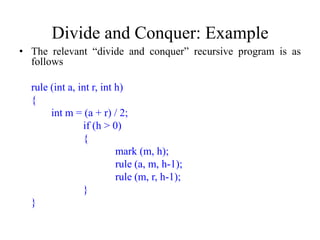
• The relevant “divide and conquer” recursive program is as
  follows

  rule (int a, int r, int h)
  {
       int m = (a + r) / 2;
                if (h > 0)
                {
                          mark (m, h);
                          rule (a, m, h-1);
                          rule (m, r, h-1);
                }
  }
Any Questions?
Thank You!

Recursion

  • 1.
    Recursion Kasun Ranga Wijeweera (Email: krw19870829@gmail.com) Department of Statistics and Computer Science Faculty of Science University of Peradeniya
  • 2.
    What is Recursion? •A fundamental concept in computer science and mathematics • A recursive program is one that calls itself • There must be a termination condition
  • 3.
    Recurrences • Recursive definitionsof functions are quite common in mathematics • The simplest type, involving integer arguments are called recurrence relations • Most familiar such a function is the factorial function, defined by the formula N ! = N * (N - 1) !, for N >=1 with 0 ! = 1
  • 4.
    Recurrences • The correspondingsimple recursive program is as follows int factorial (int N) { if (N == 0) return 1; return N * factorial (N - 1); } • Problem: factorial (-1) leads to an infinite loop
  • 5.
    Recurrences • A secondwell-known recurrence relation is the one that defines the Fibonacci numbers F (N) = F (N - 1) + F (N - 2), for N >= 2 with F (0) = F (1) =1 • This defines the sequence 1, 1, 2, 3, 5, 8, 13, 21, 34, 55, 89, 144, 233, 377, 610,…
  • 6.
    Recurrences • The correspondingrecursive program is as follows int fibonacci (int N) { if (N <= 1) return 1; return fibonacci (N - 1) + fibonacci (N - 2); } • The running time of this program is exponential
  • 7.
    Recurrences • To computeF (N) in linear time #define max 25 int fibonacci (int N) { int i, F[max]; F[0] = 1; F[1] = 1; for(i = 2; i <= max; i++) F[i] = F[i - 1] + F[i - 2]; return F[N]; }
  • 8.
    Divide and Conquer •Most of the recursive programs use two recursive calls, each operating on about half the input • This is so called “divide and conquer” paradigm • Used to achieve significant economics • They normally do not reduce to trivial loops like the factorial program • They normally do not lead to excessive re-computing as Fibonacci program, because the input is divided without overlap
  • 9.
    Divide and Conquer:Example • Let us consider the task of drawing the markings for each inch on a ruler • There is a mark at the 1/2 point • Slightly shorter marks at 1/4 intervals • Still shorter marks at 1/8 intervals, etc
  • 10.
    Divide and Conquer:Example • Suppose the desired resolution is 1/(2^n) • Put a mark at every point between 0 and (2^n), end points not included • A procedure mark (x, h) is used to mark h units high at x position • The middle mark should be n units high • The marks in the left and right halves should be n-1 units high
  • 11.
    Divide and Conquer:Example • The relevant “divide and conquer” recursive program is as follows rule (int a, int r, int h) { int m = (a + r) / 2; if (h > 0) { mark (m, h); rule (a, m, h-1); rule (m, r, h-1); } }
  • 12.
  • 13.