RECOMBINATION
MESELSON MODEL AND SITE-
SPECIFIC RECOMBINATION
M. KEERTHANA
I M.Sc BIOCHEMISTRY
GENETIC RECOMBINATION
• Genetic recombination is the production of offspring with
combinations of traits that differ from those found in either
parent
• In eukaryotes, genetic recombination during meiosis can lead
to a novel set of genetic information that can be passed on
from the parents to the offspring
• Most recombination is naturally occurring
RECOMBINATION
ABCDEFGhijklmnoPQRSTUVWXYZ
abcdefgHIJKLMNOpqrstuvwxyz
ABCDEFGHIJKLMNOPQRSTUVWXYZ
abcdefghijklmnopqrstuvwxyz
MESELSON RADDING MODEL
• It is a second recombination model that is based on one
single-strand nick for initiation
• The model retains some key features of the holliday model
namely,
1. Formation of heteroduplex DNA
2. Mismatch repair of the heteroduplex DNA to give 3:1 and 1:3
gene conversion events
3. The holliday junction intermediate that could be resolved as
non crossover or cross over
MECHANISM
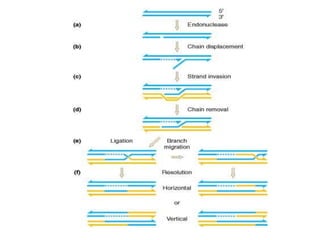
• A single strand nick is introduced into a strand of one of the
duplexes
• DNA polymerase extends the newly created 3’ end causing
displacement of strand on the other side of the nick
• With the assistance of Rec A, the displaced strand with a 5’P
tail invades a homologous region in the second duplex to form
a D loop
• The D loop is cleaved forming a single strand links between
the two duplexes
MECHANISM(ctd)
• The strands are isomerised or rotated around the crossed
strand point to allow the free ends at the exchange site to be
ligated, forming a holliday junction
• The holliday junction can branch migrate.
• Branch migration form the initial site of strand invasion forms
symmetric heteroduplex DNA
SITE-SPECIFIC RECOMBINATION
Viruses and transposable elements often integrate their
genomes into the host chromosome
Site-specific recombination, is a type of genetic
recombination in which DNA strand exchange takes place
between segments possessing at least a certain degree
of sequence homology
Site- specific recombination is used by both eukaryotes and
prokaryotes to regulate gene expression and to increase the
organisms genetic range
Each site- specific recombination involves:
• Recombinase
• A short (20-200bp) unique DNA sequence where
recombinase act
Site specific recombination
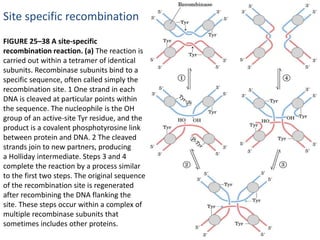
FIGURE 25–38 A site-specific
recombination reaction. (a) The reaction is
carried out within a tetramer of identical
subunits. Recombinase subunits bind to a
specific sequence, often called simply the
recombination site. 1 One strand in each
DNA is cleaved at particular points within
the sequence. The nucleophile is the OH
group of an active-site Tyr residue, and the
product is a covalent phosphotyrosine link
between protein and DNA. 2 The cleaved
strands join to new partners, producing
a Holliday intermediate. Steps 3 and 4
complete the reaction by a process similar
to the first two steps. The original sequence
of the recombination site is regenerated
after recombining the DNA flanking the
site. These steps occur within a complex of
multiple recombinase subunits that
sometimes includes other proteins.
MECHANSIM
• There are two general classes of site specific recombination
which rely on either Tyr or Ser residues in the active site.
• Recombinase is an important enzyme involved in the site
specific recombination
• The recombinase recognizes and binds to each of two
recombination sites on two different DNA molecules or within
the same DNA
MECHANISM(ctd)
• Step 1- One DNA strand in each site is cleaved at a specific
point within the site, and the recombinase becomes
covalently linked to DNA at the cleavage site through a
phosphotyrosine bond
• Step 2- The transient protein-DNA linkage preserves the
phosphodiester bond that is lost in cleaving the DNA. The
cleaved DNA strands are rejoined to new partners to form a
holliday intermediate, with new phosphodiester bond created
at the expense of the protein-DNA linkage
• Step -3 The process is repeated at the second point within
each of the two recombination sites in order to complete the
reaction
• In the systems that employ an active Ser or Tyr residue, both
strands of each recombination site are cut concurrently and
rejoined to new partners without the holliday intermediate
• In both the systems the, the exchange is always reciprocal and
precise, regenerating the recombination sites when the
reaction is complete
• The first site specific recombination system studied in vitro
was that encoded by bacteriophage ƛ. When ƛ phage DNA
enters an E.COLI cell, a complex series of regulatory events
commits the DNA to one of two fates.
• The ƛ DNA replicates and produces more bacteriophages or it
integrates into the host chromosome and replicates passively
along with the chromosome for many cell generations.
• Integration is accomplished by a phage –encoded tyrosine
class recombinase (ƛ integrase) that acts at recombination
sites on the phage and bacterial DNAs at the attachment sites
attP and attB, respectively
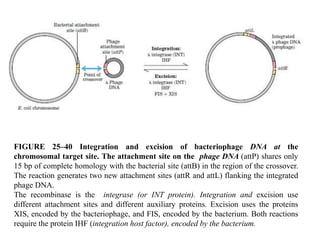
FIGURE 25–40 Integration and excision of bacteriophage DNA at the
chromosomal target site. The attachment site on the phage DNA (attP) shares only
15 bp of complete homology with the bacterial site (attB) in the region of the crossover.
The reaction generates two new attachment sites (attR and attL) flanking the integrated
phage DNA.
The recombinase is the integrase (or INT protein). Integration and excision use
different attachment sites and different auxiliary proteins. Excision uses the proteins
XIS, encoded by the bacteriophage, and FIS, encoded by the bacterium. Both reactions
require the protein IHF (integration host factor), encoded by the bacterium.
• The sequences of the recombination sites recognized by site-
specific recombinases are partially assymetric and the two
recombining sites align in the same orientation during the
recombinase reaction
• The outcome depends on the location and orientation of the
recombination sites
• If the two sites are on the same DNA molecule, the reaction
either inverts or deletes the intervening DNA ,determined by
whether the recombination sites have the opposite or the
same orientation, respectively
• If the same sites are on different DNAs the recombination is
intermolecular, if one or both DNAs are circular, the result is
an insertion

Recombination

  • 1.
    RECOMBINATION MESELSON MODEL ANDSITE- SPECIFIC RECOMBINATION M. KEERTHANA I M.Sc BIOCHEMISTRY
  • 2.
    GENETIC RECOMBINATION • Geneticrecombination is the production of offspring with combinations of traits that differ from those found in either parent • In eukaryotes, genetic recombination during meiosis can lead to a novel set of genetic information that can be passed on from the parents to the offspring • Most recombination is naturally occurring
  • 3.
  • 4.
    MESELSON RADDING MODEL •It is a second recombination model that is based on one single-strand nick for initiation • The model retains some key features of the holliday model namely, 1. Formation of heteroduplex DNA 2. Mismatch repair of the heteroduplex DNA to give 3:1 and 1:3 gene conversion events 3. The holliday junction intermediate that could be resolved as non crossover or cross over
  • 5.
    MECHANISM • A singlestrand nick is introduced into a strand of one of the duplexes • DNA polymerase extends the newly created 3’ end causing displacement of strand on the other side of the nick • With the assistance of Rec A, the displaced strand with a 5’P tail invades a homologous region in the second duplex to form a D loop • The D loop is cleaved forming a single strand links between the two duplexes
  • 6.
    MECHANISM(ctd) • The strandsare isomerised or rotated around the crossed strand point to allow the free ends at the exchange site to be ligated, forming a holliday junction • The holliday junction can branch migrate. • Branch migration form the initial site of strand invasion forms symmetric heteroduplex DNA
  • 8.
    SITE-SPECIFIC RECOMBINATION Viruses andtransposable elements often integrate their genomes into the host chromosome Site-specific recombination, is a type of genetic recombination in which DNA strand exchange takes place between segments possessing at least a certain degree of sequence homology Site- specific recombination is used by both eukaryotes and prokaryotes to regulate gene expression and to increase the organisms genetic range Each site- specific recombination involves: • Recombinase • A short (20-200bp) unique DNA sequence where recombinase act
  • 9.
    Site specific recombination FIGURE25–38 A site-specific recombination reaction. (a) The reaction is carried out within a tetramer of identical subunits. Recombinase subunits bind to a specific sequence, often called simply the recombination site. 1 One strand in each DNA is cleaved at particular points within the sequence. The nucleophile is the OH group of an active-site Tyr residue, and the product is a covalent phosphotyrosine link between protein and DNA. 2 The cleaved strands join to new partners, producing a Holliday intermediate. Steps 3 and 4 complete the reaction by a process similar to the first two steps. The original sequence of the recombination site is regenerated after recombining the DNA flanking the site. These steps occur within a complex of multiple recombinase subunits that sometimes includes other proteins.
  • 10.
    MECHANSIM • There aretwo general classes of site specific recombination which rely on either Tyr or Ser residues in the active site. • Recombinase is an important enzyme involved in the site specific recombination • The recombinase recognizes and binds to each of two recombination sites on two different DNA molecules or within the same DNA
  • 11.
    MECHANISM(ctd) • Step 1-One DNA strand in each site is cleaved at a specific point within the site, and the recombinase becomes covalently linked to DNA at the cleavage site through a phosphotyrosine bond • Step 2- The transient protein-DNA linkage preserves the phosphodiester bond that is lost in cleaving the DNA. The cleaved DNA strands are rejoined to new partners to form a holliday intermediate, with new phosphodiester bond created at the expense of the protein-DNA linkage • Step -3 The process is repeated at the second point within each of the two recombination sites in order to complete the reaction
  • 12.
    • In thesystems that employ an active Ser or Tyr residue, both strands of each recombination site are cut concurrently and rejoined to new partners without the holliday intermediate • In both the systems the, the exchange is always reciprocal and precise, regenerating the recombination sites when the reaction is complete • The first site specific recombination system studied in vitro was that encoded by bacteriophage ƛ. When ƛ phage DNA enters an E.COLI cell, a complex series of regulatory events commits the DNA to one of two fates. • The ƛ DNA replicates and produces more bacteriophages or it integrates into the host chromosome and replicates passively along with the chromosome for many cell generations.
  • 13.
    • Integration isaccomplished by a phage –encoded tyrosine class recombinase (ƛ integrase) that acts at recombination sites on the phage and bacterial DNAs at the attachment sites attP and attB, respectively
  • 14.
    FIGURE 25–40 Integrationand excision of bacteriophage DNA at the chromosomal target site. The attachment site on the phage DNA (attP) shares only 15 bp of complete homology with the bacterial site (attB) in the region of the crossover. The reaction generates two new attachment sites (attR and attL) flanking the integrated phage DNA. The recombinase is the integrase (or INT protein). Integration and excision use different attachment sites and different auxiliary proteins. Excision uses the proteins XIS, encoded by the bacteriophage, and FIS, encoded by the bacterium. Both reactions require the protein IHF (integration host factor), encoded by the bacterium.
  • 15.
    • The sequencesof the recombination sites recognized by site- specific recombinases are partially assymetric and the two recombining sites align in the same orientation during the recombinase reaction • The outcome depends on the location and orientation of the recombination sites • If the two sites are on the same DNA molecule, the reaction either inverts or deletes the intervening DNA ,determined by whether the recombination sites have the opposite or the same orientation, respectively • If the same sites are on different DNAs the recombination is intermolecular, if one or both DNAs are circular, the result is an insertion