Reasoning about laziness

        Johan Tibell
   johan.tibell@gmail.com


        2011-02-12
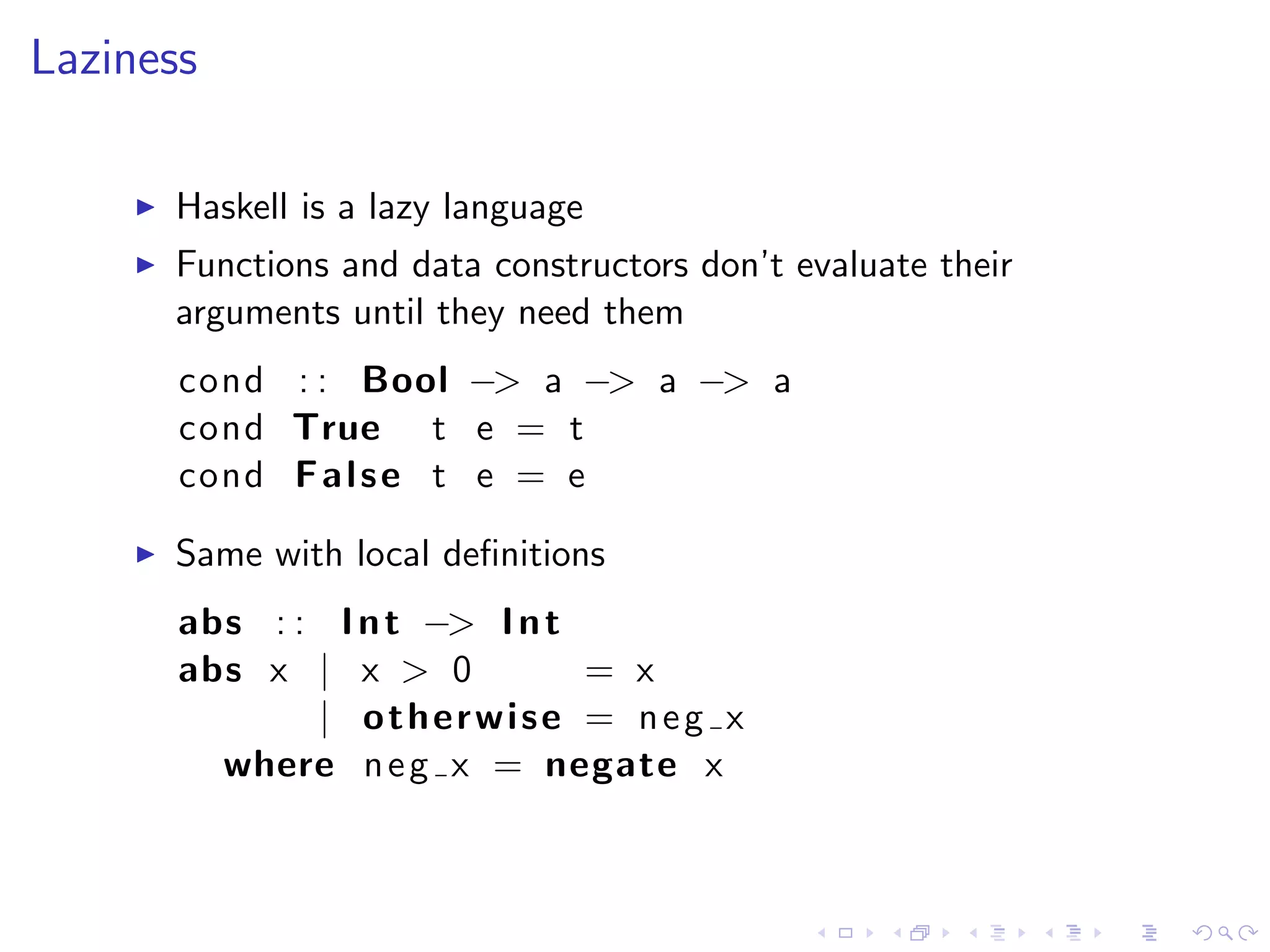
Laziness

      Haskell is a lazy language
      Functions and data constructors don’t evaluate their
      arguments until they need them
       cond : : Bool −> a −> a −> a
       cond True t e = t
       cond F a l s e t e = e

      Same with local definitions
       abs : : I n t −> I n t
       abs x | x > 0          = x
              | otherwise = neg x
         where n e g x = negate x
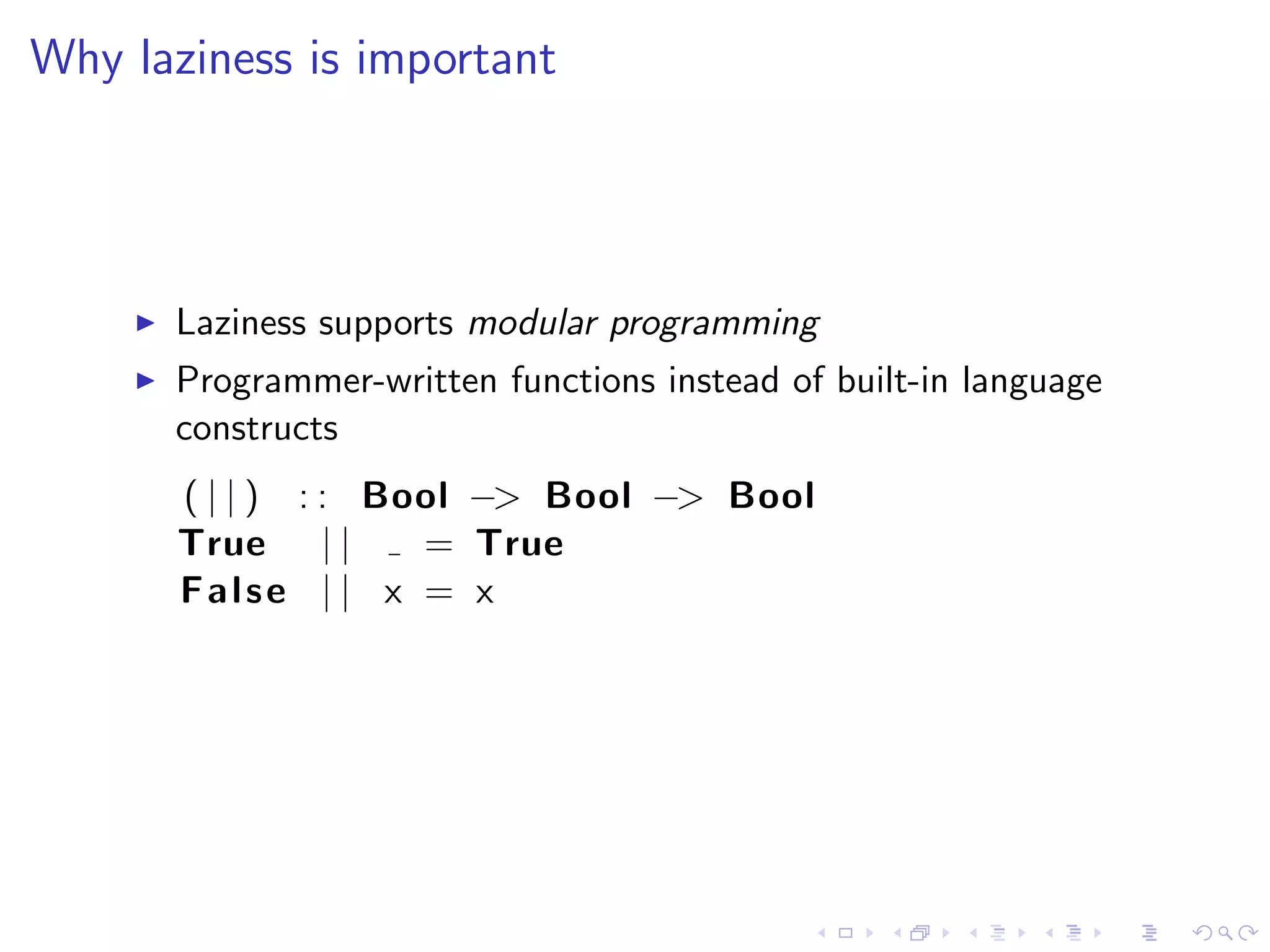
Why laziness is important


      Laziness supports modular programming
      Programmer-written functions instead of built-in language
      constructs
      ( | | ) : : Bool −> Bool −> Bool
      True | |      = True
      False | | x = x
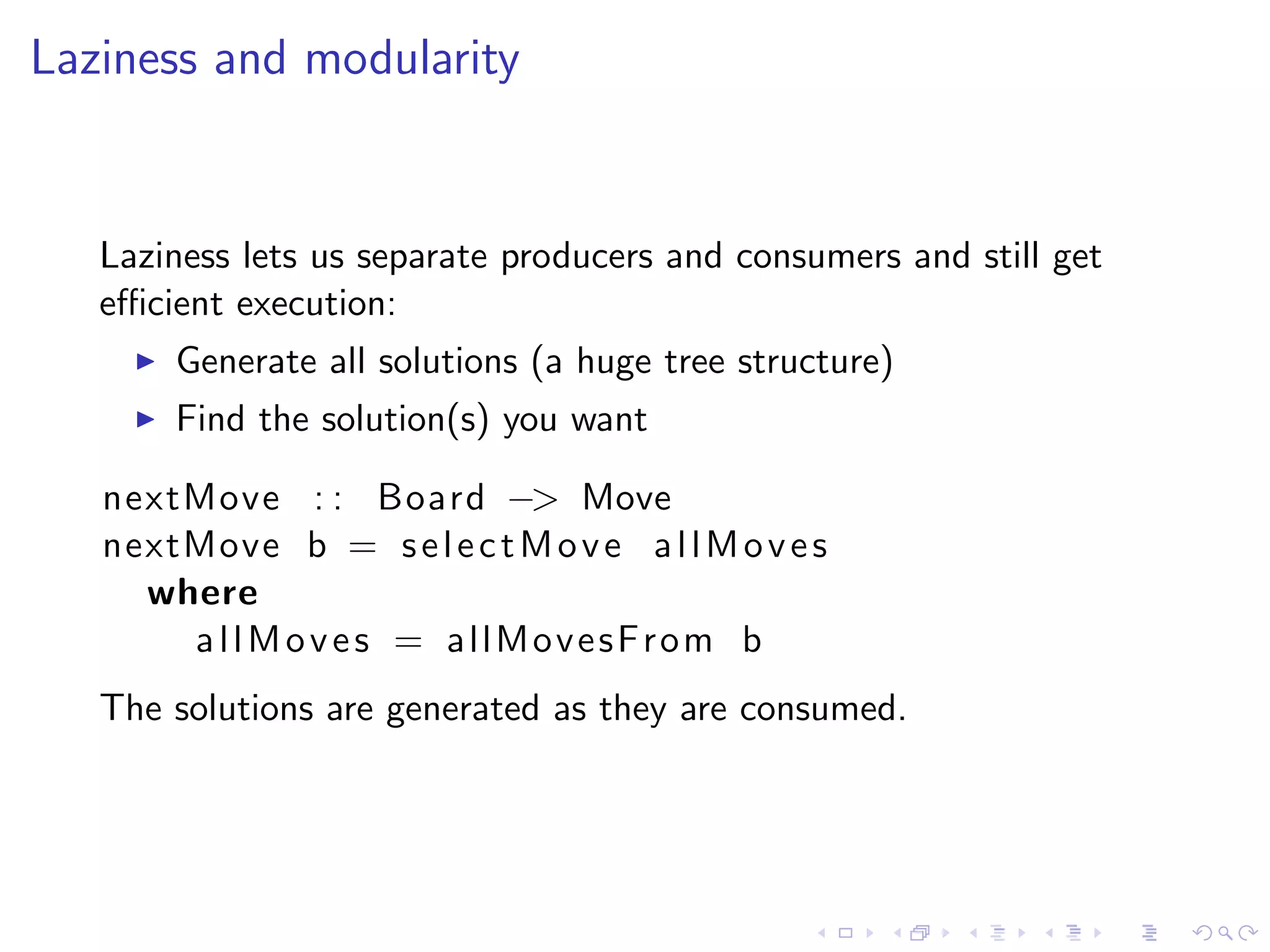
Laziness and modularity


   Laziness lets us separate producers and consumers and still get
   efficient execution:
       Generate all solutions (a huge tree structure)
       Find the solution(s) you want

   nextMove : : Board −> Move
   nextMove b = s e l e c t M o v e a l l M o v e s
     where
       allMoves = allMovesFrom b
   The solutions are generated as they are consumed.
Example: summing some numbers


  sum : : [ I n t ] −> I n t
  sum x s = sum ’ 0 x s
    where
      sum ’ a c c [ ]         = acc
      sum ’ a c c ( x : x s ) = sum ’ ( a c c + x ) x s
   foldl abstracts the accumulator recursion pattern:
   f o l d l : : ( a −> b −> a ) −> a −> [ b ] −> a
   foldl f z []             = z
   f o l d l f z ( x : xs ) = f o l d l f ( f z x ) xs

  sum = f o l d l (+) 0
A misbehaving function

   How does evaluation of this expression proceed?
   sum [ 1 , 2 , 3 ]
   Like this:

   sum   [1,2,3]
   ==>   foldl (+) 0 [1,2,3]
   ==>   foldl (+) (0+1) [2,3]
   ==>   foldl (+) ((0+1)+2) [3]
   ==>   foldl (+) (((0+1)+2)+3) []
   ==>   ((0+1)+2)+3
   ==>   (1+2)+3
   ==>   3+3
   ==>   6
Thunks


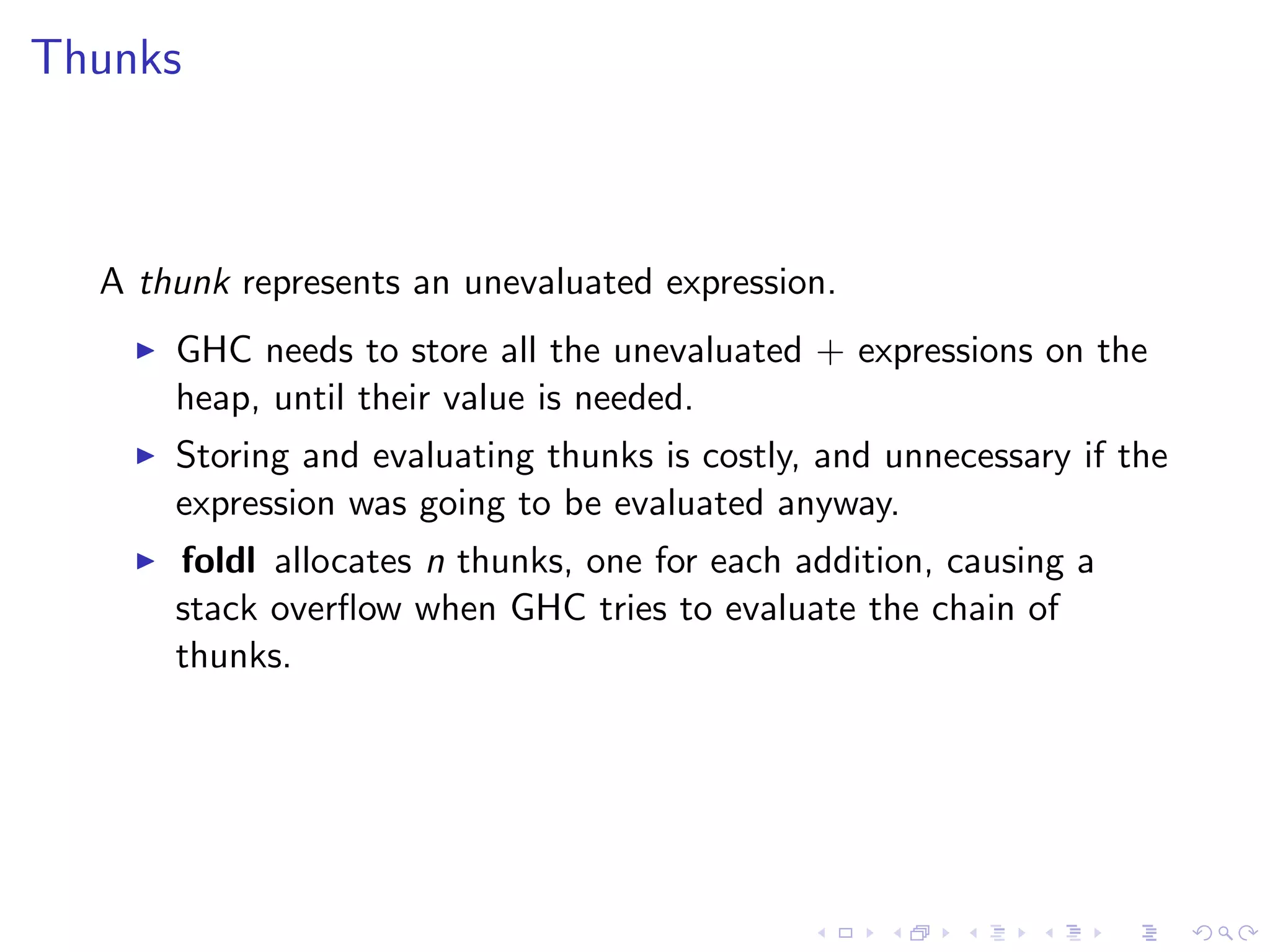
  A thunk represents an unevaluated expression.
      GHC needs to store all the unevaluated + expressions on the
      heap, until their value is needed.
      Storing and evaluating thunks is costly, and unnecessary if the
      expression was going to be evaluated anyway.
      foldl allocates n thunks, one for each addition, causing a
      stack overflow when GHC tries to evaluate the chain of
      thunks.
Controlling evaluation order


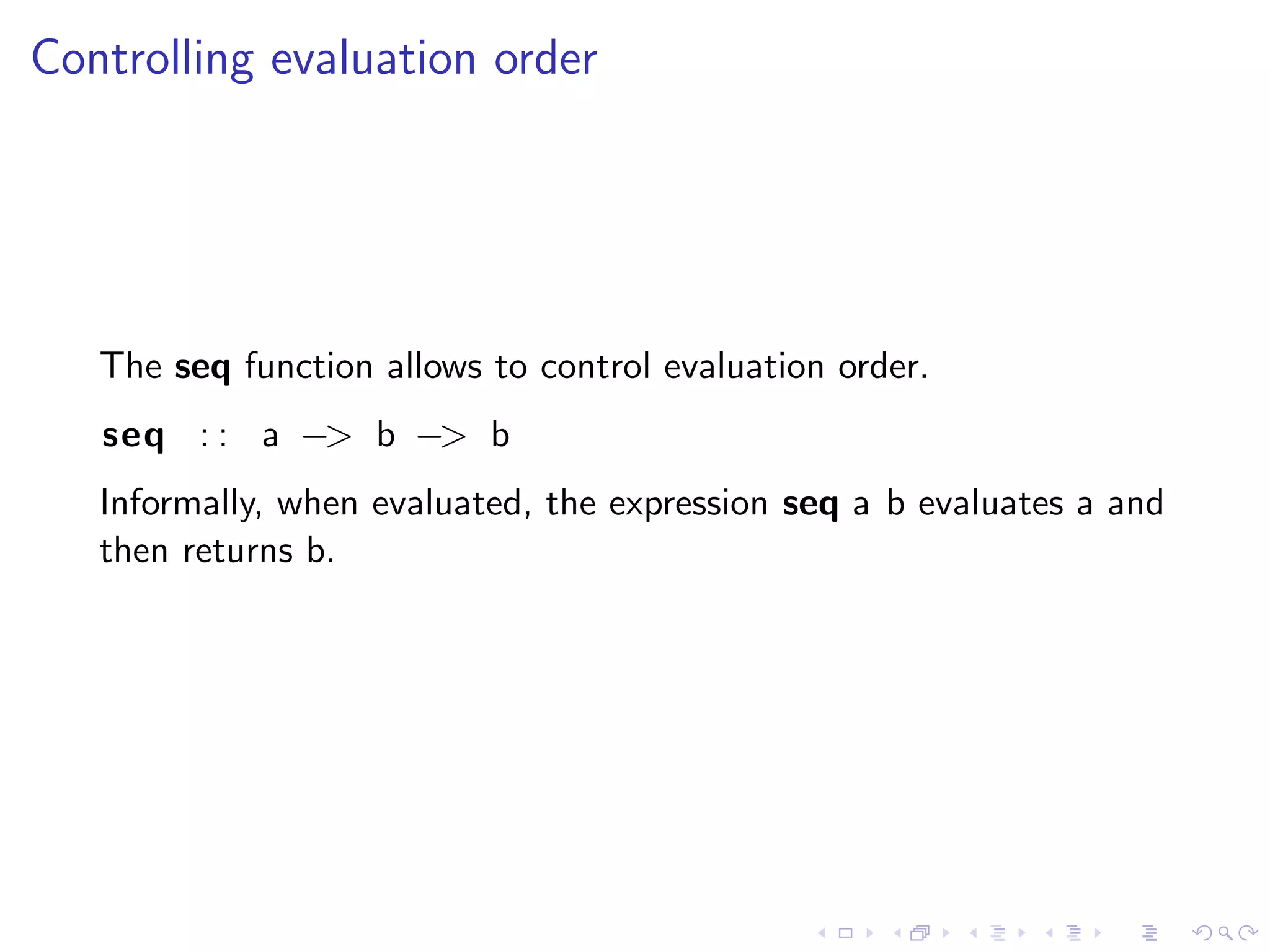
   The seq function allows to control evaluation order.
   seq : : a −> b −> b
   Informally, when evaluated, the expression seq a b evaluates a and
   then returns b.
Weak head normal form


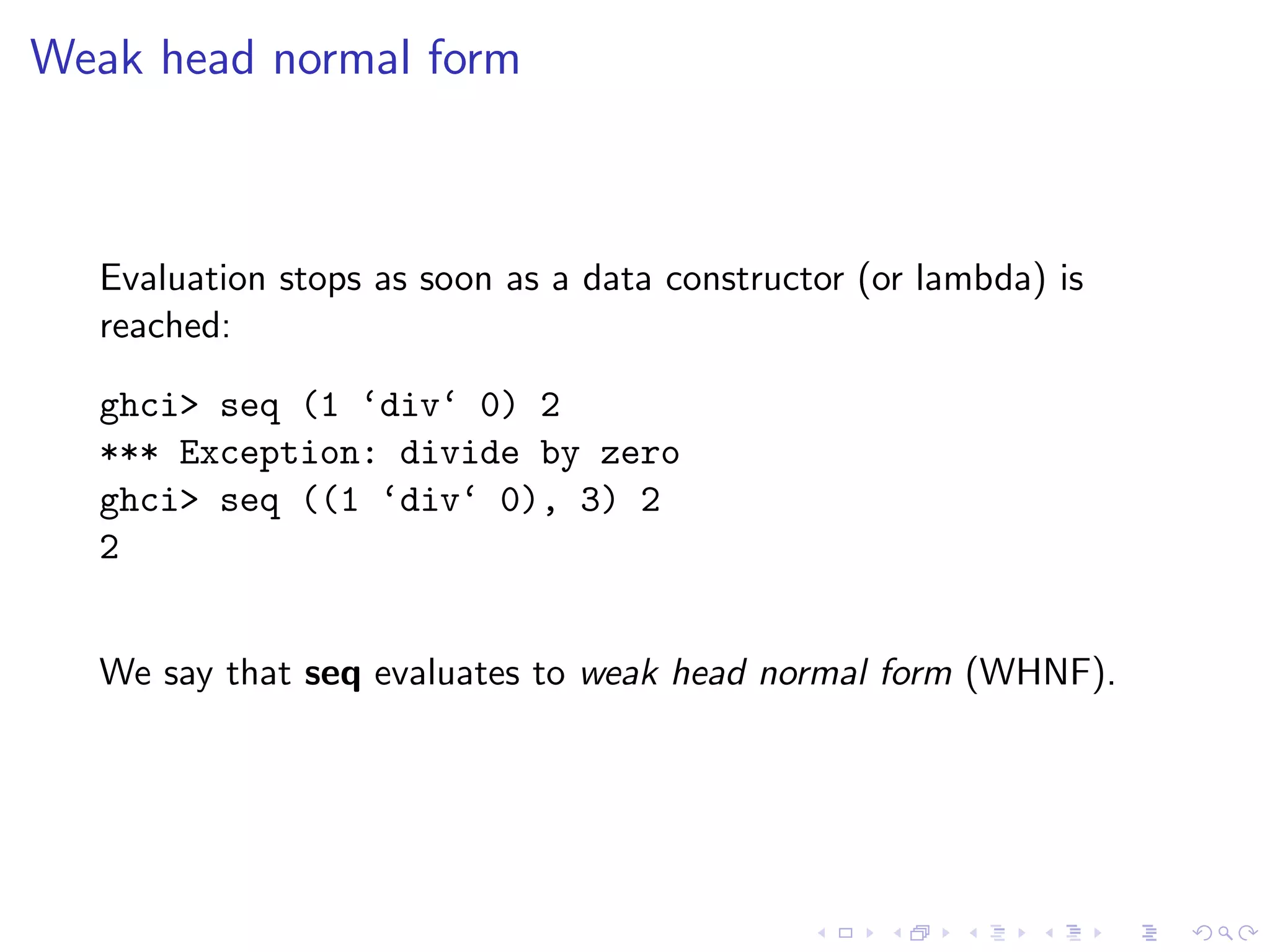
  Evaluation stops as soon as a data constructor (or lambda) is
  reached:

  ghci> seq (1 ‘div‘ 0) 2
  *** Exception: divide by zero
  ghci> seq ((1 ‘div‘ 0), 3) 2
  2


  We say that seq evaluates to weak head normal form (WHNF).
Weak head normal form


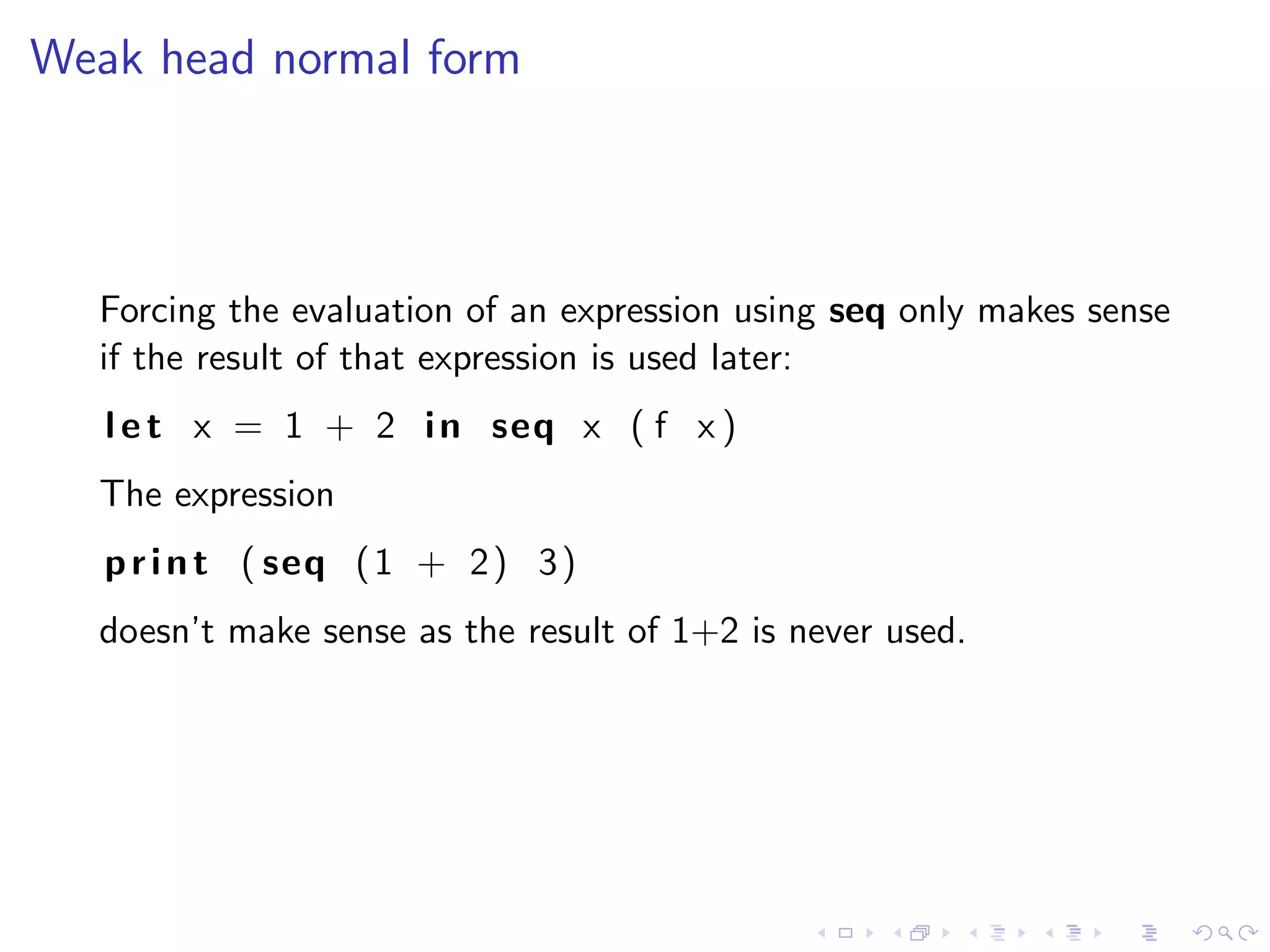
  Forcing the evaluation of an expression using seq only makes sense
  if the result of that expression is used later:
   l e t x = 1 + 2 i n seq x ( f x )
  The expression
   p r i n t ( seq ( 1 + 2 ) 3 )
  doesn’t make sense as the result of 1+2 is never used.
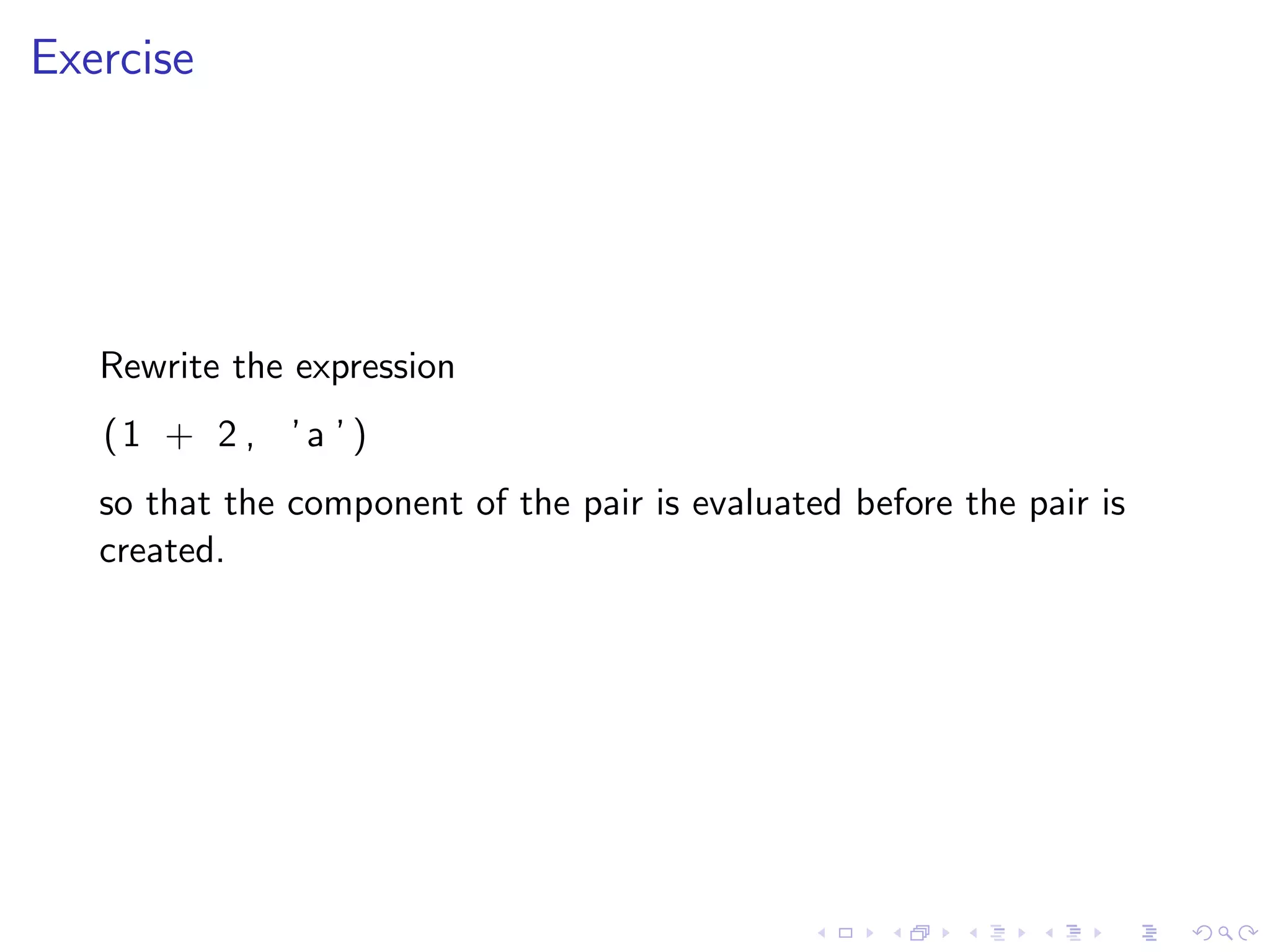
Exercise


   Rewrite the expression
   (1 + 2 , ’ a ’ )
   so that the component of the pair is evaluated before the pair is
   created.
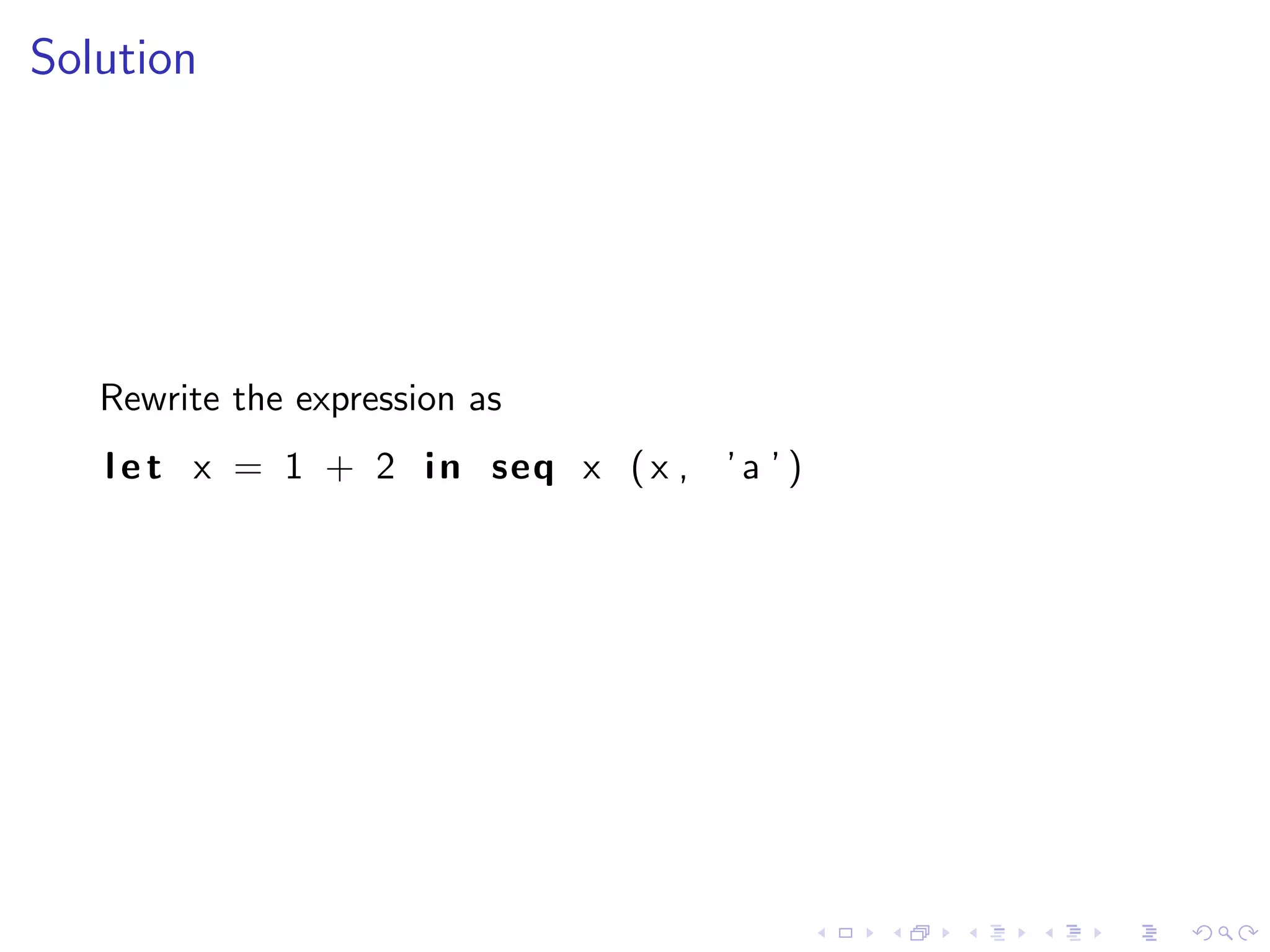
Solution


   Rewrite the expression as
   l e t x = 1 + 2 i n seq x ( x , ’ a ’ )
A strict left fold


   We want to evaluate the expression f z x before evaluating the
   recursive call:
    f o l d l ’ : : ( a −> b −> a ) −> a −> [ b ] −> a
    foldl ’ f z [ ]          = z
    foldl ’ f z ( x : xs ) = l e t z ’ = f z x
                               i n seq z ’ ( f o l d l ’ f z ’ x s )
Summing numbers, attempt 2

  How does evaluation of this expression proceed?

  foldl’ (+) 0 [1,2,3]

  Like this:

  foldl’ (+)      0 [1,2,3]
  ==> foldl’      (+) 1 [2,3]
  ==> foldl’      (+) 3 [3]
  ==> foldl’      (+) 6 []
  ==> 6

  Sanity check:

  ghci> print (foldl’ (+) 0 [1..1000000])
  500000500000
Computing the mean

  A function that computes the mean of a list of numbers:
  mean : : [ Double ] −> Double
  mean x s = s / f r o m I n t e g r a l l
    where
      ( s , l ) = f o l d l ’ s t e p (0 , 0) xs
      s t e p ( s , l ) a = ( s+a , l +1)
  We compute the length of the list and the sum of the numbers in
  one pass.

  $ ./Mean
  Stack space overflow: current size 8388608 bytes.
  Use ‘+RTS -Ksize -RTS’ to increase it.

  Didn’t we just fix that problem?!?
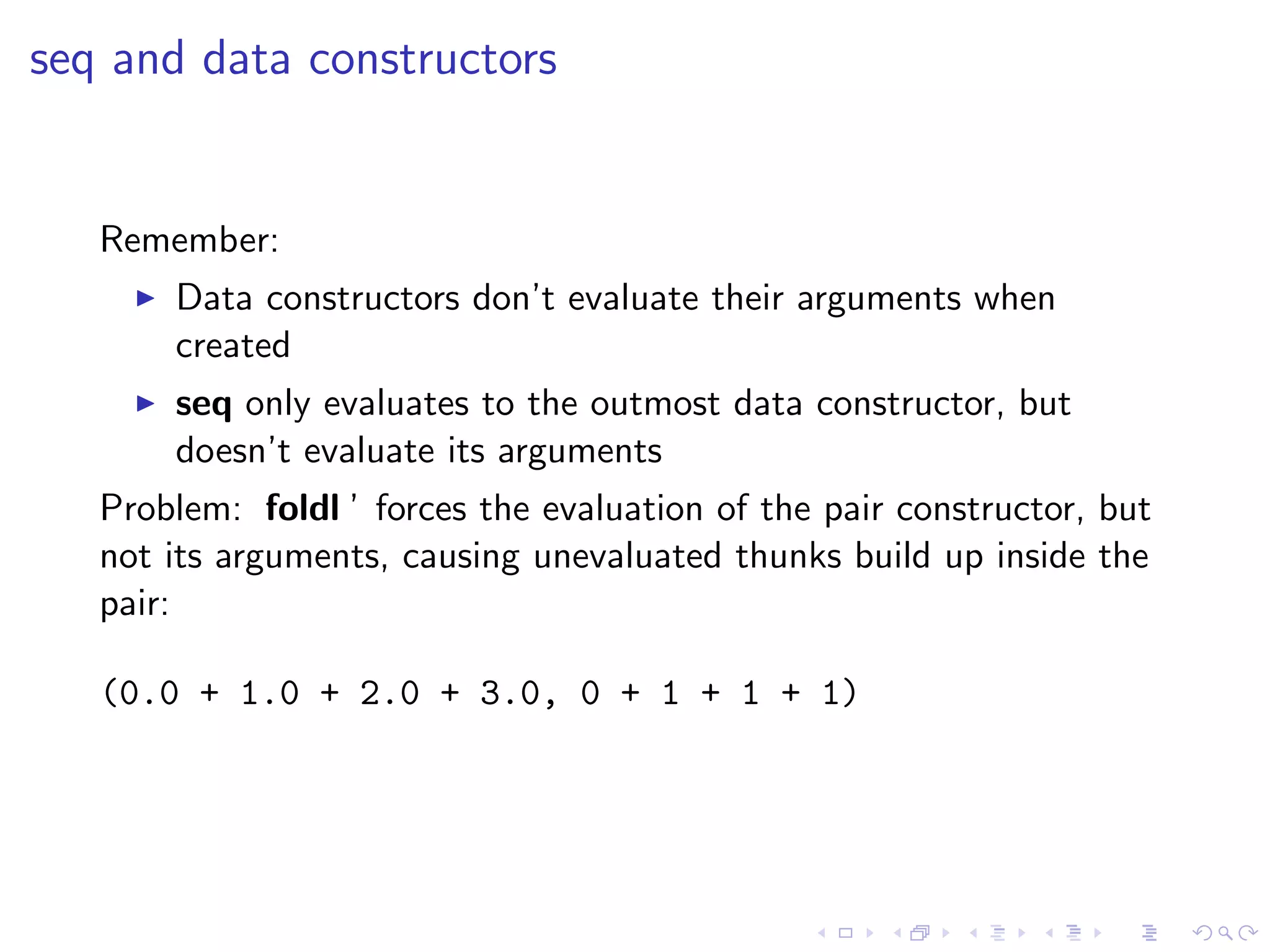
seq and data constructors


   Remember:
       Data constructors don’t evaluate their arguments when
       created
       seq only evaluates to the outmost data constructor, but
       doesn’t evaluate its arguments
   Problem: foldl ’ forces the evaluation of the pair constructor, but
   not its arguments, causing unevaluated thunks build up inside the
   pair:

   (0.0 + 1.0 + 2.0 + 3.0, 0 + 1 + 1 + 1)
Forcing evaluation of constructor arguments


   We can force GHC to evaluate the constructor arguments before
   the constructor is created:
   mean : : [ Double ] −> Double
   mean x s = s / f r o m I n t e g r a l l
     where
       ( s , l ) = f o l d l ’ s t e p (0 , 0) xs
       step (s , l ) a = let s ’ = s + a
                                      l ’ = l + 1
                               i n seq s ’ ( seq l ’ ( s ’ , l ’ ) )
Bang patterns


   A bang patterns is a concise way to express that an argument
   should be evaluated.
   {−# LANGUAGE B a n g P a t t e r n s #−}

   mean : : [ Double ] −> Double
   mean x s = s / f r o m I n t e g r a l l
     where
       ( s , l ) = f o l d l ’ s t e p (0 , 0) xs
       s t e p ( ! s , ! l ) a = ( s + a , l + 1)
   s and l are evaluated before the right-hand side of step is
   evaluated.
Strictness


   We say that a function is strict in an argument, if evaluating the
   function always causes the argument to be evaluated.
   n u l l : : [ a ] −> Bool
   n u l l [ ] = True
   null        = False
   null is strict in its first (and only) argument, as it needs to be
   evaluated to pick a return value.
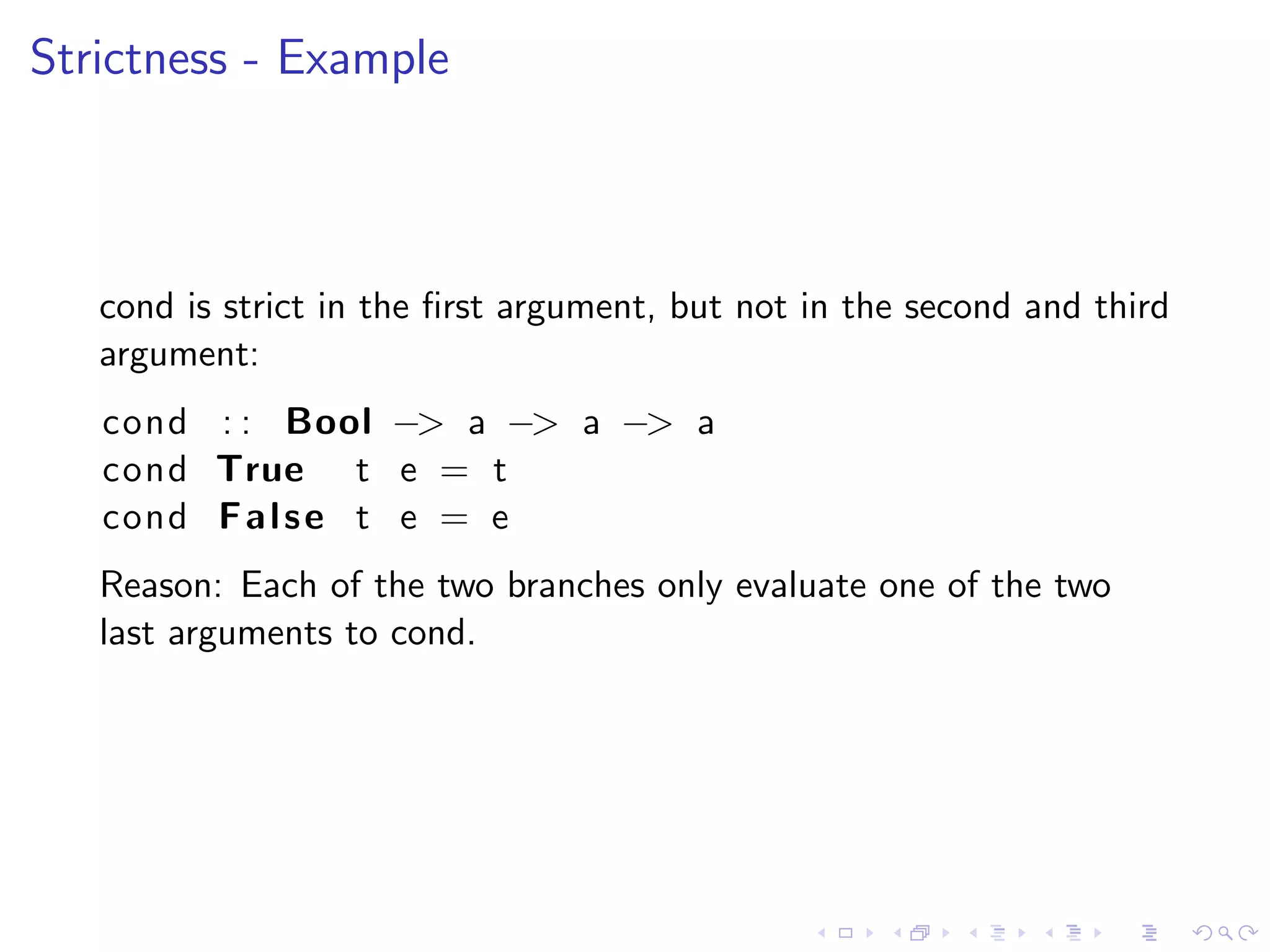
Strictness - Example


   cond is strict in the first argument, but not in the second and third
   argument:
   cond : : Bool −> a −> a −> a
   cond True t e = t
   cond F a l s e t e = e
   Reason: Each of the two branches only evaluate one of the two
   last arguments to cond.
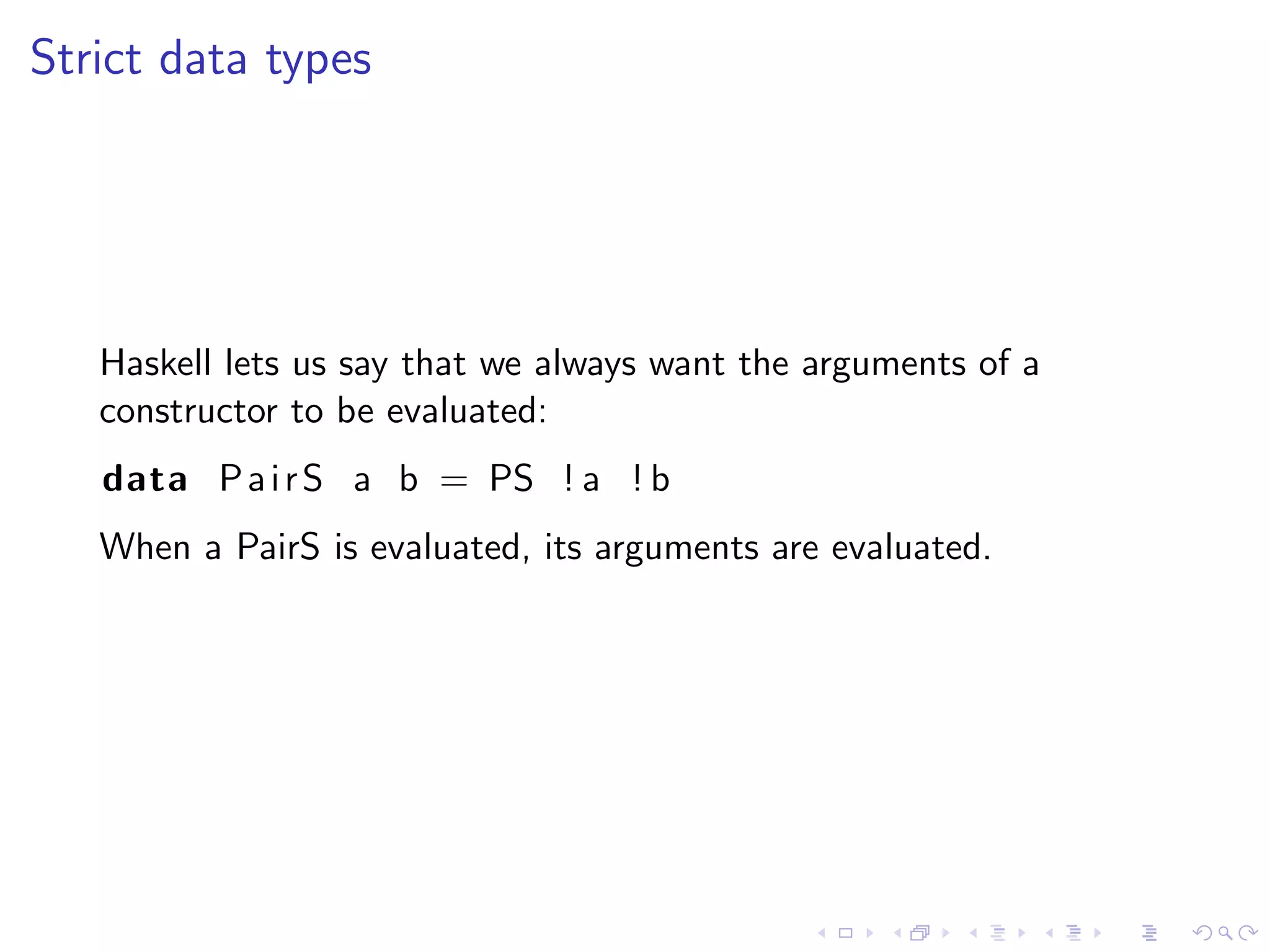
Strict data types


   Haskell lets us say that we always want the arguments of a
   constructor to be evaluated:
   data P a i r S a b = PS ! a ! b
   When a PairS is evaluated, its arguments are evaluated.
Strict pairs as accumulators


   We can use a strict pair to simplify our mean function:
   mean : : [ Double ] −> Double
   mean x s = s / f r o m I n t e g r a l l
     where
       PS s l = f o l d l ’ s t e p ( PS 0 0 ) x s
       s t e p ( PS s l ) a = PS ( s + a ) ( l + 1 )
   Tip: Prefer strict data types when laziness is not needed for your
   program to work correctly.
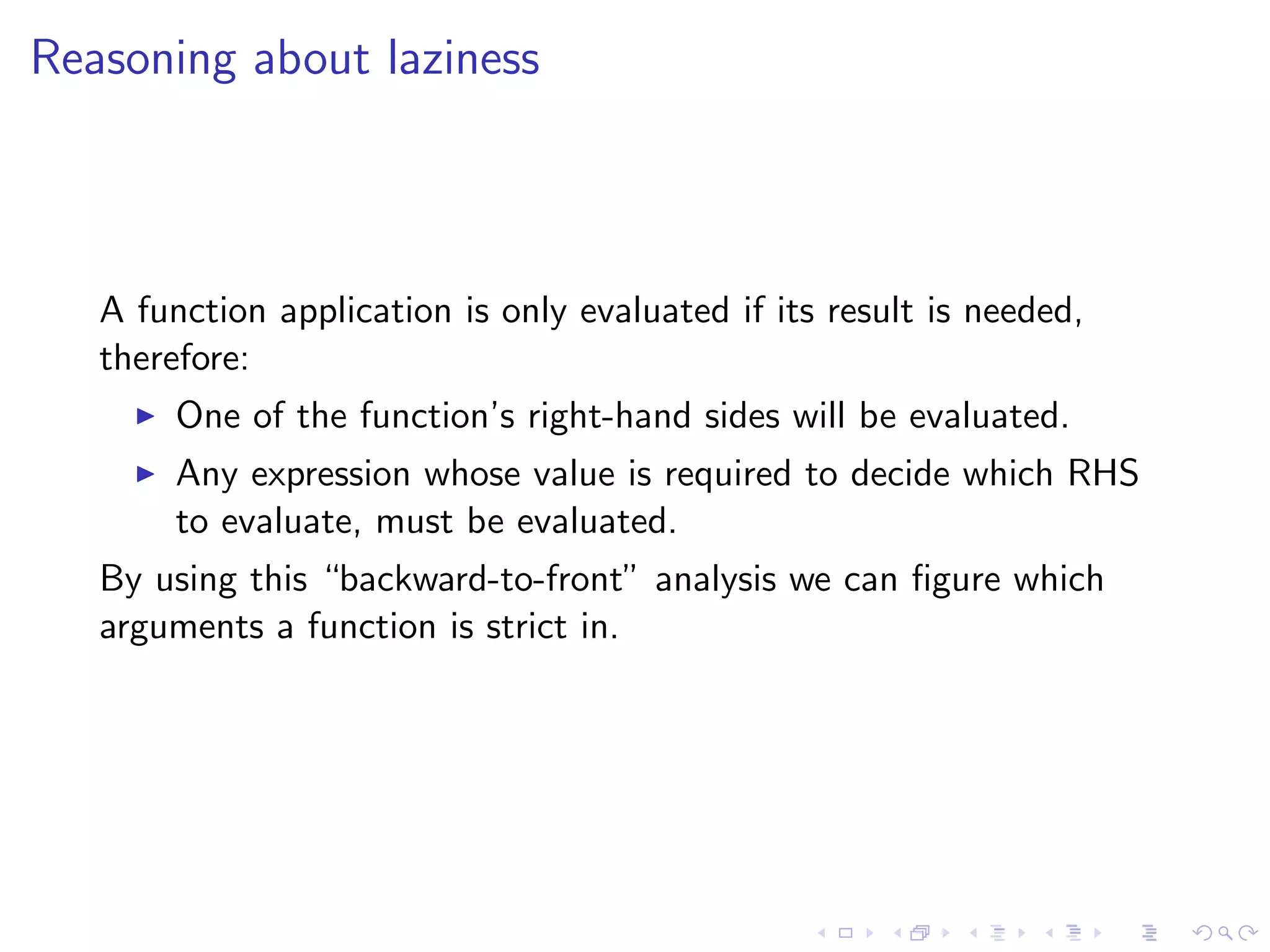
Reasoning about laziness


   A function application is only evaluated if its result is needed,
   therefore:
        One of the function’s right-hand sides will be evaluated.
        Any expression whose value is required to decide which RHS
        to evaluate, must be evaluated.
   By using this “backward-to-front” analysis we can figure which
   arguments a function is strict in.
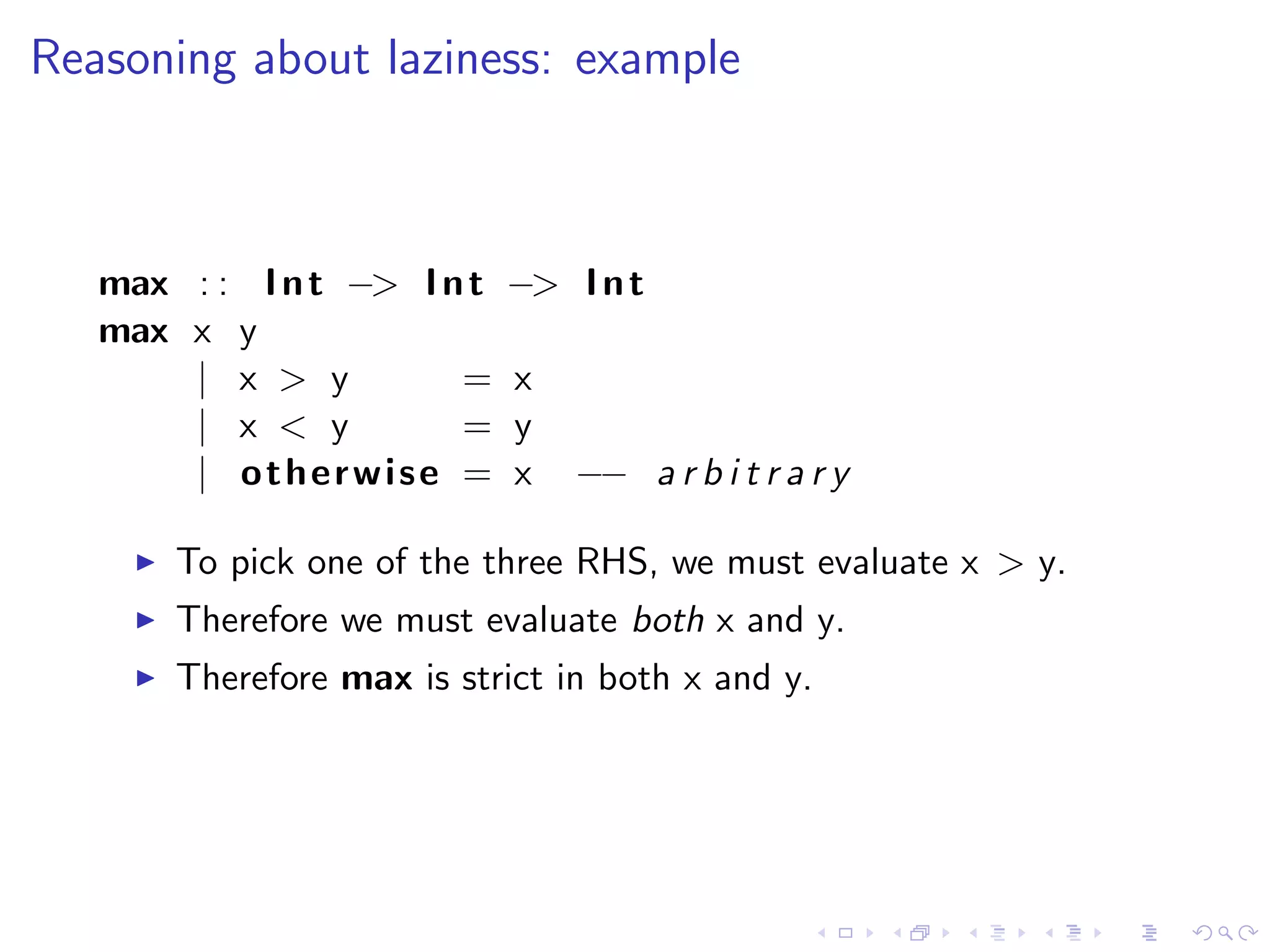
Reasoning about laziness: example


   max : : I n t −> I n t   −> I n t
   max x y
       | x > y         =    x
       | x < y         =    y
       | otherwise =        x   −− a r b i t r a r y

       To pick one of the three RHS, we must evaluate x > y.
       Therefore we must evaluate both x and y.
       Therefore max is strict in both x and y.
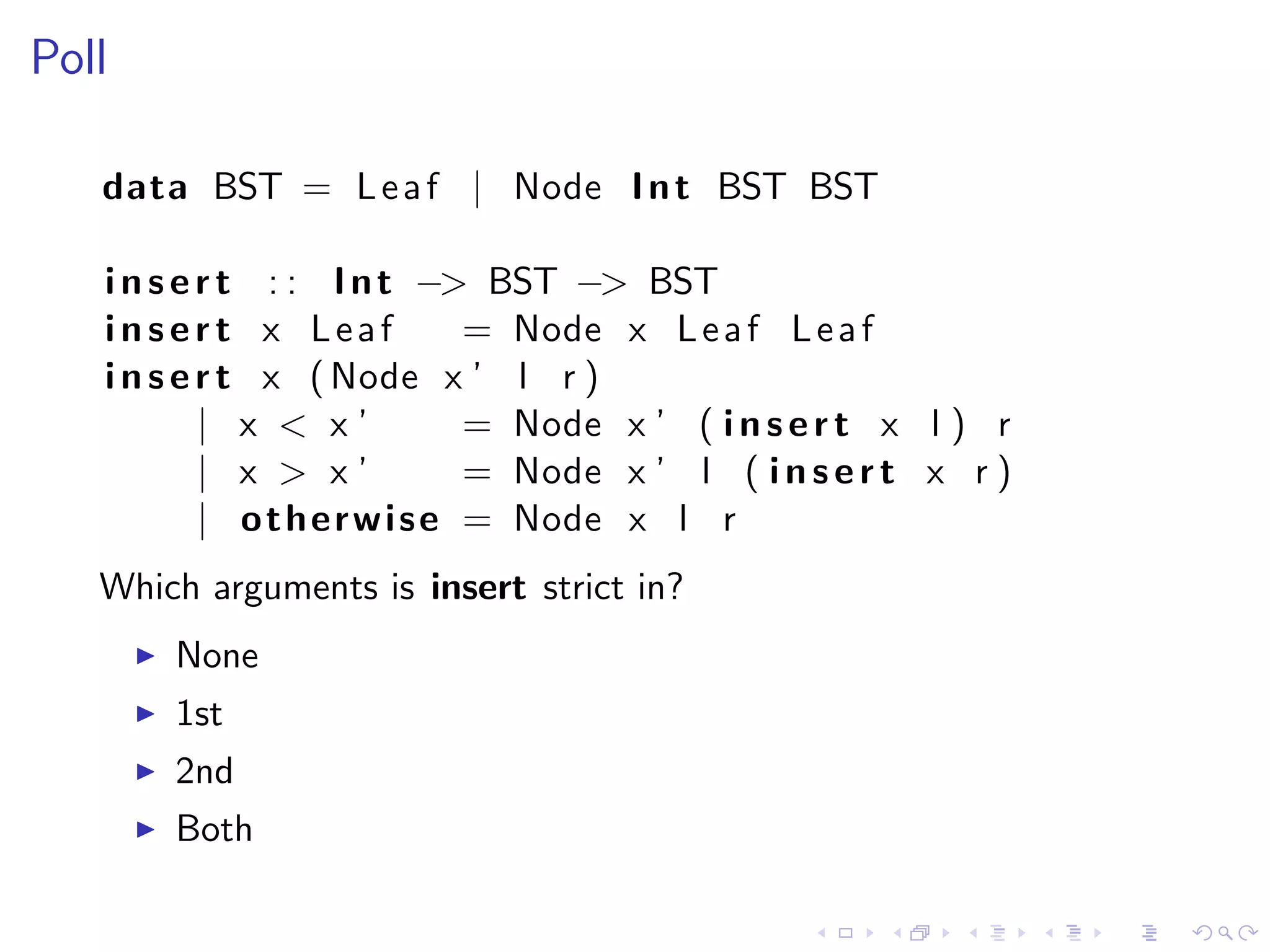
Poll

   data BST = L e a f | Node I n t BST BST

   i n s e r t : : I n t −> BST −> BST
   insert x Leaf               = Node x L e a f L e a f
   i n s e r t x ( Node x ’ l r )
           | x < x’            = Node x ’ ( i n s e r t x l ) r
           | x > x’            = Node x ’ l ( i n s e r t x r )
           | o t h e r w i s e = Node x l r
   Which arguments is insert strict in?
       None
       1st
       2nd
       Both
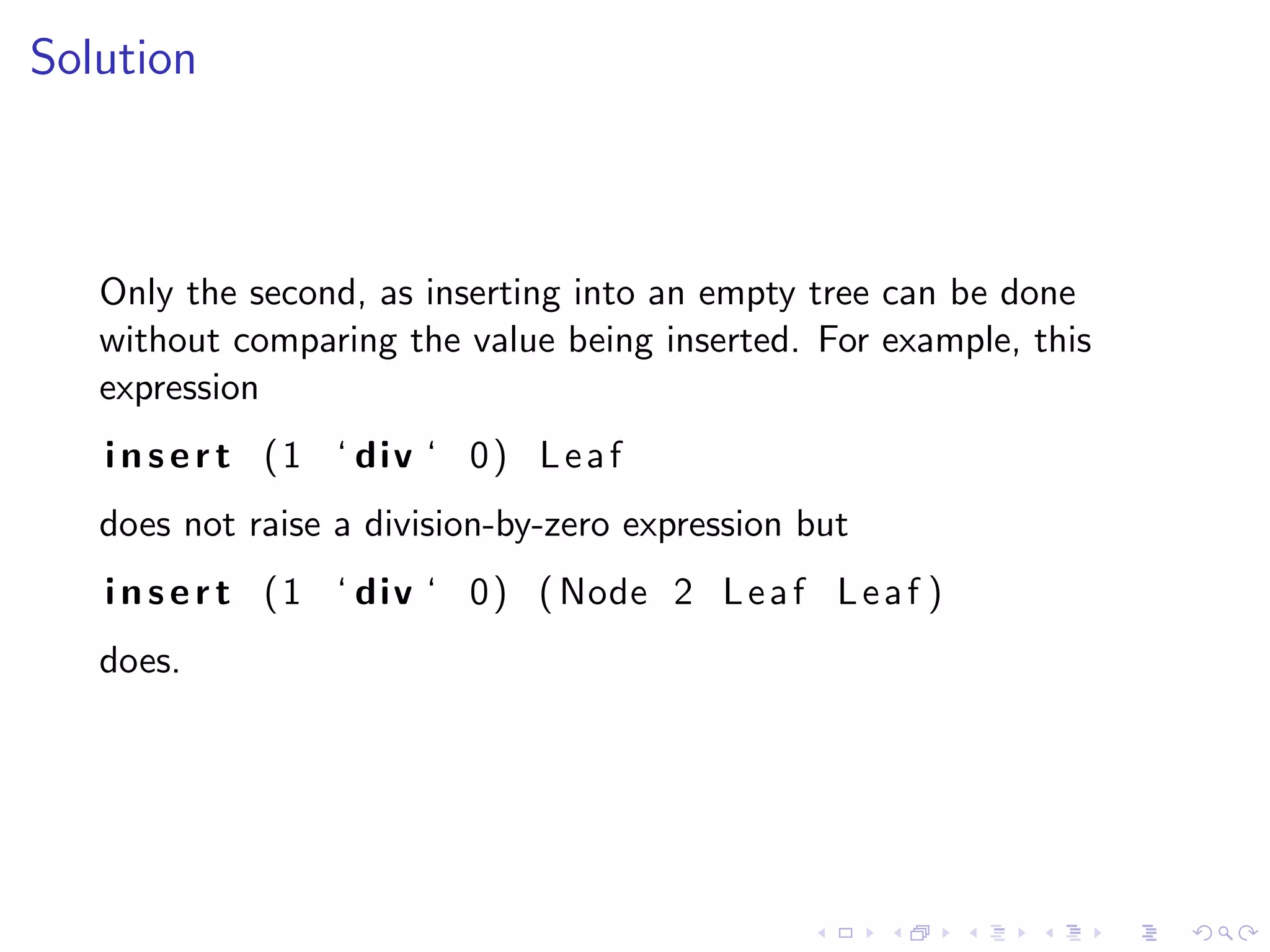
Solution


   Only the second, as inserting into an empty tree can be done
   without comparing the value being inserted. For example, this
   expression
   i n s e r t ( 1 ‘ div ‘ 0 ) L e a f
   does not raise a division-by-zero expression but
   i n s e r t ( 1 ‘ div ‘ 0 ) ( Node 2 L e a f L e a f )
   does.
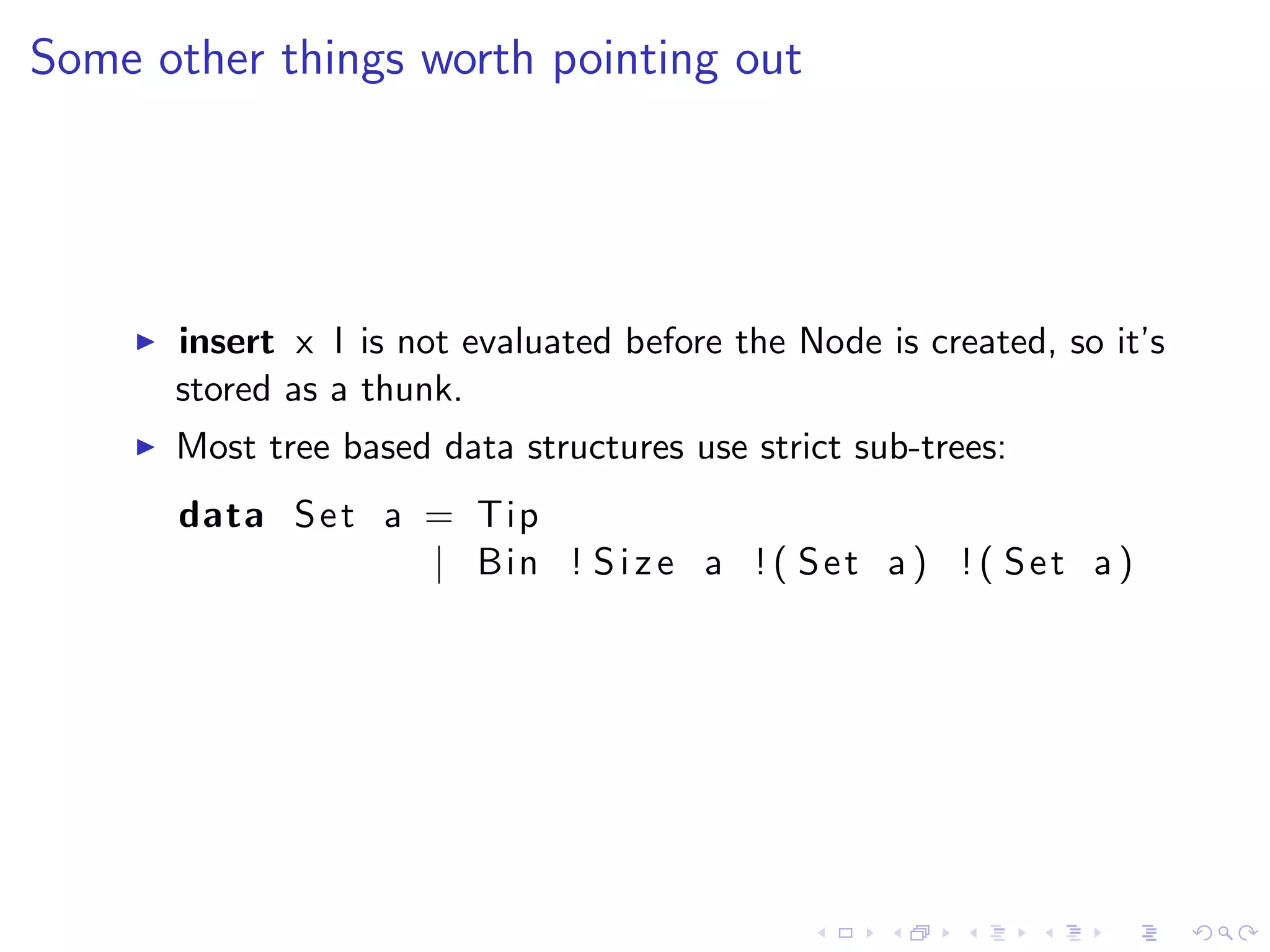
Some other things worth pointing out


      insert x l is not evaluated before the Node is created, so it’s
      stored as a thunk.
      Most tree based data structures use strict sub-trees:
      data S e t a = Tip
                   | Bin ! S i z e a ! ( S e t a ) ! ( S e t a )
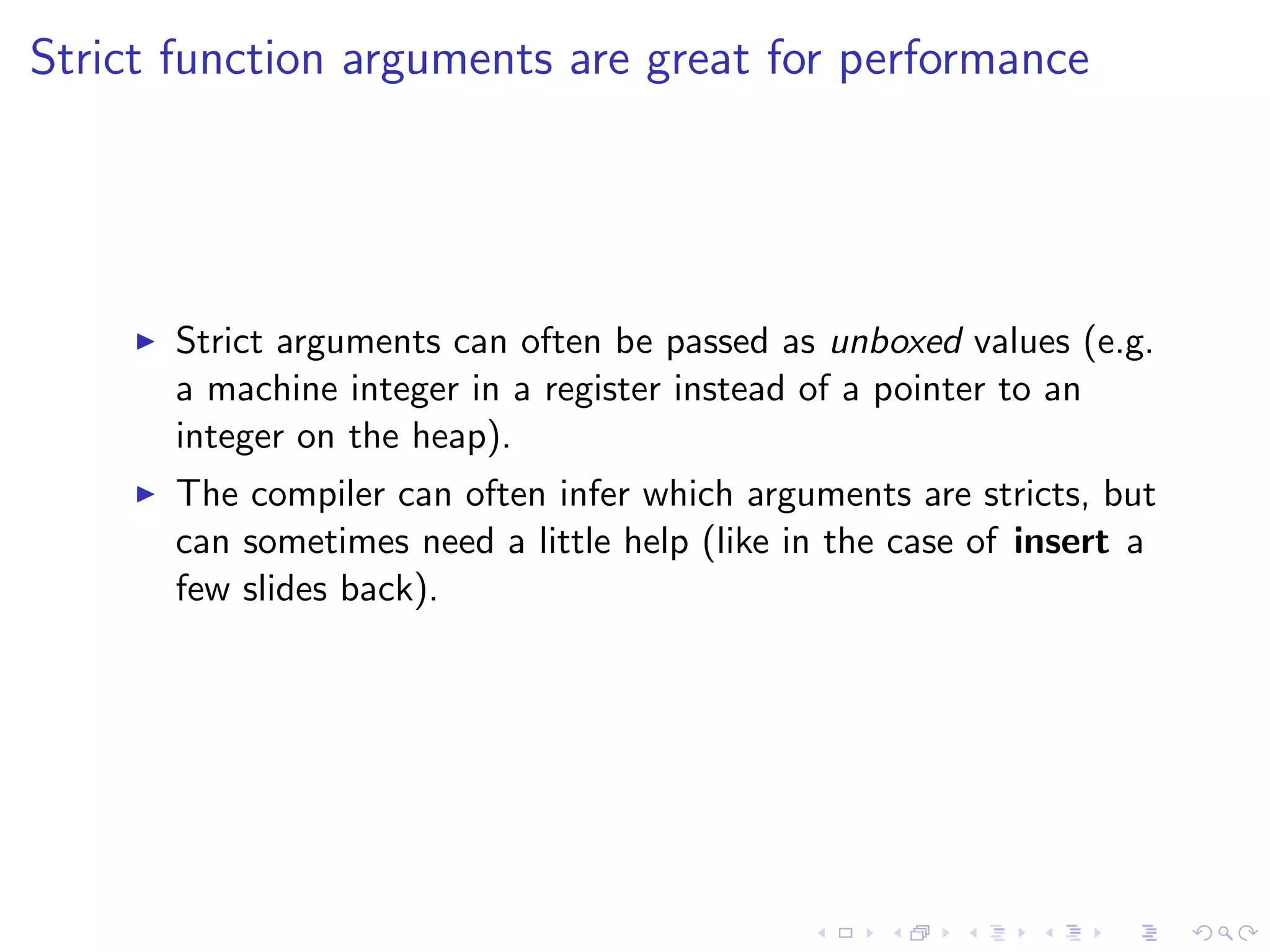
Strict function arguments are great for performance


       Strict arguments can often be passed as unboxed values (e.g.
       a machine integer in a register instead of a pointer to an
       integer on the heap).
       The compiler can often infer which arguments are stricts, but
       can sometimes need a little help (like in the case of insert a
       few slides back).
Summary


  Understanding how evaluation works in Haskell is important and
  requires practice.

Reasoning about laziness

  • 1.
    Reasoning about laziness Johan Tibell johan.tibell@gmail.com 2011-02-12
  • 2.
    Laziness Haskell is a lazy language Functions and data constructors don’t evaluate their arguments until they need them cond : : Bool −> a −> a −> a cond True t e = t cond F a l s e t e = e Same with local definitions abs : : I n t −> I n t abs x | x > 0 = x | otherwise = neg x where n e g x = negate x
  • 3.
    Why laziness isimportant Laziness supports modular programming Programmer-written functions instead of built-in language constructs ( | | ) : : Bool −> Bool −> Bool True | | = True False | | x = x
  • 4.
    Laziness and modularity Laziness lets us separate producers and consumers and still get efficient execution: Generate all solutions (a huge tree structure) Find the solution(s) you want nextMove : : Board −> Move nextMove b = s e l e c t M o v e a l l M o v e s where allMoves = allMovesFrom b The solutions are generated as they are consumed.
  • 5.
    Example: summing somenumbers sum : : [ I n t ] −> I n t sum x s = sum ’ 0 x s where sum ’ a c c [ ] = acc sum ’ a c c ( x : x s ) = sum ’ ( a c c + x ) x s foldl abstracts the accumulator recursion pattern: f o l d l : : ( a −> b −> a ) −> a −> [ b ] −> a foldl f z [] = z f o l d l f z ( x : xs ) = f o l d l f ( f z x ) xs sum = f o l d l (+) 0
  • 6.
    A misbehaving function How does evaluation of this expression proceed? sum [ 1 , 2 , 3 ] Like this: sum [1,2,3] ==> foldl (+) 0 [1,2,3] ==> foldl (+) (0+1) [2,3] ==> foldl (+) ((0+1)+2) [3] ==> foldl (+) (((0+1)+2)+3) [] ==> ((0+1)+2)+3 ==> (1+2)+3 ==> 3+3 ==> 6
  • 7.
    Thunks Athunk represents an unevaluated expression. GHC needs to store all the unevaluated + expressions on the heap, until their value is needed. Storing and evaluating thunks is costly, and unnecessary if the expression was going to be evaluated anyway. foldl allocates n thunks, one for each addition, causing a stack overflow when GHC tries to evaluate the chain of thunks.
  • 8.
    Controlling evaluation order The seq function allows to control evaluation order. seq : : a −> b −> b Informally, when evaluated, the expression seq a b evaluates a and then returns b.
  • 9.
    Weak head normalform Evaluation stops as soon as a data constructor (or lambda) is reached: ghci> seq (1 ‘div‘ 0) 2 *** Exception: divide by zero ghci> seq ((1 ‘div‘ 0), 3) 2 2 We say that seq evaluates to weak head normal form (WHNF).
  • 10.
    Weak head normalform Forcing the evaluation of an expression using seq only makes sense if the result of that expression is used later: l e t x = 1 + 2 i n seq x ( f x ) The expression p r i n t ( seq ( 1 + 2 ) 3 ) doesn’t make sense as the result of 1+2 is never used.
  • 11.
    Exercise Rewrite the expression (1 + 2 , ’ a ’ ) so that the component of the pair is evaluated before the pair is created.
  • 12.
    Solution Rewrite the expression as l e t x = 1 + 2 i n seq x ( x , ’ a ’ )
  • 13.
    A strict leftfold We want to evaluate the expression f z x before evaluating the recursive call: f o l d l ’ : : ( a −> b −> a ) −> a −> [ b ] −> a foldl ’ f z [ ] = z foldl ’ f z ( x : xs ) = l e t z ’ = f z x i n seq z ’ ( f o l d l ’ f z ’ x s )
  • 14.
    Summing numbers, attempt2 How does evaluation of this expression proceed? foldl’ (+) 0 [1,2,3] Like this: foldl’ (+) 0 [1,2,3] ==> foldl’ (+) 1 [2,3] ==> foldl’ (+) 3 [3] ==> foldl’ (+) 6 [] ==> 6 Sanity check: ghci> print (foldl’ (+) 0 [1..1000000]) 500000500000
  • 15.
    Computing the mean A function that computes the mean of a list of numbers: mean : : [ Double ] −> Double mean x s = s / f r o m I n t e g r a l l where ( s , l ) = f o l d l ’ s t e p (0 , 0) xs s t e p ( s , l ) a = ( s+a , l +1) We compute the length of the list and the sum of the numbers in one pass. $ ./Mean Stack space overflow: current size 8388608 bytes. Use ‘+RTS -Ksize -RTS’ to increase it. Didn’t we just fix that problem?!?
  • 16.
    seq and dataconstructors Remember: Data constructors don’t evaluate their arguments when created seq only evaluates to the outmost data constructor, but doesn’t evaluate its arguments Problem: foldl ’ forces the evaluation of the pair constructor, but not its arguments, causing unevaluated thunks build up inside the pair: (0.0 + 1.0 + 2.0 + 3.0, 0 + 1 + 1 + 1)
  • 17.
    Forcing evaluation ofconstructor arguments We can force GHC to evaluate the constructor arguments before the constructor is created: mean : : [ Double ] −> Double mean x s = s / f r o m I n t e g r a l l where ( s , l ) = f o l d l ’ s t e p (0 , 0) xs step (s , l ) a = let s ’ = s + a l ’ = l + 1 i n seq s ’ ( seq l ’ ( s ’ , l ’ ) )
  • 18.
    Bang patterns A bang patterns is a concise way to express that an argument should be evaluated. {−# LANGUAGE B a n g P a t t e r n s #−} mean : : [ Double ] −> Double mean x s = s / f r o m I n t e g r a l l where ( s , l ) = f o l d l ’ s t e p (0 , 0) xs s t e p ( ! s , ! l ) a = ( s + a , l + 1) s and l are evaluated before the right-hand side of step is evaluated.
  • 19.
    Strictness We say that a function is strict in an argument, if evaluating the function always causes the argument to be evaluated. n u l l : : [ a ] −> Bool n u l l [ ] = True null = False null is strict in its first (and only) argument, as it needs to be evaluated to pick a return value.
  • 20.
    Strictness - Example cond is strict in the first argument, but not in the second and third argument: cond : : Bool −> a −> a −> a cond True t e = t cond F a l s e t e = e Reason: Each of the two branches only evaluate one of the two last arguments to cond.
  • 21.
    Strict data types Haskell lets us say that we always want the arguments of a constructor to be evaluated: data P a i r S a b = PS ! a ! b When a PairS is evaluated, its arguments are evaluated.
  • 22.
    Strict pairs asaccumulators We can use a strict pair to simplify our mean function: mean : : [ Double ] −> Double mean x s = s / f r o m I n t e g r a l l where PS s l = f o l d l ’ s t e p ( PS 0 0 ) x s s t e p ( PS s l ) a = PS ( s + a ) ( l + 1 ) Tip: Prefer strict data types when laziness is not needed for your program to work correctly.
  • 23.
    Reasoning about laziness A function application is only evaluated if its result is needed, therefore: One of the function’s right-hand sides will be evaluated. Any expression whose value is required to decide which RHS to evaluate, must be evaluated. By using this “backward-to-front” analysis we can figure which arguments a function is strict in.
  • 24.
    Reasoning about laziness:example max : : I n t −> I n t −> I n t max x y | x > y = x | x < y = y | otherwise = x −− a r b i t r a r y To pick one of the three RHS, we must evaluate x > y. Therefore we must evaluate both x and y. Therefore max is strict in both x and y.
  • 25.
    Poll data BST = L e a f | Node I n t BST BST i n s e r t : : I n t −> BST −> BST insert x Leaf = Node x L e a f L e a f i n s e r t x ( Node x ’ l r ) | x < x’ = Node x ’ ( i n s e r t x l ) r | x > x’ = Node x ’ l ( i n s e r t x r ) | o t h e r w i s e = Node x l r Which arguments is insert strict in? None 1st 2nd Both
  • 26.
    Solution Only the second, as inserting into an empty tree can be done without comparing the value being inserted. For example, this expression i n s e r t ( 1 ‘ div ‘ 0 ) L e a f does not raise a division-by-zero expression but i n s e r t ( 1 ‘ div ‘ 0 ) ( Node 2 L e a f L e a f ) does.
  • 27.
    Some other thingsworth pointing out insert x l is not evaluated before the Node is created, so it’s stored as a thunk. Most tree based data structures use strict sub-trees: data S e t a = Tip | Bin ! S i z e a ! ( S e t a ) ! ( S e t a )
  • 28.
    Strict function argumentsare great for performance Strict arguments can often be passed as unboxed values (e.g. a machine integer in a register instead of a pointer to an integer on the heap). The compiler can often infer which arguments are stricts, but can sometimes need a little help (like in the case of insert a few slides back).
  • 29.
    Summary Understandinghow evaluation works in Haskell is important and requires practice.