Reason
Introduction
• There is a scene in a Broadway play where a priest is
speaking to a man at a party and is asked if he ever
hears anything interesting in confession. The priest
replies that in fact that in the very first confession he
gave after being ordained a man admitted that he’d
murdered his wife
• Later on in the party another man is introduced to the
priest and says “I met you a long time ago father, in
fact I was the first person who came to you for
confession”
• What does the author expect you to conclude from the
two previous conversations?
The structure of arguments of reason
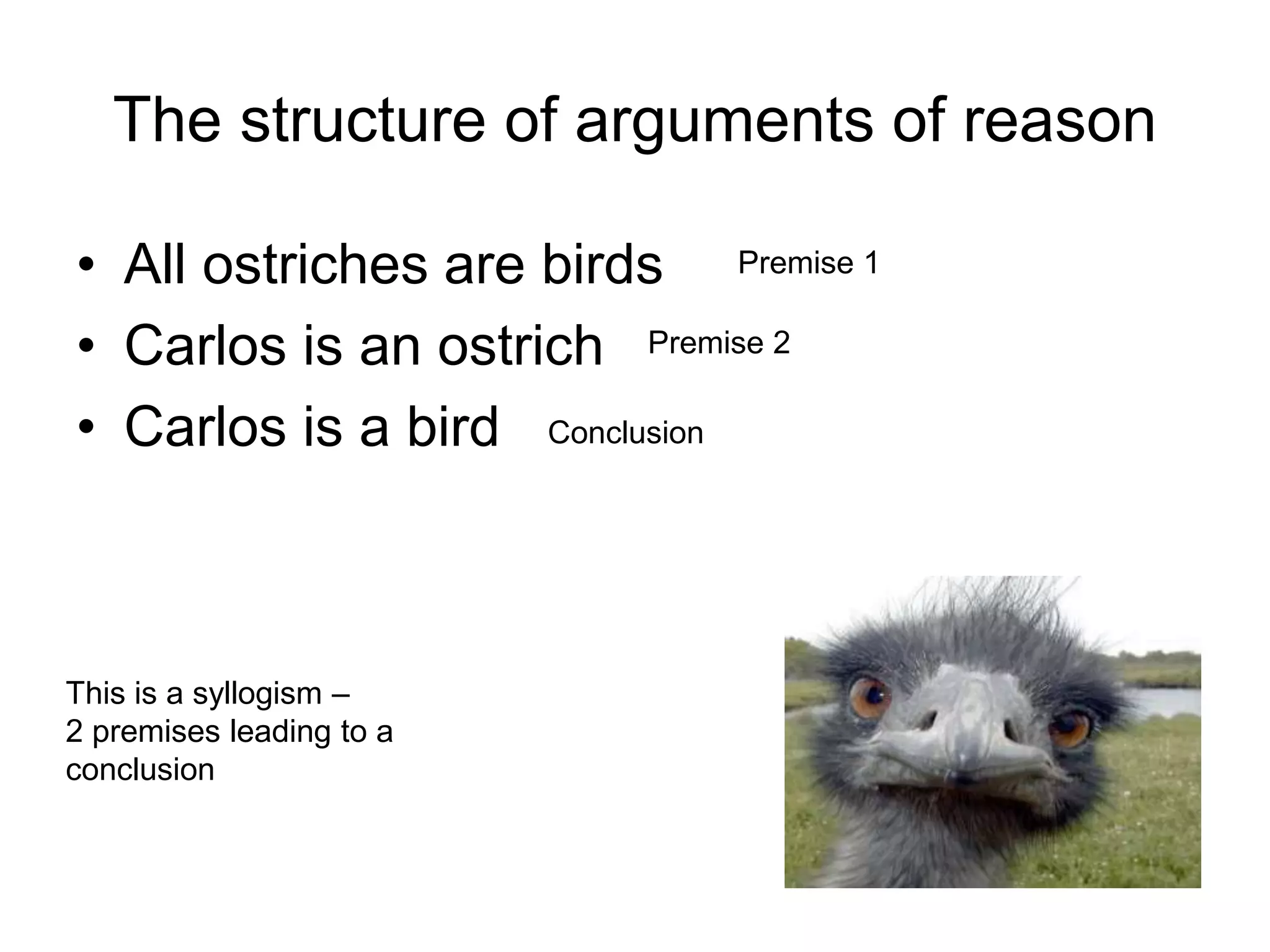
• All ostriches are birds
• Carlos is an ostrich
• Carlos is a bird
Premise 1
Premise 2
Conclusion
This is a syllogism –
2 premises leading to a
conclusion
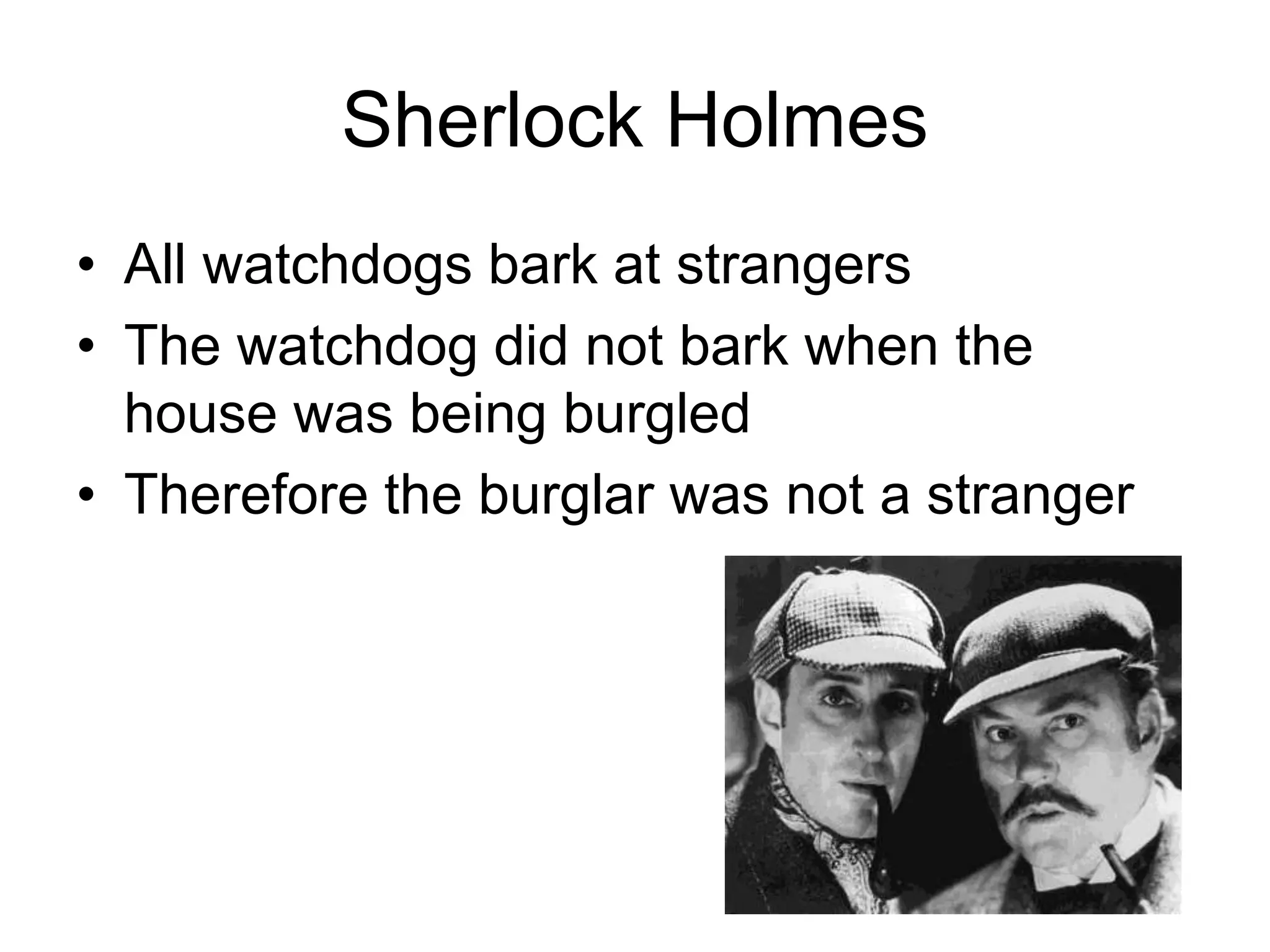
Sherlock Holmes
• Men with chalk dust on their fingers are
schoolteachers
• This man has chalk dust on his fingers
• This man is a schoolteacher
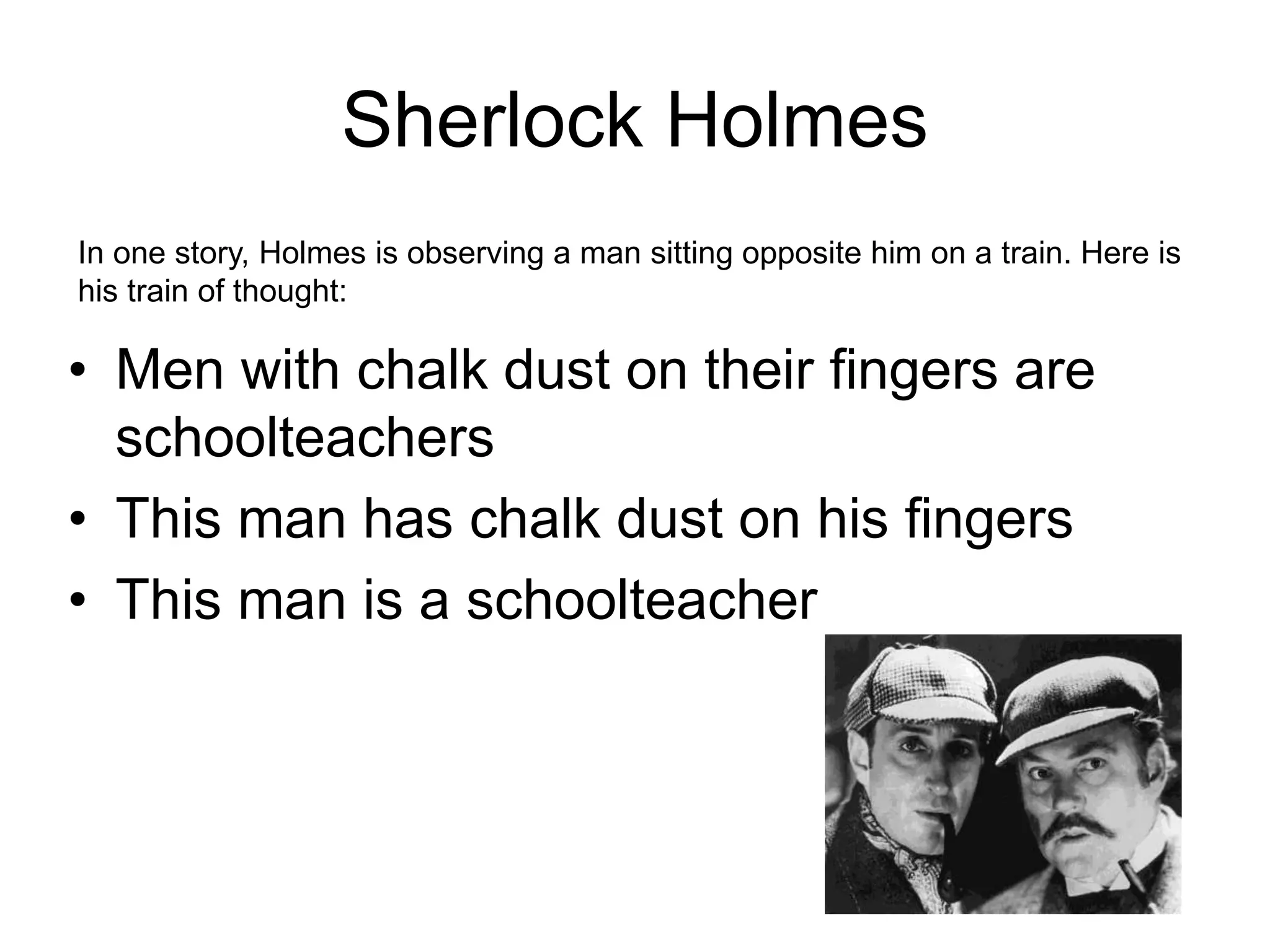
In one story, Holmes is observing a man sitting opposite him on a train. Here is
his train of thought:
Sherlock Holmes
• All watchdogs bark at strangers
• The watchdog did not bark when the
house was being burgled
• Therefore the burglar was not a stranger
The structure of arguments of reason
• All ostriches have feathers
• A turkey has feathers
• All turkeys are ostriches
An invalid syllogism occurs where the conclusion is false even if the premises are true
The structure of arguments of reason
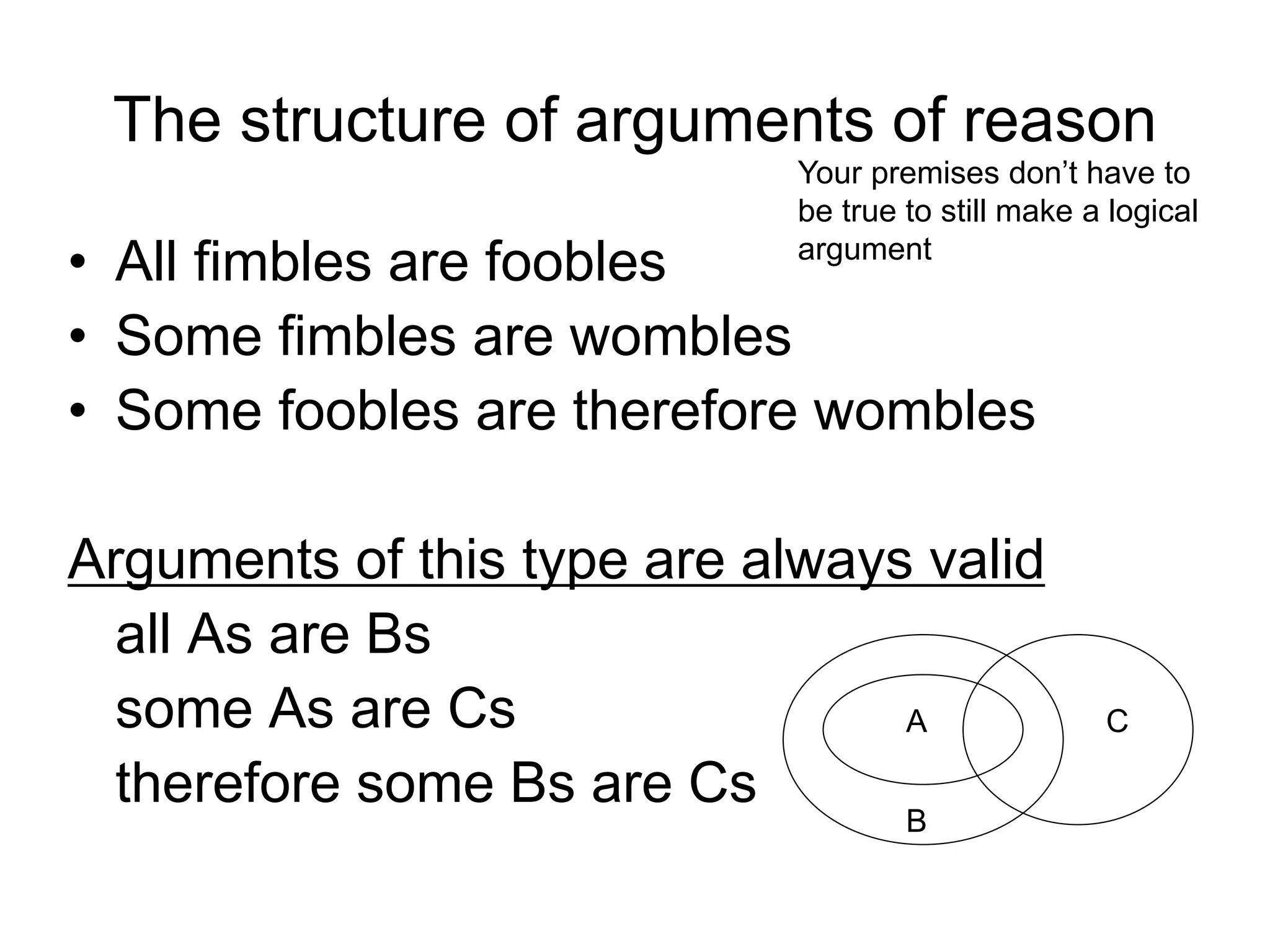
• All fimbles are foobles
• Some fimbles are wombles
• Some foobles are therefore wombles
Arguments of this type are always valid
all As are Bs
some As are Cs
therefore some Bs are Cs
A C
B
Your premises don’t have to
be true to still make a logical
argument
Example of flawed logic
In a campaign speech during the summer
of 1952, Senator Joseph McCarthy, who
had made a reputation as a tireless enemy
of communism, said, "I do not tell you that
Schlesinger, Stevenson's number one
man, number one brain trust, I don't tell
you he's a Communist. I have no
information on that point. But I do know
that if he were a Communist he would also
ridicule religion as Schlesinger has done. ”
“Guilt by association”
Test Your Reasoning Skills
The old man had just turned off the lights
in the shop and was preparing to lock up
when a youth appeared and demanded
money. The owner opened the cash
register; the contents were grabbed, and
the man ran away. The police were
informed immediately.
Test Your Reasoning Skills
• Are the following statements: true, false, or is there not enough information to come to a
conclusion?
1. A young man appeared after the lights had been turned off
2. The old man was preparing to go home
3. The robber demanded money
4. Someone opened the cash register
5. The robber demanded money from the owner
6. The person who opened the cash register was a man
7. The cash register contained money, but we are not told how much
8. The gender of the owner is not revealed in the story
9. The robber did not demand money
10.After the young man grabbed the contents of the cash register he ran away
11.A young man appeared after the lights had been turned off
12.The robber was a man
13.The owner was a man
14.The owner appeared and demanded money
15.The man ran away after he had demanded money
Questions
• Make up syllogisms for the following:
1. Two true premises and a true conclusion
2. One true premise, one false premise and a
true conclusion
3. One true premise, one false premise and a
false conclusion
4. Two false premises and a true conclusion
5. Two false premises and a false conclusion
Note that just because a syllogism is valid, it doesn’t mean that the premises
or the conclusion are true
DEDUCTION INDUCTION
Goes from the general to the
particular
Goes from the particular to the
general
All metals expand when they are
heated
Therefore this metal will expand
when I heat it
Metal A expands when heated
Metal B expands when heated
Therefore all metals expand when
heated
More certainty
Less informative
Less certainty
More informative
Deduction and Induction
The Problem of Deduction
• Deduction appears to be better as it has more
certainty associated with it
• However, the original premise of a deduction must
be based to some extent on INDUCTION
• For example, Sherlock Holmes’ deductive premise
that all watchdogs bark at strangers must have
been based on his inductive observation that dogs
A, B, C and D… don’t bark at strangers (he can’t
have observed the set of ALL watchdogs)
In the books Sherlock Holmes famously used his ‘powers of deduction’, however he
usually reasoned using a mixture of deduction and induction
The Problem of Induction
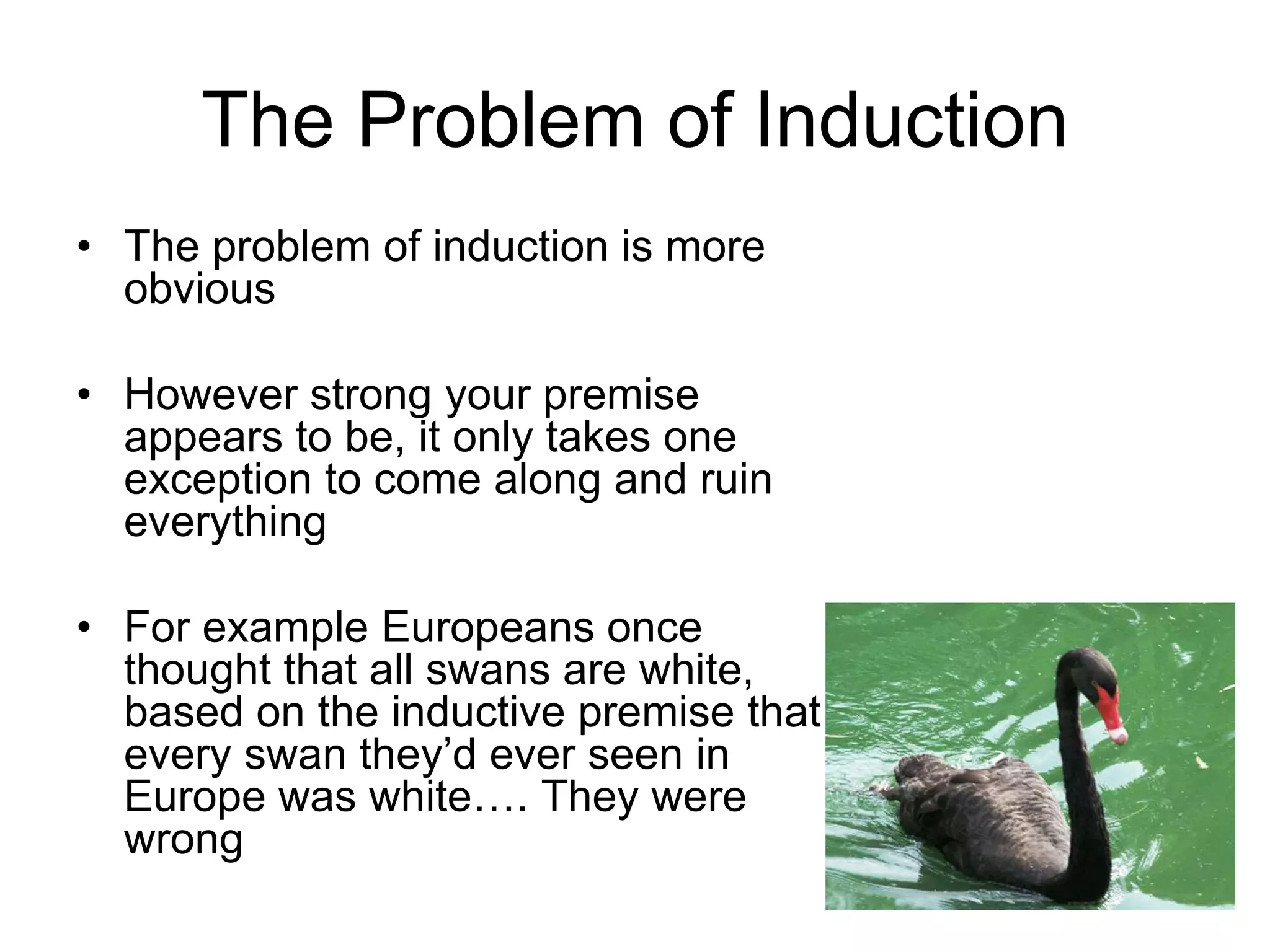
• The problem of induction is more
obvious
• However strong your premise
appears to be, it only takes one
exception to come along and ruin
everything
• For example Europeans once
thought that all swans are white,
based on the inductive premise that
every swan they’d ever seen in
Europe was white…. They were
wrong
Induction and Deduction
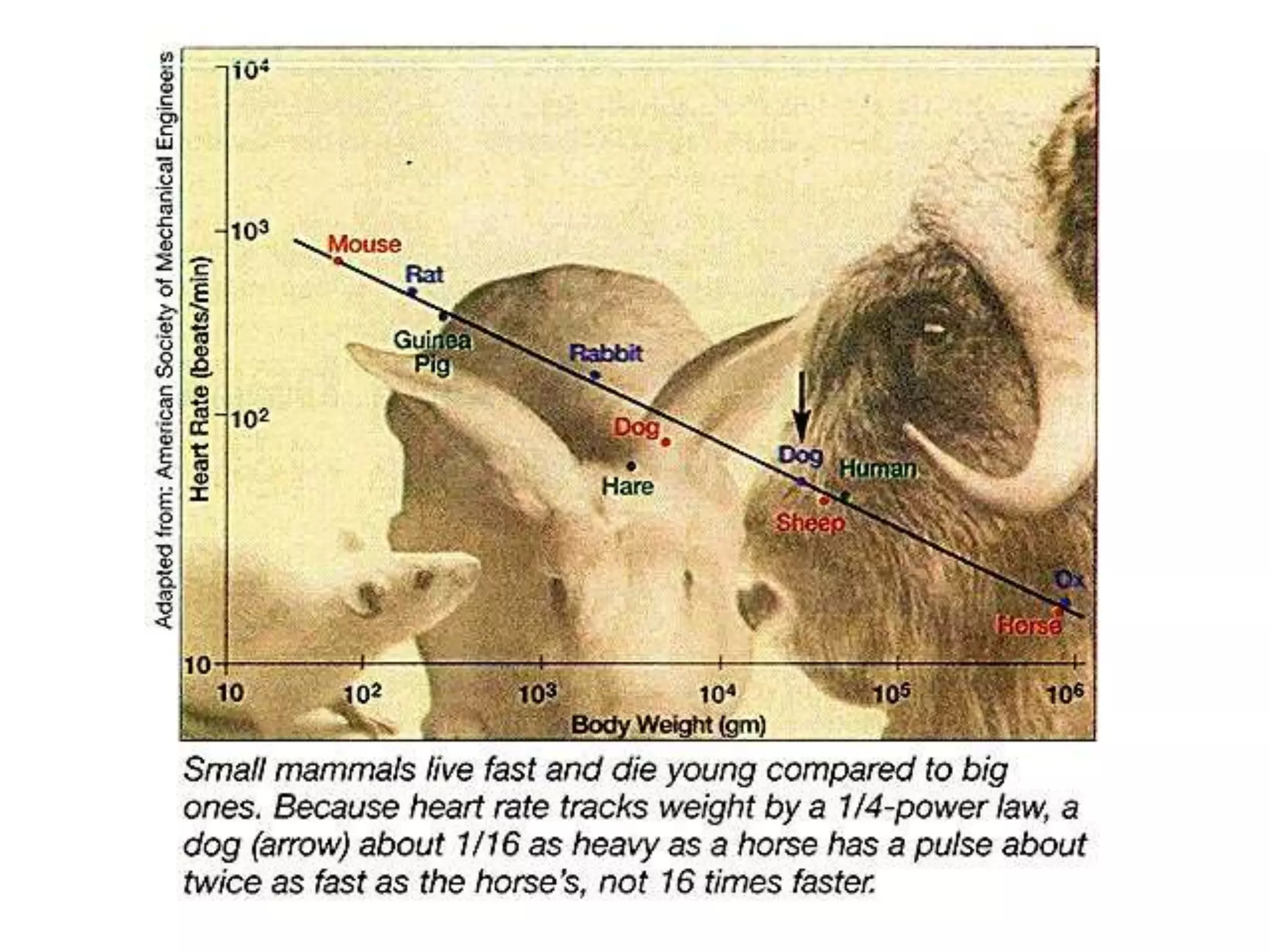
• Larger animals have slower heart rates...
Do we conclude this from the data by
deduction or induction?
• Estimate the heart rate of an Etruscan
pygmy shrew which weighs only 1.3
grams. Did you reason by deduction or
induction?
What makes some Inductions
Better than Others?
• Number of observations
• Variety of observations
• Attempt to search for exceptions
• Coherence – “Extraordinary claims require
extraordinary evidence” - Carl Sagan
• Subject area – e.g. generalisations are more reliable in
the natural sciences than the social sciences
Fallacies of Reason
• A fallacy is an argument that uses faulty
reasoning
• A formal fallacy is reasoning that is always
wrong due to a flaw in logical structure – it is
invalid in form
• An informal fallacy is reasoning that is wrong
due to one or more false premises – it is valid in
form
http://edrontheoryofknowledge.blogspot.mx/
2010/03/the-logical-fallacy-song.html
1
• Since strict gun controls were imposed in
Mexico City, the crime rate has risen. This
shows that gun control does not reduce
crime.
Hasty
Generalisation
2
• She says that I’m her best friend, and it
must be true, because she wouldn’t lie to
her best friend.
Circular reasoning
3
• The ends justify the means. After all, you
have to break eggs to make an omelette
Post hoc ergo
propter hoc
4
• Since Juan always talks about science,
you can be sure that if you meet
somebody who’s interested in science
they must be related to Juan.
Hasty
Generalisation
5
• That can’t be true, Francisco is really
clever and he doesn’t believe it
Ad Hominem
6
• We got on really well on both dates we’ve
been on. We must be well suited. Let’s get
married.
Hasty
generalisation
7
• If you’re not part of the solution then you’re
part of the problem.
False dilemma
8
• Since Isaac Newton believed in God, there
must be some truth in religion
Ad Hominem
9
• The average family in Mexico has 3
children. The Hernandez’s are a very
average family, therefore they must have 3
children.
False Analogy
10
• Nobody has proved that we are alone in
the Universe, therefore aliens must exist.
Argument ad
ignorantium
11
• Is your whole family stupid, or is it just
you?
Loaded Question
12
• No great artist has been recognised during
his lifetime. My work has not been
recognised, therefore I must be a great
artist
Post hoc ergo
propter hoc
13
• Nobody succeeds without hard work.
Since you failed your exams, it shows how
lazy you have been
False Analogy
14
• She has never been involved in any kind
of scandal, therefore she must be a very
honest person.
Post hoc ergo
propter hoc
15
• A car owner is more likely to look after her
own car than one she rents. Therefore it
stands to reason that a slave owner will
look after his slaves better than an
employer looks after his workers.
Post hoc ergo
propter hoc
16
• If you are against the war on terror then
you are against the United States
– George W Bush
False dilemma
False dichotomy
17
• The English can’t cook. He’s English
therefore he can’t cook
Hasty
generalisation
18
• I deserve to be given the job as I have
seven children and a sick mother to look
after.
Ad Misericordiam
(special pleading)
19
• "We are constantly told that Mexican pork
is not dangerous. But at the same time,
nobody has proved that it is safe."
- Nikolai Vlasov, Russian chief veterinary
inspector
Argument ad
ignorantium
Appeal to nature
20
Circular reasoning
21
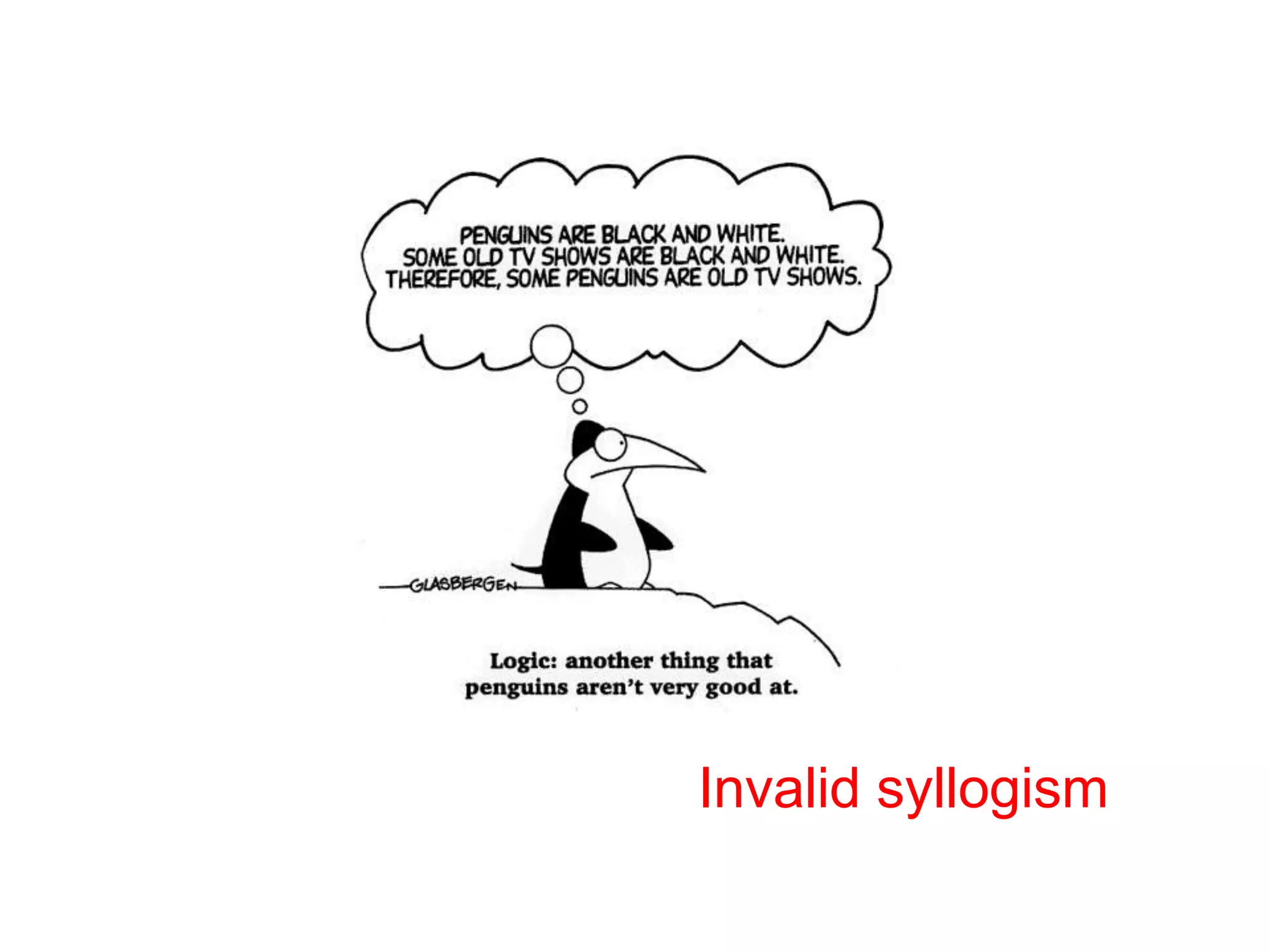
Invalid syllogism
22
23
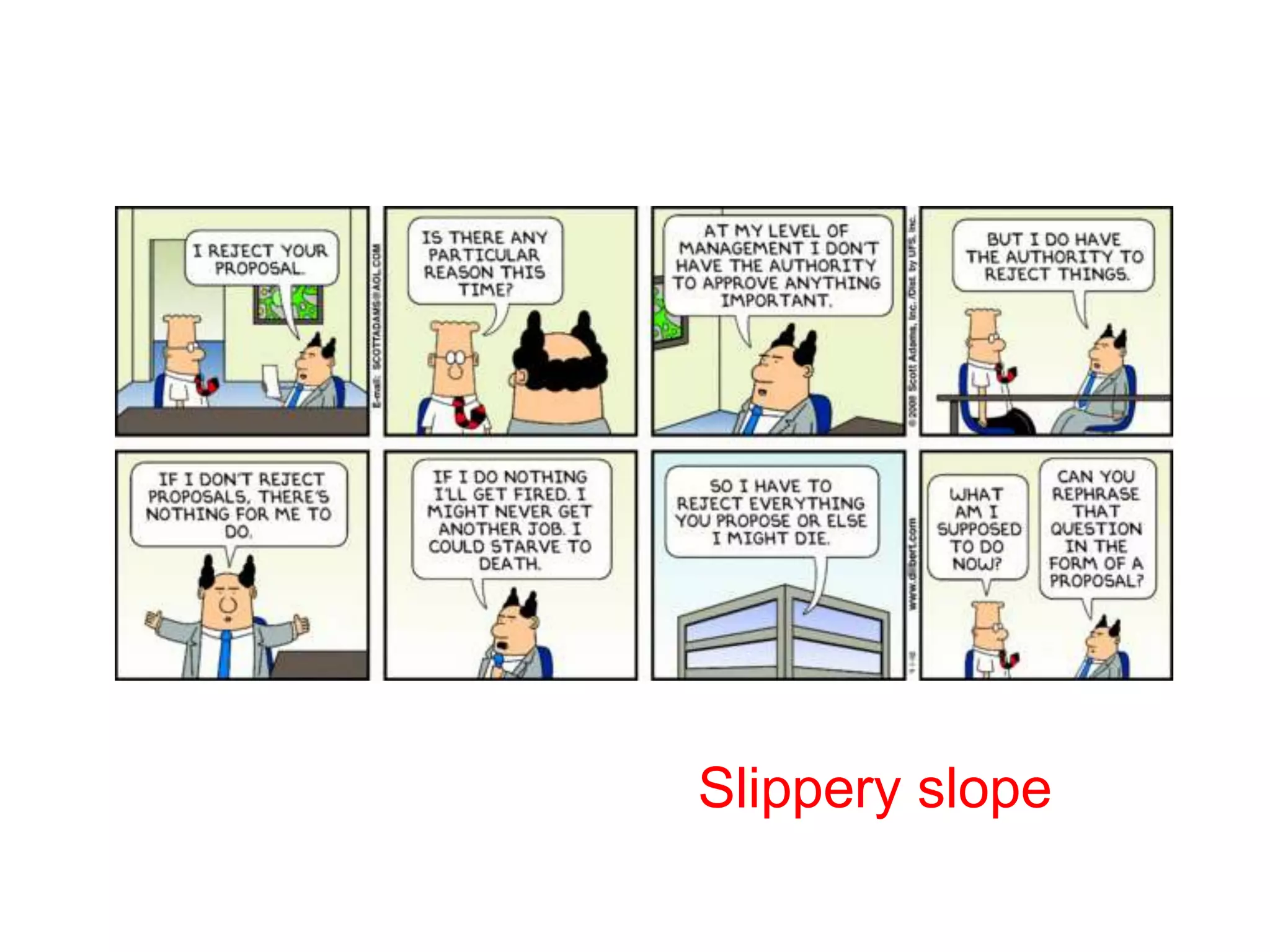
Slippery slope
False analogy
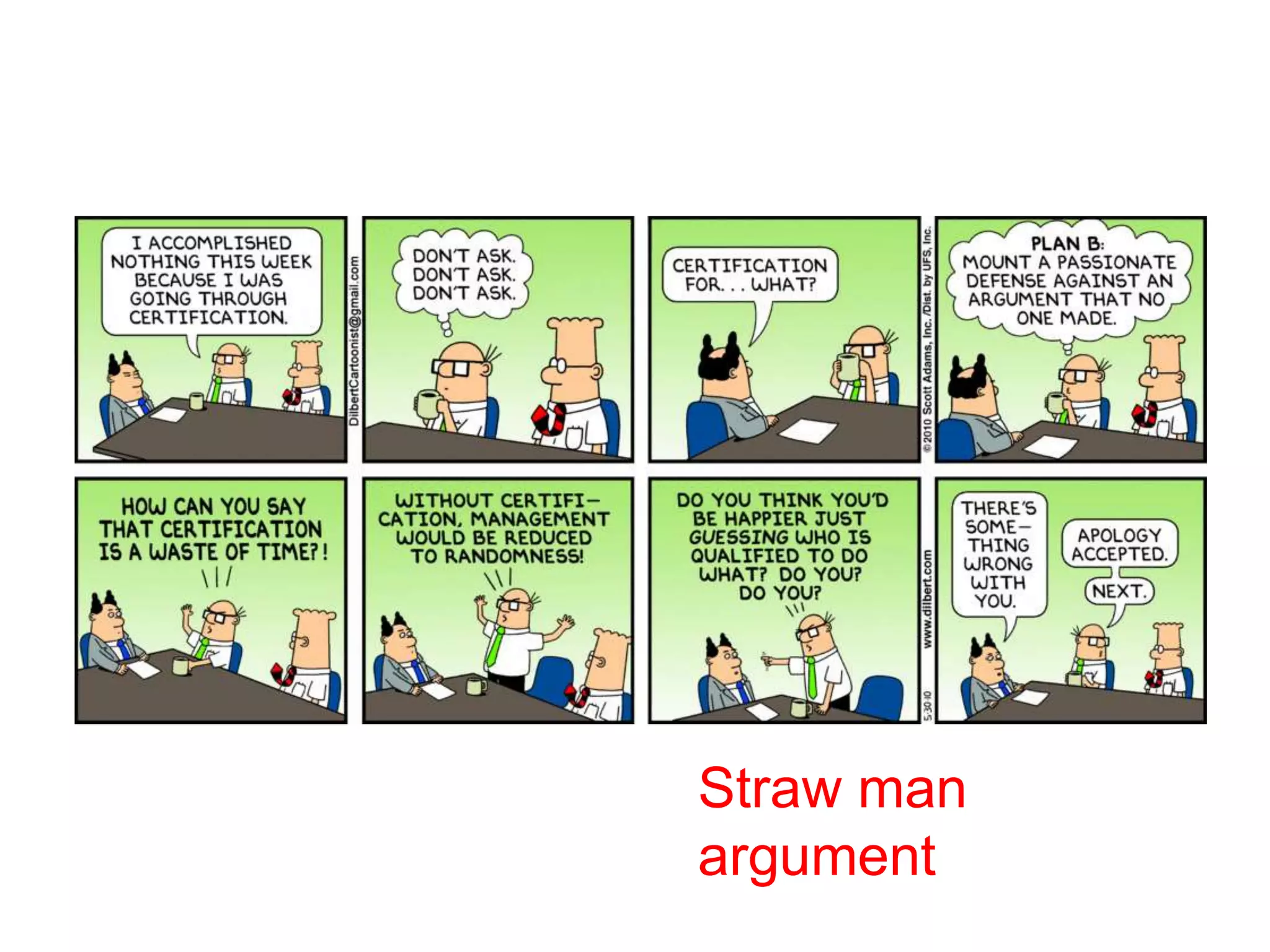
Straw man
argument
24
Non-sequitur
Bad Reasoning
• Ignorance – failure to spot our own fallacies
• Laziness – not being bothered to check the
evidence
• Pride – we don’t like to think of ourselves as
being closed-minded, and we all want to win an
argument once we are in one
• Prejudice – The way we think about things is
always linked to our pre-existing ideas on the
subject (being open-minded is hard)
But remember – “Be open-minded, but not so open-minded that your
brains fall out” Carl Sagan
Reason and Certainty
• The existence of fallacies suggests that reason
(and logic) does not provide certainty
• The fact that even simple syllogisms can lead to
false conclusions suggests that true conclusions
can only be drawn if you begin with the truth
• At least we can say that logical thinking provides
a clear framework to get to true conclusions
• Some people have such a warped sense of logic
(through ignorance, laziness, pride or prejudice)
that they perhaps can’t be reasoned with
Bananas – the atheists nightmare

Reason

  • 1.
  • 2.
    Introduction • There isa scene in a Broadway play where a priest is speaking to a man at a party and is asked if he ever hears anything interesting in confession. The priest replies that in fact that in the very first confession he gave after being ordained a man admitted that he’d murdered his wife • Later on in the party another man is introduced to the priest and says “I met you a long time ago father, in fact I was the first person who came to you for confession” • What does the author expect you to conclude from the two previous conversations?
  • 3.
    The structure ofarguments of reason • All ostriches are birds • Carlos is an ostrich • Carlos is a bird Premise 1 Premise 2 Conclusion This is a syllogism – 2 premises leading to a conclusion
  • 4.
    Sherlock Holmes • Menwith chalk dust on their fingers are schoolteachers • This man has chalk dust on his fingers • This man is a schoolteacher In one story, Holmes is observing a man sitting opposite him on a train. Here is his train of thought:
  • 5.
    Sherlock Holmes • Allwatchdogs bark at strangers • The watchdog did not bark when the house was being burgled • Therefore the burglar was not a stranger
  • 6.
    The structure ofarguments of reason • All ostriches have feathers • A turkey has feathers • All turkeys are ostriches An invalid syllogism occurs where the conclusion is false even if the premises are true
  • 7.
    The structure ofarguments of reason • All fimbles are foobles • Some fimbles are wombles • Some foobles are therefore wombles Arguments of this type are always valid all As are Bs some As are Cs therefore some Bs are Cs A C B Your premises don’t have to be true to still make a logical argument
  • 8.
    Example of flawedlogic In a campaign speech during the summer of 1952, Senator Joseph McCarthy, who had made a reputation as a tireless enemy of communism, said, "I do not tell you that Schlesinger, Stevenson's number one man, number one brain trust, I don't tell you he's a Communist. I have no information on that point. But I do know that if he were a Communist he would also ridicule religion as Schlesinger has done. ” “Guilt by association”
  • 9.
    Test Your ReasoningSkills The old man had just turned off the lights in the shop and was preparing to lock up when a youth appeared and demanded money. The owner opened the cash register; the contents were grabbed, and the man ran away. The police were informed immediately.
  • 10.
    Test Your ReasoningSkills • Are the following statements: true, false, or is there not enough information to come to a conclusion? 1. A young man appeared after the lights had been turned off 2. The old man was preparing to go home 3. The robber demanded money 4. Someone opened the cash register 5. The robber demanded money from the owner 6. The person who opened the cash register was a man 7. The cash register contained money, but we are not told how much 8. The gender of the owner is not revealed in the story 9. The robber did not demand money 10.After the young man grabbed the contents of the cash register he ran away 11.A young man appeared after the lights had been turned off 12.The robber was a man 13.The owner was a man 14.The owner appeared and demanded money 15.The man ran away after he had demanded money
  • 11.
    Questions • Make upsyllogisms for the following: 1. Two true premises and a true conclusion 2. One true premise, one false premise and a true conclusion 3. One true premise, one false premise and a false conclusion 4. Two false premises and a true conclusion 5. Two false premises and a false conclusion Note that just because a syllogism is valid, it doesn’t mean that the premises or the conclusion are true
  • 12.
    DEDUCTION INDUCTION Goes fromthe general to the particular Goes from the particular to the general All metals expand when they are heated Therefore this metal will expand when I heat it Metal A expands when heated Metal B expands when heated Therefore all metals expand when heated More certainty Less informative Less certainty More informative Deduction and Induction
  • 13.
    The Problem ofDeduction • Deduction appears to be better as it has more certainty associated with it • However, the original premise of a deduction must be based to some extent on INDUCTION • For example, Sherlock Holmes’ deductive premise that all watchdogs bark at strangers must have been based on his inductive observation that dogs A, B, C and D… don’t bark at strangers (he can’t have observed the set of ALL watchdogs) In the books Sherlock Holmes famously used his ‘powers of deduction’, however he usually reasoned using a mixture of deduction and induction
  • 14.
    The Problem ofInduction • The problem of induction is more obvious • However strong your premise appears to be, it only takes one exception to come along and ruin everything • For example Europeans once thought that all swans are white, based on the inductive premise that every swan they’d ever seen in Europe was white…. They were wrong
  • 16.
    Induction and Deduction •Larger animals have slower heart rates... Do we conclude this from the data by deduction or induction? • Estimate the heart rate of an Etruscan pygmy shrew which weighs only 1.3 grams. Did you reason by deduction or induction?
  • 17.
    What makes someInductions Better than Others? • Number of observations • Variety of observations • Attempt to search for exceptions • Coherence – “Extraordinary claims require extraordinary evidence” - Carl Sagan • Subject area – e.g. generalisations are more reliable in the natural sciences than the social sciences
  • 18.
    Fallacies of Reason •A fallacy is an argument that uses faulty reasoning • A formal fallacy is reasoning that is always wrong due to a flaw in logical structure – it is invalid in form • An informal fallacy is reasoning that is wrong due to one or more false premises – it is valid in form http://edrontheoryofknowledge.blogspot.mx/ 2010/03/the-logical-fallacy-song.html
  • 19.
    1 • Since strictgun controls were imposed in Mexico City, the crime rate has risen. This shows that gun control does not reduce crime. Hasty Generalisation
  • 20.
    2 • She saysthat I’m her best friend, and it must be true, because she wouldn’t lie to her best friend. Circular reasoning
  • 21.
    3 • The endsjustify the means. After all, you have to break eggs to make an omelette Post hoc ergo propter hoc
  • 22.
    4 • Since Juanalways talks about science, you can be sure that if you meet somebody who’s interested in science they must be related to Juan. Hasty Generalisation
  • 23.
    5 • That can’tbe true, Francisco is really clever and he doesn’t believe it Ad Hominem
  • 24.
    6 • We goton really well on both dates we’ve been on. We must be well suited. Let’s get married. Hasty generalisation
  • 25.
    7 • If you’renot part of the solution then you’re part of the problem. False dilemma
  • 26.
    8 • Since IsaacNewton believed in God, there must be some truth in religion Ad Hominem
  • 27.
    9 • The averagefamily in Mexico has 3 children. The Hernandez’s are a very average family, therefore they must have 3 children. False Analogy
  • 28.
    10 • Nobody hasproved that we are alone in the Universe, therefore aliens must exist. Argument ad ignorantium
  • 29.
    11 • Is yourwhole family stupid, or is it just you? Loaded Question
  • 30.
    12 • No greatartist has been recognised during his lifetime. My work has not been recognised, therefore I must be a great artist Post hoc ergo propter hoc
  • 31.
    13 • Nobody succeedswithout hard work. Since you failed your exams, it shows how lazy you have been False Analogy
  • 32.
    14 • She hasnever been involved in any kind of scandal, therefore she must be a very honest person. Post hoc ergo propter hoc
  • 33.
    15 • A carowner is more likely to look after her own car than one she rents. Therefore it stands to reason that a slave owner will look after his slaves better than an employer looks after his workers. Post hoc ergo propter hoc
  • 34.
    16 • If youare against the war on terror then you are against the United States – George W Bush False dilemma False dichotomy
  • 35.
    17 • The Englishcan’t cook. He’s English therefore he can’t cook Hasty generalisation
  • 36.
    18 • I deserveto be given the job as I have seven children and a sick mother to look after. Ad Misericordiam (special pleading)
  • 37.
    19 • "We areconstantly told that Mexican pork is not dangerous. But at the same time, nobody has proved that it is safe." - Nikolai Vlasov, Russian chief veterinary inspector Argument ad ignorantium
  • 38.
  • 39.
  • 40.
  • 41.
  • 42.
  • 43.
  • 44.
  • 45.
    Bad Reasoning • Ignorance– failure to spot our own fallacies • Laziness – not being bothered to check the evidence • Pride – we don’t like to think of ourselves as being closed-minded, and we all want to win an argument once we are in one • Prejudice – The way we think about things is always linked to our pre-existing ideas on the subject (being open-minded is hard) But remember – “Be open-minded, but not so open-minded that your brains fall out” Carl Sagan
  • 46.
    Reason and Certainty •The existence of fallacies suggests that reason (and logic) does not provide certainty • The fact that even simple syllogisms can lead to false conclusions suggests that true conclusions can only be drawn if you begin with the truth • At least we can say that logical thinking provides a clear framework to get to true conclusions • Some people have such a warped sense of logic (through ignorance, laziness, pride or prejudice) that they perhaps can’t be reasoned with Bananas – the atheists nightmare