1/4
Sweet Potato Tec
Real-life Case Studies: Successful Data Migration for
Salesforce
bestsalesforcespecialists.blogspot.com/2024/09/real-life-case-studies-successful-data.html
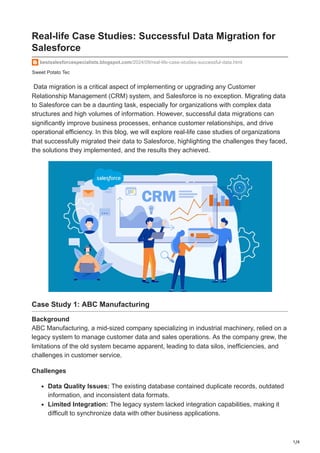
Data migration is a critical aspect of implementing or upgrading any Customer
Relationship Management (CRM) system, and Salesforce is no exception. Migrating data
to Salesforce can be a daunting task, especially for organizations with complex data
structures and high volumes of information. However, successful data migrations can
significantly improve business processes, enhance customer relationships, and drive
operational efficiency. In this blog, we will explore real-life case studies of organizations
that successfully migrated their data to Salesforce, highlighting the challenges they faced,
the solutions they implemented, and the results they achieved.
Case Study 1: ABC Manufacturing
Background
ABC Manufacturing, a mid-sized company specializing in industrial machinery, relied on a
legacy system to manage customer data and sales operations. As the company grew, the
limitations of the old system became apparent, leading to data silos, inefficiencies, and
challenges in customer service.
Challenges
Data Quality Issues: The existing database contained duplicate records, outdated
information, and inconsistent data formats.
Limited Integration: The legacy system lacked integration capabilities, making it
difficult to synchronize data with other business applications.
2/4
User Adoption: Employees were accustomed to the old system, creating
resistance to change.
Solution
To successfully migrate to Salesforce, ABC Manufacturing implemented a comprehensive
data cleansing and migration strategy:
Data Audit: They conducted a thorough audit of the existing data, identifying
duplicates, missing fields, and inconsistencies.
Data Cleansing: A dedicated team worked to clean and standardize the data,
ensuring it met Salesforce’s requirements.
Migration Plan: They developed a detailed migration plan that included timelines,
resource allocation, and risk management strategies.
Utilization of Data Loader: The team used Salesforce Data Loader to facilitate the
bulk migration of cleaned data.
Results
Improved Data Quality: Post-migration, ABC Manufacturing saw a 95% reduction
in duplicate records and improved overall data accuracy.
Enhanced Operational Efficiency: The integration of Salesforce allowed for
seamless data flow between sales, marketing, and customer service, leading to a
30% reduction in response times to customer inquiries.
Higher User Adoption: The user-friendly interface of Salesforce, combined with
comprehensive training sessions, resulted in a 75% adoption rate among
employees within the first three months.
Case Study 2: XYZ Nonprofit Organization
Background
XYZ Nonprofit Organization focused on community development and outreach programs.
They had been using multiple platforms for donor management, volunteer coordination,
and event registration. The lack of a unified system hindered their ability to manage
relationships and track engagement effectively.
Challenges
Fragmented Data: Data was scattered across different systems, leading to a lack
of visibility into donor history and volunteer contributions.
Limited Reporting Capabilities: The existing platforms provided minimal reporting
features, making it difficult to measure the impact of their programs.
Staff Training: Many staff members were unfamiliar with CRM systems, creating a
knowledge gap.
Solution
To migrate to Salesforce, XYZ Nonprofit Organization adopted a phased approach:
3/4
Stakeholder Involvement: They involved key stakeholders from different
departments in the planning process to ensure all needs were addressed.
Custom Fields and Objects: Salesforce was customized to include specific fields
and objects that captured relevant data for their unique operations.
Integration with Existing Tools: They integrated Salesforce with their email
marketing platform and financial software to create a cohesive ecosystem.
Training Programs: A series of training sessions were conducted to familiarize
staff with the new system and its features.
Results
Centralized Data Management: The organization achieved a single view of donors
and volunteers, leading to improved relationship management.
Enhanced Reporting: The robust reporting capabilities of Salesforce allowed them
to track program effectiveness and generate insightful reports.
Increased Engagement: With better data management, XYZ Nonprofit saw a 50%
increase in donor engagement and participation in volunteer activities within six
months.
Case Study 3: DEF Financial Services
Background
DEF Financial Services, a growing firm providing investment and financial planning
services, faced challenges with its existing CRM. The system was outdated, leading to
slow processes and poor customer engagement.
Challenges
Data Migration Complexity: The existing CRM contained vast amounts of
historical data, including client information, financial transactions, and
communications.
Regulatory Compliance: As a financial services firm, DEF had to ensure
compliance with industry regulations during the data migration process.
Risk Management: There was a high level of concern regarding data loss or
corruption during the migration.
Solution
DEF Financial Services took a meticulous approach to data migration:
Compliance Review: They conducted a review of regulatory requirements and
involved legal experts to ensure compliance during migration.
Data Mapping: The team mapped existing data fields to corresponding Salesforce
fields to ensure a smooth transition.
Phased Migration: They opted for a phased migration approach, starting with non-
critical data to test the process before migrating sensitive information.
Backup Procedures: Comprehensive backup procedures were implemented to
safeguard data throughout the migration.
4/4
Results
Successful Migration: The phased approach resulted in a 100% successful
migration without data loss or corruption.
Regulatory Compliance: The company met all regulatory requirements,
maintaining client trust and safeguarding sensitive information.
Increased Efficiency: Post-migration, DEF Financial Services reported a 40%
increase in efficiency in managing client accounts and inquiries.
Conclusion
These case studies demonstrate that successful data migration to Salesforce is
achievable with careful planning, execution, and a focus on data quality. By addressing
challenges such as data integrity, user adoption, and compliance, organizations can
unlock the full potential of Salesforce as a powerful CRM tool. The key takeaways
include:
Conducting thorough data audits and cleansing before migration.
Involving stakeholders in the planning process to ensure that all needs are addressed.
Adopting a phased approach to mitigate risks associated with data loss or corruption.
Providing comprehensive training to promote user adoption and maximize the benefits of
the new system.
By learning from these real-life examples, organizations can better navigate their own
data migration journeys, ultimately enhancing their operational efficiency, customer
engagement, and business success through effective data migration for Salesforce.
The Benefits of Working with a Certified Salesforce Specialist in the UK
The Importance of Working with a Certified Salesforce Specialist in the
UK
Top 10 Support Services for Salesforce in the UK: What You Need to
Know

Real-life Case Studies Successful Data Migration for Salesforce.pdf

  • 1.
    1/4 Sweet Potato Tec Real-lifeCase Studies: Successful Data Migration for Salesforce bestsalesforcespecialists.blogspot.com/2024/09/real-life-case-studies-successful-data.html Data migration is a critical aspect of implementing or upgrading any Customer Relationship Management (CRM) system, and Salesforce is no exception. Migrating data to Salesforce can be a daunting task, especially for organizations with complex data structures and high volumes of information. However, successful data migrations can significantly improve business processes, enhance customer relationships, and drive operational efficiency. In this blog, we will explore real-life case studies of organizations that successfully migrated their data to Salesforce, highlighting the challenges they faced, the solutions they implemented, and the results they achieved. Case Study 1: ABC Manufacturing Background ABC Manufacturing, a mid-sized company specializing in industrial machinery, relied on a legacy system to manage customer data and sales operations. As the company grew, the limitations of the old system became apparent, leading to data silos, inefficiencies, and challenges in customer service. Challenges Data Quality Issues: The existing database contained duplicate records, outdated information, and inconsistent data formats. Limited Integration: The legacy system lacked integration capabilities, making it difficult to synchronize data with other business applications.
  • 2.
    2/4 User Adoption: Employeeswere accustomed to the old system, creating resistance to change. Solution To successfully migrate to Salesforce, ABC Manufacturing implemented a comprehensive data cleansing and migration strategy: Data Audit: They conducted a thorough audit of the existing data, identifying duplicates, missing fields, and inconsistencies. Data Cleansing: A dedicated team worked to clean and standardize the data, ensuring it met Salesforce’s requirements. Migration Plan: They developed a detailed migration plan that included timelines, resource allocation, and risk management strategies. Utilization of Data Loader: The team used Salesforce Data Loader to facilitate the bulk migration of cleaned data. Results Improved Data Quality: Post-migration, ABC Manufacturing saw a 95% reduction in duplicate records and improved overall data accuracy. Enhanced Operational Efficiency: The integration of Salesforce allowed for seamless data flow between sales, marketing, and customer service, leading to a 30% reduction in response times to customer inquiries. Higher User Adoption: The user-friendly interface of Salesforce, combined with comprehensive training sessions, resulted in a 75% adoption rate among employees within the first three months. Case Study 2: XYZ Nonprofit Organization Background XYZ Nonprofit Organization focused on community development and outreach programs. They had been using multiple platforms for donor management, volunteer coordination, and event registration. The lack of a unified system hindered their ability to manage relationships and track engagement effectively. Challenges Fragmented Data: Data was scattered across different systems, leading to a lack of visibility into donor history and volunteer contributions. Limited Reporting Capabilities: The existing platforms provided minimal reporting features, making it difficult to measure the impact of their programs. Staff Training: Many staff members were unfamiliar with CRM systems, creating a knowledge gap. Solution To migrate to Salesforce, XYZ Nonprofit Organization adopted a phased approach:
  • 3.
    3/4 Stakeholder Involvement: Theyinvolved key stakeholders from different departments in the planning process to ensure all needs were addressed. Custom Fields and Objects: Salesforce was customized to include specific fields and objects that captured relevant data for their unique operations. Integration with Existing Tools: They integrated Salesforce with their email marketing platform and financial software to create a cohesive ecosystem. Training Programs: A series of training sessions were conducted to familiarize staff with the new system and its features. Results Centralized Data Management: The organization achieved a single view of donors and volunteers, leading to improved relationship management. Enhanced Reporting: The robust reporting capabilities of Salesforce allowed them to track program effectiveness and generate insightful reports. Increased Engagement: With better data management, XYZ Nonprofit saw a 50% increase in donor engagement and participation in volunteer activities within six months. Case Study 3: DEF Financial Services Background DEF Financial Services, a growing firm providing investment and financial planning services, faced challenges with its existing CRM. The system was outdated, leading to slow processes and poor customer engagement. Challenges Data Migration Complexity: The existing CRM contained vast amounts of historical data, including client information, financial transactions, and communications. Regulatory Compliance: As a financial services firm, DEF had to ensure compliance with industry regulations during the data migration process. Risk Management: There was a high level of concern regarding data loss or corruption during the migration. Solution DEF Financial Services took a meticulous approach to data migration: Compliance Review: They conducted a review of regulatory requirements and involved legal experts to ensure compliance during migration. Data Mapping: The team mapped existing data fields to corresponding Salesforce fields to ensure a smooth transition. Phased Migration: They opted for a phased migration approach, starting with non- critical data to test the process before migrating sensitive information. Backup Procedures: Comprehensive backup procedures were implemented to safeguard data throughout the migration.
  • 4.
    4/4 Results Successful Migration: Thephased approach resulted in a 100% successful migration without data loss or corruption. Regulatory Compliance: The company met all regulatory requirements, maintaining client trust and safeguarding sensitive information. Increased Efficiency: Post-migration, DEF Financial Services reported a 40% increase in efficiency in managing client accounts and inquiries. Conclusion These case studies demonstrate that successful data migration to Salesforce is achievable with careful planning, execution, and a focus on data quality. By addressing challenges such as data integrity, user adoption, and compliance, organizations can unlock the full potential of Salesforce as a powerful CRM tool. The key takeaways include: Conducting thorough data audits and cleansing before migration. Involving stakeholders in the planning process to ensure that all needs are addressed. Adopting a phased approach to mitigate risks associated with data loss or corruption. Providing comprehensive training to promote user adoption and maximize the benefits of the new system. By learning from these real-life examples, organizations can better navigate their own data migration journeys, ultimately enhancing their operational efficiency, customer engagement, and business success through effective data migration for Salesforce. The Benefits of Working with a Certified Salesforce Specialist in the UK The Importance of Working with a Certified Salesforce Specialist in the UK Top 10 Support Services for Salesforce in the UK: What You Need to Know