READING AS A
PHYSIOLOGICAL
PROCESS
1. Reading involves both
an organic or physiological
process and a mental or
cognitive process.
2. In the physiological
process, the most basic
step is for the eyes to
see, identify, and
recognize the printed
word or images.
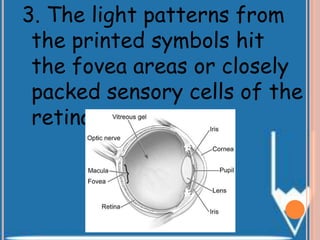
3. The light patterns from
the printed symbols hit
the fovea areas or closely
packed sensory cells of the
retina.
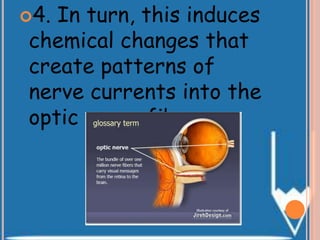
4. In turn, this induces
chemical changes that
create patterns of
nerve currents into the
optic nerve fiber.
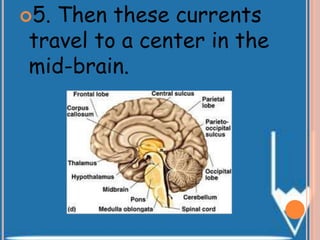
5. Then these currents
travel to a center in the
mid-brain.
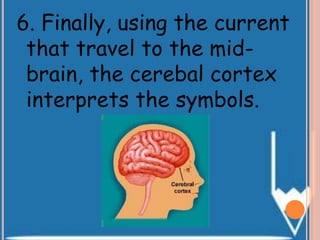
6. Finally, using the current
that travel to the mid-
brain, the cerebal cortex
interprets the symbols.
7. The stage of reading
revolves around the
ability to identify and
recognize words which
are the smallest unit
of visual identification
and meaningful
recognition.
8. Studies show eye
movement in reading
with the eye perceiving
and pausing on the
printed material
horizontally from left
to right and top-to-
bottom or right to left
9. Scientific experiments have
also shown that there are
several eye movements:
Fixation – the eyes stopping
or getting fixated on the
word/s.
Inter-fixation – the eyes
moving from stopping point to
the other.
Return sweeps – the eyes
swinging back from the end
Saccades – short quick hop
and jump movements done
especially by literate people,
to move ahead on a line of
point.
Regression – done in case
there is need to double
check what is being read.
Span of recognition – the
eyes recognition of a group
of words.

Reading as a Physiological Process

  • 1.
  • 2.
    1. Reading involvesboth an organic or physiological process and a mental or cognitive process. 2. In the physiological process, the most basic step is for the eyes to see, identify, and recognize the printed word or images.
  • 3.
    3. The lightpatterns from the printed symbols hit the fovea areas or closely packed sensory cells of the retina.
  • 4.
    4. In turn,this induces chemical changes that create patterns of nerve currents into the optic nerve fiber.
  • 5.
    5. Then thesecurrents travel to a center in the mid-brain.
  • 6.
    6. Finally, usingthe current that travel to the mid- brain, the cerebal cortex interprets the symbols.
  • 7.
    7. The stageof reading revolves around the ability to identify and recognize words which are the smallest unit of visual identification and meaningful recognition.
  • 8.
    8. Studies showeye movement in reading with the eye perceiving and pausing on the printed material horizontally from left to right and top-to- bottom or right to left
  • 9.
    9. Scientific experimentshave also shown that there are several eye movements: Fixation – the eyes stopping or getting fixated on the word/s. Inter-fixation – the eyes moving from stopping point to the other. Return sweeps – the eyes swinging back from the end
  • 10.
    Saccades – shortquick hop and jump movements done especially by literate people, to move ahead on a line of point. Regression – done in case there is need to double check what is being read. Span of recognition – the eyes recognition of a group of words.