RBI – MANDATES AND
RELEVANCE
Group No. 4
INTRODUCTION
 It is the Central Bank of India established in “1st
April 1935” under the “Reserve Bank of India Act”
 Initially it was privately owned.
 Since nationalization in 1949, the RBI is fully owned
by the Government of India.
 Its head quarter is in Mumbai.
 Its present governor is Mr. Shakti kanta Das.
 The preamble of the Reserve Bank of India: to
regulate the issue of Bank notes and keeping of
reserves with a view to securing monetary stability
in India and generally to operate the currency and
credit system of the country to its advantage; to
have a modern monetary policy framework to
meet the challenge of an increasingly complex
economy, to maintain price stability while keeping
in mind the objective of growth.
RBI Timeline
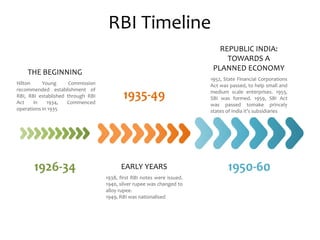
1935-49
THE BEGINNING
Hilton Young Commission
recommended establishment of
RBI, RBI established through RBI
Act in 1934, Commenced
operations in 1935
REPUBLIC INDIA:
TOWARDS A
PLANNED ECONOMY
1952, State Financial Corporations
Act was passed, to help small and
medium scale enterprises. 1955,
SBI was formed. 1959, SBI Act
was passed tomake princely
states of India it’s subsidiaries
EARLY YEARS
1938, first RBI notes were issued.
1940, silver rupee was changed to
alloy rupee.
1949, RBI was nationalised
1926-34 1950-60
RBI Timeline
1968-85
INSTITUTION
BUILDING
1962, RBI Act, Coinage Act,
Currency Ordinance were
extended to Goa and Diu. 1964,
IDBI established as subsidiary to
RBI. 1966, Co-operative banking
bought under the regulatory of
RBI. 1967, size of bank notes
reduced
DEVELOPING OF
MARKETS
1988, SEBi was established. National
Housing Bank established as apex
body of housing finance. 1989, CD’s
and CP’s were introduced as monetary
instruments. Negotiable Instruments
Law enacted to encourage use of
cheques.
ERA OF BANK
EXPANSION
1967, Introduction of social
controls over the banks and
National credit council was setup.
1968, Export credit scheme was
introduced. 1969, 14 major
scheduled banks over 50 crores
were nationalised. 1973, there
was global recession, oil shock for
which bank intoduced series of
restrictions. 1980, 6 private sector
banks nationalised.
1960-71 1985-91
RBI Timeline
2000+
CRISIS AND REFORMSIS
AND REFORMS
1991, Narsimham Rao committee
introduced phased reduction in SLR
and CRR as well as accounting
standards, income recogntion and
capital adequacy norms. 1994,
Nationsl banks alowed to tap capital
markets. NSE began operations. 1997,
FII’s allowed to invest in dated
government securities. 1999, RBI
introduced debit cards.
2009, RBI’s platinum jubiee year.
2010, RBI began process of exit
from expansionary monetary
policy. 2016, Demonetisation of
500 & 1000 notes.
CONSOLIDATING THE
GAINS
2000, stock index futures
introduced by ETF. 2001,
guidelines introduced for internet
banking. Auction format for 91
day Treasury bills changed from
uniform priced to multiple priced.
1991-2000
ROLES & FUNCTIONS
• Role in Economic Development
- Development of Banking system, FIs and backward areas
- Economic stability, growth
- Proper interest rate structure
• Promotional Role
- Promotion of commercial and co-operative banking
- Promotion of credit guarantees and credit to weaker and priority sections
- Promotion of industrial and export finance
- Promotion of differential rate of interest scheme
ROLES & FUNCTIONS
1. Monetary Authority:
• Formulates, implements and monitors the monetary policy.
• Objective: maintaining price stability while keeping in mind the objective of growth.
2. Regulator and supervisor of the financial system:
• Prescribes broad parameters of banking operations within which the country's banking and
financial system functions.
• Objective: maintain public confidence in the system, protect depositors' interest and
provide cost-effective banking services to the public.
3. Manager of Foreign Exchange
• Manages the Foreign Exchange Management Act, 1999.
• Objective: to facilitate external trade and payment and promote orderly development and
maintenance of foreign exchange market in India.
4. Issuer of currency:
• Issues and exchanges or destroys currency and coins not fit for circulation.
• Objective: to give the public adequate quantity of supplies of currency notes and coins and
in good quality.
5. Issuer of Banking License:
Roles and Functions
6. Developmental role
• Performs a wide range of promotional functions to support national objectives.
7. Regulator and Supervisor of Payment and Settlement Systems:
• Introduces and upgrades safe and efficient modes of payment systems in the
country to meet the requirements of the public at large.
• Objective: maintain public confidence in payment and settlement system
8. Banker to the Government: performs merchant banking function for the central
and the state governments; also acts as their banker.
9. Banker to Banks: maintains banking accounts of all scheduled banks.
10. Lender of last resort
11. Banker and Debt manager of Government
12. Control over NBFCs
1. RBI MANDATES ONLINE FILING OF FDI RELATED FORMS – ARF, FCGPR AND FCTRS
• a green initiative by RBI to ease the reporting of the FDI transactions
• speedy closure of the matters and
• lessen the paperwork for the authorized Dealer Banks as well as the parties to the
transaction.
2. RBI mandate on capacity building in banks
• acquiring of a certificate course mandatory for the following areas:
Treasury operations – Dealers, mid-office operations
Risk management – credit risk, market risk, operational risk, enterprise wide risk,
information security, liquidity risk
Accounting – Preparation of financial results, audit function
Credit management – credit appraisal, rating, monitoring, credit administration.
• KPMG in India is the only accounting firm accredited by Indian Banking Association
3. RBI mandates to replace all existing magnetic stripe-only cards with EMV chip cards
• Provide enhanced level of security
• Mitigate fraudulent transactions by way of cloning or card skimming
RBI MANDATES
RBI v/s Government
• Bad Loans
• Dividends
• Power Tussle
• Interest Rate
• Nirav-PNB Scam
• NBFCs
• Payment & Settlement Act
• Section 7
• Demonetisation
Quantitative & Qualitative
measures
Quantitative Qualitative
Bank Rate Policy Margin Requirements
OMO Consumer Credit Regulation
Cash Reserve Ratio Guidelines
SLR Rationing of credit
Moral Suasion
Direct Action
Important Rates by RBI
• Repo rate: 5.75%
• Reverse Repo Rate: 5.50%
• Marginal Standing acility Rate: 6.00%
• Bank Rate: 6.00%
• CRR: 4%
• SLR: 18.75%
RBI Actions
1)
2)
3)
4)
RBI Actions
5)
7)
6)
Thank You

RBI-2.pptx

  • 1.
    RBI – MANDATESAND RELEVANCE Group No. 4
  • 2.
    INTRODUCTION  It isthe Central Bank of India established in “1st April 1935” under the “Reserve Bank of India Act”  Initially it was privately owned.  Since nationalization in 1949, the RBI is fully owned by the Government of India.  Its head quarter is in Mumbai.  Its present governor is Mr. Shakti kanta Das.  The preamble of the Reserve Bank of India: to regulate the issue of Bank notes and keeping of reserves with a view to securing monetary stability in India and generally to operate the currency and credit system of the country to its advantage; to have a modern monetary policy framework to meet the challenge of an increasingly complex economy, to maintain price stability while keeping in mind the objective of growth.
  • 3.
    RBI Timeline 1935-49 THE BEGINNING HiltonYoung Commission recommended establishment of RBI, RBI established through RBI Act in 1934, Commenced operations in 1935 REPUBLIC INDIA: TOWARDS A PLANNED ECONOMY 1952, State Financial Corporations Act was passed, to help small and medium scale enterprises. 1955, SBI was formed. 1959, SBI Act was passed tomake princely states of India it’s subsidiaries EARLY YEARS 1938, first RBI notes were issued. 1940, silver rupee was changed to alloy rupee. 1949, RBI was nationalised 1926-34 1950-60
  • 4.
    RBI Timeline 1968-85 INSTITUTION BUILDING 1962, RBIAct, Coinage Act, Currency Ordinance were extended to Goa and Diu. 1964, IDBI established as subsidiary to RBI. 1966, Co-operative banking bought under the regulatory of RBI. 1967, size of bank notes reduced DEVELOPING OF MARKETS 1988, SEBi was established. National Housing Bank established as apex body of housing finance. 1989, CD’s and CP’s were introduced as monetary instruments. Negotiable Instruments Law enacted to encourage use of cheques. ERA OF BANK EXPANSION 1967, Introduction of social controls over the banks and National credit council was setup. 1968, Export credit scheme was introduced. 1969, 14 major scheduled banks over 50 crores were nationalised. 1973, there was global recession, oil shock for which bank intoduced series of restrictions. 1980, 6 private sector banks nationalised. 1960-71 1985-91
  • 5.
    RBI Timeline 2000+ CRISIS ANDREFORMSIS AND REFORMS 1991, Narsimham Rao committee introduced phased reduction in SLR and CRR as well as accounting standards, income recogntion and capital adequacy norms. 1994, Nationsl banks alowed to tap capital markets. NSE began operations. 1997, FII’s allowed to invest in dated government securities. 1999, RBI introduced debit cards. 2009, RBI’s platinum jubiee year. 2010, RBI began process of exit from expansionary monetary policy. 2016, Demonetisation of 500 & 1000 notes. CONSOLIDATING THE GAINS 2000, stock index futures introduced by ETF. 2001, guidelines introduced for internet banking. Auction format for 91 day Treasury bills changed from uniform priced to multiple priced. 1991-2000
  • 6.
    ROLES & FUNCTIONS •Role in Economic Development - Development of Banking system, FIs and backward areas - Economic stability, growth - Proper interest rate structure • Promotional Role - Promotion of commercial and co-operative banking - Promotion of credit guarantees and credit to weaker and priority sections - Promotion of industrial and export finance - Promotion of differential rate of interest scheme
  • 7.
    ROLES & FUNCTIONS 1.Monetary Authority: • Formulates, implements and monitors the monetary policy. • Objective: maintaining price stability while keeping in mind the objective of growth. 2. Regulator and supervisor of the financial system: • Prescribes broad parameters of banking operations within which the country's banking and financial system functions. • Objective: maintain public confidence in the system, protect depositors' interest and provide cost-effective banking services to the public. 3. Manager of Foreign Exchange • Manages the Foreign Exchange Management Act, 1999. • Objective: to facilitate external trade and payment and promote orderly development and maintenance of foreign exchange market in India. 4. Issuer of currency: • Issues and exchanges or destroys currency and coins not fit for circulation. • Objective: to give the public adequate quantity of supplies of currency notes and coins and in good quality. 5. Issuer of Banking License:
  • 8.
    Roles and Functions 6.Developmental role • Performs a wide range of promotional functions to support national objectives. 7. Regulator and Supervisor of Payment and Settlement Systems: • Introduces and upgrades safe and efficient modes of payment systems in the country to meet the requirements of the public at large. • Objective: maintain public confidence in payment and settlement system 8. Banker to the Government: performs merchant banking function for the central and the state governments; also acts as their banker. 9. Banker to Banks: maintains banking accounts of all scheduled banks. 10. Lender of last resort 11. Banker and Debt manager of Government 12. Control over NBFCs
  • 9.
    1. RBI MANDATESONLINE FILING OF FDI RELATED FORMS – ARF, FCGPR AND FCTRS • a green initiative by RBI to ease the reporting of the FDI transactions • speedy closure of the matters and • lessen the paperwork for the authorized Dealer Banks as well as the parties to the transaction. 2. RBI mandate on capacity building in banks • acquiring of a certificate course mandatory for the following areas: Treasury operations – Dealers, mid-office operations Risk management – credit risk, market risk, operational risk, enterprise wide risk, information security, liquidity risk Accounting – Preparation of financial results, audit function Credit management – credit appraisal, rating, monitoring, credit administration. • KPMG in India is the only accounting firm accredited by Indian Banking Association 3. RBI mandates to replace all existing magnetic stripe-only cards with EMV chip cards • Provide enhanced level of security • Mitigate fraudulent transactions by way of cloning or card skimming RBI MANDATES
  • 10.
    RBI v/s Government •Bad Loans • Dividends • Power Tussle • Interest Rate • Nirav-PNB Scam • NBFCs • Payment & Settlement Act • Section 7 • Demonetisation
  • 11.
    Quantitative & Qualitative measures QuantitativeQualitative Bank Rate Policy Margin Requirements OMO Consumer Credit Regulation Cash Reserve Ratio Guidelines SLR Rationing of credit Moral Suasion Direct Action
  • 12.
    Important Rates byRBI • Repo rate: 5.75% • Reverse Repo Rate: 5.50% • Marginal Standing acility Rate: 6.00% • Bank Rate: 6.00% • CRR: 4% • SLR: 18.75%
  • 13.
  • 14.
  • 15.

Editor's Notes

  • #4 © Copyright PresentationGO.com – The free PowerPoint template library
  • #5 © Copyright PresentationGO.com – The free PowerPoint template library
  • #6 © Copyright PresentationGO.com – The free PowerPoint template library