Radial Basis Functions and
Splines
Machine Learning Presentation
Shashanth - B.Tech 3rd Year (3-2
Semester)
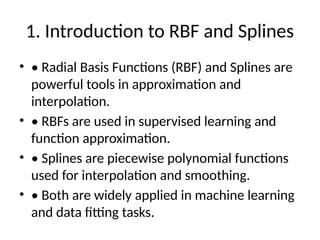
1. Introduction to RBF and Splines
• • Radial Basis Functions (RBF) and Splines are
powerful tools in approximation and
interpolation.
• • RBFs are used in supervised learning and
function approximation.
• • Splines are piecewise polynomial functions
used for interpolation and smoothing.
• • Both are widely applied in machine learning
and data fitting tasks.
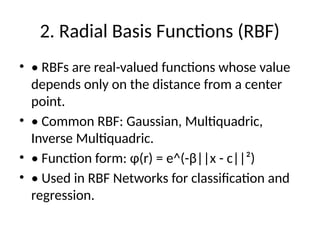
2. Radial Basis Functions (RBF)
• • RBFs are real-valued functions whose value
depends only on the distance from a center
point.
• • Common RBF: Gaussian, Multiquadric,
Inverse Multiquadric.
• • Function form: φ(r) = e^(-β||x - c||²)
• • Used in RBF Networks for classification and
regression.
3. Splines in Machine Learning
• • Splines are piecewise-defined polynomials.
• • Types: Linear, Quadratic, Cubic Splines.
• • Cubic splines are most commonly used due
to their smoothness.
• • Useful in interpolation, smoothing noisy
data, and curve fitting.
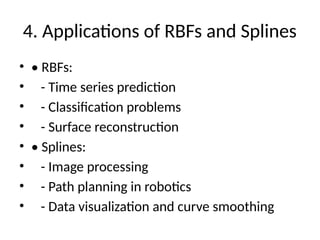
4. Applications of RBFs and Splines
• • RBFs:
• - Time series prediction
• - Classification problems
• - Surface reconstruction
• • Splines:
• - Image processing
• - Path planning in robotics
• - Data visualization and curve smoothing
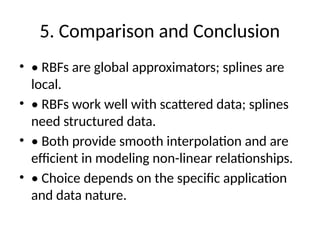
5. Comparison and Conclusion
• • RBFs are global approximators; splines are
local.
• • RBFs work well with scattered data; splines
need structured data.
• • Both provide smooth interpolation and are
efficient in modeling non-linear relationships.
• • Choice depends on the specific application
and data nature.
Thank You
• Any Questions?

RBF_and_Splines_Presentation.pptx machine learning

  • 1.
    Radial Basis Functionsand Splines Machine Learning Presentation Shashanth - B.Tech 3rd Year (3-2 Semester)
  • 2.
    1. Introduction toRBF and Splines • • Radial Basis Functions (RBF) and Splines are powerful tools in approximation and interpolation. • • RBFs are used in supervised learning and function approximation. • • Splines are piecewise polynomial functions used for interpolation and smoothing. • • Both are widely applied in machine learning and data fitting tasks.
  • 3.
    2. Radial BasisFunctions (RBF) • • RBFs are real-valued functions whose value depends only on the distance from a center point. • • Common RBF: Gaussian, Multiquadric, Inverse Multiquadric. • • Function form: φ(r) = e^(-β||x - c||²) • • Used in RBF Networks for classification and regression.
  • 4.
    3. Splines inMachine Learning • • Splines are piecewise-defined polynomials. • • Types: Linear, Quadratic, Cubic Splines. • • Cubic splines are most commonly used due to their smoothness. • • Useful in interpolation, smoothing noisy data, and curve fitting.
  • 5.
    4. Applications ofRBFs and Splines • • RBFs: • - Time series prediction • - Classification problems • - Surface reconstruction • • Splines: • - Image processing • - Path planning in robotics • - Data visualization and curve smoothing
  • 6.
    5. Comparison andConclusion • • RBFs are global approximators; splines are local. • • RBFs work well with scattered data; splines need structured data. • • Both provide smooth interpolation and are efficient in modeling non-linear relationships. • • Choice depends on the specific application and data nature.
  • 7.