COURSE TITLE :- FIELD CROPS - II ( KHARIEF )
COURSE NO. :- AGR 328
CREDIT LOAD :- 2+1
PRESENTED BY :-
( HASEENA SHABNAM )
TOPIC :- MUSTARD &
RAPESEED
Botanical Name : Brassica spp.
Family : Brassicaceae ( Cruciferae )
INTRODUCTION
Rapeseed & mustard are the 3rd most important edible
oilseed crops of the world after soybean and oil palm.
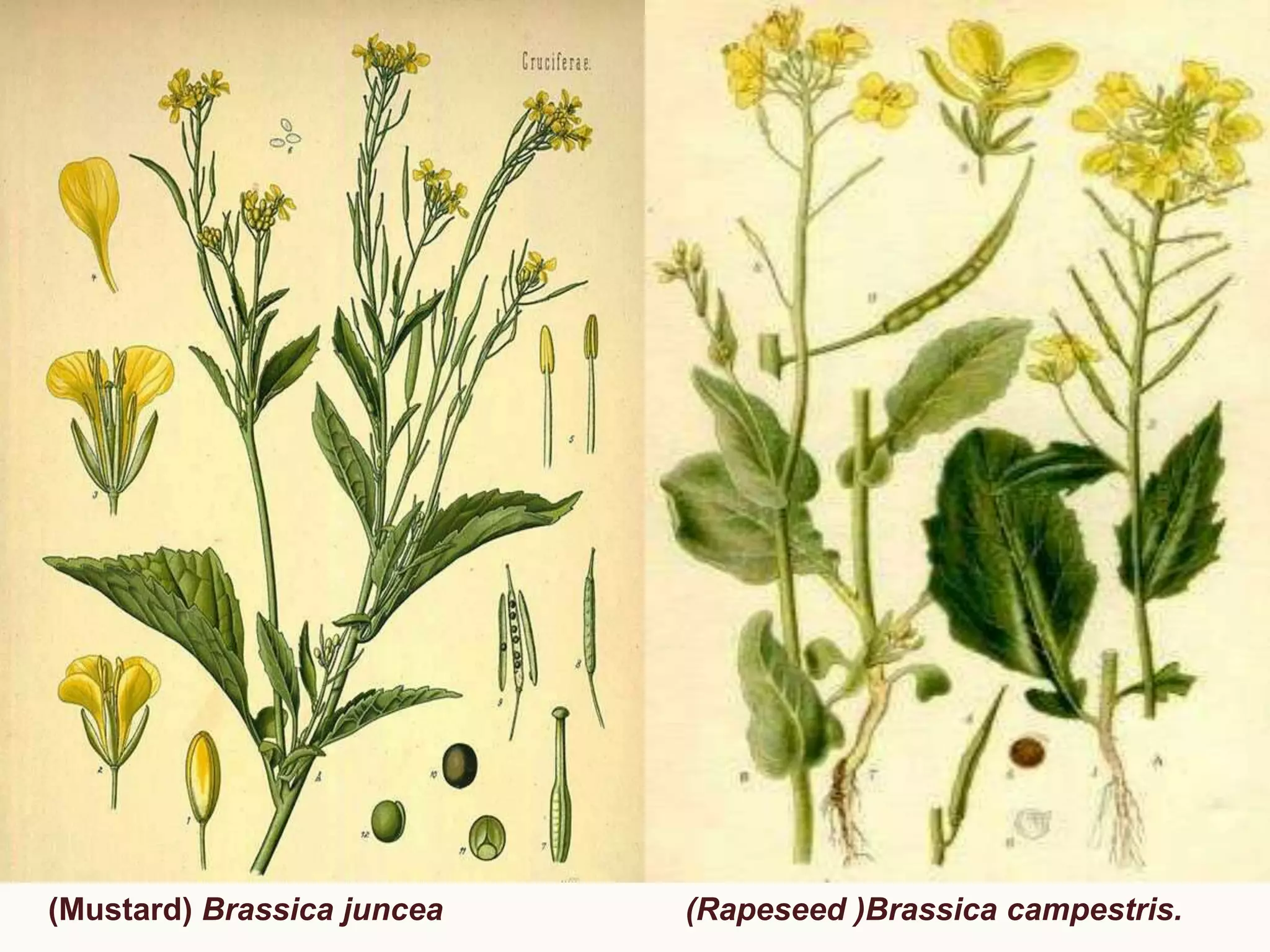
 Mustard is Brassica juncea, whereas Rapeseed is Brassica
campestris.
 This crop accounts for nearly one-third of the oil produced
in India, making it the country’s key edible oilseed crop.
 Seeds are known by different names in different places ;
Sarson , Toria or Lahi are generally termed as Rapeseeds
while Rai or Raya or Laha is termed as Mustard.
 Oil content varies from 37 to 49%.
USES
1. Its oil & seeds are used in:
~ the preparation of pickles and for flavoring curries and
vegetables.
~ human consumption ,.
~ preparation of hair oil and ,medicines ,soaps.
~ in mixture with mineral oils for lubrication.
~ Rapeseed oil is used in the manufacture of greases.
2. The oil cake is used as a cattle feed, its green stems and leaves are
good source of green fodder for cattle.
3. The leaves of young plants are used as green vegetables.
4. In tanning industry, mustard oil is used for softening leather.
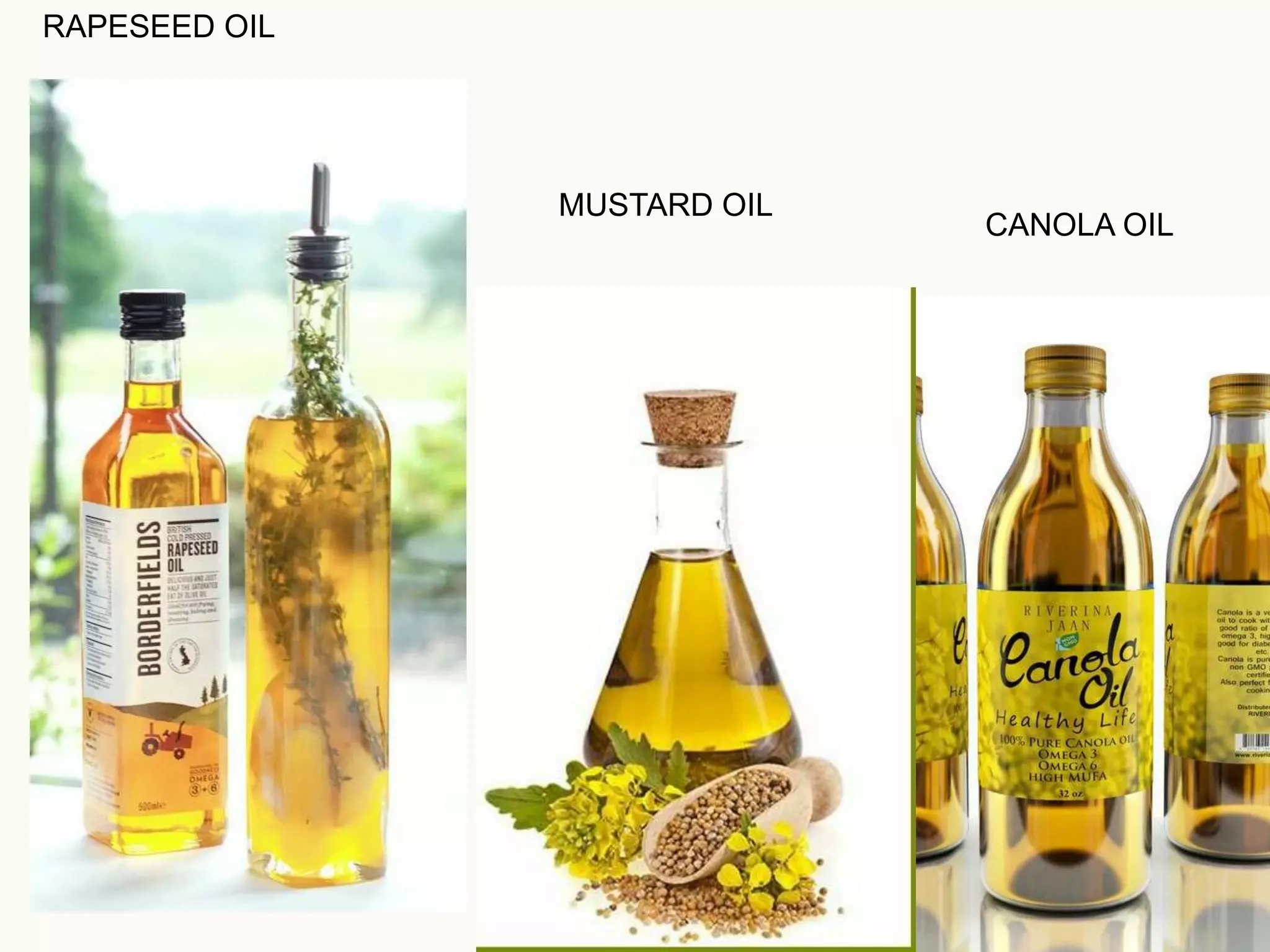
RAPESEED OIL
MUSTARD OIL
CANOLA OIL
ORIGIN& HISTORY
The place of origin is not definitely known.
 It’s cultivation has been traced to 2000-1500 B.C in India, China and Japan.
 According to Prain (1898), Bailey (1922) and others: Rai (B.juncea)
originated in China and from there it was introduced in India.
 According to Vavilov (1926)the place of origin of Rapeseed
(B. campestris) is eastern Afghanistan and adjoining parts of India & Pakistan.
 Singh(1958) considered the B. campestris var. yellow sarson to the oldest of
the various rapes & Mustard grown in India.
AREA AND DISTRIBUTION
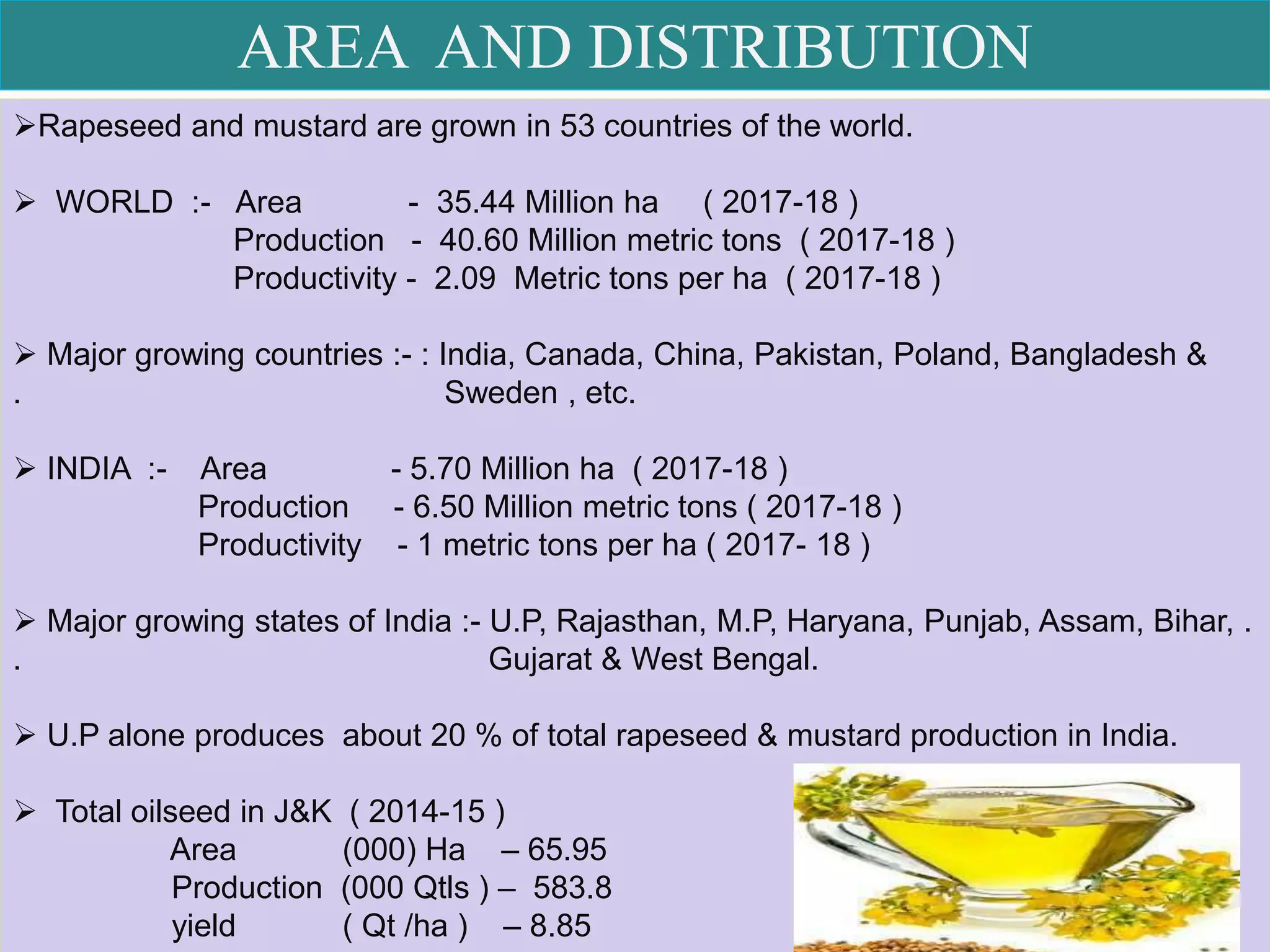
Rapeseed and mustard are grown in 53 countries of the world.
 WORLD :- Area - 35.44 Million ha ( 2017-18 )
Production - 40.60 Million metric tons ( 2017-18 )
Productivity - 2.09 Metric tons per ha ( 2017-18 )
 Major growing countries :- : India, Canada, China, Pakistan, Poland, Bangladesh &
. Sweden , etc.
 INDIA :- Area - 5.70 Million ha ( 2017-18 )
Production - 6.50 Million metric tons ( 2017-18 )
Productivity - 1 metric tons per ha ( 2017- 18 )
 Major growing states of India :- U.P, Rajasthan, M.P, Haryana, Punjab, Assam, Bihar, .
. Gujarat & West Bengal.
 U.P alone produces about 20 % of total rapeseed & mustard production in India.
 Total oilseed in J&K ( 2014-15 )
Area (000) Ha – 65.95
Production (000 Qtls ) – 583.8
yield ( Qt /ha ) – 8.85
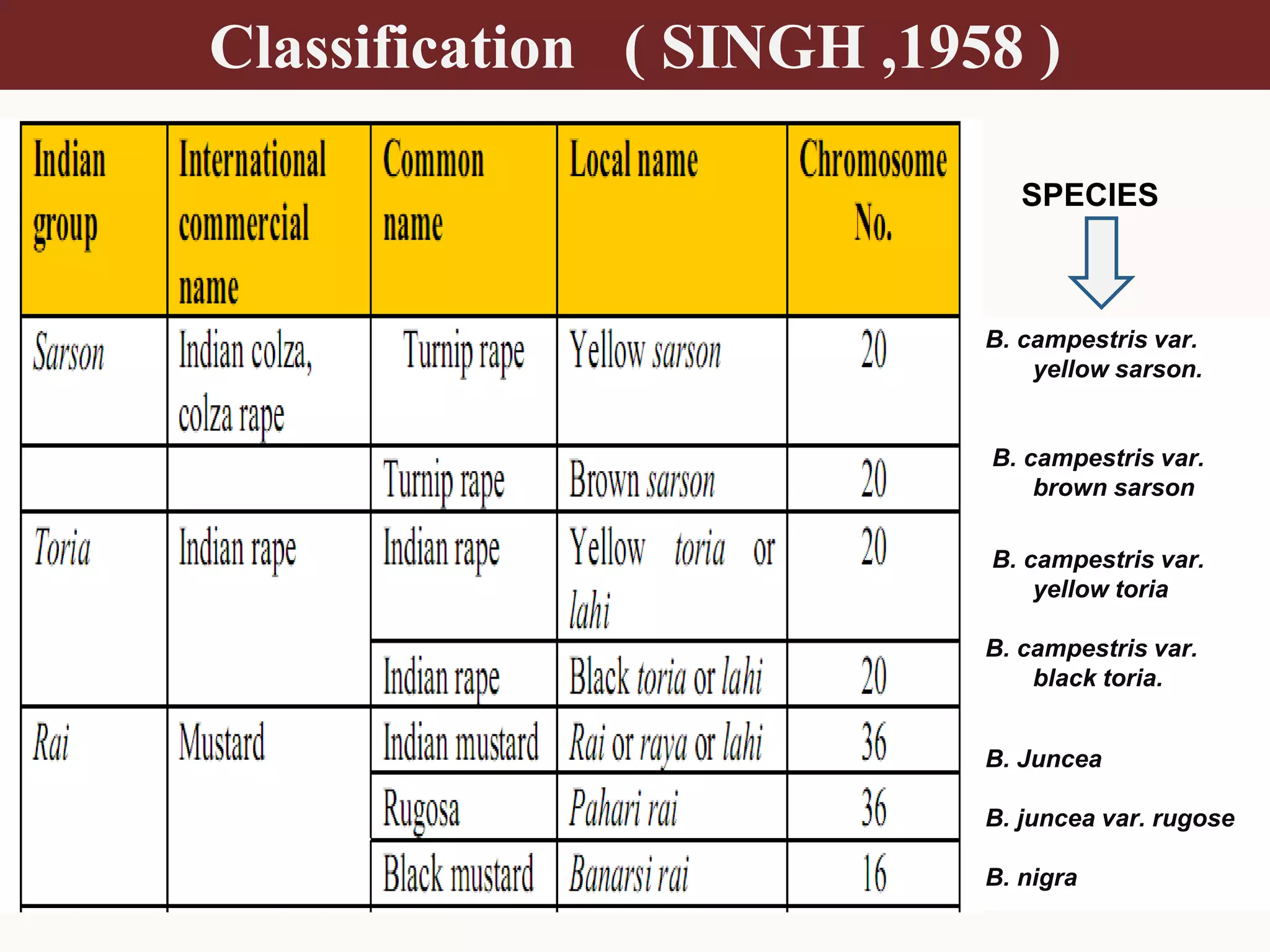
Classification ( SINGH ,1958 )
B. campestris var.
yellow sarson.
B. campestris var.
brown sarson
B. campestris var.
yellow toria
B. campestris var.
black toria.
B. Juncea
B. juncea var. rugose
B. nigra
SPECIES
BOTANICAL DESCRIPTION
• Family : Cruciferae
• Genus : Brassica
• Plant is self-pollinated but cross pollination also takes place to some extent.
• Plant is herbaceous annual , Rabi crop
Parameter Rape seed Mustard
Plant height Shorter(45-150 cm), stem is covered with a
waxy deposit
Taller(90-200 cm), erect & much
branched.
Leaves Sessile & hairy leaves dilated at the base with
clasping nature.
Stalked, broad and pinnatified
Fruits(pods) Thicker Slender
Seed color Yellow or brown Brown or dark brown
Seed coat Smooth Rough
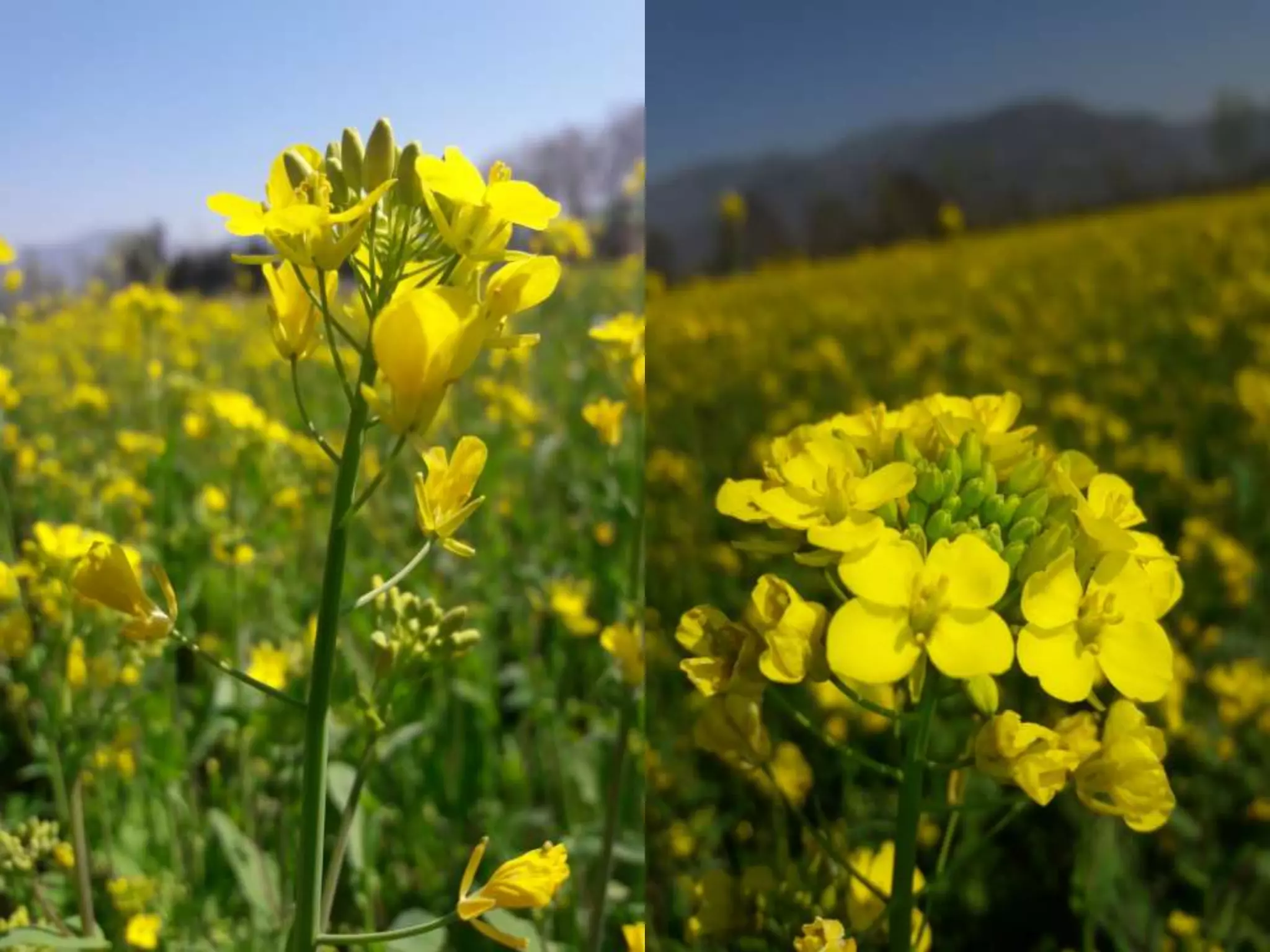
(Mustard) Brassica juncea (Rapeseed )Brassica campestris.
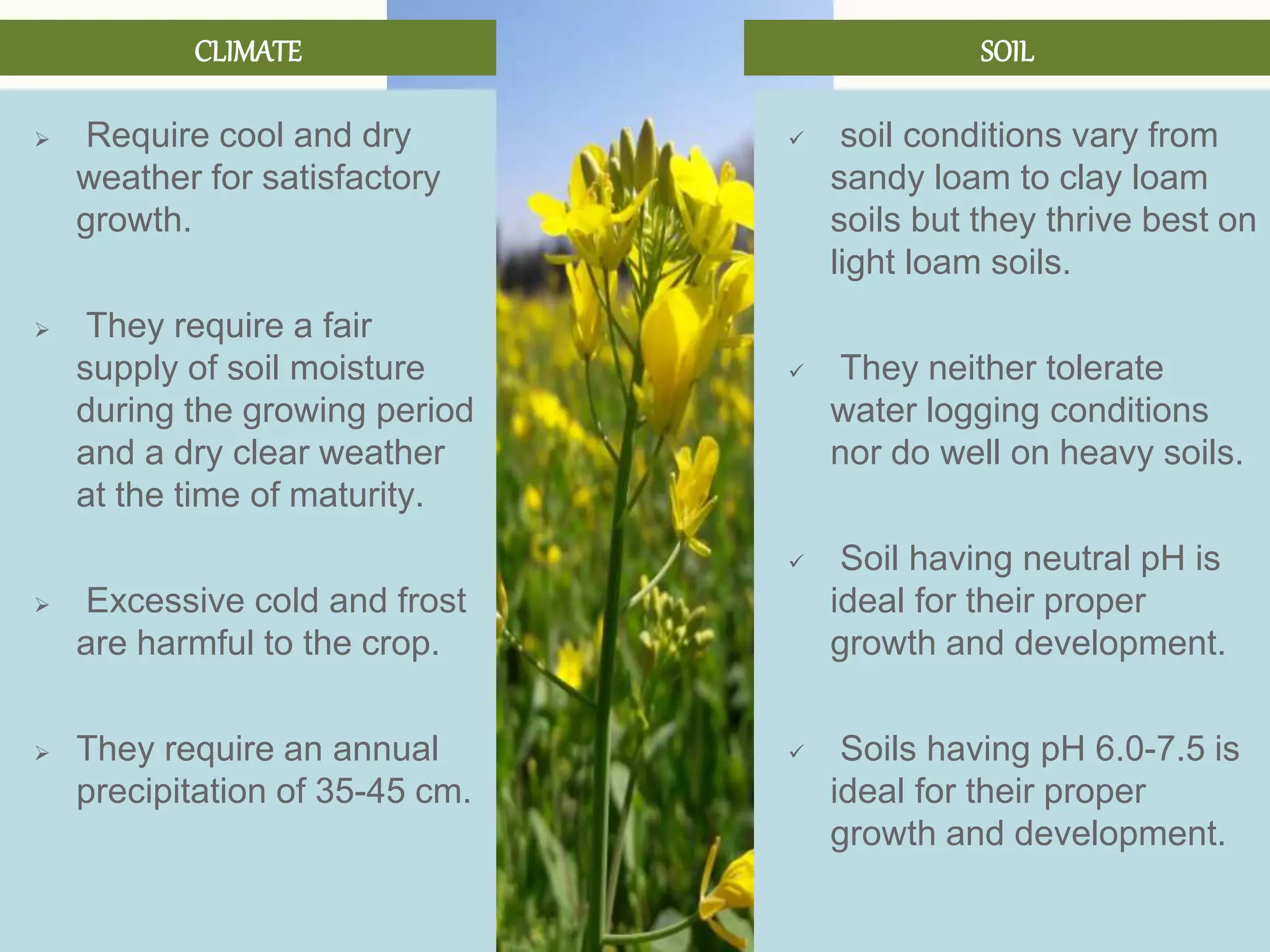
 Require cool and dry
weather for satisfactory
growth.
 They require a fair
supply of soil moisture
during the growing period
and a dry clear weather
at the time of maturity.
 Excessive cold and frost
are harmful to the crop.
 They require an annual
precipitation of 35-45 cm.
 soil conditions vary from
sandy loam to clay loam
soils but they thrive best on
light loam soils.
 They neither tolerate
water logging conditions
nor do well on heavy soils.
 Soil having neutral pH is
ideal for their proper
growth and development.
 Soils having pH 6.0-7.5 is
ideal for their proper
growth and development.
CLIMATE SOIL
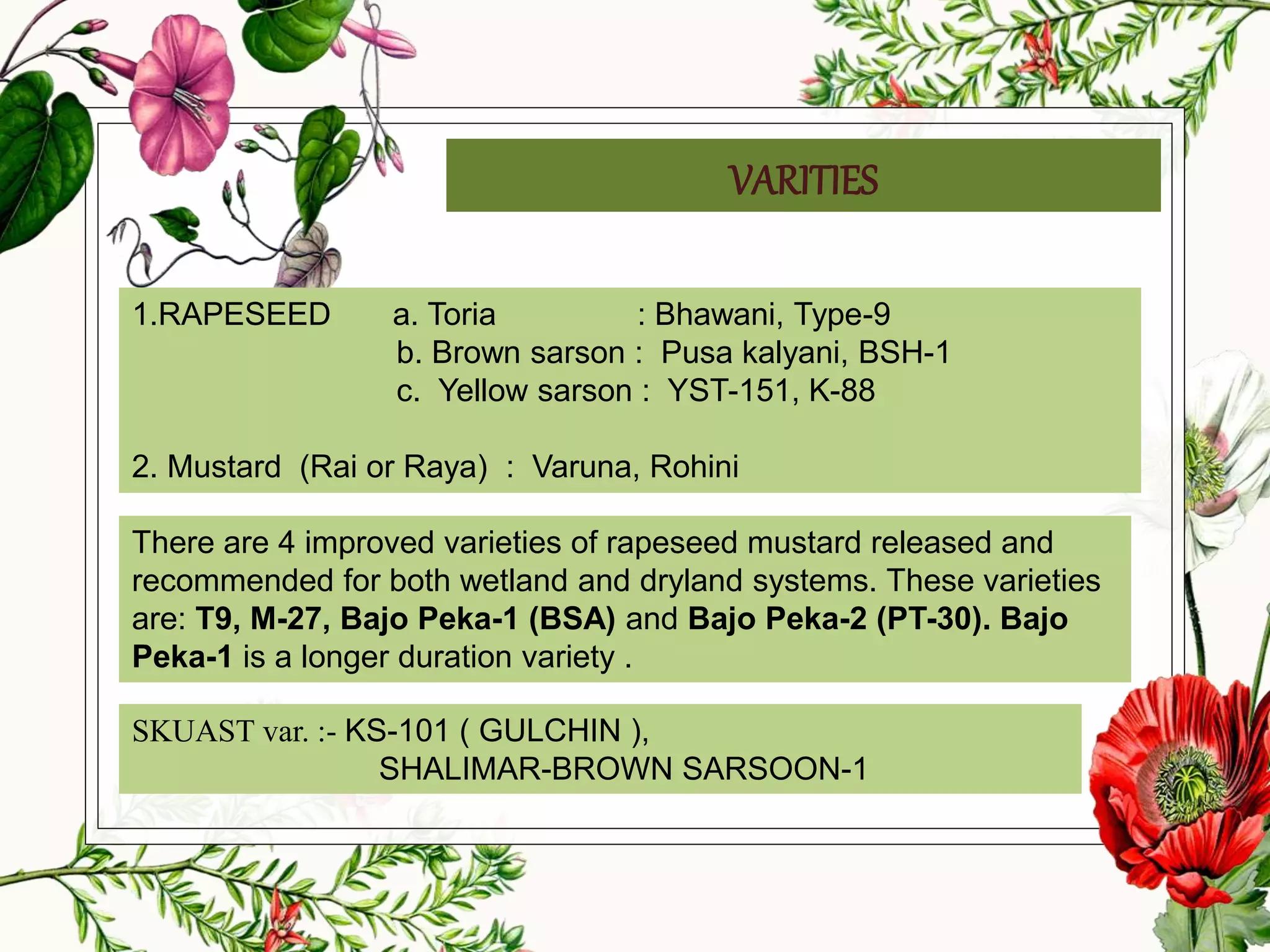
VARITIES
1.RAPESEED a. Toria : Bhawani, Type-9
b. Brown sarson : Pusa kalyani, BSH-1
c. Yellow sarson : YST-151, K-88
2. Mustard (Rai or Raya) : Varuna, Rohini
There are 4 improved varieties of rapeseed mustard released and
recommended for both wetland and dryland systems. These varieties
are: T9, M-27, Bajo Peka-1 (BSA) and Bajo Peka-2 (PT-30). Bajo
Peka-1 is a longer duration variety .
SKUAST var. :- KS-101 ( GULCHIN ),
SHALIMAR-BROWN SARSOON-1
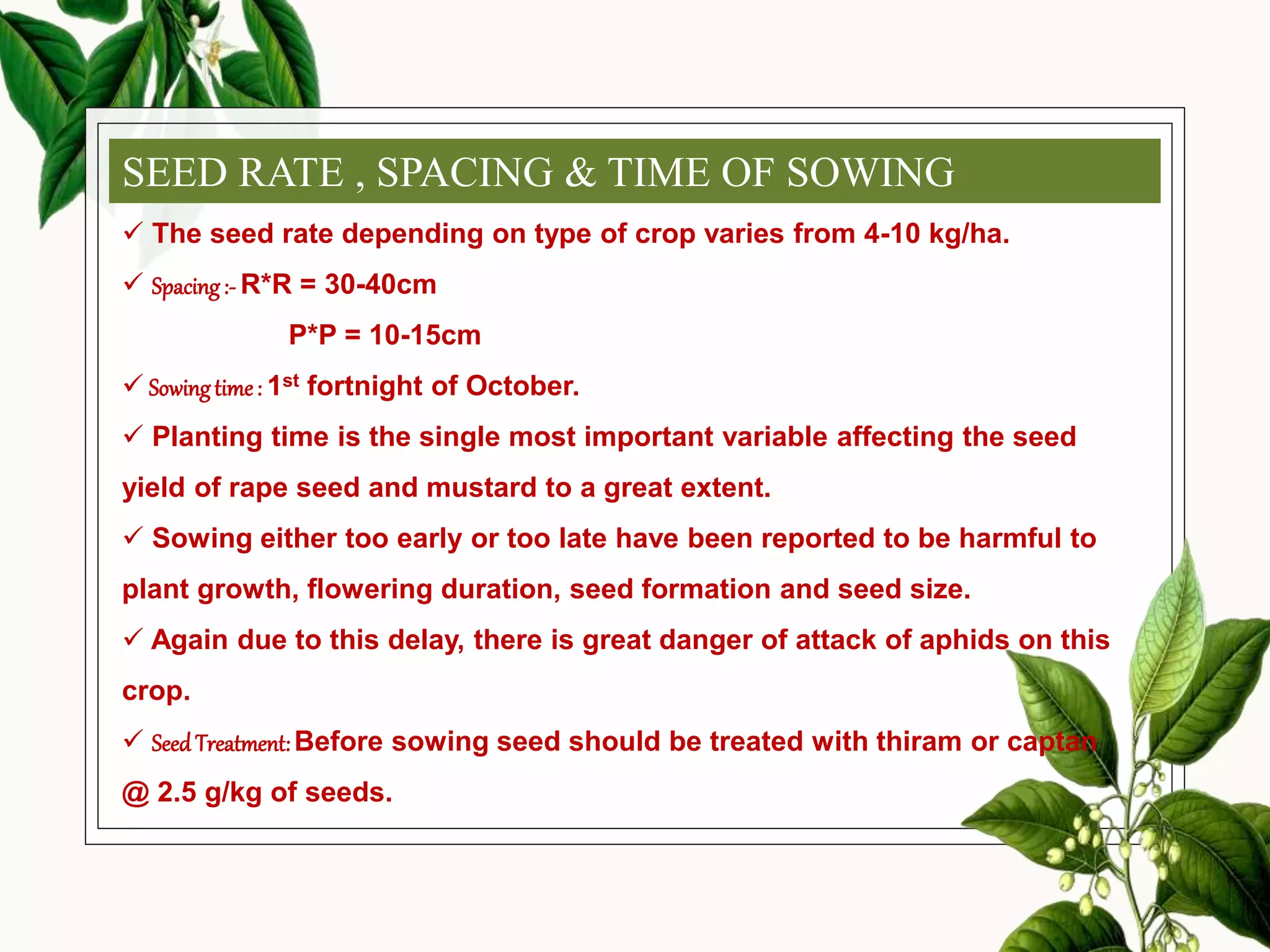
SEED RATE , SPACING & TIME OF SOWING
 The seed rate depending on type of crop varies from 4-10 kg/ha.
 Spacing:- R*R = 30-40cm
P*P = 10-15cm
 Sowingtime: 1st fortnight of October.
 Planting time is the single most important variable affecting the seed
yield of rape seed and mustard to a great extent.
 Sowing either too early or too late have been reported to be harmful to
plant growth, flowering duration, seed formation and seed size.
 Again due to this delay, there is great danger of attack of aphids on this
crop.
 Seed Treatment:Before sowing seed should be treated with thiram or captan
@ 2.5 g/kg of seeds.
SEEDS RAPESEEDS
MUSTARD SEEDS
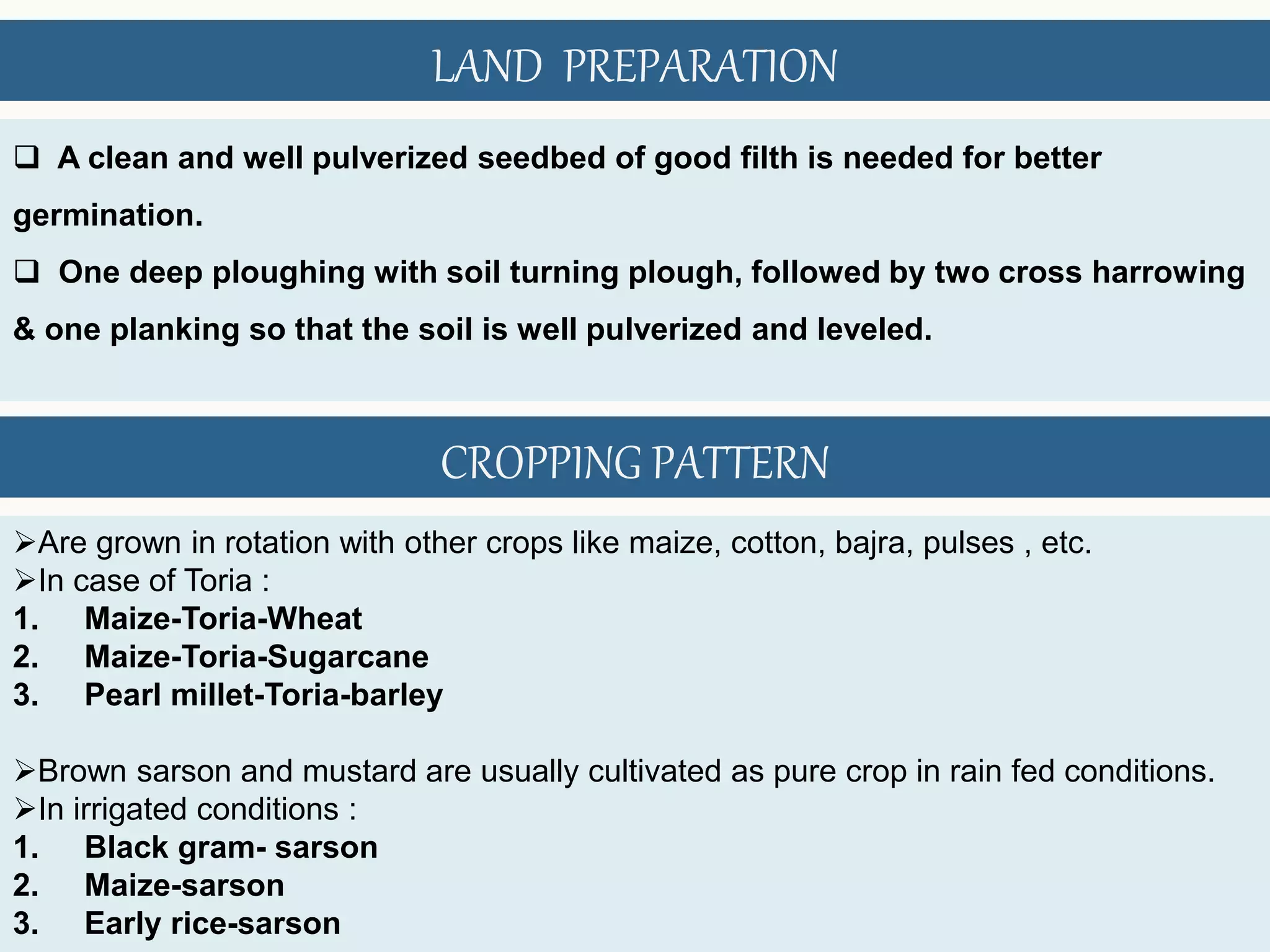
LAND PREPARATION
 A clean and well pulverized seedbed of good filth is needed for better
germination.
 One deep ploughing with soil turning plough, followed by two cross harrowing
& one planking so that the soil is well pulverized and leveled.
CROPPING PATTERN
Are grown in rotation with other crops like maize, cotton, bajra, pulses , etc.
In case of Toria :
1. Maize-Toria-Wheat
2. Maize-Toria-Sugarcane
3. Pearl millet-Toria-barley
Brown sarson and mustard are usually cultivated as pure crop in rain fed conditions.
In irrigated conditions :
1. Black gram- sarson
2. Maize-sarson
3. Early rice-sarson
MANURES ANDFERTILIZERS
 If available, apply 10-15 tons of farm yard manure or compost
at the time of field preparation.
 Apply 60-90 : 60 : 40 kg NPK per hectare. Phosphorous and
potash should be based on soil test recommendations.
 Rape seed and mustard have higher requirement for Sulphur,
therefore, nitrogen should preferably be applied through
ammonium sulphate and phosphorous from single
Superphosphate.
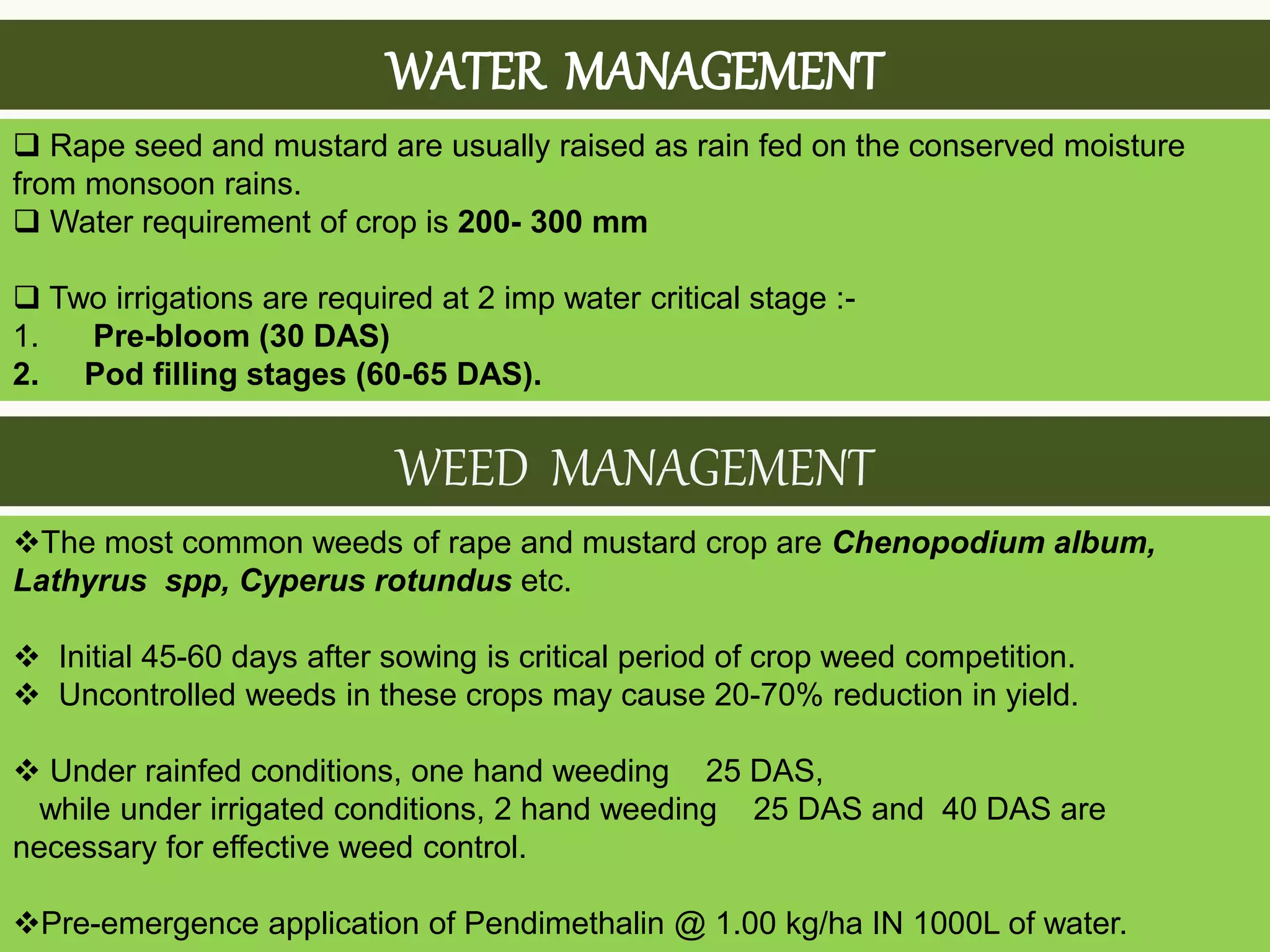
WATER MANAGEMENT
 Rape seed and mustard are usually raised as rain fed on the conserved moisture
from monsoon rains.
 Water requirement of crop is 200- 300 mm
 Two irrigations are required at 2 imp water critical stage :-
1. Pre-bloom (30 DAS)
2. Pod filling stages (60-65 DAS).
WEED MANAGEMENT
The most common weeds of rape and mustard crop are Chenopodium album,
Lathyrus spp, Cyperus rotundus etc.
 Initial 45-60 days after sowing is critical period of crop weed competition.
 Uncontrolled weeds in these crops may cause 20-70% reduction in yield.
 Under rainfed conditions, one hand weeding 25 DAS,
while under irrigated conditions, 2 hand weeding 25 DAS and 40 DAS are
necessary for effective weed control.
Pre-emergence application of Pendimethalin @ 1.00 kg/ha IN 1000L of water.
HARVESTING
◉ As soon as the pods turn yellowish-brown,
harvest the crop.
◉ Harvest just before the pods open in order to
avoid shattering losses.
◉ Threshing is done with the help of sticks.
◉ The threshed seed is separated from the husk
with the help of slow moving natural air current.
◉ Cleaned seed must be dried in the sun for four to
five days or till the moisture content comes down
to 8 percent.
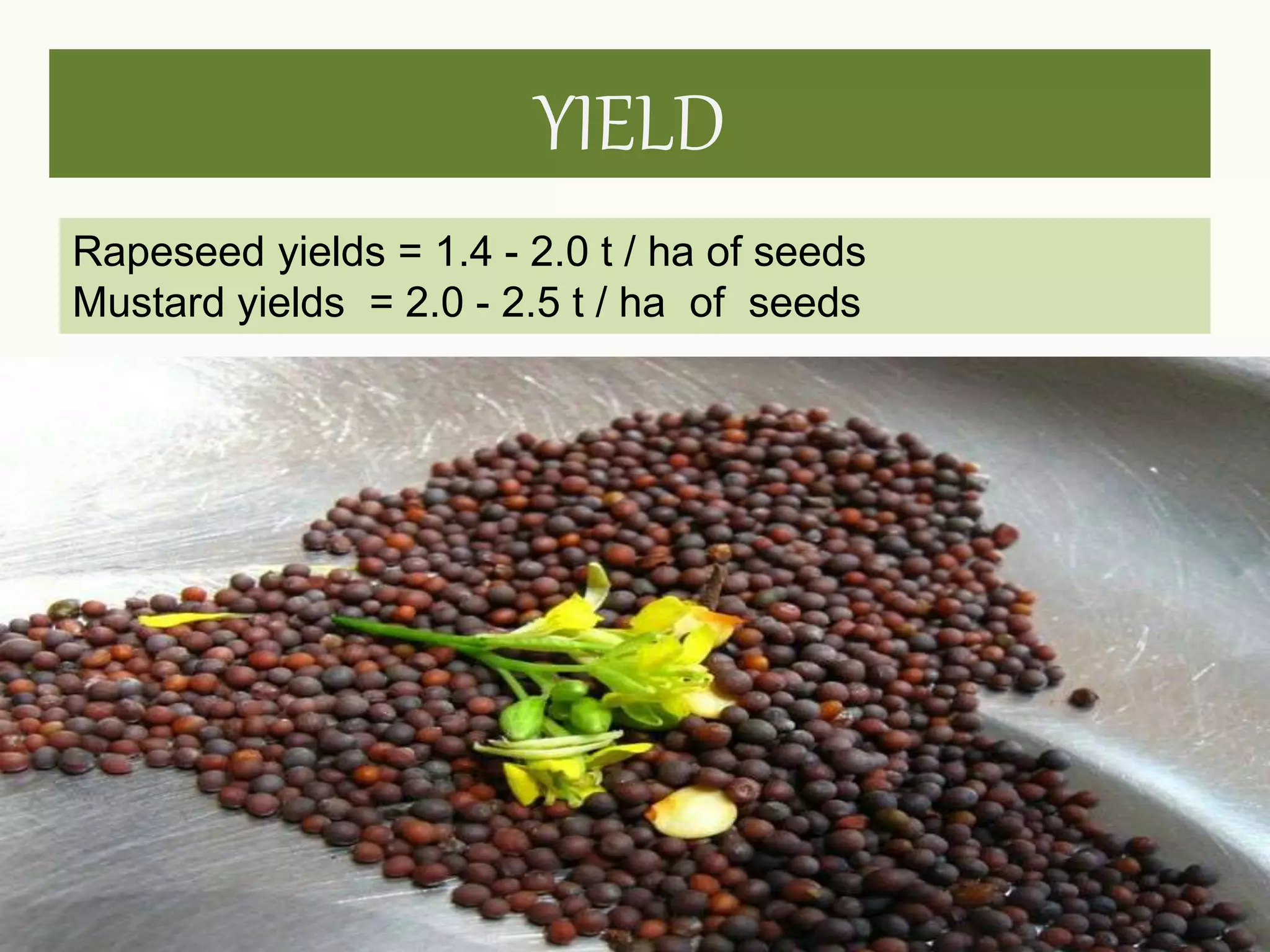
YIELD
Rapeseed yields = 1.4 - 2.0 t / ha of seeds
Mustard yields = 2.0 - 2.5 t / ha of seeds
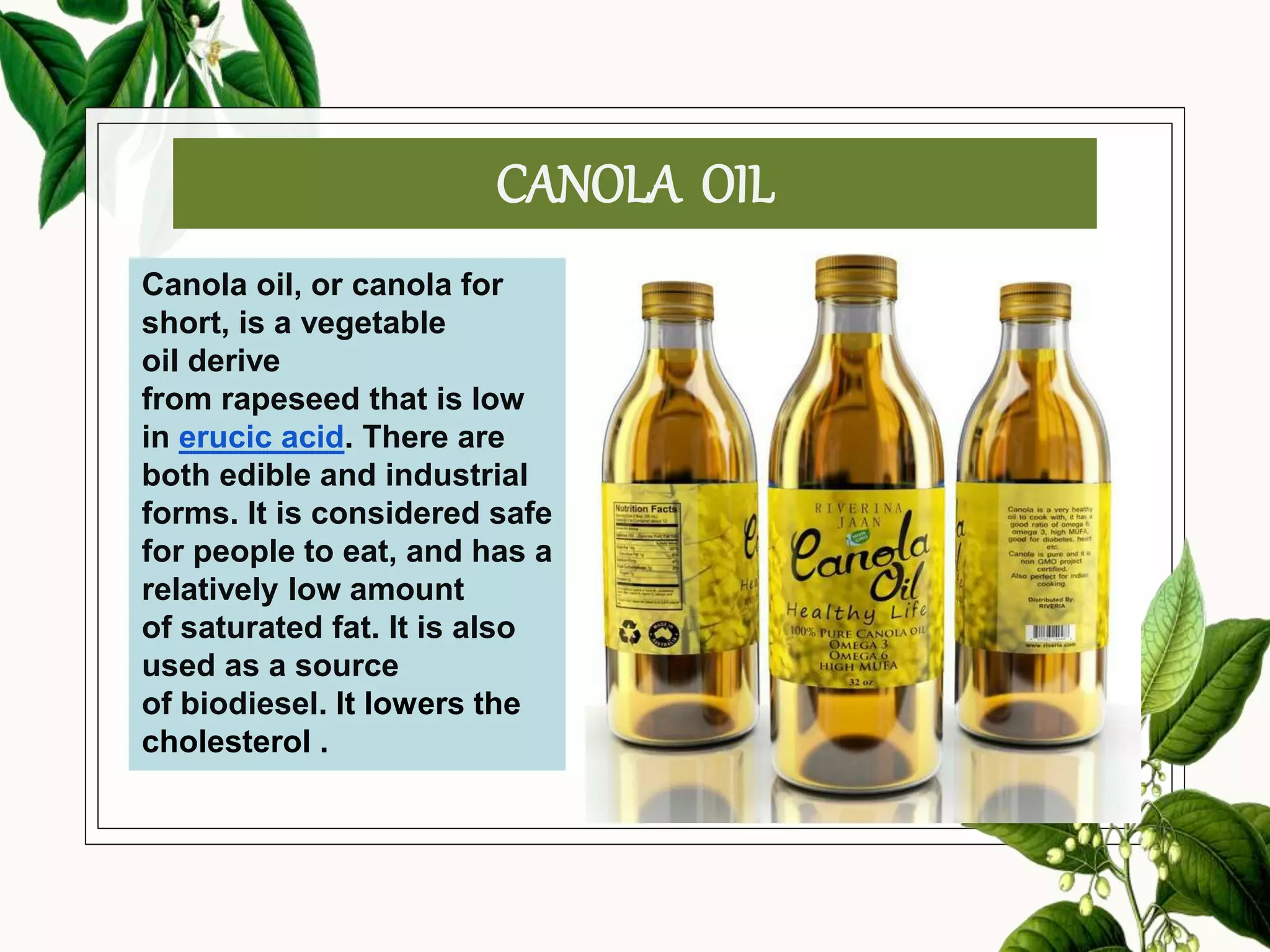
CANOLA OIL
Canola oil, or canola for
short, is a vegetable
oil derive
from rapeseed that is low
in erucic acid. There are
both edible and industrial
forms. It is considered safe
for people to eat, and has a
relatively low amount
of saturated fat. It is also
used as a source
of biodiesel. It lowers the
cholesterol .
Rapeseed & Mustard ppt by Haseena Shabnam

Rapeseed & Mustard ppt by Haseena Shabnam

  • 1.
    COURSE TITLE :-FIELD CROPS - II ( KHARIEF ) COURSE NO. :- AGR 328 CREDIT LOAD :- 2+1 PRESENTED BY :- ( HASEENA SHABNAM )
  • 2.
    TOPIC :- MUSTARD& RAPESEED Botanical Name : Brassica spp. Family : Brassicaceae ( Cruciferae )
  • 3.
    INTRODUCTION Rapeseed & mustardare the 3rd most important edible oilseed crops of the world after soybean and oil palm.  Mustard is Brassica juncea, whereas Rapeseed is Brassica campestris.  This crop accounts for nearly one-third of the oil produced in India, making it the country’s key edible oilseed crop.  Seeds are known by different names in different places ; Sarson , Toria or Lahi are generally termed as Rapeseeds while Rai or Raya or Laha is termed as Mustard.  Oil content varies from 37 to 49%.
  • 5.
    USES 1. Its oil& seeds are used in: ~ the preparation of pickles and for flavoring curries and vegetables. ~ human consumption ,. ~ preparation of hair oil and ,medicines ,soaps. ~ in mixture with mineral oils for lubrication. ~ Rapeseed oil is used in the manufacture of greases. 2. The oil cake is used as a cattle feed, its green stems and leaves are good source of green fodder for cattle. 3. The leaves of young plants are used as green vegetables. 4. In tanning industry, mustard oil is used for softening leather.
  • 6.
  • 7.
    ORIGIN& HISTORY The placeof origin is not definitely known.  It’s cultivation has been traced to 2000-1500 B.C in India, China and Japan.  According to Prain (1898), Bailey (1922) and others: Rai (B.juncea) originated in China and from there it was introduced in India.  According to Vavilov (1926)the place of origin of Rapeseed (B. campestris) is eastern Afghanistan and adjoining parts of India & Pakistan.  Singh(1958) considered the B. campestris var. yellow sarson to the oldest of the various rapes & Mustard grown in India.
  • 8.
    AREA AND DISTRIBUTION Rapeseedand mustard are grown in 53 countries of the world.  WORLD :- Area - 35.44 Million ha ( 2017-18 ) Production - 40.60 Million metric tons ( 2017-18 ) Productivity - 2.09 Metric tons per ha ( 2017-18 )  Major growing countries :- : India, Canada, China, Pakistan, Poland, Bangladesh & . Sweden , etc.  INDIA :- Area - 5.70 Million ha ( 2017-18 ) Production - 6.50 Million metric tons ( 2017-18 ) Productivity - 1 metric tons per ha ( 2017- 18 )  Major growing states of India :- U.P, Rajasthan, M.P, Haryana, Punjab, Assam, Bihar, . . Gujarat & West Bengal.  U.P alone produces about 20 % of total rapeseed & mustard production in India.  Total oilseed in J&K ( 2014-15 ) Area (000) Ha – 65.95 Production (000 Qtls ) – 583.8 yield ( Qt /ha ) – 8.85
  • 9.
    Classification ( SINGH,1958 ) B. campestris var. yellow sarson. B. campestris var. brown sarson B. campestris var. yellow toria B. campestris var. black toria. B. Juncea B. juncea var. rugose B. nigra SPECIES
  • 10.
    BOTANICAL DESCRIPTION • Family: Cruciferae • Genus : Brassica • Plant is self-pollinated but cross pollination also takes place to some extent. • Plant is herbaceous annual , Rabi crop Parameter Rape seed Mustard Plant height Shorter(45-150 cm), stem is covered with a waxy deposit Taller(90-200 cm), erect & much branched. Leaves Sessile & hairy leaves dilated at the base with clasping nature. Stalked, broad and pinnatified Fruits(pods) Thicker Slender Seed color Yellow or brown Brown or dark brown Seed coat Smooth Rough
  • 11.
    (Mustard) Brassica juncea(Rapeseed )Brassica campestris.
  • 12.
     Require cooland dry weather for satisfactory growth.  They require a fair supply of soil moisture during the growing period and a dry clear weather at the time of maturity.  Excessive cold and frost are harmful to the crop.  They require an annual precipitation of 35-45 cm.  soil conditions vary from sandy loam to clay loam soils but they thrive best on light loam soils.  They neither tolerate water logging conditions nor do well on heavy soils.  Soil having neutral pH is ideal for their proper growth and development.  Soils having pH 6.0-7.5 is ideal for their proper growth and development. CLIMATE SOIL
  • 13.
    VARITIES 1.RAPESEED a. Toria: Bhawani, Type-9 b. Brown sarson : Pusa kalyani, BSH-1 c. Yellow sarson : YST-151, K-88 2. Mustard (Rai or Raya) : Varuna, Rohini There are 4 improved varieties of rapeseed mustard released and recommended for both wetland and dryland systems. These varieties are: T9, M-27, Bajo Peka-1 (BSA) and Bajo Peka-2 (PT-30). Bajo Peka-1 is a longer duration variety . SKUAST var. :- KS-101 ( GULCHIN ), SHALIMAR-BROWN SARSOON-1
  • 14.
    SEED RATE ,SPACING & TIME OF SOWING  The seed rate depending on type of crop varies from 4-10 kg/ha.  Spacing:- R*R = 30-40cm P*P = 10-15cm  Sowingtime: 1st fortnight of October.  Planting time is the single most important variable affecting the seed yield of rape seed and mustard to a great extent.  Sowing either too early or too late have been reported to be harmful to plant growth, flowering duration, seed formation and seed size.  Again due to this delay, there is great danger of attack of aphids on this crop.  Seed Treatment:Before sowing seed should be treated with thiram or captan @ 2.5 g/kg of seeds.
  • 15.
  • 16.
    LAND PREPARATION  Aclean and well pulverized seedbed of good filth is needed for better germination.  One deep ploughing with soil turning plough, followed by two cross harrowing & one planking so that the soil is well pulverized and leveled. CROPPING PATTERN Are grown in rotation with other crops like maize, cotton, bajra, pulses , etc. In case of Toria : 1. Maize-Toria-Wheat 2. Maize-Toria-Sugarcane 3. Pearl millet-Toria-barley Brown sarson and mustard are usually cultivated as pure crop in rain fed conditions. In irrigated conditions : 1. Black gram- sarson 2. Maize-sarson 3. Early rice-sarson
  • 17.
    MANURES ANDFERTILIZERS  Ifavailable, apply 10-15 tons of farm yard manure or compost at the time of field preparation.  Apply 60-90 : 60 : 40 kg NPK per hectare. Phosphorous and potash should be based on soil test recommendations.  Rape seed and mustard have higher requirement for Sulphur, therefore, nitrogen should preferably be applied through ammonium sulphate and phosphorous from single Superphosphate.
  • 18.
    WATER MANAGEMENT  Rapeseed and mustard are usually raised as rain fed on the conserved moisture from monsoon rains.  Water requirement of crop is 200- 300 mm  Two irrigations are required at 2 imp water critical stage :- 1. Pre-bloom (30 DAS) 2. Pod filling stages (60-65 DAS). WEED MANAGEMENT The most common weeds of rape and mustard crop are Chenopodium album, Lathyrus spp, Cyperus rotundus etc.  Initial 45-60 days after sowing is critical period of crop weed competition.  Uncontrolled weeds in these crops may cause 20-70% reduction in yield.  Under rainfed conditions, one hand weeding 25 DAS, while under irrigated conditions, 2 hand weeding 25 DAS and 40 DAS are necessary for effective weed control. Pre-emergence application of Pendimethalin @ 1.00 kg/ha IN 1000L of water.
  • 19.
    HARVESTING ◉ As soonas the pods turn yellowish-brown, harvest the crop. ◉ Harvest just before the pods open in order to avoid shattering losses. ◉ Threshing is done with the help of sticks. ◉ The threshed seed is separated from the husk with the help of slow moving natural air current. ◉ Cleaned seed must be dried in the sun for four to five days or till the moisture content comes down to 8 percent.
  • 20.
    YIELD Rapeseed yields =1.4 - 2.0 t / ha of seeds Mustard yields = 2.0 - 2.5 t / ha of seeds
  • 21.
    CANOLA OIL Canola oil,or canola for short, is a vegetable oil derive from rapeseed that is low in erucic acid. There are both edible and industrial forms. It is considered safe for people to eat, and has a relatively low amount of saturated fat. It is also used as a source of biodiesel. It lowers the cholesterol .