RANGE MANAGEMENT
B.Sc. Final Year 1st Semester
Credit Hours: 2
Full Marks: 50(TH: 40 & PR.10)
By: Deepak Gautam
UNIT: ONE
1.1 TERMINOLOGY
1.2 RANGE LAND ECOSYSTEM OF NEPAL
1.3 FORAGE RESOURCES OF NEPAL
1.4 IMPORTANCE OF LIVESTOCK IN NEPAL
Rangeland: Open area used for grazing or hunting animals.
Rangelands are those lands on which the native vegetation (climax or
natural potential plant community) is predominantly grasses, grass-like plants,
forbs, or shrubs suitable for grazing or browsing use.
What Rangelands are not?
Barren desert, farmland, closed canopy forests, or
land covered by solid rock, concrete and/or glaciers.
Note: Rangelands are distinguished from pasture lands
because they grow primarily native vegetation, rather than
plants established by humans.
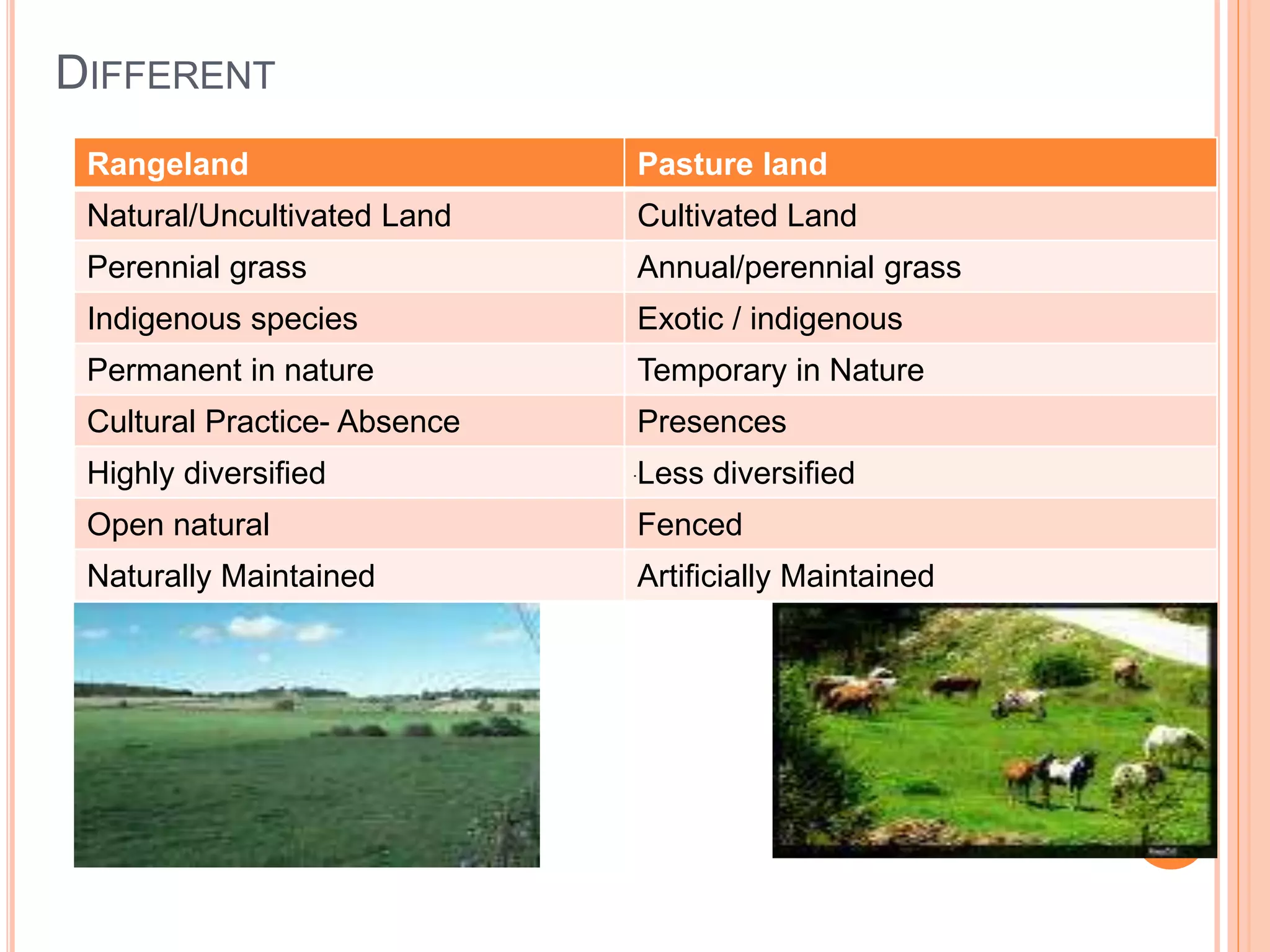
DIFFERENT
Rangeland Pasture land
Natural/Uncultivated Land Cultivated Land
Perennial grass Annual/perennial grass
Indigenous species Exotic / indigenous
Permanent in nature Temporary in Nature
Cultural Practice- Absence Presences
Highly diversified Less diversified
Open natural Fenced
Naturally Maintained Artificially Maintained
 Rangelands comprise almost half (50%) of the landmass of the
world.
 Global extent of major rangeland cover types:
 Grassland 42%
 Shrubland 23%
 Woodland 12%
 Other (tundra, desert, forest) 23%
Note:
 About 75% of the land is under rangeland in Australia.
 South America, rangelands cover about 33% of the total land
area.
 About 12% land is covered by rangeland in Nepal.
For more details about rangeland content please visit:
https://en.wikipedia.org/wiki/Rangeland
1.1 IMPORTANT TERMS:
 Range: Broad, open, unfenced areas over which grazing
animals roam.
 Forage: Palatable herbaceous plants
 Fodder: Palatable plants to the animals used by cut and
carries system.
 Herbage: Both palatable and non-palatable plants.
 Browse: Palatable leaves or shoots/twig
 Forbs: Plants with solid, non-woody stem, usually
broadleaf with reticulated venation.
 Range analysis: It is a critical study of range classes each
of them in individual form.
 Range science: Science that deals with the use of
rangelands in a sustainable way to meet the needs of
people.
 Range management: Purposeful and effective use of
resources to obtain sustainable resources.
FORAGE:
 Herbaceous plant palatable to the animals
 It includes plant material
(mainly plant leaves and stems) eaten by grazing livestock.
 The term forage has meant only plants eaten by the animals
directly as pasture, crop residue, or immature cereal crops.
HERBAGE:
 Non woody (no persistent woody stem above ground) flowering
plants that can be considered in the same sense as fodder and
forage but in this case the plants may be both palatable or
unpalatable to the animals.
 A herbaceous plant (simply herb) is a plant that has leaves and
stems that die down at the end of the growing season to the soil
level.
 A herbaceous plant may be annual, biennial or perennial.
BROWSE:
 Palatable twig/leafy growth of woody perennial shrubs, vines,
and even tree such as, Leucaena species used as animals feed.
BROWSING:
 It is a type of predation in which a herbivore feeds on leaves,
soft shoot, or fruits of high growing, generally woody plants such
as shrubs. (Chapman et al., 1999)
 This types of feeding behavior found in Goat, Elephant.
GRAZING:
 Grazing generally describes a type of predation in which a
herbivore feeds on plants (such as grasses), and also on other
multicellular autotrophs (such as algae).
 Grazing differs from true predation because the organism being
eaten is not killed. Eg: Sheep, Cow
CHARACTERISTICS OF RANGELAND
 Low rainfall/moisture stress
 Not suitable for agriculture
 High or low temperature
 Degraded land (rocky/stony)
 Shallow soil (low soil fertility)
 Shorter growing season
of the vegetation
 Prevalence of rain shadow
 Poor drainage
 Desert like environmental
situation
Major Types of rangeland of the world
1.Prairie
2. Grasslands
3. Steppe
4. Pampas
5. Shrub land
6. Woodland
7. Savanna
8. Tundra
9. Wetlands
10. Deserts
1.PARIRIE:
 Temperate grassland
 Vegetation dominated by grasses, herbs, and shrubs.
 Largest prairie of the world is sundogs prairie North America.
2. GRASSLAND
Vegetation is dominated by grasses and forbs
World's largest grassland is found in African savanna
3.STEPPE
A vast semiarid grass.
 Found in southeast Europe, Siberia, and central North
America.
4.PAMPAS:
 Fertile South American lowlands.
 Vegetation dominated by Poaceae species.
 Poaceae species means grass family species.
SHRUB LAND:
 Vegetation dominated by shrubs and also geophytes.
Geophytes : Plant having underground storage. E.g Tulip
6. WOOD LANDS
 Low-dense forest forming open habitats with plenty of sunlight
and limited shade.
 Woodlands may support an understory of shrubs and
herbaceous plants including grasses.
7. SAVANNA:
Consists tropical vegetation with tree lees/ dotted trees
/patch of trees.
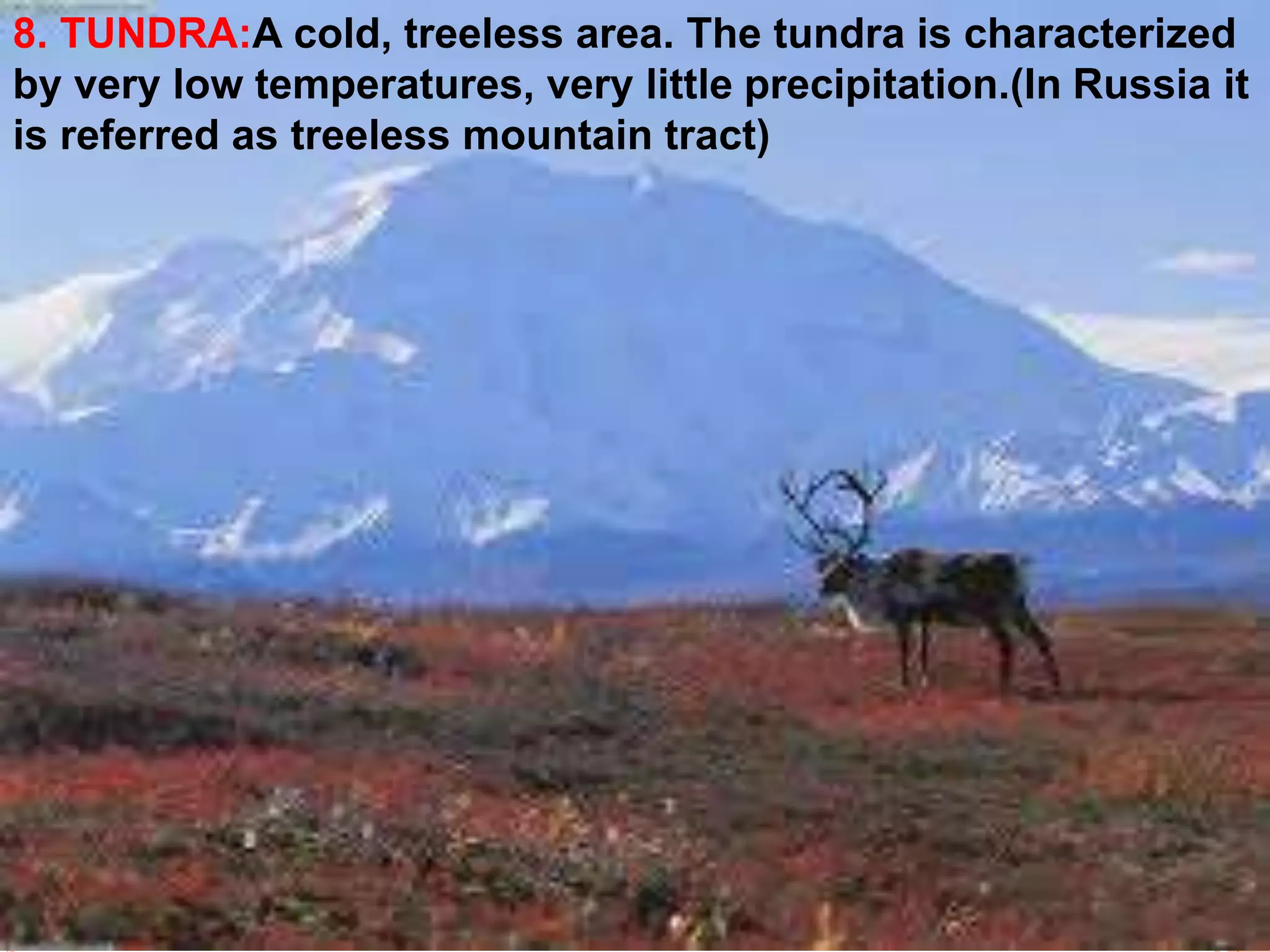
8. TUNDRA:A cold, treeless area. The tundra is characterized
by very low temperatures, very little precipitation.(In Russia it
is referred as treeless mountain tract)
9. WETLANDS:
 Generally, wetlands mean rivers, ponds, lakes, reservoirs and forests, and
water logged lands in and around human habitation. The Nepali term for
wetlands is Simsar.
 Wetlands having vegetation comes under rangeland in which animal graze.
TYPES OF WETLANDS
Marshes:
 Periodically or continually flooded wetlands.
 Dominated by non- woody emergent plants.
 Plants that are adapted to living in shallow water or in moisture saturated
soils.
Swamps:
 Swamps are dominated by tree or shrubs and occur in a variety of flooding
conditions.
 Standing water can be present in swamps during all or just a small part of the
year.
Peat lands:
 In peat lands, plants are produced more quickly than they can decay and
there is accumulation of partially decomposed plant material, which is called
peat.
 Peat provides an organic soil that influence the plants growth.
10. DESERT: Low rainfall (generally >30cm rainfall
per year)with bushy vegetations.
Types of deserts:
Hot and dry desert
 Semiarid desert
Coastal desert
 Cold desert
Hot and dry deserts
 Located around the equator.
Hot and warm temperature throughout the year.
 Temperature reached around 50 degree Celsius.
 Example: Sahara desert, Sandy Desert of Australia and
Sonorant Desert of North America.
Semiarid deserts
 Moderate versions of hot and dry deserts.
 Temperature not more than 40o C.
For e.g.: Sagebrush desert and some deserts of North
America, Greenland, Russia, Europe and Northern Asia.
Coastal deserts
Temperature normal throughout the year.
 Average temperature in summer is 13-24o C and is around
5o C in winter.
 Atacama Desert of Chile is the most famous coastal desert.
Cold deserts:
Winters in these deserts are extremely cold and are very long.
 Summers are relatively warmer and moist with abundant rainfall.
Temperature may reach up to 26o C during the summers.
For e.g Gobi desert
CAUTION!!!
Desert having only sand dunes don’t comes under
rangeland.
 Wetlands having vegetation in which animal graze or
browse comes under rangeland.
NOTE:
Grasslands are called different name in different parts of
the world
1. Steppes in Asia
2. Prairies in North America
3. Pampas’, ‘llanos’ and ‘cerrados’ in South America;
4. Savannas’ and ‘velds’ in Africa;
5. Down lands or ‘rangelands’ in Australia
 What goods and services are derived from rangelands?
Rangelands serve multiple purposes as:
 A habitat for a wide array of game and non-game animal
species;
 A habitat for a diverse and wide array of native plant
species;
 A source of high quality water, clean air and open spaces;
 A setting for recreational, hiking, camping, fishing,
hunting and nature experiences.
 The foundation for low-input, fully renewable food and
fiber production systems of grazing industries.
 Because of the diversity of goods and services derived
from rangelands, their management and health are linked
closely to the economic well being of many communities.

Range management 1.1

  • 1.
    RANGE MANAGEMENT B.Sc. FinalYear 1st Semester Credit Hours: 2 Full Marks: 50(TH: 40 & PR.10) By: Deepak Gautam
  • 2.
    UNIT: ONE 1.1 TERMINOLOGY 1.2RANGE LAND ECOSYSTEM OF NEPAL 1.3 FORAGE RESOURCES OF NEPAL 1.4 IMPORTANCE OF LIVESTOCK IN NEPAL
  • 3.
    Rangeland: Open areaused for grazing or hunting animals. Rangelands are those lands on which the native vegetation (climax or natural potential plant community) is predominantly grasses, grass-like plants, forbs, or shrubs suitable for grazing or browsing use.
  • 4.
    What Rangelands arenot? Barren desert, farmland, closed canopy forests, or land covered by solid rock, concrete and/or glaciers. Note: Rangelands are distinguished from pasture lands because they grow primarily native vegetation, rather than plants established by humans.
  • 5.
    DIFFERENT Rangeland Pasture land Natural/UncultivatedLand Cultivated Land Perennial grass Annual/perennial grass Indigenous species Exotic / indigenous Permanent in nature Temporary in Nature Cultural Practice- Absence Presences Highly diversified Less diversified Open natural Fenced Naturally Maintained Artificially Maintained
  • 6.
     Rangelands comprisealmost half (50%) of the landmass of the world.  Global extent of major rangeland cover types:  Grassland 42%  Shrubland 23%  Woodland 12%  Other (tundra, desert, forest) 23% Note:  About 75% of the land is under rangeland in Australia.  South America, rangelands cover about 33% of the total land area.  About 12% land is covered by rangeland in Nepal. For more details about rangeland content please visit: https://en.wikipedia.org/wiki/Rangeland
  • 7.
    1.1 IMPORTANT TERMS: Range: Broad, open, unfenced areas over which grazing animals roam.  Forage: Palatable herbaceous plants  Fodder: Palatable plants to the animals used by cut and carries system.  Herbage: Both palatable and non-palatable plants.  Browse: Palatable leaves or shoots/twig  Forbs: Plants with solid, non-woody stem, usually broadleaf with reticulated venation.  Range analysis: It is a critical study of range classes each of them in individual form.  Range science: Science that deals with the use of rangelands in a sustainable way to meet the needs of people.  Range management: Purposeful and effective use of resources to obtain sustainable resources.
  • 8.
    FORAGE:  Herbaceous plantpalatable to the animals  It includes plant material (mainly plant leaves and stems) eaten by grazing livestock.  The term forage has meant only plants eaten by the animals directly as pasture, crop residue, or immature cereal crops. HERBAGE:  Non woody (no persistent woody stem above ground) flowering plants that can be considered in the same sense as fodder and forage but in this case the plants may be both palatable or unpalatable to the animals.  A herbaceous plant (simply herb) is a plant that has leaves and stems that die down at the end of the growing season to the soil level.  A herbaceous plant may be annual, biennial or perennial.
  • 9.
    BROWSE:  Palatable twig/leafygrowth of woody perennial shrubs, vines, and even tree such as, Leucaena species used as animals feed. BROWSING:  It is a type of predation in which a herbivore feeds on leaves, soft shoot, or fruits of high growing, generally woody plants such as shrubs. (Chapman et al., 1999)  This types of feeding behavior found in Goat, Elephant.
  • 10.
    GRAZING:  Grazing generallydescribes a type of predation in which a herbivore feeds on plants (such as grasses), and also on other multicellular autotrophs (such as algae).  Grazing differs from true predation because the organism being eaten is not killed. Eg: Sheep, Cow
  • 11.
    CHARACTERISTICS OF RANGELAND Low rainfall/moisture stress  Not suitable for agriculture  High or low temperature  Degraded land (rocky/stony)  Shallow soil (low soil fertility)  Shorter growing season of the vegetation  Prevalence of rain shadow  Poor drainage  Desert like environmental situation
  • 12.
    Major Types ofrangeland of the world 1.Prairie 2. Grasslands 3. Steppe 4. Pampas 5. Shrub land 6. Woodland 7. Savanna 8. Tundra 9. Wetlands 10. Deserts
  • 14.
    1.PARIRIE:  Temperate grassland Vegetation dominated by grasses, herbs, and shrubs.  Largest prairie of the world is sundogs prairie North America.
  • 15.
    2. GRASSLAND Vegetation isdominated by grasses and forbs World's largest grassland is found in African savanna
  • 16.
    3.STEPPE A vast semiaridgrass.  Found in southeast Europe, Siberia, and central North America.
  • 17.
    4.PAMPAS:  Fertile SouthAmerican lowlands.  Vegetation dominated by Poaceae species.  Poaceae species means grass family species.
  • 18.
    SHRUB LAND:  Vegetationdominated by shrubs and also geophytes. Geophytes : Plant having underground storage. E.g Tulip
  • 19.
    6. WOOD LANDS Low-dense forest forming open habitats with plenty of sunlight and limited shade.  Woodlands may support an understory of shrubs and herbaceous plants including grasses.
  • 20.
    7. SAVANNA: Consists tropicalvegetation with tree lees/ dotted trees /patch of trees.
  • 21.
    8. TUNDRA:A cold,treeless area. The tundra is characterized by very low temperatures, very little precipitation.(In Russia it is referred as treeless mountain tract)
  • 22.
    9. WETLANDS:  Generally,wetlands mean rivers, ponds, lakes, reservoirs and forests, and water logged lands in and around human habitation. The Nepali term for wetlands is Simsar.  Wetlands having vegetation comes under rangeland in which animal graze. TYPES OF WETLANDS Marshes:  Periodically or continually flooded wetlands.  Dominated by non- woody emergent plants.  Plants that are adapted to living in shallow water or in moisture saturated soils. Swamps:  Swamps are dominated by tree or shrubs and occur in a variety of flooding conditions.  Standing water can be present in swamps during all or just a small part of the year. Peat lands:  In peat lands, plants are produced more quickly than they can decay and there is accumulation of partially decomposed plant material, which is called peat.  Peat provides an organic soil that influence the plants growth.
  • 25.
    10. DESERT: Lowrainfall (generally >30cm rainfall per year)with bushy vegetations. Types of deserts: Hot and dry desert  Semiarid desert Coastal desert  Cold desert
  • 26.
    Hot and drydeserts  Located around the equator. Hot and warm temperature throughout the year.  Temperature reached around 50 degree Celsius.  Example: Sahara desert, Sandy Desert of Australia and Sonorant Desert of North America.
  • 27.
    Semiarid deserts  Moderateversions of hot and dry deserts.  Temperature not more than 40o C. For e.g.: Sagebrush desert and some deserts of North America, Greenland, Russia, Europe and Northern Asia.
  • 28.
    Coastal deserts Temperature normalthroughout the year.  Average temperature in summer is 13-24o C and is around 5o C in winter.  Atacama Desert of Chile is the most famous coastal desert.
  • 29.
    Cold deserts: Winters inthese deserts are extremely cold and are very long.  Summers are relatively warmer and moist with abundant rainfall. Temperature may reach up to 26o C during the summers. For e.g Gobi desert
  • 30.
    CAUTION!!! Desert having onlysand dunes don’t comes under rangeland.  Wetlands having vegetation in which animal graze or browse comes under rangeland. NOTE: Grasslands are called different name in different parts of the world 1. Steppes in Asia 2. Prairies in North America 3. Pampas’, ‘llanos’ and ‘cerrados’ in South America; 4. Savannas’ and ‘velds’ in Africa; 5. Down lands or ‘rangelands’ in Australia
  • 31.
     What goodsand services are derived from rangelands? Rangelands serve multiple purposes as:  A habitat for a wide array of game and non-game animal species;  A habitat for a diverse and wide array of native plant species;  A source of high quality water, clean air and open spaces;  A setting for recreational, hiking, camping, fishing, hunting and nature experiences.  The foundation for low-input, fully renewable food and fiber production systems of grazing industries.  Because of the diversity of goods and services derived from rangelands, their management and health are linked closely to the economic well being of many communities.