RADIOLOGICAL EQUIPMENT
Lecture-1- Introduction
Dr. Emad Taleb
COURSE ASSESSMENT
 Examination: 40%
 Mid Term Examination? 15 %
 Final Examination 40 %
 Course work: 60 %
 (class homework) 5 %
 Attends 10 %
 Quizzes? 15 % (3 X5 )
 Practice 30 %
2
COURSE OUTLINE
 UNIT I - MEDICAL X-RAY EQUIPMENT
 UNIT II - COMPUTER TOMOGRAPHY
 UNIT III - ULTRASOUND MACHINE
 UNIT IV– MAGNETIC RESONANCE IMAGING
 UNIT V - NUCLEAR MEDICINE SYSTEMS
 UNIT VI - RADIATION THERAPY AND RADIATION SAFETY
3
WHAT IS RADIOLOGY?
• Radiology is a medical specialty uses imaging concept to both
diagnose and treat human diseases.
• Person handling the radiological equipment is called a Radiologist.
• Radiologist use an array of imaging technologies such as
– X-ray,
– computed tomography (CT),
– ultrasound,
– nuclear medicine,
– positron emission tomography (PET) and
– magnetic resonance imaging (MRI) to diagnose or treat diseases.
• Interventional radiology is the performance of minimally invasive
medical procedures with the guidance of imaging technologies.
• The acquisition of medical imaging is usually carried out by the
radiographer or radiologic technologist. 4
IMAGING MODALITIES
Projection (plain) Radiography
• X-rays were discovered by Wilhelm Conrad Roentgen
• Radiographs or Roentgenographs, named after the
discoverer of X-rays, are produced by transmitting X-rays
through a patient.
• A capture device then converts them into visible light,
which then forms an image for review and diagnosis.
• The original, and still common, imaging procedure uses
silver impregnated films.
5
• A X-ray tube generates a beam of X-rays which is aimed at
the patient.
• The X-rays that pass through the patient are filtered by
placing a device called X-ray filter, made of aluminum to
reduce scatter and noise.
• It then strikes an undeveloped film, which is held tightly to
a screen of light-emitting phosphors in a light-tight
cassette.
• The film is then developed chemically and an image
appears on the film.
6
DIGITAL RADIOGRAPHY
• Digital radiography (DR)- X-rays strike a plate of
sensors that converts the signals generated into digital
information and an image displayed on a computer screen.
• Plain radiography was the only imaging modality available
during the first 50 years of radiology.
• Due to its availability, speed, and lower costs compared to
other modalities, radiography is often the first-line test of
choice in radiologic diagnosis.
7
FLUOROSCOPY
• Fluoroscopy and angiography are special applications of X-
ray imaging.
• A fluorescent screen and image intensifier tube is connected
to a closed-circuit television system (CCTV).
• An image intensifier tube is a vacuum tube device for
increasing the intensity of available light in an optical
system to allow use under low light conditions
• This allows real-time imaging of structures in motion or
augmented with a radiocontrast agent.
8
• Radiocontrast agents are administered, often swallowed
or injected into the body of the patient, to delineate
anatomy and functioning of the blood vessels, the
genitourinary system or the gastrointestinal tract.
• Two radiocontrasts are presently in use:
– Barium as (BaSO4) may be given orally or rectally for
evaluation of the GI tract.
– Iodine, in multiple proprietary forms, may be given by
oral, rectal, intraarterial or intravenous routes.
9
• These radiocontrast agents strongly absorb or scatter X-ray
radiation.
• In conjunction with the real-time imaging it allows
demonstration of dynamic processes, such as peristalsis in
the
digestive tract or blood flow in arteries and veins.
• odine contrast may also be concentrated in abnormal areas
more or less than in normal tissues and make abnormalities
(tumors, cysts, inflammation) more conspicuous.
• Carbon dioxide can be used as a contrast agent in the
venous system;
• This contrast agent attenuates the X-ray radiation less than
the surrounding tissues.
10
CT SCANNING
• CT imaging uses X-rays in conjunction with computing
algorithms to image the body.
• In CT, an X-ray generating tube opposite an X-ray
detector in a ring shaped apparatus rotate around a patient
producing a computer generated cross-sectional image
(tomogram).
• CT is acquired in the axial plane, while coronal and
sagittal images can be rendered by computer
reconstruction.
11
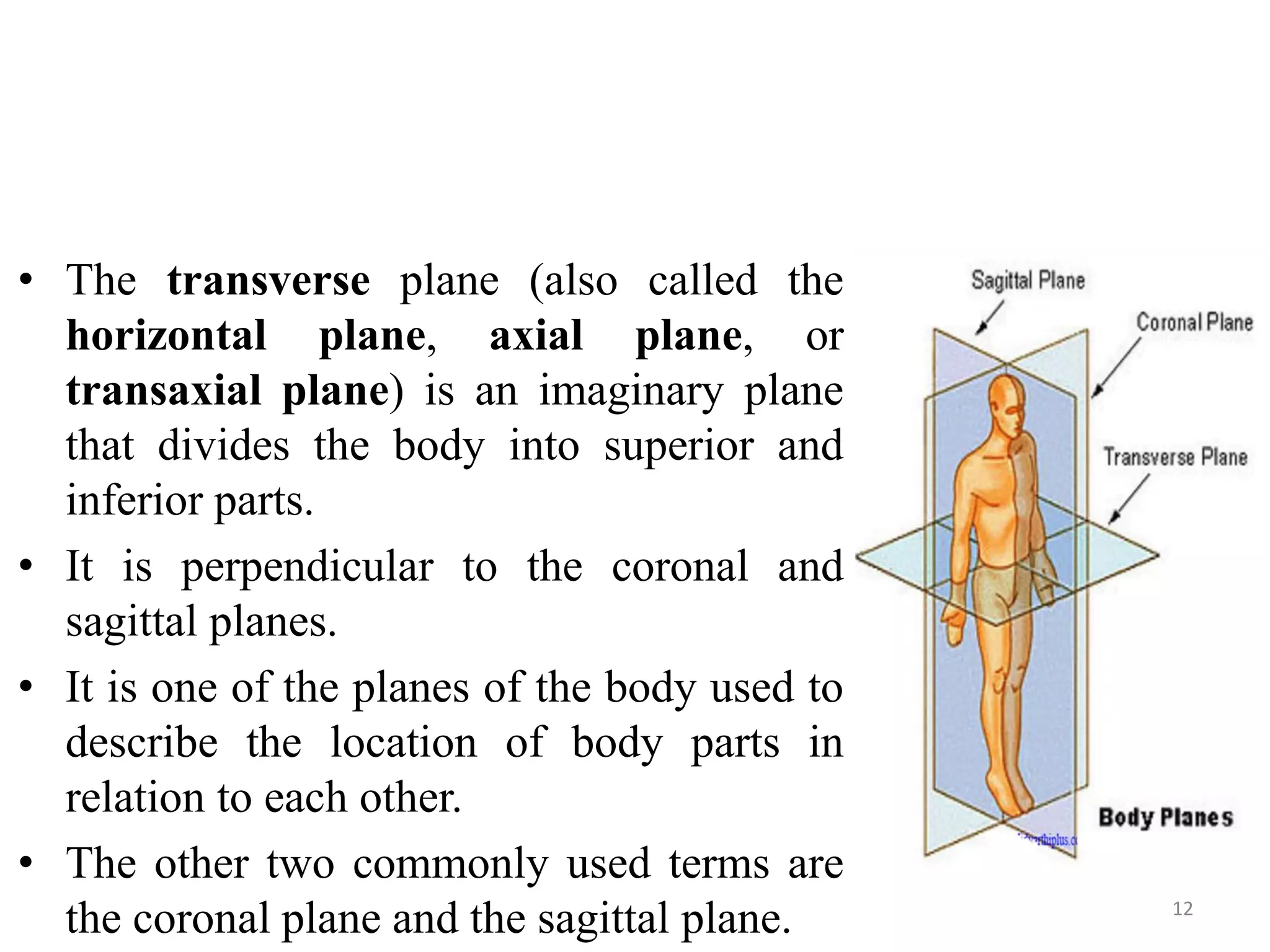
• The transverse plane (also called the
horizontal plane, axial plane, or
transaxial plane) is an imaginary plane
that divides the body into superior and
inferior parts.
• It is perpendicular to the coronal and
sagittal planes.
• It is one of the planes of the body used to
describe the location of body parts in
relation to each other.
• The other two commonly used terms are
the coronal plane and the sagittal plane. 12
• A coronal plane (also known as the frontal plane) is any
vertical plane that divides the body into ventral and dorsal
(belly and back) sections.
• It is one of the planes of the body used to describe the
location of body parts in relation to each other.
• Sagittal plane is a vertical plane which passes from
ventral (front) to dorsal (rear) dividing the body into right
and left halves.
13
• Radiocontrast agents are often used with CT for enhanced
delineation of anatomy.
• Although radiographs provide higher spatial resolution, CT
can detect more subtle variations in attenuation of X-rays.
• The measure of how closely lines can be resolved in an
image is called spatial resolution.
• Spatial resolution refers to the number of independent pixel
values per unit length.
• CT exposes the patient to more ionizing radiation than a
radiograph.
14
• Spiral Multi-detector CT utilizes 8,16 or 64 detectors during
continuous motion of the patient through the radiation beam
to obtain much finer detail images in a shorter exam time.
• CT scanning has become the test of choice in diagnosing
some urgent and emergent conditions such as:
– cerebral hemorrhage,
– pulmonary embolism (clots in the arteries of the lungs),
– aortic dissection (tearing of the aortic wall),
– appendicitis, and
– obstructing kidney stones.
15
• Continuing improvements in CT technology including
faster scanning times and improved resolution have
dramatically increased the accuracy and usefulness of CT
scanning and consequently increased utilization in
medical diagnosis.
• The first commercially viable CT scanner was invented
by Sir Godfrey Hounsfield at EMI Central Research
Labs, Great Britain in 1972.
16
ULTRASOUND
• Medical ultrasonography uses ultrasound (high-frequency
sound waves) to visualize soft tissue structures in the
body in real time.
• No ionizing radiation is involved, but the quality of the
imagesobtained using ultrasound is highly dependent on
the skill of the person (ultrasonographer) performing the
exam.
• Ultrasound is also limited by its inability to image
through air (lungs, bowel loops) or bone.
• The use of ultrasound in medical imaging has developed
mostly within the last 30 years.
17
• The first ultrasound images were static and two
dimensional (2D), but with modern-day ultrasonography
3D reconstructions can be observed in real-time;
effectively becoming 4D.
• Because ultrasound does not utilize ionizing radiation,
unlike radiography, CT scans, and nuclear medicine
imaging techniques, it is generally considered safer.
• For this reason, this modality plays a vital role in
obstetrical imaging.
18
• Fetal anatomic development can be thoroughly evaluated
allowing early diagnosis of many fetal anomalies.
• Growth can be assessed over time, important in patients
with chronic disease or gestation-induced disease, and in
multiple gestations (twins, triplets etc.).
• Color-Flow Doppler Ultrasound measures the severity of
peripheral vascular disease and is used by Cardiology for
dynamic evaluation of the heart, heart valves and major
vessels.
• Stenosis of the carotid arteries can presage cerebral
infarcts(strokes).
19
• Small portable ultrasound devices now replace bulky
units.
• Extensive hemoperitoneum (bleeding inside the body
cavity) or injury to the major organs may require
emergent surgical exploration and repair and ultrasound is
used in these applications.
20
MAGNETIC RESONANCE IMAGING
• MRI uses strong magnetic fields to
align atomic nuclei (usually
hydrogen protons) within body
tissues,
• Uses a radio signal to disturb the axis
of rotation of these nuclei and
observes the radio frequency signal
generated as the nuclei return to their
baseline states.
• The radio signals are collected by
small antennae, called coils, placed
near the area of interest.
• An advantage of MRI is its ability to
produce images in axial, coronal,
sagittal and multiple planes with
equal ease. 21
• MRI scans give the best soft tissue contrast of all the imaging
modalities. Why?
• With advances in scanning speed and spatial resolution, and
improvements in computer 3D algorithms and hardware,
MRI has become a tool in musculoskeletal radiology and
neuroradiology.
• One disadvantage is that the patient has to hold still for long
periods of time in a noisy, cramped space while the imaging
is performed.
• Recent improvements in magnet design including
– stronger magnetic fields (up to 3 teslas),
– shortening exam times, and
– more open magnet designs, 22
• MRI has great benefit in imaging the brain, spine, and
musculoskeletal system.
• The modality is currently contraindicated for patients
with pacemakers, cochlear implants, some indwelling
medication pumps, certain types of cerebral aneurysm
clips, metal fragments in the eyes and some metallic
hardware due to the powerful magnetic fields and strong
fluctuating radio signals the body is exposed to.
• Areas of potential advancement include functional
imaging, cardiovascular MRI, as well as MR image
guided therapy.
23
NUCLEAR MEDICINE
• Nuclear medicine imaging involves the administration into
the patient of radiopharmaceuticals consisting of substances
with affinity for certain body tissues labeled with radioactive
tracer.
• A radioactive tracer, or radioactive label, is a chemical
compound in which one or more atoms have been replaced
by a radioisotope.
• By virtue of its radioactivity it can be used to explore the
mechanism of chemical reactions by tracing the path that the
radioisotope follows.
• Radioisotopes of hydrogen, carbon, phosphorus, sulphur, and
iodine have been used extensively to trace the path of
biochemical reactions. 24
• The most commonly used tracers are:
– Technetium-99m,
– Iodine-123,
– Iodine-131,
– Gallium-67 and
– Thallium-201.
• The heart, lungs, thyroid, liver, gallbladder, and bones are
commonly evaluated for particular conditions using these
techniques.
• Nuclear medicine is useful in displaying physiological
function.
25
• The excretory function of the kidneys,
• iodine concentrating ability of the thyroid,
• blood flow to heart muscle, etc. can be measured.
• The principal imaging device is the gamma camera which
detects the radiation emitted by the tracer in the body and
displays it as an image.
• With computer processing, the information can be displayed
as axial, coronal and sagittal images.
• In the most modern devices Nuclear Medicine images can be
fused with a CT scan taken quasi-simultaneously so that the
physiological information can be overlaid or co-registered
with the anatomical structures to improve diagnostic accuracy.
26
PET
• PET,(positron emission tomography), scanning also falls
under "nuclear medicine.“
• In PET scanning, a radioactive biologically-active
substance, most often Fluorine-18 Fluorodeoxyglucose, is
injected into a patient and the radiation emitted by the
patient is detected to produce multi-planar images of the
body.
• Metabolically more active tissues, such as cancer,
concentrate the active substance more than normal tissues.
• PET images can be combined with CT images to improve
diagnostic accuracy.
27
• The applications of nuclear medicine can include bone
scanning which traditionally has had a strong role in the
workup/staging of cancers.
• Myocardial perfusion imaging is a sensitive and specific
screening exam for reversible myocardial ischemia
(Imbalance between myocardial oxygen supply and
demand).
• Molecular Imaging is the new and exciting frontier in this
field.
28

Radiology_Equipment_Lec-1_Dr. Emad Taleb.pdf

  • 1.
  • 2.
    COURSE ASSESSMENT  Examination:40%  Mid Term Examination? 15 %  Final Examination 40 %  Course work: 60 %  (class homework) 5 %  Attends 10 %  Quizzes? 15 % (3 X5 )  Practice 30 % 2
  • 3.
    COURSE OUTLINE  UNITI - MEDICAL X-RAY EQUIPMENT  UNIT II - COMPUTER TOMOGRAPHY  UNIT III - ULTRASOUND MACHINE  UNIT IV– MAGNETIC RESONANCE IMAGING  UNIT V - NUCLEAR MEDICINE SYSTEMS  UNIT VI - RADIATION THERAPY AND RADIATION SAFETY 3
  • 4.
    WHAT IS RADIOLOGY? •Radiology is a medical specialty uses imaging concept to both diagnose and treat human diseases. • Person handling the radiological equipment is called a Radiologist. • Radiologist use an array of imaging technologies such as – X-ray, – computed tomography (CT), – ultrasound, – nuclear medicine, – positron emission tomography (PET) and – magnetic resonance imaging (MRI) to diagnose or treat diseases. • Interventional radiology is the performance of minimally invasive medical procedures with the guidance of imaging technologies. • The acquisition of medical imaging is usually carried out by the radiographer or radiologic technologist. 4
  • 5.
    IMAGING MODALITIES Projection (plain)Radiography • X-rays were discovered by Wilhelm Conrad Roentgen • Radiographs or Roentgenographs, named after the discoverer of X-rays, are produced by transmitting X-rays through a patient. • A capture device then converts them into visible light, which then forms an image for review and diagnosis. • The original, and still common, imaging procedure uses silver impregnated films. 5
  • 6.
    • A X-raytube generates a beam of X-rays which is aimed at the patient. • The X-rays that pass through the patient are filtered by placing a device called X-ray filter, made of aluminum to reduce scatter and noise. • It then strikes an undeveloped film, which is held tightly to a screen of light-emitting phosphors in a light-tight cassette. • The film is then developed chemically and an image appears on the film. 6
  • 7.
    DIGITAL RADIOGRAPHY • Digitalradiography (DR)- X-rays strike a plate of sensors that converts the signals generated into digital information and an image displayed on a computer screen. • Plain radiography was the only imaging modality available during the first 50 years of radiology. • Due to its availability, speed, and lower costs compared to other modalities, radiography is often the first-line test of choice in radiologic diagnosis. 7
  • 8.
    FLUOROSCOPY • Fluoroscopy andangiography are special applications of X- ray imaging. • A fluorescent screen and image intensifier tube is connected to a closed-circuit television system (CCTV). • An image intensifier tube is a vacuum tube device for increasing the intensity of available light in an optical system to allow use under low light conditions • This allows real-time imaging of structures in motion or augmented with a radiocontrast agent. 8
  • 9.
    • Radiocontrast agentsare administered, often swallowed or injected into the body of the patient, to delineate anatomy and functioning of the blood vessels, the genitourinary system or the gastrointestinal tract. • Two radiocontrasts are presently in use: – Barium as (BaSO4) may be given orally or rectally for evaluation of the GI tract. – Iodine, in multiple proprietary forms, may be given by oral, rectal, intraarterial or intravenous routes. 9
  • 10.
    • These radiocontrastagents strongly absorb or scatter X-ray radiation. • In conjunction with the real-time imaging it allows demonstration of dynamic processes, such as peristalsis in the digestive tract or blood flow in arteries and veins. • odine contrast may also be concentrated in abnormal areas more or less than in normal tissues and make abnormalities (tumors, cysts, inflammation) more conspicuous. • Carbon dioxide can be used as a contrast agent in the venous system; • This contrast agent attenuates the X-ray radiation less than the surrounding tissues. 10
  • 11.
    CT SCANNING • CTimaging uses X-rays in conjunction with computing algorithms to image the body. • In CT, an X-ray generating tube opposite an X-ray detector in a ring shaped apparatus rotate around a patient producing a computer generated cross-sectional image (tomogram). • CT is acquired in the axial plane, while coronal and sagittal images can be rendered by computer reconstruction. 11
  • 12.
    • The transverseplane (also called the horizontal plane, axial plane, or transaxial plane) is an imaginary plane that divides the body into superior and inferior parts. • It is perpendicular to the coronal and sagittal planes. • It is one of the planes of the body used to describe the location of body parts in relation to each other. • The other two commonly used terms are the coronal plane and the sagittal plane. 12
  • 13.
    • A coronalplane (also known as the frontal plane) is any vertical plane that divides the body into ventral and dorsal (belly and back) sections. • It is one of the planes of the body used to describe the location of body parts in relation to each other. • Sagittal plane is a vertical plane which passes from ventral (front) to dorsal (rear) dividing the body into right and left halves. 13
  • 14.
    • Radiocontrast agentsare often used with CT for enhanced delineation of anatomy. • Although radiographs provide higher spatial resolution, CT can detect more subtle variations in attenuation of X-rays. • The measure of how closely lines can be resolved in an image is called spatial resolution. • Spatial resolution refers to the number of independent pixel values per unit length. • CT exposes the patient to more ionizing radiation than a radiograph. 14
  • 15.
    • Spiral Multi-detectorCT utilizes 8,16 or 64 detectors during continuous motion of the patient through the radiation beam to obtain much finer detail images in a shorter exam time. • CT scanning has become the test of choice in diagnosing some urgent and emergent conditions such as: – cerebral hemorrhage, – pulmonary embolism (clots in the arteries of the lungs), – aortic dissection (tearing of the aortic wall), – appendicitis, and – obstructing kidney stones. 15
  • 16.
    • Continuing improvementsin CT technology including faster scanning times and improved resolution have dramatically increased the accuracy and usefulness of CT scanning and consequently increased utilization in medical diagnosis. • The first commercially viable CT scanner was invented by Sir Godfrey Hounsfield at EMI Central Research Labs, Great Britain in 1972. 16
  • 17.
    ULTRASOUND • Medical ultrasonographyuses ultrasound (high-frequency sound waves) to visualize soft tissue structures in the body in real time. • No ionizing radiation is involved, but the quality of the imagesobtained using ultrasound is highly dependent on the skill of the person (ultrasonographer) performing the exam. • Ultrasound is also limited by its inability to image through air (lungs, bowel loops) or bone. • The use of ultrasound in medical imaging has developed mostly within the last 30 years. 17
  • 18.
    • The firstultrasound images were static and two dimensional (2D), but with modern-day ultrasonography 3D reconstructions can be observed in real-time; effectively becoming 4D. • Because ultrasound does not utilize ionizing radiation, unlike radiography, CT scans, and nuclear medicine imaging techniques, it is generally considered safer. • For this reason, this modality plays a vital role in obstetrical imaging. 18
  • 19.
    • Fetal anatomicdevelopment can be thoroughly evaluated allowing early diagnosis of many fetal anomalies. • Growth can be assessed over time, important in patients with chronic disease or gestation-induced disease, and in multiple gestations (twins, triplets etc.). • Color-Flow Doppler Ultrasound measures the severity of peripheral vascular disease and is used by Cardiology for dynamic evaluation of the heart, heart valves and major vessels. • Stenosis of the carotid arteries can presage cerebral infarcts(strokes). 19
  • 20.
    • Small portableultrasound devices now replace bulky units. • Extensive hemoperitoneum (bleeding inside the body cavity) or injury to the major organs may require emergent surgical exploration and repair and ultrasound is used in these applications. 20
  • 21.
    MAGNETIC RESONANCE IMAGING •MRI uses strong magnetic fields to align atomic nuclei (usually hydrogen protons) within body tissues, • Uses a radio signal to disturb the axis of rotation of these nuclei and observes the radio frequency signal generated as the nuclei return to their baseline states. • The radio signals are collected by small antennae, called coils, placed near the area of interest. • An advantage of MRI is its ability to produce images in axial, coronal, sagittal and multiple planes with equal ease. 21
  • 22.
    • MRI scansgive the best soft tissue contrast of all the imaging modalities. Why? • With advances in scanning speed and spatial resolution, and improvements in computer 3D algorithms and hardware, MRI has become a tool in musculoskeletal radiology and neuroradiology. • One disadvantage is that the patient has to hold still for long periods of time in a noisy, cramped space while the imaging is performed. • Recent improvements in magnet design including – stronger magnetic fields (up to 3 teslas), – shortening exam times, and – more open magnet designs, 22
  • 23.
    • MRI hasgreat benefit in imaging the brain, spine, and musculoskeletal system. • The modality is currently contraindicated for patients with pacemakers, cochlear implants, some indwelling medication pumps, certain types of cerebral aneurysm clips, metal fragments in the eyes and some metallic hardware due to the powerful magnetic fields and strong fluctuating radio signals the body is exposed to. • Areas of potential advancement include functional imaging, cardiovascular MRI, as well as MR image guided therapy. 23
  • 24.
    NUCLEAR MEDICINE • Nuclearmedicine imaging involves the administration into the patient of radiopharmaceuticals consisting of substances with affinity for certain body tissues labeled with radioactive tracer. • A radioactive tracer, or radioactive label, is a chemical compound in which one or more atoms have been replaced by a radioisotope. • By virtue of its radioactivity it can be used to explore the mechanism of chemical reactions by tracing the path that the radioisotope follows. • Radioisotopes of hydrogen, carbon, phosphorus, sulphur, and iodine have been used extensively to trace the path of biochemical reactions. 24
  • 25.
    • The mostcommonly used tracers are: – Technetium-99m, – Iodine-123, – Iodine-131, – Gallium-67 and – Thallium-201. • The heart, lungs, thyroid, liver, gallbladder, and bones are commonly evaluated for particular conditions using these techniques. • Nuclear medicine is useful in displaying physiological function. 25
  • 26.
    • The excretoryfunction of the kidneys, • iodine concentrating ability of the thyroid, • blood flow to heart muscle, etc. can be measured. • The principal imaging device is the gamma camera which detects the radiation emitted by the tracer in the body and displays it as an image. • With computer processing, the information can be displayed as axial, coronal and sagittal images. • In the most modern devices Nuclear Medicine images can be fused with a CT scan taken quasi-simultaneously so that the physiological information can be overlaid or co-registered with the anatomical structures to improve diagnostic accuracy. 26
  • 27.
    PET • PET,(positron emissiontomography), scanning also falls under "nuclear medicine.“ • In PET scanning, a radioactive biologically-active substance, most often Fluorine-18 Fluorodeoxyglucose, is injected into a patient and the radiation emitted by the patient is detected to produce multi-planar images of the body. • Metabolically more active tissues, such as cancer, concentrate the active substance more than normal tissues. • PET images can be combined with CT images to improve diagnostic accuracy. 27
  • 28.
    • The applicationsof nuclear medicine can include bone scanning which traditionally has had a strong role in the workup/staging of cancers. • Myocardial perfusion imaging is a sensitive and specific screening exam for reversible myocardial ischemia (Imbalance between myocardial oxygen supply and demand). • Molecular Imaging is the new and exciting frontier in this field. 28