RADIATION DETECTION AND MEASUREMENT
Lecture 04
Shahid Younas
Semi-Conductor Detectors- Basics
Lecture 04
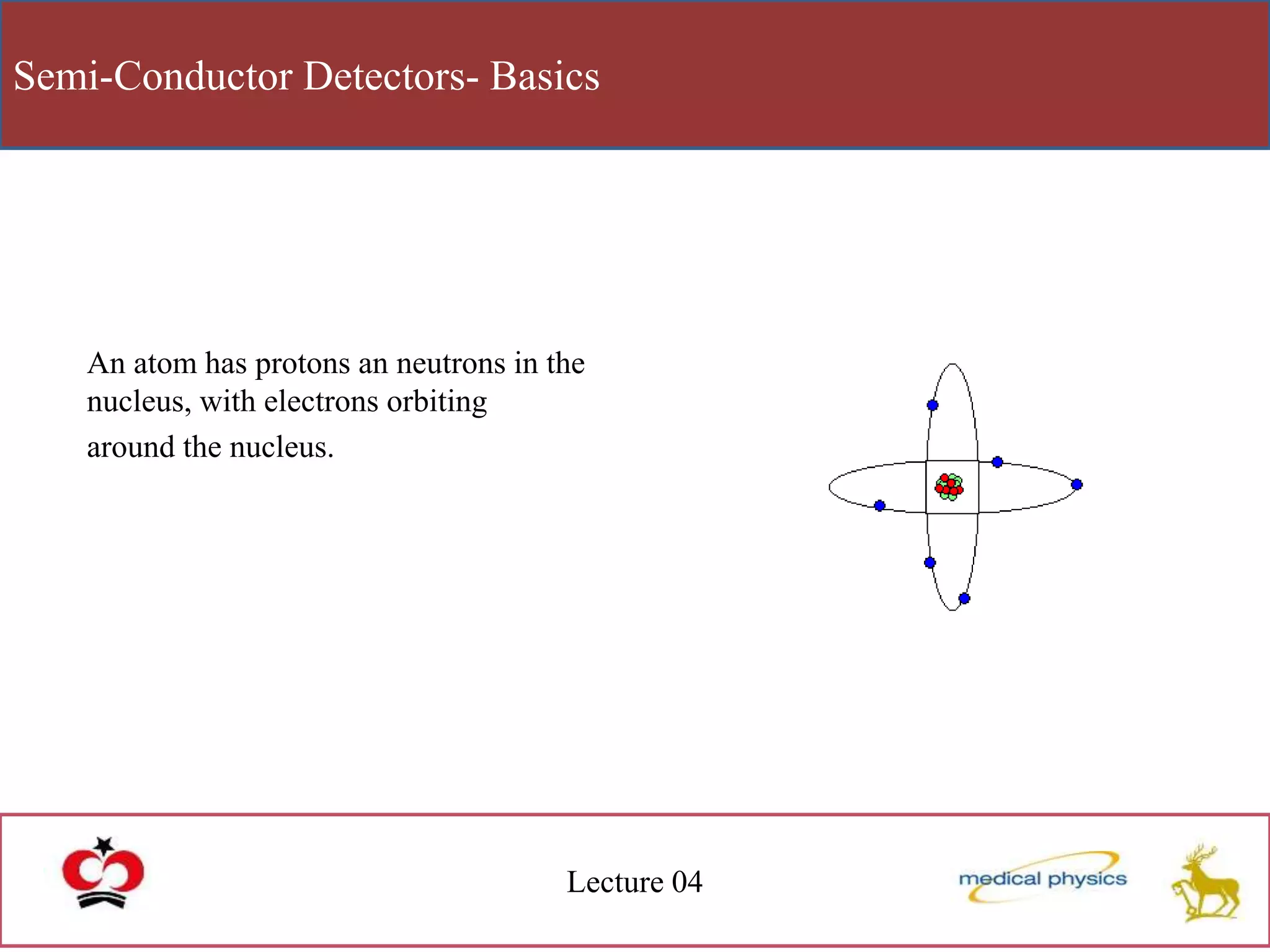
An atom has protons an neutrons in the
nucleus, with electrons orbiting
around the nucleus.
Semi-Conductor Detectors- Basics
Lecture 04
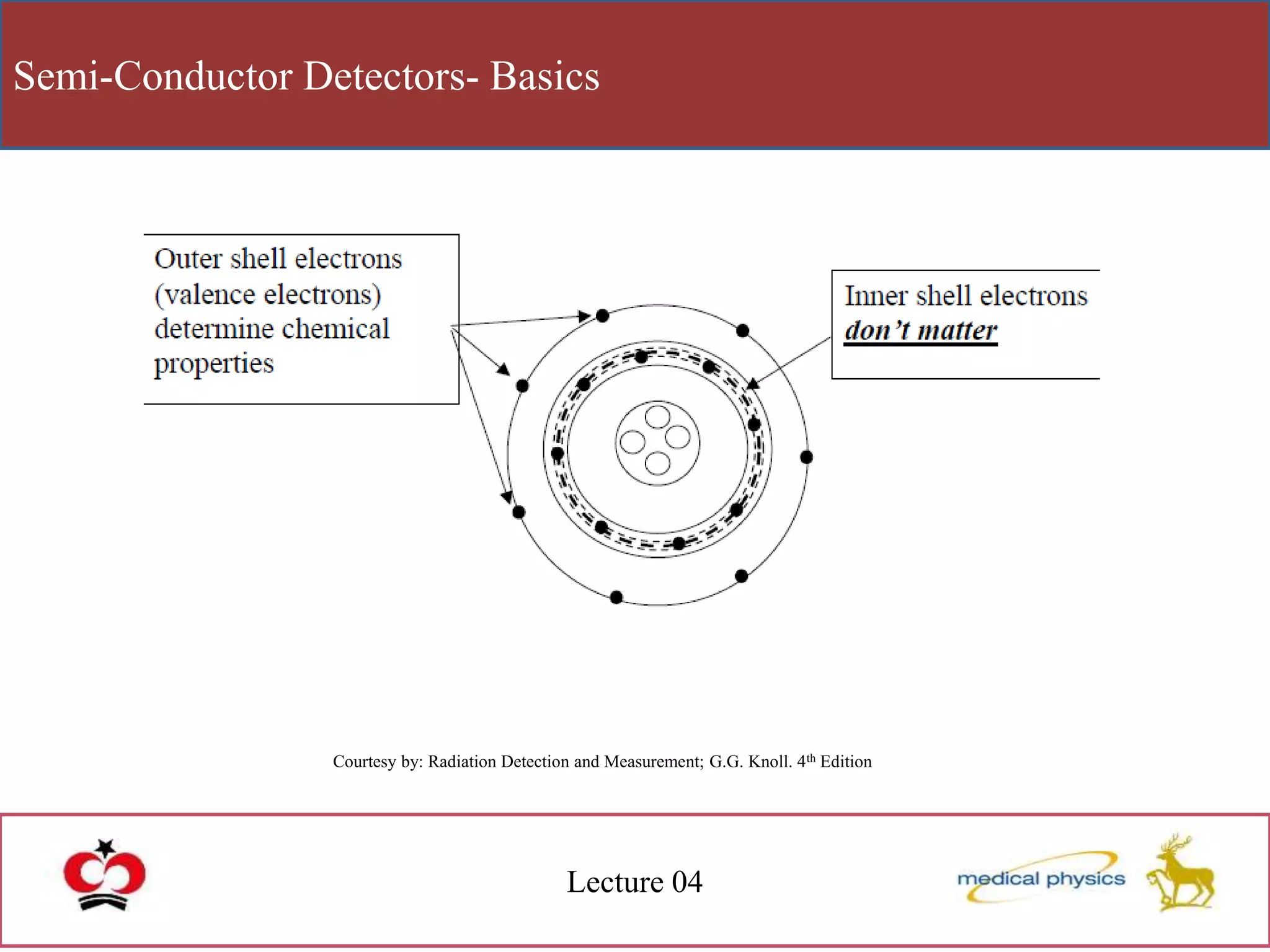
Courtesy by: Radiation Detection and Measurement; G.G. Knoll. 4th Edition
Semi-Conductor Detectors- Basics
Lecture 04
Semi-Conductor Detectors- Basics
Lecture 04
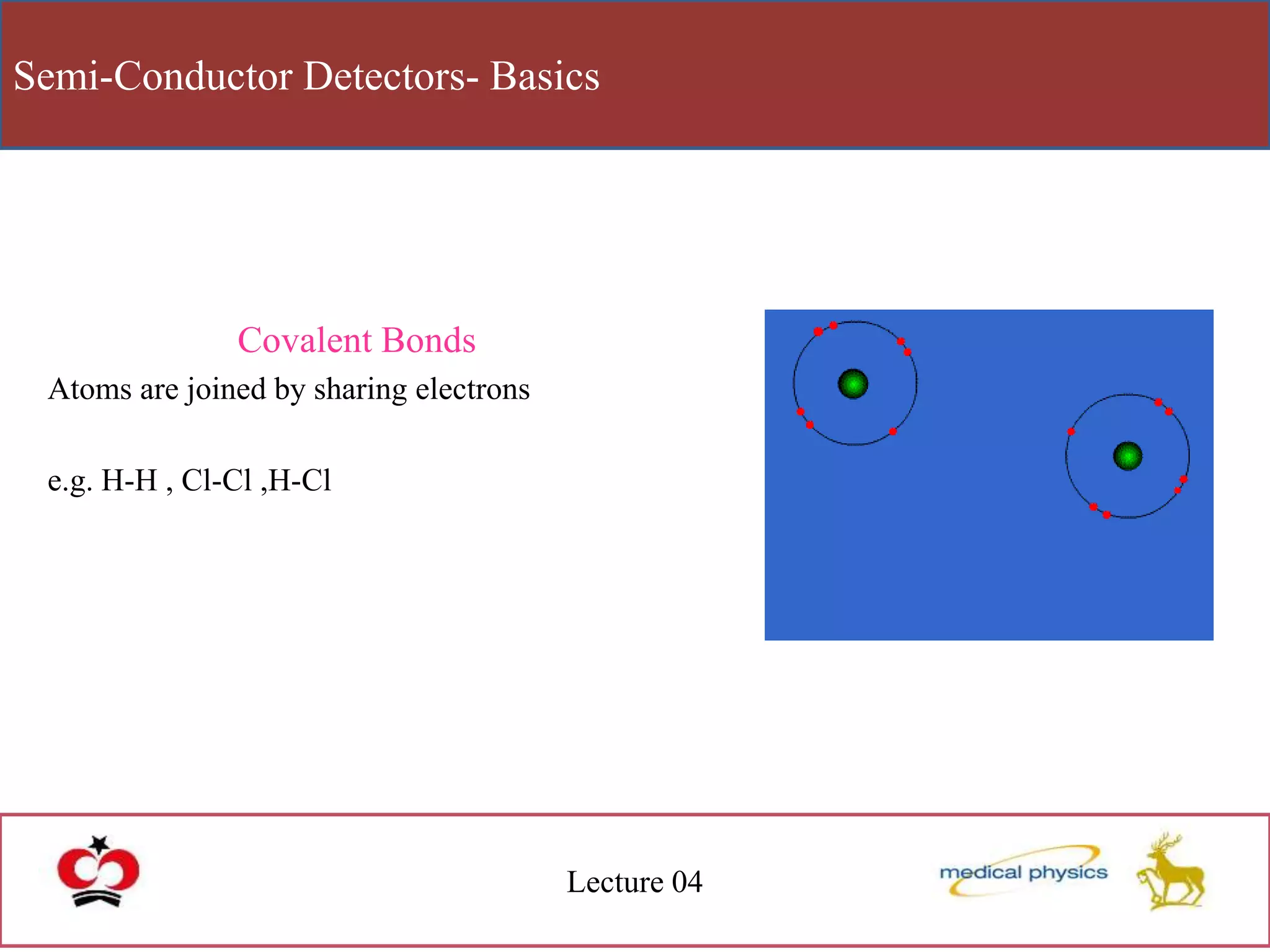
Covalent Bonds
Atoms are joined by sharing electrons
e.g. H-H , Cl-Cl ,H-Cl
Semi-Conductor Detectors- Basics
Lecture 04
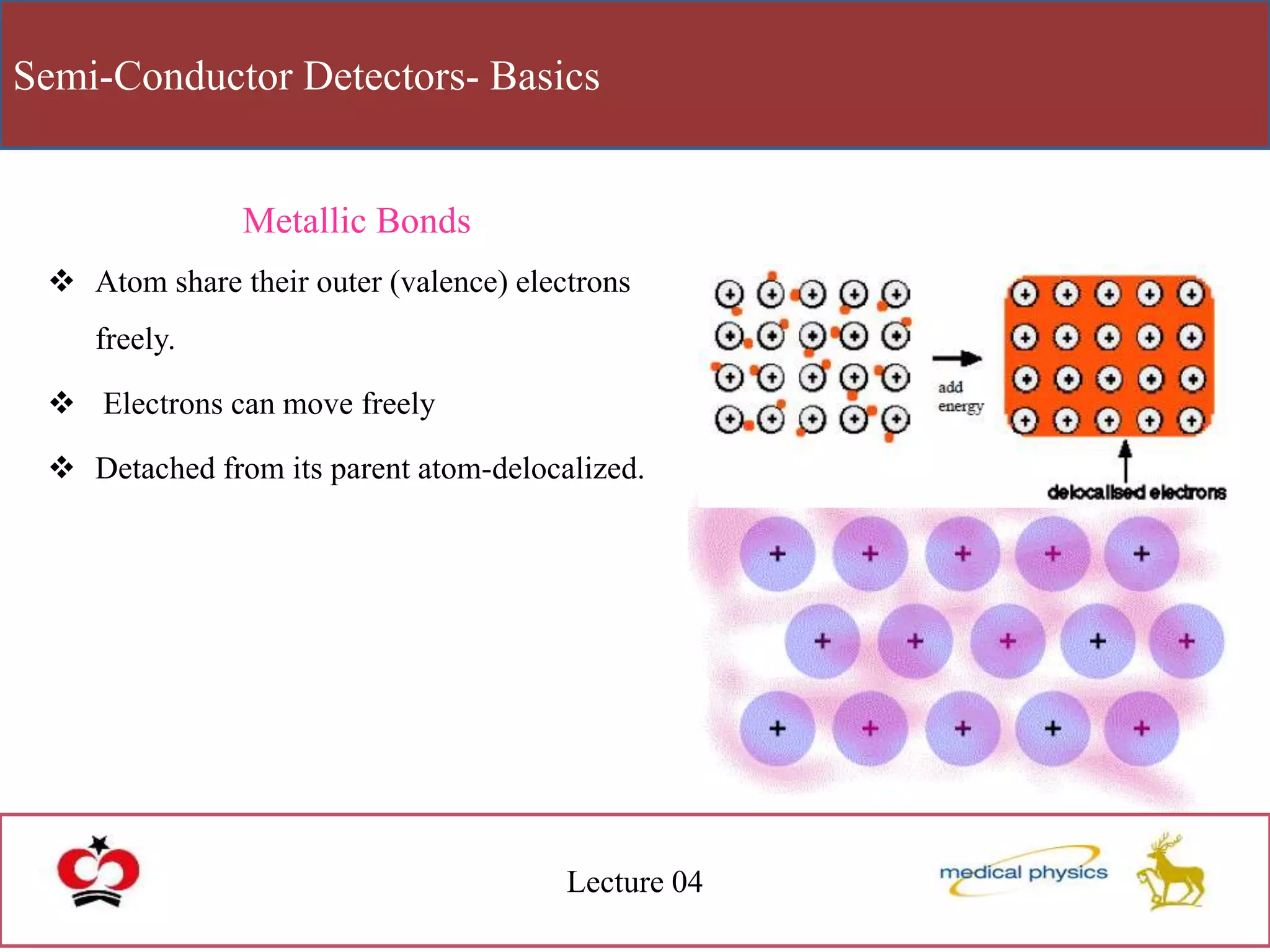
Metallic Bonds
 Atom share their outer (valence) electrons
freely.
 Electrons can move freely
 Detached from its parent atom-delocalized.
Semi-Conductor Detectors- Basics
Lecture 04
You have studies Molecular, Ionic and Covenant Bonds. Do you know
about James Bond?
Semi-Conductor Detectors- Basics
Lecture 04
In crystalline materials,
electrons exist in energy
bands, separated by forbidden
gaps.
In metals least tightly bound
electrons exist in a partially
occupied band- conduction
band.
Semi-Conductor Detectors- Basics
Lecture 04
Do you know the difference between crystalline and semi
conductor materials?
Semi-Conductor Detectors- Basics
Lecture 04
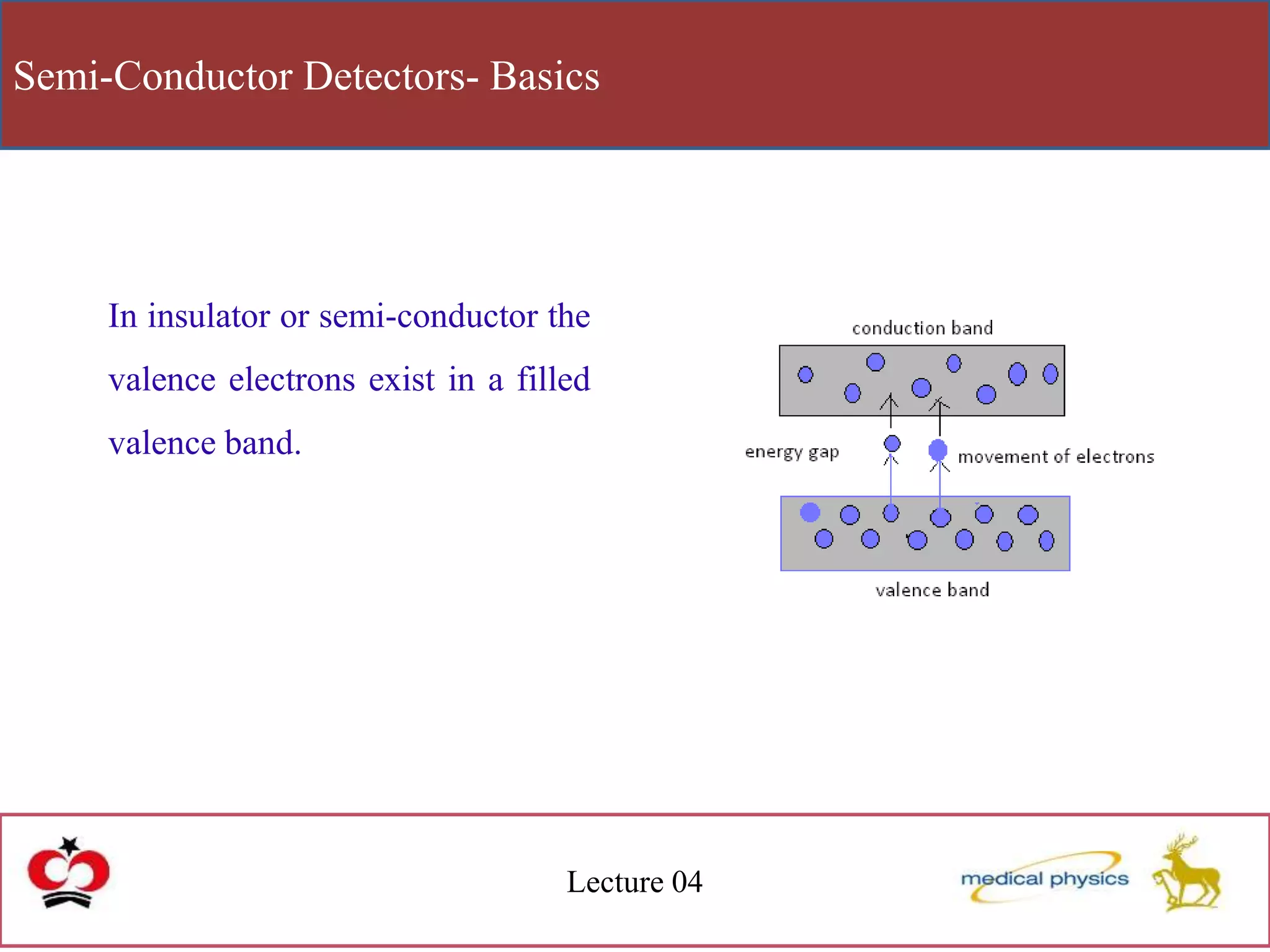
In insulator or semi-conductor the
valence electrons exist in a filled
valence band.
Semi-Conductor Detectors- Basics
Lecture 04
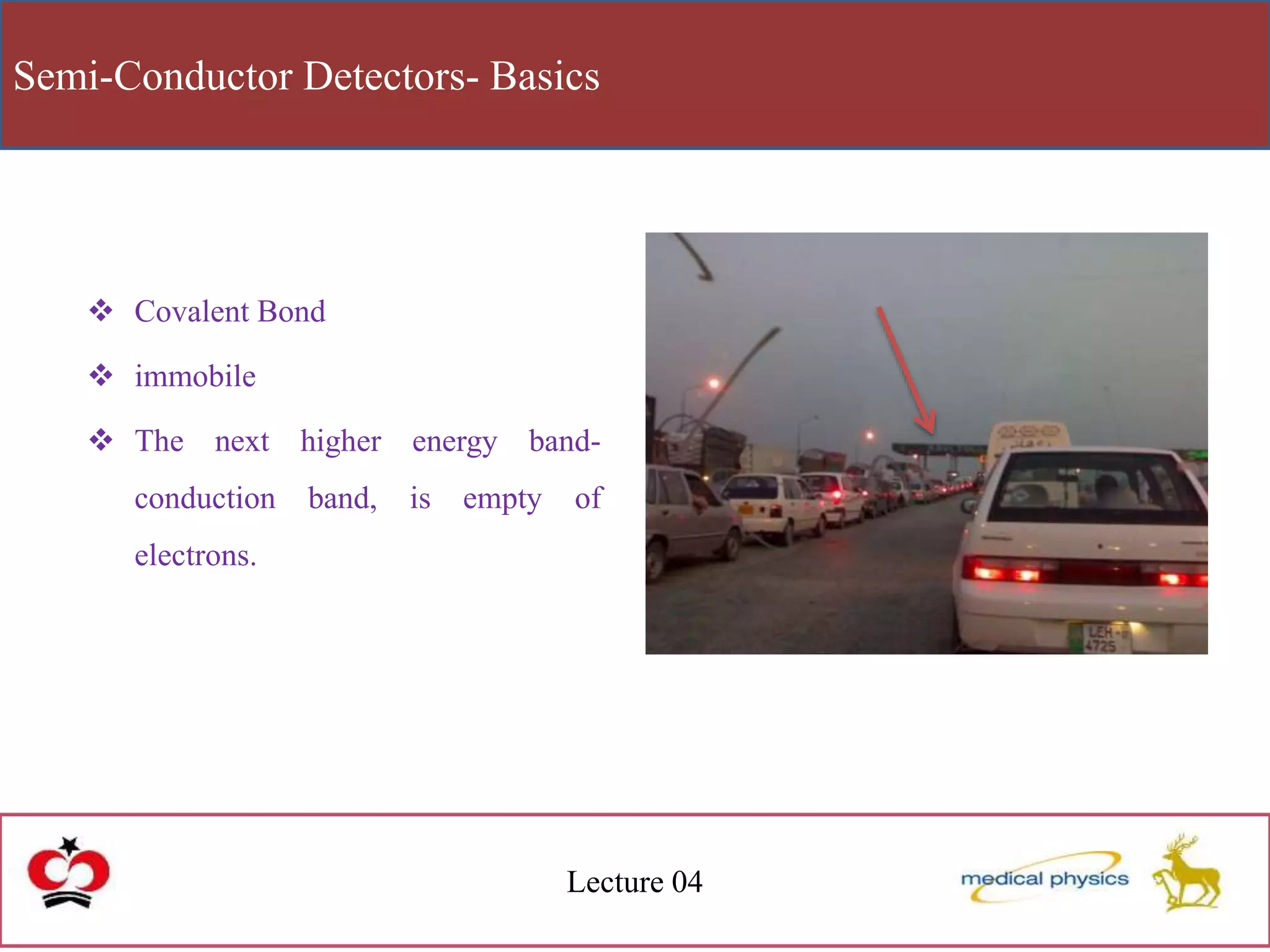
 Covalent Bond
 immobile
 The next higher energy band-
conduction band, is empty of
electrons.
Semi-Conductor Detectors- Basics
Lecture 04
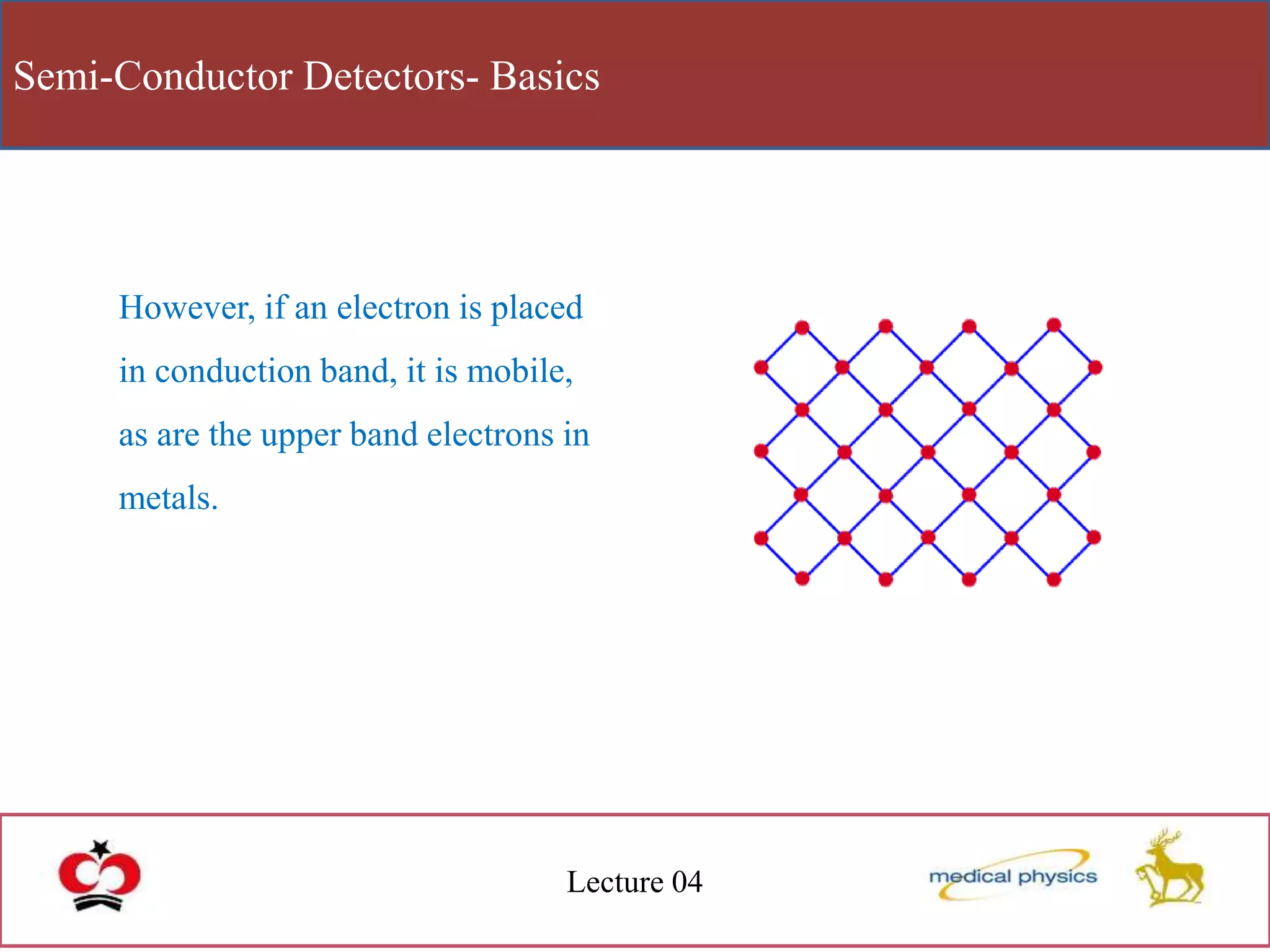
However, if an electron is placed
in conduction band, it is mobile,
as are the upper band electrons in
metals.
Semi-Conductor Detectors- Basics
Lecture 04
Do you know how much Toll-Tax needs to pay to move the electrons in
conduction band in semi-conductor and conductors?
Band gap Energy is 1-2 eV and 5 eV respectively.
Semi-Conductor Detectors- Basics
Lecture 04
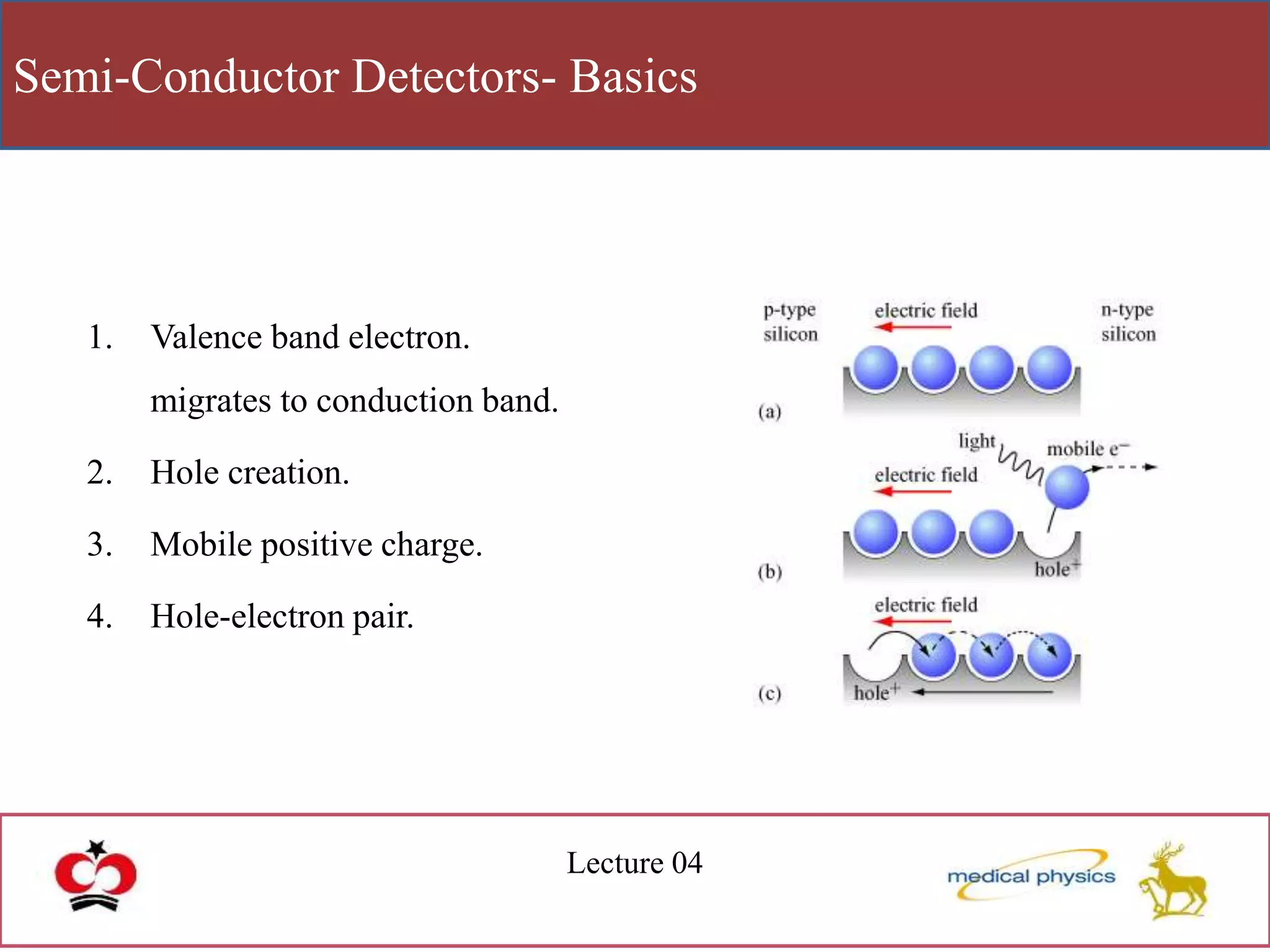
1. Valence band electron.
migrates to conduction band.
2. Hole creation.
3. Mobile positive charge.
4. Hole-electron pair.
Semi-Conductor Detectors- Basics
Lecture 04
 Semi-conductor can be then used as radiation detector.
 Ionizing radiation, visible or ultraviolet light, or thermal energy can
donate 1 eV to raise the electrons in conduction band.
Semi-Conductor Detectors- Basics
Lecture 04
 Semi-conductor can be then used as radiation detector.
 Applied voltage between terminals on opposite of crystals.
 Electric current flows.
 Similar gas-filled detector.
Semi-Conductor Detectors- Basics
Lecture 03
 Doping- tracer amount of impurities.
 Impurity atoms fills sites in the crystal lattice that would
otherwise by occupied by atoms of the semiconductor material.
 p-type and n-type materials.
 semi-conductor diodes.
Semi-Conductor Detectors- Basics
Lecture 04
Unfortunately,
radiation induced current is “masked” by a larger current induced by
applied voltage.
Semi-Conductor Detectors- Basics
Lecture 04
 Cadmium zinc telluride (CZT)
 High Cost
 Low Quantum Detection Efficiency
 Cooling required
Semi-Conductor Detectors- Basics
Lecture 04
CZT is one of the examples of semi-conductor materials?
Do you know another semi-conductor material.
Semi-Conductor Detectors- Basics
Lecture 04
Have you thought of a Gamma Camera other than NaI(Tl)?
Semi-Conductor Detectors- Basics
Lecture 04
Today we shall perform Detection Efficiency of Dose Calibrators in
Injection Room.
Happy Birthday to my beloved Father!
Lecture 04
You are 73 Years now.

Radiation detection and measurement