R18 B.Tech. ECE Syllabus JNTU HYDERABAD
1
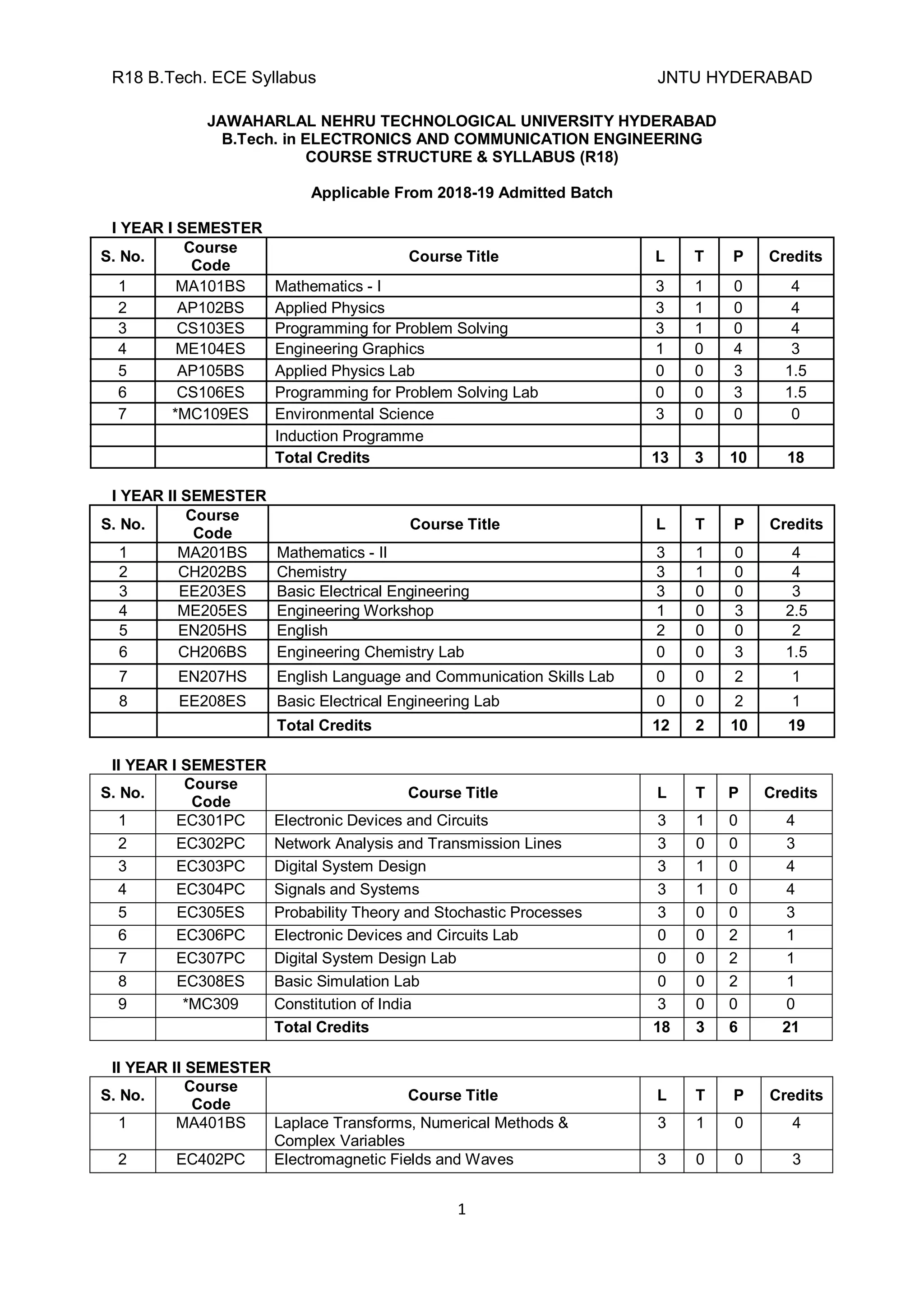
JAWAHARLAL NEHRU TECHNOLOGICAL UNIVERSITY HYDERABAD
B.Tech. in ELECTRONICS AND COMMUNICATION ENGINEERING
COURSE STRUCTURE & SYLLABUS (R18)
Applicable From 2018-19 Admitted Batch
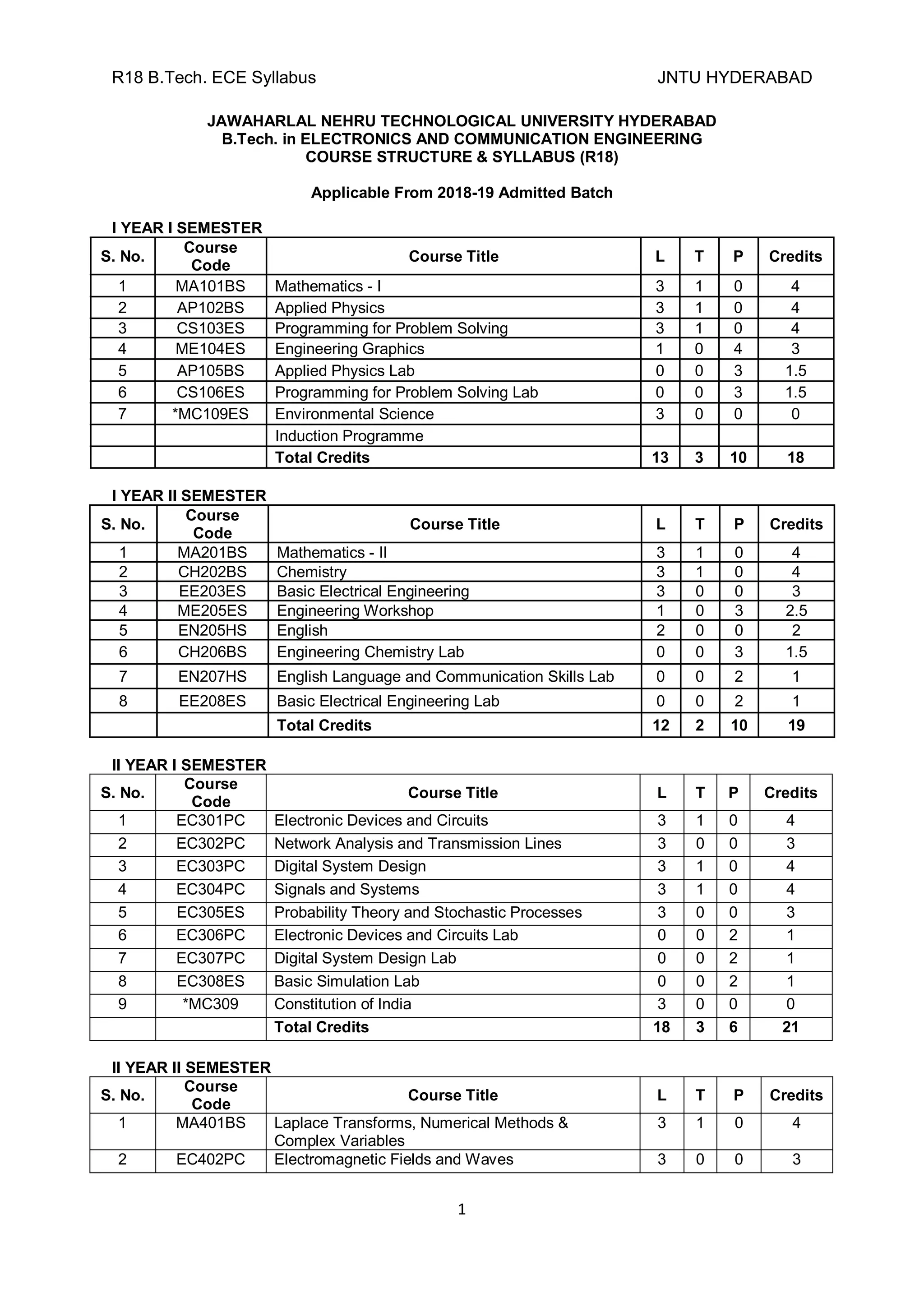
I YEAR I SEMESTER
S. No.
Course
Code
Course Title L T P Credits
1 MA101BS Mathematics - I 3 1 0 4
2 AP102BS Applied Physics 3 1 0 4
3 CS103ES Programming for Problem Solving 3 1 0 4
4 ME104ES Engineering Graphics 1 0 4 3
5 AP105BS Applied Physics Lab 0 0 3 1.5
6 CS106ES Programming for Problem Solving Lab 0 0 3 1.5
7 *MC109ES Environmental Science 3 0 0 0
Induction Programme
Total Credits 13 3 10 18
I YEAR II SEMESTER
S. No.
Course
Code
Course Title L T P Credits
1 MA201BS Mathematics - II 3 1 0 4
2 CH202BS Chemistry 3 1 0 4
3 EE203ES Basic Electrical Engineering 3 0 0 3
4 ME205ES Engineering Workshop 1 0 3 2.5
5 EN205HS English 2 0 0 2
6 CH206BS Engineering Chemistry Lab 0 0 3 1.5
7 EN207HS English Language and Communication Skills Lab 0 0 2 1
8 EE208ES Basic Electrical Engineering Lab 0 0 2 1
Total Credits 12 2 10 19
II YEAR I SEMESTER
S. No.
Course
Code
Course Title L T P Credits
1 EC301PC Electronic Devices and Circuits 3 1 0 4
2 EC302PC Network Analysis and Transmission Lines 3 0 0 3
3 EC303PC Digital System Design 3 1 0 4
4 EC304PC Signals and Systems 3 1 0 4
5 EC305ES Probability Theory and Stochastic Processes 3 0 0 3
6 EC306PC Electronic Devices and Circuits Lab 0 0 2 1
7 EC307PC Digital System Design Lab 0 0 2 1
8 EC308ES Basic Simulation Lab 0 0 2 1
9 *MC309 Constitution of India 3 0 0 0
Total Credits 18 3 6 21
II YEAR II SEMESTER
S. No.
Course
Code
Course Title L T P Credits
1 MA401BS Laplace Transforms, Numerical Methods &
Complex Variables
3 1 0 4
2 EC402PC Electromagnetic Fields and Waves 3 0 0 3
R18 B.Tech. ECE Syllabus JNTU HYDERABAD
29
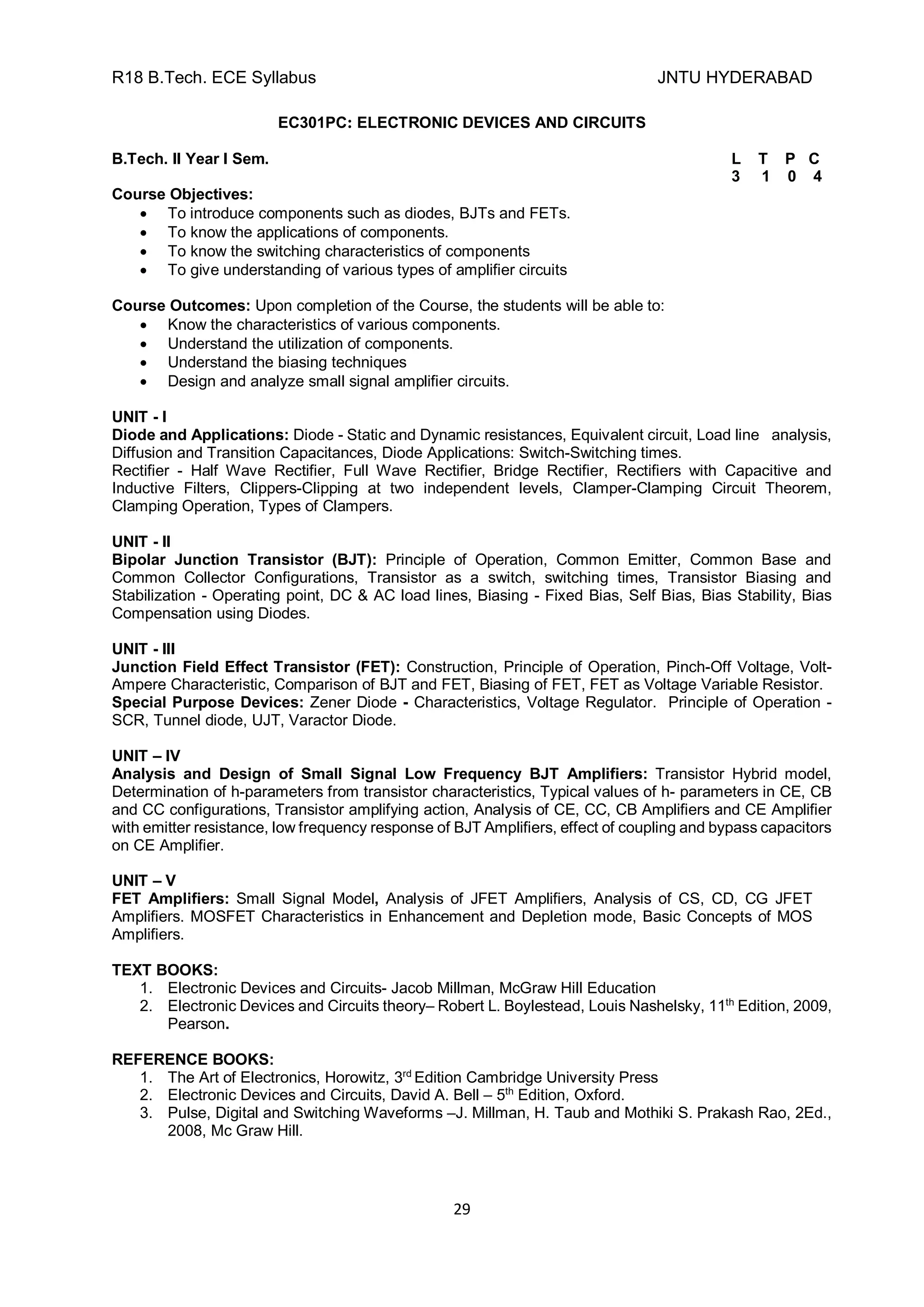
EC301PC: ELECTRONIC DEVICES AND CIRCUITS
B.Tech. II Year I Sem. L T P C
3 1 0 4
Course Objectives:
 To introduce components such as diodes, BJTs and FETs.
 To know the applications of components.
 To know the switching characteristics of components
 To give understanding of various types of amplifier circuits
Course Outcomes: Upon completion of the Course, the students will be able to:
 Know the characteristics of various components.
 Understand the utilization of components.
 Understand the biasing techniques
 Design and analyze small signal amplifier circuits.
UNIT - I
Diode and Applications: Diode - Static and Dynamic resistances, Equivalent circuit, Load line analysis,
Diffusion and Transition Capacitances, Diode Applications: Switch-Switching times.
Rectifier - Half Wave Rectifier, Full Wave Rectifier, Bridge Rectifier, Rectifiers with Capacitive and
Inductive Filters, Clippers-Clipping at two independent levels, Clamper-Clamping Circuit Theorem,
Clamping Operation, Types of Clampers.
UNIT - II
Bipolar Junction Transistor (BJT): Principle of Operation, Common Emitter, Common Base and
Common Collector Configurations, Transistor as a switch, switching times, Transistor Biasing and
Stabilization - Operating point, DC & AC load lines, Biasing - Fixed Bias, Self Bias, Bias Stability, Bias
Compensation using Diodes.
UNIT - III
Junction Field Effect Transistor (FET): Construction, Principle of Operation, Pinch-Off Voltage, Volt-
Ampere Characteristic, Comparison of BJT and FET, Biasing of FET, FET as Voltage Variable Resistor.
Special Purpose Devices: Zener Diode - Characteristics, Voltage Regulator. Principle of Operation -
SCR, Tunnel diode, UJT, Varactor Diode.
UNIT – IV
Analysis and Design of Small Signal Low Frequency BJT Amplifiers: Transistor Hybrid model,
Determination of h-parameters from transistor characteristics, Typical values of h- parameters in CE, CB
and CC configurations, Transistor amplifying action, Analysis of CE, CC, CB Amplifiers and CE Amplifier
with emitter resistance, low frequency response of BJT Amplifiers, effect of coupling and bypass capacitors
on CE Amplifier.
UNIT – V
FET Amplifiers: Small Signal Model, Analysis of JFET Amplifiers, Analysis of CS, CD, CG JFET
Amplifiers. MOSFET Characteristics in Enhancement and Depletion mode, Basic Concepts of MOS
Amplifiers.
TEXT BOOKS:
1. Electronic Devices and Circuits- Jacob Millman, McGraw Hill Education
2. Electronic Devices and Circuits theory– Robert L. Boylestead, Louis Nashelsky, 11th
Edition, 2009,
Pearson.
REFERENCE BOOKS:
1. The Art of Electronics, Horowitz, 3rd
Edition Cambridge University Press
2. Electronic Devices and Circuits, David A. Bell – 5th
Edition, Oxford.
3. Pulse, Digital and Switching Waveforms –J. Millman, H. Taub and Mothiki S. Prakash Rao, 2Ed.,
2008, Mc Graw Hill.
R18 B.Tech. ECE Syllabus JNTU HYDERABAD
30
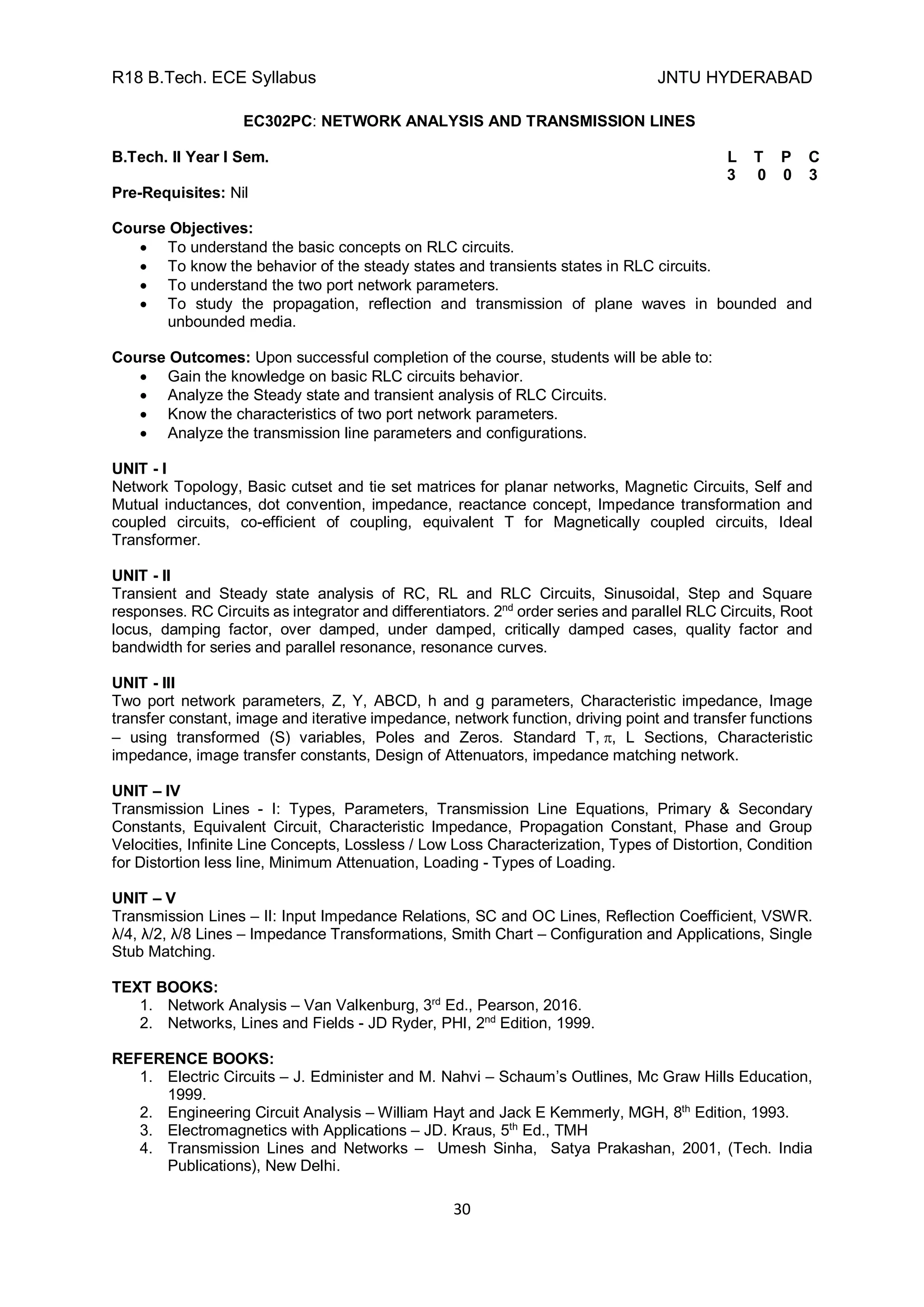
EC302PC: NETWORK ANALYSIS AND TRANSMISSION LINES
B.Tech. II Year I Sem. L T P C
3 0 0 3
Pre-Requisites: Nil
Course Objectives:
 To understand the basic concepts on RLC circuits.
 To know the behavior of the steady states and transients states in RLC circuits.
 To understand the two port network parameters.
 To study the propagation, reflection and transmission of plane waves in bounded and
unbounded media.
Course Outcomes: Upon successful completion of the course, students will be able to:
 Gain the knowledge on basic RLC circuits behavior.
 Analyze the Steady state and transient analysis of RLC Circuits.
 Know the characteristics of two port network parameters.
 Analyze the transmission line parameters and configurations.
UNIT - I
Network Topology, Basic cutset and tie set matrices for planar networks, Magnetic Circuits, Self and
Mutual inductances, dot convention, impedance, reactance concept, Impedance transformation and
coupled circuits, co-efficient of coupling, equivalent T for Magnetically coupled circuits, Ideal
Transformer.
UNIT - II
Transient and Steady state analysis of RC, RL and RLC Circuits, Sinusoidal, Step and Square
responses. RC Circuits as integrator and differentiators. 2nd
order series and parallel RLC Circuits, Root
locus, damping factor, over damped, under damped, critically damped cases, quality factor and
bandwidth for series and parallel resonance, resonance curves.
UNIT - III
Two port network parameters, Z, Y, ABCD, h and g parameters, Characteristic impedance, Image
transfer constant, image and iterative impedance, network function, driving point and transfer functions
– using transformed (S) variables, Poles and Zeros. Standard T,, L Sections, Characteristic
impedance, image transfer constants, Design of Attenuators, impedance matching network.
UNIT – IV
Transmission Lines - I: Types, Parameters, Transmission Line Equations, Primary & Secondary
Constants, Equivalent Circuit, Characteristic Impedance, Propagation Constant, Phase and Group
Velocities, Infinite Line Concepts, Lossless / Low Loss Characterization, Types of Distortion, Condition
for Distortion less line, Minimum Attenuation, Loading - Types of Loading.
UNIT – V
Transmission Lines – II: Input Impedance Relations, SC and OC Lines, Reflection Coefficient, VSWR.
λ/4, λ/2, λ/8 Lines – Impedance Transformations, Smith Chart – Configuration and Applications, Single
Stub Matching.
TEXT BOOKS:
1. Network Analysis – Van Valkenburg, 3rd
Ed., Pearson, 2016.
2. Networks, Lines and Fields - JD Ryder, PHI, 2nd
Edition, 1999.
REFERENCE BOOKS:
1. Electric Circuits – J. Edminister and M. Nahvi – Schaum’s Outlines, Mc Graw Hills Education,
1999.
2. Engineering Circuit Analysis – William Hayt and Jack E Kemmerly, MGH, 8th
Edition, 1993.
3. Electromagnetics with Applications – JD. Kraus, 5th
Ed., TMH
4. Transmission Lines and Networks – Umesh Sinha, Satya Prakashan, 2001, (Tech. India
Publications), New Delhi.
R18 B.Tech. ECE Syllabus JNTU HYDERABAD
31
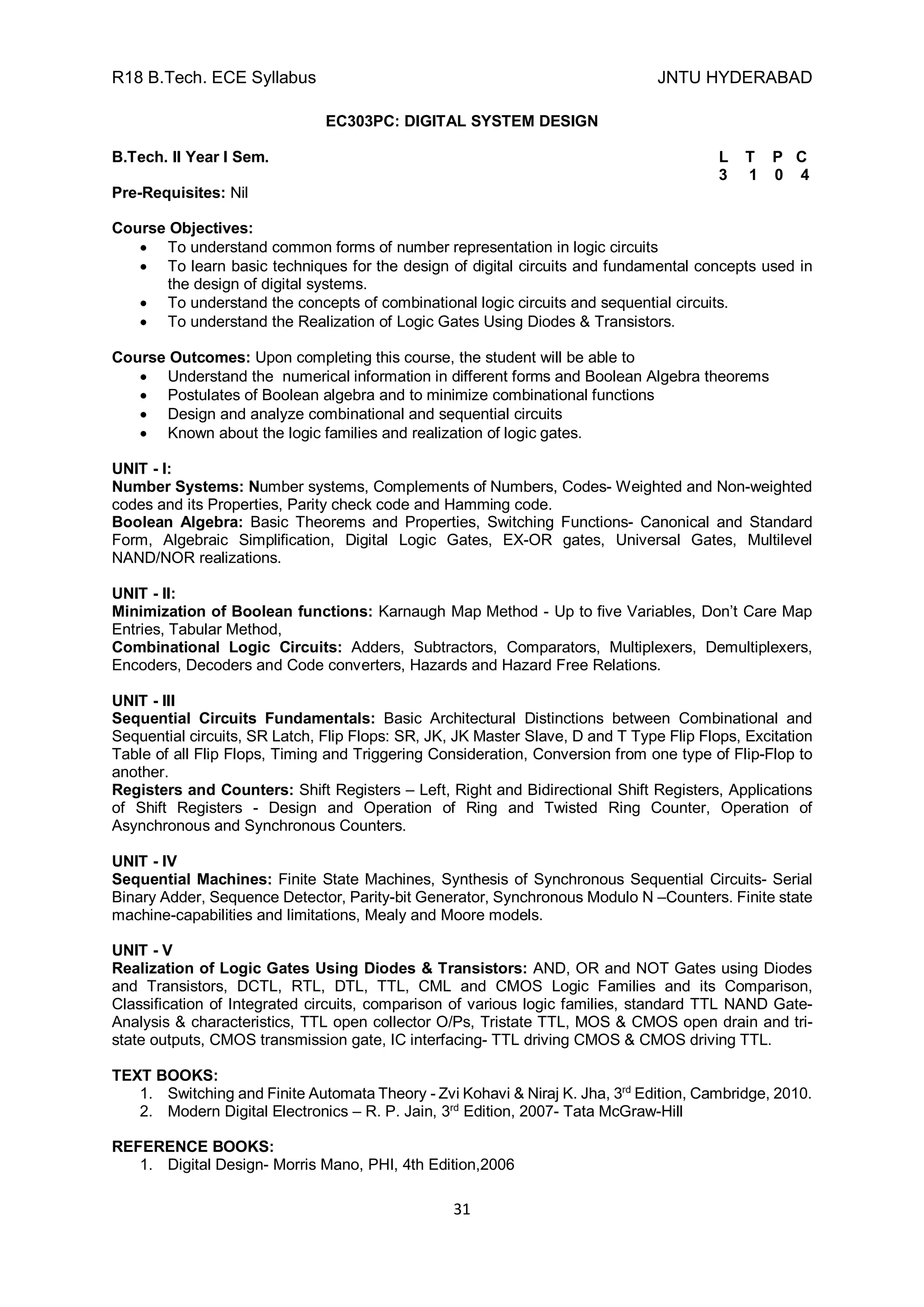
EC303PC: DIGITAL SYSTEM DESIGN
B.Tech. II Year I Sem. L T P C
3 1 0 4
Pre-Requisites: Nil
Course Objectives:
 To understand common forms of number representation in logic circuits
 To learn basic techniques for the design of digital circuits and fundamental concepts used in
the design of digital systems.
 To understand the concepts of combinational logic circuits and sequential circuits.
 To understand the Realization of Logic Gates Using Diodes & Transistors.
Course Outcomes: Upon completing this course, the student will be able to
 Understand the numerical information in different forms and Boolean Algebra theorems
 Postulates of Boolean algebra and to minimize combinational functions
 Design and analyze combinational and sequential circuits
 Known about the logic families and realization of logic gates.
UNIT - I:
Number Systems: Number systems, Complements of Numbers, Codes- Weighted and Non-weighted
codes and its Properties, Parity check code and Hamming code.
Boolean Algebra: Basic Theorems and Properties, Switching Functions- Canonical and Standard
Form, Algebraic Simplification, Digital Logic Gates, EX-OR gates, Universal Gates, Multilevel
NAND/NOR realizations.
UNIT - II:
Minimization of Boolean functions: Karnaugh Map Method - Up to five Variables, Don’t Care Map
Entries, Tabular Method,
Combinational Logic Circuits: Adders, Subtractors, Comparators, Multiplexers, Demultiplexers,
Encoders, Decoders and Code converters, Hazards and Hazard Free Relations.
UNIT - III
Sequential Circuits Fundamentals: Basic Architectural Distinctions between Combinational and
Sequential circuits, SR Latch, Flip Flops: SR, JK, JK Master Slave, D and T Type Flip Flops, Excitation
Table of all Flip Flops, Timing and Triggering Consideration, Conversion from one type of Flip-Flop to
another.
Registers and Counters: Shift Registers – Left, Right and Bidirectional Shift Registers, Applications
of Shift Registers - Design and Operation of Ring and Twisted Ring Counter, Operation of
Asynchronous and Synchronous Counters.
UNIT - IV
Sequential Machines: Finite State Machines, Synthesis of Synchronous Sequential Circuits- Serial
Binary Adder, Sequence Detector, Parity-bit Generator, Synchronous Modulo N –Counters. Finite state
machine-capabilities and limitations, Mealy and Moore models.
UNIT - V
Realization of Logic Gates Using Diodes & Transistors: AND, OR and NOT Gates using Diodes
and Transistors, DCTL, RTL, DTL, TTL, CML and CMOS Logic Families and its Comparison,
Classification of Integrated circuits, comparison of various logic families, standard TTL NAND Gate-
Analysis & characteristics, TTL open collector O/Ps, Tristate TTL, MOS & CMOS open drain and tri-
state outputs, CMOS transmission gate, IC interfacing- TTL driving CMOS & CMOS driving TTL.
TEXT BOOKS:
1. Switching and Finite Automata Theory - Zvi Kohavi & Niraj K. Jha, 3rd
Edition, Cambridge, 2010.
2. Modern Digital Electronics – R. P. Jain, 3rd
Edition, 2007- Tata McGraw-Hill
REFERENCE BOOKS:
1. Digital Design- Morris Mano, PHI, 4th Edition,2006
R18 B.Tech. ECE Syllabus JNTU HYDERABAD
32
2. Introduction to Switching Theory and Logic Design – Fredriac J. Hill, Gerald R. Peterson, 3rd
Ed, John Wiley & Sons Inc.
3. Fundamentals of Logic Design- Charles H. Roth, Cengage Learning, 5th, Edition, 2004.
4. Switching Theory and Logic Design – A Anand Kumar, PHI, 2013
R18 B.Tech. ECE Syllabus JNTU HYDERABAD
33
EC304PC: SIGNALS AND SYSTEMS
B.Tech. II Year I Sem. L T P C
3 1 0 4
Pre-requisite: Nil
Course Objectives:
 This gives the basics of Signals and Systems required for all Electrical Engineering related
courses.
 To understand the behavior of signal in time and frequency domain
 To understand the characteristics of LTI systems
 This gives concepts of Signals and Systems and its analysis using different transform
techniques.
Course Outcomes: Upon completing this course, the student will be able to
 Differentiate various signal functions.
 Represent any arbitrary signal in time and frequency domain.
 Understand the characteristics of linear time invariant systems.
 Analyze the signals with different transform technique
UNIT - I
Signal Analysis: Analogy between Vectors and Signals, Orthogonal Signal Space, Signal
approximation using Orthogonal functions, Mean Square Error, Closed or complete set of Orthogonal
functions, Orthogonality in Complex functions, Classification of Signals and systems, Exponential and
Sinusoidal signals, Concepts of Impulse function, Unit Step function, Signum function.
UNIT – II
Fourier series: Representation of Fourier series, Continuous time periodic signals, Properties of
Fourier Series, Dirichlet’s conditions, Trigonometric Fourier Series and Exponential Fourier Series,
Complex Fourier spectrum.
Fourier Transforms: Deriving Fourier Transform from Fourier series, Fourier Transform of arbitrary
signal, Fourier Transform of standard signals, Fourier Transform of Periodic Signals, Properties of
Fourier Transform, Fourier Transforms involving Impulse function and Signum function, Introduction to
Hilbert Transform.
UNIT - III
Signal Transmission through Linear Systems: Linear System, Impulse response, Response of a
Linear System, Linear Time Invariant(LTI) System, Linear Time Variant (LTV) System, Transfer function
of a LTI System, Filter characteristic of Linear System, Distortion less transmission through a system,
Signal bandwidth, System Bandwidth, Ideal LPF, HPF, and BPF characteristics, Causality and Paley-
Wiener criterion for physical realization, Relationship between Bandwidth and rise time, Convolution
and Correlation of Signals, Concept of convolution in Time domain and Frequency domain, Graphical
representation of Convolution.
UNIT – IV
Laplace Transforms: Laplace Transforms (L.T), Inverse Laplace Transform, Concept of Region of
Convergence (ROC) for Laplace Transforms, Properties of L.T, Relation between L.T and F.T of a
signal, Laplace Transform of certain signals using waveform synthesis.
Z–Transforms: Concept of Z- Transform of a Discrete Sequence, Distinction between Laplace, Fourier
and Z Transforms, Region of Convergence in Z-Transform, Constraints on ROC for various classes of
signals, Inverse Z-transform, Properties of Z-transforms.
UNIT - V
Sampling theorem: Graphical and analytical proof for Band Limited Signals, Impulse Sampling, Natural
and Flat top Sampling, Reconstruction of signal from its samples, Effect of under sampling – Aliasing,
Introduction to Band Pass Sampling.
Correlation: Cross Correlation and Auto Correlation of Functions, Properties of Correlation Functions,
Energy Density Spectrum, Parsevals Theorem, Power Density Spectrum, Relation between
Autocorrelation Function and Energy/Power Spectral Density Function, Relation between Convolution
R18 B.Tech. ECE Syllabus JNTU HYDERABAD
34
and Correlation, Detection of Periodic Signals in the presence of Noise by Correlation, Extraction of
Signal from Noise by Filtering.
TEXT BOOKS:
1. Signals, Systems & Communications - B.P. Lathi, 2013, BSP.
2. Signals and Systems - A.V. Oppenheim, A.S. Willsky and S.H. Nawabi, 2 Ed.
REFERENCE BOOKS:
1. Signals and Systems – Simon Haykin and Van Veen, Wiley 2 Ed.,
2. Signals and Systems – A. Rama Krishna Rao, 2008, TMH
3. Fundamentals of Signals and Systems - Michel J. Robert, 2008, MGH International Edition.
4. Signals, Systems and Transforms - C. L. Philips, J.M.Parr and Eve A.Riskin, 3 Ed., 2004, PE.
5. Signals and Systems – K. Deergha Rao, Birkhauser, 2018.
R18 B.Tech. ECE Syllabus JNTU HYDERABAD
35
EC305ES: PROBABILITY THEORY AND STOCHASTIC PROCESSES
B.Tech. II Year I Sem. L T P C
3 0 0 3
Pre-requisite: Nil
Course Objectives:
 This gives basic understanding of random signals and processes sing
 Utilization of Random signals and systems in Communications and Signal Processing areas.
 To know the Spectral and temporal characteristics of Random Process.
 To Learn the Basic concepts of Noise sources
Course Outcomes: Upon completing this course, the student will be able to
 Understand the concepts of Random Process and its Characteristics.
 Understand the response of linear time Invariant system for a Random Processes.
 Determine the Spectral and temporal characteristics of Random Signals.
 Understand the concepts of Noise in Communication systems.
UNIT - I
Probability & Random Variable: Probability introduced through Sets and Relative Frequency:
Experiments and Sample Spaces, Discrete and Continuous Sample Spaces, Events, Probability
Definitions and Axioms, Joint Probability, Conditional Probability, Total Probability, Bay’s Theorem,
Independent Events, Random Variable- Definition, Conditions for a Function to be a Random Variable,
Discrete, Continuous and Mixed Random Variable, Distribution and Density functions, Properties,
Binomial, Poisson, Uniform, Gaussian, Exponential, Rayleigh, Methods of defining Conditioning Event,
Conditional Distribution, Conditional Density and their Properties.
UNIT - II
Operations on Single & Multiple Random Variables – Expectations: Expected Value of a Random
Variable, Function of a Random Variable, Moments about the Origin, Central Moments, Variance and
Skew, Chebychev’s Inequality, Characteristic Function, Moment Generating Function, Transformations
of a Random Variable: Monotonic and Non-monotonic Transformations of Continuous Random
Variable, Transformation of a Discrete Random Variable.
Vector Random Variables, Joint Distribution Function and its Properties, Marginal Distribution
Functions, Conditional Distribution and Density – Point Conditioning, Conditional Distribution and
Density – Interval conditioning, Statistical Independence.
Sum of Two Random Variables, Sum of Several Random Variables, Central Limit Theorem, (Proof not
expected). Unequal Distribution, Equal Distributions. Expected Value of a Function of Random
Variables: Joint Moments about the Origin, Joint Central Moments, Joint Characteristic Functions,
Jointly Gaussian Random Variables: Two Random Variables case, N Random Variable case,
Properties, Transformations of Multiple Random Variables, Linear Transformations of Gaussian
Random Variables.
UNIT - III
Random Processes – Temporal Characteristics: The Random Process Concept, Classification of
Processes, Deterministic and Nondeterministic Processes, Distribution and Density Functions, concept
of Stationarity and Statistical Independence. First-Order Stationary Processes, Second- Order and
Wide-Sense Stationarity, (N-Order) and Strict-Sense Stationarity, Time Averages and Ergodicity, Mean-
Ergodic Processes, Correlation-Ergodic Processes, Autocorrelation Function and Its Properties, Cross-
Correlation Function and Its Properties, Covariance Functions, Gaussian Random Processes, Poisson
Random Process. Random Signal Response of Linear Systems: System Response – Convolution,
Mean and Mean-squared Value of System Response, autocorrelation Function of Response, Cross-
Correlation Functions of Input and Output.
UNIT - IV
Random Processes – Spectral Characteristics: The Power Spectrum: Properties, Relationship
between Power Spectrum and Autocorrelation Function, The Cross-Power Density Spectrum,
Properties, Relationship between Cross-Power Spectrum and Cross-Correlation Function. Spectral
R18 B.Tech. ECE Syllabus JNTU HYDERABAD
36
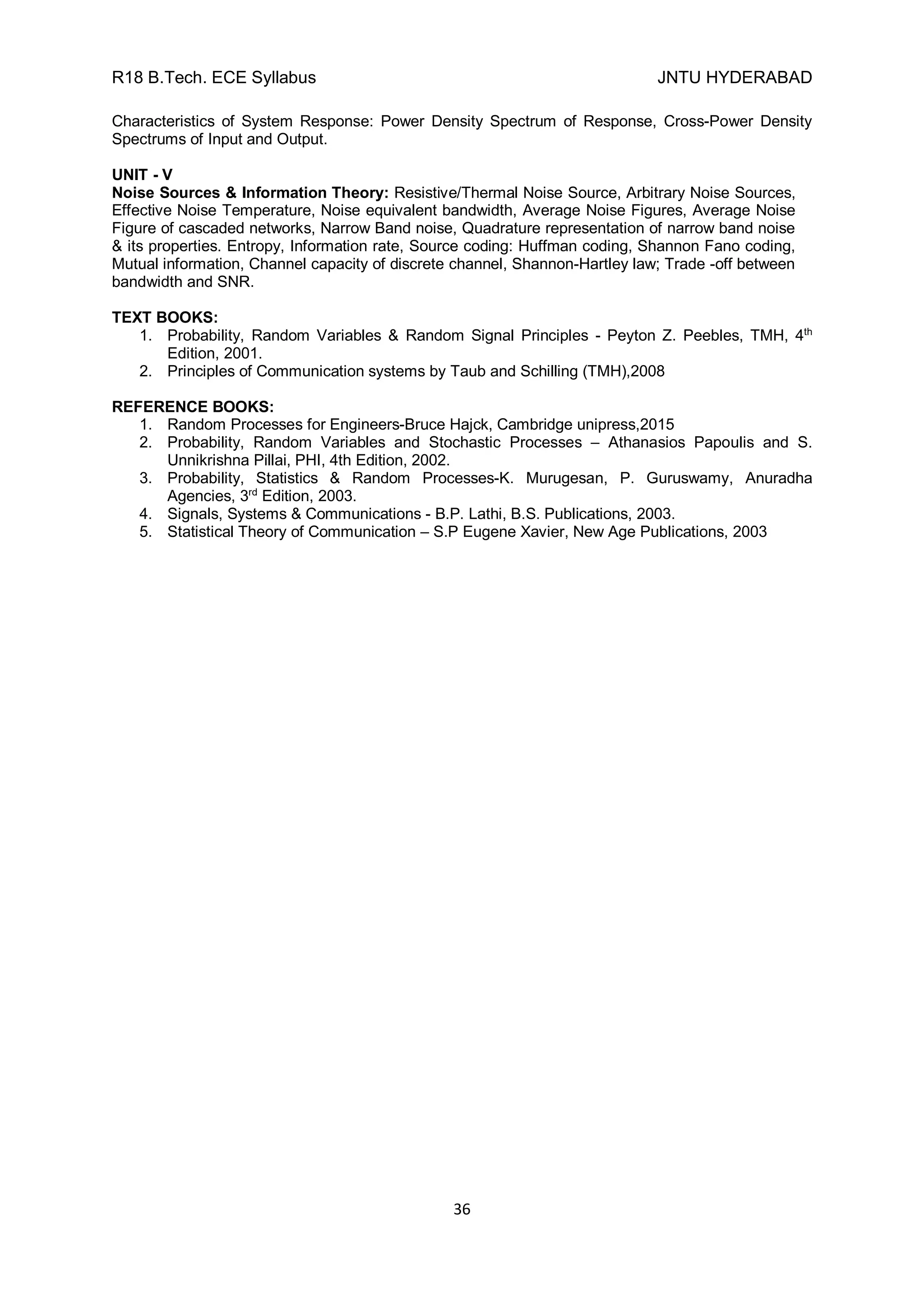
Characteristics of System Response: Power Density Spectrum of Response, Cross-Power Density
Spectrums of Input and Output.
UNIT - V
Noise Sources & Information Theory: Resistive/Thermal Noise Source, Arbitrary Noise Sources,
Effective Noise Temperature, Noise equivalent bandwidth, Average Noise Figures, Average Noise
Figure of cascaded networks, Narrow Band noise, Quadrature representation of narrow band noise
& its properties. Entropy, Information rate, Source coding: Huffman coding, Shannon Fano coding,
Mutual information, Channel capacity of discrete channel, Shannon-Hartley law; Trade -off between
bandwidth and SNR.
TEXT BOOKS:
1. Probability, Random Variables & Random Signal Principles - Peyton Z. Peebles, TMH, 4th
Edition, 2001.
2. Principles of Communication systems by Taub and Schilling (TMH),2008
REFERENCE BOOKS:
1. Random Processes for Engineers-Bruce Hajck, Cambridge unipress,2015
2. Probability, Random Variables and Stochastic Processes – Athanasios Papoulis and S.
Unnikrishna Pillai, PHI, 4th Edition, 2002.
3. Probability, Statistics & Random Processes-K. Murugesan, P. Guruswamy, Anuradha
Agencies, 3rd
Edition, 2003.
4. Signals, Systems & Communications - B.P. Lathi, B.S. Publications, 2003.
5. Statistical Theory of Communication – S.P Eugene Xavier, New Age Publications, 2003
R18 B.Tech. ECE Syllabus JNTU HYDERABAD
37
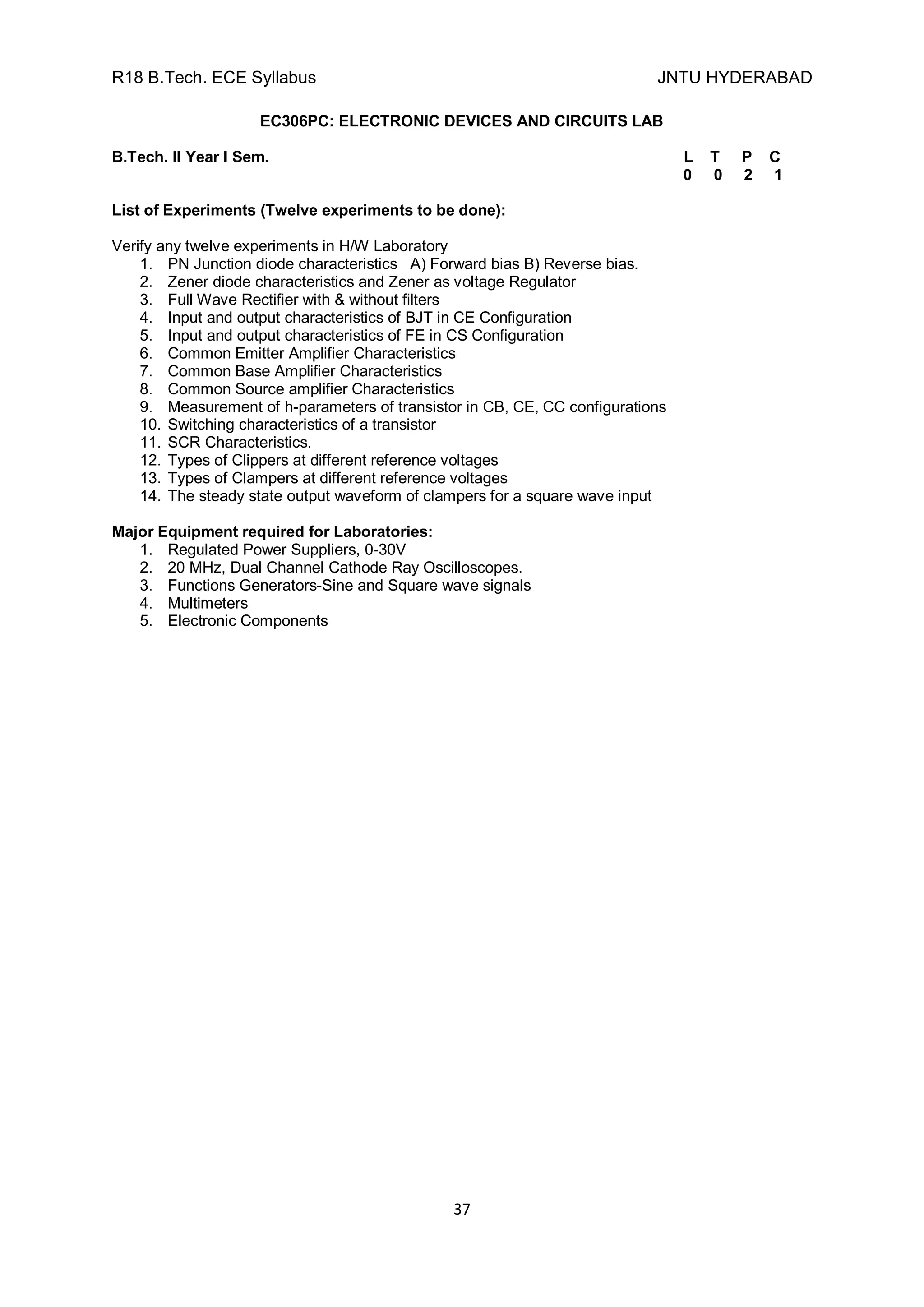
EC306PC: ELECTRONIC DEVICES AND CIRCUITS LAB
B.Tech. II Year I Sem. L T P C
0 0 2 1
List of Experiments (Twelve experiments to be done):
Verify any twelve experiments in H/W Laboratory
1. PN Junction diode characteristics A) Forward bias B) Reverse bias.
2. Zener diode characteristics and Zener as voltage Regulator
3. Full Wave Rectifier with & without filters
4. Input and output characteristics of BJT in CE Configuration
5. Input and output characteristics of FE in CS Configuration
6. Common Emitter Amplifier Characteristics
7. Common Base Amplifier Characteristics
8. Common Source amplifier Characteristics
9. Measurement of h-parameters of transistor in CB, CE, CC configurations
10. Switching characteristics of a transistor
11. SCR Characteristics.
12. Types of Clippers at different reference voltages
13. Types of Clampers at different reference voltages
14. The steady state output waveform of clampers for a square wave input
Major Equipment required for Laboratories:
1. Regulated Power Suppliers, 0-30V
2. 20 MHz, Dual Channel Cathode Ray Oscilloscopes.
3. Functions Generators-Sine and Square wave signals
4. Multimeters
5. Electronic Components
R18 B.Tech. ECE Syllabus JNTU HYDERABAD
38
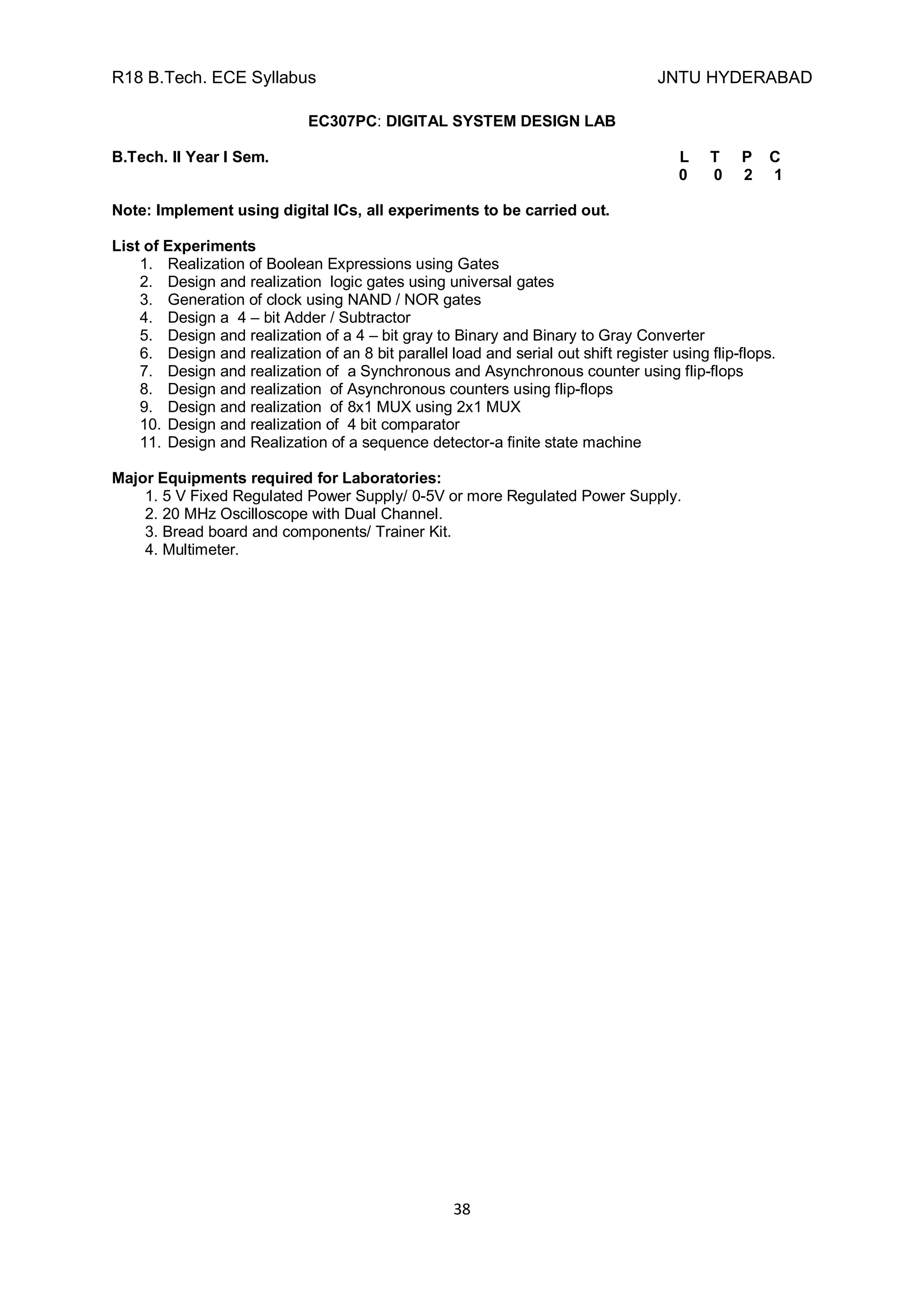
EC307PC: DIGITAL SYSTEM DESIGN LAB
B.Tech. II Year I Sem. L T P C
0 0 2 1
Note: Implement using digital ICs, all experiments to be carried out.
List of Experiments
1. Realization of Boolean Expressions using Gates
2. Design and realization logic gates using universal gates
3. Generation of clock using NAND / NOR gates
4. Design a 4 – bit Adder / Subtractor
5. Design and realization of a 4 – bit gray to Binary and Binary to Gray Converter
6. Design and realization of an 8 bit parallel load and serial out shift register using flip-flops.
7. Design and realization of a Synchronous and Asynchronous counter using flip-flops
8. Design and realization of Asynchronous counters using flip-flops
9. Design and realization of 8x1 MUX using 2x1 MUX
10. Design and realization of 4 bit comparator
11. Design and Realization of a sequence detector-a finite state machine
Major Equipments required for Laboratories:
1. 5 V Fixed Regulated Power Supply/ 0-5V or more Regulated Power Supply.
2. 20 MHz Oscilloscope with Dual Channel.
3. Bread board and components/ Trainer Kit.
4. Multimeter.
R18 B.Tech. ECE Syllabus JNTU HYDERABAD
39
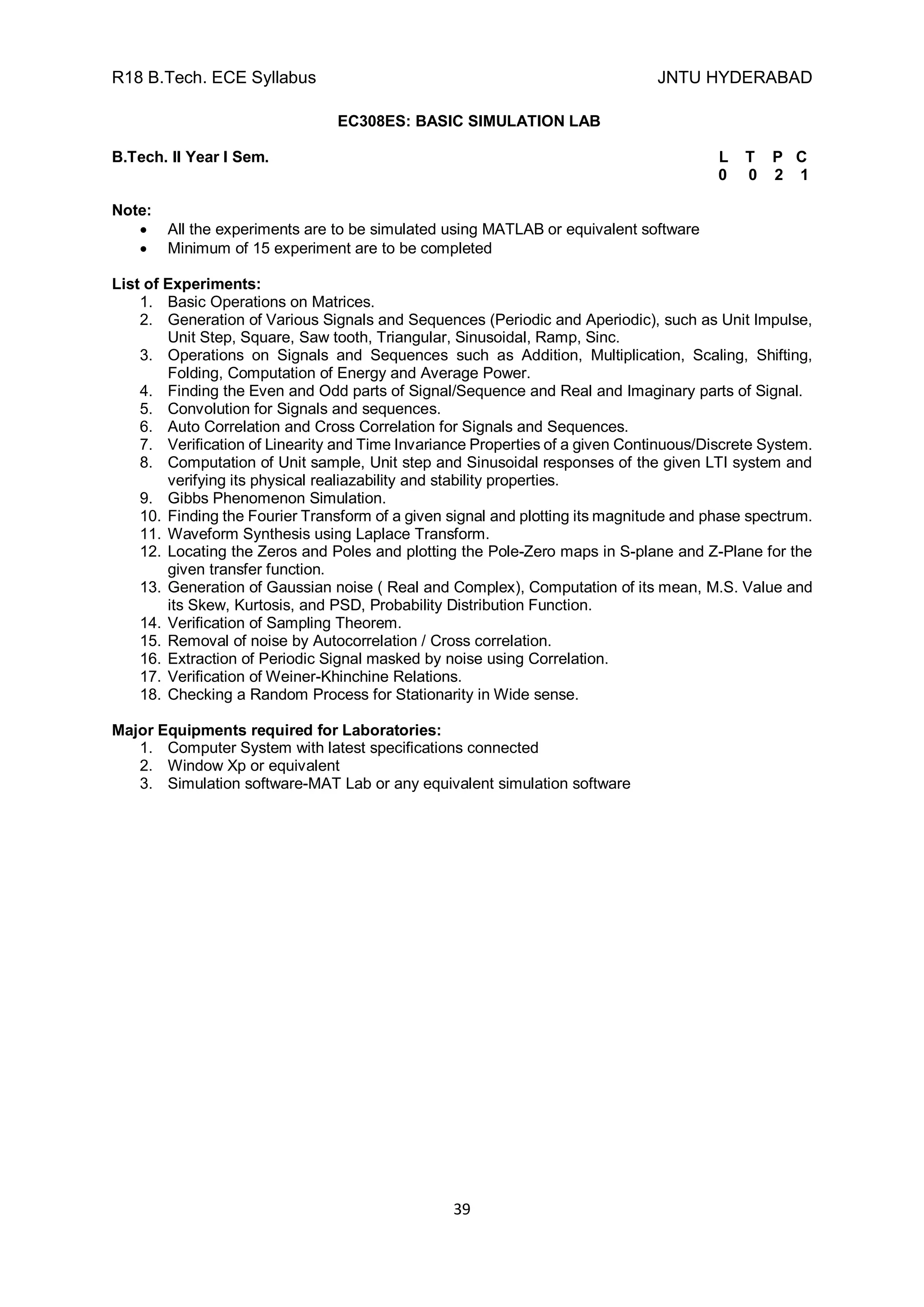
EC308ES: BASIC SIMULATION LAB
B.Tech. II Year I Sem. L T P C
0 0 2 1
Note:
 All the experiments are to be simulated using MATLAB or equivalent software
 Minimum of 15 experiment are to be completed
List of Experiments:
1. Basic Operations on Matrices.
2. Generation of Various Signals and Sequences (Periodic and Aperiodic), such as Unit Impulse,
Unit Step, Square, Saw tooth, Triangular, Sinusoidal, Ramp, Sinc.
3. Operations on Signals and Sequences such as Addition, Multiplication, Scaling, Shifting,
Folding, Computation of Energy and Average Power.
4. Finding the Even and Odd parts of Signal/Sequence and Real and Imaginary parts of Signal.
5. Convolution for Signals and sequences.
6. Auto Correlation and Cross Correlation for Signals and Sequences.
7. Verification of Linearity and Time Invariance Properties of a given Continuous/Discrete System.
8. Computation of Unit sample, Unit step and Sinusoidal responses of the given LTI system and
verifying its physical realiazability and stability properties.
9. Gibbs Phenomenon Simulation.
10. Finding the Fourier Transform of a given signal and plotting its magnitude and phase spectrum.
11. Waveform Synthesis using Laplace Transform.
12. Locating the Zeros and Poles and plotting the Pole-Zero maps in S-plane and Z-Plane for the
given transfer function.
13. Generation of Gaussian noise ( Real and Complex), Computation of its mean, M.S. Value and
its Skew, Kurtosis, and PSD, Probability Distribution Function.
14. Verification of Sampling Theorem.
15. Removal of noise by Autocorrelation / Cross correlation.
16. Extraction of Periodic Signal masked by noise using Correlation.
17. Verification of Weiner-Khinchine Relations.
18. Checking a Random Process for Stationarity in Wide sense.
Major Equipments required for Laboratories:
1. Computer System with latest specifications connected
2. Window Xp or equivalent
3. Simulation software-MAT Lab or any equivalent simulation software
R18 B.Tech. ECE Syllabus JNTU HYDERABAD
40
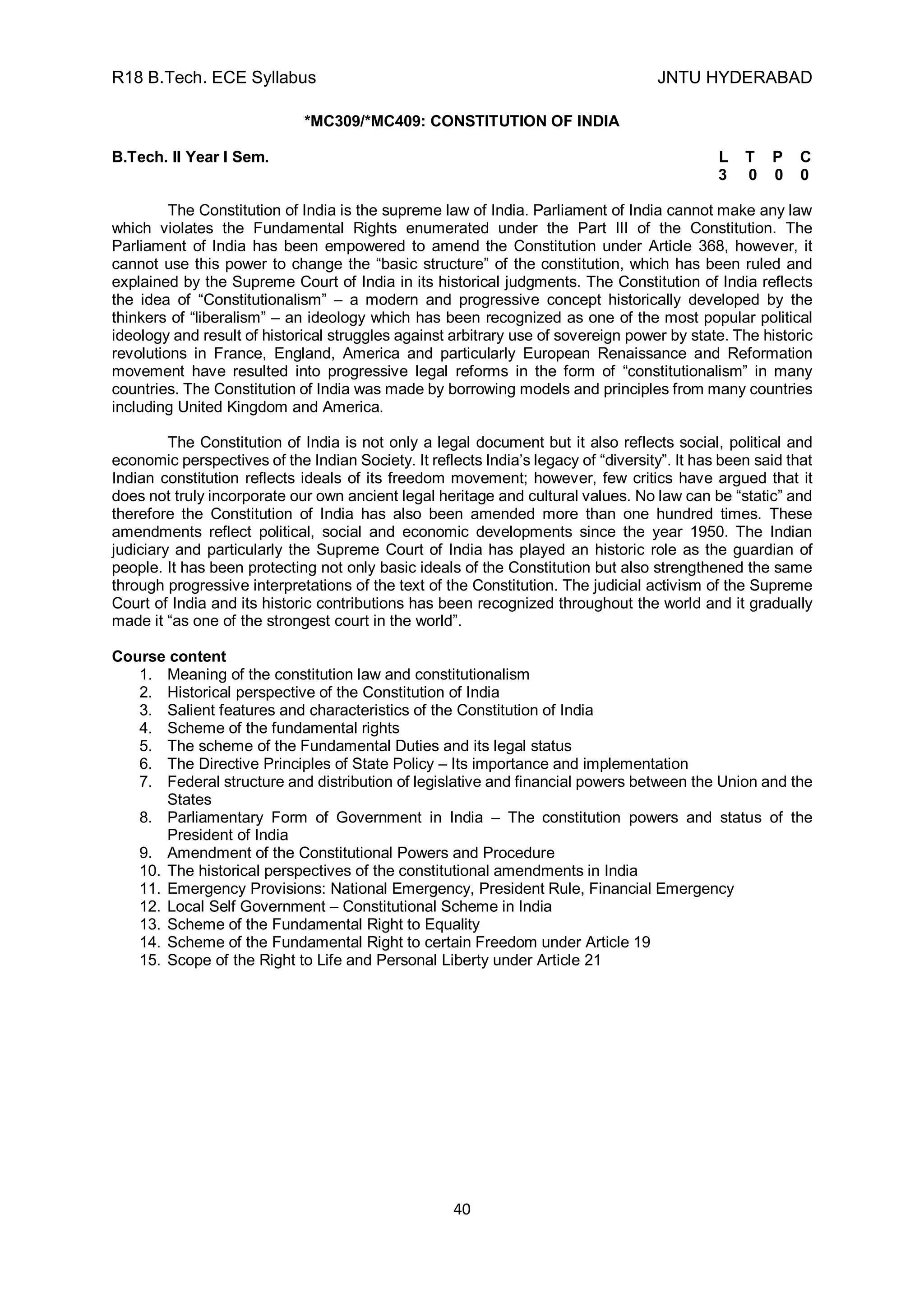
*MC309/*MC409: CONSTITUTION OF INDIA
B.Tech. II Year I Sem. L T P C
3 0 0 0
The Constitution of India is the supreme law of India. Parliament of India cannot make any law
which violates the Fundamental Rights enumerated under the Part III of the Constitution. The
Parliament of India has been empowered to amend the Constitution under Article 368, however, it
cannot use this power to change the “basic structure” of the constitution, which has been ruled and
explained by the Supreme Court of India in its historical judgments. The Constitution of India reflects
the idea of “Constitutionalism” – a modern and progressive concept historically developed by the
thinkers of “liberalism” – an ideology which has been recognized as one of the most popular political
ideology and result of historical struggles against arbitrary use of sovereign power by state. The historic
revolutions in France, England, America and particularly European Renaissance and Reformation
movement have resulted into progressive legal reforms in the form of “constitutionalism” in many
countries. The Constitution of India was made by borrowing models and principles from many countries
including United Kingdom and America.
The Constitution of India is not only a legal document but it also reflects social, political and
economic perspectives of the Indian Society. It reflects India’s legacy of “diversity”. It has been said that
Indian constitution reflects ideals of its freedom movement; however, few critics have argued that it
does not truly incorporate our own ancient legal heritage and cultural values. No law can be “static” and
therefore the Constitution of India has also been amended more than one hundred times. These
amendments reflect political, social and economic developments since the year 1950. The Indian
judiciary and particularly the Supreme Court of India has played an historic role as the guardian of
people. It has been protecting not only basic ideals of the Constitution but also strengthened the same
through progressive interpretations of the text of the Constitution. The judicial activism of the Supreme
Court of India and its historic contributions has been recognized throughout the world and it gradually
made it “as one of the strongest court in the world”.
Course content
1. Meaning of the constitution law and constitutionalism
2. Historical perspective of the Constitution of India
3. Salient features and characteristics of the Constitution of India
4. Scheme of the fundamental rights
5. The scheme of the Fundamental Duties and its legal status
6. The Directive Principles of State Policy – Its importance and implementation
7. Federal structure and distribution of legislative and financial powers between the Union and the
States
8. Parliamentary Form of Government in India – The constitution powers and status of the
President of India
9. Amendment of the Constitutional Powers and Procedure
10. The historical perspectives of the constitutional amendments in India
11. Emergency Provisions: National Emergency, President Rule, Financial Emergency
12. Local Self Government – Constitutional Scheme in India
13. Scheme of the Fundamental Right to Equality
14. Scheme of the Fundamental Right to certain Freedom under Article 19
15. Scope of the Right to Life and Personal Liberty under Article 21
R18 B.Tech. ECE Syllabus JNTU HYDERABAD
1
JAWAHARLAL NEHRU TECHNOLOGICAL UNIVERSITY HYDERABAD
B.Tech. in ELECTRONICS AND COMMUNICATION ENGINEERING
COURSE STRUCTURE & SYLLABUS (R18)
Applicable From 2018-19 Admitted Batch
I YEAR I SEMESTER
S. No.
Course
Code
Course Title L T P Credits
1 MA101BS Mathematics - I 3 1 0 4
2 AP102BS Applied Physics 3 1 0 4
3 CS103ES Programming for Problem Solving 3 1 0 4
4 ME104ES Engineering Graphics 1 0 4 3
5 AP105BS Applied Physics Lab 0 0 3 1.5
6 CS106ES Programming for Problem Solving Lab 0 0 3 1.5
7 *MC109ES Environmental Science 3 0 0 0
Induction Programme
Total Credits 13 3 10 18
I YEAR II SEMESTER
S. No.
Course
Code
Course Title L T P Credits
1 MA201BS Mathematics - II 3 1 0 4
2 CH202BS Chemistry 3 1 0 4
3 EE203ES Basic Electrical Engineering 3 0 0 3
4 ME205ES Engineering Workshop 1 0 3 2.5
5 EN205HS English 2 0 0 2
6 CH206BS Engineering Chemistry Lab 0 0 3 1.5
7 EN207HS English Language and Communication Skills Lab 0 0 2 1
8 EE208ES Basic Electrical Engineering Lab 0 0 2 1
Total Credits 12 2 10 19
II YEAR I SEMESTER
S. No.
Course
Code
Course Title L T P Credits
1 EC301PC Electronic Devices and Circuits 3 1 0 4
2 EC302PC Network Analysis and Transmission Lines 3 0 0 3
3 EC303PC Digital System Design 3 1 0 4
4 EC304PC Signals and Systems 3 1 0 4
5 EC305ES Probability Theory and Stochastic Processes 3 0 0 3
6 EC306PC Electronic Devices and Circuits Lab 0 0 2 1
7 EC307PC Digital System Design Lab 0 0 2 1
8 EC308ES Basic Simulation Lab 0 0 2 1
9 *MC309 Constitution of India 3 0 0 0
Total Credits 18 3 6 21
II YEAR II SEMESTER
S. No.
Course
Code
Course Title L T P Credits
1 MA401BS Laplace Transforms, Numerical Methods &
Complex Variables
3 1 0 4
2 EC402PC Electromagnetic Fields and Waves 3 0 0 3
R18 B.Tech. ECE Syllabus JNTU HYDERABAD
2
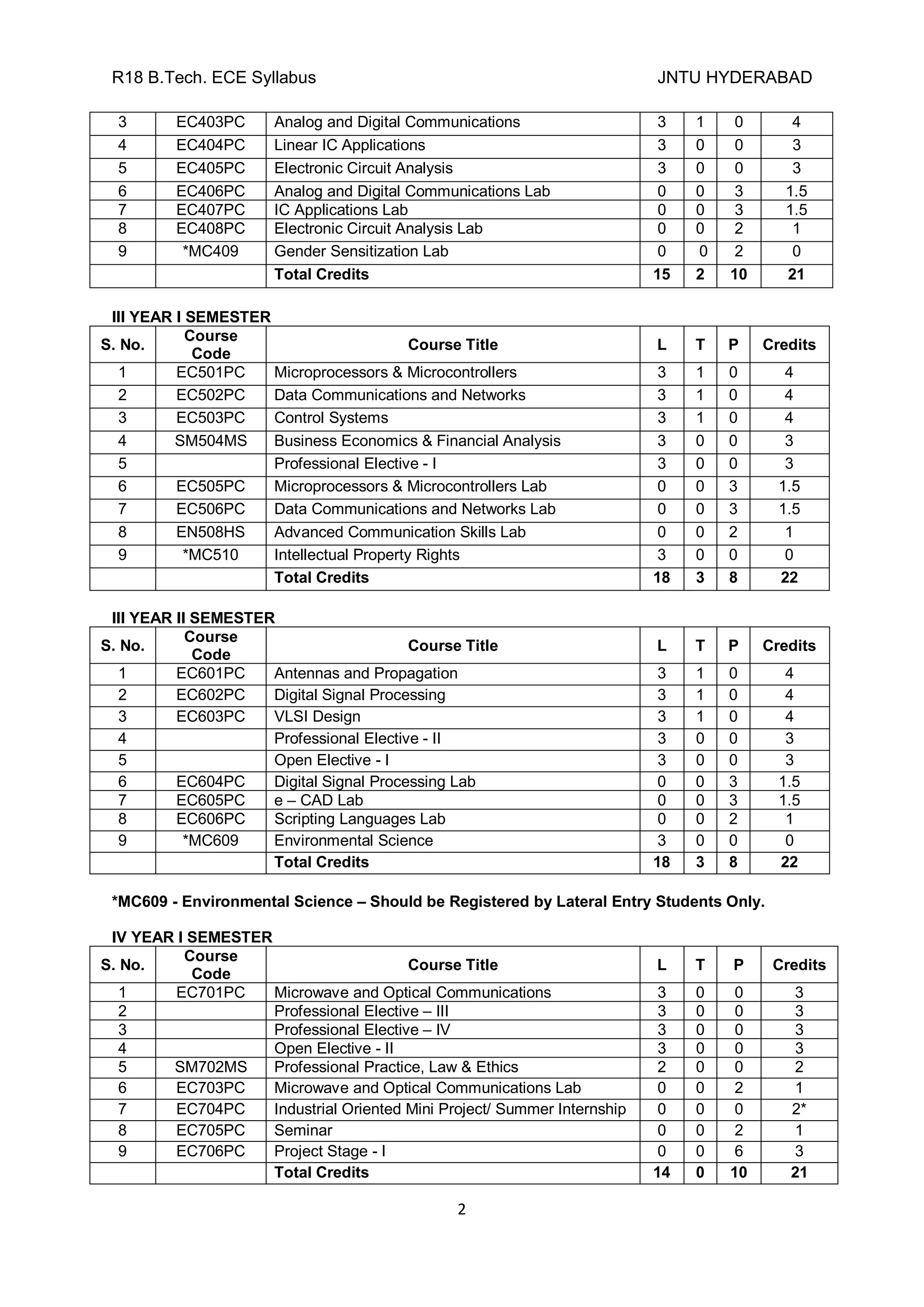
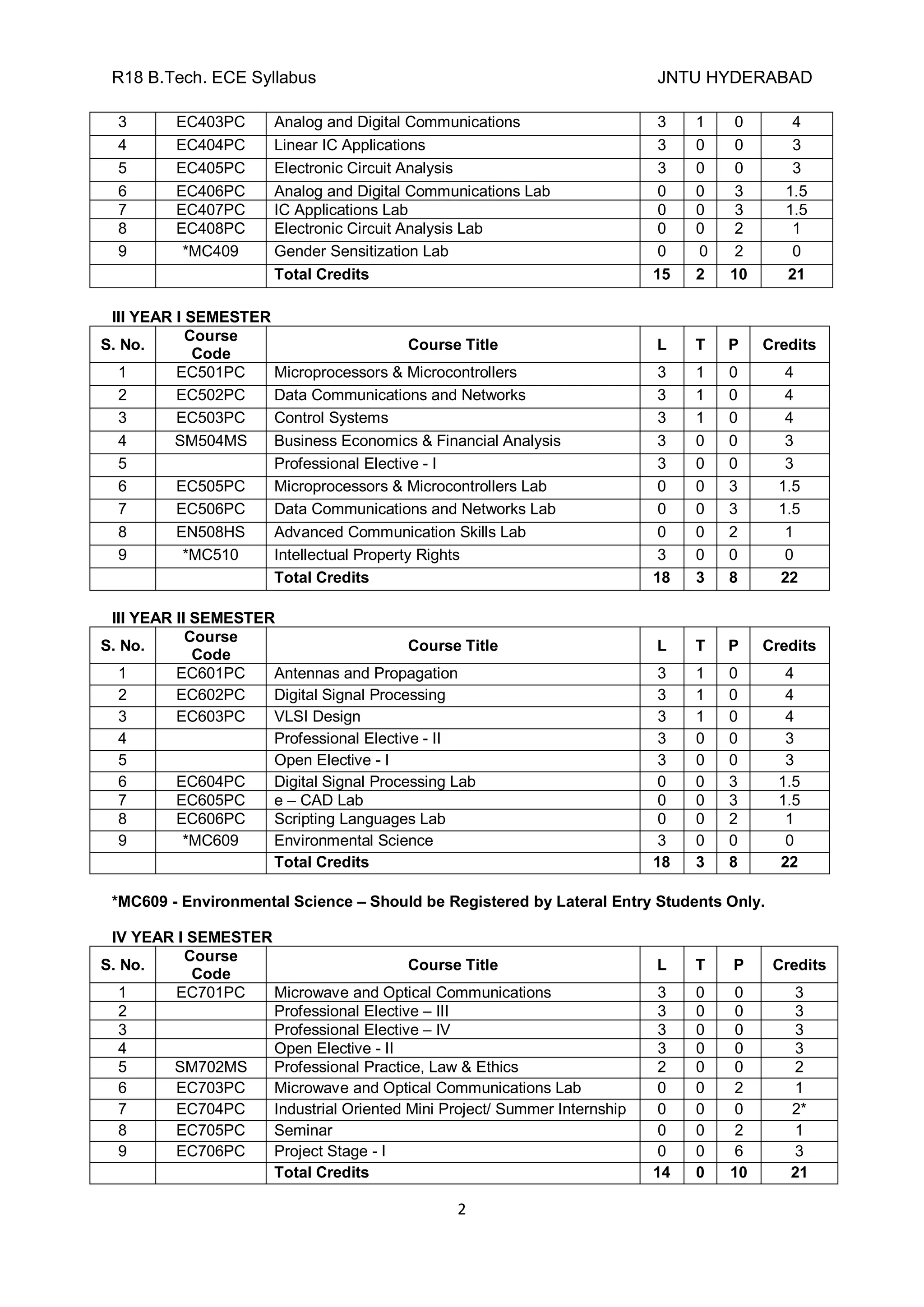
3 EC403PC Analog and Digital Communications 3 1 0 4
4 EC404PC Linear IC Applications 3 0 0 3
5 EC405PC Electronic Circuit Analysis 3 0 0 3
6 EC406PC Analog and Digital Communications Lab 0 0 3 1.5
7 EC407PC IC Applications Lab 0 0 3 1.5
8 EC408PC Electronic Circuit Analysis Lab 0 0 2 1
9 *MC409 Gender Sensitization Lab 0 0 2 0
Total Credits 15 2 10 21
III YEAR I SEMESTER
S. No.
Course
Code
Course Title L T P Credits
1 EC501PC Microprocessors & Microcontrollers 3 1 0 4
2 EC502PC Data Communications and Networks 3 1 0 4
3 EC503PC Control Systems 3 1 0 4
4 SM504MS Business Economics & Financial Analysis 3 0 0 3
5 Professional Elective - I 3 0 0 3
6 EC505PC Microprocessors & Microcontrollers Lab 0 0 3 1.5
7 EC506PC Data Communications and Networks Lab 0 0 3 1.5
8 EN508HS Advanced Communication Skills Lab 0 0 2 1
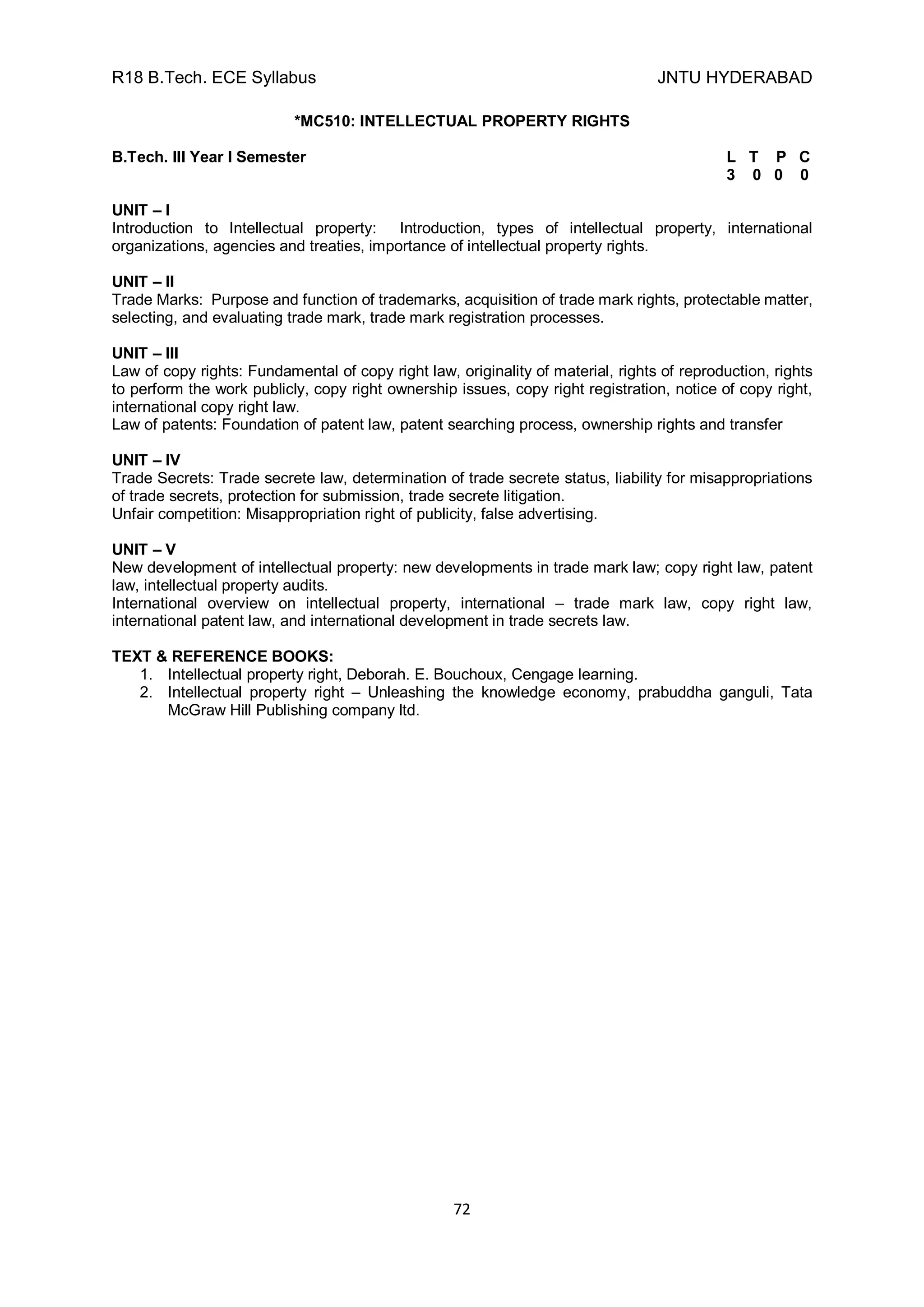
9 *MC510 Intellectual Property Rights 3 0 0 0
Total Credits 18 3 8 22
III YEAR II SEMESTER
S. No.
Course
Code
Course Title L T P Credits
1 EC601PC Antennas and Propagation 3 1 0 4
2 EC602PC Digital Signal Processing 3 1 0 4
3 EC603PC VLSI Design 3 1 0 4
4 Professional Elective - II 3 0 0 3
5 Open Elective - I 3 0 0 3
6 EC604PC Digital Signal Processing Lab 0 0 3 1.5
7 EC605PC e – CAD Lab 0 0 3 1.5
8 EC606PC Scripting Languages Lab 0 0 2 1
9 *MC609 Environmental Science 3 0 0 0
Total Credits 18 3 8 22
*MC609 - Environmental Science – Should be Registered by Lateral Entry Students Only.
IV YEAR I SEMESTER
S. No.
Course
Code
Course Title L T P Credits
1 EC701PC Microwave and Optical Communications 3 0 0 3
2 Professional Elective – III 3 0 0 3
3 Professional Elective – IV 3 0 0 3
4 Open Elective - II 3 0 0 3
5 SM702MS Professional Practice, Law & Ethics 2 0 0 2
6 EC703PC Microwave and Optical Communications Lab 0 0 2 1
7 EC704PC Industrial Oriented Mini Project/ Summer Internship 0 0 0 2*
8 EC705PC Seminar 0 0 2 1
9 EC706PC Project Stage - I 0 0 6 3
Total Credits 14 0 10 21
R18 B.Tech. ECE Syllabus JNTU HYDERABAD
41
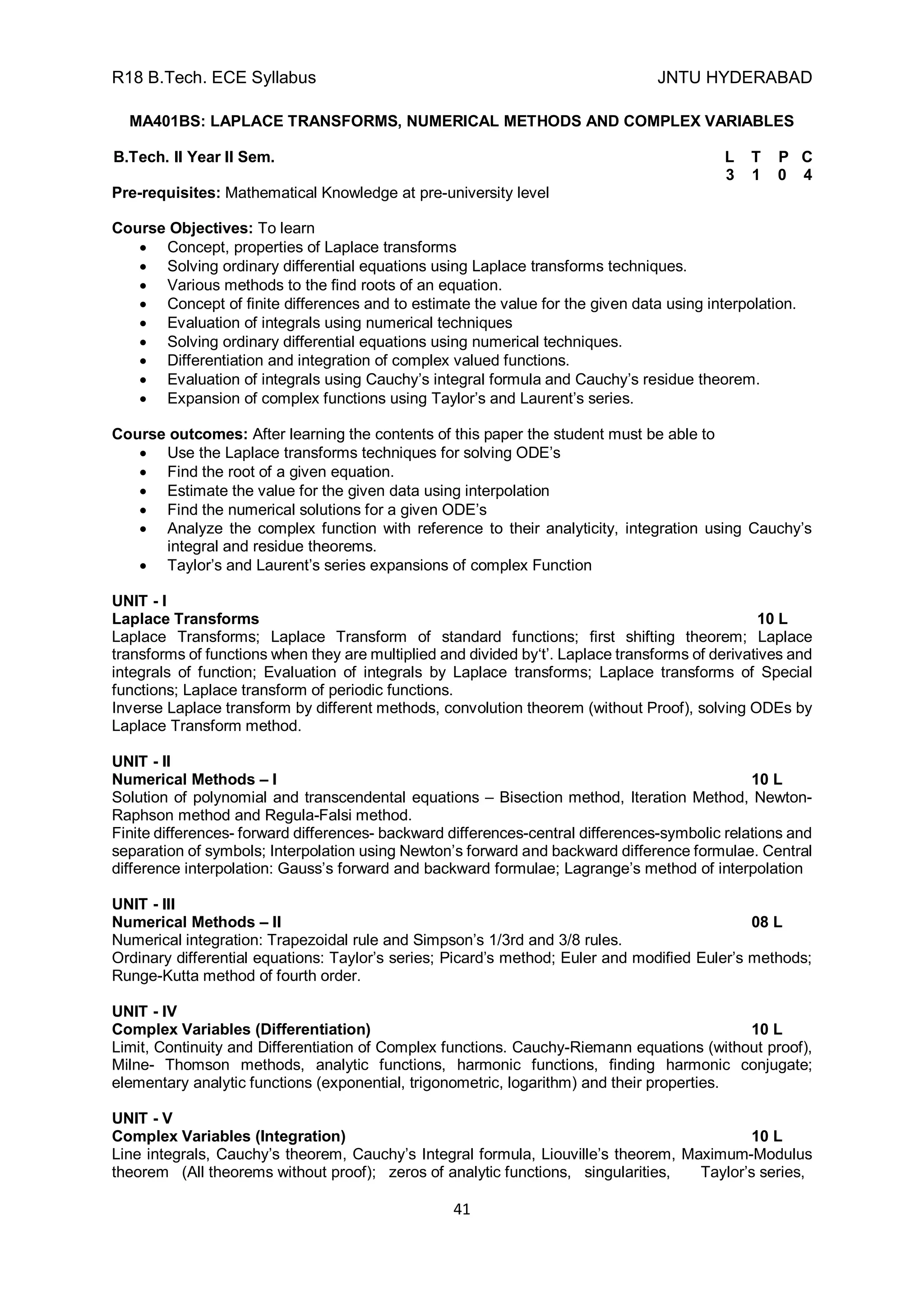
MA401BS: LAPLACE TRANSFORMS, NUMERICAL METHODS AND COMPLEX VARIABLES
B.Tech. II Year II Sem. L T P C
3 1 0 4
Pre-requisites: Mathematical Knowledge at pre-university level
Course Objectives: To learn
 Concept, properties of Laplace transforms
 Solving ordinary differential equations using Laplace transforms techniques.
 Various methods to the find roots of an equation.
 Concept of finite differences and to estimate the value for the given data using interpolation.
 Evaluation of integrals using numerical techniques
 Solving ordinary differential equations using numerical techniques.
 Differentiation and integration of complex valued functions.
 Evaluation of integrals using Cauchy’s integral formula and Cauchy’s residue theorem.
 Expansion of complex functions using Taylor’s and Laurent’s series.
Course outcomes: After learning the contents of this paper the student must be able to
 Use the Laplace transforms techniques for solving ODE’s
 Find the root of a given equation.
 Estimate the value for the given data using interpolation
 Find the numerical solutions for a given ODE’s
 Analyze the complex function with reference to their analyticity, integration using Cauchy’s
integral and residue theorems.
 Taylor’s and Laurent’s series expansions of complex Function
UNIT - I
Laplace Transforms 10 L
Laplace Transforms; Laplace Transform of standard functions; first shifting theorem; Laplace
transforms of functions when they are multiplied and divided by‘t’. Laplace transforms of derivatives and
integrals of function; Evaluation of integrals by Laplace transforms; Laplace transforms of Special
functions; Laplace transform of periodic functions.
Inverse Laplace transform by different methods, convolution theorem (without Proof), solving ODEs by
Laplace Transform method.
UNIT - II
Numerical Methods – I 10 L
Solution of polynomial and transcendental equations – Bisection method, Iteration Method, Newton-
Raphson method and Regula-Falsi method.
Finite differences- forward differences- backward differences-central differences-symbolic relations and
separation of symbols; Interpolation using Newton’s forward and backward difference formulae. Central
difference interpolation: Gauss’s forward and backward formulae; Lagrange’s method of interpolation
UNIT - III
Numerical Methods – II 08 L
Numerical integration: Trapezoidal rule and Simpson’s 1/3rd and 3/8 rules.
Ordinary differential equations: Taylor’s series; Picard’s method; Euler and modified Euler’s methods;
Runge-Kutta method of fourth order.
UNIT - IV
Complex Variables (Differentiation) 10 L
Limit, Continuity and Differentiation of Complex functions. Cauchy-Riemann equations (without proof),
Milne- Thomson methods, analytic functions, harmonic functions, finding harmonic conjugate;
elementary analytic functions (exponential, trigonometric, logarithm) and their properties.
UNIT - V
Complex Variables (Integration) 10 L
Line integrals, Cauchy’s theorem, Cauchy’s Integral formula, Liouville’s theorem, Maximum-Modulus
theorem (All theorems without proof); zeros of analytic functions, singularities, Taylor’s series,
R18 B.Tech. ECE Syllabus JNTU HYDERABAD
42
Laurent’s series; Residues, Cauchy Residue theorem (without proof).
TEXT BOOKS:
1. B.S. Grewal, Higher Engineering Mathematics, Khanna Publishers, 36th
Edition, 2010.
2. S.S. Sastry, Introductory methods of numerical analysis, PHI, 4th Edition, 2005.
3. J. W. Brown and R. V. Churchill, Complex Variables and Applications, 7th Ed., Mc-Graw Hill,
2004.
REFERENCE BOOKS:
1. M. K. Jain, SRK Iyengar, R.K. Jain, Numerical methods for Scientific and Engineering
Computations , New Age International publishers.
2. Erwin kreyszig, Advanced Engineering Mathematics, 9th Edition, John Wiley & Sons,2006.
R18 B.Tech. ECE Syllabus JNTU HYDERABAD
43
EC402PC: ELECTROMAGNETIC FIELDS AND WAVES
B.Tech. II Year II Sem. L T P C
3 0 0 3
Pre-requisite: Applied Physics
Course Objectives:
 To learn the Basic Laws, Concepts and proofs related to Electrostatic Fields and
Magnetostatic Fields, and apply them to solve physics and engineering problems.
 To distinguish between static and time-varying fields, and understand the significance
and utility of Maxwell’s Equations and Boundary Conditions, and gain ability to provide
solutions to communication engineering problems.
 To analyze the characteristics of Uniform Plane Waves (UPW), determine their
propagation parameters and estimate the same for dielectric and dissipative media.
 To conceptually understand the waveguides and to determine the characteristics of
rectangular waveguides, microstrip lines .
Course Outcomes: Upon completing this course, the student will be able to
 Get the knowledge of Basic Laws, Concepts and proofs related to Electrostatic Fields and
Magnetostatic Fields.
 Distinguish between the static and time-varying fields, establish the corresponding sets of
Maxwell’s Equations and Boundary Conditions.
 Analyze the Wave Equations for good conductors, good dielectrics and evaluate the UPW
Characteristics for several practical media of interest.
 To analyze completely the rectangular waveguides, their mode characteristics, and design
waveguides for solving practical problems.
UNIT – I
Electrostatics: Coulomb’s Law, Electric Field Intensity – Fields due to Different Charge Distributions,
Electric Flux Density, Gauss Law and Applications, Electric Potential, Relations Between E and V,
Maxwell’s Two Equations for Electrostatic Fields, Energy Density. Convection and Conduction
Currents, Dielectric Constant, Isotropic and Homogeneous Dielectrics, Continuity Equation, Relaxation
Time, Poisson’s and Laplace’s Equations, Capacitance – Parallel Plate, Coaxial, Spherical Capacitors.
UNIT – II
Magnetostatics: Biot-Savart’s Law, Ampere’s Circuital Law and Applications, Magnetic Flux Density,
Maxwell’s Two Equations for Magnetostatic Fields, Magnetic Scalar and Vector Potentials, Forces due
to Magnetic Fields, Ampere’s Force Law.
UNIT – III
Maxwell’s Equations (Time Varying Fields): Faraday’s Law and Transformer EMF, Inconsistency of
Ampere’s Law and Displacement Current Density, Maxwell’s Equations in Different Forms, Conditions
at a Boundary Surface - Dielectric-Dielectric and Dielectric-Conductor Interfaces.
UNIT – IV
EM Wave Characteristics: Wave Equations for Conducting and Perfect Dielectric Media, Uniform
Plane Waves – Definitions, Relation between E & H, Sinusoidal Variations, Wave Propagation in
Lossless and Conducting Media, Conductors & Dielectrics – Characterization, Wave Propagation in
Good Conductors and Good Dielectrics, Polarization.
Reflection and Refraction of Plane Waves – Normal and Oblique Incidences for both Perfect Conductor
and Perfect Dielectrics, Brewster Angle, Critical Angle and Total Internal Reflection, Surface
Impedance, Poynting Vector and Poynting Theorem.
UNIT – V
Waveguides: Electromagnetic Spectrum and Bands. Rectangular Waveguides – Solution of Wave
Equations in Rectangular Coordinates, TE/TM mode analysis, Expressions for Fields, Characteristic
Equation and Cut-off Frequencies, Dominant and Degenerate Modes, Sketches of TE and TM mode
fields in the cross-section, Phase and Group Velocities, Wavelengths and Impedance Relations,
R18 B.Tech. ECE Syllabus JNTU HYDERABAD
44
Equation of Power Transmission, Impossibility of TEM Mode. Microstrip Lines – Zo Relations, Effective
Dielectric Constant.
TEXT BOOKS:
1. Engineering Electromagnetics – William H. Hayt Jr. and John A. Buck, 8th
Ed., McGrawHill,2014
2. Principles of Electromagnetics – Matthew N.O. sadiku and S.V. Kulkarni, 6th
Ed., Oxford
University Press, Aisan Edition, 2015.
REFERENCE BOOKS:
1. Electromagnetic Waves and Radiating Systems – E.C. Jordan and K.G. Balmain, 2nd
Ed., 2000,
PHI.
2. Engineering Electromagnetics – Nathan Ida, 2nd
Ed., 2005, Springer (India) Pvt. Ltd., New Delhi.
R18 B.Tech. ECE Syllabus JNTU HYDERABAD
45
EC403PC: ANALOG AND DIGITAL COMMUNICATIONS
B.Tech. II Year II Semester L T P C
3 1 0 4
Prerequisite: Probability theory and Stochastic Processes
Course Objectives:
 To develop ability to analyze system requirements of analog and digital communication
systems.
 To understand the generation, detection of various analog and digital modulation techniques.
 To acquire theoretical knowledge of each block in AM, FM transmitters and receivers.
 To understand the concepts of baseband transmissions.
Course Outcomes: Upon completing this course, the student will be able to
 Analyze and design of various continuous wave and angle modulation and demodulation
techniques
 Understand the effect of noise present in continuous wave and angle modulation techniques.
 Attain the knowledge about AM , FM Transmitters and Receivers
 Analyze and design the various Pulse Modulation Techniques.
 Understand the concepts of Digital Modulation Techniques and Baseband transmission.
UNIT - I
Amplitude Modulation: Need for modulation, Amplitude Modulation - Time and frequency domain
description, single tone modulation, power relations in AM waves, Generation of AM waves - Switching
modulator, Detection of AM Waves - Envelope detector, DSBSC modulation - time and frequency
domain description, Generation of DSBSC Waves - Balanced Modulators, Coherent detection of DSB-
SC Modulated waves, COSTAS Loop, SSB modulation - time and frequency domain description,
frequency discrimination and Phase discrimination methods for generating SSB, Demodulation of SSB
Waves, principle of Vestigial side band modulation.
UNIT - II
Angle Modulation: Basic concepts of Phase Modulation, Frequency Modulation: Single tone frequency
modulation, Spectrum Analysis of Sinusoidal FM Wave using Bessel functions, Narrow band FM, Wide
band FM, Constant Average Power, Transmission bandwidth of FM Wave - Generation of FM Signal-
Armstrong Method, Detection of FM Signal: Balanced slope detector, Phase locked loop, Comparison
of FM and AM., Concept of Pre-emphasis and de-emphasis.
UNIT - III
Transmitters: Classification of Transmitters, AM Transmitters, FM Transmitters
Receivers: Radio Receiver - Receiver Types - Tuned radio frequency receiver, Superhetrodyne
receiver, RF section and Characteristics - Frequency changing and tracking, Intermediate frequency,
Image frequency, AGC, Amplitude limiting, FM Receiver, Comparison of AM and FM Receivers.
UNIT - IV
Pulse Modulation: Types of Pulse modulation- PAM, PWM and PPM. Comparison of FDM and TDM.
Pulse Code Modulation: PCM Generation and Reconstruction, Quantization Noise, Non-Uniform
Quantization and Companding, DPCM, Adaptive DPCM, DM and Adaptive DM, Noise in PCM and DM.
UNIT - V
Digital Modulation Techniques: ASK- Modulator, Coherent ASK Detector, FSK- Modulator, Non-
Coherent FSK Detector, BPSK- Modulator, Coherent BPSK Detection. Principles of QPSK, Differential
PSK and QAM.
Baseband Transmission and Optimal Reception of Digital Signal: A Baseband Signal Receiver,
Probability of Error, Optimum Receiver, Coherent Reception, ISI, Eye Diagrams.
TEXT BOOKS:
1. Analog and Digital Communications – Simon Haykin, John Wiley, 2005.
2. Electronics Communication Systems-Fundamentals through Advanced-Wayne Tomasi, 5th
Edition, 2009, PHI.
R18 B.Tech. ECE Syllabus JNTU HYDERABAD
46
REFERENCE BOOKS:
1. Principles of Communication Systems - Herbert Taub, Donald L Schilling, Goutam Saha, 3rd
Edition, McGraw-Hill, 2008.
2. Electronic Communications – Dennis Roddy and John Coolean , 4th
Edition , PEA, 2004
3. Electronics & Communication System – George Kennedy and Bernard Davis, TMH 2004
4. Analog and Digital Communication – K. Sam Shanmugam, Willey ,2005
R18 B.Tech. ECE Syllabus JNTU HYDERABAD
47
EC404PC: LINEAR IC APPLICATIONS
B.Tech. II Year II Sem. L T P C
3 0 0 3
Pre-requisite: Electronic Devices & Circuits
Course Objectives: The main objectives of the course are:
 To introduce the basic building blocks of linear integrated circuits.
 To introduce the theory and applications of analog multipliers and PLL.
 To introduce the concepts of waveform generation and introduce some special function ICs.
Course Outcomes: Upon completing this course, the student will be able to
 A thorough understanding of operational amplifiers with linear integrated circuits.
 Attain the knowledge of functional diagrams and applications of IC 555 and IC 565
 Acquire the knowledge about the Data converters.
UNIT - I
Integrated Circuits: Classification, chip size and circuit complexity, basic information of Op-amp, ideal
and practical Op-amp, internal circuits, Op-amp characteristics, DC and AC Characteristics, 741 op-
amp and its features, modes of operation-inverting, non-inverting, differential.
UNIT - II
Op-amp and Applications: Basic information of Op-amp, instrumentation amplifier, ac amplifier, V to
I and I to V converters, Sample & hold circuits, multipliers and dividers, differentiators and integrators,
comparators, Schmitt trigger, Multivibrators, introduction to voltage regulators, features of 723
UNIT - III
Active Filters & Oscillators: Introduction, 1st order LPF, HPF filters, Band pass, Band reject and all
pass filters. Oscillator types and principle of operation - RC, Wien and quadrature type, waveform
generators - triangular, sawtooth, square wave and VCO.
UNIT - IV
Timers & Phase Locked Loops: Introduction to 555 timer, functional diagram, monostable and astable
operations and applications, Schmitt Trigger. PLL - introduction, block schematic, principles and
description of individual blocks of 565.
UNIT - V
D-A and A-D Converters: Introduction, basic DAC techniques, weighted resistor DAC, R-2R ladder
DAC, inverted R-2R DAC, and IC 1408 DAC, Different types of ADCs - parallel comparator type ADC,
counter type ADC, successive approximation ADC dual slope integration type ADC, DAC and ADC
specifications.
TEXT BOOKS:
1. Linear Integrated Circuits, D. Roy Chowdhury, New Age International(p) Ltd.
2. Op-Amps & Linear ICs, Ramakanth A. Gayakwad, PHI
REFERENCES BOOKS:
1. Operational Amplifiers & Linear Integrated Circuits, R.F. Coughlin & Fredrick F. Driscoll, PHI.
2. Operational Amplifiers & Linear Integrated Circuits: Theory & Applications, Denton J. Daibey,
TMH.
3. Design with Operational Amplifiers & Analog Integrated Circuits, Sergio Franco, McGraw Hill.
4. Digital Fundamentals - Floyd and Jain, Pearson Education.
R18 B.Tech. ECE Syllabus JNTU HYDERABAD
48
EC405PC: ELECTRONIC CIRCUIT ANALYSIS
B.Tech. II Year II Sem. L T P C
3 0 0 3
Pre-requisite: Electronic Devices and Circuits
Course Objectives:
 Learn the concepts of high frequency analysis of transistors.
 To give understanding of various types of amplifier circuits such as small signal, cascaded,
large signal and tuned amplifiers.
 To familiarize the Concept of feedback in amplifiers so as to differentiate between negative and
positive feedback
 To construct various multivibrators using transistors and sweep circuits.
Course Outcomes: Upon completing this course, the student will be able to
 Design the multistage amplifiers and understand the concepts of High Frequency Analysis of
Transistors.
 Utilize the Concepts of negative feedback to improve the stability of amplifiers and positive
feedback to generate sustained oscillations
 Design and realize different classes of Power Amplifiers and tuned amplifiers useable for audio
and Radio applications.
 Design Multivibrators and sweep circuits for various applications.
UNIT – I
Multistage Amplifiers: Classification of Amplifiers, Distortion in amplifiers, Different coupling schemes
used in amplifiers, Frequency response and Analysis of multistage amplifiers, Casca RC Coupled
amplifiers, Cascode amplifier, Darlington pair.
Transistor at High Frequency: Hybrid -𝜋model of Common Emitter transistor model, fα, fβ and unity
gain bandwidth, Gain-bandwidth product.
UNIT II
Feedback Amplifiers: Concepts of feedback – Classification of feedback amplifiers – General
characteristics of Negative feedback amplifiers – Effect of Feedback on Amplifier characteristics –
Voltage series, Voltage shunt, Current series and Current shunt Feedback configurations – Simple
problems.
UNIT -III
Oscillators: Condition for Oscillations, RC type Oscillators-RC phase shift and Wien-bridge Oscillators,
LC type Oscillators –Generalized analysis of LC Oscillators, Hartley and Colpitts Oscillators, Frequency
and amplitude stability of Oscillators, Crystal Oscillator.
UNIT -IV
Large Signal Amplifiers: Class A Power Amplifier- Series fed and Transformer coupled, Conversion
Efficiency, Class B Power Amplifier- Push Pull and Complimentary Symmetry configurations,
Conversion Efficiency, Principle of operation of Class AB and Class –C Amplifiers.
Tuned Amplifiers: Introduction, single Tuned Amplifiers – Q-factor, frequency response of tuned
amplifiers, Concept of stagger tuning and synchronous tuning.
UNIT –V
Multivibrators: Analysis and Design of Bistable, Monostable, Astable Multivibrators and Schmitt trigger
using Transistors.
Time Base Generators: General features of a Time base Signal, Methods of Generating Time Base
Waveform, concepts of Transistor Miller and Bootstrap Time Base Generator, Methods of Linearity
improvement.
TEXT BOOKS:
1. Integrated Electronics, Jacob Millman, Christos C Halkias, McGraw Hill Education.
2. Electronic Devices Conventional and current version -Thomas L. Floyd 2015, Pearson.
R18 B.Tech. ECE Syllabus JNTU HYDERABAD
49
REFERENCE BOOKS:
1. Electronic Devices and Circuits, David A. Bell – 5th
Edition, Oxford.
2. Electronic Devices and Circuits theory– Robert L. Boylestead, Louis Nashelsky, 11th
Edition,
2009, Pearson
R18 B.Tech. ECE Syllabus JNTU HYDERABAD
50
5.
R18 B.Tech. ECE Syllabus JNTU HYDERABAD
51
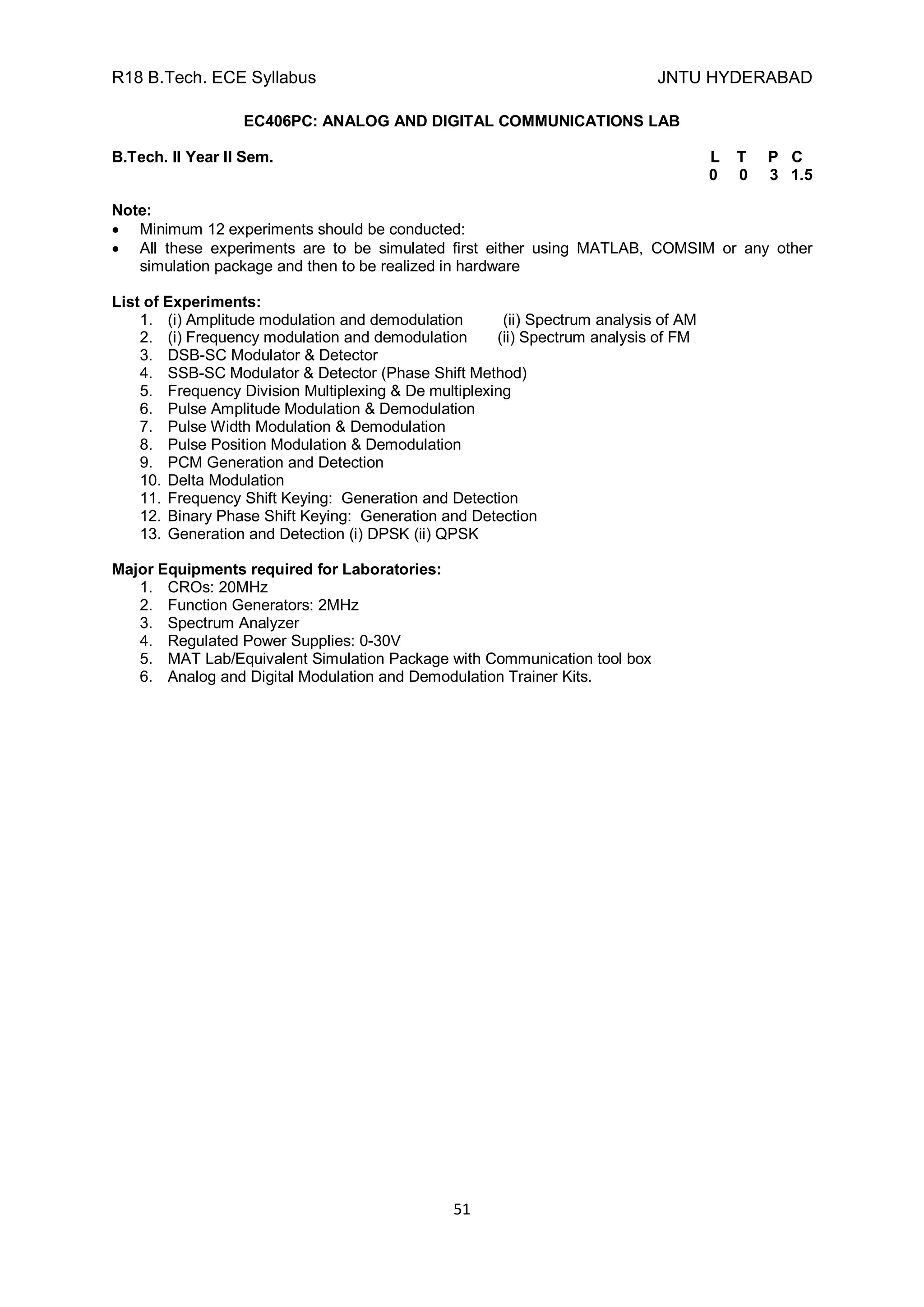
EC406PC: ANALOG AND DIGITAL COMMUNICATIONS LAB
B.Tech. II Year II Sem. L T P C
0 0 3 1.5
Note:
 Minimum 12 experiments should be conducted:
 All these experiments are to be simulated first either using MATLAB, COMSIM or any other
simulation package and then to be realized in hardware
List of Experiments:
1. (i) Amplitude modulation and demodulation (ii) Spectrum analysis of AM
2. (i) Frequency modulation and demodulation (ii) Spectrum analysis of FM
3. DSB-SC Modulator & Detector
4. SSB-SC Modulator & Detector (Phase Shift Method)
5. Frequency Division Multiplexing & De multiplexing
6. Pulse Amplitude Modulation & Demodulation
7. Pulse Width Modulation & Demodulation
8. Pulse Position Modulation & Demodulation
9. PCM Generation and Detection
10. Delta Modulation
11. Frequency Shift Keying: Generation and Detection
12. Binary Phase Shift Keying: Generation and Detection
13. Generation and Detection (i) DPSK (ii) QPSK
Major Equipments required for Laboratories:
1. CROs: 20MHz
2. Function Generators: 2MHz
3. Spectrum Analyzer
4. Regulated Power Supplies: 0-30V
5. MAT Lab/Equivalent Simulation Package with Communication tool box
6. Analog and Digital Modulation and Demodulation Trainer Kits.
R18 B.Tech. ECE Syllabus JNTU HYDERABAD
52
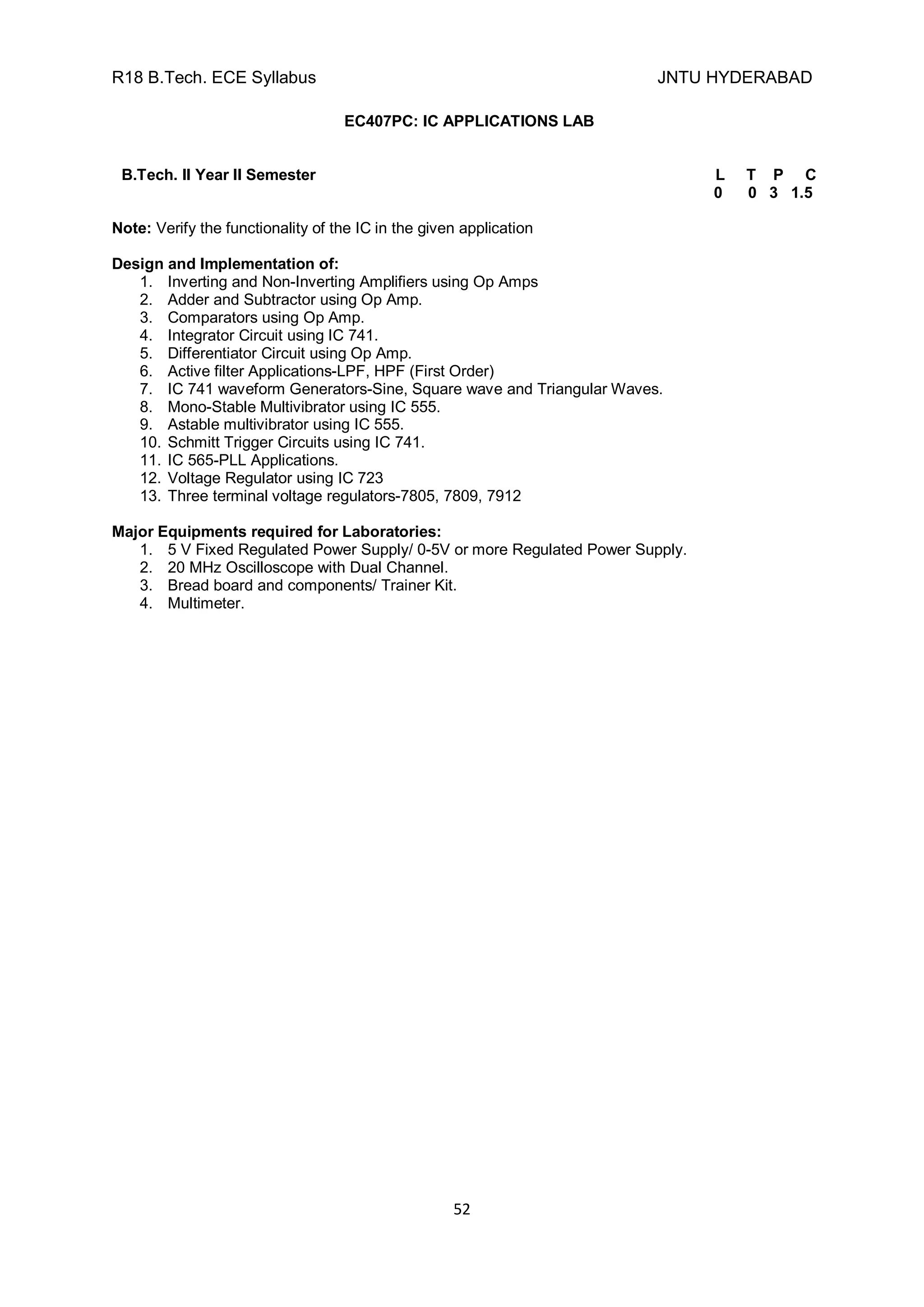
EC407PC: IC APPLICATIONS LAB
B.Tech. II Year II Semester L T P C
0 0 3 1.5
Note: Verify the functionality of the IC in the given application
Design and Implementation of:
1. Inverting and Non-Inverting Amplifiers using Op Amps
2. Adder and Subtractor using Op Amp.
3. Comparators using Op Amp.
4. Integrator Circuit using IC 741.
5. Differentiator Circuit using Op Amp.
6. Active filter Applications-LPF, HPF (First Order)
7. IC 741 waveform Generators-Sine, Square wave and Triangular Waves.
8. Mono-Stable Multivibrator using IC 555.
9. Astable multivibrator using IC 555.
10. Schmitt Trigger Circuits using IC 741.
11. IC 565-PLL Applications.
12. Voltage Regulator using IC 723
13. Three terminal voltage regulators-7805, 7809, 7912
Major Equipments required for Laboratories:
1. 5 V Fixed Regulated Power Supply/ 0-5V or more Regulated Power Supply.
2. 20 MHz Oscilloscope with Dual Channel.
3. Bread board and components/ Trainer Kit.
4. Multimeter.
R18 B.Tech. ECE Syllabus JNTU HYDERABAD
53
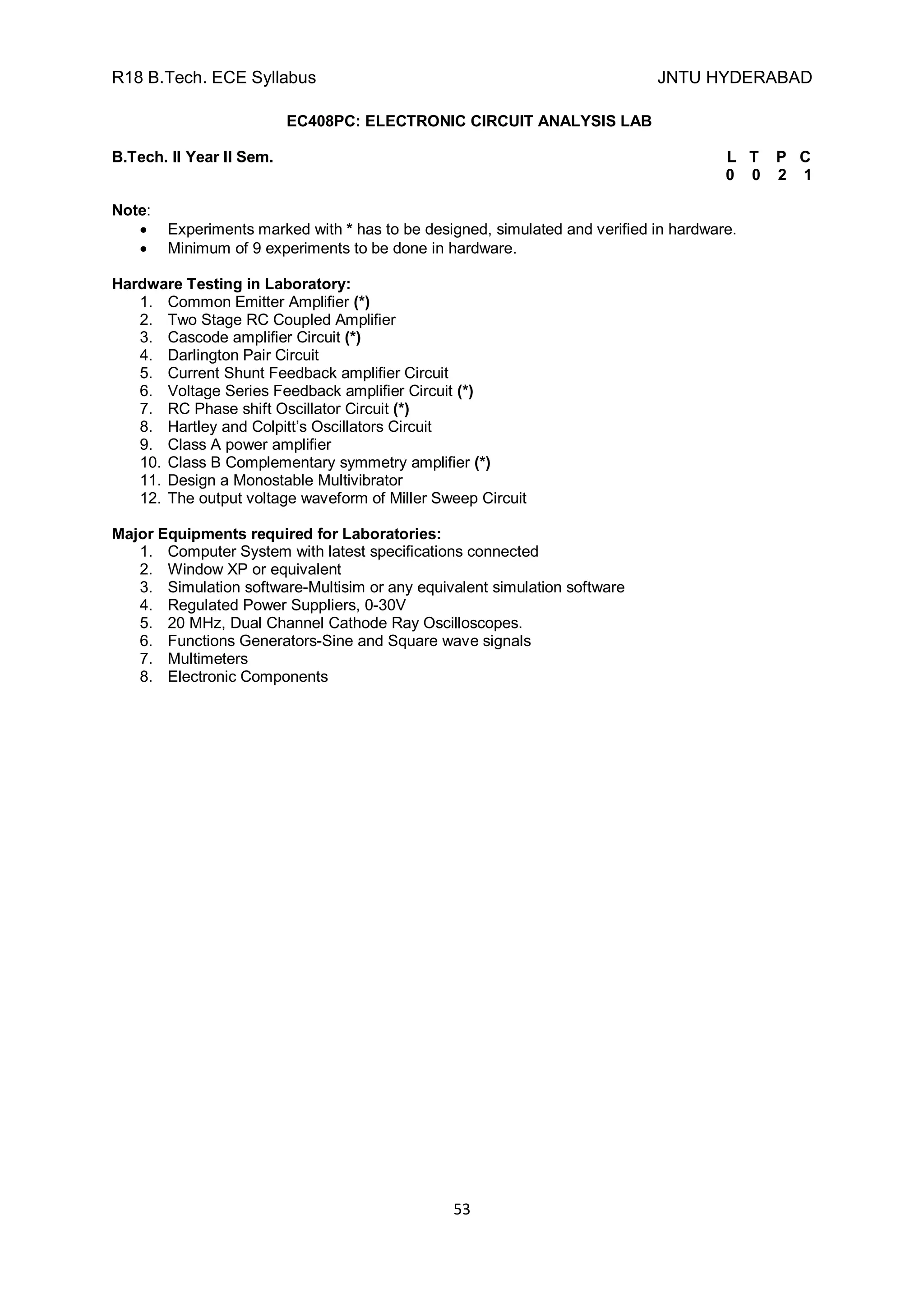
EC408PC: ELECTRONIC CIRCUIT ANALYSIS LAB
B.Tech. II Year II Sem. L T P C
0 0 2 1
Note:
 Experiments marked with * has to be designed, simulated and verified in hardware.
 Minimum of 9 experiments to be done in hardware.
Hardware Testing in Laboratory:
1. Common Emitter Amplifier (*)
2. Two Stage RC Coupled Amplifier
3. Cascode amplifier Circuit (*)
4. Darlington Pair Circuit
5. Current Shunt Feedback amplifier Circuit
6. Voltage Series Feedback amplifier Circuit (*)
7. RC Phase shift Oscillator Circuit (*)
8. Hartley and Colpitt’s Oscillators Circuit
9. Class A power amplifier
10. Class B Complementary symmetry amplifier (*)
11. Design a Monostable Multivibrator
12. The output voltage waveform of Miller Sweep Circuit
Major Equipments required for Laboratories:
1. Computer System with latest specifications connected
2. Window XP or equivalent
3. Simulation software-Multisim or any equivalent simulation software
4. Regulated Power Suppliers, 0-30V
5. 20 MHz, Dual Channel Cathode Ray Oscilloscopes.
6. Functions Generators-Sine and Square wave signals
7. Multimeters
8. Electronic Components
R18 B.Tech. ECE Syllabus JNTU HYDERABAD
54
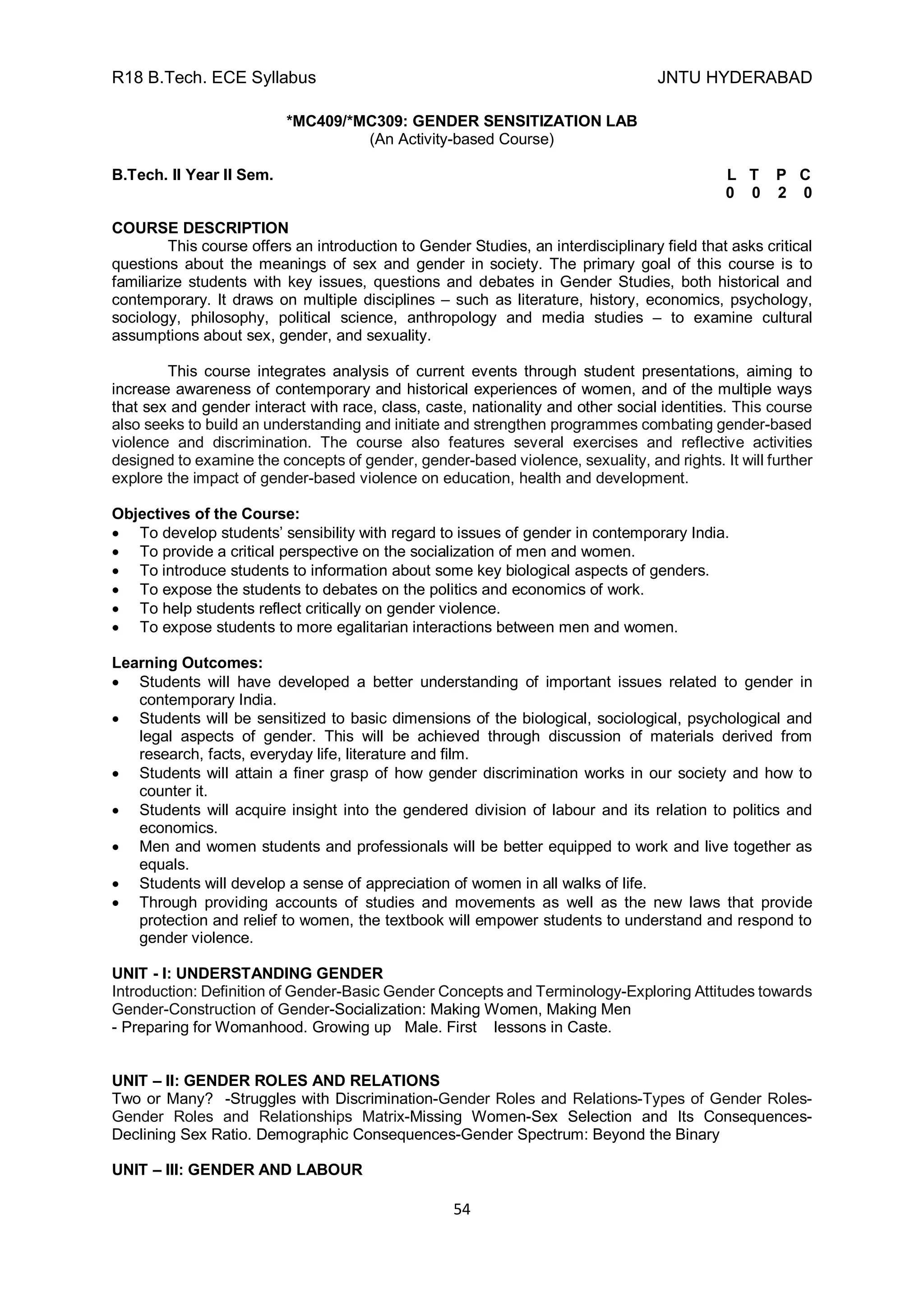
*MC409/*MC309: GENDER SENSITIZATION LAB
(An Activity-based Course)
B.Tech. II Year II Sem. L T P C
0 0 2 0
COURSE DESCRIPTION
This course offers an introduction to Gender Studies, an interdisciplinary field that asks critical
questions about the meanings of sex and gender in society. The primary goal of this course is to
familiarize students with key issues, questions and debates in Gender Studies, both historical and
contemporary. It draws on multiple disciplines – such as literature, history, economics, psychology,
sociology, philosophy, political science, anthropology and media studies – to examine cultural
assumptions about sex, gender, and sexuality.
This course integrates analysis of current events through student presentations, aiming to
increase awareness of contemporary and historical experiences of women, and of the multiple ways
that sex and gender interact with race, class, caste, nationality and other social identities. This course
also seeks to build an understanding and initiate and strengthen programmes combating gender-based
violence and discrimination. The course also features several exercises and reflective activities
designed to examine the concepts of gender, gender-based violence, sexuality, and rights. It will further
explore the impact of gender-based violence on education, health and development.
Objectives of the Course:
 To develop students’ sensibility with regard to issues of gender in contemporary India.
 To provide a critical perspective on the socialization of men and women.
 To introduce students to information about some key biological aspects of genders.
 To expose the students to debates on the politics and economics of work.
 To help students reflect critically on gender violence.
 To expose students to more egalitarian interactions between men and women.
Learning Outcomes:
 Students will have developed a better understanding of important issues related to gender in
contemporary India.
 Students will be sensitized to basic dimensions of the biological, sociological, psychological and
legal aspects of gender. This will be achieved through discussion of materials derived from
research, facts, everyday life, literature and film.
 Students will attain a finer grasp of how gender discrimination works in our society and how to
counter it.
 Students will acquire insight into the gendered division of labour and its relation to politics and
economics.
 Men and women students and professionals will be better equipped to work and live together as
equals.
 Students will develop a sense of appreciation of women in all walks of life.
 Through providing accounts of studies and movements as well as the new laws that provide
protection and relief to women, the textbook will empower students to understand and respond to
gender violence.
UNIT - I: UNDERSTANDING GENDER
Introduction: Definition of Gender-Basic Gender Concepts and Terminology-Exploring Attitudes towards
Gender-Construction of Gender-Socialization: Making Women, Making Men
- Preparing for Womanhood. Growing up Male. First lessons in Caste.
UNIT – II: GENDER ROLES AND RELATIONS
Two or Many? -Struggles with Discrimination-Gender Roles and Relations-Types of Gender Roles-
Gender Roles and Relationships Matrix-Missing Women-Sex Selection and Its Consequences-
Declining Sex Ratio. Demographic Consequences-Gender Spectrum: Beyond the Binary
UNIT – III: GENDER AND LABOUR
R18 B.Tech. ECE Syllabus JNTU HYDERABAD
55
Division and Valuation of Labour-Housework: The Invisible Labor- “My Mother doesn’t Work.” “Share
the Load.”-Work: Its Politics and Economics -Fact and Fiction. Unrecognized and Unaccounted work. -
Gender Development Issues-Gender, Governance and Sustainable Development-Gender and Human
Rights-Gender and Mainstreaming
UNIT – IV: GENDER - BASED VIOLENCE
The Concept of Violence- Types of Gender-based Violence-Gender-based Violence from a Human
Rights Perspective-Sexual Harassment: Say No! -Sexual Harassment, not Eve-teasing- Coping with
Everyday Harassment- Further Reading: “Chupulu”.
Domestic Violence: Speaking OutIs Home a Safe Place? -When Women Unite [Film]. Rebuilding Lives.
Thinking about Sexual Violence Blaming the Victim-“I Fought for my Life….”
UNIT – V: GENDER AND CULTURE
Gender and Film-Gender and Electronic Media-Gender and Advertisement-Gender and Popular
Literature- Gender Development Issues-Gender Issues-Gender Sensitive Language-Gender and
Popular Literature - Just Relationships: Being Together as Equals
Mary Kom and Onler. Love and Acid just do not Mix. Love Letters. Mothers and Fathers. Rosa Parks-
The Brave Heart.
Note: Since it is Interdisciplinary Course, Resource Persons can be drawn from the fields of
English Literature or Sociology or Political Science or any other qualified faculty who has
expertise in this field from engineering departments.
 Classes will consist of a combination of activities: dialogue-based lectures, discussions,
collaborative learning activities, group work and in-class assignments. Apart from the
above prescribed book, Teachers can make use of any authentic materials related to the
topics given in the syllabus on “Gender”.
 ESSENTIAL READING: The Textbook, “Towards a World of Equals: A Bilingual Textbook on
Gender” written by A.Suneetha, Uma Bhrugubanda, DuggiralaVasanta, Rama Melkote,
Vasudha Nagaraj, Asma Rasheed, Gogu Shyamala, Deepa Sreenivas and Susie Tharu
published by Telugu Akademi, Telangana Government in 2015.
ASSESSMENT AND GRADING:
 Discussion & Classroom Participation: 20%
 Project/Assignment: 30%
 End Term Exam: 50%
R18 B.Tech. ECE Syllabus JNTU HYDERABAD
2
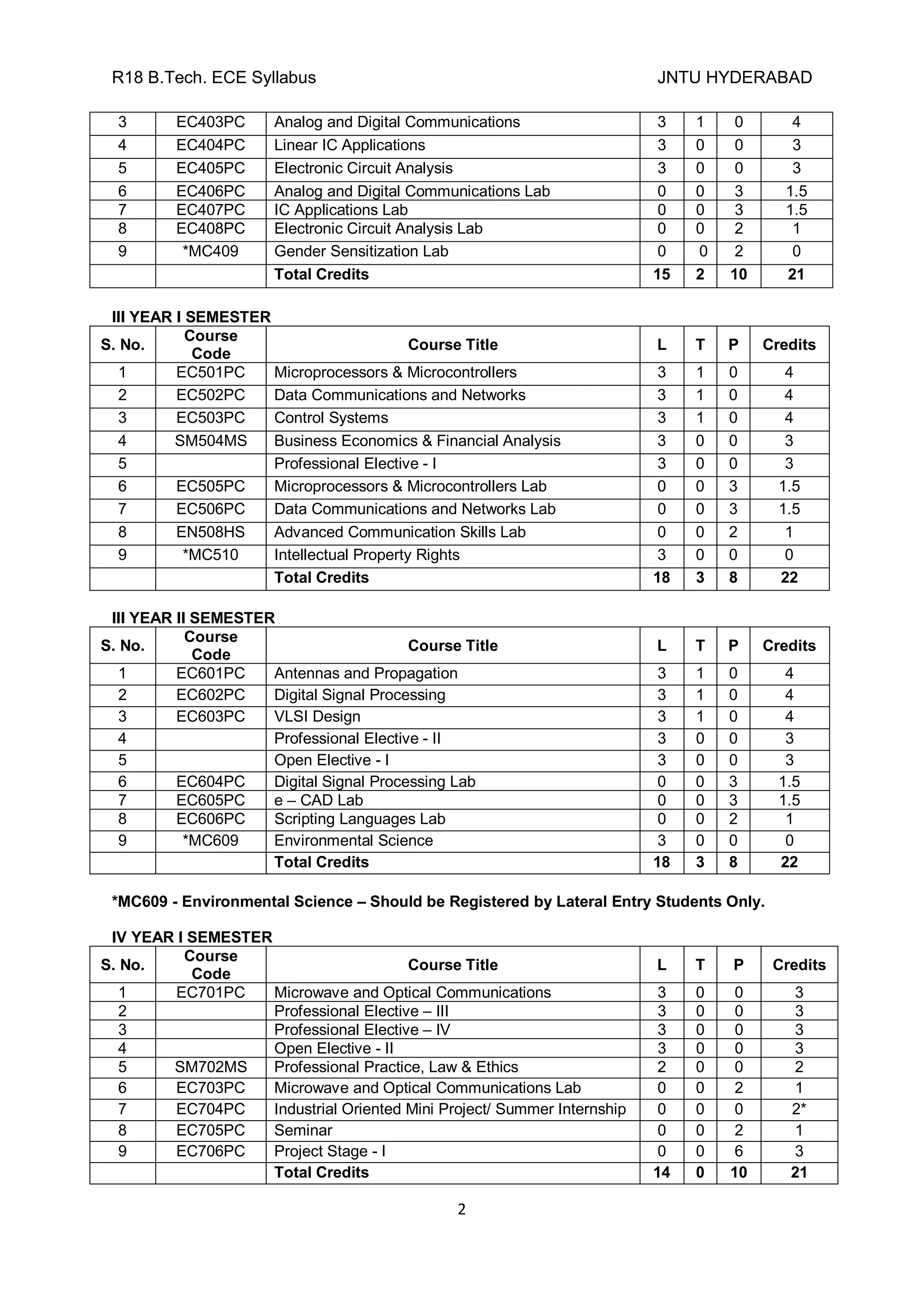
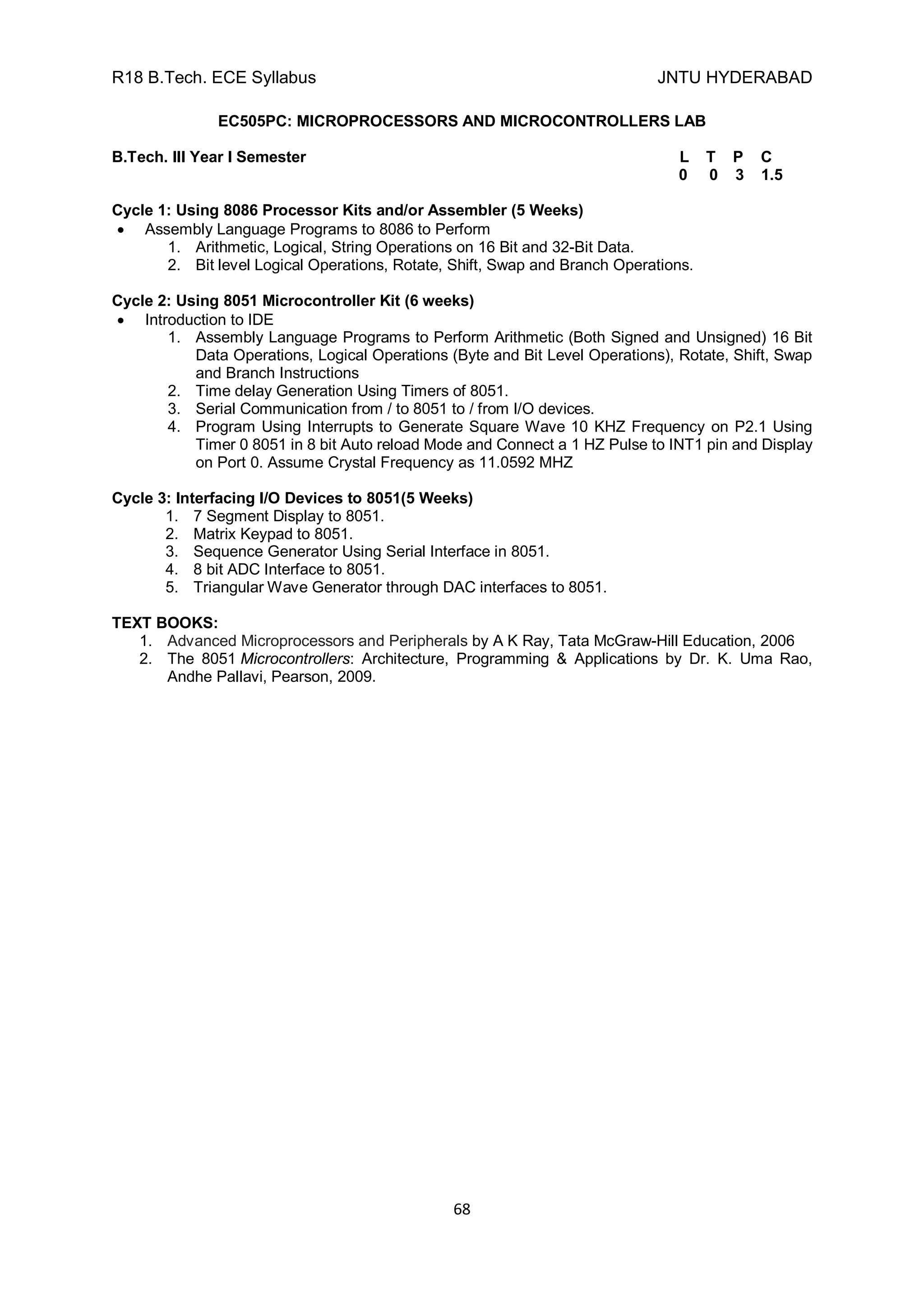
3 EC403PC Analog and Digital Communications 3 1 0 4
4 EC404PC Linear IC Applications 3 0 0 3
5 EC405PC Electronic Circuit Analysis 3 0 0 3
6 EC406PC Analog and Digital Communications Lab 0 0 3 1.5
7 EC407PC IC Applications Lab 0 0 3 1.5
8 EC408PC Electronic Circuit Analysis Lab 0 0 2 1
9 *MC409 Gender Sensitization Lab 0 0 2 0
Total Credits 15 2 10 21
III YEAR I SEMESTER
S. No.
Course
Code
Course Title L T P Credits
1 EC501PC Microprocessors & Microcontrollers 3 1 0 4
2 EC502PC Data Communications and Networks 3 1 0 4
3 EC503PC Control Systems 3 1 0 4
4 SM504MS Business Economics & Financial Analysis 3 0 0 3
5 Professional Elective - I 3 0 0 3
6 EC505PC Microprocessors & Microcontrollers Lab 0 0 3 1.5
7 EC506PC Data Communications and Networks Lab 0 0 3 1.5
8 EN508HS Advanced Communication Skills Lab 0 0 2 1
9 *MC510 Intellectual Property Rights 3 0 0 0
Total Credits 18 3 8 22
III YEAR II SEMESTER
S. No.
Course
Code
Course Title L T P Credits
1 EC601PC Antennas and Propagation 3 1 0 4
2 EC602PC Digital Signal Processing 3 1 0 4
3 EC603PC VLSI Design 3 1 0 4
4 Professional Elective - II 3 0 0 3
5 Open Elective - I 3 0 0 3
6 EC604PC Digital Signal Processing Lab 0 0 3 1.5
7 EC605PC e – CAD Lab 0 0 3 1.5
8 EC606PC Scripting Languages Lab 0 0 2 1
9 *MC609 Environmental Science 3 0 0 0
Total Credits 18 3 8 22
*MC609 - Environmental Science – Should be Registered by Lateral Entry Students Only.
IV YEAR I SEMESTER
S. No.
Course
Code
Course Title L T P Credits
1 EC701PC Microwave and Optical Communications 3 0 0 3
2 Professional Elective – III 3 0 0 3
3 Professional Elective – IV 3 0 0 3
4 Open Elective - II 3 0 0 3
5 SM702MS Professional Practice, Law & Ethics 2 0 0 2
6 EC703PC Microwave and Optical Communications Lab 0 0 2 1
7 EC704PC Industrial Oriented Mini Project/ Summer Internship 0 0 0 2*
8 EC705PC Seminar 0 0 2 1
9 EC706PC Project Stage - I 0 0 6 3
Total Credits 14 0 10 21
R18 B.Tech. ECE Syllabus JNTU HYDERABAD
56
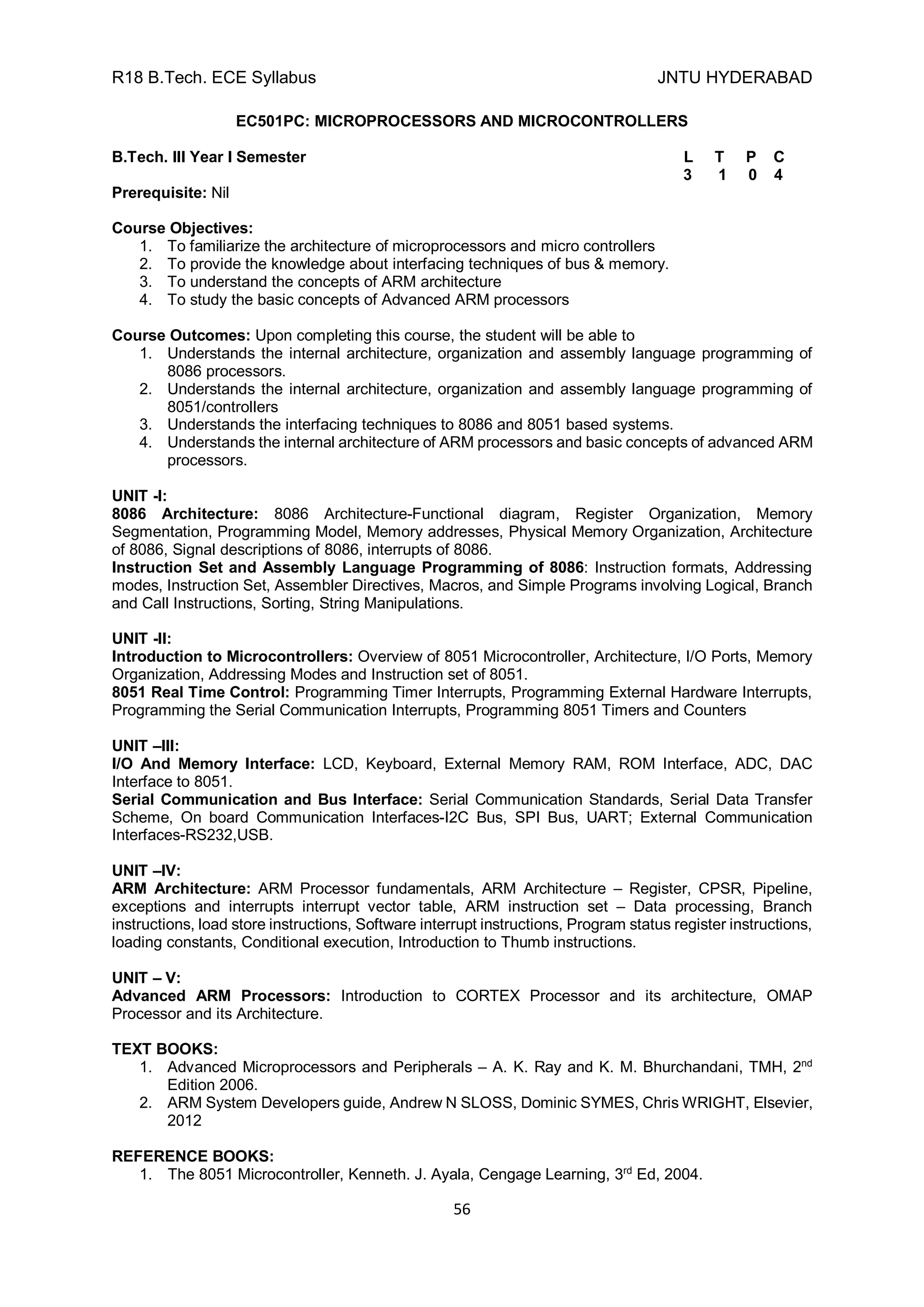
EC501PC: MICROPROCESSORS AND MICROCONTROLLERS
B.Tech. III Year I Semester L T P C
3 1 0 4
Prerequisite: Nil
Course Objectives:
1. To familiarize the architecture of microprocessors and micro controllers
2. To provide the knowledge about interfacing techniques of bus & memory.
3. To understand the concepts of ARM architecture
4. To study the basic concepts of Advanced ARM processors
Course Outcomes: Upon completing this course, the student will be able to
1. Understands the internal architecture, organization and assembly language programming of
8086 processors.
2. Understands the internal architecture, organization and assembly language programming of
8051/controllers
3. Understands the interfacing techniques to 8086 and 8051 based systems.
4. Understands the internal architecture of ARM processors and basic concepts of advanced ARM
processors.
UNIT -I:
8086 Architecture: 8086 Architecture-Functional diagram, Register Organization, Memory
Segmentation, Programming Model, Memory addresses, Physical Memory Organization, Architecture
of 8086, Signal descriptions of 8086, interrupts of 8086.
Instruction Set and Assembly Language Programming of 8086: Instruction formats, Addressing
modes, Instruction Set, Assembler Directives, Macros, and Simple Programs involving Logical, Branch
and Call Instructions, Sorting, String Manipulations.
UNIT -II:
Introduction to Microcontrollers: Overview of 8051 Microcontroller, Architecture, I/O Ports, Memory
Organization, Addressing Modes and Instruction set of 8051.
8051 Real Time Control: Programming Timer Interrupts, Programming External Hardware Interrupts,
Programming the Serial Communication Interrupts, Programming 8051 Timers and Counters
UNIT –III:
I/O And Memory Interface: LCD, Keyboard, External Memory RAM, ROM Interface, ADC, DAC
Interface to 8051.
Serial Communication and Bus Interface: Serial Communication Standards, Serial Data Transfer
Scheme, On board Communication Interfaces-I2C Bus, SPI Bus, UART; External Communication
Interfaces-RS232,USB.
UNIT –IV:
ARM Architecture: ARM Processor fundamentals, ARM Architecture – Register, CPSR, Pipeline,
exceptions and interrupts interrupt vector table, ARM instruction set – Data processing, Branch
instructions, load store instructions, Software interrupt instructions, Program status register instructions,
loading constants, Conditional execution, Introduction to Thumb instructions.
UNIT – V:
Advanced ARM Processors: Introduction to CORTEX Processor and its architecture, OMAP
Processor and its Architecture.
TEXT BOOKS:
1. Advanced Microprocessors and Peripherals – A. K. Ray and K. M. Bhurchandani, TMH, 2nd
Edition 2006.
2. ARM System Developers guide, Andrew N SLOSS, Dominic SYMES, Chris WRIGHT, Elsevier,
2012
REFERENCE BOOKS:
1. The 8051 Microcontroller, Kenneth. J. Ayala, Cengage Learning, 3rd
Ed, 2004.
R18 B.Tech. ECE Syllabus JNTU HYDERABAD
57
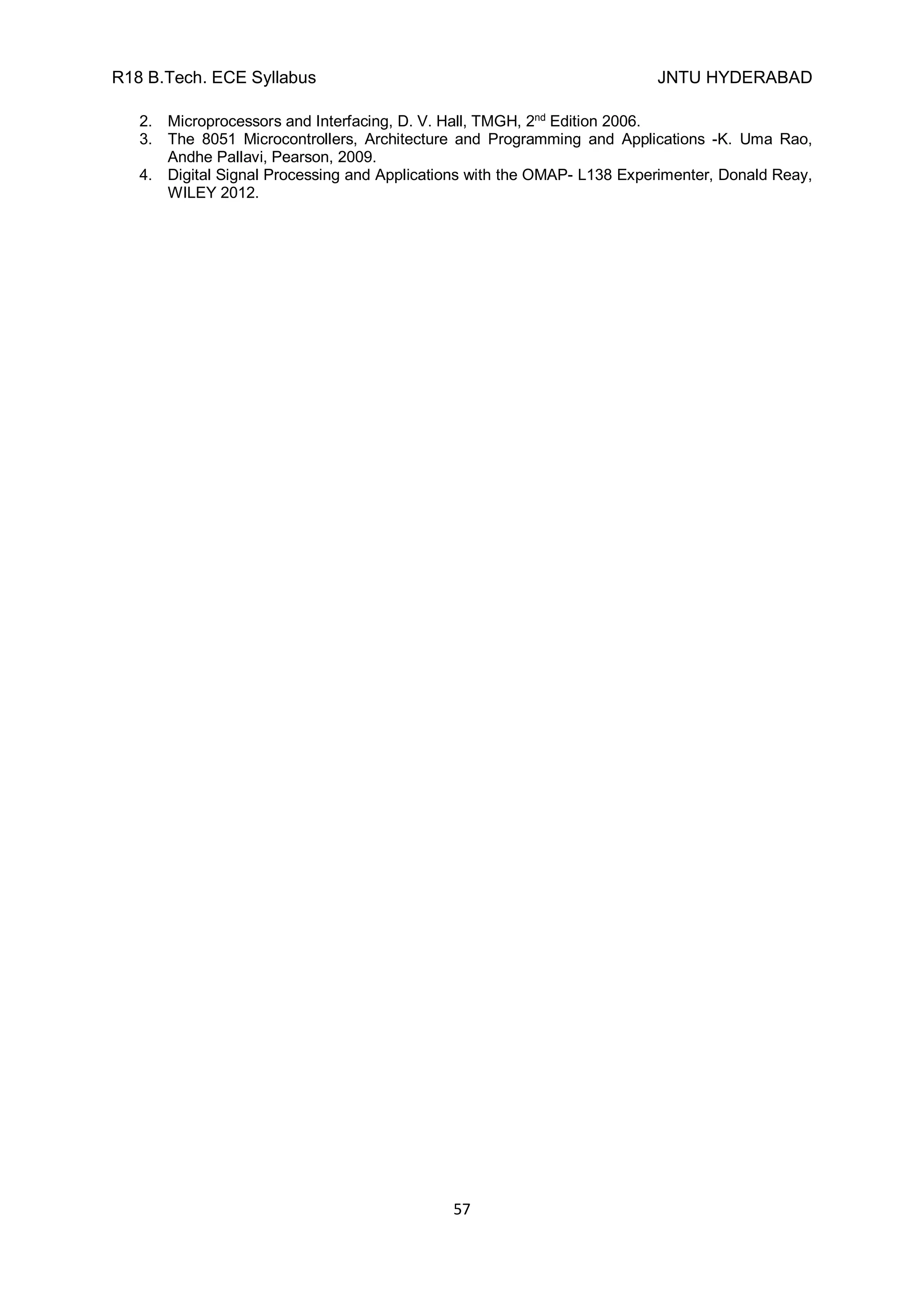
2. Microprocessors and Interfacing, D. V. Hall, TMGH, 2nd
Edition 2006.
3. The 8051 Microcontrollers, Architecture and Programming and Applications -K. Uma Rao,
Andhe Pallavi, Pearson, 2009.
4. Digital Signal Processing and Applications with the OMAP- L138 Experimenter, Donald Reay,
WILEY 2012.
R18 B.Tech. ECE Syllabus JNTU HYDERABAD
58
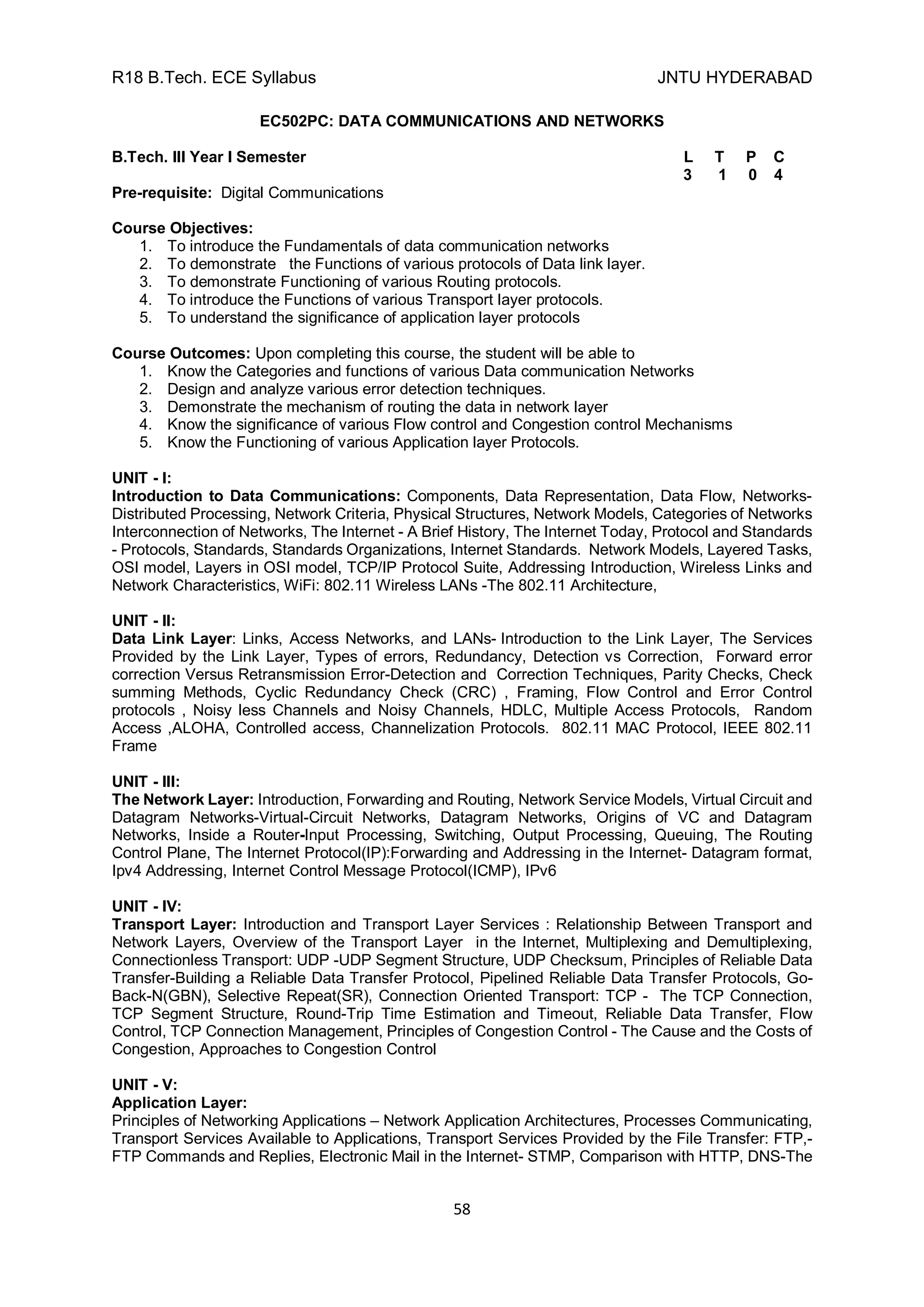
EC502PC: DATA COMMUNICATIONS AND NETWORKS
B.Tech. III Year I Semester L T P C
3 1 0 4
Pre-requisite: Digital Communications
Course Objectives:
1. To introduce the Fundamentals of data communication networks
2. To demonstrate the Functions of various protocols of Data link layer.
3. To demonstrate Functioning of various Routing protocols.
4. To introduce the Functions of various Transport layer protocols.
5. To understand the significance of application layer protocols
Course Outcomes: Upon completing this course, the student will be able to
1. Know the Categories and functions of various Data communication Networks
2. Design and analyze various error detection techniques.
3. Demonstrate the mechanism of routing the data in network layer
4. Know the significance of various Flow control and Congestion control Mechanisms
5. Know the Functioning of various Application layer Protocols.
UNIT - I:
Introduction to Data Communications: Components, Data Representation, Data Flow, Networks-
Distributed Processing, Network Criteria, Physical Structures, Network Models, Categories of Networks
Interconnection of Networks, The Internet - A Brief History, The Internet Today, Protocol and Standards
- Protocols, Standards, Standards Organizations, Internet Standards. Network Models, Layered Tasks,
OSI model, Layers in OSI model, TCP/IP Protocol Suite, Addressing Introduction, Wireless Links and
Network Characteristics, WiFi: 802.11 Wireless LANs -The 802.11 Architecture,
UNIT - II:
Data Link Layer: Links, Access Networks, and LANs- Introduction to the Link Layer, The Services
Provided by the Link Layer, Types of errors, Redundancy, Detection vs Correction, Forward error
correction Versus Retransmission Error-Detection and Correction Techniques, Parity Checks, Check
summing Methods, Cyclic Redundancy Check (CRC) , Framing, Flow Control and Error Control
protocols , Noisy less Channels and Noisy Channels, HDLC, Multiple Access Protocols, Random
Access ,ALOHA, Controlled access, Channelization Protocols. 802.11 MAC Protocol, IEEE 802.11
Frame
UNIT - III:
The Network Layer: Introduction, Forwarding and Routing, Network Service Models, Virtual Circuit and
Datagram Networks-Virtual-Circuit Networks, Datagram Networks, Origins of VC and Datagram
Networks, Inside a Router-Input Processing, Switching, Output Processing, Queuing, The Routing
Control Plane, The Internet Protocol(IP):Forwarding and Addressing in the Internet- Datagram format,
Ipv4 Addressing, Internet Control Message Protocol(ICMP), IPv6
UNIT - IV:
Transport Layer: Introduction and Transport Layer Services : Relationship Between Transport and
Network Layers, Overview of the Transport Layer in the Internet, Multiplexing and Demultiplexing,
Connectionless Transport: UDP -UDP Segment Structure, UDP Checksum, Principles of Reliable Data
Transfer-Building a Reliable Data Transfer Protocol, Pipelined Reliable Data Transfer Protocols, Go-
Back-N(GBN), Selective Repeat(SR), Connection Oriented Transport: TCP - The TCP Connection,
TCP Segment Structure, Round-Trip Time Estimation and Timeout, Reliable Data Transfer, Flow
Control, TCP Connection Management, Principles of Congestion Control - The Cause and the Costs of
Congestion, Approaches to Congestion Control
UNIT - V:
Application Layer:
Principles of Networking Applications – Network Application Architectures, Processes Communicating,
Transport Services Available to Applications, Transport Services Provided by the File Transfer: FTP,-
FTP Commands and Replies, Electronic Mail in the Internet- STMP, Comparison with HTTP, DNS-The
R18 B.Tech. ECE Syllabus JNTU HYDERABAD
59
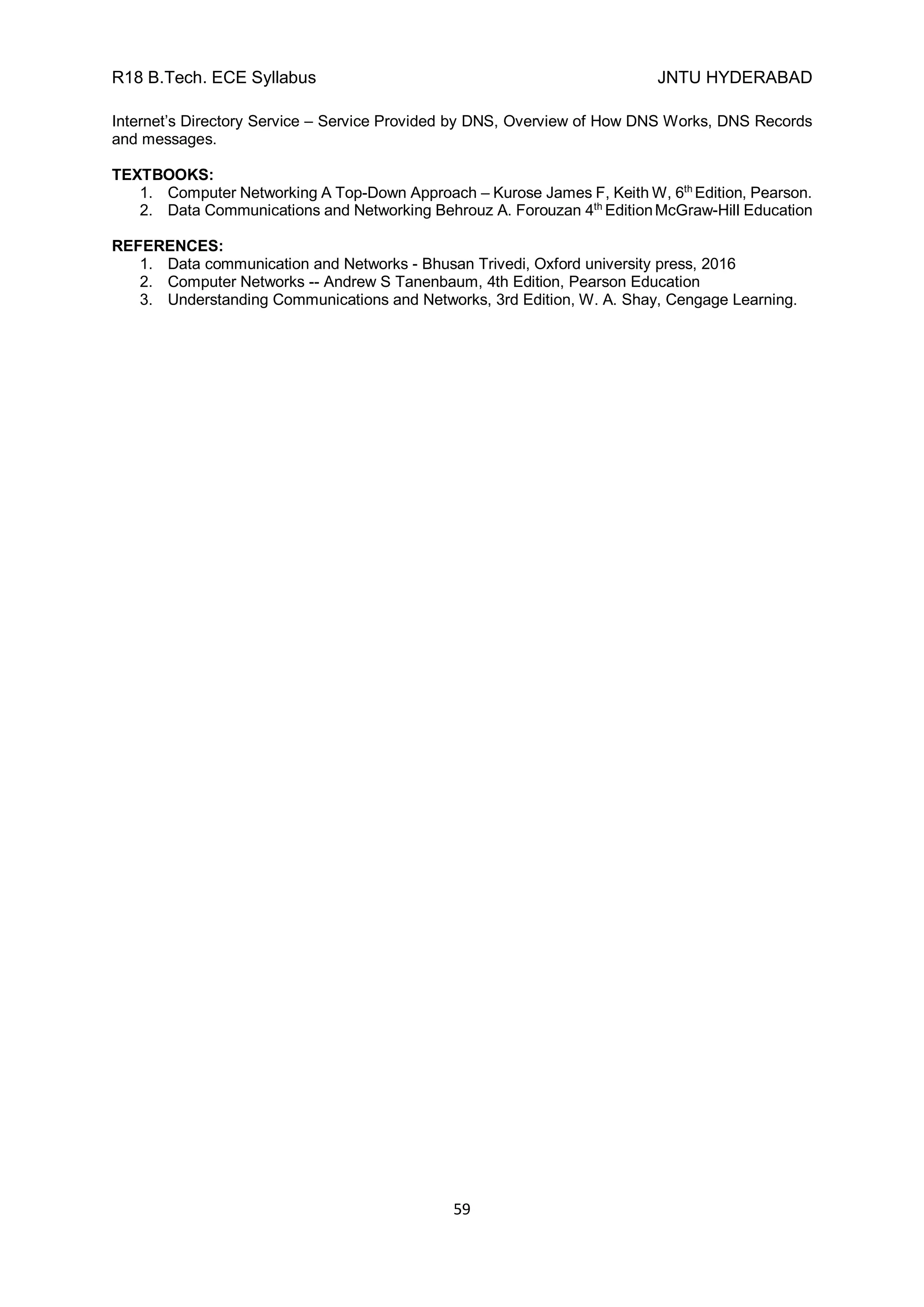
Internet’s Directory Service – Service Provided by DNS, Overview of How DNS Works, DNS Records
and messages.
TEXTBOOKS:
1. Computer Networking A Top-Down Approach – Kurose James F, Keith W, 6th
Edition, Pearson.
2. Data Communications and Networking Behrouz A. Forouzan 4th
EditionMcGraw-Hill Education
REFERENCES:
1. Data communication and Networks - Bhusan Trivedi, Oxford university press, 2016
2. Computer Networks -- Andrew S Tanenbaum, 4th Edition, Pearson Education
3. Understanding Communications and Networks, 3rd Edition, W. A. Shay, Cengage Learning.
R18 B.Tech. ECE Syllabus JNTU HYDERABAD
60
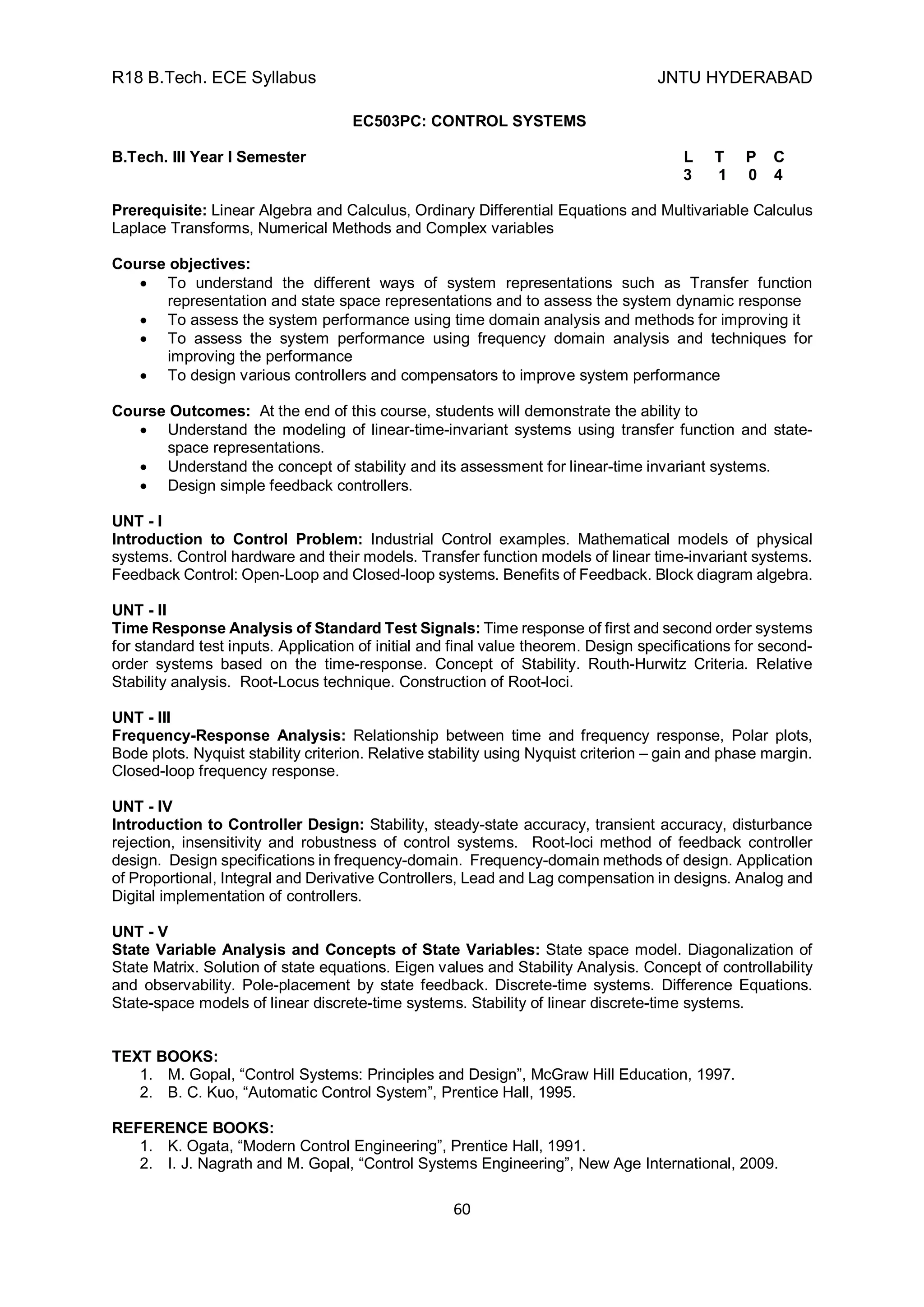
EC503PC: CONTROL SYSTEMS
B.Tech. III Year I Semester L T P C
3 1 0 4
Prerequisite: Linear Algebra and Calculus, Ordinary Differential Equations and Multivariable Calculus
Laplace Transforms, Numerical Methods and Complex variables
Course objectives:
 To understand the different ways of system representations such as Transfer function
representation and state space representations and to assess the system dynamic response
 To assess the system performance using time domain analysis and methods for improving it
 To assess the system performance using frequency domain analysis and techniques for
improving the performance
 To design various controllers and compensators to improve system performance
Course Outcomes: At the end of this course, students will demonstrate the ability to
 Understand the modeling of linear-time-invariant systems using transfer function and state-
space representations.
 Understand the concept of stability and its assessment for linear-time invariant systems.
 Design simple feedback controllers.
UNT - I
Introduction to Control Problem: Industrial Control examples. Mathematical models of physical
systems. Control hardware and their models. Transfer function models of linear time-invariant systems.
Feedback Control: Open-Loop and Closed-loop systems. Benefits of Feedback. Block diagram algebra.
UNT - II
Time Response Analysis of Standard Test Signals: Time response of first and second order systems
for standard test inputs. Application of initial and final value theorem. Design specifications for second-
order systems based on the time-response. Concept of Stability. Routh-Hurwitz Criteria. Relative
Stability analysis. Root-Locus technique. Construction of Root-loci.
UNT - III
Frequency-Response Analysis: Relationship between time and frequency response, Polar plots,
Bode plots. Nyquist stability criterion. Relative stability using Nyquist criterion – gain and phase margin.
Closed-loop frequency response.
UNT - IV
Introduction to Controller Design: Stability, steady-state accuracy, transient accuracy, disturbance
rejection, insensitivity and robustness of control systems. Root-loci method of feedback controller
design. Design specifications in frequency-domain. Frequency-domain methods of design. Application
of Proportional, Integral and Derivative Controllers, Lead and Lag compensation in designs. Analog and
Digital implementation of controllers.
UNT - V
State Variable Analysis and Concepts of State Variables: State space model. Diagonalization of
State Matrix. Solution of state equations. Eigen values and Stability Analysis. Concept of controllability
and observability. Pole-placement by state feedback. Discrete-time systems. Difference Equations.
State-space models of linear discrete-time systems. Stability of linear discrete-time systems.
TEXT BOOKS:
1. M. Gopal, “Control Systems: Principles and Design”, McGraw Hill Education, 1997.
2. B. C. Kuo, “Automatic Control System”, Prentice Hall, 1995.
REFERENCE BOOKS:
1. K. Ogata, “Modern Control Engineering”, Prentice Hall, 1991.
2. I. J. Nagrath and M. Gopal, “Control Systems Engineering”, New Age International, 2009.
R18 B.Tech. ECE Syllabus JNTU HYDERABAD
61
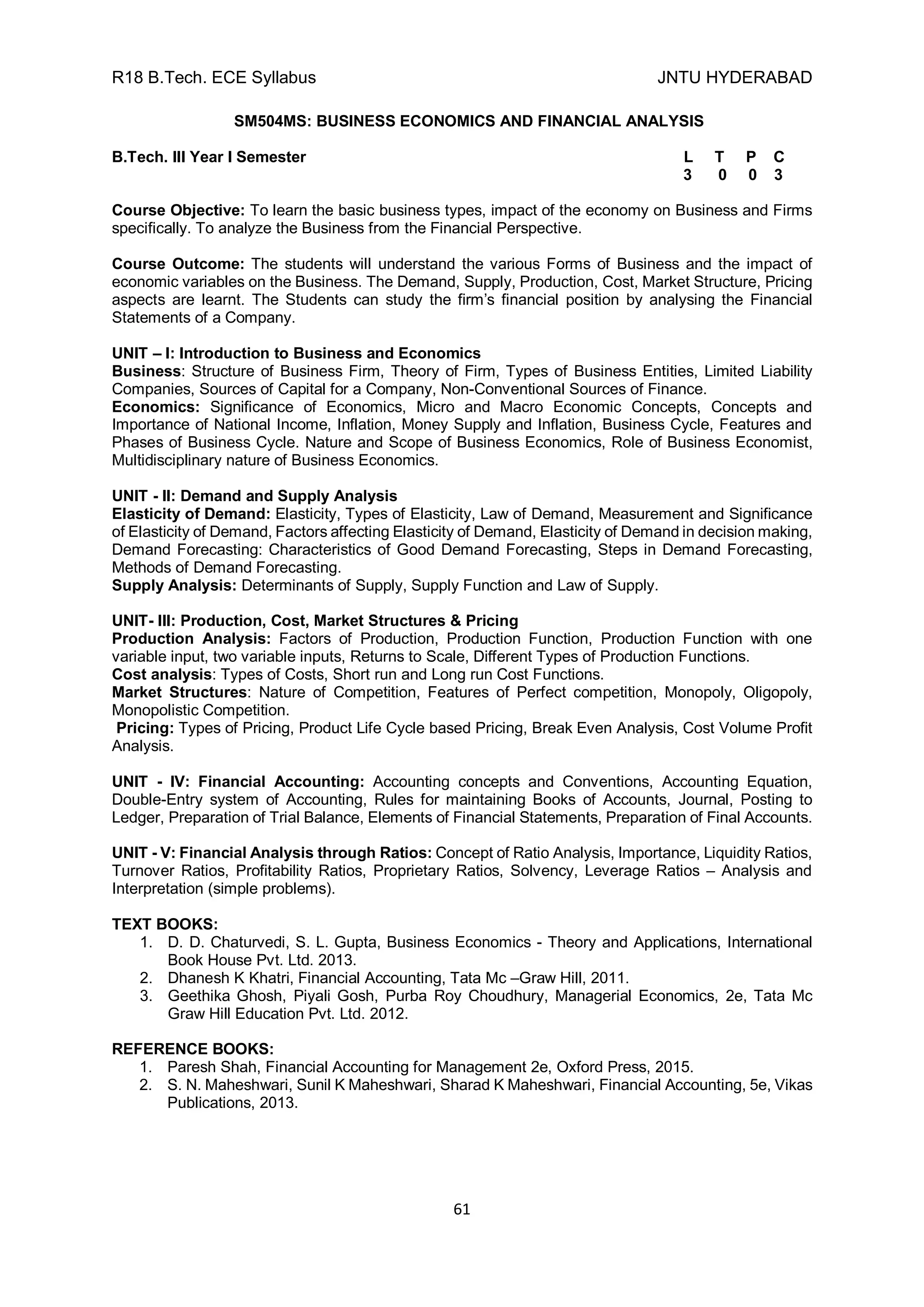
SM504MS: BUSINESS ECONOMICS AND FINANCIAL ANALYSIS
B.Tech. III Year I Semester L T P C
3 0 0 3
Course Objective: To learn the basic business types, impact of the economy on Business and Firms
specifically. To analyze the Business from the Financial Perspective.
Course Outcome: The students will understand the various Forms of Business and the impact of
economic variables on the Business. The Demand, Supply, Production, Cost, Market Structure, Pricing
aspects are learnt. The Students can study the firm’s financial position by analysing the Financial
Statements of a Company.
UNIT – I: Introduction to Business and Economics
Business: Structure of Business Firm, Theory of Firm, Types of Business Entities, Limited Liability
Companies, Sources of Capital for a Company, Non-Conventional Sources of Finance.
Economics: Significance of Economics, Micro and Macro Economic Concepts, Concepts and
Importance of National Income, Inflation, Money Supply and Inflation, Business Cycle, Features and
Phases of Business Cycle. Nature and Scope of Business Economics, Role of Business Economist,
Multidisciplinary nature of Business Economics.
UNIT - II: Demand and Supply Analysis
Elasticity of Demand: Elasticity, Types of Elasticity, Law of Demand, Measurement and Significance
of Elasticity of Demand, Factors affecting Elasticity of Demand, Elasticity of Demand in decision making,
Demand Forecasting: Characteristics of Good Demand Forecasting, Steps in Demand Forecasting,
Methods of Demand Forecasting.
Supply Analysis: Determinants of Supply, Supply Function and Law of Supply.
UNIT- III: Production, Cost, Market Structures & Pricing
Production Analysis: Factors of Production, Production Function, Production Function with one
variable input, two variable inputs, Returns to Scale, Different Types of Production Functions.
Cost analysis: Types of Costs, Short run and Long run Cost Functions.
Market Structures: Nature of Competition, Features of Perfect competition, Monopoly, Oligopoly,
Monopolistic Competition.
Pricing: Types of Pricing, Product Life Cycle based Pricing, Break Even Analysis, Cost Volume Profit
Analysis.
UNIT - IV: Financial Accounting: Accounting concepts and Conventions, Accounting Equation,
Double-Entry system of Accounting, Rules for maintaining Books of Accounts, Journal, Posting to
Ledger, Preparation of Trial Balance, Elements of Financial Statements, Preparation of Final Accounts.
UNIT - V: Financial Analysis through Ratios: Concept of Ratio Analysis, Importance, Liquidity Ratios,
Turnover Ratios, Profitability Ratios, Proprietary Ratios, Solvency, Leverage Ratios – Analysis and
Interpretation (simple problems).
TEXT BOOKS:
1. D. D. Chaturvedi, S. L. Gupta, Business Economics - Theory and Applications, International
Book House Pvt. Ltd. 2013.
2. Dhanesh K Khatri, Financial Accounting, Tata Mc –Graw Hill, 2011.
3. Geethika Ghosh, Piyali Gosh, Purba Roy Choudhury, Managerial Economics, 2e, Tata Mc
Graw Hill Education Pvt. Ltd. 2012.
REFERENCE BOOKS:
1. Paresh Shah, Financial Accounting for Management 2e, Oxford Press, 2015.
2. S. N. Maheshwari, Sunil K Maheshwari, Sharad K Maheshwari, Financial Accounting, 5e, Vikas
Publications, 2013.
R18 B.Tech. ECE Syllabus JNTU HYDERABAD
62
EC511PE: COMPUTER ORGANIZATION & OPERATING SYSTEMS
B.Tech. III Year I Semester L T P C
3 0 0 3
Course Objectives:
1. To understand the structure of a computer and its operations.
2. To understand the RTL and Micro-level operations and control in a computer.
3. Understanding the concepts of I/O and memory organization and operating systems.
Course Outcomes:
1. Able to visualize the organization of different blocks in a computer.
2. Able to use micro-level operations to control different units in a computer.
3. Able to use Operating systems in a computer.
UNIT - I:
Basic Structure of Computers: Computer Types, Functional Unit, Basic OPERATIONAL Concepts,
Bus Structures, Software, Performance, Multiprocessors and Multi Computers, Data Representation,
Fixed Point Representation, Floating – Point Representation.
Register Transfer Language and Micro Operations: Register Transfer Language, Register Transfer
Bus and Memory Transfers, Arithmetic Micro Operations, Logic Micro Operations, Shift Micro
Operations, Arithmetic Logic Shift Unit, Instruction Codes, Computer Registers Computer Instructions
– Instruction Cycle, Memory – Reference Instructions, Input – Output and Interrupt, STACK
Organization, Instruction Formats, Addressing Modes, DATA Transfer and Manipulation, Program
Control, Reduced Instruction Set Computer.
UNIT - II:
Micro Programmed Control: Control Memory, Address Sequencing, Microprogram Examples, Design
of Control Unit, Hard Wired Control, Microprogrammed Control
The Memory System: Basic Concepts of Semiconductor RAM Memories, Read-Only Memories,
Cache Memories Performance Considerations, Virtual Memories Secondary Storage, Introduction to
RAID.
UNIT - III:
Input-Output Organization: Peripheral Devices, Input-Output Interface, Asynchronous Data Transfer
Modes, Priority Interrupt, Direct Memory Access, Input –Output Processor (IOP), Serial
Communication; Introduction to Peripheral Components, Interconnect (PCI) Bus, Introduction to
Standard Serial Communication Protocols like RS232, USB, IEEE 1394.
UNIT - IV:
Operating Systems Overview: Overview of Computer Operating Systems Functions, Protection and
Security, Distributed Systems, Special Purpose Systems, Operating Systems Structures-Operating
System Services and Systems Calls, System Programs, Operating Systems Generation
Memory Management: Swapping, Contiguous Memory Allocation, Paging, Structure of The Page
Table, Segmentation, Virtual Memory, Demand Paging, Page-Replacement Algorithms, Allocation of
Frames, Thrashing Case Studies - UNIX, Linux, Windows
Principles of Deadlock: System Model, Deadlock Characterization, Deadlock Prevention, Detection
and Avoidance, Recovery from Deadlock.
UNIT - V:
File System Interface: The Concept of a File, Access Methods, Directory Structure, File System
Mounting, File Sharing, Protection.
File System Implementation: File System Structure, File System Implementation, Directory
Implementation, Allocation Methods, Free-Space Management.
TEXT BOOKS:
1. Computer Organization – Carl Hamacher, Zvonks Vranesic, Safea Zaky, Vth Edition, McGraw
Hill.
2. Computer Systems Architecture – M. Moris Mano, IIIrd Edition, Pearson
R18 B.Tech. ECE Syllabus JNTU HYDERABAD
63
3. Operating System Concepts- Abraham Silberchatz, Peter B. Galvin, Greg Gagne, 8th Edition,
John Wiley.
REFERENCE BOOKS:
1. Computer Organization and Architecture – William Stallings Sixth Edition, Pearson
2. Structured Computer Organization – Andrew S. Tanenbaum, 4th Edition PHI
3. Fundamentals of Computer Organization and Design - Sivaraama Dandamudi Springer Int.
Edition.
4. Operating Systems – Internals and Design Principles, Stallings, sixth Edition–2009, Pearson
Education.
5. Modern Operating Systems, Andrew S Tanenbaum 2nd
Edition, PHI.
6. Principles of Operating Systems, B.L. Stuart, Cengage Learning, India Edition.
R18 B.Tech. ECE Syllabus JNTU HYDERABAD
64
EC512PE: ERROR CORRECTING CODES
B.Tech. III Year I Semester L T P C
3 0 0 3
Prerequisite: Digital Communications
Course Objectives:
1. To acquire the knowledge in measurement of information and errors.
2. To study the generation of various code methods used in communications.
3. To study the various application of codes.
Course Outcomes:
1. Able to transmit and store reliable data and detect errors in data through coding.
2. Able to understand the designing of various codes like block codes, cyclic codes, convolution
codes, turbo codes and space codes.
UNIT – I:
Coding for Reliable Digital Transmission and storage: Mathematical model of Information, A
Logarithmic Measure of Information, Average and Mutual Information and Entropy, Types of Errors,
Error Control Strategies.
Linear Block Codes: Introduction to Linear Block Codes, Syndrome and Error Detection, Minimum
Distance of a Block code, Error-Detecting and Error-correcting Capabilities of a Block code, Standard
array and Syndrome Decoding, Probability of an undetected error for Linear Codes over a BSC,
Hamming Codes. Applications of Block codes for Error control in data storage system
UNIT - II:
Cyclic Codes: Description, Generator and Parity-check Matrices, Encoding, Syndrome Computation
and Error Detection, Decoding, Cyclic Hamming Codes, Shortened cyclic codes, Error-trapping
decoding for cyclic codes, Majority logic decoding for cyclic codes.
UNIT – III:
Convolutional Codes: Encoding of Convolutional Codes, Structural and Distance Properties,
maximum likelihood decoding, Sequential decoding, Majority- logic decoding of Convolution codes.
Application of Viterbi Decoding and Sequential Decoding, Applications of Convolutional codes in ARQ
system.
UNIT – IV:
Turbo Codes: LDPC Codes- Codes based on sparse graphs, Decoding for binary erasure channel,
Log-likelihood algebra, Brief propagation, Product codes, Iterative decoding of product codes,
Concatenated convolutional codes- Parallel concatenation, The UMTS Turbo code, Serial
concatenation, Parallel concatenation, Turbo decoding
UNIT - V:
Space-Time Codes: Introduction, Digital modulation schemes, Diversity, Orthogonal space- Time
Block codes, Alamouti’s schemes, Extension to more than Two Transmit Antennas, Simulation Results,
Spatial Multiplexing: General Concept, Iterative APP Preprocessing and Per-layer Decoding, Linear
Multilayer Detection, Original BLAST Detection, QL Decomposition and Interface Cancellation,
Performance of Multi – Layer Detection Schemes, Unified Description by Linear Dispersion Codes.
TEXT BOOKS:
1. Error Control Coding- Fundamentals and Applications –Shu Lin, Daniel J. Costello, Jr, Prentice
Hall, Inc.
2. Error Correcting Coding Theory-Man Young Rhee- 1989, McGraw-Hill
REFERENCE BOOKS:
1. Error Correcting Coding Theory-Man Young Rhee-1989, McGraw – Hill Publishing, 19
2. Digital Communications-Fundamental and Application - Bernard Sklar, PE.
3. Digital Communications- John G. Proakis, 5th
ed., 2008, TMH.
4. Introduction to Error Control Codes-Salvatore Gravano-oxford
R18 B.Tech. ECE Syllabus JNTU HYDERABAD
65
5. Error Correction Coding – Mathematical Methods and Algorithms – Todd K. Moon, 2006, Wiley
India.
6. Information Theory, Coding and Cryptography – Ranjan Bose, 2nd
Edition, 2009, TMH.
R18 B.Tech. ECE Syllabus JNTU HYDERABAD
66
EC513PE: ELECTRONIC MEASUREMENTS AND INSTRUMENTATION
B.Tech. III Year I Semester L T P C
3 0 0 3
Prerequisite: Basic Electrical and Electronics Engineering
Course Objectives:
1. It provides an understanding of various measuring system functioning and metrics for
performance analysis.
2. Provides understanding of principle of operation, working of different electronic instruments viz.
signal generators, signal analyzers, recorders and measuring equipment.
3. Understanding the concepts of various measuring bridges and their balancing conditions.
4. Provides understanding of use of various measuring techniques for measurement of different
physical parameters using different classes of transducers.
Course Outcomes: Upon completing this course, the student will be able to
1. Measure electrical parameters with different meters and understand the basic definition of
measuring parameters.
2. Use various types of signal generators, signal analyzers for generating and analyzing various
real-time signals.
3. Operate an Oscilloscope to measure various signals.
4. Measure various physical parameters by appropriately selecting the transducers.
UNIT - I:
Block Schematics of Measuring Systems: Performance Characteristics, Static Characteristics,
Accuracy, Precision, Resolution, Types of Errors, Gaussian Error, Root Sum Squares formula, Dynamic
Characteristics, Repeatability, Reproducibility, Fidelity, Lag; Measuring Instruments: DC Voltmeters, D’
Arsonval Movement, DC Current Meters, AC Voltmeters and Current Meters, Ohmmeters, Multimeters,
Meter Protection, Extension of Range, True RMS Responding Voltmeters, Specifications of
Instruments.
UNIT - II:
Signal Analyzers: AF, HF Wave Analyzers, Harmonic Distortion, Heterodyne wave Analyzers,
Spectrum Analyzers, Power Analyzers, Capacitance-Voltage Meters, Oscillators. Signal Generators:
AF, RF Signal Generators, Sweep Frequency Generators, Pulse and Square wave Generators,
Function Generators, Arbitrary Waveform Generator, Video Signal Generators, and Specifications
UNIT III:
Oscilloscopes: CRT, Block Schematic of CRO, Time Base Circuits, Lissajous Figures, CRO Probes,
High Frequency CRO Considerations, Delay lines, Applications: Measurement of Time, Period and
Frequency Specifications.
Special Purpose Oscilloscopes: Dual Trace, Dual Beam CROs, Sampling Oscilloscopes, Storage
Oscilloscopes, Digital Storage CROs.
UNIT IV:
Transducers: Classification, Strain Gauges, Bounded, unbounded; Force and Displacement
Transducers, Resistance Thermometers, Hotwire Anemometers, LVDT, Thermocouples, Synchros,
Special Resistance Thermometers, Digital Temperature sensing system, Piezoelectric Transducers,
Variable Capacitance Transducers, Magneto Strictive Transducers, gyroscopes, accelerometers.
UNIT V:
Bridges: Wheat Stone Bridge, Kelvin Bridge, and Maxwell Bridge.
Measurement of Physical Parameters: Flow Measurement, Displacement Meters, Liquid level
Measurement, Measurement of Humidity and Moisture, Velocity, Force, Pressure – High Pressure,
Vacuum level, Temperature -Measurements, Data Acquisition Systems.
TEXT BOOKS:
1. Modern Electronic Instrumentation and Measurement Techniques: A.D. Helbincs, W. D.
Cooper: PHI 5th
Edition 2003.
2. Electronic Instrumentation: H. S. Kalsi – TMH, 2nd
Edition 2004.
R18 B.Tech. ECE Syllabus JNTU HYDERABAD
67
REFERENCE BOOKS:
1. Electrical and Electronic Measurement and Measuring Instruments – A K Sawhney, Dhanpat
Rai & Sons, 2013.
2. Electronic Instrumentation and Measurements – David A. Bell, Oxford Univ. Press, 1997.
3. Industrial Instrumentation: T.R. Padmanabham Springer 2009.
4. Electronic Measurements and Instrumentation – K. Lal Kishore, Pearson Education 2010.
R18 B.Tech. ECE Syllabus JNTU HYDERABAD
68
EC505PC: MICROPROCESSORS AND MICROCONTROLLERS LAB
B.Tech. III Year I Semester L T P C
0 0 3 1.5
Cycle 1: Using 8086 Processor Kits and/or Assembler (5 Weeks)
 Assembly Language Programs to 8086 to Perform
1. Arithmetic, Logical, String Operations on 16 Bit and 32-Bit Data.
2. Bit level Logical Operations, Rotate, Shift, Swap and Branch Operations.
Cycle 2: Using 8051 Microcontroller Kit (6 weeks)
 Introduction to IDE
1. Assembly Language Programs to Perform Arithmetic (Both Signed and Unsigned) 16 Bit
Data Operations, Logical Operations (Byte and Bit Level Operations), Rotate, Shift, Swap
and Branch Instructions
2. Time delay Generation Using Timers of 8051.
3. Serial Communication from / to 8051 to / from I/O devices.
4. Program Using Interrupts to Generate Square Wave 10 KHZ Frequency on P2.1 Using
Timer 0 8051 in 8 bit Auto reload Mode and Connect a 1 HZ Pulse to INT1 pin and Display
on Port 0. Assume Crystal Frequency as 11.0592 MHZ
Cycle 3: Interfacing I/O Devices to 8051(5 Weeks)
1. 7 Segment Display to 8051.
2. Matrix Keypad to 8051.
3. Sequence Generator Using Serial Interface in 8051.
4. 8 bit ADC Interface to 8051.
5. Triangular Wave Generator through DAC interfaces to 8051.
TEXT BOOKS:
1. Advanced Microprocessors and Peripherals by A K Ray, Tata McGraw-Hill Education, 2006
2. The 8051 Microcontrollers: Architecture, Programming & Applications by Dr. K. Uma Rao,
Andhe Pallavi, Pearson, 2009.
R18 B.Tech. ECE Syllabus JNTU HYDERABAD
69
EC506PC: DATA COMMUNICATIONS AND NETWORKS LAB
B.Tech. III Year I Semester L T P C
0 0 3 1.5
Note:
A. Minimum of 12 Experiments have to be conducted
B. All the Experiments may be Conducted using Network Simulation software like NS-2, NSG-2.1
and Wire SHARK/equivalent software.
Note: For Experiments 2 to 10 Performance may be evaluated through simulation by using the
parameters Throughput, Packet Delivery Ratio, Delay etc.
1. Writing a TCL Script to create two nodes and links between nodes
2. Writing a TCL Script to transmit data between nodes
3. Evaluate the performance of various LAN Topologies
4. Evaluate the performance of Drop Tail and RED queue management schemes
5. Evaluate the performance of CBQ and FQ Scheduling Mechanisms
6. Evaluate the performance of TCP and UDP Protocols
7. Evaluate the performance of TCP, New Reno and Vegas
8. Evaluate the performance of AODV and DSR routing protocols
9. Evaluate the performance of AODV and DSDV routing protocols
10. Evaluate the performance of IEEE 802.11 and IEEE 802.15.4
11. Evaluate the performance of IEEE 802.11 and SMAC
12. Capturing and Analysis of TCP and IP Packets
13. Simulation and Analysis of ICMP and IGMP Packets
14. Analyze the Protocols SCTP, ARP, NetBIOS, IPX VINES
15. Analysis of HTTP, DNS and DHCP Protocols
Major Equipment Required:
Required software (Open Source) like NS-2, NSG-2.1 and Wire SHARK
R18 B.Tech. ECE Syllabus JNTU HYDERABAD
70
EN508HS: ADVANCED COMMUNICATION SKILLS LAB
B.Tech. III Year I Semester L T P C
0 0 2 1
1. INTRODUCTION:
The introduction of the Advanced Communication Skills Lab is considered essential at 3rd
year level. At
this stage, the students need to prepare themselves for their careers which may require them to listen
to, read, speak and write in English both for their professional and interpersonal communication in the
globalized context.
The proposed course should be a laboratory course to enable students to use ‘good’ English and
perform the following:
 Gathering ideas and information to organize ideas relevantly and coherently.
 Engaging in debates.
 Participating in group discussions.
 Facing interviews.
 Writing project/research reports/technical reports.
 Making oral presentations.
 Writing formal letters.
 Transferring information from non-verbal to verbal texts and vice-versa.
 Taking part in social and professional communication.
2. OBJECTIVES:
This Lab focuses on using multi-media instruction for language development to meet the following
targets:
 To improve the students’ fluency in English, through a well-developed vocabulary and enable
them to listen to English spoken at normal conversational speed by educated English speakers
and respond appropriately in different socio-cultural and professional contexts.
 Further, they would be required to communicate their ideas relevantly and coherently in writing.
 To prepare all the students for their placements.
3. SYLLABUS:
The following course content to conduct the activities is prescribed for the Advanced English
Communication Skills (AECS) Lab:
1. Activities on Fundamentals of Inter-personal Communication and Building Vocabulary -
Starting a conversation – responding appropriately and relevantly – using the right body language
– Role Play in different situations & Discourse Skills- using visuals - Synonyms and antonyms, word
roots, one-word substitutes, prefixes and suffixes, study of word origin, business vocabulary,
analogy, idioms and phrases, collocations & usage of vocabulary.
2. Activities on Reading Comprehension –General Vs Local comprehension, reading for facts,
guessing meanings from context, scanning, skimming, inferring meaning, critical reading& effective
googling.
3. Activities on Writing Skills – Structure and presentation of different types of writing – letter
writing/Resume writing/ e-correspondence/Technical report writing/ – planning for writing –
improving one’s writing.
4. Activities on Presentation Skills – Oral presentations (individual and group) through JAM
sessions/seminars/PPTs and written presentations through posters/projects/reports/ e-
mails/assignments etc.
5. Activities on Group Discussion and Interview Skills – Dynamics of group discussion,
intervention, summarizing, modulation of voice, body language, relevance, fluency and organization
of ideas and rubrics for evaluation- Concept and process, pre-interview planning, opening
strategies, answering strategies, interview through tele-conference & video-conference and Mock
Interviews.
4. MINIMUM REQUIREMENT:
The Advanced English Communication Skills (AECS) Laboratory shall have the following infrastructural
facilities to accommodate at least 35 students in the lab:
 Spacious room with appropriate acoustics.
 Round Tables with movable chairs
R18 B.Tech. ECE Syllabus JNTU HYDERABAD
71
 Audio-visual aids
 LCD Projector
 Public Address system
 P – IV Processor, Hard Disk – 80 GB, RAM–512 MB Minimum, Speed – 2.8 GHZ
 T. V, a digital stereo & Camcorder
 Headphones of High quality
5. SUGGESTED SOFTWARE:
The software consisting of the prescribed topics elaborated above should be procured and used.
 Oxford Advanced Learner’s Compass, 7th
Edition
 DELTA’s key to the Next Generation TOEFL Test: Advanced Skill Practice.
 Lingua TOEFL CBT Insider, by Dream tech
 TOEFL & GRE (KAPLAN, AARCO & BARRONS, USA, Cracking GRE by CLIFFS)
TEXT BOOKS:
1. Effective Technical Communication by M Asharaf Rizvi. McGraw Hill Education (India) Pvt. Ltd.
2nd
Edition
2. Academic Writing: A Handbook for International Students by Stephen Bailey, Routledge, 5th
Edition.
REFERENCES:
1. Learn Correct English – A Book of Grammar, Usage and Composition by Shiv K. Kumar and
Hemalatha Nagarajan. Pearson 2007
2. Professional Communication by Aruna Koneru, McGraw Hill Education (India) Pvt. Ltd, 2016.
3. Technical Communication by Meenakshi Raman & Sangeeta Sharma, Oxford University Press
2009.
4. Technical Communication by Paul V. Anderson. 2007. Cengage Learning pvt. Ltd. New Delhi.
5. English Vocabulary in Use series, Cambridge University Press 2008.
6. Handbook for Technical Communication by David A. McMurrey & Joanne Buckley. 2012. Cengage
Learning.
7. Communication Skills by Leena Sen, PHI Learning Pvt Ltd., New Delhi, 2009.
8. Job Hunting by Colm Downes, Cambridge University Press 2008.
9. English for Technical Communication for Engineering Students, Aysha Vishwamohan, Tata Mc
Graw-Hill 2009.
R18 B.Tech. ECE Syllabus JNTU HYDERABAD
72
*MC510: INTELLECTUAL PROPERTY RIGHTS
B.Tech. III Year I Semester L T P C
3 0 0 0
UNIT – I
Introduction to Intellectual property: Introduction, types of intellectual property, international
organizations, agencies and treaties, importance of intellectual property rights.
UNIT – II
Trade Marks: Purpose and function of trademarks, acquisition of trade mark rights, protectable matter,
selecting, and evaluating trade mark, trade mark registration processes.
UNIT – III
Law of copy rights: Fundamental of copy right law, originality of material, rights of reproduction, rights
to perform the work publicly, copy right ownership issues, copy right registration, notice of copy right,
international copy right law.
Law of patents: Foundation of patent law, patent searching process, ownership rights and transfer
UNIT – IV
Trade Secrets: Trade secrete law, determination of trade secrete status, liability for misappropriations
of trade secrets, protection for submission, trade secrete litigation.
Unfair competition: Misappropriation right of publicity, false advertising.
UNIT – V
New development of intellectual property: new developments in trade mark law; copy right law, patent
law, intellectual property audits.
International overview on intellectual property, international – trade mark law, copy right law,
international patent law, and international development in trade secrets law.
TEXT & REFERENCE BOOKS:
1. Intellectual property right, Deborah. E. Bouchoux, Cengage learning.
2. Intellectual property right – Unleashing the knowledge economy, prabuddha ganguli, Tata
McGraw Hill Publishing company ltd.
R18 B.Tech. ECE Syllabus JNTU HYDERABAD
2
3 EC403PC Analog and Digital Communications 3 1 0 4
4 EC404PC Linear IC Applications 3 0 0 3
5 EC405PC Electronic Circuit Analysis 3 0 0 3
6 EC406PC Analog and Digital Communications Lab 0 0 3 1.5
7 EC407PC IC Applications Lab 0 0 3 1.5
8 EC408PC Electronic Circuit Analysis Lab 0 0 2 1
9 *MC409 Gender Sensitization Lab 0 0 2 0
Total Credits 15 2 10 21
III YEAR I SEMESTER
S. No.
Course
Code
Course Title L T P Credits
1 EC501PC Microprocessors & Microcontrollers 3 1 0 4
2 EC502PC Data Communications and Networks 3 1 0 4
3 EC503PC Control Systems 3 1 0 4
4 SM504MS Business Economics & Financial Analysis 3 0 0 3
5 Professional Elective - I 3 0 0 3
6 EC505PC Microprocessors & Microcontrollers Lab 0 0 3 1.5
7 EC506PC Data Communications and Networks Lab 0 0 3 1.5
8 EN508HS Advanced Communication Skills Lab 0 0 2 1
9 *MC510 Intellectual Property Rights 3 0 0 0
Total Credits 18 3 8 22
III YEAR II SEMESTER
S. No.
Course
Code
Course Title L T P Credits
1 EC601PC Antennas and Propagation 3 1 0 4
2 EC602PC Digital Signal Processing 3 1 0 4
3 EC603PC VLSI Design 3 1 0 4
4 Professional Elective - II 3 0 0 3
5 Open Elective - I 3 0 0 3
6 EC604PC Digital Signal Processing Lab 0 0 3 1.5
7 EC605PC e – CAD Lab 0 0 3 1.5
8 EC606PC Scripting Languages Lab 0 0 2 1
9 *MC609 Environmental Science 3 0 0 0
Total Credits 18 3 8 22
*MC609 - Environmental Science – Should be Registered by Lateral Entry Students Only.
IV YEAR I SEMESTER
S. No.
Course
Code
Course Title L T P Credits
1 EC701PC Microwave and Optical Communications 3 0 0 3
2 Professional Elective – III 3 0 0 3
3 Professional Elective – IV 3 0 0 3
4 Open Elective - II 3 0 0 3
5 SM702MS Professional Practice, Law & Ethics 2 0 0 2
6 EC703PC Microwave and Optical Communications Lab 0 0 2 1
7 EC704PC Industrial Oriented Mini Project/ Summer Internship 0 0 0 2*
8 EC705PC Seminar 0 0 2 1
9 EC706PC Project Stage - I 0 0 6 3
Total Credits 14 0 10 21
R18 B.Tech. ECE Syllabus JNTU HYDERABAD
73
EC601PC: ANTENNAS AND PROPAGATION
B.Tech. III Year II Semester L T P C
3 1 0 4
Pre-requisite: Electromagnetic Theory and Transmission Lines
Course Objectives: The course objectives are:
1. To understand the concept of radiation, antenna definitions and significance of antenna
parameters, to derive and analyze the radiation characteristics of thin wire dipole antennas
and solve numerical problems.
2. To analyze the characteristics and design relations of UHF, VHF and Microwave Antennas.
3. To identify the antenna array requirements, to determine the characteristics of ULAs and
estimate the patterns of BSA, EFA, and Binomial Arrays.
4. To understand the concepts and set-up requirements for microwave measurements, and
familiarize with the procedure to enable antenna measurements.
5. To define and distinguish between different phenomenon of wave propagation (ground wave,
space wave and sky wave), their frequency dependence, and estimate their characteristics,
identifying their profiles and parameters involved.
Course Outcomes: Upon completing this course, the student will be able to explain the mechanism
of radiation, definitions of different antenna characteristic parameters and establish their mathematical
relations.
1. Characterize the antennas based on frequency, configure the geometry and establish the
radiation patterns of VHF, UHF and Microwave antennas and also antenna arrays.
2. Specify the requirements for microwave measurements and arrange a setup to carry out the
antenna far zone pattern and gain measurements in the laboratory.
3. Classify the different wave propagation mechanisms, determine the characteristic features of
different wave propagations, and estimate the parameters involved.
UNIT - I
Antenna Basics: Basic Antenna Parameters – Patterns, Beam Area, Radiation Intensity, Beam
Efficiency, Directivity-Gain-Resolution, Antenna Apertures, Effective Height.
Fields from Oscillating Dipole, Field Zones, Front - to-back Ratio, Antenna Theorems, Radiation,
Retarded Potentials – Helmholtz Theorem
Thin Linear Wire Antennas – Radiation from Small Electric Dipole, Quarter Wave Monopole and Half
Wave Dipole – Current Distributions, Field Components, Radiated Power, Radiation Resistance, Beam
Width, Directivity, Effective Area and Effective Height, Natural Current Distributions, Far Fields and
Patterns of Thin Linear Centre-fed Antennas of Different Lengths. Loop Antennas - Small Loop,
Comparison of Far Fields of Small Loop and Short Dipole, Radiation Resistances and Directivities of
Small Loops (Qualitative Treatment).
UNIT - II
Antenna Arrays: Point Sources – Definition, Patterns, arrays of 2 Isotropic Sources - Different Cases,
Principle of Pattern Multiplication, Uniform Linear Arrays – Broadside Arrays, Endfire Arrays, EFA with
Increased Directivity, Derivation of their Characteristics and Comparison, BSAs with Non-uniform
Amplitude Distributions – General Considerations and Binomial Arrays.
Antenna Measurements: Introduction, Concepts - Reciprocity, Near and Far Fields, Coordinate
System, Sources of Errors. Patterns to be Measured, Directivity Measurement, Gain Measurements
(by Comparison, Absolute and 3-Antenna Methods)
UNIT - III:
VHF, UHF and Microwave Antennas - I: Arrays with Parasitic Elements, Yagi-Uda Array, Folded
Dipoles and their Characteristics, Helical Antennas – Helical Geometry, Helix Modes, Practical Design
Considerations for Monofilar Helical Antenna in Axial and Normal Modes, Horn Antennas – Types,
Fermat’s Principle, Optimum Horns, Design Considerations of Pyramidal Horns.
UNIT - IV
VHF, UHF and Microwave Antennas - II: Microstrip Antennas – Introduction, Features, Advantages
and Limitations, Rectangular Patch Antennas – Geometry and Parameters, Characteristics of Microstrip
R18 B.Tech. ECE Syllabus JNTU HYDERABAD
74
Antennas. Reflector Antennas – Introduction, Flat Sheet and Corner Reflectors, Paraboloidal
Reflectors – Geometry, Pattern Characteristics, Feed Methods, Reflector Types – Related Features.
UNIT - V:
Wave Propagation - Definitions, Categorizations and General Classifications, Different Modes of Wave
Propagation, Ray/Mode Concepts,
Ground Wave Propagation –Plane Earth Reflections, Space and Surface Waves, Wave Tilt, Curved
Earth Reflections.
Space Wave Propagation –Field Strength Variation with Distance and Height, Effect of Earth’s
Curvature, Absorption, Super Refraction, M-Curves and Duct Propagation, Scattering Phenomena,
Troposphere Propagation.
Sky Wave Propagation –Structure of Ionosphere, Refraction and Reflection of Sky Waves by
Ionosphere, Ray Path, Critical Frequency, MUF, LUF, OF, Virtual Height and Skip Distance, Relation
between MUF and Skip Distance, Multi-hop Propagation.
TEXT BOOKS:
1. Antennas and Wave Propagation – J.D. Kraus, R.J. Marhefka and Ahmad S. Khan, TMH, New
Delhi, 4th ed., (Special Indian Edition), 2010.
2. Electromagnetic Waves and Radiating Systems – E.C. Jordan and K.G. Balmain, PHI, 2nd ed.,
2000.
REFERENCE BOOKS:
1. Antenna Theory - C.A. Balanis, John Wiley & Sons, 3rd
Ed., 2005.
2. Antennas and Wave Propagation – K.D. Prasad, Satya Prakashan, Tech India Publications,
New Delhi, 2001.
3. Radio Engineering Handbook- Keith henney, 3rd
edition TMH.
4. Antenna Engineering Handbook –John Leonidas Volakis, 3rd
edition, 2007
R18 B.Tech. ECE Syllabus JNTU HYDERABAD
75
EC602PC: DIGITAL SIGNAL PROCESSING
B.Tech. III Year II Semester L T P C
3 1 0 4
Prerequisite: Signals and Systems
Course Objectives:
1. To provide background and fundamental material for the analysis and processing of digital
signals.
2. To understand the fast computation of DFT and appreciate the FFT processing.
3. To study the designs and structures of digital (IIR and FIR) filters and analyze and synthesize
for a given specifications.
4. To acquaint in Multi-rate signal processing techniques and finite word length effects.
Course Outcomes: Upon completing this course, the student will be able to
1. Understand the LTI system characteristics and Multirate signal processing.
2. Understand the inter-relationship between DFT and various transforms.
3. Design a digital filter for a given specification.
4. Understand the significance of various filter structures and effects of round off errors.
UNIT - I:
Introduction: Introduction to Digital Signal Processing: Discrete Time Signals & Sequences,
conversion of continuous to discrete signal, Normalized Frequency, Linear Shift Invariant Systems,
Stability, and Causality, linear differential equation to difference equation, Linear Constant Coefficient
Difference Equations, Frequency Domain Representation of Discrete Time Signals and Systems
Multirate Digital Signal Processing: Introduction, Down Sampling, Decimation, Up sampling,
Interpolation, Sampling Rate Conversion.
UNIT - II:
Discrete Fourier series: Fourier Series, Fourier Transform, Laplace Transform and Z-Transform
relation, DFS Representation of Periodic Sequences, Properties of Discrete Fourier Series, Discrete
Fourier Transforms: Properties of DFT, Linear Convolution of Sequences using DFT, Computation of
DFT: Over-Lap Add Method, Over-Lap Save Method, Relation between DTFT, DFS, DFT and Z-
Transform.
Fast Fourier Transforms: Fast Fourier Transforms (FFT) - Radix-2 Decimation-in-Time and
Decimation-in-Frequency FFT Algorithms, Inverse FFT.
UNIT - III
IIR Digital Filters: Analog filter approximations – Butterworth and Chebyshev, Design of IIR Digital
Filters from Analog Filters, Step and Impulse Invariant Techniques, Bilinear Transformation Method,
Spectral Transformations.
UNIT - IV
FIR Digital Filters: Characteristics of FIR Digital Filters, Frequency Response. Design of FIR Filters:
Fourier Method, Digital Filters using Window Techniques, Frequency Sampling Technique, Comparison
of IIR & FIR filters.
UNIT - V
Realization of Digital Filters: Applications of Z – Transforms, Solution of Difference Equations of
Digital Filters, System Function, Stability Criterion, Frequency Response of Stable Systems, Realization
of Digital Filters – Direct, Canonic, Cascade and Parallel Forms.
Finite Word Length Effects: Limit cycles, Overflow Oscillations, Round-off Noise in IIR Digital Filters,
Computational Output Round Off Noise, Methods to Prevent Overflow, Trade Off Between Round Off
and Overflow Noise, Measurement of Coefficient Quantization Effects through Pole-Zero Movement,
Dead Band Effects.
TEXT BOOKS:
1. Discrete Time Signal Processing – A. V. Oppenheim and R.W. Schaffer, PHI, 2009
2. Digital Signal Processing, Principles, Algorithms, and Applications: John G. Proakis, Dimitris G.
Manolakis, Pearson Education / PHI, 2007.
R18 B.Tech. ECE Syllabus JNTU HYDERABAD
76
REFERENCE BOOKS:
1. Digital Signal Processing – Fundamentals and Applications – Li Tan, Elsevier, 2008
2. Fundamentals of Digital Signal Processing using MATLAB – Robert J. Schilling, Sandra L.
Harris, Thomson, 2007
3. Digital Signal Processing – S. Salivahanan, A. Vallavaraj and C. Gnanapriya, TMH, 2009
4. Digital Signal Processing - A Practical approach, Emmanuel C. Ifeachor and Barrie W. Jervis,
2nd
Edition, Pearson Education, 2009
R18 B.Tech. ECE Syllabus JNTU HYDERABAD
77
EC603PC: VLSI DESIGN
B.Tech. III Year II Semester L T P C
3 1 0 4
Prerequisite: Electronic Circuit Analysis; Switching Theory and Logic Design
Course Objectives: The objectives of the course are to:
1. Give exposure to different steps involved in the fabrication of ICs.
2. Explain electrical properties of MOS and BiCMOS devices to analyze the behavior of inverters
designed with various loads.
3. Give exposure to the design rules to be followed to draw the layout of any logic circuit.
4. Provide design concepts to design building blocks of data path of any system using gates.
5. Understand basic programmable logic devices and testing of CMOS circuits.
Course Outcomes: Upon completing this course, the student will be able to
1. Acquire qualitative knowledge about the fabrication process of integrated circuits using MOS
transistors.
2. Draw the layout of any logic circuit which helps to understand and estimate parasitic effect of
any logic circuit
3. Design building blocks of data path systems, memories and simple logic circuits using PLA,
PAL, FPGA and CPLD.
4. Understand different types of faults that can occur in a system and learn the concept of testing
and adding extra hardware to improve testability of system.
UNIT – I
Introduction: Introduction to IC Technology – MOS, PMOS, NMOS, CMOS & BiCMOS
Basic Electrical Properties: Basic Electrical Properties of MOS and BiCMOS Circuits: Ids-Vds
relationships, MOS transistor threshold Voltage, gm, gds, Figure of merit; Pass transistor, NMOS Inverter,
Various pull ups, CMOS Inverter analysis and design, Bi-CMOS Inverters.
UNIT - II
VLSI Circuit Design Processes: VLSI Design Flow, MOS Layers, Stick Diagrams, Design Rules and
Layout, Transistors Layout Diagrams for NMOS and CMOS Inverters and Gates, Scaling of MOS
circuits.
UNIT – III
Gate Level Design: Logic Gates and Other complex gates, Switch logic, Alternate gate circuits, Time
delays, Driving large capacitive loads, Wiring capacitance, Fan – in, Fan – out.
UNIT - IV
Data Path Subsystems: Subsystem Design, Shifters, Adders, ALUs, Multipliers, Parity generators,
Comparators, Zero/One Detectors, Counters.
Array Subsystems: SRAM, DRAM, ROM, Serial Access Memories.
UNIT - V
Programmable Logic Devices: Design Approach – PLA, PAL, Standard Cells FPGAs, CPLDs.
CMOS Testing: CMOS Testing, Test Principles, Design Strategies for test, Chip level Test Techniques.
TEXT BOOKS:
1. Essentials of VLSI circuits and systems – Kamran Eshraghian, Eshraghian Dougles and A.
Pucknell, PHI, 2005 Edition
2. CMOS VLSI Design – A Circuits and Systems Perspective, Neil H. E Weste, David Harris, Ayan
Banerjee, 3rd
Ed, Pearson, 2009.
REFERENCE BOOKS:
1. Introduction to VLSI Systems: A Logic, Circuit and System Perspective – Ming-BO Lin, CRC
Press, 2011
2. CMOS logic circuit Design - John. P. Uyemura, Springer, 2007.
3. Modern VLSI Design - Wayne Wolf, Pearson Education, 3rd Edition, 1997.
4. VLSI Design- K. Lal Kishore, V. S. V. Prabhakar, I.K International, 2009.
R18 B.Tech. ECE Syllabus JNTU HYDERABAD
78
EI603PC/EC611PE: OBJECT ORIENTED PROGRAMMING THROUGH JAVA
B.Tech. III Year II Semester L T P C
3 0 0 3
Prerequisites: Programming for Problem Solving.
Course Objectives:
1. Introduces Object Oriented Programming Concepts Using The Java Language
2. Introduces The Principles Of Inheritance And Polymorphism; And Demonstrates How They
Relate To The Design Of Abstract Classes.
3. Introduces The Implementation Of Packages And Interfaces.
4. Introduces Exception Handling, Event Handling and Multithreading.
5. Introduces The Design Of Graphical User Interface Using Applets And Swings.
Course Outcomes:
1. Develop Applications for Range of Problems Using Object-Oriented Programming Techniques
2. Design Simple Graphical User Interface Applications.
UNIT - I:
Object Oriented Thinking and Java Basics: Need for OOP Paradigm, Summary of OOP Concepts,
Coping with Complexity, Abstraction Mechanisms, A Way of Viewing World – Agents, Responsibility,
Messages, Methods, History of Java, Java Buzzwords, Data Types, Variables, Scope and Life Time of
Variables, Arrays, Operators, Expressions, Control Statements, Type Conversion and Casting, Simple
Java Program, Concepts of Classes, Objects, Constructors, Methods, Access Control, This Keyword,
Garbage Collection, Overloading Methods and Constructors, Method Binding, Inheritance, Overriding
and Exceptions, Parameter Passing, Recursion, Nested and Inner Classes, Exploring String Class.
UNIT - II:
Inheritance, Packages and Interfaces: Hierarchical Abstractions, Base Class Object, Subclass,
Subtype, Substitutability, Forms of Inheritance- Specialization, Specification, Construction, Extension,
Limitation, Combination, Benefits of Inheritance, Costs of Inheritance. Member Access Rules, Super
Uses, Using Final with Inheritance, Polymorphism- Method Overriding, Abstract Classes, The Object
Class.
Defining, Creating and Accessing a Package, Understanding Classpath, Importing Packages,
Differences between Classes and Interfaces, Defining an Interface, Implementing Interface, Applying
Interfaces, Variables in Interface and Extending Interfaces, Exploring Java.IO.
UNIT - III:
Exception Handling and Multithreading: Concepts of Exception Handling, Benefits of Exception
Handling, Termination or Resumptive Models, Exception Hierarchy, Usage of Try, Catch, Throw,
Throws and Finally, Built in Exceptions, Creating Own Exception Sub Classes.
String Handling, Exploring Java.Util, Differences between Multi-Threading and Multitasking, Thread Life
Cycle, Creating Threads, Thread Priorities, Synchronizing Threads, Interthread Communication,
Thread Groups, Daemon Threads.
Enumerations, Autoboxing, Annotations, Generics.
UNIT - IV:
Event Handling: Events, Event Sources, Event Classes, Event Listeners, Delegation Event Model,
Handling Mouse and Keyboard Events, Adapter Classes.
The AWT Class Hierarchy, User Interface Components- Labels, Button, Canvas, Scrollbars, Text
Components, Check Box, Check Box Groups, Choices, Lists Panels – Scrollpane, Dialogs, Menubar,
Graphics, Layout Manager – Layout Manager Types – Border, Grid, Flow, Card and Grid Bag.
UNIT - V:
Applets: Concepts f Applets, Differences between Applets and Applications, Life Cycle of an Applet,
Types of Applets, Creating Applets, Passing Parameters to Applets.
Swing: Introduction, Limitations of AWT, MVC Architecture, Components, Containers, Exploring
Swing- Japplet, Jframe and Jcomponent, Icons and Labels, Text Fields, Buttons – The Jbutton Class,
Check Boxes, Radio Buttons, Combo Boxes, Tabbed Panes, Scroll Panes, Trees, and Tables.
R18 B.Tech. ECE Syllabus JNTU HYDERABAD
79
TEXT BOOKS:
1. Java the Complete Reference, 7th
Edition, Herbert Schildt, TMH.
2. Understanding OOP with Java Updated Edition, T. Budd, Pearson Education.
REFERENCE BOOKS:
1. An Introduction to Programming and OO Design using Java, J. Nino and F.A. Hosch, John
Wiley & Sons.
2. An Introduction to OOP, Third Edition, T. Budd, Pearson Education.
3. Introduction to Java Programming, Y. Daniel Liang, Pearson Education.
4. An Introduction to Java Programming and Object-Oriented Application Development, R.A.
Johnson- Thomson.
5. Core Java 2, Vol 1, Fundamentals, Cay. S. Horstmann and Gary Cornell, Eighth Edition,
Pearson Education.
6. Core Java 2, Vol 2, Advanced Features, Cay. S. Horstmann and Gary Cornell, eighth Edition,
Pearson Education
R18 B.Tech. ECE Syllabus JNTU HYDERABAD
80
EC612PE: MOBILE COMMUNICATIONS AND NETWORKS
B.Tech. III Year II Semester L T P C
3 0 0 3
Prerequisites: Analog and Digital Communications
Course Objectives:
1. To provide the student with an understanding of the cellular concept, frequency reuse, hand-
off strategies.
2. To provide the student with an understanding of Co-channel and Non-Co-Channel
interferences.
3. To give the student an understanding of cell coverage for signal and traffic, diversity techniques
and channel assignment
4. To give the student an understanding types of handoff.
5. To understand challenges and application of Adhoc wireless Networks.
Course Outcomes: Upon completing this course, the student will be able to:
1. Known the evolution of cellular and mobile communication system.
2. The student will be able to understand Co-Channel and Non-Co-Channel interferences.
3. Understand impairments due to multipath fading channel and how to overcome the different
fading effects.
4. Familiar with cell coverage for signal and traffic, diversity, techniques, frequency management,
Channel assignment and types of handoff.
5. Know the difference between cellular and Adhoc Networks and design goals of MAC Layer
protocol.
UNIT - I
Introduction to Cellular Mobile Radio Systems: Limitations of Conventional Mobile Telephone
Systems. Basic Cellular Mobile System, First, Second, Third and Fourth Generation Cellular Wireless
Systems. Uniqueness of Mobile Radio Environment-Fading-Tie Dispersion Parameters, Coherence
Bandwidth, Doppler Spread and Coherence Time.
Fundamentals of Cellular Radio System Design: Concept of Frequency Reuse, Co-Channel
Interference, Co-Channel Interference Reduction Factor, Desired C/I from a Normal Case in a Omni
Directional Antenna System, System Capacity Improving Coverage and Capacity in Cellular Systems-
Cell Splitting, Sectoring, Microcell Zone Concept.
UNIT – II
Co-Channel Interference: Measurement of Real Time Co-Channel Interference, Design of Antenna
System, Antenna Parameters and their effects, diversity techniques-space diversity, polarization
diversity, frequency diversity, time diversity.
Non Co-Channel Interference: Adjacent Channel Interference, Near end far end interference, cross
talk, effects on coverage and interference by power decrease, antenna height decrease, effects of cell
site components.
UNIT – III
Cell Coverage for Signal and Traffic: Signal Reflections in flat and Hilly Terrain, effects of Human
Made Structures, phase difference between direct and reflected paths, constant standard deviation,
straight line path loss slope, general formula for mobile propagation over water and flat open area, near
and long-distance propagation, path loss from a point to point prediction model in different conditions,
merits of lee model.
Frequency Management and Channel Assignment: Numbering and Grouping, Setup Access and
Paging Channels, Channel Assignments to Cell Sites and Mobile Units.
UNIT - IV
Handoffs and Dropped Calls: Handoff Initiation, types of Handoff, Delaying Handoff, advantages of
Handoff, Power Difference Handoff, Forced Handoff, Mobile Assisted and Soft Handoff, Intersystem
handoff, Introduction to Dropped Call Rates and their Evaluation.
R18 B.Tech. ECE Syllabus JNTU HYDERABAD
81
UNIT - V
Ad Hoc Wireless Networks: Introduction, Cellular and Ad Hoc wireless Networks, Applications and
Ad Hoc Wireless Networks, Issues in Ad Hoc Wireless Networks, Ad Hoc Wireless Internet, MAC
Protocols for Ad Hoc Wireless, Introduction, issues in designing AMAC Protocol for Ad Hoc wireless
Networks, Design Goals of AMAC protocol for Ad Hoc Wireless Networks, Classification of MAC
Protocols.
TEXT BOOKS:
1. Mobile Cellular Telecommunications-W.C.Y. Lee, Mc Graw Hill, 2nd
Edn., 1989.
2. Wireless Communications-Theodore. S. Rapport, Pearson Education, 2nd
Edn., 2002.
REFERENCE BOOKS:
1. Ad Hoc Wireless Networks: Architectures and Protocols-C. Siva ram Murthy and B.S. Manoj,
2004, PHI.
2. Modern Wireless Communications-Simon Haykin, Michael Moher, Pearson Education, 2005.
3. Wireless Communications and Networking, Vijay Garg, Elsevier Publications, 2007.
4. Wireless Communications-Andrea Goldsmith, Cambridge University Press, 2005.
R18 B.Tech. ECE Syllabus JNTU HYDERABAD
82
EC613PE: EMBEDDED SYSTEM DESIGN
B.Tech. III Year II Semester L T P C
3 0 0 3
Prerequisite: Microprocessors and Microcontrollers; Computer Organization and Operating Systems
Course Objectives:
1. To provide an overview of Design Principles of Embedded System.
2. To provide clear understanding about the role of firmware.
3. To understand the necessity of operating systems in correlation with hardware systems.
4. To learn the methods of interfacing and synchronization for tasking.
Course Outcomes: Upon completing this course, the student will be able to
1. To understand the selection procedure of Processors in the embedded domain.
2. Design Procedure for Embedded Firmware.
3. To visualize the role of Real time Operating Systems in Embedded Systems.
4. To evaluate the Correlation between task synchronization and latency issues
UNIT - I:
Introduction to Embedded Systems: Definition of Embedded System, Embedded Systems Vs
General Computing Systems, History of Embedded Systems, Classification, Major Application Areas,
Purpose of Embedded Systems, Characteristics and Quality Attributes of Embedded Systems.
UNIT - II:
Typical Embedded System: Core of the Embedded System: General Purpose and Domain Specific
Processors, ASICs, PLDs, Commercial Off-The-Shelf Components (COTS), Memory: ROM, RAM,
Memory according to the type of Interface, Memory Shadowing, Memory selection for Embedded
Systems, Sensors and Actuators, Communication Interface: Onboard and External Communication
Interfaces.
UNIT - III:
Embedded Firmware: Reset Circuit, Brown-out Protection Circuit, Oscillator Unit, Real Time Clock,
Watchdog Timer, Embedded Firmware Design Approaches and Development Languages.
UNIT - IV:
RTOS Based Embedded System Design: Operating System Basics, Types of Operating Systems,
Tasks, Process and Threads, Multiprocessing and Multitasking, Task Scheduling.
UNIT - V:
Task Communication: Shared Memory, Message Passing, Remote Procedure Call and Sockets,
Task Synchronization: Task Communication/Synchronization Issues, Task Synchronization
Techniques, Device Drivers, Methods to Choose an RTOS.
TEXT BOOK:
1. Introduction to Embedded Systems - Shibu K.V, Mc Graw Hill.
REFERENCE BOOKS:
2. Embedded Systems - Raj Kamal, TMH.
3. Embedded System Design - Frank Vahid, Tony Givargis, John Wiley.
4. Embedded Systems – Lyla, Pearson, 2013
5. An Embedded Software Primer - David E. Simon, Pearson Education.
R18 B.Tech. ECE Syllabus JNTU HYDERABAD
83
EC604PC: DIGITAL SIGNAL PROCESSING LAB
B.Tech. III Year II Semester L T P C
0 0 3 1.5
The Programs shall be implemented in Software (Using MATLAB / Lab View / C Programming/
Equivalent) and Hardware (Using TI / Analog Devices / Motorola / Equivalent DSP processors).
Note: - Minimum of 12 experiments has to be conducted.
List of Experiments:
1. Generation of Sinusoidal Waveform / Signal based on Recursive Difference Equations
2. Histogram of White Gaussian Noise and Uniformly Distributed Noise.
3. To find DFT / IDFT of given DT Signal
4. To find Frequency Response of a given System given in Transfer Function/ Differential equation
form.
5. Obtain Fourier series coefficients by formula and using FET and compare for half sine wave.
6. Implementation of FFT of given Sequence
7. Determination of Power Spectrum of a given Signal(s).
8. Implementation of LP FIR Filter for a given Sequence/Signal.
9. Implementation of HP IIR Filter for a given Sequence/Signal
10. Generation of Narrow Band Signal through Filtering
11. Generation of DTMF Signals
12. Implementation of Decimation Process
13. Implementation of Interpolation Process
14. Implementation of I/D Sampling Rate Converters
15. Impulse Response of First order and Second Order Systems.
R18 B.Tech. ECE Syllabus JNTU HYDERABAD
84
EC605PC: e - CAD LAB
B.Tech. III Year II Semester L T P C
0 0 3 1.5
Note: Any SIX of the following experiments from each part are to be conducted (Total 12)
Part - I
All the following experiments have to be implemented using HDL
1. Realize all the logic gates
2. Design of 8-to-3 encoder (without and with priority) and 2-to-4 decoder
3. Design of 8-to-1 multiplexer and 1-to-8 demultiplexer
4. Design of 4 bit binary to gray code converter
5. Design of 4 bit comparator
6. Design of Full adder using 3 modeling styles
7. Design of flip flops: SR, D, JK, T
8. Design of 4-bit binary, BCD counters (synchronous/ asynchronous reset) or any sequence
counter
9. Finite State Machine Design
Part-II
Layout, physical verification, placement & route for complex design, static timing analysis, IR
drop analysis and crosstalk analysis for the following:
1. Basic logic gates
2. CMOS inverter
3. CMOS NOR/ NAND gates
4. CMOS XOR and MUX gates
5. Static / Dynamic logic circuit (register cell)
6. Latch
7. Pass transistor
8. Layout of any combinational circuit (complex CMOS logic gate).
R18 B.Tech. ECE Syllabus JNTU HYDERABAD
85
EC606PC: SCRIPTING LANGUAGES LAB
B.Tech. III Year II Semester L T P C
0 0 2 1
Prerequisites: Any High-level programming language (C, C++)
Course Objectives:
 To Understand the concepts of scripting languages for developing web-based projects
 To understand the applications the of Ruby, TCL, Perl scripting languages
Course Outcomes:
 Ability to understand the differences between Scripting languages and programming languages
 Able to gain some fluency programming in Ruby, Perl, TCL
List of Experiments
1. Write a Ruby script to create a new string which is n copies of a given string where n is a non-
negative integer
2. Write a Ruby script which accept the radius of a circle from the user and compute the parameter
and area.
3. Write a Ruby script which accept the user's first and last name and print them in reverse order
with a space between them
4. Write a Ruby script to accept a filename from the user print the extension of that
5. Write a Ruby script to find the greatest of three numbers
6. Write a Ruby script to print odd numbers from 10 to 1
7. Write a Ruby scirpt to check two integers and return true if one of them is 20 otherwise return
their sum
8. Write a Ruby script to check two temperatures and return true if one is less than 0 and the other
is greater than 100
9. Write a Ruby script to print the elements of a given array
10. Write a Ruby program to retrieve the total marks where subject name and marks of a student
stored in a hash
11. Write a TCL script to find the factorial of a number
12. Write a TCL script that multiplies the numbers from 1 to 10
13. Write a TCL script for Sorting a list using a comparison function
14. Write a TCL script to (i)create a list (ii )append elements to the list (iii)Traverse the list
(iv)Concatenate the list
15. Write a TCL script to comparing the file modified times.
16. Write a TCL script to Copy a file and translate to native format.
17. a) Write a Perl script to find the largest number among three numbers.
b) Write a Perl script to print the multiplication tables from 1-10 using subroutines.
18. Write a Perl program to implement the following list of manipulating functions
a)Shift
b)Unshift
c)Push
19. a) Write a Perl script to substitute a word, with another word in a string.
b) Write a Perl script to validate IP address and email address.
20. Write a Perl script to print the file in reverse order using command line arguments
R18 B.Tech. ECE Syllabus JNTU HYDERABAD
86
*MC609: ENVIRONMENTAL SCIENCE
B.Tech. III Year II Semester L T P C
3 0 0 0
Course Objectives:
 Understanding the importance of ecological balance for sustainable development.
 Understanding the impacts of developmental activities and mitigation measures
 Understanding the environmental policies and regulations
Course Outcomes:
Based on this course, the Engineering graduate will understand /evaluate / develop technologies on the
basis of ecological principles and environmental regulations which in turn helps in sustainable
development
UNIT - I
Ecosystems: Definition, Scope and Importance of ecosystem. Classification, structure, and function of
an ecosystem, Food chains, food webs, and ecological pyramids. Flow of energy, Biogeochemical
cycles, Bioaccumulation, Biomagnification, ecosystem value, services and carrying capacity, Field
visits.
UNIT - II
Natural Resources: Classification of Resources: Living and Non-Living resources, water
resources: use and over utilization of surface and ground water, floods and droughts, Dams: benefits
and problems. Mineral resources: use and exploitation, environmental effects of extracting and using
mineral resources, Land resources: Forest resources, Energy resources: growing energy needs,
renewable and non renewable energy sources, use of alternate energy source, case studies.
UNIT - III
Biodiversity And Biotic Resources: Introduction, Definition, genetic, species and ecosystem
diversity. Value of biodiversity; consumptive use, productive use, social, ethical, aesthetic and optional
values. India as a mega diversity nation, Hot spots of biodiversity. Field visit. Threats to biodiversity:
habitat loss, poaching of wildlife, man-wildlife conflicts; conservation of biodiversity: In-Situ and Ex-situ
conservation. National Biodiversity act.
UNIT - IV
Environmental Pollution and Control Technologies: Environmental Pollution: Classification of
pollution, Air Pollution: Primary and secondary pollutants, Automobile and Industrial pollution, Ambient
air quality standards. Water pollution: Sources and types of pollution, drinking water quality standards.
Soil Pollution: Sources and types, Impacts of modern agriculture, degradation of soil. Noise Pollution:
Sources and Health hazards, standards, Solid waste: Municipal Solid Waste management,
composition and characteristics of e-Waste and its management. Pollution control technologies:
Wastewater Treatment methods: Primary, secondary and Tertiary.
Overview of air pollution control technologies, Concepts of bioremediation. Global Environmental
Problems and Global Efforts: Climate change and impacts on human environment. Ozone depletion
and Ozone depleting substances (ODS). Deforestation and desertification. International conventions /
Protocols: Earth summit, Kyoto protocol, and Montréal Protocol.
UNIT - V
Environmental Policy, Legislation & EIA: Environmental Protection act, Legal aspects Air Act- 1981,
Water Act, Forest Act, Wild life Act, Municipal solid waste management and handling rules, biomedical
waste management and handling rules, hazardous waste management and handling rules. EIA: EIA
structure, methods of baseline data acquisition. Overview on Impacts of air, water, biological and Socio-
economical aspects. Strategies for risk assessment, Concepts of Environmental Management Plan
(EMP). Towards Sustainable Future: Concept of Sustainable Development, Population and its
explosion, Crazy Consumerism, Environmental Education, Urban Sprawl, Human health,
Environmental Ethics, Concept of Green Building, Ecological Foot Print, Life Cycle assessment (LCA),
Low carbon life style.
R18 B.Tech. ECE Syllabus JNTU HYDERABAD
87
TEXT BOOKS:
1. Textbook of Environmental Studies for Undergraduate Courses by Erach Bharucha for
University Grants Commission.
2. Environmental Studies by R. Rajagopalan, Oxford University Press.
REFERENCE BOOKS:
1. Environmental Science: towards a sustainable future by Richard T. Wright. 2008 PHL Learning
Private Ltd. New Delhi.
2. Environmental Engineering and science by Gilbert M. Masters and Wendell P. Ela. 2008 PHI
Learning Pvt. Ltd.
3. Environmental Science by Daniel B. Botkin & Edward A. Keller, Wiley INDIA edition.
4. Environmental Studies by Anubha Kaushik, 4th
Edition, New age international publishers.
5. Text book of Environmental Science and Technology - Dr. M. Anji Reddy 2007, BS Publications.

R18_B-TECH_ECE_SYLLABUS.pdf

  • 1.
    R18 B.Tech. ECESyllabus JNTU HYDERABAD 1 JAWAHARLAL NEHRU TECHNOLOGICAL UNIVERSITY HYDERABAD B.Tech. in ELECTRONICS AND COMMUNICATION ENGINEERING COURSE STRUCTURE & SYLLABUS (R18) Applicable From 2018-19 Admitted Batch I YEAR I SEMESTER S. No. Course Code Course Title L T P Credits 1 MA101BS Mathematics - I 3 1 0 4 2 AP102BS Applied Physics 3 1 0 4 3 CS103ES Programming for Problem Solving 3 1 0 4 4 ME104ES Engineering Graphics 1 0 4 3 5 AP105BS Applied Physics Lab 0 0 3 1.5 6 CS106ES Programming for Problem Solving Lab 0 0 3 1.5 7 *MC109ES Environmental Science 3 0 0 0 Induction Programme Total Credits 13 3 10 18 I YEAR II SEMESTER S. No. Course Code Course Title L T P Credits 1 MA201BS Mathematics - II 3 1 0 4 2 CH202BS Chemistry 3 1 0 4 3 EE203ES Basic Electrical Engineering 3 0 0 3 4 ME205ES Engineering Workshop 1 0 3 2.5 5 EN205HS English 2 0 0 2 6 CH206BS Engineering Chemistry Lab 0 0 3 1.5 7 EN207HS English Language and Communication Skills Lab 0 0 2 1 8 EE208ES Basic Electrical Engineering Lab 0 0 2 1 Total Credits 12 2 10 19 II YEAR I SEMESTER S. No. Course Code Course Title L T P Credits 1 EC301PC Electronic Devices and Circuits 3 1 0 4 2 EC302PC Network Analysis and Transmission Lines 3 0 0 3 3 EC303PC Digital System Design 3 1 0 4 4 EC304PC Signals and Systems 3 1 0 4 5 EC305ES Probability Theory and Stochastic Processes 3 0 0 3 6 EC306PC Electronic Devices and Circuits Lab 0 0 2 1 7 EC307PC Digital System Design Lab 0 0 2 1 8 EC308ES Basic Simulation Lab 0 0 2 1 9 *MC309 Constitution of India 3 0 0 0 Total Credits 18 3 6 21 II YEAR II SEMESTER S. No. Course Code Course Title L T P Credits 1 MA401BS Laplace Transforms, Numerical Methods & Complex Variables 3 1 0 4 2 EC402PC Electromagnetic Fields and Waves 3 0 0 3
  • 2.
    R18 B.Tech. ECESyllabus JNTU HYDERABAD 29 EC301PC: ELECTRONIC DEVICES AND CIRCUITS B.Tech. II Year I Sem. L T P C 3 1 0 4 Course Objectives:  To introduce components such as diodes, BJTs and FETs.  To know the applications of components.  To know the switching characteristics of components  To give understanding of various types of amplifier circuits Course Outcomes: Upon completion of the Course, the students will be able to:  Know the characteristics of various components.  Understand the utilization of components.  Understand the biasing techniques  Design and analyze small signal amplifier circuits. UNIT - I Diode and Applications: Diode - Static and Dynamic resistances, Equivalent circuit, Load line analysis, Diffusion and Transition Capacitances, Diode Applications: Switch-Switching times. Rectifier - Half Wave Rectifier, Full Wave Rectifier, Bridge Rectifier, Rectifiers with Capacitive and Inductive Filters, Clippers-Clipping at two independent levels, Clamper-Clamping Circuit Theorem, Clamping Operation, Types of Clampers. UNIT - II Bipolar Junction Transistor (BJT): Principle of Operation, Common Emitter, Common Base and Common Collector Configurations, Transistor as a switch, switching times, Transistor Biasing and Stabilization - Operating point, DC & AC load lines, Biasing - Fixed Bias, Self Bias, Bias Stability, Bias Compensation using Diodes. UNIT - III Junction Field Effect Transistor (FET): Construction, Principle of Operation, Pinch-Off Voltage, Volt- Ampere Characteristic, Comparison of BJT and FET, Biasing of FET, FET as Voltage Variable Resistor. Special Purpose Devices: Zener Diode - Characteristics, Voltage Regulator. Principle of Operation - SCR, Tunnel diode, UJT, Varactor Diode. UNIT – IV Analysis and Design of Small Signal Low Frequency BJT Amplifiers: Transistor Hybrid model, Determination of h-parameters from transistor characteristics, Typical values of h- parameters in CE, CB and CC configurations, Transistor amplifying action, Analysis of CE, CC, CB Amplifiers and CE Amplifier with emitter resistance, low frequency response of BJT Amplifiers, effect of coupling and bypass capacitors on CE Amplifier. UNIT – V FET Amplifiers: Small Signal Model, Analysis of JFET Amplifiers, Analysis of CS, CD, CG JFET Amplifiers. MOSFET Characteristics in Enhancement and Depletion mode, Basic Concepts of MOS Amplifiers. TEXT BOOKS: 1. Electronic Devices and Circuits- Jacob Millman, McGraw Hill Education 2. Electronic Devices and Circuits theory– Robert L. Boylestead, Louis Nashelsky, 11th Edition, 2009, Pearson. REFERENCE BOOKS: 1. The Art of Electronics, Horowitz, 3rd Edition Cambridge University Press 2. Electronic Devices and Circuits, David A. Bell – 5th Edition, Oxford. 3. Pulse, Digital and Switching Waveforms –J. Millman, H. Taub and Mothiki S. Prakash Rao, 2Ed., 2008, Mc Graw Hill.
  • 3.
    R18 B.Tech. ECESyllabus JNTU HYDERABAD 30 EC302PC: NETWORK ANALYSIS AND TRANSMISSION LINES B.Tech. II Year I Sem. L T P C 3 0 0 3 Pre-Requisites: Nil Course Objectives:  To understand the basic concepts on RLC circuits.  To know the behavior of the steady states and transients states in RLC circuits.  To understand the two port network parameters.  To study the propagation, reflection and transmission of plane waves in bounded and unbounded media. Course Outcomes: Upon successful completion of the course, students will be able to:  Gain the knowledge on basic RLC circuits behavior.  Analyze the Steady state and transient analysis of RLC Circuits.  Know the characteristics of two port network parameters.  Analyze the transmission line parameters and configurations. UNIT - I Network Topology, Basic cutset and tie set matrices for planar networks, Magnetic Circuits, Self and Mutual inductances, dot convention, impedance, reactance concept, Impedance transformation and coupled circuits, co-efficient of coupling, equivalent T for Magnetically coupled circuits, Ideal Transformer. UNIT - II Transient and Steady state analysis of RC, RL and RLC Circuits, Sinusoidal, Step and Square responses. RC Circuits as integrator and differentiators. 2nd order series and parallel RLC Circuits, Root locus, damping factor, over damped, under damped, critically damped cases, quality factor and bandwidth for series and parallel resonance, resonance curves. UNIT - III Two port network parameters, Z, Y, ABCD, h and g parameters, Characteristic impedance, Image transfer constant, image and iterative impedance, network function, driving point and transfer functions – using transformed (S) variables, Poles and Zeros. Standard T,, L Sections, Characteristic impedance, image transfer constants, Design of Attenuators, impedance matching network. UNIT – IV Transmission Lines - I: Types, Parameters, Transmission Line Equations, Primary & Secondary Constants, Equivalent Circuit, Characteristic Impedance, Propagation Constant, Phase and Group Velocities, Infinite Line Concepts, Lossless / Low Loss Characterization, Types of Distortion, Condition for Distortion less line, Minimum Attenuation, Loading - Types of Loading. UNIT – V Transmission Lines – II: Input Impedance Relations, SC and OC Lines, Reflection Coefficient, VSWR. λ/4, λ/2, λ/8 Lines – Impedance Transformations, Smith Chart – Configuration and Applications, Single Stub Matching. TEXT BOOKS: 1. Network Analysis – Van Valkenburg, 3rd Ed., Pearson, 2016. 2. Networks, Lines and Fields - JD Ryder, PHI, 2nd Edition, 1999. REFERENCE BOOKS: 1. Electric Circuits – J. Edminister and M. Nahvi – Schaum’s Outlines, Mc Graw Hills Education, 1999. 2. Engineering Circuit Analysis – William Hayt and Jack E Kemmerly, MGH, 8th Edition, 1993. 3. Electromagnetics with Applications – JD. Kraus, 5th Ed., TMH 4. Transmission Lines and Networks – Umesh Sinha, Satya Prakashan, 2001, (Tech. India Publications), New Delhi.
  • 4.
    R18 B.Tech. ECESyllabus JNTU HYDERABAD 31 EC303PC: DIGITAL SYSTEM DESIGN B.Tech. II Year I Sem. L T P C 3 1 0 4 Pre-Requisites: Nil Course Objectives:  To understand common forms of number representation in logic circuits  To learn basic techniques for the design of digital circuits and fundamental concepts used in the design of digital systems.  To understand the concepts of combinational logic circuits and sequential circuits.  To understand the Realization of Logic Gates Using Diodes & Transistors. Course Outcomes: Upon completing this course, the student will be able to  Understand the numerical information in different forms and Boolean Algebra theorems  Postulates of Boolean algebra and to minimize combinational functions  Design and analyze combinational and sequential circuits  Known about the logic families and realization of logic gates. UNIT - I: Number Systems: Number systems, Complements of Numbers, Codes- Weighted and Non-weighted codes and its Properties, Parity check code and Hamming code. Boolean Algebra: Basic Theorems and Properties, Switching Functions- Canonical and Standard Form, Algebraic Simplification, Digital Logic Gates, EX-OR gates, Universal Gates, Multilevel NAND/NOR realizations. UNIT - II: Minimization of Boolean functions: Karnaugh Map Method - Up to five Variables, Don’t Care Map Entries, Tabular Method, Combinational Logic Circuits: Adders, Subtractors, Comparators, Multiplexers, Demultiplexers, Encoders, Decoders and Code converters, Hazards and Hazard Free Relations. UNIT - III Sequential Circuits Fundamentals: Basic Architectural Distinctions between Combinational and Sequential circuits, SR Latch, Flip Flops: SR, JK, JK Master Slave, D and T Type Flip Flops, Excitation Table of all Flip Flops, Timing and Triggering Consideration, Conversion from one type of Flip-Flop to another. Registers and Counters: Shift Registers – Left, Right and Bidirectional Shift Registers, Applications of Shift Registers - Design and Operation of Ring and Twisted Ring Counter, Operation of Asynchronous and Synchronous Counters. UNIT - IV Sequential Machines: Finite State Machines, Synthesis of Synchronous Sequential Circuits- Serial Binary Adder, Sequence Detector, Parity-bit Generator, Synchronous Modulo N –Counters. Finite state machine-capabilities and limitations, Mealy and Moore models. UNIT - V Realization of Logic Gates Using Diodes & Transistors: AND, OR and NOT Gates using Diodes and Transistors, DCTL, RTL, DTL, TTL, CML and CMOS Logic Families and its Comparison, Classification of Integrated circuits, comparison of various logic families, standard TTL NAND Gate- Analysis & characteristics, TTL open collector O/Ps, Tristate TTL, MOS & CMOS open drain and tri- state outputs, CMOS transmission gate, IC interfacing- TTL driving CMOS & CMOS driving TTL. TEXT BOOKS: 1. Switching and Finite Automata Theory - Zvi Kohavi & Niraj K. Jha, 3rd Edition, Cambridge, 2010. 2. Modern Digital Electronics – R. P. Jain, 3rd Edition, 2007- Tata McGraw-Hill REFERENCE BOOKS: 1. Digital Design- Morris Mano, PHI, 4th Edition,2006
  • 5.
    R18 B.Tech. ECESyllabus JNTU HYDERABAD 32 2. Introduction to Switching Theory and Logic Design – Fredriac J. Hill, Gerald R. Peterson, 3rd Ed, John Wiley & Sons Inc. 3. Fundamentals of Logic Design- Charles H. Roth, Cengage Learning, 5th, Edition, 2004. 4. Switching Theory and Logic Design – A Anand Kumar, PHI, 2013
  • 6.
    R18 B.Tech. ECESyllabus JNTU HYDERABAD 33 EC304PC: SIGNALS AND SYSTEMS B.Tech. II Year I Sem. L T P C 3 1 0 4 Pre-requisite: Nil Course Objectives:  This gives the basics of Signals and Systems required for all Electrical Engineering related courses.  To understand the behavior of signal in time and frequency domain  To understand the characteristics of LTI systems  This gives concepts of Signals and Systems and its analysis using different transform techniques. Course Outcomes: Upon completing this course, the student will be able to  Differentiate various signal functions.  Represent any arbitrary signal in time and frequency domain.  Understand the characteristics of linear time invariant systems.  Analyze the signals with different transform technique UNIT - I Signal Analysis: Analogy between Vectors and Signals, Orthogonal Signal Space, Signal approximation using Orthogonal functions, Mean Square Error, Closed or complete set of Orthogonal functions, Orthogonality in Complex functions, Classification of Signals and systems, Exponential and Sinusoidal signals, Concepts of Impulse function, Unit Step function, Signum function. UNIT – II Fourier series: Representation of Fourier series, Continuous time periodic signals, Properties of Fourier Series, Dirichlet’s conditions, Trigonometric Fourier Series and Exponential Fourier Series, Complex Fourier spectrum. Fourier Transforms: Deriving Fourier Transform from Fourier series, Fourier Transform of arbitrary signal, Fourier Transform of standard signals, Fourier Transform of Periodic Signals, Properties of Fourier Transform, Fourier Transforms involving Impulse function and Signum function, Introduction to Hilbert Transform. UNIT - III Signal Transmission through Linear Systems: Linear System, Impulse response, Response of a Linear System, Linear Time Invariant(LTI) System, Linear Time Variant (LTV) System, Transfer function of a LTI System, Filter characteristic of Linear System, Distortion less transmission through a system, Signal bandwidth, System Bandwidth, Ideal LPF, HPF, and BPF characteristics, Causality and Paley- Wiener criterion for physical realization, Relationship between Bandwidth and rise time, Convolution and Correlation of Signals, Concept of convolution in Time domain and Frequency domain, Graphical representation of Convolution. UNIT – IV Laplace Transforms: Laplace Transforms (L.T), Inverse Laplace Transform, Concept of Region of Convergence (ROC) for Laplace Transforms, Properties of L.T, Relation between L.T and F.T of a signal, Laplace Transform of certain signals using waveform synthesis. Z–Transforms: Concept of Z- Transform of a Discrete Sequence, Distinction between Laplace, Fourier and Z Transforms, Region of Convergence in Z-Transform, Constraints on ROC for various classes of signals, Inverse Z-transform, Properties of Z-transforms. UNIT - V Sampling theorem: Graphical and analytical proof for Band Limited Signals, Impulse Sampling, Natural and Flat top Sampling, Reconstruction of signal from its samples, Effect of under sampling – Aliasing, Introduction to Band Pass Sampling. Correlation: Cross Correlation and Auto Correlation of Functions, Properties of Correlation Functions, Energy Density Spectrum, Parsevals Theorem, Power Density Spectrum, Relation between Autocorrelation Function and Energy/Power Spectral Density Function, Relation between Convolution
  • 7.
    R18 B.Tech. ECESyllabus JNTU HYDERABAD 34 and Correlation, Detection of Periodic Signals in the presence of Noise by Correlation, Extraction of Signal from Noise by Filtering. TEXT BOOKS: 1. Signals, Systems & Communications - B.P. Lathi, 2013, BSP. 2. Signals and Systems - A.V. Oppenheim, A.S. Willsky and S.H. Nawabi, 2 Ed. REFERENCE BOOKS: 1. Signals and Systems – Simon Haykin and Van Veen, Wiley 2 Ed., 2. Signals and Systems – A. Rama Krishna Rao, 2008, TMH 3. Fundamentals of Signals and Systems - Michel J. Robert, 2008, MGH International Edition. 4. Signals, Systems and Transforms - C. L. Philips, J.M.Parr and Eve A.Riskin, 3 Ed., 2004, PE. 5. Signals and Systems – K. Deergha Rao, Birkhauser, 2018.
  • 8.
    R18 B.Tech. ECESyllabus JNTU HYDERABAD 35 EC305ES: PROBABILITY THEORY AND STOCHASTIC PROCESSES B.Tech. II Year I Sem. L T P C 3 0 0 3 Pre-requisite: Nil Course Objectives:  This gives basic understanding of random signals and processes sing  Utilization of Random signals and systems in Communications and Signal Processing areas.  To know the Spectral and temporal characteristics of Random Process.  To Learn the Basic concepts of Noise sources Course Outcomes: Upon completing this course, the student will be able to  Understand the concepts of Random Process and its Characteristics.  Understand the response of linear time Invariant system for a Random Processes.  Determine the Spectral and temporal characteristics of Random Signals.  Understand the concepts of Noise in Communication systems. UNIT - I Probability & Random Variable: Probability introduced through Sets and Relative Frequency: Experiments and Sample Spaces, Discrete and Continuous Sample Spaces, Events, Probability Definitions and Axioms, Joint Probability, Conditional Probability, Total Probability, Bay’s Theorem, Independent Events, Random Variable- Definition, Conditions for a Function to be a Random Variable, Discrete, Continuous and Mixed Random Variable, Distribution and Density functions, Properties, Binomial, Poisson, Uniform, Gaussian, Exponential, Rayleigh, Methods of defining Conditioning Event, Conditional Distribution, Conditional Density and their Properties. UNIT - II Operations on Single & Multiple Random Variables – Expectations: Expected Value of a Random Variable, Function of a Random Variable, Moments about the Origin, Central Moments, Variance and Skew, Chebychev’s Inequality, Characteristic Function, Moment Generating Function, Transformations of a Random Variable: Monotonic and Non-monotonic Transformations of Continuous Random Variable, Transformation of a Discrete Random Variable. Vector Random Variables, Joint Distribution Function and its Properties, Marginal Distribution Functions, Conditional Distribution and Density – Point Conditioning, Conditional Distribution and Density – Interval conditioning, Statistical Independence. Sum of Two Random Variables, Sum of Several Random Variables, Central Limit Theorem, (Proof not expected). Unequal Distribution, Equal Distributions. Expected Value of a Function of Random Variables: Joint Moments about the Origin, Joint Central Moments, Joint Characteristic Functions, Jointly Gaussian Random Variables: Two Random Variables case, N Random Variable case, Properties, Transformations of Multiple Random Variables, Linear Transformations of Gaussian Random Variables. UNIT - III Random Processes – Temporal Characteristics: The Random Process Concept, Classification of Processes, Deterministic and Nondeterministic Processes, Distribution and Density Functions, concept of Stationarity and Statistical Independence. First-Order Stationary Processes, Second- Order and Wide-Sense Stationarity, (N-Order) and Strict-Sense Stationarity, Time Averages and Ergodicity, Mean- Ergodic Processes, Correlation-Ergodic Processes, Autocorrelation Function and Its Properties, Cross- Correlation Function and Its Properties, Covariance Functions, Gaussian Random Processes, Poisson Random Process. Random Signal Response of Linear Systems: System Response – Convolution, Mean and Mean-squared Value of System Response, autocorrelation Function of Response, Cross- Correlation Functions of Input and Output. UNIT - IV Random Processes – Spectral Characteristics: The Power Spectrum: Properties, Relationship between Power Spectrum and Autocorrelation Function, The Cross-Power Density Spectrum, Properties, Relationship between Cross-Power Spectrum and Cross-Correlation Function. Spectral
  • 9.
    R18 B.Tech. ECESyllabus JNTU HYDERABAD 36 Characteristics of System Response: Power Density Spectrum of Response, Cross-Power Density Spectrums of Input and Output. UNIT - V Noise Sources & Information Theory: Resistive/Thermal Noise Source, Arbitrary Noise Sources, Effective Noise Temperature, Noise equivalent bandwidth, Average Noise Figures, Average Noise Figure of cascaded networks, Narrow Band noise, Quadrature representation of narrow band noise & its properties. Entropy, Information rate, Source coding: Huffman coding, Shannon Fano coding, Mutual information, Channel capacity of discrete channel, Shannon-Hartley law; Trade -off between bandwidth and SNR. TEXT BOOKS: 1. Probability, Random Variables & Random Signal Principles - Peyton Z. Peebles, TMH, 4th Edition, 2001. 2. Principles of Communication systems by Taub and Schilling (TMH),2008 REFERENCE BOOKS: 1. Random Processes for Engineers-Bruce Hajck, Cambridge unipress,2015 2. Probability, Random Variables and Stochastic Processes – Athanasios Papoulis and S. Unnikrishna Pillai, PHI, 4th Edition, 2002. 3. Probability, Statistics & Random Processes-K. Murugesan, P. Guruswamy, Anuradha Agencies, 3rd Edition, 2003. 4. Signals, Systems & Communications - B.P. Lathi, B.S. Publications, 2003. 5. Statistical Theory of Communication – S.P Eugene Xavier, New Age Publications, 2003
  • 10.
    R18 B.Tech. ECESyllabus JNTU HYDERABAD 37 EC306PC: ELECTRONIC DEVICES AND CIRCUITS LAB B.Tech. II Year I Sem. L T P C 0 0 2 1 List of Experiments (Twelve experiments to be done): Verify any twelve experiments in H/W Laboratory 1. PN Junction diode characteristics A) Forward bias B) Reverse bias. 2. Zener diode characteristics and Zener as voltage Regulator 3. Full Wave Rectifier with & without filters 4. Input and output characteristics of BJT in CE Configuration 5. Input and output characteristics of FE in CS Configuration 6. Common Emitter Amplifier Characteristics 7. Common Base Amplifier Characteristics 8. Common Source amplifier Characteristics 9. Measurement of h-parameters of transistor in CB, CE, CC configurations 10. Switching characteristics of a transistor 11. SCR Characteristics. 12. Types of Clippers at different reference voltages 13. Types of Clampers at different reference voltages 14. The steady state output waveform of clampers for a square wave input Major Equipment required for Laboratories: 1. Regulated Power Suppliers, 0-30V 2. 20 MHz, Dual Channel Cathode Ray Oscilloscopes. 3. Functions Generators-Sine and Square wave signals 4. Multimeters 5. Electronic Components
  • 11.
    R18 B.Tech. ECESyllabus JNTU HYDERABAD 38 EC307PC: DIGITAL SYSTEM DESIGN LAB B.Tech. II Year I Sem. L T P C 0 0 2 1 Note: Implement using digital ICs, all experiments to be carried out. List of Experiments 1. Realization of Boolean Expressions using Gates 2. Design and realization logic gates using universal gates 3. Generation of clock using NAND / NOR gates 4. Design a 4 – bit Adder / Subtractor 5. Design and realization of a 4 – bit gray to Binary and Binary to Gray Converter 6. Design and realization of an 8 bit parallel load and serial out shift register using flip-flops. 7. Design and realization of a Synchronous and Asynchronous counter using flip-flops 8. Design and realization of Asynchronous counters using flip-flops 9. Design and realization of 8x1 MUX using 2x1 MUX 10. Design and realization of 4 bit comparator 11. Design and Realization of a sequence detector-a finite state machine Major Equipments required for Laboratories: 1. 5 V Fixed Regulated Power Supply/ 0-5V or more Regulated Power Supply. 2. 20 MHz Oscilloscope with Dual Channel. 3. Bread board and components/ Trainer Kit. 4. Multimeter.
  • 12.
    R18 B.Tech. ECESyllabus JNTU HYDERABAD 39 EC308ES: BASIC SIMULATION LAB B.Tech. II Year I Sem. L T P C 0 0 2 1 Note:  All the experiments are to be simulated using MATLAB or equivalent software  Minimum of 15 experiment are to be completed List of Experiments: 1. Basic Operations on Matrices. 2. Generation of Various Signals and Sequences (Periodic and Aperiodic), such as Unit Impulse, Unit Step, Square, Saw tooth, Triangular, Sinusoidal, Ramp, Sinc. 3. Operations on Signals and Sequences such as Addition, Multiplication, Scaling, Shifting, Folding, Computation of Energy and Average Power. 4. Finding the Even and Odd parts of Signal/Sequence and Real and Imaginary parts of Signal. 5. Convolution for Signals and sequences. 6. Auto Correlation and Cross Correlation for Signals and Sequences. 7. Verification of Linearity and Time Invariance Properties of a given Continuous/Discrete System. 8. Computation of Unit sample, Unit step and Sinusoidal responses of the given LTI system and verifying its physical realiazability and stability properties. 9. Gibbs Phenomenon Simulation. 10. Finding the Fourier Transform of a given signal and plotting its magnitude and phase spectrum. 11. Waveform Synthesis using Laplace Transform. 12. Locating the Zeros and Poles and plotting the Pole-Zero maps in S-plane and Z-Plane for the given transfer function. 13. Generation of Gaussian noise ( Real and Complex), Computation of its mean, M.S. Value and its Skew, Kurtosis, and PSD, Probability Distribution Function. 14. Verification of Sampling Theorem. 15. Removal of noise by Autocorrelation / Cross correlation. 16. Extraction of Periodic Signal masked by noise using Correlation. 17. Verification of Weiner-Khinchine Relations. 18. Checking a Random Process for Stationarity in Wide sense. Major Equipments required for Laboratories: 1. Computer System with latest specifications connected 2. Window Xp or equivalent 3. Simulation software-MAT Lab or any equivalent simulation software
  • 13.
    R18 B.Tech. ECESyllabus JNTU HYDERABAD 40 *MC309/*MC409: CONSTITUTION OF INDIA B.Tech. II Year I Sem. L T P C 3 0 0 0 The Constitution of India is the supreme law of India. Parliament of India cannot make any law which violates the Fundamental Rights enumerated under the Part III of the Constitution. The Parliament of India has been empowered to amend the Constitution under Article 368, however, it cannot use this power to change the “basic structure” of the constitution, which has been ruled and explained by the Supreme Court of India in its historical judgments. The Constitution of India reflects the idea of “Constitutionalism” – a modern and progressive concept historically developed by the thinkers of “liberalism” – an ideology which has been recognized as one of the most popular political ideology and result of historical struggles against arbitrary use of sovereign power by state. The historic revolutions in France, England, America and particularly European Renaissance and Reformation movement have resulted into progressive legal reforms in the form of “constitutionalism” in many countries. The Constitution of India was made by borrowing models and principles from many countries including United Kingdom and America. The Constitution of India is not only a legal document but it also reflects social, political and economic perspectives of the Indian Society. It reflects India’s legacy of “diversity”. It has been said that Indian constitution reflects ideals of its freedom movement; however, few critics have argued that it does not truly incorporate our own ancient legal heritage and cultural values. No law can be “static” and therefore the Constitution of India has also been amended more than one hundred times. These amendments reflect political, social and economic developments since the year 1950. The Indian judiciary and particularly the Supreme Court of India has played an historic role as the guardian of people. It has been protecting not only basic ideals of the Constitution but also strengthened the same through progressive interpretations of the text of the Constitution. The judicial activism of the Supreme Court of India and its historic contributions has been recognized throughout the world and it gradually made it “as one of the strongest court in the world”. Course content 1. Meaning of the constitution law and constitutionalism 2. Historical perspective of the Constitution of India 3. Salient features and characteristics of the Constitution of India 4. Scheme of the fundamental rights 5. The scheme of the Fundamental Duties and its legal status 6. The Directive Principles of State Policy – Its importance and implementation 7. Federal structure and distribution of legislative and financial powers between the Union and the States 8. Parliamentary Form of Government in India – The constitution powers and status of the President of India 9. Amendment of the Constitutional Powers and Procedure 10. The historical perspectives of the constitutional amendments in India 11. Emergency Provisions: National Emergency, President Rule, Financial Emergency 12. Local Self Government – Constitutional Scheme in India 13. Scheme of the Fundamental Right to Equality 14. Scheme of the Fundamental Right to certain Freedom under Article 19 15. Scope of the Right to Life and Personal Liberty under Article 21
  • 14.
    R18 B.Tech. ECESyllabus JNTU HYDERABAD 1 JAWAHARLAL NEHRU TECHNOLOGICAL UNIVERSITY HYDERABAD B.Tech. in ELECTRONICS AND COMMUNICATION ENGINEERING COURSE STRUCTURE & SYLLABUS (R18) Applicable From 2018-19 Admitted Batch I YEAR I SEMESTER S. No. Course Code Course Title L T P Credits 1 MA101BS Mathematics - I 3 1 0 4 2 AP102BS Applied Physics 3 1 0 4 3 CS103ES Programming for Problem Solving 3 1 0 4 4 ME104ES Engineering Graphics 1 0 4 3 5 AP105BS Applied Physics Lab 0 0 3 1.5 6 CS106ES Programming for Problem Solving Lab 0 0 3 1.5 7 *MC109ES Environmental Science 3 0 0 0 Induction Programme Total Credits 13 3 10 18 I YEAR II SEMESTER S. No. Course Code Course Title L T P Credits 1 MA201BS Mathematics - II 3 1 0 4 2 CH202BS Chemistry 3 1 0 4 3 EE203ES Basic Electrical Engineering 3 0 0 3 4 ME205ES Engineering Workshop 1 0 3 2.5 5 EN205HS English 2 0 0 2 6 CH206BS Engineering Chemistry Lab 0 0 3 1.5 7 EN207HS English Language and Communication Skills Lab 0 0 2 1 8 EE208ES Basic Electrical Engineering Lab 0 0 2 1 Total Credits 12 2 10 19 II YEAR I SEMESTER S. No. Course Code Course Title L T P Credits 1 EC301PC Electronic Devices and Circuits 3 1 0 4 2 EC302PC Network Analysis and Transmission Lines 3 0 0 3 3 EC303PC Digital System Design 3 1 0 4 4 EC304PC Signals and Systems 3 1 0 4 5 EC305ES Probability Theory and Stochastic Processes 3 0 0 3 6 EC306PC Electronic Devices and Circuits Lab 0 0 2 1 7 EC307PC Digital System Design Lab 0 0 2 1 8 EC308ES Basic Simulation Lab 0 0 2 1 9 *MC309 Constitution of India 3 0 0 0 Total Credits 18 3 6 21 II YEAR II SEMESTER S. No. Course Code Course Title L T P Credits 1 MA401BS Laplace Transforms, Numerical Methods & Complex Variables 3 1 0 4 2 EC402PC Electromagnetic Fields and Waves 3 0 0 3
  • 15.
    R18 B.Tech. ECESyllabus JNTU HYDERABAD 2 3 EC403PC Analog and Digital Communications 3 1 0 4 4 EC404PC Linear IC Applications 3 0 0 3 5 EC405PC Electronic Circuit Analysis 3 0 0 3 6 EC406PC Analog and Digital Communications Lab 0 0 3 1.5 7 EC407PC IC Applications Lab 0 0 3 1.5 8 EC408PC Electronic Circuit Analysis Lab 0 0 2 1 9 *MC409 Gender Sensitization Lab 0 0 2 0 Total Credits 15 2 10 21 III YEAR I SEMESTER S. No. Course Code Course Title L T P Credits 1 EC501PC Microprocessors & Microcontrollers 3 1 0 4 2 EC502PC Data Communications and Networks 3 1 0 4 3 EC503PC Control Systems 3 1 0 4 4 SM504MS Business Economics & Financial Analysis 3 0 0 3 5 Professional Elective - I 3 0 0 3 6 EC505PC Microprocessors & Microcontrollers Lab 0 0 3 1.5 7 EC506PC Data Communications and Networks Lab 0 0 3 1.5 8 EN508HS Advanced Communication Skills Lab 0 0 2 1 9 *MC510 Intellectual Property Rights 3 0 0 0 Total Credits 18 3 8 22 III YEAR II SEMESTER S. No. Course Code Course Title L T P Credits 1 EC601PC Antennas and Propagation 3 1 0 4 2 EC602PC Digital Signal Processing 3 1 0 4 3 EC603PC VLSI Design 3 1 0 4 4 Professional Elective - II 3 0 0 3 5 Open Elective - I 3 0 0 3 6 EC604PC Digital Signal Processing Lab 0 0 3 1.5 7 EC605PC e – CAD Lab 0 0 3 1.5 8 EC606PC Scripting Languages Lab 0 0 2 1 9 *MC609 Environmental Science 3 0 0 0 Total Credits 18 3 8 22 *MC609 - Environmental Science – Should be Registered by Lateral Entry Students Only. IV YEAR I SEMESTER S. No. Course Code Course Title L T P Credits 1 EC701PC Microwave and Optical Communications 3 0 0 3 2 Professional Elective – III 3 0 0 3 3 Professional Elective – IV 3 0 0 3 4 Open Elective - II 3 0 0 3 5 SM702MS Professional Practice, Law & Ethics 2 0 0 2 6 EC703PC Microwave and Optical Communications Lab 0 0 2 1 7 EC704PC Industrial Oriented Mini Project/ Summer Internship 0 0 0 2* 8 EC705PC Seminar 0 0 2 1 9 EC706PC Project Stage - I 0 0 6 3 Total Credits 14 0 10 21
  • 16.
    R18 B.Tech. ECESyllabus JNTU HYDERABAD 41 MA401BS: LAPLACE TRANSFORMS, NUMERICAL METHODS AND COMPLEX VARIABLES B.Tech. II Year II Sem. L T P C 3 1 0 4 Pre-requisites: Mathematical Knowledge at pre-university level Course Objectives: To learn  Concept, properties of Laplace transforms  Solving ordinary differential equations using Laplace transforms techniques.  Various methods to the find roots of an equation.  Concept of finite differences and to estimate the value for the given data using interpolation.  Evaluation of integrals using numerical techniques  Solving ordinary differential equations using numerical techniques.  Differentiation and integration of complex valued functions.  Evaluation of integrals using Cauchy’s integral formula and Cauchy’s residue theorem.  Expansion of complex functions using Taylor’s and Laurent’s series. Course outcomes: After learning the contents of this paper the student must be able to  Use the Laplace transforms techniques for solving ODE’s  Find the root of a given equation.  Estimate the value for the given data using interpolation  Find the numerical solutions for a given ODE’s  Analyze the complex function with reference to their analyticity, integration using Cauchy’s integral and residue theorems.  Taylor’s and Laurent’s series expansions of complex Function UNIT - I Laplace Transforms 10 L Laplace Transforms; Laplace Transform of standard functions; first shifting theorem; Laplace transforms of functions when they are multiplied and divided by‘t’. Laplace transforms of derivatives and integrals of function; Evaluation of integrals by Laplace transforms; Laplace transforms of Special functions; Laplace transform of periodic functions. Inverse Laplace transform by different methods, convolution theorem (without Proof), solving ODEs by Laplace Transform method. UNIT - II Numerical Methods – I 10 L Solution of polynomial and transcendental equations – Bisection method, Iteration Method, Newton- Raphson method and Regula-Falsi method. Finite differences- forward differences- backward differences-central differences-symbolic relations and separation of symbols; Interpolation using Newton’s forward and backward difference formulae. Central difference interpolation: Gauss’s forward and backward formulae; Lagrange’s method of interpolation UNIT - III Numerical Methods – II 08 L Numerical integration: Trapezoidal rule and Simpson’s 1/3rd and 3/8 rules. Ordinary differential equations: Taylor’s series; Picard’s method; Euler and modified Euler’s methods; Runge-Kutta method of fourth order. UNIT - IV Complex Variables (Differentiation) 10 L Limit, Continuity and Differentiation of Complex functions. Cauchy-Riemann equations (without proof), Milne- Thomson methods, analytic functions, harmonic functions, finding harmonic conjugate; elementary analytic functions (exponential, trigonometric, logarithm) and their properties. UNIT - V Complex Variables (Integration) 10 L Line integrals, Cauchy’s theorem, Cauchy’s Integral formula, Liouville’s theorem, Maximum-Modulus theorem (All theorems without proof); zeros of analytic functions, singularities, Taylor’s series,
  • 17.
    R18 B.Tech. ECESyllabus JNTU HYDERABAD 42 Laurent’s series; Residues, Cauchy Residue theorem (without proof). TEXT BOOKS: 1. B.S. Grewal, Higher Engineering Mathematics, Khanna Publishers, 36th Edition, 2010. 2. S.S. Sastry, Introductory methods of numerical analysis, PHI, 4th Edition, 2005. 3. J. W. Brown and R. V. Churchill, Complex Variables and Applications, 7th Ed., Mc-Graw Hill, 2004. REFERENCE BOOKS: 1. M. K. Jain, SRK Iyengar, R.K. Jain, Numerical methods for Scientific and Engineering Computations , New Age International publishers. 2. Erwin kreyszig, Advanced Engineering Mathematics, 9th Edition, John Wiley & Sons,2006.
  • 18.
    R18 B.Tech. ECESyllabus JNTU HYDERABAD 43 EC402PC: ELECTROMAGNETIC FIELDS AND WAVES B.Tech. II Year II Sem. L T P C 3 0 0 3 Pre-requisite: Applied Physics Course Objectives:  To learn the Basic Laws, Concepts and proofs related to Electrostatic Fields and Magnetostatic Fields, and apply them to solve physics and engineering problems.  To distinguish between static and time-varying fields, and understand the significance and utility of Maxwell’s Equations and Boundary Conditions, and gain ability to provide solutions to communication engineering problems.  To analyze the characteristics of Uniform Plane Waves (UPW), determine their propagation parameters and estimate the same for dielectric and dissipative media.  To conceptually understand the waveguides and to determine the characteristics of rectangular waveguides, microstrip lines . Course Outcomes: Upon completing this course, the student will be able to  Get the knowledge of Basic Laws, Concepts and proofs related to Electrostatic Fields and Magnetostatic Fields.  Distinguish between the static and time-varying fields, establish the corresponding sets of Maxwell’s Equations and Boundary Conditions.  Analyze the Wave Equations for good conductors, good dielectrics and evaluate the UPW Characteristics for several practical media of interest.  To analyze completely the rectangular waveguides, their mode characteristics, and design waveguides for solving practical problems. UNIT – I Electrostatics: Coulomb’s Law, Electric Field Intensity – Fields due to Different Charge Distributions, Electric Flux Density, Gauss Law and Applications, Electric Potential, Relations Between E and V, Maxwell’s Two Equations for Electrostatic Fields, Energy Density. Convection and Conduction Currents, Dielectric Constant, Isotropic and Homogeneous Dielectrics, Continuity Equation, Relaxation Time, Poisson’s and Laplace’s Equations, Capacitance – Parallel Plate, Coaxial, Spherical Capacitors. UNIT – II Magnetostatics: Biot-Savart’s Law, Ampere’s Circuital Law and Applications, Magnetic Flux Density, Maxwell’s Two Equations for Magnetostatic Fields, Magnetic Scalar and Vector Potentials, Forces due to Magnetic Fields, Ampere’s Force Law. UNIT – III Maxwell’s Equations (Time Varying Fields): Faraday’s Law and Transformer EMF, Inconsistency of Ampere’s Law and Displacement Current Density, Maxwell’s Equations in Different Forms, Conditions at a Boundary Surface - Dielectric-Dielectric and Dielectric-Conductor Interfaces. UNIT – IV EM Wave Characteristics: Wave Equations for Conducting and Perfect Dielectric Media, Uniform Plane Waves – Definitions, Relation between E & H, Sinusoidal Variations, Wave Propagation in Lossless and Conducting Media, Conductors & Dielectrics – Characterization, Wave Propagation in Good Conductors and Good Dielectrics, Polarization. Reflection and Refraction of Plane Waves – Normal and Oblique Incidences for both Perfect Conductor and Perfect Dielectrics, Brewster Angle, Critical Angle and Total Internal Reflection, Surface Impedance, Poynting Vector and Poynting Theorem. UNIT – V Waveguides: Electromagnetic Spectrum and Bands. Rectangular Waveguides – Solution of Wave Equations in Rectangular Coordinates, TE/TM mode analysis, Expressions for Fields, Characteristic Equation and Cut-off Frequencies, Dominant and Degenerate Modes, Sketches of TE and TM mode fields in the cross-section, Phase and Group Velocities, Wavelengths and Impedance Relations,
  • 19.
    R18 B.Tech. ECESyllabus JNTU HYDERABAD 44 Equation of Power Transmission, Impossibility of TEM Mode. Microstrip Lines – Zo Relations, Effective Dielectric Constant. TEXT BOOKS: 1. Engineering Electromagnetics – William H. Hayt Jr. and John A. Buck, 8th Ed., McGrawHill,2014 2. Principles of Electromagnetics – Matthew N.O. sadiku and S.V. Kulkarni, 6th Ed., Oxford University Press, Aisan Edition, 2015. REFERENCE BOOKS: 1. Electromagnetic Waves and Radiating Systems – E.C. Jordan and K.G. Balmain, 2nd Ed., 2000, PHI. 2. Engineering Electromagnetics – Nathan Ida, 2nd Ed., 2005, Springer (India) Pvt. Ltd., New Delhi.
  • 20.
    R18 B.Tech. ECESyllabus JNTU HYDERABAD 45 EC403PC: ANALOG AND DIGITAL COMMUNICATIONS B.Tech. II Year II Semester L T P C 3 1 0 4 Prerequisite: Probability theory and Stochastic Processes Course Objectives:  To develop ability to analyze system requirements of analog and digital communication systems.  To understand the generation, detection of various analog and digital modulation techniques.  To acquire theoretical knowledge of each block in AM, FM transmitters and receivers.  To understand the concepts of baseband transmissions. Course Outcomes: Upon completing this course, the student will be able to  Analyze and design of various continuous wave and angle modulation and demodulation techniques  Understand the effect of noise present in continuous wave and angle modulation techniques.  Attain the knowledge about AM , FM Transmitters and Receivers  Analyze and design the various Pulse Modulation Techniques.  Understand the concepts of Digital Modulation Techniques and Baseband transmission. UNIT - I Amplitude Modulation: Need for modulation, Amplitude Modulation - Time and frequency domain description, single tone modulation, power relations in AM waves, Generation of AM waves - Switching modulator, Detection of AM Waves - Envelope detector, DSBSC modulation - time and frequency domain description, Generation of DSBSC Waves - Balanced Modulators, Coherent detection of DSB- SC Modulated waves, COSTAS Loop, SSB modulation - time and frequency domain description, frequency discrimination and Phase discrimination methods for generating SSB, Demodulation of SSB Waves, principle of Vestigial side band modulation. UNIT - II Angle Modulation: Basic concepts of Phase Modulation, Frequency Modulation: Single tone frequency modulation, Spectrum Analysis of Sinusoidal FM Wave using Bessel functions, Narrow band FM, Wide band FM, Constant Average Power, Transmission bandwidth of FM Wave - Generation of FM Signal- Armstrong Method, Detection of FM Signal: Balanced slope detector, Phase locked loop, Comparison of FM and AM., Concept of Pre-emphasis and de-emphasis. UNIT - III Transmitters: Classification of Transmitters, AM Transmitters, FM Transmitters Receivers: Radio Receiver - Receiver Types - Tuned radio frequency receiver, Superhetrodyne receiver, RF section and Characteristics - Frequency changing and tracking, Intermediate frequency, Image frequency, AGC, Amplitude limiting, FM Receiver, Comparison of AM and FM Receivers. UNIT - IV Pulse Modulation: Types of Pulse modulation- PAM, PWM and PPM. Comparison of FDM and TDM. Pulse Code Modulation: PCM Generation and Reconstruction, Quantization Noise, Non-Uniform Quantization and Companding, DPCM, Adaptive DPCM, DM and Adaptive DM, Noise in PCM and DM. UNIT - V Digital Modulation Techniques: ASK- Modulator, Coherent ASK Detector, FSK- Modulator, Non- Coherent FSK Detector, BPSK- Modulator, Coherent BPSK Detection. Principles of QPSK, Differential PSK and QAM. Baseband Transmission and Optimal Reception of Digital Signal: A Baseband Signal Receiver, Probability of Error, Optimum Receiver, Coherent Reception, ISI, Eye Diagrams. TEXT BOOKS: 1. Analog and Digital Communications – Simon Haykin, John Wiley, 2005. 2. Electronics Communication Systems-Fundamentals through Advanced-Wayne Tomasi, 5th Edition, 2009, PHI.
  • 21.
    R18 B.Tech. ECESyllabus JNTU HYDERABAD 46 REFERENCE BOOKS: 1. Principles of Communication Systems - Herbert Taub, Donald L Schilling, Goutam Saha, 3rd Edition, McGraw-Hill, 2008. 2. Electronic Communications – Dennis Roddy and John Coolean , 4th Edition , PEA, 2004 3. Electronics & Communication System – George Kennedy and Bernard Davis, TMH 2004 4. Analog and Digital Communication – K. Sam Shanmugam, Willey ,2005
  • 22.
    R18 B.Tech. ECESyllabus JNTU HYDERABAD 47 EC404PC: LINEAR IC APPLICATIONS B.Tech. II Year II Sem. L T P C 3 0 0 3 Pre-requisite: Electronic Devices & Circuits Course Objectives: The main objectives of the course are:  To introduce the basic building blocks of linear integrated circuits.  To introduce the theory and applications of analog multipliers and PLL.  To introduce the concepts of waveform generation and introduce some special function ICs. Course Outcomes: Upon completing this course, the student will be able to  A thorough understanding of operational amplifiers with linear integrated circuits.  Attain the knowledge of functional diagrams and applications of IC 555 and IC 565  Acquire the knowledge about the Data converters. UNIT - I Integrated Circuits: Classification, chip size and circuit complexity, basic information of Op-amp, ideal and practical Op-amp, internal circuits, Op-amp characteristics, DC and AC Characteristics, 741 op- amp and its features, modes of operation-inverting, non-inverting, differential. UNIT - II Op-amp and Applications: Basic information of Op-amp, instrumentation amplifier, ac amplifier, V to I and I to V converters, Sample & hold circuits, multipliers and dividers, differentiators and integrators, comparators, Schmitt trigger, Multivibrators, introduction to voltage regulators, features of 723 UNIT - III Active Filters & Oscillators: Introduction, 1st order LPF, HPF filters, Band pass, Band reject and all pass filters. Oscillator types and principle of operation - RC, Wien and quadrature type, waveform generators - triangular, sawtooth, square wave and VCO. UNIT - IV Timers & Phase Locked Loops: Introduction to 555 timer, functional diagram, monostable and astable operations and applications, Schmitt Trigger. PLL - introduction, block schematic, principles and description of individual blocks of 565. UNIT - V D-A and A-D Converters: Introduction, basic DAC techniques, weighted resistor DAC, R-2R ladder DAC, inverted R-2R DAC, and IC 1408 DAC, Different types of ADCs - parallel comparator type ADC, counter type ADC, successive approximation ADC dual slope integration type ADC, DAC and ADC specifications. TEXT BOOKS: 1. Linear Integrated Circuits, D. Roy Chowdhury, New Age International(p) Ltd. 2. Op-Amps & Linear ICs, Ramakanth A. Gayakwad, PHI REFERENCES BOOKS: 1. Operational Amplifiers & Linear Integrated Circuits, R.F. Coughlin & Fredrick F. Driscoll, PHI. 2. Operational Amplifiers & Linear Integrated Circuits: Theory & Applications, Denton J. Daibey, TMH. 3. Design with Operational Amplifiers & Analog Integrated Circuits, Sergio Franco, McGraw Hill. 4. Digital Fundamentals - Floyd and Jain, Pearson Education.
  • 23.
    R18 B.Tech. ECESyllabus JNTU HYDERABAD 48 EC405PC: ELECTRONIC CIRCUIT ANALYSIS B.Tech. II Year II Sem. L T P C 3 0 0 3 Pre-requisite: Electronic Devices and Circuits Course Objectives:  Learn the concepts of high frequency analysis of transistors.  To give understanding of various types of amplifier circuits such as small signal, cascaded, large signal and tuned amplifiers.  To familiarize the Concept of feedback in amplifiers so as to differentiate between negative and positive feedback  To construct various multivibrators using transistors and sweep circuits. Course Outcomes: Upon completing this course, the student will be able to  Design the multistage amplifiers and understand the concepts of High Frequency Analysis of Transistors.  Utilize the Concepts of negative feedback to improve the stability of amplifiers and positive feedback to generate sustained oscillations  Design and realize different classes of Power Amplifiers and tuned amplifiers useable for audio and Radio applications.  Design Multivibrators and sweep circuits for various applications. UNIT – I Multistage Amplifiers: Classification of Amplifiers, Distortion in amplifiers, Different coupling schemes used in amplifiers, Frequency response and Analysis of multistage amplifiers, Casca RC Coupled amplifiers, Cascode amplifier, Darlington pair. Transistor at High Frequency: Hybrid -𝜋model of Common Emitter transistor model, fα, fβ and unity gain bandwidth, Gain-bandwidth product. UNIT II Feedback Amplifiers: Concepts of feedback – Classification of feedback amplifiers – General characteristics of Negative feedback amplifiers – Effect of Feedback on Amplifier characteristics – Voltage series, Voltage shunt, Current series and Current shunt Feedback configurations – Simple problems. UNIT -III Oscillators: Condition for Oscillations, RC type Oscillators-RC phase shift and Wien-bridge Oscillators, LC type Oscillators –Generalized analysis of LC Oscillators, Hartley and Colpitts Oscillators, Frequency and amplitude stability of Oscillators, Crystal Oscillator. UNIT -IV Large Signal Amplifiers: Class A Power Amplifier- Series fed and Transformer coupled, Conversion Efficiency, Class B Power Amplifier- Push Pull and Complimentary Symmetry configurations, Conversion Efficiency, Principle of operation of Class AB and Class –C Amplifiers. Tuned Amplifiers: Introduction, single Tuned Amplifiers – Q-factor, frequency response of tuned amplifiers, Concept of stagger tuning and synchronous tuning. UNIT –V Multivibrators: Analysis and Design of Bistable, Monostable, Astable Multivibrators and Schmitt trigger using Transistors. Time Base Generators: General features of a Time base Signal, Methods of Generating Time Base Waveform, concepts of Transistor Miller and Bootstrap Time Base Generator, Methods of Linearity improvement. TEXT BOOKS: 1. Integrated Electronics, Jacob Millman, Christos C Halkias, McGraw Hill Education. 2. Electronic Devices Conventional and current version -Thomas L. Floyd 2015, Pearson.
  • 24.
    R18 B.Tech. ECESyllabus JNTU HYDERABAD 49 REFERENCE BOOKS: 1. Electronic Devices and Circuits, David A. Bell – 5th Edition, Oxford. 2. Electronic Devices and Circuits theory– Robert L. Boylestead, Louis Nashelsky, 11th Edition, 2009, Pearson
  • 25.
    R18 B.Tech. ECESyllabus JNTU HYDERABAD 50 5.
  • 26.
    R18 B.Tech. ECESyllabus JNTU HYDERABAD 51 EC406PC: ANALOG AND DIGITAL COMMUNICATIONS LAB B.Tech. II Year II Sem. L T P C 0 0 3 1.5 Note:  Minimum 12 experiments should be conducted:  All these experiments are to be simulated first either using MATLAB, COMSIM or any other simulation package and then to be realized in hardware List of Experiments: 1. (i) Amplitude modulation and demodulation (ii) Spectrum analysis of AM 2. (i) Frequency modulation and demodulation (ii) Spectrum analysis of FM 3. DSB-SC Modulator & Detector 4. SSB-SC Modulator & Detector (Phase Shift Method) 5. Frequency Division Multiplexing & De multiplexing 6. Pulse Amplitude Modulation & Demodulation 7. Pulse Width Modulation & Demodulation 8. Pulse Position Modulation & Demodulation 9. PCM Generation and Detection 10. Delta Modulation 11. Frequency Shift Keying: Generation and Detection 12. Binary Phase Shift Keying: Generation and Detection 13. Generation and Detection (i) DPSK (ii) QPSK Major Equipments required for Laboratories: 1. CROs: 20MHz 2. Function Generators: 2MHz 3. Spectrum Analyzer 4. Regulated Power Supplies: 0-30V 5. MAT Lab/Equivalent Simulation Package with Communication tool box 6. Analog and Digital Modulation and Demodulation Trainer Kits.
  • 27.
    R18 B.Tech. ECESyllabus JNTU HYDERABAD 52 EC407PC: IC APPLICATIONS LAB B.Tech. II Year II Semester L T P C 0 0 3 1.5 Note: Verify the functionality of the IC in the given application Design and Implementation of: 1. Inverting and Non-Inverting Amplifiers using Op Amps 2. Adder and Subtractor using Op Amp. 3. Comparators using Op Amp. 4. Integrator Circuit using IC 741. 5. Differentiator Circuit using Op Amp. 6. Active filter Applications-LPF, HPF (First Order) 7. IC 741 waveform Generators-Sine, Square wave and Triangular Waves. 8. Mono-Stable Multivibrator using IC 555. 9. Astable multivibrator using IC 555. 10. Schmitt Trigger Circuits using IC 741. 11. IC 565-PLL Applications. 12. Voltage Regulator using IC 723 13. Three terminal voltage regulators-7805, 7809, 7912 Major Equipments required for Laboratories: 1. 5 V Fixed Regulated Power Supply/ 0-5V or more Regulated Power Supply. 2. 20 MHz Oscilloscope with Dual Channel. 3. Bread board and components/ Trainer Kit. 4. Multimeter.
  • 28.
    R18 B.Tech. ECESyllabus JNTU HYDERABAD 53 EC408PC: ELECTRONIC CIRCUIT ANALYSIS LAB B.Tech. II Year II Sem. L T P C 0 0 2 1 Note:  Experiments marked with * has to be designed, simulated and verified in hardware.  Minimum of 9 experiments to be done in hardware. Hardware Testing in Laboratory: 1. Common Emitter Amplifier (*) 2. Two Stage RC Coupled Amplifier 3. Cascode amplifier Circuit (*) 4. Darlington Pair Circuit 5. Current Shunt Feedback amplifier Circuit 6. Voltage Series Feedback amplifier Circuit (*) 7. RC Phase shift Oscillator Circuit (*) 8. Hartley and Colpitt’s Oscillators Circuit 9. Class A power amplifier 10. Class B Complementary symmetry amplifier (*) 11. Design a Monostable Multivibrator 12. The output voltage waveform of Miller Sweep Circuit Major Equipments required for Laboratories: 1. Computer System with latest specifications connected 2. Window XP or equivalent 3. Simulation software-Multisim or any equivalent simulation software 4. Regulated Power Suppliers, 0-30V 5. 20 MHz, Dual Channel Cathode Ray Oscilloscopes. 6. Functions Generators-Sine and Square wave signals 7. Multimeters 8. Electronic Components
  • 29.
    R18 B.Tech. ECESyllabus JNTU HYDERABAD 54 *MC409/*MC309: GENDER SENSITIZATION LAB (An Activity-based Course) B.Tech. II Year II Sem. L T P C 0 0 2 0 COURSE DESCRIPTION This course offers an introduction to Gender Studies, an interdisciplinary field that asks critical questions about the meanings of sex and gender in society. The primary goal of this course is to familiarize students with key issues, questions and debates in Gender Studies, both historical and contemporary. It draws on multiple disciplines – such as literature, history, economics, psychology, sociology, philosophy, political science, anthropology and media studies – to examine cultural assumptions about sex, gender, and sexuality. This course integrates analysis of current events through student presentations, aiming to increase awareness of contemporary and historical experiences of women, and of the multiple ways that sex and gender interact with race, class, caste, nationality and other social identities. This course also seeks to build an understanding and initiate and strengthen programmes combating gender-based violence and discrimination. The course also features several exercises and reflective activities designed to examine the concepts of gender, gender-based violence, sexuality, and rights. It will further explore the impact of gender-based violence on education, health and development. Objectives of the Course:  To develop students’ sensibility with regard to issues of gender in contemporary India.  To provide a critical perspective on the socialization of men and women.  To introduce students to information about some key biological aspects of genders.  To expose the students to debates on the politics and economics of work.  To help students reflect critically on gender violence.  To expose students to more egalitarian interactions between men and women. Learning Outcomes:  Students will have developed a better understanding of important issues related to gender in contemporary India.  Students will be sensitized to basic dimensions of the biological, sociological, psychological and legal aspects of gender. This will be achieved through discussion of materials derived from research, facts, everyday life, literature and film.  Students will attain a finer grasp of how gender discrimination works in our society and how to counter it.  Students will acquire insight into the gendered division of labour and its relation to politics and economics.  Men and women students and professionals will be better equipped to work and live together as equals.  Students will develop a sense of appreciation of women in all walks of life.  Through providing accounts of studies and movements as well as the new laws that provide protection and relief to women, the textbook will empower students to understand and respond to gender violence. UNIT - I: UNDERSTANDING GENDER Introduction: Definition of Gender-Basic Gender Concepts and Terminology-Exploring Attitudes towards Gender-Construction of Gender-Socialization: Making Women, Making Men - Preparing for Womanhood. Growing up Male. First lessons in Caste. UNIT – II: GENDER ROLES AND RELATIONS Two or Many? -Struggles with Discrimination-Gender Roles and Relations-Types of Gender Roles- Gender Roles and Relationships Matrix-Missing Women-Sex Selection and Its Consequences- Declining Sex Ratio. Demographic Consequences-Gender Spectrum: Beyond the Binary UNIT – III: GENDER AND LABOUR
  • 30.
    R18 B.Tech. ECESyllabus JNTU HYDERABAD 55 Division and Valuation of Labour-Housework: The Invisible Labor- “My Mother doesn’t Work.” “Share the Load.”-Work: Its Politics and Economics -Fact and Fiction. Unrecognized and Unaccounted work. - Gender Development Issues-Gender, Governance and Sustainable Development-Gender and Human Rights-Gender and Mainstreaming UNIT – IV: GENDER - BASED VIOLENCE The Concept of Violence- Types of Gender-based Violence-Gender-based Violence from a Human Rights Perspective-Sexual Harassment: Say No! -Sexual Harassment, not Eve-teasing- Coping with Everyday Harassment- Further Reading: “Chupulu”. Domestic Violence: Speaking OutIs Home a Safe Place? -When Women Unite [Film]. Rebuilding Lives. Thinking about Sexual Violence Blaming the Victim-“I Fought for my Life….” UNIT – V: GENDER AND CULTURE Gender and Film-Gender and Electronic Media-Gender and Advertisement-Gender and Popular Literature- Gender Development Issues-Gender Issues-Gender Sensitive Language-Gender and Popular Literature - Just Relationships: Being Together as Equals Mary Kom and Onler. Love and Acid just do not Mix. Love Letters. Mothers and Fathers. Rosa Parks- The Brave Heart. Note: Since it is Interdisciplinary Course, Resource Persons can be drawn from the fields of English Literature or Sociology or Political Science or any other qualified faculty who has expertise in this field from engineering departments.  Classes will consist of a combination of activities: dialogue-based lectures, discussions, collaborative learning activities, group work and in-class assignments. Apart from the above prescribed book, Teachers can make use of any authentic materials related to the topics given in the syllabus on “Gender”.  ESSENTIAL READING: The Textbook, “Towards a World of Equals: A Bilingual Textbook on Gender” written by A.Suneetha, Uma Bhrugubanda, DuggiralaVasanta, Rama Melkote, Vasudha Nagaraj, Asma Rasheed, Gogu Shyamala, Deepa Sreenivas and Susie Tharu published by Telugu Akademi, Telangana Government in 2015. ASSESSMENT AND GRADING:  Discussion & Classroom Participation: 20%  Project/Assignment: 30%  End Term Exam: 50%
  • 31.
    R18 B.Tech. ECESyllabus JNTU HYDERABAD 2 3 EC403PC Analog and Digital Communications 3 1 0 4 4 EC404PC Linear IC Applications 3 0 0 3 5 EC405PC Electronic Circuit Analysis 3 0 0 3 6 EC406PC Analog and Digital Communications Lab 0 0 3 1.5 7 EC407PC IC Applications Lab 0 0 3 1.5 8 EC408PC Electronic Circuit Analysis Lab 0 0 2 1 9 *MC409 Gender Sensitization Lab 0 0 2 0 Total Credits 15 2 10 21 III YEAR I SEMESTER S. No. Course Code Course Title L T P Credits 1 EC501PC Microprocessors & Microcontrollers 3 1 0 4 2 EC502PC Data Communications and Networks 3 1 0 4 3 EC503PC Control Systems 3 1 0 4 4 SM504MS Business Economics & Financial Analysis 3 0 0 3 5 Professional Elective - I 3 0 0 3 6 EC505PC Microprocessors & Microcontrollers Lab 0 0 3 1.5 7 EC506PC Data Communications and Networks Lab 0 0 3 1.5 8 EN508HS Advanced Communication Skills Lab 0 0 2 1 9 *MC510 Intellectual Property Rights 3 0 0 0 Total Credits 18 3 8 22 III YEAR II SEMESTER S. No. Course Code Course Title L T P Credits 1 EC601PC Antennas and Propagation 3 1 0 4 2 EC602PC Digital Signal Processing 3 1 0 4 3 EC603PC VLSI Design 3 1 0 4 4 Professional Elective - II 3 0 0 3 5 Open Elective - I 3 0 0 3 6 EC604PC Digital Signal Processing Lab 0 0 3 1.5 7 EC605PC e – CAD Lab 0 0 3 1.5 8 EC606PC Scripting Languages Lab 0 0 2 1 9 *MC609 Environmental Science 3 0 0 0 Total Credits 18 3 8 22 *MC609 - Environmental Science – Should be Registered by Lateral Entry Students Only. IV YEAR I SEMESTER S. No. Course Code Course Title L T P Credits 1 EC701PC Microwave and Optical Communications 3 0 0 3 2 Professional Elective – III 3 0 0 3 3 Professional Elective – IV 3 0 0 3 4 Open Elective - II 3 0 0 3 5 SM702MS Professional Practice, Law & Ethics 2 0 0 2 6 EC703PC Microwave and Optical Communications Lab 0 0 2 1 7 EC704PC Industrial Oriented Mini Project/ Summer Internship 0 0 0 2* 8 EC705PC Seminar 0 0 2 1 9 EC706PC Project Stage - I 0 0 6 3 Total Credits 14 0 10 21
  • 32.
    R18 B.Tech. ECESyllabus JNTU HYDERABAD 56 EC501PC: MICROPROCESSORS AND MICROCONTROLLERS B.Tech. III Year I Semester L T P C 3 1 0 4 Prerequisite: Nil Course Objectives: 1. To familiarize the architecture of microprocessors and micro controllers 2. To provide the knowledge about interfacing techniques of bus & memory. 3. To understand the concepts of ARM architecture 4. To study the basic concepts of Advanced ARM processors Course Outcomes: Upon completing this course, the student will be able to 1. Understands the internal architecture, organization and assembly language programming of 8086 processors. 2. Understands the internal architecture, organization and assembly language programming of 8051/controllers 3. Understands the interfacing techniques to 8086 and 8051 based systems. 4. Understands the internal architecture of ARM processors and basic concepts of advanced ARM processors. UNIT -I: 8086 Architecture: 8086 Architecture-Functional diagram, Register Organization, Memory Segmentation, Programming Model, Memory addresses, Physical Memory Organization, Architecture of 8086, Signal descriptions of 8086, interrupts of 8086. Instruction Set and Assembly Language Programming of 8086: Instruction formats, Addressing modes, Instruction Set, Assembler Directives, Macros, and Simple Programs involving Logical, Branch and Call Instructions, Sorting, String Manipulations. UNIT -II: Introduction to Microcontrollers: Overview of 8051 Microcontroller, Architecture, I/O Ports, Memory Organization, Addressing Modes and Instruction set of 8051. 8051 Real Time Control: Programming Timer Interrupts, Programming External Hardware Interrupts, Programming the Serial Communication Interrupts, Programming 8051 Timers and Counters UNIT –III: I/O And Memory Interface: LCD, Keyboard, External Memory RAM, ROM Interface, ADC, DAC Interface to 8051. Serial Communication and Bus Interface: Serial Communication Standards, Serial Data Transfer Scheme, On board Communication Interfaces-I2C Bus, SPI Bus, UART; External Communication Interfaces-RS232,USB. UNIT –IV: ARM Architecture: ARM Processor fundamentals, ARM Architecture – Register, CPSR, Pipeline, exceptions and interrupts interrupt vector table, ARM instruction set – Data processing, Branch instructions, load store instructions, Software interrupt instructions, Program status register instructions, loading constants, Conditional execution, Introduction to Thumb instructions. UNIT – V: Advanced ARM Processors: Introduction to CORTEX Processor and its architecture, OMAP Processor and its Architecture. TEXT BOOKS: 1. Advanced Microprocessors and Peripherals – A. K. Ray and K. M. Bhurchandani, TMH, 2nd Edition 2006. 2. ARM System Developers guide, Andrew N SLOSS, Dominic SYMES, Chris WRIGHT, Elsevier, 2012 REFERENCE BOOKS: 1. The 8051 Microcontroller, Kenneth. J. Ayala, Cengage Learning, 3rd Ed, 2004.
  • 33.
    R18 B.Tech. ECESyllabus JNTU HYDERABAD 57 2. Microprocessors and Interfacing, D. V. Hall, TMGH, 2nd Edition 2006. 3. The 8051 Microcontrollers, Architecture and Programming and Applications -K. Uma Rao, Andhe Pallavi, Pearson, 2009. 4. Digital Signal Processing and Applications with the OMAP- L138 Experimenter, Donald Reay, WILEY 2012.
  • 34.
    R18 B.Tech. ECESyllabus JNTU HYDERABAD 58 EC502PC: DATA COMMUNICATIONS AND NETWORKS B.Tech. III Year I Semester L T P C 3 1 0 4 Pre-requisite: Digital Communications Course Objectives: 1. To introduce the Fundamentals of data communication networks 2. To demonstrate the Functions of various protocols of Data link layer. 3. To demonstrate Functioning of various Routing protocols. 4. To introduce the Functions of various Transport layer protocols. 5. To understand the significance of application layer protocols Course Outcomes: Upon completing this course, the student will be able to 1. Know the Categories and functions of various Data communication Networks 2. Design and analyze various error detection techniques. 3. Demonstrate the mechanism of routing the data in network layer 4. Know the significance of various Flow control and Congestion control Mechanisms 5. Know the Functioning of various Application layer Protocols. UNIT - I: Introduction to Data Communications: Components, Data Representation, Data Flow, Networks- Distributed Processing, Network Criteria, Physical Structures, Network Models, Categories of Networks Interconnection of Networks, The Internet - A Brief History, The Internet Today, Protocol and Standards - Protocols, Standards, Standards Organizations, Internet Standards. Network Models, Layered Tasks, OSI model, Layers in OSI model, TCP/IP Protocol Suite, Addressing Introduction, Wireless Links and Network Characteristics, WiFi: 802.11 Wireless LANs -The 802.11 Architecture, UNIT - II: Data Link Layer: Links, Access Networks, and LANs- Introduction to the Link Layer, The Services Provided by the Link Layer, Types of errors, Redundancy, Detection vs Correction, Forward error correction Versus Retransmission Error-Detection and Correction Techniques, Parity Checks, Check summing Methods, Cyclic Redundancy Check (CRC) , Framing, Flow Control and Error Control protocols , Noisy less Channels and Noisy Channels, HDLC, Multiple Access Protocols, Random Access ,ALOHA, Controlled access, Channelization Protocols. 802.11 MAC Protocol, IEEE 802.11 Frame UNIT - III: The Network Layer: Introduction, Forwarding and Routing, Network Service Models, Virtual Circuit and Datagram Networks-Virtual-Circuit Networks, Datagram Networks, Origins of VC and Datagram Networks, Inside a Router-Input Processing, Switching, Output Processing, Queuing, The Routing Control Plane, The Internet Protocol(IP):Forwarding and Addressing in the Internet- Datagram format, Ipv4 Addressing, Internet Control Message Protocol(ICMP), IPv6 UNIT - IV: Transport Layer: Introduction and Transport Layer Services : Relationship Between Transport and Network Layers, Overview of the Transport Layer in the Internet, Multiplexing and Demultiplexing, Connectionless Transport: UDP -UDP Segment Structure, UDP Checksum, Principles of Reliable Data Transfer-Building a Reliable Data Transfer Protocol, Pipelined Reliable Data Transfer Protocols, Go- Back-N(GBN), Selective Repeat(SR), Connection Oriented Transport: TCP - The TCP Connection, TCP Segment Structure, Round-Trip Time Estimation and Timeout, Reliable Data Transfer, Flow Control, TCP Connection Management, Principles of Congestion Control - The Cause and the Costs of Congestion, Approaches to Congestion Control UNIT - V: Application Layer: Principles of Networking Applications – Network Application Architectures, Processes Communicating, Transport Services Available to Applications, Transport Services Provided by the File Transfer: FTP,- FTP Commands and Replies, Electronic Mail in the Internet- STMP, Comparison with HTTP, DNS-The
  • 35.
    R18 B.Tech. ECESyllabus JNTU HYDERABAD 59 Internet’s Directory Service – Service Provided by DNS, Overview of How DNS Works, DNS Records and messages. TEXTBOOKS: 1. Computer Networking A Top-Down Approach – Kurose James F, Keith W, 6th Edition, Pearson. 2. Data Communications and Networking Behrouz A. Forouzan 4th EditionMcGraw-Hill Education REFERENCES: 1. Data communication and Networks - Bhusan Trivedi, Oxford university press, 2016 2. Computer Networks -- Andrew S Tanenbaum, 4th Edition, Pearson Education 3. Understanding Communications and Networks, 3rd Edition, W. A. Shay, Cengage Learning.
  • 36.
    R18 B.Tech. ECESyllabus JNTU HYDERABAD 60 EC503PC: CONTROL SYSTEMS B.Tech. III Year I Semester L T P C 3 1 0 4 Prerequisite: Linear Algebra and Calculus, Ordinary Differential Equations and Multivariable Calculus Laplace Transforms, Numerical Methods and Complex variables Course objectives:  To understand the different ways of system representations such as Transfer function representation and state space representations and to assess the system dynamic response  To assess the system performance using time domain analysis and methods for improving it  To assess the system performance using frequency domain analysis and techniques for improving the performance  To design various controllers and compensators to improve system performance Course Outcomes: At the end of this course, students will demonstrate the ability to  Understand the modeling of linear-time-invariant systems using transfer function and state- space representations.  Understand the concept of stability and its assessment for linear-time invariant systems.  Design simple feedback controllers. UNT - I Introduction to Control Problem: Industrial Control examples. Mathematical models of physical systems. Control hardware and their models. Transfer function models of linear time-invariant systems. Feedback Control: Open-Loop and Closed-loop systems. Benefits of Feedback. Block diagram algebra. UNT - II Time Response Analysis of Standard Test Signals: Time response of first and second order systems for standard test inputs. Application of initial and final value theorem. Design specifications for second- order systems based on the time-response. Concept of Stability. Routh-Hurwitz Criteria. Relative Stability analysis. Root-Locus technique. Construction of Root-loci. UNT - III Frequency-Response Analysis: Relationship between time and frequency response, Polar plots, Bode plots. Nyquist stability criterion. Relative stability using Nyquist criterion – gain and phase margin. Closed-loop frequency response. UNT - IV Introduction to Controller Design: Stability, steady-state accuracy, transient accuracy, disturbance rejection, insensitivity and robustness of control systems. Root-loci method of feedback controller design. Design specifications in frequency-domain. Frequency-domain methods of design. Application of Proportional, Integral and Derivative Controllers, Lead and Lag compensation in designs. Analog and Digital implementation of controllers. UNT - V State Variable Analysis and Concepts of State Variables: State space model. Diagonalization of State Matrix. Solution of state equations. Eigen values and Stability Analysis. Concept of controllability and observability. Pole-placement by state feedback. Discrete-time systems. Difference Equations. State-space models of linear discrete-time systems. Stability of linear discrete-time systems. TEXT BOOKS: 1. M. Gopal, “Control Systems: Principles and Design”, McGraw Hill Education, 1997. 2. B. C. Kuo, “Automatic Control System”, Prentice Hall, 1995. REFERENCE BOOKS: 1. K. Ogata, “Modern Control Engineering”, Prentice Hall, 1991. 2. I. J. Nagrath and M. Gopal, “Control Systems Engineering”, New Age International, 2009.
  • 37.
    R18 B.Tech. ECESyllabus JNTU HYDERABAD 61 SM504MS: BUSINESS ECONOMICS AND FINANCIAL ANALYSIS B.Tech. III Year I Semester L T P C 3 0 0 3 Course Objective: To learn the basic business types, impact of the economy on Business and Firms specifically. To analyze the Business from the Financial Perspective. Course Outcome: The students will understand the various Forms of Business and the impact of economic variables on the Business. The Demand, Supply, Production, Cost, Market Structure, Pricing aspects are learnt. The Students can study the firm’s financial position by analysing the Financial Statements of a Company. UNIT – I: Introduction to Business and Economics Business: Structure of Business Firm, Theory of Firm, Types of Business Entities, Limited Liability Companies, Sources of Capital for a Company, Non-Conventional Sources of Finance. Economics: Significance of Economics, Micro and Macro Economic Concepts, Concepts and Importance of National Income, Inflation, Money Supply and Inflation, Business Cycle, Features and Phases of Business Cycle. Nature and Scope of Business Economics, Role of Business Economist, Multidisciplinary nature of Business Economics. UNIT - II: Demand and Supply Analysis Elasticity of Demand: Elasticity, Types of Elasticity, Law of Demand, Measurement and Significance of Elasticity of Demand, Factors affecting Elasticity of Demand, Elasticity of Demand in decision making, Demand Forecasting: Characteristics of Good Demand Forecasting, Steps in Demand Forecasting, Methods of Demand Forecasting. Supply Analysis: Determinants of Supply, Supply Function and Law of Supply. UNIT- III: Production, Cost, Market Structures & Pricing Production Analysis: Factors of Production, Production Function, Production Function with one variable input, two variable inputs, Returns to Scale, Different Types of Production Functions. Cost analysis: Types of Costs, Short run and Long run Cost Functions. Market Structures: Nature of Competition, Features of Perfect competition, Monopoly, Oligopoly, Monopolistic Competition. Pricing: Types of Pricing, Product Life Cycle based Pricing, Break Even Analysis, Cost Volume Profit Analysis. UNIT - IV: Financial Accounting: Accounting concepts and Conventions, Accounting Equation, Double-Entry system of Accounting, Rules for maintaining Books of Accounts, Journal, Posting to Ledger, Preparation of Trial Balance, Elements of Financial Statements, Preparation of Final Accounts. UNIT - V: Financial Analysis through Ratios: Concept of Ratio Analysis, Importance, Liquidity Ratios, Turnover Ratios, Profitability Ratios, Proprietary Ratios, Solvency, Leverage Ratios – Analysis and Interpretation (simple problems). TEXT BOOKS: 1. D. D. Chaturvedi, S. L. Gupta, Business Economics - Theory and Applications, International Book House Pvt. Ltd. 2013. 2. Dhanesh K Khatri, Financial Accounting, Tata Mc –Graw Hill, 2011. 3. Geethika Ghosh, Piyali Gosh, Purba Roy Choudhury, Managerial Economics, 2e, Tata Mc Graw Hill Education Pvt. Ltd. 2012. REFERENCE BOOKS: 1. Paresh Shah, Financial Accounting for Management 2e, Oxford Press, 2015. 2. S. N. Maheshwari, Sunil K Maheshwari, Sharad K Maheshwari, Financial Accounting, 5e, Vikas Publications, 2013.
  • 38.
    R18 B.Tech. ECESyllabus JNTU HYDERABAD 62 EC511PE: COMPUTER ORGANIZATION & OPERATING SYSTEMS B.Tech. III Year I Semester L T P C 3 0 0 3 Course Objectives: 1. To understand the structure of a computer and its operations. 2. To understand the RTL and Micro-level operations and control in a computer. 3. Understanding the concepts of I/O and memory organization and operating systems. Course Outcomes: 1. Able to visualize the organization of different blocks in a computer. 2. Able to use micro-level operations to control different units in a computer. 3. Able to use Operating systems in a computer. UNIT - I: Basic Structure of Computers: Computer Types, Functional Unit, Basic OPERATIONAL Concepts, Bus Structures, Software, Performance, Multiprocessors and Multi Computers, Data Representation, Fixed Point Representation, Floating – Point Representation. Register Transfer Language and Micro Operations: Register Transfer Language, Register Transfer Bus and Memory Transfers, Arithmetic Micro Operations, Logic Micro Operations, Shift Micro Operations, Arithmetic Logic Shift Unit, Instruction Codes, Computer Registers Computer Instructions – Instruction Cycle, Memory – Reference Instructions, Input – Output and Interrupt, STACK Organization, Instruction Formats, Addressing Modes, DATA Transfer and Manipulation, Program Control, Reduced Instruction Set Computer. UNIT - II: Micro Programmed Control: Control Memory, Address Sequencing, Microprogram Examples, Design of Control Unit, Hard Wired Control, Microprogrammed Control The Memory System: Basic Concepts of Semiconductor RAM Memories, Read-Only Memories, Cache Memories Performance Considerations, Virtual Memories Secondary Storage, Introduction to RAID. UNIT - III: Input-Output Organization: Peripheral Devices, Input-Output Interface, Asynchronous Data Transfer Modes, Priority Interrupt, Direct Memory Access, Input –Output Processor (IOP), Serial Communication; Introduction to Peripheral Components, Interconnect (PCI) Bus, Introduction to Standard Serial Communication Protocols like RS232, USB, IEEE 1394. UNIT - IV: Operating Systems Overview: Overview of Computer Operating Systems Functions, Protection and Security, Distributed Systems, Special Purpose Systems, Operating Systems Structures-Operating System Services and Systems Calls, System Programs, Operating Systems Generation Memory Management: Swapping, Contiguous Memory Allocation, Paging, Structure of The Page Table, Segmentation, Virtual Memory, Demand Paging, Page-Replacement Algorithms, Allocation of Frames, Thrashing Case Studies - UNIX, Linux, Windows Principles of Deadlock: System Model, Deadlock Characterization, Deadlock Prevention, Detection and Avoidance, Recovery from Deadlock. UNIT - V: File System Interface: The Concept of a File, Access Methods, Directory Structure, File System Mounting, File Sharing, Protection. File System Implementation: File System Structure, File System Implementation, Directory Implementation, Allocation Methods, Free-Space Management. TEXT BOOKS: 1. Computer Organization – Carl Hamacher, Zvonks Vranesic, Safea Zaky, Vth Edition, McGraw Hill. 2. Computer Systems Architecture – M. Moris Mano, IIIrd Edition, Pearson
  • 39.
    R18 B.Tech. ECESyllabus JNTU HYDERABAD 63 3. Operating System Concepts- Abraham Silberchatz, Peter B. Galvin, Greg Gagne, 8th Edition, John Wiley. REFERENCE BOOKS: 1. Computer Organization and Architecture – William Stallings Sixth Edition, Pearson 2. Structured Computer Organization – Andrew S. Tanenbaum, 4th Edition PHI 3. Fundamentals of Computer Organization and Design - Sivaraama Dandamudi Springer Int. Edition. 4. Operating Systems – Internals and Design Principles, Stallings, sixth Edition–2009, Pearson Education. 5. Modern Operating Systems, Andrew S Tanenbaum 2nd Edition, PHI. 6. Principles of Operating Systems, B.L. Stuart, Cengage Learning, India Edition.
  • 40.
    R18 B.Tech. ECESyllabus JNTU HYDERABAD 64 EC512PE: ERROR CORRECTING CODES B.Tech. III Year I Semester L T P C 3 0 0 3 Prerequisite: Digital Communications Course Objectives: 1. To acquire the knowledge in measurement of information and errors. 2. To study the generation of various code methods used in communications. 3. To study the various application of codes. Course Outcomes: 1. Able to transmit and store reliable data and detect errors in data through coding. 2. Able to understand the designing of various codes like block codes, cyclic codes, convolution codes, turbo codes and space codes. UNIT – I: Coding for Reliable Digital Transmission and storage: Mathematical model of Information, A Logarithmic Measure of Information, Average and Mutual Information and Entropy, Types of Errors, Error Control Strategies. Linear Block Codes: Introduction to Linear Block Codes, Syndrome and Error Detection, Minimum Distance of a Block code, Error-Detecting and Error-correcting Capabilities of a Block code, Standard array and Syndrome Decoding, Probability of an undetected error for Linear Codes over a BSC, Hamming Codes. Applications of Block codes for Error control in data storage system UNIT - II: Cyclic Codes: Description, Generator and Parity-check Matrices, Encoding, Syndrome Computation and Error Detection, Decoding, Cyclic Hamming Codes, Shortened cyclic codes, Error-trapping decoding for cyclic codes, Majority logic decoding for cyclic codes. UNIT – III: Convolutional Codes: Encoding of Convolutional Codes, Structural and Distance Properties, maximum likelihood decoding, Sequential decoding, Majority- logic decoding of Convolution codes. Application of Viterbi Decoding and Sequential Decoding, Applications of Convolutional codes in ARQ system. UNIT – IV: Turbo Codes: LDPC Codes- Codes based on sparse graphs, Decoding for binary erasure channel, Log-likelihood algebra, Brief propagation, Product codes, Iterative decoding of product codes, Concatenated convolutional codes- Parallel concatenation, The UMTS Turbo code, Serial concatenation, Parallel concatenation, Turbo decoding UNIT - V: Space-Time Codes: Introduction, Digital modulation schemes, Diversity, Orthogonal space- Time Block codes, Alamouti’s schemes, Extension to more than Two Transmit Antennas, Simulation Results, Spatial Multiplexing: General Concept, Iterative APP Preprocessing and Per-layer Decoding, Linear Multilayer Detection, Original BLAST Detection, QL Decomposition and Interface Cancellation, Performance of Multi – Layer Detection Schemes, Unified Description by Linear Dispersion Codes. TEXT BOOKS: 1. Error Control Coding- Fundamentals and Applications –Shu Lin, Daniel J. Costello, Jr, Prentice Hall, Inc. 2. Error Correcting Coding Theory-Man Young Rhee- 1989, McGraw-Hill REFERENCE BOOKS: 1. Error Correcting Coding Theory-Man Young Rhee-1989, McGraw – Hill Publishing, 19 2. Digital Communications-Fundamental and Application - Bernard Sklar, PE. 3. Digital Communications- John G. Proakis, 5th ed., 2008, TMH. 4. Introduction to Error Control Codes-Salvatore Gravano-oxford
  • 41.
    R18 B.Tech. ECESyllabus JNTU HYDERABAD 65 5. Error Correction Coding – Mathematical Methods and Algorithms – Todd K. Moon, 2006, Wiley India. 6. Information Theory, Coding and Cryptography – Ranjan Bose, 2nd Edition, 2009, TMH.
  • 42.
    R18 B.Tech. ECESyllabus JNTU HYDERABAD 66 EC513PE: ELECTRONIC MEASUREMENTS AND INSTRUMENTATION B.Tech. III Year I Semester L T P C 3 0 0 3 Prerequisite: Basic Electrical and Electronics Engineering Course Objectives: 1. It provides an understanding of various measuring system functioning and metrics for performance analysis. 2. Provides understanding of principle of operation, working of different electronic instruments viz. signal generators, signal analyzers, recorders and measuring equipment. 3. Understanding the concepts of various measuring bridges and their balancing conditions. 4. Provides understanding of use of various measuring techniques for measurement of different physical parameters using different classes of transducers. Course Outcomes: Upon completing this course, the student will be able to 1. Measure electrical parameters with different meters and understand the basic definition of measuring parameters. 2. Use various types of signal generators, signal analyzers for generating and analyzing various real-time signals. 3. Operate an Oscilloscope to measure various signals. 4. Measure various physical parameters by appropriately selecting the transducers. UNIT - I: Block Schematics of Measuring Systems: Performance Characteristics, Static Characteristics, Accuracy, Precision, Resolution, Types of Errors, Gaussian Error, Root Sum Squares formula, Dynamic Characteristics, Repeatability, Reproducibility, Fidelity, Lag; Measuring Instruments: DC Voltmeters, D’ Arsonval Movement, DC Current Meters, AC Voltmeters and Current Meters, Ohmmeters, Multimeters, Meter Protection, Extension of Range, True RMS Responding Voltmeters, Specifications of Instruments. UNIT - II: Signal Analyzers: AF, HF Wave Analyzers, Harmonic Distortion, Heterodyne wave Analyzers, Spectrum Analyzers, Power Analyzers, Capacitance-Voltage Meters, Oscillators. Signal Generators: AF, RF Signal Generators, Sweep Frequency Generators, Pulse and Square wave Generators, Function Generators, Arbitrary Waveform Generator, Video Signal Generators, and Specifications UNIT III: Oscilloscopes: CRT, Block Schematic of CRO, Time Base Circuits, Lissajous Figures, CRO Probes, High Frequency CRO Considerations, Delay lines, Applications: Measurement of Time, Period and Frequency Specifications. Special Purpose Oscilloscopes: Dual Trace, Dual Beam CROs, Sampling Oscilloscopes, Storage Oscilloscopes, Digital Storage CROs. UNIT IV: Transducers: Classification, Strain Gauges, Bounded, unbounded; Force and Displacement Transducers, Resistance Thermometers, Hotwire Anemometers, LVDT, Thermocouples, Synchros, Special Resistance Thermometers, Digital Temperature sensing system, Piezoelectric Transducers, Variable Capacitance Transducers, Magneto Strictive Transducers, gyroscopes, accelerometers. UNIT V: Bridges: Wheat Stone Bridge, Kelvin Bridge, and Maxwell Bridge. Measurement of Physical Parameters: Flow Measurement, Displacement Meters, Liquid level Measurement, Measurement of Humidity and Moisture, Velocity, Force, Pressure – High Pressure, Vacuum level, Temperature -Measurements, Data Acquisition Systems. TEXT BOOKS: 1. Modern Electronic Instrumentation and Measurement Techniques: A.D. Helbincs, W. D. Cooper: PHI 5th Edition 2003. 2. Electronic Instrumentation: H. S. Kalsi – TMH, 2nd Edition 2004.
  • 43.
    R18 B.Tech. ECESyllabus JNTU HYDERABAD 67 REFERENCE BOOKS: 1. Electrical and Electronic Measurement and Measuring Instruments – A K Sawhney, Dhanpat Rai & Sons, 2013. 2. Electronic Instrumentation and Measurements – David A. Bell, Oxford Univ. Press, 1997. 3. Industrial Instrumentation: T.R. Padmanabham Springer 2009. 4. Electronic Measurements and Instrumentation – K. Lal Kishore, Pearson Education 2010.
  • 44.
    R18 B.Tech. ECESyllabus JNTU HYDERABAD 68 EC505PC: MICROPROCESSORS AND MICROCONTROLLERS LAB B.Tech. III Year I Semester L T P C 0 0 3 1.5 Cycle 1: Using 8086 Processor Kits and/or Assembler (5 Weeks)  Assembly Language Programs to 8086 to Perform 1. Arithmetic, Logical, String Operations on 16 Bit and 32-Bit Data. 2. Bit level Logical Operations, Rotate, Shift, Swap and Branch Operations. Cycle 2: Using 8051 Microcontroller Kit (6 weeks)  Introduction to IDE 1. Assembly Language Programs to Perform Arithmetic (Both Signed and Unsigned) 16 Bit Data Operations, Logical Operations (Byte and Bit Level Operations), Rotate, Shift, Swap and Branch Instructions 2. Time delay Generation Using Timers of 8051. 3. Serial Communication from / to 8051 to / from I/O devices. 4. Program Using Interrupts to Generate Square Wave 10 KHZ Frequency on P2.1 Using Timer 0 8051 in 8 bit Auto reload Mode and Connect a 1 HZ Pulse to INT1 pin and Display on Port 0. Assume Crystal Frequency as 11.0592 MHZ Cycle 3: Interfacing I/O Devices to 8051(5 Weeks) 1. 7 Segment Display to 8051. 2. Matrix Keypad to 8051. 3. Sequence Generator Using Serial Interface in 8051. 4. 8 bit ADC Interface to 8051. 5. Triangular Wave Generator through DAC interfaces to 8051. TEXT BOOKS: 1. Advanced Microprocessors and Peripherals by A K Ray, Tata McGraw-Hill Education, 2006 2. The 8051 Microcontrollers: Architecture, Programming & Applications by Dr. K. Uma Rao, Andhe Pallavi, Pearson, 2009.
  • 45.
    R18 B.Tech. ECESyllabus JNTU HYDERABAD 69 EC506PC: DATA COMMUNICATIONS AND NETWORKS LAB B.Tech. III Year I Semester L T P C 0 0 3 1.5 Note: A. Minimum of 12 Experiments have to be conducted B. All the Experiments may be Conducted using Network Simulation software like NS-2, NSG-2.1 and Wire SHARK/equivalent software. Note: For Experiments 2 to 10 Performance may be evaluated through simulation by using the parameters Throughput, Packet Delivery Ratio, Delay etc. 1. Writing a TCL Script to create two nodes and links between nodes 2. Writing a TCL Script to transmit data between nodes 3. Evaluate the performance of various LAN Topologies 4. Evaluate the performance of Drop Tail and RED queue management schemes 5. Evaluate the performance of CBQ and FQ Scheduling Mechanisms 6. Evaluate the performance of TCP and UDP Protocols 7. Evaluate the performance of TCP, New Reno and Vegas 8. Evaluate the performance of AODV and DSR routing protocols 9. Evaluate the performance of AODV and DSDV routing protocols 10. Evaluate the performance of IEEE 802.11 and IEEE 802.15.4 11. Evaluate the performance of IEEE 802.11 and SMAC 12. Capturing and Analysis of TCP and IP Packets 13. Simulation and Analysis of ICMP and IGMP Packets 14. Analyze the Protocols SCTP, ARP, NetBIOS, IPX VINES 15. Analysis of HTTP, DNS and DHCP Protocols Major Equipment Required: Required software (Open Source) like NS-2, NSG-2.1 and Wire SHARK
  • 46.
    R18 B.Tech. ECESyllabus JNTU HYDERABAD 70 EN508HS: ADVANCED COMMUNICATION SKILLS LAB B.Tech. III Year I Semester L T P C 0 0 2 1 1. INTRODUCTION: The introduction of the Advanced Communication Skills Lab is considered essential at 3rd year level. At this stage, the students need to prepare themselves for their careers which may require them to listen to, read, speak and write in English both for their professional and interpersonal communication in the globalized context. The proposed course should be a laboratory course to enable students to use ‘good’ English and perform the following:  Gathering ideas and information to organize ideas relevantly and coherently.  Engaging in debates.  Participating in group discussions.  Facing interviews.  Writing project/research reports/technical reports.  Making oral presentations.  Writing formal letters.  Transferring information from non-verbal to verbal texts and vice-versa.  Taking part in social and professional communication. 2. OBJECTIVES: This Lab focuses on using multi-media instruction for language development to meet the following targets:  To improve the students’ fluency in English, through a well-developed vocabulary and enable them to listen to English spoken at normal conversational speed by educated English speakers and respond appropriately in different socio-cultural and professional contexts.  Further, they would be required to communicate their ideas relevantly and coherently in writing.  To prepare all the students for their placements. 3. SYLLABUS: The following course content to conduct the activities is prescribed for the Advanced English Communication Skills (AECS) Lab: 1. Activities on Fundamentals of Inter-personal Communication and Building Vocabulary - Starting a conversation – responding appropriately and relevantly – using the right body language – Role Play in different situations & Discourse Skills- using visuals - Synonyms and antonyms, word roots, one-word substitutes, prefixes and suffixes, study of word origin, business vocabulary, analogy, idioms and phrases, collocations & usage of vocabulary. 2. Activities on Reading Comprehension –General Vs Local comprehension, reading for facts, guessing meanings from context, scanning, skimming, inferring meaning, critical reading& effective googling. 3. Activities on Writing Skills – Structure and presentation of different types of writing – letter writing/Resume writing/ e-correspondence/Technical report writing/ – planning for writing – improving one’s writing. 4. Activities on Presentation Skills – Oral presentations (individual and group) through JAM sessions/seminars/PPTs and written presentations through posters/projects/reports/ e- mails/assignments etc. 5. Activities on Group Discussion and Interview Skills – Dynamics of group discussion, intervention, summarizing, modulation of voice, body language, relevance, fluency and organization of ideas and rubrics for evaluation- Concept and process, pre-interview planning, opening strategies, answering strategies, interview through tele-conference & video-conference and Mock Interviews. 4. MINIMUM REQUIREMENT: The Advanced English Communication Skills (AECS) Laboratory shall have the following infrastructural facilities to accommodate at least 35 students in the lab:  Spacious room with appropriate acoustics.  Round Tables with movable chairs
  • 47.
    R18 B.Tech. ECESyllabus JNTU HYDERABAD 71  Audio-visual aids  LCD Projector  Public Address system  P – IV Processor, Hard Disk – 80 GB, RAM–512 MB Minimum, Speed – 2.8 GHZ  T. V, a digital stereo & Camcorder  Headphones of High quality 5. SUGGESTED SOFTWARE: The software consisting of the prescribed topics elaborated above should be procured and used.  Oxford Advanced Learner’s Compass, 7th Edition  DELTA’s key to the Next Generation TOEFL Test: Advanced Skill Practice.  Lingua TOEFL CBT Insider, by Dream tech  TOEFL & GRE (KAPLAN, AARCO & BARRONS, USA, Cracking GRE by CLIFFS) TEXT BOOKS: 1. Effective Technical Communication by M Asharaf Rizvi. McGraw Hill Education (India) Pvt. Ltd. 2nd Edition 2. Academic Writing: A Handbook for International Students by Stephen Bailey, Routledge, 5th Edition. REFERENCES: 1. Learn Correct English – A Book of Grammar, Usage and Composition by Shiv K. Kumar and Hemalatha Nagarajan. Pearson 2007 2. Professional Communication by Aruna Koneru, McGraw Hill Education (India) Pvt. Ltd, 2016. 3. Technical Communication by Meenakshi Raman & Sangeeta Sharma, Oxford University Press 2009. 4. Technical Communication by Paul V. Anderson. 2007. Cengage Learning pvt. Ltd. New Delhi. 5. English Vocabulary in Use series, Cambridge University Press 2008. 6. Handbook for Technical Communication by David A. McMurrey & Joanne Buckley. 2012. Cengage Learning. 7. Communication Skills by Leena Sen, PHI Learning Pvt Ltd., New Delhi, 2009. 8. Job Hunting by Colm Downes, Cambridge University Press 2008. 9. English for Technical Communication for Engineering Students, Aysha Vishwamohan, Tata Mc Graw-Hill 2009.
  • 48.
    R18 B.Tech. ECESyllabus JNTU HYDERABAD 72 *MC510: INTELLECTUAL PROPERTY RIGHTS B.Tech. III Year I Semester L T P C 3 0 0 0 UNIT – I Introduction to Intellectual property: Introduction, types of intellectual property, international organizations, agencies and treaties, importance of intellectual property rights. UNIT – II Trade Marks: Purpose and function of trademarks, acquisition of trade mark rights, protectable matter, selecting, and evaluating trade mark, trade mark registration processes. UNIT – III Law of copy rights: Fundamental of copy right law, originality of material, rights of reproduction, rights to perform the work publicly, copy right ownership issues, copy right registration, notice of copy right, international copy right law. Law of patents: Foundation of patent law, patent searching process, ownership rights and transfer UNIT – IV Trade Secrets: Trade secrete law, determination of trade secrete status, liability for misappropriations of trade secrets, protection for submission, trade secrete litigation. Unfair competition: Misappropriation right of publicity, false advertising. UNIT – V New development of intellectual property: new developments in trade mark law; copy right law, patent law, intellectual property audits. International overview on intellectual property, international – trade mark law, copy right law, international patent law, and international development in trade secrets law. TEXT & REFERENCE BOOKS: 1. Intellectual property right, Deborah. E. Bouchoux, Cengage learning. 2. Intellectual property right – Unleashing the knowledge economy, prabuddha ganguli, Tata McGraw Hill Publishing company ltd.
  • 49.
    R18 B.Tech. ECESyllabus JNTU HYDERABAD 2 3 EC403PC Analog and Digital Communications 3 1 0 4 4 EC404PC Linear IC Applications 3 0 0 3 5 EC405PC Electronic Circuit Analysis 3 0 0 3 6 EC406PC Analog and Digital Communications Lab 0 0 3 1.5 7 EC407PC IC Applications Lab 0 0 3 1.5 8 EC408PC Electronic Circuit Analysis Lab 0 0 2 1 9 *MC409 Gender Sensitization Lab 0 0 2 0 Total Credits 15 2 10 21 III YEAR I SEMESTER S. No. Course Code Course Title L T P Credits 1 EC501PC Microprocessors & Microcontrollers 3 1 0 4 2 EC502PC Data Communications and Networks 3 1 0 4 3 EC503PC Control Systems 3 1 0 4 4 SM504MS Business Economics & Financial Analysis 3 0 0 3 5 Professional Elective - I 3 0 0 3 6 EC505PC Microprocessors & Microcontrollers Lab 0 0 3 1.5 7 EC506PC Data Communications and Networks Lab 0 0 3 1.5 8 EN508HS Advanced Communication Skills Lab 0 0 2 1 9 *MC510 Intellectual Property Rights 3 0 0 0 Total Credits 18 3 8 22 III YEAR II SEMESTER S. No. Course Code Course Title L T P Credits 1 EC601PC Antennas and Propagation 3 1 0 4 2 EC602PC Digital Signal Processing 3 1 0 4 3 EC603PC VLSI Design 3 1 0 4 4 Professional Elective - II 3 0 0 3 5 Open Elective - I 3 0 0 3 6 EC604PC Digital Signal Processing Lab 0 0 3 1.5 7 EC605PC e – CAD Lab 0 0 3 1.5 8 EC606PC Scripting Languages Lab 0 0 2 1 9 *MC609 Environmental Science 3 0 0 0 Total Credits 18 3 8 22 *MC609 - Environmental Science – Should be Registered by Lateral Entry Students Only. IV YEAR I SEMESTER S. No. Course Code Course Title L T P Credits 1 EC701PC Microwave and Optical Communications 3 0 0 3 2 Professional Elective – III 3 0 0 3 3 Professional Elective – IV 3 0 0 3 4 Open Elective - II 3 0 0 3 5 SM702MS Professional Practice, Law & Ethics 2 0 0 2 6 EC703PC Microwave and Optical Communications Lab 0 0 2 1 7 EC704PC Industrial Oriented Mini Project/ Summer Internship 0 0 0 2* 8 EC705PC Seminar 0 0 2 1 9 EC706PC Project Stage - I 0 0 6 3 Total Credits 14 0 10 21
  • 50.
    R18 B.Tech. ECESyllabus JNTU HYDERABAD 73 EC601PC: ANTENNAS AND PROPAGATION B.Tech. III Year II Semester L T P C 3 1 0 4 Pre-requisite: Electromagnetic Theory and Transmission Lines Course Objectives: The course objectives are: 1. To understand the concept of radiation, antenna definitions and significance of antenna parameters, to derive and analyze the radiation characteristics of thin wire dipole antennas and solve numerical problems. 2. To analyze the characteristics and design relations of UHF, VHF and Microwave Antennas. 3. To identify the antenna array requirements, to determine the characteristics of ULAs and estimate the patterns of BSA, EFA, and Binomial Arrays. 4. To understand the concepts and set-up requirements for microwave measurements, and familiarize with the procedure to enable antenna measurements. 5. To define and distinguish between different phenomenon of wave propagation (ground wave, space wave and sky wave), their frequency dependence, and estimate their characteristics, identifying their profiles and parameters involved. Course Outcomes: Upon completing this course, the student will be able to explain the mechanism of radiation, definitions of different antenna characteristic parameters and establish their mathematical relations. 1. Characterize the antennas based on frequency, configure the geometry and establish the radiation patterns of VHF, UHF and Microwave antennas and also antenna arrays. 2. Specify the requirements for microwave measurements and arrange a setup to carry out the antenna far zone pattern and gain measurements in the laboratory. 3. Classify the different wave propagation mechanisms, determine the characteristic features of different wave propagations, and estimate the parameters involved. UNIT - I Antenna Basics: Basic Antenna Parameters – Patterns, Beam Area, Radiation Intensity, Beam Efficiency, Directivity-Gain-Resolution, Antenna Apertures, Effective Height. Fields from Oscillating Dipole, Field Zones, Front - to-back Ratio, Antenna Theorems, Radiation, Retarded Potentials – Helmholtz Theorem Thin Linear Wire Antennas – Radiation from Small Electric Dipole, Quarter Wave Monopole and Half Wave Dipole – Current Distributions, Field Components, Radiated Power, Radiation Resistance, Beam Width, Directivity, Effective Area and Effective Height, Natural Current Distributions, Far Fields and Patterns of Thin Linear Centre-fed Antennas of Different Lengths. Loop Antennas - Small Loop, Comparison of Far Fields of Small Loop and Short Dipole, Radiation Resistances and Directivities of Small Loops (Qualitative Treatment). UNIT - II Antenna Arrays: Point Sources – Definition, Patterns, arrays of 2 Isotropic Sources - Different Cases, Principle of Pattern Multiplication, Uniform Linear Arrays – Broadside Arrays, Endfire Arrays, EFA with Increased Directivity, Derivation of their Characteristics and Comparison, BSAs with Non-uniform Amplitude Distributions – General Considerations and Binomial Arrays. Antenna Measurements: Introduction, Concepts - Reciprocity, Near and Far Fields, Coordinate System, Sources of Errors. Patterns to be Measured, Directivity Measurement, Gain Measurements (by Comparison, Absolute and 3-Antenna Methods) UNIT - III: VHF, UHF and Microwave Antennas - I: Arrays with Parasitic Elements, Yagi-Uda Array, Folded Dipoles and their Characteristics, Helical Antennas – Helical Geometry, Helix Modes, Practical Design Considerations for Monofilar Helical Antenna in Axial and Normal Modes, Horn Antennas – Types, Fermat’s Principle, Optimum Horns, Design Considerations of Pyramidal Horns. UNIT - IV VHF, UHF and Microwave Antennas - II: Microstrip Antennas – Introduction, Features, Advantages and Limitations, Rectangular Patch Antennas – Geometry and Parameters, Characteristics of Microstrip
  • 51.
    R18 B.Tech. ECESyllabus JNTU HYDERABAD 74 Antennas. Reflector Antennas – Introduction, Flat Sheet and Corner Reflectors, Paraboloidal Reflectors – Geometry, Pattern Characteristics, Feed Methods, Reflector Types – Related Features. UNIT - V: Wave Propagation - Definitions, Categorizations and General Classifications, Different Modes of Wave Propagation, Ray/Mode Concepts, Ground Wave Propagation –Plane Earth Reflections, Space and Surface Waves, Wave Tilt, Curved Earth Reflections. Space Wave Propagation –Field Strength Variation with Distance and Height, Effect of Earth’s Curvature, Absorption, Super Refraction, M-Curves and Duct Propagation, Scattering Phenomena, Troposphere Propagation. Sky Wave Propagation –Structure of Ionosphere, Refraction and Reflection of Sky Waves by Ionosphere, Ray Path, Critical Frequency, MUF, LUF, OF, Virtual Height and Skip Distance, Relation between MUF and Skip Distance, Multi-hop Propagation. TEXT BOOKS: 1. Antennas and Wave Propagation – J.D. Kraus, R.J. Marhefka and Ahmad S. Khan, TMH, New Delhi, 4th ed., (Special Indian Edition), 2010. 2. Electromagnetic Waves and Radiating Systems – E.C. Jordan and K.G. Balmain, PHI, 2nd ed., 2000. REFERENCE BOOKS: 1. Antenna Theory - C.A. Balanis, John Wiley & Sons, 3rd Ed., 2005. 2. Antennas and Wave Propagation – K.D. Prasad, Satya Prakashan, Tech India Publications, New Delhi, 2001. 3. Radio Engineering Handbook- Keith henney, 3rd edition TMH. 4. Antenna Engineering Handbook –John Leonidas Volakis, 3rd edition, 2007
  • 52.
    R18 B.Tech. ECESyllabus JNTU HYDERABAD 75 EC602PC: DIGITAL SIGNAL PROCESSING B.Tech. III Year II Semester L T P C 3 1 0 4 Prerequisite: Signals and Systems Course Objectives: 1. To provide background and fundamental material for the analysis and processing of digital signals. 2. To understand the fast computation of DFT and appreciate the FFT processing. 3. To study the designs and structures of digital (IIR and FIR) filters and analyze and synthesize for a given specifications. 4. To acquaint in Multi-rate signal processing techniques and finite word length effects. Course Outcomes: Upon completing this course, the student will be able to 1. Understand the LTI system characteristics and Multirate signal processing. 2. Understand the inter-relationship between DFT and various transforms. 3. Design a digital filter for a given specification. 4. Understand the significance of various filter structures and effects of round off errors. UNIT - I: Introduction: Introduction to Digital Signal Processing: Discrete Time Signals & Sequences, conversion of continuous to discrete signal, Normalized Frequency, Linear Shift Invariant Systems, Stability, and Causality, linear differential equation to difference equation, Linear Constant Coefficient Difference Equations, Frequency Domain Representation of Discrete Time Signals and Systems Multirate Digital Signal Processing: Introduction, Down Sampling, Decimation, Up sampling, Interpolation, Sampling Rate Conversion. UNIT - II: Discrete Fourier series: Fourier Series, Fourier Transform, Laplace Transform and Z-Transform relation, DFS Representation of Periodic Sequences, Properties of Discrete Fourier Series, Discrete Fourier Transforms: Properties of DFT, Linear Convolution of Sequences using DFT, Computation of DFT: Over-Lap Add Method, Over-Lap Save Method, Relation between DTFT, DFS, DFT and Z- Transform. Fast Fourier Transforms: Fast Fourier Transforms (FFT) - Radix-2 Decimation-in-Time and Decimation-in-Frequency FFT Algorithms, Inverse FFT. UNIT - III IIR Digital Filters: Analog filter approximations – Butterworth and Chebyshev, Design of IIR Digital Filters from Analog Filters, Step and Impulse Invariant Techniques, Bilinear Transformation Method, Spectral Transformations. UNIT - IV FIR Digital Filters: Characteristics of FIR Digital Filters, Frequency Response. Design of FIR Filters: Fourier Method, Digital Filters using Window Techniques, Frequency Sampling Technique, Comparison of IIR & FIR filters. UNIT - V Realization of Digital Filters: Applications of Z – Transforms, Solution of Difference Equations of Digital Filters, System Function, Stability Criterion, Frequency Response of Stable Systems, Realization of Digital Filters – Direct, Canonic, Cascade and Parallel Forms. Finite Word Length Effects: Limit cycles, Overflow Oscillations, Round-off Noise in IIR Digital Filters, Computational Output Round Off Noise, Methods to Prevent Overflow, Trade Off Between Round Off and Overflow Noise, Measurement of Coefficient Quantization Effects through Pole-Zero Movement, Dead Band Effects. TEXT BOOKS: 1. Discrete Time Signal Processing – A. V. Oppenheim and R.W. Schaffer, PHI, 2009 2. Digital Signal Processing, Principles, Algorithms, and Applications: John G. Proakis, Dimitris G. Manolakis, Pearson Education / PHI, 2007.
  • 53.
    R18 B.Tech. ECESyllabus JNTU HYDERABAD 76 REFERENCE BOOKS: 1. Digital Signal Processing – Fundamentals and Applications – Li Tan, Elsevier, 2008 2. Fundamentals of Digital Signal Processing using MATLAB – Robert J. Schilling, Sandra L. Harris, Thomson, 2007 3. Digital Signal Processing – S. Salivahanan, A. Vallavaraj and C. Gnanapriya, TMH, 2009 4. Digital Signal Processing - A Practical approach, Emmanuel C. Ifeachor and Barrie W. Jervis, 2nd Edition, Pearson Education, 2009
  • 54.
    R18 B.Tech. ECESyllabus JNTU HYDERABAD 77 EC603PC: VLSI DESIGN B.Tech. III Year II Semester L T P C 3 1 0 4 Prerequisite: Electronic Circuit Analysis; Switching Theory and Logic Design Course Objectives: The objectives of the course are to: 1. Give exposure to different steps involved in the fabrication of ICs. 2. Explain electrical properties of MOS and BiCMOS devices to analyze the behavior of inverters designed with various loads. 3. Give exposure to the design rules to be followed to draw the layout of any logic circuit. 4. Provide design concepts to design building blocks of data path of any system using gates. 5. Understand basic programmable logic devices and testing of CMOS circuits. Course Outcomes: Upon completing this course, the student will be able to 1. Acquire qualitative knowledge about the fabrication process of integrated circuits using MOS transistors. 2. Draw the layout of any logic circuit which helps to understand and estimate parasitic effect of any logic circuit 3. Design building blocks of data path systems, memories and simple logic circuits using PLA, PAL, FPGA and CPLD. 4. Understand different types of faults that can occur in a system and learn the concept of testing and adding extra hardware to improve testability of system. UNIT – I Introduction: Introduction to IC Technology – MOS, PMOS, NMOS, CMOS & BiCMOS Basic Electrical Properties: Basic Electrical Properties of MOS and BiCMOS Circuits: Ids-Vds relationships, MOS transistor threshold Voltage, gm, gds, Figure of merit; Pass transistor, NMOS Inverter, Various pull ups, CMOS Inverter analysis and design, Bi-CMOS Inverters. UNIT - II VLSI Circuit Design Processes: VLSI Design Flow, MOS Layers, Stick Diagrams, Design Rules and Layout, Transistors Layout Diagrams for NMOS and CMOS Inverters and Gates, Scaling of MOS circuits. UNIT – III Gate Level Design: Logic Gates and Other complex gates, Switch logic, Alternate gate circuits, Time delays, Driving large capacitive loads, Wiring capacitance, Fan – in, Fan – out. UNIT - IV Data Path Subsystems: Subsystem Design, Shifters, Adders, ALUs, Multipliers, Parity generators, Comparators, Zero/One Detectors, Counters. Array Subsystems: SRAM, DRAM, ROM, Serial Access Memories. UNIT - V Programmable Logic Devices: Design Approach – PLA, PAL, Standard Cells FPGAs, CPLDs. CMOS Testing: CMOS Testing, Test Principles, Design Strategies for test, Chip level Test Techniques. TEXT BOOKS: 1. Essentials of VLSI circuits and systems – Kamran Eshraghian, Eshraghian Dougles and A. Pucknell, PHI, 2005 Edition 2. CMOS VLSI Design – A Circuits and Systems Perspective, Neil H. E Weste, David Harris, Ayan Banerjee, 3rd Ed, Pearson, 2009. REFERENCE BOOKS: 1. Introduction to VLSI Systems: A Logic, Circuit and System Perspective – Ming-BO Lin, CRC Press, 2011 2. CMOS logic circuit Design - John. P. Uyemura, Springer, 2007. 3. Modern VLSI Design - Wayne Wolf, Pearson Education, 3rd Edition, 1997. 4. VLSI Design- K. Lal Kishore, V. S. V. Prabhakar, I.K International, 2009.
  • 55.
    R18 B.Tech. ECESyllabus JNTU HYDERABAD 78 EI603PC/EC611PE: OBJECT ORIENTED PROGRAMMING THROUGH JAVA B.Tech. III Year II Semester L T P C 3 0 0 3 Prerequisites: Programming for Problem Solving. Course Objectives: 1. Introduces Object Oriented Programming Concepts Using The Java Language 2. Introduces The Principles Of Inheritance And Polymorphism; And Demonstrates How They Relate To The Design Of Abstract Classes. 3. Introduces The Implementation Of Packages And Interfaces. 4. Introduces Exception Handling, Event Handling and Multithreading. 5. Introduces The Design Of Graphical User Interface Using Applets And Swings. Course Outcomes: 1. Develop Applications for Range of Problems Using Object-Oriented Programming Techniques 2. Design Simple Graphical User Interface Applications. UNIT - I: Object Oriented Thinking and Java Basics: Need for OOP Paradigm, Summary of OOP Concepts, Coping with Complexity, Abstraction Mechanisms, A Way of Viewing World – Agents, Responsibility, Messages, Methods, History of Java, Java Buzzwords, Data Types, Variables, Scope and Life Time of Variables, Arrays, Operators, Expressions, Control Statements, Type Conversion and Casting, Simple Java Program, Concepts of Classes, Objects, Constructors, Methods, Access Control, This Keyword, Garbage Collection, Overloading Methods and Constructors, Method Binding, Inheritance, Overriding and Exceptions, Parameter Passing, Recursion, Nested and Inner Classes, Exploring String Class. UNIT - II: Inheritance, Packages and Interfaces: Hierarchical Abstractions, Base Class Object, Subclass, Subtype, Substitutability, Forms of Inheritance- Specialization, Specification, Construction, Extension, Limitation, Combination, Benefits of Inheritance, Costs of Inheritance. Member Access Rules, Super Uses, Using Final with Inheritance, Polymorphism- Method Overriding, Abstract Classes, The Object Class. Defining, Creating and Accessing a Package, Understanding Classpath, Importing Packages, Differences between Classes and Interfaces, Defining an Interface, Implementing Interface, Applying Interfaces, Variables in Interface and Extending Interfaces, Exploring Java.IO. UNIT - III: Exception Handling and Multithreading: Concepts of Exception Handling, Benefits of Exception Handling, Termination or Resumptive Models, Exception Hierarchy, Usage of Try, Catch, Throw, Throws and Finally, Built in Exceptions, Creating Own Exception Sub Classes. String Handling, Exploring Java.Util, Differences between Multi-Threading and Multitasking, Thread Life Cycle, Creating Threads, Thread Priorities, Synchronizing Threads, Interthread Communication, Thread Groups, Daemon Threads. Enumerations, Autoboxing, Annotations, Generics. UNIT - IV: Event Handling: Events, Event Sources, Event Classes, Event Listeners, Delegation Event Model, Handling Mouse and Keyboard Events, Adapter Classes. The AWT Class Hierarchy, User Interface Components- Labels, Button, Canvas, Scrollbars, Text Components, Check Box, Check Box Groups, Choices, Lists Panels – Scrollpane, Dialogs, Menubar, Graphics, Layout Manager – Layout Manager Types – Border, Grid, Flow, Card and Grid Bag. UNIT - V: Applets: Concepts f Applets, Differences between Applets and Applications, Life Cycle of an Applet, Types of Applets, Creating Applets, Passing Parameters to Applets. Swing: Introduction, Limitations of AWT, MVC Architecture, Components, Containers, Exploring Swing- Japplet, Jframe and Jcomponent, Icons and Labels, Text Fields, Buttons – The Jbutton Class, Check Boxes, Radio Buttons, Combo Boxes, Tabbed Panes, Scroll Panes, Trees, and Tables.
  • 56.
    R18 B.Tech. ECESyllabus JNTU HYDERABAD 79 TEXT BOOKS: 1. Java the Complete Reference, 7th Edition, Herbert Schildt, TMH. 2. Understanding OOP with Java Updated Edition, T. Budd, Pearson Education. REFERENCE BOOKS: 1. An Introduction to Programming and OO Design using Java, J. Nino and F.A. Hosch, John Wiley & Sons. 2. An Introduction to OOP, Third Edition, T. Budd, Pearson Education. 3. Introduction to Java Programming, Y. Daniel Liang, Pearson Education. 4. An Introduction to Java Programming and Object-Oriented Application Development, R.A. Johnson- Thomson. 5. Core Java 2, Vol 1, Fundamentals, Cay. S. Horstmann and Gary Cornell, Eighth Edition, Pearson Education. 6. Core Java 2, Vol 2, Advanced Features, Cay. S. Horstmann and Gary Cornell, eighth Edition, Pearson Education
  • 57.
    R18 B.Tech. ECESyllabus JNTU HYDERABAD 80 EC612PE: MOBILE COMMUNICATIONS AND NETWORKS B.Tech. III Year II Semester L T P C 3 0 0 3 Prerequisites: Analog and Digital Communications Course Objectives: 1. To provide the student with an understanding of the cellular concept, frequency reuse, hand- off strategies. 2. To provide the student with an understanding of Co-channel and Non-Co-Channel interferences. 3. To give the student an understanding of cell coverage for signal and traffic, diversity techniques and channel assignment 4. To give the student an understanding types of handoff. 5. To understand challenges and application of Adhoc wireless Networks. Course Outcomes: Upon completing this course, the student will be able to: 1. Known the evolution of cellular and mobile communication system. 2. The student will be able to understand Co-Channel and Non-Co-Channel interferences. 3. Understand impairments due to multipath fading channel and how to overcome the different fading effects. 4. Familiar with cell coverage for signal and traffic, diversity, techniques, frequency management, Channel assignment and types of handoff. 5. Know the difference between cellular and Adhoc Networks and design goals of MAC Layer protocol. UNIT - I Introduction to Cellular Mobile Radio Systems: Limitations of Conventional Mobile Telephone Systems. Basic Cellular Mobile System, First, Second, Third and Fourth Generation Cellular Wireless Systems. Uniqueness of Mobile Radio Environment-Fading-Tie Dispersion Parameters, Coherence Bandwidth, Doppler Spread and Coherence Time. Fundamentals of Cellular Radio System Design: Concept of Frequency Reuse, Co-Channel Interference, Co-Channel Interference Reduction Factor, Desired C/I from a Normal Case in a Omni Directional Antenna System, System Capacity Improving Coverage and Capacity in Cellular Systems- Cell Splitting, Sectoring, Microcell Zone Concept. UNIT – II Co-Channel Interference: Measurement of Real Time Co-Channel Interference, Design of Antenna System, Antenna Parameters and their effects, diversity techniques-space diversity, polarization diversity, frequency diversity, time diversity. Non Co-Channel Interference: Adjacent Channel Interference, Near end far end interference, cross talk, effects on coverage and interference by power decrease, antenna height decrease, effects of cell site components. UNIT – III Cell Coverage for Signal and Traffic: Signal Reflections in flat and Hilly Terrain, effects of Human Made Structures, phase difference between direct and reflected paths, constant standard deviation, straight line path loss slope, general formula for mobile propagation over water and flat open area, near and long-distance propagation, path loss from a point to point prediction model in different conditions, merits of lee model. Frequency Management and Channel Assignment: Numbering and Grouping, Setup Access and Paging Channels, Channel Assignments to Cell Sites and Mobile Units. UNIT - IV Handoffs and Dropped Calls: Handoff Initiation, types of Handoff, Delaying Handoff, advantages of Handoff, Power Difference Handoff, Forced Handoff, Mobile Assisted and Soft Handoff, Intersystem handoff, Introduction to Dropped Call Rates and their Evaluation.
  • 58.
    R18 B.Tech. ECESyllabus JNTU HYDERABAD 81 UNIT - V Ad Hoc Wireless Networks: Introduction, Cellular and Ad Hoc wireless Networks, Applications and Ad Hoc Wireless Networks, Issues in Ad Hoc Wireless Networks, Ad Hoc Wireless Internet, MAC Protocols for Ad Hoc Wireless, Introduction, issues in designing AMAC Protocol for Ad Hoc wireless Networks, Design Goals of AMAC protocol for Ad Hoc Wireless Networks, Classification of MAC Protocols. TEXT BOOKS: 1. Mobile Cellular Telecommunications-W.C.Y. Lee, Mc Graw Hill, 2nd Edn., 1989. 2. Wireless Communications-Theodore. S. Rapport, Pearson Education, 2nd Edn., 2002. REFERENCE BOOKS: 1. Ad Hoc Wireless Networks: Architectures and Protocols-C. Siva ram Murthy and B.S. Manoj, 2004, PHI. 2. Modern Wireless Communications-Simon Haykin, Michael Moher, Pearson Education, 2005. 3. Wireless Communications and Networking, Vijay Garg, Elsevier Publications, 2007. 4. Wireless Communications-Andrea Goldsmith, Cambridge University Press, 2005.
  • 59.
    R18 B.Tech. ECESyllabus JNTU HYDERABAD 82 EC613PE: EMBEDDED SYSTEM DESIGN B.Tech. III Year II Semester L T P C 3 0 0 3 Prerequisite: Microprocessors and Microcontrollers; Computer Organization and Operating Systems Course Objectives: 1. To provide an overview of Design Principles of Embedded System. 2. To provide clear understanding about the role of firmware. 3. To understand the necessity of operating systems in correlation with hardware systems. 4. To learn the methods of interfacing and synchronization for tasking. Course Outcomes: Upon completing this course, the student will be able to 1. To understand the selection procedure of Processors in the embedded domain. 2. Design Procedure for Embedded Firmware. 3. To visualize the role of Real time Operating Systems in Embedded Systems. 4. To evaluate the Correlation between task synchronization and latency issues UNIT - I: Introduction to Embedded Systems: Definition of Embedded System, Embedded Systems Vs General Computing Systems, History of Embedded Systems, Classification, Major Application Areas, Purpose of Embedded Systems, Characteristics and Quality Attributes of Embedded Systems. UNIT - II: Typical Embedded System: Core of the Embedded System: General Purpose and Domain Specific Processors, ASICs, PLDs, Commercial Off-The-Shelf Components (COTS), Memory: ROM, RAM, Memory according to the type of Interface, Memory Shadowing, Memory selection for Embedded Systems, Sensors and Actuators, Communication Interface: Onboard and External Communication Interfaces. UNIT - III: Embedded Firmware: Reset Circuit, Brown-out Protection Circuit, Oscillator Unit, Real Time Clock, Watchdog Timer, Embedded Firmware Design Approaches and Development Languages. UNIT - IV: RTOS Based Embedded System Design: Operating System Basics, Types of Operating Systems, Tasks, Process and Threads, Multiprocessing and Multitasking, Task Scheduling. UNIT - V: Task Communication: Shared Memory, Message Passing, Remote Procedure Call and Sockets, Task Synchronization: Task Communication/Synchronization Issues, Task Synchronization Techniques, Device Drivers, Methods to Choose an RTOS. TEXT BOOK: 1. Introduction to Embedded Systems - Shibu K.V, Mc Graw Hill. REFERENCE BOOKS: 2. Embedded Systems - Raj Kamal, TMH. 3. Embedded System Design - Frank Vahid, Tony Givargis, John Wiley. 4. Embedded Systems – Lyla, Pearson, 2013 5. An Embedded Software Primer - David E. Simon, Pearson Education.
  • 60.
    R18 B.Tech. ECESyllabus JNTU HYDERABAD 83 EC604PC: DIGITAL SIGNAL PROCESSING LAB B.Tech. III Year II Semester L T P C 0 0 3 1.5 The Programs shall be implemented in Software (Using MATLAB / Lab View / C Programming/ Equivalent) and Hardware (Using TI / Analog Devices / Motorola / Equivalent DSP processors). Note: - Minimum of 12 experiments has to be conducted. List of Experiments: 1. Generation of Sinusoidal Waveform / Signal based on Recursive Difference Equations 2. Histogram of White Gaussian Noise and Uniformly Distributed Noise. 3. To find DFT / IDFT of given DT Signal 4. To find Frequency Response of a given System given in Transfer Function/ Differential equation form. 5. Obtain Fourier series coefficients by formula and using FET and compare for half sine wave. 6. Implementation of FFT of given Sequence 7. Determination of Power Spectrum of a given Signal(s). 8. Implementation of LP FIR Filter for a given Sequence/Signal. 9. Implementation of HP IIR Filter for a given Sequence/Signal 10. Generation of Narrow Band Signal through Filtering 11. Generation of DTMF Signals 12. Implementation of Decimation Process 13. Implementation of Interpolation Process 14. Implementation of I/D Sampling Rate Converters 15. Impulse Response of First order and Second Order Systems.
  • 61.
    R18 B.Tech. ECESyllabus JNTU HYDERABAD 84 EC605PC: e - CAD LAB B.Tech. III Year II Semester L T P C 0 0 3 1.5 Note: Any SIX of the following experiments from each part are to be conducted (Total 12) Part - I All the following experiments have to be implemented using HDL 1. Realize all the logic gates 2. Design of 8-to-3 encoder (without and with priority) and 2-to-4 decoder 3. Design of 8-to-1 multiplexer and 1-to-8 demultiplexer 4. Design of 4 bit binary to gray code converter 5. Design of 4 bit comparator 6. Design of Full adder using 3 modeling styles 7. Design of flip flops: SR, D, JK, T 8. Design of 4-bit binary, BCD counters (synchronous/ asynchronous reset) or any sequence counter 9. Finite State Machine Design Part-II Layout, physical verification, placement & route for complex design, static timing analysis, IR drop analysis and crosstalk analysis for the following: 1. Basic logic gates 2. CMOS inverter 3. CMOS NOR/ NAND gates 4. CMOS XOR and MUX gates 5. Static / Dynamic logic circuit (register cell) 6. Latch 7. Pass transistor 8. Layout of any combinational circuit (complex CMOS logic gate).
  • 62.
    R18 B.Tech. ECESyllabus JNTU HYDERABAD 85 EC606PC: SCRIPTING LANGUAGES LAB B.Tech. III Year II Semester L T P C 0 0 2 1 Prerequisites: Any High-level programming language (C, C++) Course Objectives:  To Understand the concepts of scripting languages for developing web-based projects  To understand the applications the of Ruby, TCL, Perl scripting languages Course Outcomes:  Ability to understand the differences between Scripting languages and programming languages  Able to gain some fluency programming in Ruby, Perl, TCL List of Experiments 1. Write a Ruby script to create a new string which is n copies of a given string where n is a non- negative integer 2. Write a Ruby script which accept the radius of a circle from the user and compute the parameter and area. 3. Write a Ruby script which accept the user's first and last name and print them in reverse order with a space between them 4. Write a Ruby script to accept a filename from the user print the extension of that 5. Write a Ruby script to find the greatest of three numbers 6. Write a Ruby script to print odd numbers from 10 to 1 7. Write a Ruby scirpt to check two integers and return true if one of them is 20 otherwise return their sum 8. Write a Ruby script to check two temperatures and return true if one is less than 0 and the other is greater than 100 9. Write a Ruby script to print the elements of a given array 10. Write a Ruby program to retrieve the total marks where subject name and marks of a student stored in a hash 11. Write a TCL script to find the factorial of a number 12. Write a TCL script that multiplies the numbers from 1 to 10 13. Write a TCL script for Sorting a list using a comparison function 14. Write a TCL script to (i)create a list (ii )append elements to the list (iii)Traverse the list (iv)Concatenate the list 15. Write a TCL script to comparing the file modified times. 16. Write a TCL script to Copy a file and translate to native format. 17. a) Write a Perl script to find the largest number among three numbers. b) Write a Perl script to print the multiplication tables from 1-10 using subroutines. 18. Write a Perl program to implement the following list of manipulating functions a)Shift b)Unshift c)Push 19. a) Write a Perl script to substitute a word, with another word in a string. b) Write a Perl script to validate IP address and email address. 20. Write a Perl script to print the file in reverse order using command line arguments
  • 63.
    R18 B.Tech. ECESyllabus JNTU HYDERABAD 86 *MC609: ENVIRONMENTAL SCIENCE B.Tech. III Year II Semester L T P C 3 0 0 0 Course Objectives:  Understanding the importance of ecological balance for sustainable development.  Understanding the impacts of developmental activities and mitigation measures  Understanding the environmental policies and regulations Course Outcomes: Based on this course, the Engineering graduate will understand /evaluate / develop technologies on the basis of ecological principles and environmental regulations which in turn helps in sustainable development UNIT - I Ecosystems: Definition, Scope and Importance of ecosystem. Classification, structure, and function of an ecosystem, Food chains, food webs, and ecological pyramids. Flow of energy, Biogeochemical cycles, Bioaccumulation, Biomagnification, ecosystem value, services and carrying capacity, Field visits. UNIT - II Natural Resources: Classification of Resources: Living and Non-Living resources, water resources: use and over utilization of surface and ground water, floods and droughts, Dams: benefits and problems. Mineral resources: use and exploitation, environmental effects of extracting and using mineral resources, Land resources: Forest resources, Energy resources: growing energy needs, renewable and non renewable energy sources, use of alternate energy source, case studies. UNIT - III Biodiversity And Biotic Resources: Introduction, Definition, genetic, species and ecosystem diversity. Value of biodiversity; consumptive use, productive use, social, ethical, aesthetic and optional values. India as a mega diversity nation, Hot spots of biodiversity. Field visit. Threats to biodiversity: habitat loss, poaching of wildlife, man-wildlife conflicts; conservation of biodiversity: In-Situ and Ex-situ conservation. National Biodiversity act. UNIT - IV Environmental Pollution and Control Technologies: Environmental Pollution: Classification of pollution, Air Pollution: Primary and secondary pollutants, Automobile and Industrial pollution, Ambient air quality standards. Water pollution: Sources and types of pollution, drinking water quality standards. Soil Pollution: Sources and types, Impacts of modern agriculture, degradation of soil. Noise Pollution: Sources and Health hazards, standards, Solid waste: Municipal Solid Waste management, composition and characteristics of e-Waste and its management. Pollution control technologies: Wastewater Treatment methods: Primary, secondary and Tertiary. Overview of air pollution control technologies, Concepts of bioremediation. Global Environmental Problems and Global Efforts: Climate change and impacts on human environment. Ozone depletion and Ozone depleting substances (ODS). Deforestation and desertification. International conventions / Protocols: Earth summit, Kyoto protocol, and Montréal Protocol. UNIT - V Environmental Policy, Legislation & EIA: Environmental Protection act, Legal aspects Air Act- 1981, Water Act, Forest Act, Wild life Act, Municipal solid waste management and handling rules, biomedical waste management and handling rules, hazardous waste management and handling rules. EIA: EIA structure, methods of baseline data acquisition. Overview on Impacts of air, water, biological and Socio- economical aspects. Strategies for risk assessment, Concepts of Environmental Management Plan (EMP). Towards Sustainable Future: Concept of Sustainable Development, Population and its explosion, Crazy Consumerism, Environmental Education, Urban Sprawl, Human health, Environmental Ethics, Concept of Green Building, Ecological Foot Print, Life Cycle assessment (LCA), Low carbon life style.
  • 64.
    R18 B.Tech. ECESyllabus JNTU HYDERABAD 87 TEXT BOOKS: 1. Textbook of Environmental Studies for Undergraduate Courses by Erach Bharucha for University Grants Commission. 2. Environmental Studies by R. Rajagopalan, Oxford University Press. REFERENCE BOOKS: 1. Environmental Science: towards a sustainable future by Richard T. Wright. 2008 PHL Learning Private Ltd. New Delhi. 2. Environmental Engineering and science by Gilbert M. Masters and Wendell P. Ela. 2008 PHI Learning Pvt. Ltd. 3. Environmental Science by Daniel B. Botkin & Edward A. Keller, Wiley INDIA edition. 4. Environmental Studies by Anubha Kaushik, 4th Edition, New age international publishers. 5. Text book of Environmental Science and Technology - Dr. M. Anji Reddy 2007, BS Publications.