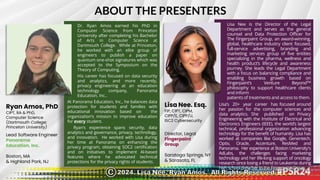
ABOUT THE PRESENTERS
Ryan Amos, PhD
CIPT, BA & PhD,
Computer Science
(Dartmouth College;
Princeton University)
Lead Software Engineer
Panorama
Education, Inc.
Boston, MA
& Highland Park, NJ
Dr. Ryan Amos earned his PhD in
Computer Science from Princeton
University after completing his Bachelor
of Arts in Computer Science at
Dartmouth College. While at Princeton,
he worked with an elite group of
engineers to publish a paper on
quantum one-shot signatures which was
accepted to the Symposium on the
Theory of Computing.
His career has focused on data security
and analytics, and more recently,
privacy engineering at an education
technology company, Panorama
Education, Inc..
At Panorama Education, Inc., he balances data
protection for students and families with
educational innovation based on the
organization’s mission to improve education
for every student.
Ryan’s experience spans security, data
analytics and governance, privacy, technology,
and innovation. He worked with Lisa during
her time at Panorama on enhancing the
privacy program, obtaining SOC2 certification
and on initiatives to implement AI-based
features where he advocated technical
protections for the privacy rights of students.
Lisa Nee. Esq.
FIP, CIPT, CIPM,
CIPP/E, CIPP/U,
ISC2 Cybersecurity
Director, Legal
Fingerpaint
Group
Saratoga Springs, NY
& Sarasota, FL
Lisa Nee is the Director of the Legal
Department and serves as the general
counsel and Data Protection Officer for
The Fingerpaint Group, an award-winning,
global, healthcare industry client focused,
full-service advertising, branding and
marketing services group of five entities
specializing in the pharma, wellness and
health product’s lifecycle and awareness
journey. She leads the Legal Department
with a focus on balancing compliance and
enabling business growth based on
Fingerpaint’s Venture BeyondTM
philosophy to support healthcare clients
and inform
patients of treatments and access to them.
Lisa’s 20+ year career has focused around
her passion for the computer sciences and
data analytics. She published on Privacy
Engineering with the Institute of Electrical and
Electronics Engineers (IEEE), the world’s largest
technical, professional organization advancing
technology for the benefit of humanity. Lisa has
worked at companies like Google, Genentech,
Optiv, Oracle, Accenture, ResMed and
Panorama. Her experience at Boston University’s
AdLabs, the challenges facing marketing
technology and her life-long support of oncology
research since losing a friend to Leukemia during
high schooldrew her to the FingerpaintGroup.
2024. Lisa Nee, Ryan Amos. All Rights Reserved.
©
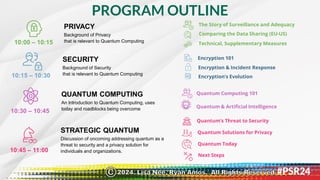
PROGRAM OUTLINE
10:00 – 10:15
PRIVACY
Background of Privacy
that is relevant to Quantum Computing
10:15 – 10:30
10:30 – 10:45
10:45 – 11:00
SECURITY
Background of Security
that is relevant to Quantum Computing
QUANTUM COMPUTING
An Introduction to Quantum Computing, uses
today and roadblocks being overcome
STRATEGIC QUANTUM
Discussion of oncoming addressing quantum as a
threat to security and a privacy solution for
individuals and organizations.
Quantum’s Threat to Security
Quantum Solutions for Privacy
Quantum Computing 101
Quantum & Artificial Intelligence
Encryption 101
Encryption & Incident Response
Encryption’s Evolution
The Story of Surveillance and Adequacy
Comparing the Data Sharing (EU-US)
Technical, Supplementary Measures
Next Steps
Quantum Today
2024. Lisa Nee, Ryan Amos. All Rights Reserved.
©
The Story of Surveillance
and Adequacy
Comparing the Data Sharing
(EU-US)
Supplemental Measures
& Encryption
PRIVACY
PRIMER
2024. Lisa Nee, Ryan Amos. All Rights Reserved.
©
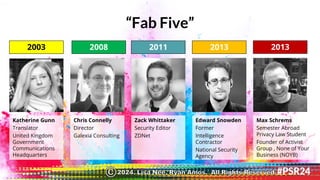
“Fab Five”
Katherine Gunn
Translator
United Kingdom
Government
Communications
Headquarters
Chris Connelly
Director
Galexia Consulting
Zack Whittaker
Security Editor
ZDNet
Edward Snowden
Former
Intelligence
Contractor
National Security
Agency
Max Schrems
Semester Abroad
Privacy Law Student
Founder of Activist
Group , None of Your
Business (NOYB)
2003 2008 2011 2013 2013
2024. Lisa Nee, Ryan Amos. All Rights Reserved.
©
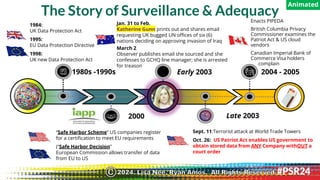
The Story of Surveillance & Adequacy
1984:
UK Data Protection Act
1995:
EU Data Protection Directive
1998:
UK new Data Protection Act
1980s -1990s
“Safe Harbor Scheme” US companies register
for a certification to meet EU requirements
(“Safe Harbor Decision”
European Commission allows transfer of data
from EU to US
2000
Enacts PIPEDA
British Columbia Privacy
Commissioner examines the
Patriot Act & US cloud
vendors
Canadian Imperial Bank of
Commerce Visa holders
complain
2004 - 2005
Early 2003
Jan. 31 to Feb.
Katherine Gunn prints out and shares email
requesting UK bugged UN offices of six (6)
nations deciding on approving invasion of Iraq
March 2
Observer publishes email she sourced and she
confesses to GCHQ line manager; she is arrested
for treason
Late 2003
Sept. 11:Terrorist attack at World Trade Towers
Oct. 26: US Patriot Act enables US government to
obtain stored data from ANY Company withOUT a
court order
Animated
2024. Lisa Nee, Ryan Amos. All Rights Reserved.
©
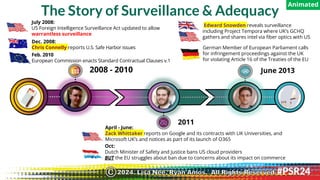
The Story of Surveillance & Adequacy
April - June:
Zack Whittaker reports on Google and its contracts with UK Universities, and
Microsoft UK’s and notices as part of its launch of O365
Oct:
Dutch Minister of Safety and Justice bans US cloud providers
BUT the EU struggles about ban due to concerns about its impact on commerce
2011
July 2008:
US Foreign Intelligence Surveillance Act updated to allow
warrantless surveillance
Feb. 2010
European Commission enacts Standard Contractual Clauses v.1
2008 - 2010
Dec. 2008:
Chris Connelly reports U.S. Safe Harbor issues
Edward Snowden reveals surveillance
including Project Tempora where UK’s GCHQ
gathers and shares intel via fiber optics with US
German Member of European Parliament calls
for infringement proceedings against the UK
for violating Article 16 of the Treaties of the EU
June 2013
Animated
2024. Lisa Nee, Ryan Amos. All Rights Reserved.
©
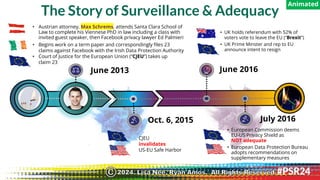
The Story of Surveillance & Adequacy
• UK holds referendum with 52% of
voters vote to leave the EU (“Brexit”)
• UK Prime Minster and rep to EU
announce intent to resign
June 2016
CJEU
invalidates
US-EU Safe Harbor
Oct. 6, 2015 July 2016
• European Commission deems
EU-US Privacy Shield as
NOT adequate
• European Data Protection Bureau
adopts recommendations on
supplementary measures
• Austrian attorney, Max Schrems, attends Santa Clara School of
Law to complete his Viennese PhD in law including a class with
invited guest speaker, then Facebook privacy lawyer Ed Palmieri
• Begins work on a term paper and correspondingly files 23
claims against Facebook with the Irish Data Protection Authority
• Court of Justice for the European Union (“CJEU”) takes up
claim 23
June 2013
Animated
2024. Lisa Nee, Ryan Amos. All Rights Reserved.
©
IAPP
2024 PSR
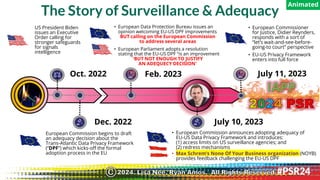
The Story of Surveillance & Adequacy
US President Biden
issues an Executive
Order calling for
stronger safeguards
for signals
intelligence
Oct. 2022
European Commission begins to draft
an adequacy decision about the
Trans-Atlantic Data Privacy Framework
(“DPF”) which kicks-off the formal
adoption process in the EU
Dec. 2022
• European Data Protection Bureau issues an
opinion welcoming EU-US DPF improvements
BUT calling on the European Commission
to address several areas
• European Parliament adopts a resolution
stating that the EU-US DPF “is an improvement
“BUT NOT ENOUGH TO JUSTIFY
AN ADEQUECY DECISION”
Feb. 2023
July 10, 2023
• European Commission announces adopting adequacy of
EU-US Data Privacy Framework and introduces:
(1) access limits on US surveillance agencies; and
(2) redress mechanisms
• Max Schrem’s None Of Your Business organization (NOYB)
provides feedback challenging the EU-US DPF
July 11, 2023
• European Commissioner
for Justice, Didier Reynders,
responds with a sort of
“let’s wait-and-see-before-
going-to court” perspective
• EU-US Privacy Framework
enters into full force
Animated
2024. Lisa Nee, Ryan Amos. All Rights Reserved.
©
Comparing the Data Sharing
EU-US
Safe Harbor
EU-US
Privacy Shield
EU-US / Trans-Atlantic
Data Privacy Framework
US STATE LAWS
REGISTRATION Dept. of Commerce Dept. of Commerce Dept. of Commerce None (yet)
CERTIFICATION At Certification Annually Annually None (yet)
MONITORING None; only privately Yes Yes None; only privately
ENFORCEMENT
Federal Trade
Commission
Federal Trade
Commission
Federal Trade
Commission
State Agency or
State Attorney General
THIRD PARTIES Yes Yes Yes Depends on State
THIRD PARTY
SUBPROCESSORS
No Yes Yes Depends on State
DATA PROTECTION
ADDENDUM
No Yes Yes Depends on State
LIABLE FOR THIRD
PARTIES
No
Yes, unless proven no
responsibility
Yes, unless proven no
responsibility
Depends on State
REDRESS FOR EU DATA
SUBJECT
No Omnibus Person EU Data Protection Review Court Depends on State
LIMITS SURVEILLANCE No No Somewhat limits No
PROHIBITS [UNKNOWN]
FEDERAL DATA SEIZURE
No No (only after the fact) No (only after the fact) No
Animated
2024. Lisa Nee, Ryan Amos. All Rights Reserved.
©
ntary Measures
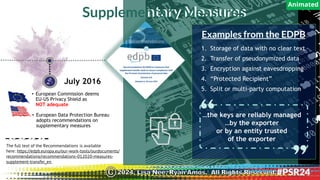
Supplementary Measures
July 2016
• European Commission deems
EU-US Privacy Shield as
NOT adequate
• European Data Protection Bureau
adopts recommendations on
supplementary measures
The full text of the Recommendations is available
here: https://edpb.europa.eu/our-work-tools/ourdocuments/
recommendations/recommendations-012020-measures-
supplement-transfer_en
1. Storage of data with no clear text
2. Transfer of pseudonymized data
3. Encryption against eavesdropping
4. “Protected Recipient”
5. Split or multi-party computation
…the keys are reliably managed
…by the exporter
or by an entity trusted
of the exporter
Examples from the EDPB
Animated
2024. Lisa Nee, Ryan Amos. All Rights Reserved.
©
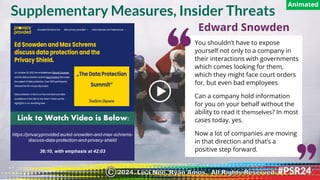
https://privacyprovided.eu/ed-snowden-and-max-schrems-
discuss-data-protection-and-privacy-shield
36:10, with emphasis at 42:03
Link to Watch Video is Below:
You shouldn’t have to expose
yourself not only to a company in
their interactions with governments
which comes looking for them,
which they might face court orders
for, but even bad employees.
Can a company hold information
for you on your behalf without the
ability to read it themselves? In most
cases today, yes.
Now a lot of companies are moving
in that direction and that’s a
positive step forward.
Edward Snowden
Supplementary Measures, Insider Threats
Animated
2024. Lisa Nee, Ryan Amos. All Rights Reserved.
©
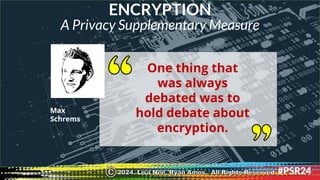
ENCRYPTION
A Privacy Supplementary Measure
Max
Schrems
One thing that
was always
debated was to
hold debate about
encryption.
2024. Lisa Nee, Ryan Amos. All Rights Reserved.
©
Encryption 101
Encryption’s Evolution
Encryption in the News
SECURITY
SECONDMENT
2024. Lisa Nee, Ryan Amos. All Rights Reserved.
©
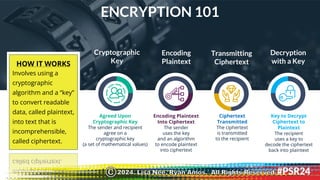
Encoding
Plaintext
Transmitting
Ciphertext
Decryption
with a Key
ENCRYPTION 101
Agreed Upon
Cryptographic Key
The sender and recipient
agree on a
cryptographic key
(a set of mathematical values)
Encoding Plaintext
Into Ciphertext
The sender
uses the key
and an algorithm
to encode plaintext
into ciphertext
Ciphertext
Transmitted
The ciphertext
is transmitted
to the recipient
Key to Decrypt
Ciphertext to
Plaintext
The recipient
uses a key to
decode the ciphertext
back into plaintext
Cryptographic
Key
HOW IT WORKS
Involves using a
cryptographic
algorithm and a “key”
to convert readable
data, called plaintext,
into text that is
incomprehensible,
called ciphertext.
2024. Lisa Nee, Ryan Amos. All Rights Reserved.
©
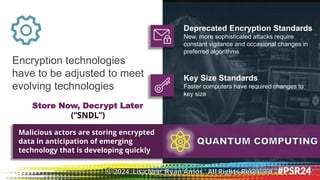
Encryption technologies
have to be adjusted to meet
evolving technologies
Malicious actors are storing encrypted
data in anticipation of emerging
technology that is developing quickly
Deprecated Encryption Standards
New, more sophisticated attacks require
constant vigilance and occasional changes in
preferred algorithms
Key Size Standards
Faster computers have required changes to
key size
QUANTUM COMPUTING
Store Now, Decrypt Later
(“SNDL”)
© 2024. Lisa Nee, Ryan Amos. All Rights Reserved.
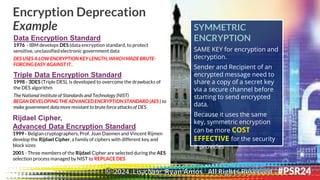
SYMMETRIC
ENCRYPTION
SAME KEY for encryption and
decryption.
Sender and Recipient of an
encrypted message need to
share a copy of a secret key
via a secure channel before
starting to send encrypted
data.
Because it uses the same
key, symmetric encryption
can be more COST
EFFECTIVE for the security
it provides
Encryption Deprecation
Example
Data Encryption Standard
1976 - IBM develops DES (data encryption standard, to protect
sensitive, unclassified electronic government data
DES USES A LOW ENCRYPTION KEY LENGTH, WHICH MADE BRUTE-
FORCING EASY AGAINST IT..
Triple Data Encryption Standard
1998 - 3DES (Triple DES), is developed to overcome the drawbacks of
the DES algorithm
The National Institute of Standards and Technology (NIST)
BEGAN DEVELOPING THE ADVANCEDENCRYPTION STANDARD (AES ) to
make government data more resistant to brute force attacks of DES
Rijdael Cipher,
Advanced Data Encryption Standard
1999 - Belgian cryptographers, Prof. Joan Daemen and Vincent Rijmen
develop the Rijdael Cipher, a family of ciphers with different key and
block sizes
2001 - Three members of the Rijdael Cipher are selected during the AES
selection process managed by NIST to REPLACE DES.
© 2024. Lisa Nee, Ryan Amos. All Rights Reserved.
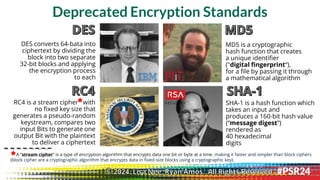
Deprecated Encryption Standards
MD5 is a cryptographic
hash function that creates
a unique identifier
("digital fingerprint“),
for a file by passing it through
a mathematical algorithm
SHA-1 is a hash function which
takes an input and
produces a 160-bit hash value
(“message digest”)
rendered as
40 hexadecimal
digits
DES converts 64-bata into
ciphertext by dividing the
block into two separate
32-bit blocks and applying
the encryption process
to each
RC4 is a stream cipher with
no fixed key size that
generates a pseudo-random
keystream, compares two
input Bits to generate one
output Bit with the plaintext
to deliver a ciphertext
DES MD5
RC4 SHA-1
A “stream cipher” is a type of encryption algorithm that encrypts data one bit or byte at a time, making it faster and simpler than block ciphers
(block cipher are a cryptographic algorithm that encrypts data in fixed-size blocks using a cryptographic key).
*
*
© 2024. Lisa Nee, Ryan Amos. All Rights Reserved.
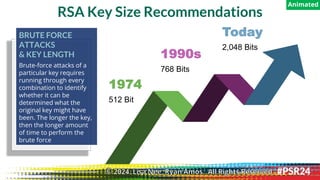
RSA Key Size Recommendations
1990s
768 Bits
1974
512 Bit
Today
2,048 Bits
BRUTE FORCE
ATTACKS
& KEY LENGTH
Brute-force attacks of a
particular key requires
running through every
combination to identify
whether it can be
determined what the
original key might have
been. The longer the key,
then the longer amount
of time to perform the
brute force
Animated
© 2024. Lisa Nee, Ryan Amos. All Rights Reserved.
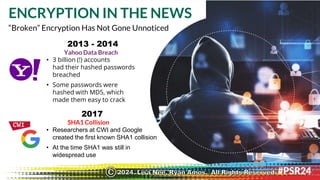
“Broken” Encryption Has Not Gone Unnoticed
ENCRYPTION IN THE NEWS
2013 - 2014
2017
Yahoo Data Breach
• 3 billion (!) accounts
had their hashed passwords
breached
• Some passwords were
hashed with MD5, which
made them easy to crack
SHA1 Collision
• Researchers at CWI and Google
created the first known SHA1 collision
• At the time SHA1 was still in
widespread use
2024. Lisa Nee, Ryan Amos. All Rights Reserved.
©
ENCRYPTION IN THE NEWS
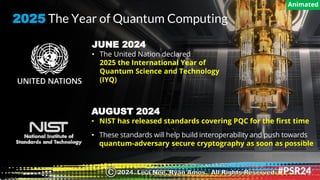
AUGUST 2024
• NIST has released standards covering PQC for the first time
• These standards will help build interoperability and push towards
quantum-adversary secure cryptography as soon as possible
2025 The Year of Quantum Computing
JUNE 2024
• The United Nation declared
2025 the International Year of
Quantum Science and Technology
(IYQ)
Animated
2024. Lisa Nee, Ryan Amos. All Rights Reserved.
©
MATH
Why many chose law & policy…
BEFORE WE GO ANY FURTHER…
Let’s talk about why we are grateful to have Ryan Amos, PhD with us today
Animated
2024. Lisa Nee, Ryan Amos. All Rights Reserved.
©
Quantum Computing 101
Quantum Computing
& Artificial Intelligence
QUANTUM
COMPUTING
2024. Lisa Nee, Ryan Amos. All Rights Reserved.
©
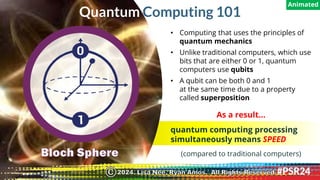
Quantum Computing 101
Bloch Sphere
• Computing that uses the principles of
quantum mechanics
• Unlike traditional computers, which use
bits that are either 0 or 1, quantum
computers use qubits
• A qubit can be both 0 and 1
at the same time due to a property
called superposition
As a result…
quantum computing processing
simultaneously means SPEED
(compared to traditional computers)
Animated
2024. Lisa Nee, Ryan Amos. All Rights Reserved.
©
Quantum Computing 101
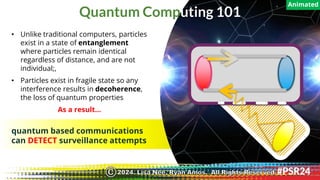
• Unlike traditional computers, particles
exist in a state of entanglement
where particles remain identical
regardless of distance, and are not
individual;,
• Particles exist in fragile state so any
interference results in decoherence,
the loss of quantum properties
As a result…
Animated
quantum based communications
can DETECT surveillance attempts
2024. Lisa Nee, Ryan Amos. All Rights Reserved.
©
Quantum Computing 101
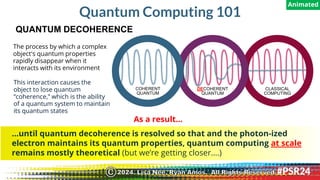
…until quantum decoherence is resolved so that and the photon-ized
electron maintains its quantum properties, quantum computing at scale
remains mostly theoretical (but we’re getting closer….)
COHERENT
QUANTUM
DECOHERENT
QUANTUM
CLASSICAL
COMPUTING
The process by which a complex
object's quantum properties
rapidly disappear when it
interacts with its environment
This interaction causes the
object to lose quantum
“coherence,” which is the ability
of a quantum system to maintain
its quantum states
QUANTUM DECOHERENCE
Animated
As a result…
2024. Lisa Nee, Ryan Amos. All Rights Reserved.
©
Quantum Computing 101
Quantum sensing and computing elements need
to communicate with each other over distances
ranging from 10 micrometers—about the size of a
human hair—to hundreds of kilometers, all while
maintaining quantum coherence
Challenges for Quantum Computing to be Available At-Scale
China has set records on
the longest distance of
successful quantum
communication at 4,600
km (2,858 miles) using
across the
Beijing-Shanghai
Trunk Line using the
Micius satellite
DISTANCE
T
EMPERATUR
E
Quantum network models
are more stable at low
temperatures, which limits
their real-world
applications of quantum.
However, a study achieved
a stable connection at
room temperature, which
puts it within reach of real-
world use
For quantum computers to be more widely
accessible, the equipment themselves need designs
that are practical, using room temperature
superconductors
SOURCES:
https:// https://computing.mit.edu/news/a-new-way-for-quantum-computing-
systems-to-keep-their-cool/; see also https://scitechdaily.com/finally-revealed-
the-surprising-cause-of-qubit-decay-in-quantum-computers
See Slide 39 for additional advances by China as it relates to the
“distance problem”
*
*
Animated
2024. Lisa Nee, Ryan Amos. All Rights Reserved.
©
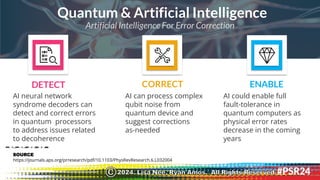
DETECT
Quantum & Artificial Intelligence
SOURCE
https://journals.aps.org/prresearch/pdf/10.1103/PhysRevResearch.6.L032004
AI neural network
syndrome decoders can
detect and correct errors
in quantum processors
to address issues related
to decoherence
AI can process complex
qubit noise from
quantum device and
suggest corrections
as-needed
AI could enable full
fault-tolerance in
quantum computers as
physical error rates
decrease in the coming
years
CORRECT ENABLE
Artificial Intelligence For Error Correction
2024. Lisa Nee, Ryan Amos. All Rights Reserved.
©
Quantum & Artificial Intelligence
SOURCE
https://www.quantonation.com/2024/07/09/the-ai-boom-is-good-for-quantum-
tech/?
utm_source=substack&utm_medium=email
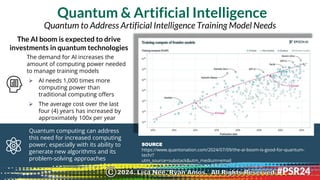
The demand for AI increases the
amount of computing power needed
to manage training models
➢ AI needs 1,000 times more
computing power than
traditional computing offers
➢ The average cost over the last
four (4) years has increased by
approximately 100x per year
The AI boom is expected to drive
investments in quantum technologies
Quantum computing can address
this need for increased computing
power, especially with its ability to
generate new algorithms and its
problem-solving approaches
Quantum to Address Artificial Intelligence Training Model Needs
2024. Lisa Nee, Ryan Amos. All Rights Reserved.
©
Quantum & Security
Quantum & Privacy
Next Steps
QUANTUM
READINESS
Quantum Today
2024. Lisa Nee, Ryan Amos. All Rights Reserved.
©
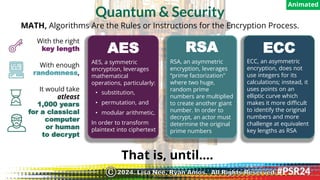
Quantum & Security
MATH, Algorithms Are the Rules or Instructions for the Encryption Process.
With the right
key length
With enough
randomness,
It would take
atleast
1,000 years
for a classical
computer
or human
to decrypt
AES, a symmetric
encryption, leverages
mathematical
operations, particularly:
• substitution,
• permutation, and
• modular arithmetic,
In order to transform
plaintext into ciphertext
AES
RSA, an asymmetric
encryption, leverages
“prime factorization"
where two huge,
random prime
numbers are multiplied
to create another giant
number. In order to
decrypt, an actor must
determine the original
prime numbers
RSA
ECC, an asymmetric
encryption, does not
use integers for its
calculations; instead, it
uses points on an
elliptic curve which
makes it more difficult
to identify the original
numbers and more
challenge at equivalent
key lengths as RSA
ECC
That is, until….
Animated
2024. Lisa Nee, Ryan Amos. All Rights Reserved.
©
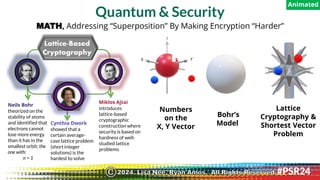
Quantum & Security
Lattice-Based
Cryptography
Neils Bohr
theorized on the
stability of atoms
and identified that
electrons cannot
lose more energy
than it has in the
smallest orbit; the
one with:
n = 1
Cynthia Dwork
showed that a
certain average-
case lattice problem
(short integer
solutions) is the
hardest to solve
Miklos Ajtai
introduces
lattice-based
cryptographic
construction where
security is based on
hardness of well-
studied lattice
problems
Bohr’s
Model
Lattice
Cryptography &
Shortest Vector
Problem
Numbers
on the
X, Y Vector
MATH, Addressing “Superposition” By Making Encryption “Harder”
Animated
2024. Lisa Nee, Ryan Amos. All Rights Reserved.
©
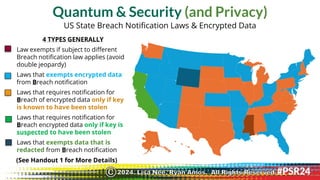
Quantum & Security (and Privacy)
4 TYPES GENERALLY
Law exempts if subject to different
Breach notification law applies (avoid
double jeopardy)
Laws that exempts encrypted data
from Breach notification
Laws that requires notification for
Breach of encrypted data only if key
is known to have been stolen
Laws that requires notification for
Breach encrypted data only if key is
suspected to have been stolen
Laws that exempts data that is
redacted from Breach notification
US State Breach Notification Laws & Encrypted Data
(See Handout 1 for More Details)
2024. Lisa Nee, Ryan Amos. All Rights Reserved.
©
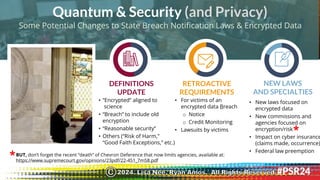
DEFINITIONS
UPDATE
RETROACTIVE
REQUIREMENTS
NEW LAWS
AND SPECIALTIES
• “Encrypted” aligned to
science
• “Breach” to include old
encryption
• “Reasonable security”
• Others (“Risk of Harm,”
“Good Faith Exceptions,” etc.)
• For victims of an
encrypted data Breach
o Notice
o Credit Monitoring
• Lawsuits by victims
• New laws focused on
encrypted data
• New commissions and
agencies focused on
encryption/risk
• Impact on cyber insurance
(claims made, occurrence)
• Federal law preemption
Quantum & Security (and Privacy)
Some Potential Changes to State Breach Notification Laws & Encrypted Data
BUT, don’t forget the recent “death” of Chevron Deference that now limits agencies, available at:
https://www.supremecourt.gov/opinions/23pdf/22-451_7m58.pdf
*
*
2024. Lisa Nee, Ryan Amos. All Rights Reserved.
©
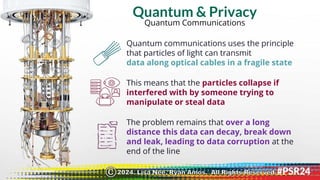
Quantum & Privacy
Quantum Communications
Quantum communications uses the principle
that particles of light can transmit
data along optical cables in a fragile state
This means that the particles collapse if
interfered with by someone trying to
manipulate or steal data
The problem remains that over a long
distance this data can decay, break down
and leak, leading to data corruption at the
end of the line
2024. Lisa Nee, Ryan Amos. All Rights Reserved.
©
Quantum & Privacy
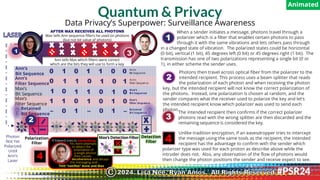
Data Privacy’s Superpower: Surveillance Awareness
1 0
–
0 1 1 0 0
1 0 1 0
1 1 0
1
0 1
0
– –
Ann’s
Bit Sequence
Ann’s
Filter Sequence
Max’s
Bit Sequence
Max’s
Filter Sequence
Retained
Bit Sequence
Ann’s
Bit Sequence
Ann’s
Filter Sequence
Max’s
Bit Sequence
Max’s
Filter Sequence
Retained
Bit Sequence
1 0 1
0 1 1 0
1 0
1 0 1 1 0
AFTER MAX RECEIVES ALL PHOTONS
Max tells Ann sequence filters he used on photons
(but not bit value of photons)
Ann tells Max which filters were correct
which are the bits they will use to form a key
Unlike tradition encryption, if an eavesdropper tries to intercept
the message using the same tools as the recipient, the intended
recipient has the advantage to confirm with the sender which
polarizer type was used for each proton as describe above while the
intruder does not. Also, any observation of the flow of photons would
then change the photon positions the sender and receive expect to see.
4
When a sender initiates a message, photons travel through a
polarizer which is a filter that enables certain photons to pass
through it with the same vibrations and lets others pass through
in a changed state of vibration. The polarized states could be horizontal
(0 bit), vertical (1 bit), 45 degrees left (0 bit) or 45 degrees right (1 bit). The
transmission has one of two polarizations representing a single bit (0 or
1), in either scheme the sender uses.
1
The intended recipient then confirms if the correct polarizer
photons read with the wrong splitter are then discarded and the
remaining sequence is considered the key.
3
Photons then travel across optical fiber from the polarizer to the
intended recipient. This process uses a beam splitter that reads
the polarization of each photon and when receiving the photon
key, but the intended recipient will not know the correct polarization of
the photons. Instead, one polarization is chosen at random, and the
sender compares what the receiver used to polarize the key and let’s
the intended recipient know which polarizer was used to send each
photon.
2
If Edward tries to eavesdrop,
LASER
Photon
Not Yet
Polarized
Until
Ann’s
Laser
1
4
Polarization
Filter
Detection
Filter
3
2
Animated
2024. Lisa Nee, Ryan Amos. All Rights Reserved.
©
Max’s DetectionFilter
his mere attempts
to detect the
orientation of
a single photon
then causes
decoherence and decays
the messaging and…
THIS “notifies” Anne and Max
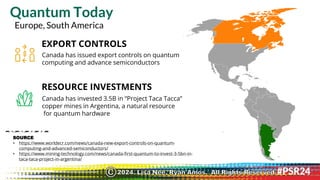
Quantum Today
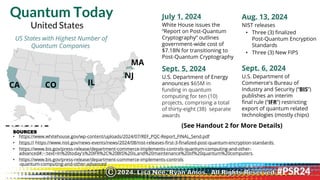
Canada has issued export controls on quantum
computing and advance semiconductors
SOURCE
• https://www.worldecr.com/news/canada-new-export-controls-on-quantum-
computing-and-advanced-semiconductors/
• https://www.mining-technology.com/news/canada-first-quantum-to-invest-3-5bn-in-
taca-taca-project-in-argentina/
Canada has invested 3.5B in “Project Taca Tacca”
copper mines in Argentina, a natural resource
for quantum hardware
EXPORT CONTROLS
RESOURCE INVESTMENTS
Europe, South America
2024. Lisa Nee, Ryan Amos. All Rights Reserved.
©
Quantum Today
SOURCES
• https://www.whitehouse.gov/wp-content/uploads/2024/07/REF_PQC-Report_FINAL_Send.pdf
• https:// https://www.nist.gov/news-events/news/2024/08/nist-releases-first-3-finalized-post-quantum-encryption-standards;
• https://www.bis.gov/press-release/department-commerce-implements-controls-quantum-computing-and-other-
advanced#:~:text=In%20today's%20IFR%2C%20BIS%20is,and%20maintenance%20of%20quantum%20computers.
• https://www.bis.gov/press-release/department-commerce-implements-controls
-quantum-computing-and-other-advanced
July 1, 2024
White House issues the
“Report on Post-Quantum
Cryptography“ outlines
government-wide cost of
$7.1BN for transitioning to
Post-Quantum Cryptography
Aug. 13, 2024
NIST releases
• Three (3) finalized
Post-Quantum Encryption
Standards
• Three (3) New FIPS
Sept. 5, 2024
U.S. Department of Energy
announces $65M in
funding in quantum
computing for ten (10)
projects, comprising a total
of thirty-eight (38) separate
awards
Sept. 6, 2024
U.S. Department of
Commerce's Bureau of
Industry and Security (“BIS”)
publishes an interim
final rule (“IFR”) restricting
export of quantum related
technologies (mostly chips)
CA CO IL
NJ
MA
US States with Highest Number of
Quantum Companies
United States
(See Handout 2 for More Details)
2024. Lisa Nee, Ryan Amos. All Rights Reserved.
©
Quantum Today
Europe
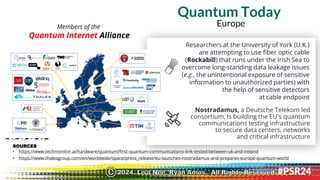
Researchers at the University of York (U.K.)
are attempting to use fiber optic cable
(Rockabill) that runs under the Irish Sea to
overcome long-standing data leakage issues
(e.g., the unintentional exposure of sensitive
information to unauthorized parties) with
the help of sensitive detectors
at cable endpoint
SOURCES
• https://www.techmonitor.ai/hardware/quantum/first-quantum-communications-link-tested-between-uk-and-ireland
• https://www.thalesgroup.com/en/worldwide/space/press_release/eu-launches-nostradamus-and-prepares-europe-quantum-world
Nostradamus, a Deutsche Telekom led
consortium, Is building the EU's quantum
communications testing infrastructure
to secure data centers, networks
and critical infrastructure
Members of the
Quantum Internet Alliance
2024. Lisa Nee, Ryan Amos. All Rights Reserved.
©
Quantum & Privacy
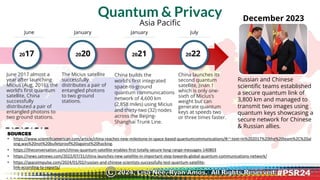
2017 2020 2021 2022
June
June 2017 almost a
year after launching
Micius (Aug. 2016), the
world’s first quantum
satellite, China
successfully
distributed a pair of
entangled photons to
two ground stations.
January
The Micius satellite
successfully
distributes a pair of
entangled photons
to two ground
stations.
January
China builds the
world’s first integrated
space-to-ground
quantum communications
network of 4,600 km
(2,858 miles) using Micius
and thirty-two (32) nodes
across the Beijing-
Shanghai Trunk Line.
July
China launches its
second quantum
satellite, Jinan 1
which is only one-
sixth of Micius’s
weight but can
generate quantum
keys at speeds two
or three times faster.
Asia Pacific
Russian and Chinese
scientific teams established
a secure quantum link of
3,800 km and managed to
transmit two images using
quantum keys showcasing a
secure network for Chinese
& Russian allies.
December 2023
SOURCES
• https://www.scientificamerican.com/article/china-reaches-new-milestone-in-space-based-quantumcommunications/#:~:text=In%202017%20the%20team%2C%20al
ong,was%20not%20bulletproof%20against%20hacking.
• https://theconversation.com/chinas-quantum-satellite-enables-first-totally-secure-long-range-messages-140803
• https://news.satnews.com/2022/07/31/china-launches-new-satellite-in-important-step-towards-global-quantum-communications-network/
• https://spaceimpulse.com/2024/01/02/russian-and-chinese-scientists-successfully-test-quantum-satellite-
link-according-to-reports/
2024. Lisa Nee, Ryan Amos. All Rights Reserved.
©
Next Steps
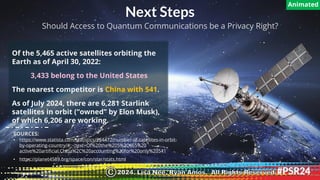
Of the 5,465 active satellites orbiting the
Earth as of April 30, 2022:
3,433 belong to the United States
The nearest competitor is China with 541.
As of July 2024, there are 6,281 Starlink
satellites in orbit (“owned” by Elon Musk),
of which 6,206 are working.
SOURCES:
• https://www.statista.com/statistics/264472/number-of-satellites-in-orbit-
by-operating-country/#:~:text=Of%20the%205%2C465%20
active%20artificial,China%2C%20accounting%20for%20only%20541
• https://planet4589.org/space/con/star/stats.html
Should Access to Quantum Communications be a Privacy Right?
Animated
2024. Lisa Nee, Ryan Amos. All Rights Reserved.
©
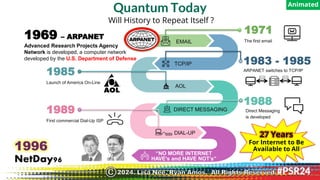
Quantum Today
1971
The first email
1985
Launch of America On-Line
1983 - 1985
ARPANET switches to TCP/IP
1989
First commercial Dial-Up ISP
1969 – ARPANET
Advanced Research Projects Agency
Network is developed, a computer network
developed by the U.S. Department of Defense
1988
Direct Messaging
is developed
EMAIL
TCP/IP
AOL
DIRECT MESSAGING
DIAL-UP
“NO MORE INTERNET
HAVE’s and HAVE NOT’s”
1996
NetDay96
Will History to Repeat Itself ?
27 Years
For Internet to Be
Available to All
Animated
2024. Lisa Nee, Ryan Amos. All Rights Reserved.
©
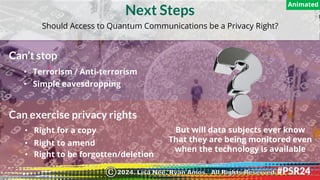
• Right to be forgotten/deletion
Can’t stop
• Terrorism / Anti-terrorism
• Simple eavesdropping
Can exercise privacy rights
• Right for a copy
• Right to amend
Next Steps
Should Access to Quantum Communications be a Privacy Right?
But will data subjects ever know
That they are being monitored even
when the technology is available
Animated
2024. Lisa Nee, Ryan Amos. All Rights Reserved.
©
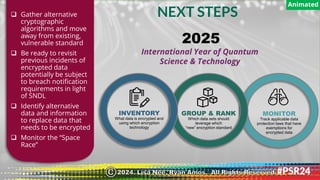
NEXT STEPS
❑ Gather alternative
cryptographic
algorithms and move
away from existing,
vulnerable standard
❑ Be ready to revisit
previous incidents of
encrypted data
potentially be subject
to breach notification
requirements in light
of SNDL
❑ Identify alternative
data and information
to replace data that
needs to be encrypted
❑ Monitor the “Space
Race”
INVENTORY
What data is encrypted and
using which encryption
technology
GROUP & RANK
Which data sets should
leverage which
“new” encryption standard
MONITOR
Track applicable data
protection laws that have
exemptions for
encrypted data
2025
International Year of Quantum
Science & Technology
Animated
2024. Lisa Nee, Ryan Amos. All Rights Reserved.
©
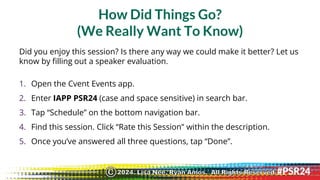
How Did Things Go?
(We Really Want To Know)
Did you enjoy this session? Is there any way we could make it better? Let us
know by filling out a speaker evaluation.
1. Open the Cvent Events app.
2. Enter IAPP PSR24 (case and space sensitive) in search bar.
3. Tap “Schedule” on the bottom navigation bar.
4. Find this session. Click “Rate this Session” within the description.
5. Once you’ve answered all three questions, tap “Done”.
2024. Lisa Nee, Ryan Amos. All Rights Reserved.
©
APPENDIX
2024. Lisa Nee, Ryan Amos. All Rights Reserved.
©
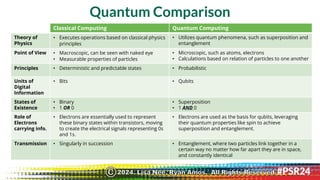
Quantum Comparison
Classical Computing Quantum Computing
Theory of
Physics
• Executes operations based on classical physics
principles
• Utilizes quantum phenomena, such as superposition and
entanglement
Point of View • Macroscopic, can be seen with naked eye
• Measurable properties of particles
• Microscopic, such as atoms, electrons
• Calculations based on relation of particles to one another
Principles • Deterministic and predictable states • Probabilistic
Units of
Digital
Information
• Bits • Qubits
States of
Existence
• Binary
• 1 OR 0
• Superposition
• 1 AND 0
Role of
Electrons
carrying info.
• Electrons are essentially used to represent
these binary states within transistors, moving
to create the electrical signals representing 0s
and 1s.
• Electrons are used as the basis for qubits, leveraging
their quantum properties like spin to achieve
superposition and entanglement.
Transmission • Singularly in succession • Entanglement, where two particles link together in a
certain way no matter how far apart they are in space,
and constantly identical
2024. Lisa Nee, Ryan Amos. All Rights Reserved.
©
RESOURCE LIST
• NIST Center of Excellence for Quantum Computing
https://www.nccoe.nist.gov/crypto-agility-considerations-migrating-post-quantum-cryptographic-
algorithms
• MIT Newsletter (focus: quantum computing)
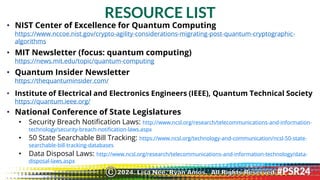
https://news.mit.edu/topic/quantum-computing
• Quantum Insider Newsletter
https://thequantuminsider.com/
• Institute of Electrical and Electronics Engineers (IEEE), Quantum Technical Society
https://quantum.ieee.org/
• National Conference of State Legislatures
• Security Breach Notification Laws: http://www.ncsl.org/research/telecommunications-and-information-
technology/security-breach-notification-laws.aspx
• 50 State Searchable Bill Tracking: https://www.ncsl.org/technology-and-communication/ncsl-50-state-
searchable-bill-tracking-databases
• Data Disposal Laws: http://www.ncsl.org/research/telecommunications-and-information-technology/data-
disposal-laws.aspx
2024. Lisa Nee, Ryan Amos. All Rights Reserved.
©
Quantum & Security
NIST, Federal Information Processing Standards (FIPS)
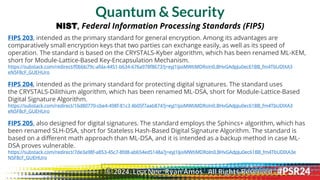
FIPS 203, intended as the primary standard for general encryption. Among its advantages are
comparatively small encryption keys that two parties can exchange easily, as well as its speed of
operation. The standard is based on the CRYSTALS-Kyber algorithm, which has been renamed ML-KEM,
short for Module-Lattice-Based Key-Encapsulation Mechanism.
https://substack.com/redirect/f0bbb79c-afda-4451-b634-676a978f8673?j=eyJ1IjoiMWtiMDRoIn0.BHvGAdpJu0ec61BB_fm4TbUDIXA3
eN5F8cF_GUEHUro
FIPS 204, intended as the primary standard for protecting digital signatures. The standard uses
the CRYSTALS-Dilithium algorithm, which has been renamed ML-DSA, short for Module-Lattice-Based
Digital Signature Algorithm.
https://substack.com/redirect/16d80770-cbe4-498f-81c3 4b05f7aab874?j=eyJ1IjoiMWtiMDRoIn0.BHvGAdpJu0ec61BB_fm4TbUDIXA3
eN5F8cF_GUEHUro
FIPS 205, also designed for digital signatures. The standard employs the Sphincs+ algorithm, which has
been renamed SLH-DSA, short for Stateless Hash-Based Digital Signature Algorithm. The standard is
based on a different math approach than ML-DSA, and it is intended as a backup method in case ML-
DSA proves vulnerable.
https://substack.com/redirect/7de3a98f-a853-45c7-8fd8-ab654ed5148a?j=eyJ1IjoiMWtiMDRoIn0.BHvGAdpJu0ec61BB_fm4TbUDIXA3e
N5F8cF_GUEHUro
© 2024. Lisa Nee, Ryan Amos. All Rights Reserved.
Quantum Computing_A Security Threat, a Privacy Solution and a Privacy Right_Newest_Update.pdf

Quantum Computing_A Security Threat, a Privacy Solution and a Privacy Right_Newest_Update.pdf

  • 3.
    ABOUT THE PRESENTERS RyanAmos, PhD CIPT, BA & PhD, Computer Science (Dartmouth College; Princeton University) Lead Software Engineer Panorama Education, Inc. Boston, MA & Highland Park, NJ Dr. Ryan Amos earned his PhD in Computer Science from Princeton University after completing his Bachelor of Arts in Computer Science at Dartmouth College. While at Princeton, he worked with an elite group of engineers to publish a paper on quantum one-shot signatures which was accepted to the Symposium on the Theory of Computing. His career has focused on data security and analytics, and more recently, privacy engineering at an education technology company, Panorama Education, Inc.. At Panorama Education, Inc., he balances data protection for students and families with educational innovation based on the organization’s mission to improve education for every student. Ryan’s experience spans security, data analytics and governance, privacy, technology, and innovation. He worked with Lisa during her time at Panorama on enhancing the privacy program, obtaining SOC2 certification and on initiatives to implement AI-based features where he advocated technical protections for the privacy rights of students. Lisa Nee. Esq. FIP, CIPT, CIPM, CIPP/E, CIPP/U, ISC2 Cybersecurity Director, Legal Fingerpaint Group Saratoga Springs, NY & Sarasota, FL Lisa Nee is the Director of the Legal Department and serves as the general counsel and Data Protection Officer for The Fingerpaint Group, an award-winning, global, healthcare industry client focused, full-service advertising, branding and marketing services group of five entities specializing in the pharma, wellness and health product’s lifecycle and awareness journey. She leads the Legal Department with a focus on balancing compliance and enabling business growth based on Fingerpaint’s Venture BeyondTM philosophy to support healthcare clients and inform patients of treatments and access to them. Lisa’s 20+ year career has focused around her passion for the computer sciences and data analytics. She published on Privacy Engineering with the Institute of Electrical and Electronics Engineers (IEEE), the world’s largest technical, professional organization advancing technology for the benefit of humanity. Lisa has worked at companies like Google, Genentech, Optiv, Oracle, Accenture, ResMed and Panorama. Her experience at Boston University’s AdLabs, the challenges facing marketing technology and her life-long support of oncology research since losing a friend to Leukemia during high schooldrew her to the FingerpaintGroup. 2024. Lisa Nee, Ryan Amos. All Rights Reserved. ©
  • 4.
    PROGRAM OUTLINE 10:00 –10:15 PRIVACY Background of Privacy that is relevant to Quantum Computing 10:15 – 10:30 10:30 – 10:45 10:45 – 11:00 SECURITY Background of Security that is relevant to Quantum Computing QUANTUM COMPUTING An Introduction to Quantum Computing, uses today and roadblocks being overcome STRATEGIC QUANTUM Discussion of oncoming addressing quantum as a threat to security and a privacy solution for individuals and organizations. Quantum’s Threat to Security Quantum Solutions for Privacy Quantum Computing 101 Quantum & Artificial Intelligence Encryption 101 Encryption & Incident Response Encryption’s Evolution The Story of Surveillance and Adequacy Comparing the Data Sharing (EU-US) Technical, Supplementary Measures Next Steps Quantum Today 2024. Lisa Nee, Ryan Amos. All Rights Reserved. ©
  • 5.
    The Story ofSurveillance and Adequacy Comparing the Data Sharing (EU-US) Supplemental Measures & Encryption PRIVACY PRIMER 2024. Lisa Nee, Ryan Amos. All Rights Reserved. ©
  • 6.
    “Fab Five” Katherine Gunn Translator UnitedKingdom Government Communications Headquarters Chris Connelly Director Galexia Consulting Zack Whittaker Security Editor ZDNet Edward Snowden Former Intelligence Contractor National Security Agency Max Schrems Semester Abroad Privacy Law Student Founder of Activist Group , None of Your Business (NOYB) 2003 2008 2011 2013 2013 2024. Lisa Nee, Ryan Amos. All Rights Reserved. ©
  • 7.
    The Story ofSurveillance & Adequacy 1984: UK Data Protection Act 1995: EU Data Protection Directive 1998: UK new Data Protection Act 1980s -1990s “Safe Harbor Scheme” US companies register for a certification to meet EU requirements (“Safe Harbor Decision” European Commission allows transfer of data from EU to US 2000 Enacts PIPEDA British Columbia Privacy Commissioner examines the Patriot Act & US cloud vendors Canadian Imperial Bank of Commerce Visa holders complain 2004 - 2005 Early 2003 Jan. 31 to Feb. Katherine Gunn prints out and shares email requesting UK bugged UN offices of six (6) nations deciding on approving invasion of Iraq March 2 Observer publishes email she sourced and she confesses to GCHQ line manager; she is arrested for treason Late 2003 Sept. 11:Terrorist attack at World Trade Towers Oct. 26: US Patriot Act enables US government to obtain stored data from ANY Company withOUT a court order Animated 2024. Lisa Nee, Ryan Amos. All Rights Reserved. ©
  • 8.
    The Story ofSurveillance & Adequacy April - June: Zack Whittaker reports on Google and its contracts with UK Universities, and Microsoft UK’s and notices as part of its launch of O365 Oct: Dutch Minister of Safety and Justice bans US cloud providers BUT the EU struggles about ban due to concerns about its impact on commerce 2011 July 2008: US Foreign Intelligence Surveillance Act updated to allow warrantless surveillance Feb. 2010 European Commission enacts Standard Contractual Clauses v.1 2008 - 2010 Dec. 2008: Chris Connelly reports U.S. Safe Harbor issues Edward Snowden reveals surveillance including Project Tempora where UK’s GCHQ gathers and shares intel via fiber optics with US German Member of European Parliament calls for infringement proceedings against the UK for violating Article 16 of the Treaties of the EU June 2013 Animated 2024. Lisa Nee, Ryan Amos. All Rights Reserved. ©
  • 9.
    The Story ofSurveillance & Adequacy • UK holds referendum with 52% of voters vote to leave the EU (“Brexit”) • UK Prime Minster and rep to EU announce intent to resign June 2016 CJEU invalidates US-EU Safe Harbor Oct. 6, 2015 July 2016 • European Commission deems EU-US Privacy Shield as NOT adequate • European Data Protection Bureau adopts recommendations on supplementary measures • Austrian attorney, Max Schrems, attends Santa Clara School of Law to complete his Viennese PhD in law including a class with invited guest speaker, then Facebook privacy lawyer Ed Palmieri • Begins work on a term paper and correspondingly files 23 claims against Facebook with the Irish Data Protection Authority • Court of Justice for the European Union (“CJEU”) takes up claim 23 June 2013 Animated 2024. Lisa Nee, Ryan Amos. All Rights Reserved. ©
  • 10.
    IAPP 2024 PSR The Storyof Surveillance & Adequacy US President Biden issues an Executive Order calling for stronger safeguards for signals intelligence Oct. 2022 European Commission begins to draft an adequacy decision about the Trans-Atlantic Data Privacy Framework (“DPF”) which kicks-off the formal adoption process in the EU Dec. 2022 • European Data Protection Bureau issues an opinion welcoming EU-US DPF improvements BUT calling on the European Commission to address several areas • European Parliament adopts a resolution stating that the EU-US DPF “is an improvement “BUT NOT ENOUGH TO JUSTIFY AN ADEQUECY DECISION” Feb. 2023 July 10, 2023 • European Commission announces adopting adequacy of EU-US Data Privacy Framework and introduces: (1) access limits on US surveillance agencies; and (2) redress mechanisms • Max Schrem’s None Of Your Business organization (NOYB) provides feedback challenging the EU-US DPF July 11, 2023 • European Commissioner for Justice, Didier Reynders, responds with a sort of “let’s wait-and-see-before- going-to court” perspective • EU-US Privacy Framework enters into full force Animated 2024. Lisa Nee, Ryan Amos. All Rights Reserved. ©
  • 11.
    Comparing the DataSharing EU-US Safe Harbor EU-US Privacy Shield EU-US / Trans-Atlantic Data Privacy Framework US STATE LAWS REGISTRATION Dept. of Commerce Dept. of Commerce Dept. of Commerce None (yet) CERTIFICATION At Certification Annually Annually None (yet) MONITORING None; only privately Yes Yes None; only privately ENFORCEMENT Federal Trade Commission Federal Trade Commission Federal Trade Commission State Agency or State Attorney General THIRD PARTIES Yes Yes Yes Depends on State THIRD PARTY SUBPROCESSORS No Yes Yes Depends on State DATA PROTECTION ADDENDUM No Yes Yes Depends on State LIABLE FOR THIRD PARTIES No Yes, unless proven no responsibility Yes, unless proven no responsibility Depends on State REDRESS FOR EU DATA SUBJECT No Omnibus Person EU Data Protection Review Court Depends on State LIMITS SURVEILLANCE No No Somewhat limits No PROHIBITS [UNKNOWN] FEDERAL DATA SEIZURE No No (only after the fact) No (only after the fact) No Animated 2024. Lisa Nee, Ryan Amos. All Rights Reserved. ©
  • 12.
    ntary Measures Supplementary Measures July2016 • European Commission deems EU-US Privacy Shield as NOT adequate • European Data Protection Bureau adopts recommendations on supplementary measures The full text of the Recommendations is available here: https://edpb.europa.eu/our-work-tools/ourdocuments/ recommendations/recommendations-012020-measures- supplement-transfer_en 1. Storage of data with no clear text 2. Transfer of pseudonymized data 3. Encryption against eavesdropping 4. “Protected Recipient” 5. Split or multi-party computation …the keys are reliably managed …by the exporter or by an entity trusted of the exporter Examples from the EDPB Animated 2024. Lisa Nee, Ryan Amos. All Rights Reserved. ©
  • 13.
    https://privacyprovided.eu/ed-snowden-and-max-schrems- discuss-data-protection-and-privacy-shield 36:10, with emphasisat 42:03 Link to Watch Video is Below: You shouldn’t have to expose yourself not only to a company in their interactions with governments which comes looking for them, which they might face court orders for, but even bad employees. Can a company hold information for you on your behalf without the ability to read it themselves? In most cases today, yes. Now a lot of companies are moving in that direction and that’s a positive step forward. Edward Snowden Supplementary Measures, Insider Threats Animated 2024. Lisa Nee, Ryan Amos. All Rights Reserved. ©
  • 14.
    ENCRYPTION A Privacy SupplementaryMeasure Max Schrems One thing that was always debated was to hold debate about encryption. 2024. Lisa Nee, Ryan Amos. All Rights Reserved. ©
  • 15.
    Encryption 101 Encryption’s Evolution Encryptionin the News SECURITY SECONDMENT 2024. Lisa Nee, Ryan Amos. All Rights Reserved. ©
  • 16.
    Encoding Plaintext Transmitting Ciphertext Decryption with a Key ENCRYPTION101 Agreed Upon Cryptographic Key The sender and recipient agree on a cryptographic key (a set of mathematical values) Encoding Plaintext Into Ciphertext The sender uses the key and an algorithm to encode plaintext into ciphertext Ciphertext Transmitted The ciphertext is transmitted to the recipient Key to Decrypt Ciphertext to Plaintext The recipient uses a key to decode the ciphertext back into plaintext Cryptographic Key HOW IT WORKS Involves using a cryptographic algorithm and a “key” to convert readable data, called plaintext, into text that is incomprehensible, called ciphertext. 2024. Lisa Nee, Ryan Amos. All Rights Reserved. ©
  • 17.
    Encryption technologies have tobe adjusted to meet evolving technologies Malicious actors are storing encrypted data in anticipation of emerging technology that is developing quickly Deprecated Encryption Standards New, more sophisticated attacks require constant vigilance and occasional changes in preferred algorithms Key Size Standards Faster computers have required changes to key size QUANTUM COMPUTING Store Now, Decrypt Later (“SNDL”) © 2024. Lisa Nee, Ryan Amos. All Rights Reserved.
  • 18.
    SYMMETRIC ENCRYPTION SAME KEY forencryption and decryption. Sender and Recipient of an encrypted message need to share a copy of a secret key via a secure channel before starting to send encrypted data. Because it uses the same key, symmetric encryption can be more COST EFFECTIVE for the security it provides Encryption Deprecation Example Data Encryption Standard 1976 - IBM develops DES (data encryption standard, to protect sensitive, unclassified electronic government data DES USES A LOW ENCRYPTION KEY LENGTH, WHICH MADE BRUTE- FORCING EASY AGAINST IT.. Triple Data Encryption Standard 1998 - 3DES (Triple DES), is developed to overcome the drawbacks of the DES algorithm The National Institute of Standards and Technology (NIST) BEGAN DEVELOPING THE ADVANCEDENCRYPTION STANDARD (AES ) to make government data more resistant to brute force attacks of DES Rijdael Cipher, Advanced Data Encryption Standard 1999 - Belgian cryptographers, Prof. Joan Daemen and Vincent Rijmen develop the Rijdael Cipher, a family of ciphers with different key and block sizes 2001 - Three members of the Rijdael Cipher are selected during the AES selection process managed by NIST to REPLACE DES. © 2024. Lisa Nee, Ryan Amos. All Rights Reserved.
  • 19.
    Deprecated Encryption Standards MD5is a cryptographic hash function that creates a unique identifier ("digital fingerprint“), for a file by passing it through a mathematical algorithm SHA-1 is a hash function which takes an input and produces a 160-bit hash value (“message digest”) rendered as 40 hexadecimal digits DES converts 64-bata into ciphertext by dividing the block into two separate 32-bit blocks and applying the encryption process to each RC4 is a stream cipher with no fixed key size that generates a pseudo-random keystream, compares two input Bits to generate one output Bit with the plaintext to deliver a ciphertext DES MD5 RC4 SHA-1 A “stream cipher” is a type of encryption algorithm that encrypts data one bit or byte at a time, making it faster and simpler than block ciphers (block cipher are a cryptographic algorithm that encrypts data in fixed-size blocks using a cryptographic key). * * © 2024. Lisa Nee, Ryan Amos. All Rights Reserved.
  • 20.
    RSA Key SizeRecommendations 1990s 768 Bits 1974 512 Bit Today 2,048 Bits BRUTE FORCE ATTACKS & KEY LENGTH Brute-force attacks of a particular key requires running through every combination to identify whether it can be determined what the original key might have been. The longer the key, then the longer amount of time to perform the brute force Animated © 2024. Lisa Nee, Ryan Amos. All Rights Reserved.
  • 21.
    “Broken” Encryption HasNot Gone Unnoticed ENCRYPTION IN THE NEWS 2013 - 2014 2017 Yahoo Data Breach • 3 billion (!) accounts had their hashed passwords breached • Some passwords were hashed with MD5, which made them easy to crack SHA1 Collision • Researchers at CWI and Google created the first known SHA1 collision • At the time SHA1 was still in widespread use 2024. Lisa Nee, Ryan Amos. All Rights Reserved. ©
  • 22.
    ENCRYPTION IN THENEWS AUGUST 2024 • NIST has released standards covering PQC for the first time • These standards will help build interoperability and push towards quantum-adversary secure cryptography as soon as possible 2025 The Year of Quantum Computing JUNE 2024 • The United Nation declared 2025 the International Year of Quantum Science and Technology (IYQ) Animated 2024. Lisa Nee, Ryan Amos. All Rights Reserved. ©
  • 23.
    MATH Why many choselaw & policy… BEFORE WE GO ANY FURTHER… Let’s talk about why we are grateful to have Ryan Amos, PhD with us today Animated 2024. Lisa Nee, Ryan Amos. All Rights Reserved. ©
  • 24.
    Quantum Computing 101 QuantumComputing & Artificial Intelligence QUANTUM COMPUTING 2024. Lisa Nee, Ryan Amos. All Rights Reserved. ©
  • 25.
    Quantum Computing 101 BlochSphere • Computing that uses the principles of quantum mechanics • Unlike traditional computers, which use bits that are either 0 or 1, quantum computers use qubits • A qubit can be both 0 and 1 at the same time due to a property called superposition As a result… quantum computing processing simultaneously means SPEED (compared to traditional computers) Animated 2024. Lisa Nee, Ryan Amos. All Rights Reserved. ©
  • 26.
    Quantum Computing 101 •Unlike traditional computers, particles exist in a state of entanglement where particles remain identical regardless of distance, and are not individual;, • Particles exist in fragile state so any interference results in decoherence, the loss of quantum properties As a result… Animated quantum based communications can DETECT surveillance attempts 2024. Lisa Nee, Ryan Amos. All Rights Reserved. ©
  • 27.
    Quantum Computing 101 …untilquantum decoherence is resolved so that and the photon-ized electron maintains its quantum properties, quantum computing at scale remains mostly theoretical (but we’re getting closer….) COHERENT QUANTUM DECOHERENT QUANTUM CLASSICAL COMPUTING The process by which a complex object's quantum properties rapidly disappear when it interacts with its environment This interaction causes the object to lose quantum “coherence,” which is the ability of a quantum system to maintain its quantum states QUANTUM DECOHERENCE Animated As a result… 2024. Lisa Nee, Ryan Amos. All Rights Reserved. ©
  • 28.
    Quantum Computing 101 Quantumsensing and computing elements need to communicate with each other over distances ranging from 10 micrometers—about the size of a human hair—to hundreds of kilometers, all while maintaining quantum coherence Challenges for Quantum Computing to be Available At-Scale China has set records on the longest distance of successful quantum communication at 4,600 km (2,858 miles) using across the Beijing-Shanghai Trunk Line using the Micius satellite DISTANCE T EMPERATUR E Quantum network models are more stable at low temperatures, which limits their real-world applications of quantum. However, a study achieved a stable connection at room temperature, which puts it within reach of real- world use For quantum computers to be more widely accessible, the equipment themselves need designs that are practical, using room temperature superconductors SOURCES: https:// https://computing.mit.edu/news/a-new-way-for-quantum-computing- systems-to-keep-their-cool/; see also https://scitechdaily.com/finally-revealed- the-surprising-cause-of-qubit-decay-in-quantum-computers See Slide 39 for additional advances by China as it relates to the “distance problem” * * Animated 2024. Lisa Nee, Ryan Amos. All Rights Reserved. ©
  • 29.
    DETECT Quantum & ArtificialIntelligence SOURCE https://journals.aps.org/prresearch/pdf/10.1103/PhysRevResearch.6.L032004 AI neural network syndrome decoders can detect and correct errors in quantum processors to address issues related to decoherence AI can process complex qubit noise from quantum device and suggest corrections as-needed AI could enable full fault-tolerance in quantum computers as physical error rates decrease in the coming years CORRECT ENABLE Artificial Intelligence For Error Correction 2024. Lisa Nee, Ryan Amos. All Rights Reserved. ©
  • 30.
    Quantum & ArtificialIntelligence SOURCE https://www.quantonation.com/2024/07/09/the-ai-boom-is-good-for-quantum- tech/? utm_source=substack&utm_medium=email The demand for AI increases the amount of computing power needed to manage training models ➢ AI needs 1,000 times more computing power than traditional computing offers ➢ The average cost over the last four (4) years has increased by approximately 100x per year The AI boom is expected to drive investments in quantum technologies Quantum computing can address this need for increased computing power, especially with its ability to generate new algorithms and its problem-solving approaches Quantum to Address Artificial Intelligence Training Model Needs 2024. Lisa Nee, Ryan Amos. All Rights Reserved. ©
  • 31.
    Quantum & Security Quantum& Privacy Next Steps QUANTUM READINESS Quantum Today 2024. Lisa Nee, Ryan Amos. All Rights Reserved. ©
  • 32.
    Quantum & Security MATH,Algorithms Are the Rules or Instructions for the Encryption Process. With the right key length With enough randomness, It would take atleast 1,000 years for a classical computer or human to decrypt AES, a symmetric encryption, leverages mathematical operations, particularly: • substitution, • permutation, and • modular arithmetic, In order to transform plaintext into ciphertext AES RSA, an asymmetric encryption, leverages “prime factorization" where two huge, random prime numbers are multiplied to create another giant number. In order to decrypt, an actor must determine the original prime numbers RSA ECC, an asymmetric encryption, does not use integers for its calculations; instead, it uses points on an elliptic curve which makes it more difficult to identify the original numbers and more challenge at equivalent key lengths as RSA ECC That is, until…. Animated 2024. Lisa Nee, Ryan Amos. All Rights Reserved. ©
  • 33.
    Quantum & Security Lattice-Based Cryptography NeilsBohr theorized on the stability of atoms and identified that electrons cannot lose more energy than it has in the smallest orbit; the one with: n = 1 Cynthia Dwork showed that a certain average- case lattice problem (short integer solutions) is the hardest to solve Miklos Ajtai introduces lattice-based cryptographic construction where security is based on hardness of well- studied lattice problems Bohr’s Model Lattice Cryptography & Shortest Vector Problem Numbers on the X, Y Vector MATH, Addressing “Superposition” By Making Encryption “Harder” Animated 2024. Lisa Nee, Ryan Amos. All Rights Reserved. ©
  • 34.
    Quantum & Security(and Privacy) 4 TYPES GENERALLY Law exempts if subject to different Breach notification law applies (avoid double jeopardy) Laws that exempts encrypted data from Breach notification Laws that requires notification for Breach of encrypted data only if key is known to have been stolen Laws that requires notification for Breach encrypted data only if key is suspected to have been stolen Laws that exempts data that is redacted from Breach notification US State Breach Notification Laws & Encrypted Data (See Handout 1 for More Details) 2024. Lisa Nee, Ryan Amos. All Rights Reserved. ©
  • 35.
    DEFINITIONS UPDATE RETROACTIVE REQUIREMENTS NEW LAWS AND SPECIALTIES •“Encrypted” aligned to science • “Breach” to include old encryption • “Reasonable security” • Others (“Risk of Harm,” “Good Faith Exceptions,” etc.) • For victims of an encrypted data Breach o Notice o Credit Monitoring • Lawsuits by victims • New laws focused on encrypted data • New commissions and agencies focused on encryption/risk • Impact on cyber insurance (claims made, occurrence) • Federal law preemption Quantum & Security (and Privacy) Some Potential Changes to State Breach Notification Laws & Encrypted Data BUT, don’t forget the recent “death” of Chevron Deference that now limits agencies, available at: https://www.supremecourt.gov/opinions/23pdf/22-451_7m58.pdf * * 2024. Lisa Nee, Ryan Amos. All Rights Reserved. ©
  • 36.
    Quantum & Privacy QuantumCommunications Quantum communications uses the principle that particles of light can transmit data along optical cables in a fragile state This means that the particles collapse if interfered with by someone trying to manipulate or steal data The problem remains that over a long distance this data can decay, break down and leak, leading to data corruption at the end of the line 2024. Lisa Nee, Ryan Amos. All Rights Reserved. ©
  • 37.
    Quantum & Privacy DataPrivacy’s Superpower: Surveillance Awareness 1 0 – 0 1 1 0 0 1 0 1 0 1 1 0 1 0 1 0 – – Ann’s Bit Sequence Ann’s Filter Sequence Max’s Bit Sequence Max’s Filter Sequence Retained Bit Sequence Ann’s Bit Sequence Ann’s Filter Sequence Max’s Bit Sequence Max’s Filter Sequence Retained Bit Sequence 1 0 1 0 1 1 0 1 0 1 0 1 1 0 AFTER MAX RECEIVES ALL PHOTONS Max tells Ann sequence filters he used on photons (but not bit value of photons) Ann tells Max which filters were correct which are the bits they will use to form a key Unlike tradition encryption, if an eavesdropper tries to intercept the message using the same tools as the recipient, the intended recipient has the advantage to confirm with the sender which polarizer type was used for each proton as describe above while the intruder does not. Also, any observation of the flow of photons would then change the photon positions the sender and receive expect to see. 4 When a sender initiates a message, photons travel through a polarizer which is a filter that enables certain photons to pass through it with the same vibrations and lets others pass through in a changed state of vibration. The polarized states could be horizontal (0 bit), vertical (1 bit), 45 degrees left (0 bit) or 45 degrees right (1 bit). The transmission has one of two polarizations representing a single bit (0 or 1), in either scheme the sender uses. 1 The intended recipient then confirms if the correct polarizer photons read with the wrong splitter are then discarded and the remaining sequence is considered the key. 3 Photons then travel across optical fiber from the polarizer to the intended recipient. This process uses a beam splitter that reads the polarization of each photon and when receiving the photon key, but the intended recipient will not know the correct polarization of the photons. Instead, one polarization is chosen at random, and the sender compares what the receiver used to polarize the key and let’s the intended recipient know which polarizer was used to send each photon. 2 If Edward tries to eavesdrop, LASER Photon Not Yet Polarized Until Ann’s Laser 1 4 Polarization Filter Detection Filter 3 2 Animated 2024. Lisa Nee, Ryan Amos. All Rights Reserved. © Max’s DetectionFilter his mere attempts to detect the orientation of a single photon then causes decoherence and decays the messaging and… THIS “notifies” Anne and Max
  • 38.
    Quantum Today Canada hasissued export controls on quantum computing and advance semiconductors SOURCE • https://www.worldecr.com/news/canada-new-export-controls-on-quantum- computing-and-advanced-semiconductors/ • https://www.mining-technology.com/news/canada-first-quantum-to-invest-3-5bn-in- taca-taca-project-in-argentina/ Canada has invested 3.5B in “Project Taca Tacca” copper mines in Argentina, a natural resource for quantum hardware EXPORT CONTROLS RESOURCE INVESTMENTS Europe, South America 2024. Lisa Nee, Ryan Amos. All Rights Reserved. ©
  • 39.
    Quantum Today SOURCES • https://www.whitehouse.gov/wp-content/uploads/2024/07/REF_PQC-Report_FINAL_Send.pdf •https:// https://www.nist.gov/news-events/news/2024/08/nist-releases-first-3-finalized-post-quantum-encryption-standards; • https://www.bis.gov/press-release/department-commerce-implements-controls-quantum-computing-and-other- advanced#:~:text=In%20today's%20IFR%2C%20BIS%20is,and%20maintenance%20of%20quantum%20computers. • https://www.bis.gov/press-release/department-commerce-implements-controls -quantum-computing-and-other-advanced July 1, 2024 White House issues the “Report on Post-Quantum Cryptography“ outlines government-wide cost of $7.1BN for transitioning to Post-Quantum Cryptography Aug. 13, 2024 NIST releases • Three (3) finalized Post-Quantum Encryption Standards • Three (3) New FIPS Sept. 5, 2024 U.S. Department of Energy announces $65M in funding in quantum computing for ten (10) projects, comprising a total of thirty-eight (38) separate awards Sept. 6, 2024 U.S. Department of Commerce's Bureau of Industry and Security (“BIS”) publishes an interim final rule (“IFR”) restricting export of quantum related technologies (mostly chips) CA CO IL NJ MA US States with Highest Number of Quantum Companies United States (See Handout 2 for More Details) 2024. Lisa Nee, Ryan Amos. All Rights Reserved. ©
  • 40.
    Quantum Today Europe Researchers atthe University of York (U.K.) are attempting to use fiber optic cable (Rockabill) that runs under the Irish Sea to overcome long-standing data leakage issues (e.g., the unintentional exposure of sensitive information to unauthorized parties) with the help of sensitive detectors at cable endpoint SOURCES • https://www.techmonitor.ai/hardware/quantum/first-quantum-communications-link-tested-between-uk-and-ireland • https://www.thalesgroup.com/en/worldwide/space/press_release/eu-launches-nostradamus-and-prepares-europe-quantum-world Nostradamus, a Deutsche Telekom led consortium, Is building the EU's quantum communications testing infrastructure to secure data centers, networks and critical infrastructure Members of the Quantum Internet Alliance 2024. Lisa Nee, Ryan Amos. All Rights Reserved. ©
  • 41.
    Quantum & Privacy 20172020 2021 2022 June June 2017 almost a year after launching Micius (Aug. 2016), the world’s first quantum satellite, China successfully distributed a pair of entangled photons to two ground stations. January The Micius satellite successfully distributes a pair of entangled photons to two ground stations. January China builds the world’s first integrated space-to-ground quantum communications network of 4,600 km (2,858 miles) using Micius and thirty-two (32) nodes across the Beijing- Shanghai Trunk Line. July China launches its second quantum satellite, Jinan 1 which is only one- sixth of Micius’s weight but can generate quantum keys at speeds two or three times faster. Asia Pacific Russian and Chinese scientific teams established a secure quantum link of 3,800 km and managed to transmit two images using quantum keys showcasing a secure network for Chinese & Russian allies. December 2023 SOURCES • https://www.scientificamerican.com/article/china-reaches-new-milestone-in-space-based-quantumcommunications/#:~:text=In%202017%20the%20team%2C%20al ong,was%20not%20bulletproof%20against%20hacking. • https://theconversation.com/chinas-quantum-satellite-enables-first-totally-secure-long-range-messages-140803 • https://news.satnews.com/2022/07/31/china-launches-new-satellite-in-important-step-towards-global-quantum-communications-network/ • https://spaceimpulse.com/2024/01/02/russian-and-chinese-scientists-successfully-test-quantum-satellite- link-according-to-reports/ 2024. Lisa Nee, Ryan Amos. All Rights Reserved. ©
  • 42.
    Next Steps Of the5,465 active satellites orbiting the Earth as of April 30, 2022: 3,433 belong to the United States The nearest competitor is China with 541. As of July 2024, there are 6,281 Starlink satellites in orbit (“owned” by Elon Musk), of which 6,206 are working. SOURCES: • https://www.statista.com/statistics/264472/number-of-satellites-in-orbit- by-operating-country/#:~:text=Of%20the%205%2C465%20 active%20artificial,China%2C%20accounting%20for%20only%20541 • https://planet4589.org/space/con/star/stats.html Should Access to Quantum Communications be a Privacy Right? Animated 2024. Lisa Nee, Ryan Amos. All Rights Reserved. ©
  • 43.
    Quantum Today 1971 The firstemail 1985 Launch of America On-Line 1983 - 1985 ARPANET switches to TCP/IP 1989 First commercial Dial-Up ISP 1969 – ARPANET Advanced Research Projects Agency Network is developed, a computer network developed by the U.S. Department of Defense 1988 Direct Messaging is developed EMAIL TCP/IP AOL DIRECT MESSAGING DIAL-UP “NO MORE INTERNET HAVE’s and HAVE NOT’s” 1996 NetDay96 Will History to Repeat Itself ? 27 Years For Internet to Be Available to All Animated 2024. Lisa Nee, Ryan Amos. All Rights Reserved. ©
  • 44.
    • Right tobe forgotten/deletion Can’t stop • Terrorism / Anti-terrorism • Simple eavesdropping Can exercise privacy rights • Right for a copy • Right to amend Next Steps Should Access to Quantum Communications be a Privacy Right? But will data subjects ever know That they are being monitored even when the technology is available Animated 2024. Lisa Nee, Ryan Amos. All Rights Reserved. ©
  • 45.
    NEXT STEPS ❑ Gatheralternative cryptographic algorithms and move away from existing, vulnerable standard ❑ Be ready to revisit previous incidents of encrypted data potentially be subject to breach notification requirements in light of SNDL ❑ Identify alternative data and information to replace data that needs to be encrypted ❑ Monitor the “Space Race” INVENTORY What data is encrypted and using which encryption technology GROUP & RANK Which data sets should leverage which “new” encryption standard MONITOR Track applicable data protection laws that have exemptions for encrypted data 2025 International Year of Quantum Science & Technology Animated 2024. Lisa Nee, Ryan Amos. All Rights Reserved. ©
  • 46.
    How Did ThingsGo? (We Really Want To Know) Did you enjoy this session? Is there any way we could make it better? Let us know by filling out a speaker evaluation. 1. Open the Cvent Events app. 2. Enter IAPP PSR24 (case and space sensitive) in search bar. 3. Tap “Schedule” on the bottom navigation bar. 4. Find this session. Click “Rate this Session” within the description. 5. Once you’ve answered all three questions, tap “Done”. 2024. Lisa Nee, Ryan Amos. All Rights Reserved. ©
  • 47.
    APPENDIX 2024. Lisa Nee,Ryan Amos. All Rights Reserved. ©
  • 48.
    Quantum Comparison Classical ComputingQuantum Computing Theory of Physics • Executes operations based on classical physics principles • Utilizes quantum phenomena, such as superposition and entanglement Point of View • Macroscopic, can be seen with naked eye • Measurable properties of particles • Microscopic, such as atoms, electrons • Calculations based on relation of particles to one another Principles • Deterministic and predictable states • Probabilistic Units of Digital Information • Bits • Qubits States of Existence • Binary • 1 OR 0 • Superposition • 1 AND 0 Role of Electrons carrying info. • Electrons are essentially used to represent these binary states within transistors, moving to create the electrical signals representing 0s and 1s. • Electrons are used as the basis for qubits, leveraging their quantum properties like spin to achieve superposition and entanglement. Transmission • Singularly in succession • Entanglement, where two particles link together in a certain way no matter how far apart they are in space, and constantly identical 2024. Lisa Nee, Ryan Amos. All Rights Reserved. ©
  • 49.
    RESOURCE LIST • NISTCenter of Excellence for Quantum Computing https://www.nccoe.nist.gov/crypto-agility-considerations-migrating-post-quantum-cryptographic- algorithms • MIT Newsletter (focus: quantum computing) https://news.mit.edu/topic/quantum-computing • Quantum Insider Newsletter https://thequantuminsider.com/ • Institute of Electrical and Electronics Engineers (IEEE), Quantum Technical Society https://quantum.ieee.org/ • National Conference of State Legislatures • Security Breach Notification Laws: http://www.ncsl.org/research/telecommunications-and-information- technology/security-breach-notification-laws.aspx • 50 State Searchable Bill Tracking: https://www.ncsl.org/technology-and-communication/ncsl-50-state- searchable-bill-tracking-databases • Data Disposal Laws: http://www.ncsl.org/research/telecommunications-and-information-technology/data- disposal-laws.aspx 2024. Lisa Nee, Ryan Amos. All Rights Reserved. ©
  • 50.
    Quantum & Security NIST,Federal Information Processing Standards (FIPS) FIPS 203, intended as the primary standard for general encryption. Among its advantages are comparatively small encryption keys that two parties can exchange easily, as well as its speed of operation. The standard is based on the CRYSTALS-Kyber algorithm, which has been renamed ML-KEM, short for Module-Lattice-Based Key-Encapsulation Mechanism. https://substack.com/redirect/f0bbb79c-afda-4451-b634-676a978f8673?j=eyJ1IjoiMWtiMDRoIn0.BHvGAdpJu0ec61BB_fm4TbUDIXA3 eN5F8cF_GUEHUro FIPS 204, intended as the primary standard for protecting digital signatures. The standard uses the CRYSTALS-Dilithium algorithm, which has been renamed ML-DSA, short for Module-Lattice-Based Digital Signature Algorithm. https://substack.com/redirect/16d80770-cbe4-498f-81c3 4b05f7aab874?j=eyJ1IjoiMWtiMDRoIn0.BHvGAdpJu0ec61BB_fm4TbUDIXA3 eN5F8cF_GUEHUro FIPS 205, also designed for digital signatures. The standard employs the Sphincs+ algorithm, which has been renamed SLH-DSA, short for Stateless Hash-Based Digital Signature Algorithm. The standard is based on a different math approach than ML-DSA, and it is intended as a backup method in case ML- DSA proves vulnerable. https://substack.com/redirect/7de3a98f-a853-45c7-8fd8-ab654ed5148a?j=eyJ1IjoiMWtiMDRoIn0.BHvGAdpJu0ec61BB_fm4TbUDIXA3e N5F8cF_GUEHUro © 2024. Lisa Nee, Ryan Amos. All Rights Reserved.