INTRODUCTION
• Quality - Meeting Customer Requirements
• Function - What Must Be Done ?
• Deployment - Who Will Do It? , When ?
DEFINITION
QFD may be defined as “A system for translating
customer requirements into appropriate company
requirements at each stage from research and product
development to engineering and manufacturing to
marketing/sales and distribution”.
“Customer Driven Product / Process Development”
TIMELINE OF QFD
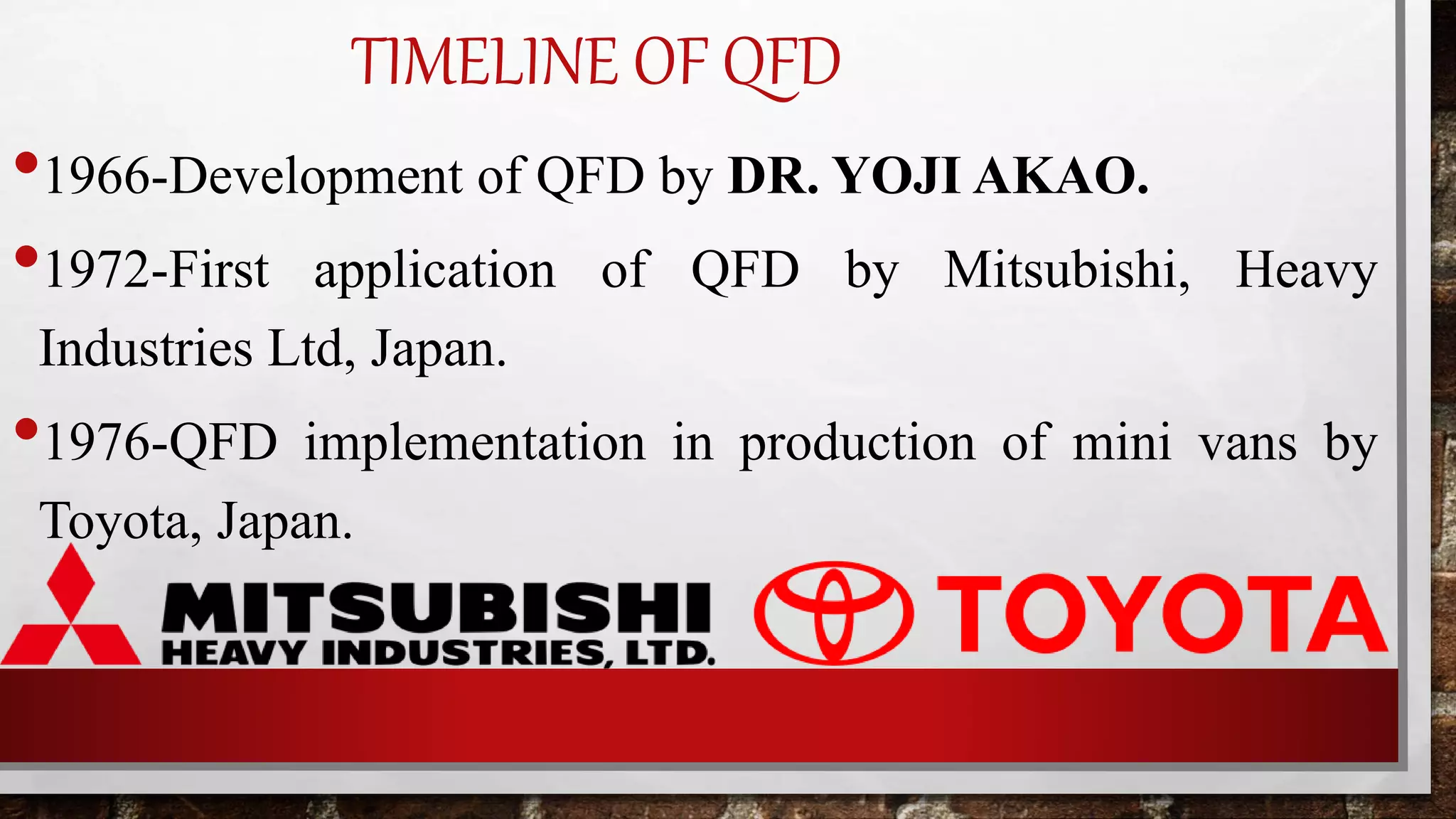
•1966-Development of QFD by DR. YOJI AKAO.
•1972-First application of QFD by Mitsubishi, Heavy
Industries Ltd, Japan.
•1976-QFD implementation in production of mini vans by
Toyota, Japan.
CUSTOMER REQUIREMENTS
• In order to understand the area of customer requirements we
must understand three distinct factors:
•The Customer Chain
• Obtaining Customer Requirements
• Organising of Customer Requirements
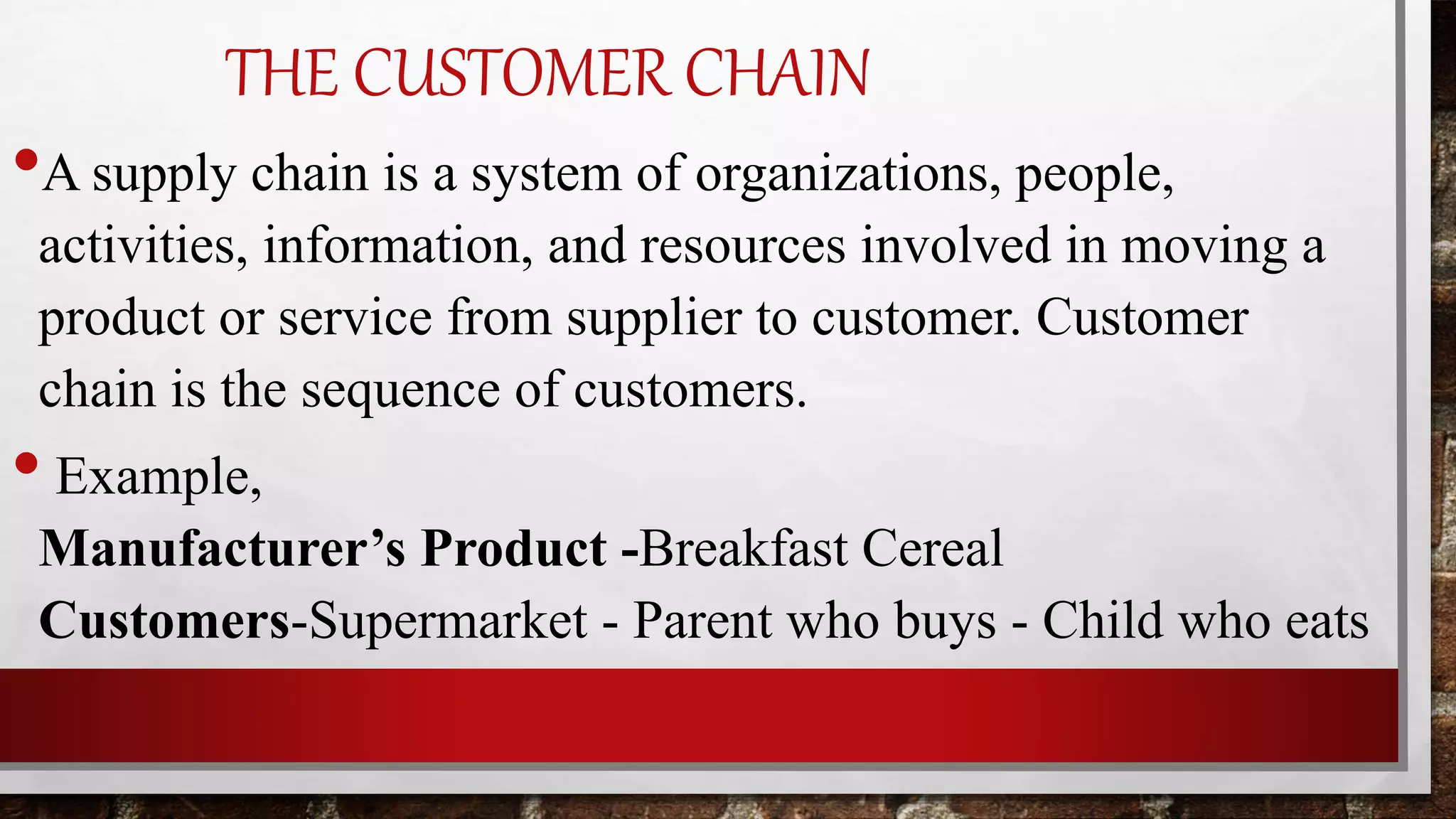
THE CUSTOMER CHAIN
•A supply chain is a system of organizations, people,
activities, information, and resources involved in moving a
product or service from supplier to customer. Customer
chain is the sequence of customers.
• Example,
Manufacturer’s Product -Breakfast Cereal
Customers-Supermarket - Parent who buys - Child who eats
OBTAINING CUSTOMER REQUIREMENTS
•The various sources of obtaining the customer requirements
are:
•Customer Survey.
•Focus Groups.
•Direct discussions or Interviews.
•Market Survey.
ORGANISING CUSTOMER REQUIREMENTS
•The customer research techniques may not highlight all the
customer needs but the common needs of the customers.
• To simplify the sampling the raw customer data is organised
into groups of associated data.
•The process of organising the data allows the QFD team to
reach a common understanding of customer needs.
CUSTOMER SATISFACTION MODEL
Excitement
Needs
Performance
Needs
Basic
Needs
Satisfied
Customer
Dissatisfied
Customer
Don’t Have
Don’t Do
Included
Do Well


Excitement
Needs
Performance
Needs
Basic
Needs
Satisfied
Customer
Dissatisfied
Customer
Don’t Have
Don’t Do
Included
Do Well


ORGANISING CUSTOMER REQUIREMENTS
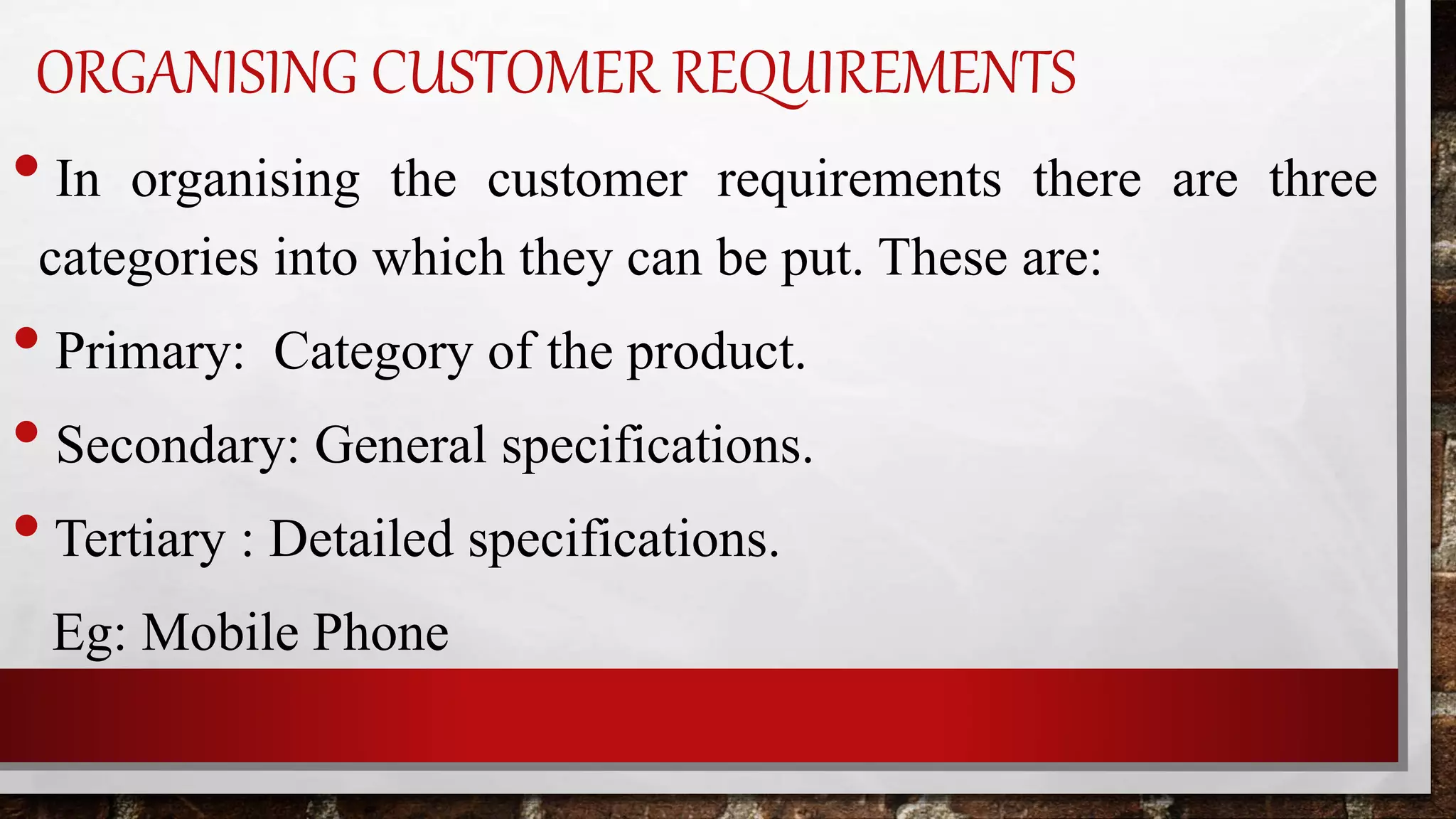
• In organising the customer requirements there are three
categories into which they can be put. These are:
• Primary: Category of the product.
• Secondary: General specifications.
•Tertiary : Detailed specifications.
Eg: Mobile Phone
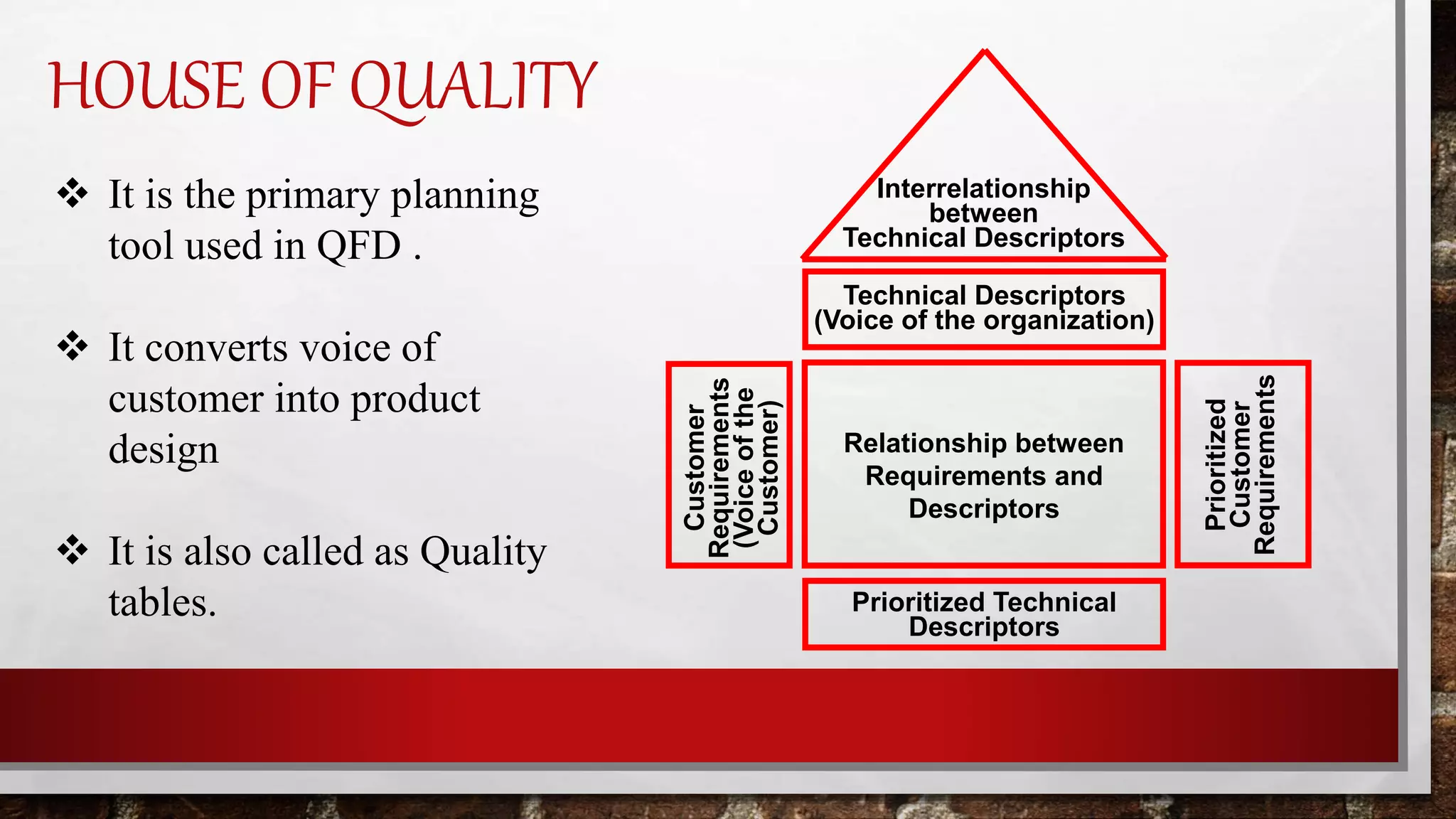
Technical Descriptors
(Voice of the organization)
Prioritized Technical
Descriptors
Interrelationship
between
Technical Descriptors
Customer
Requirements
(Voiceofthe
Customer)
Prioritized
Customer
Requirements
Relationship between
Requirements and
Descriptors
HOUSE OF QUALITY
 It is the primary planning
tool used in QFD .
 It converts voice of
customer into product
design
 It is also called as Quality
tables.
QFD BENEFITS
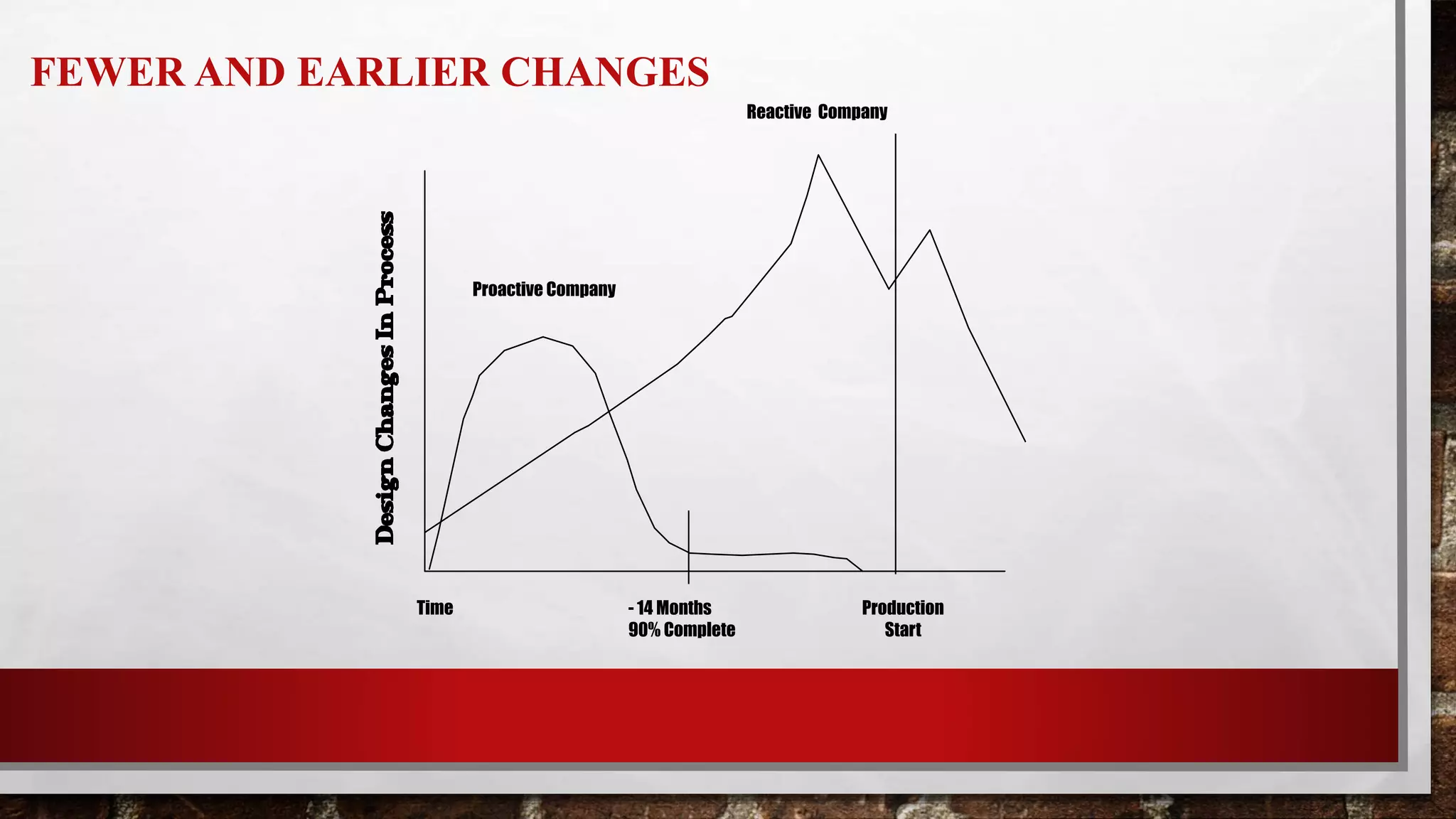
Proactive Company
Reactive Company
Time - 14 Months
90% Complete
Production
Start
FEWER AND EARLIER CHANGES
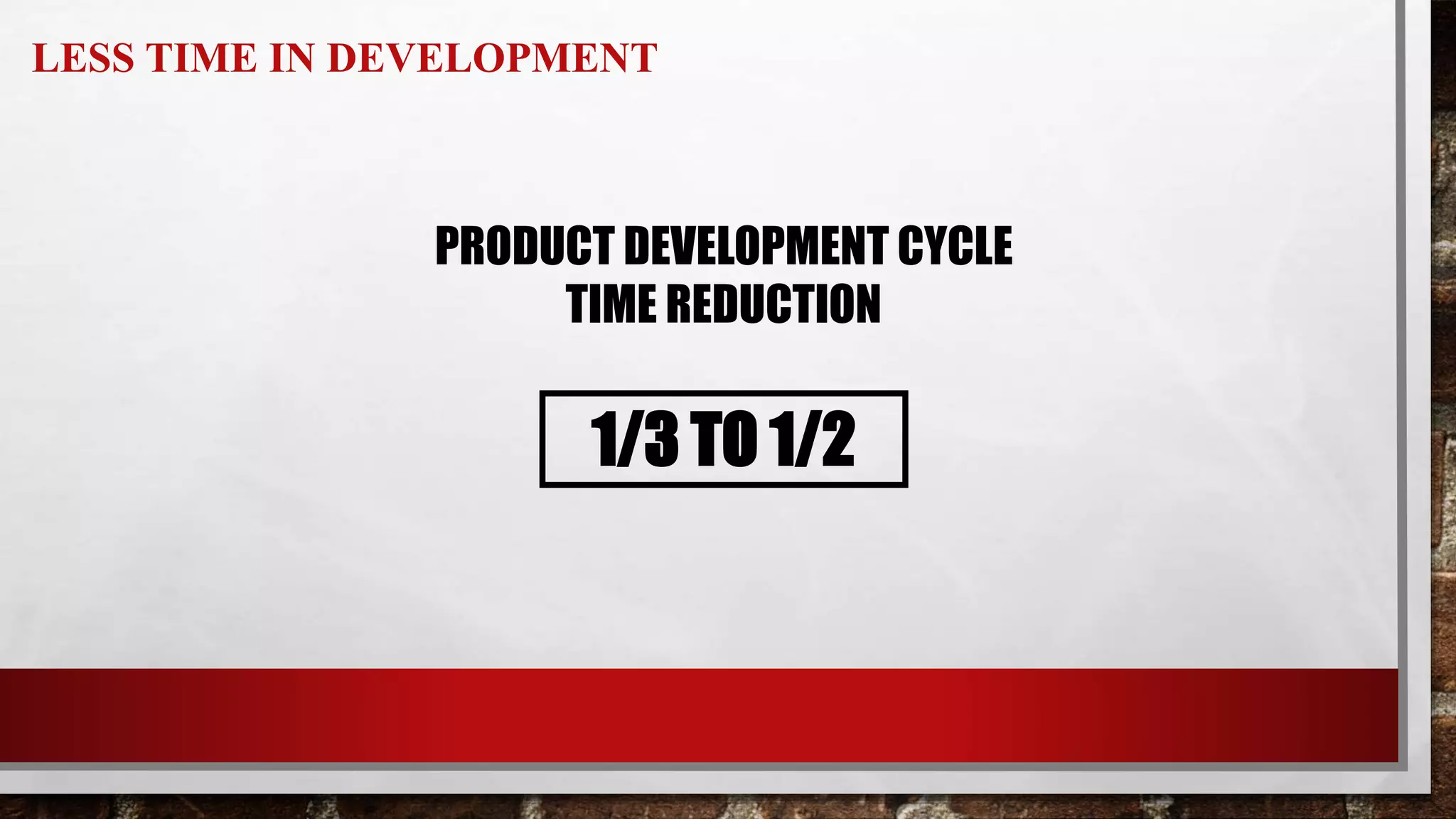
LESS TIME IN DEVELOPMENT
PRODUCT DEVELOPMENT CYCLE
TIME REDUCTION
1/3 TO 1/2
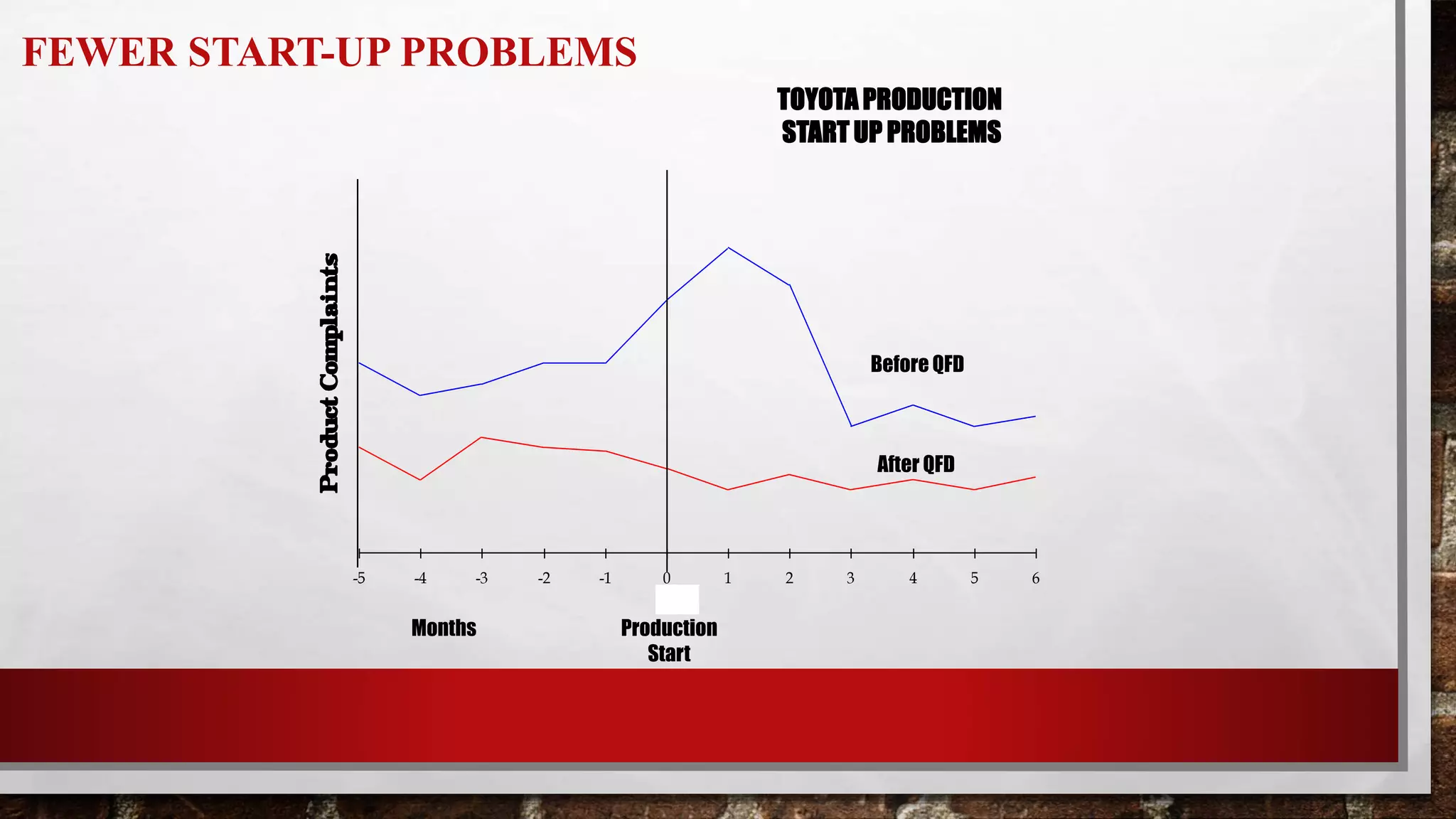
FEWER START-UP PROBLEMS
-5 -4 -3 -2 -1 0 1 2 3 4 5 6
Before QFD
After QFD
Production
Start
Months
TOYOTA PRODUCTION
START UP PROBLEMS
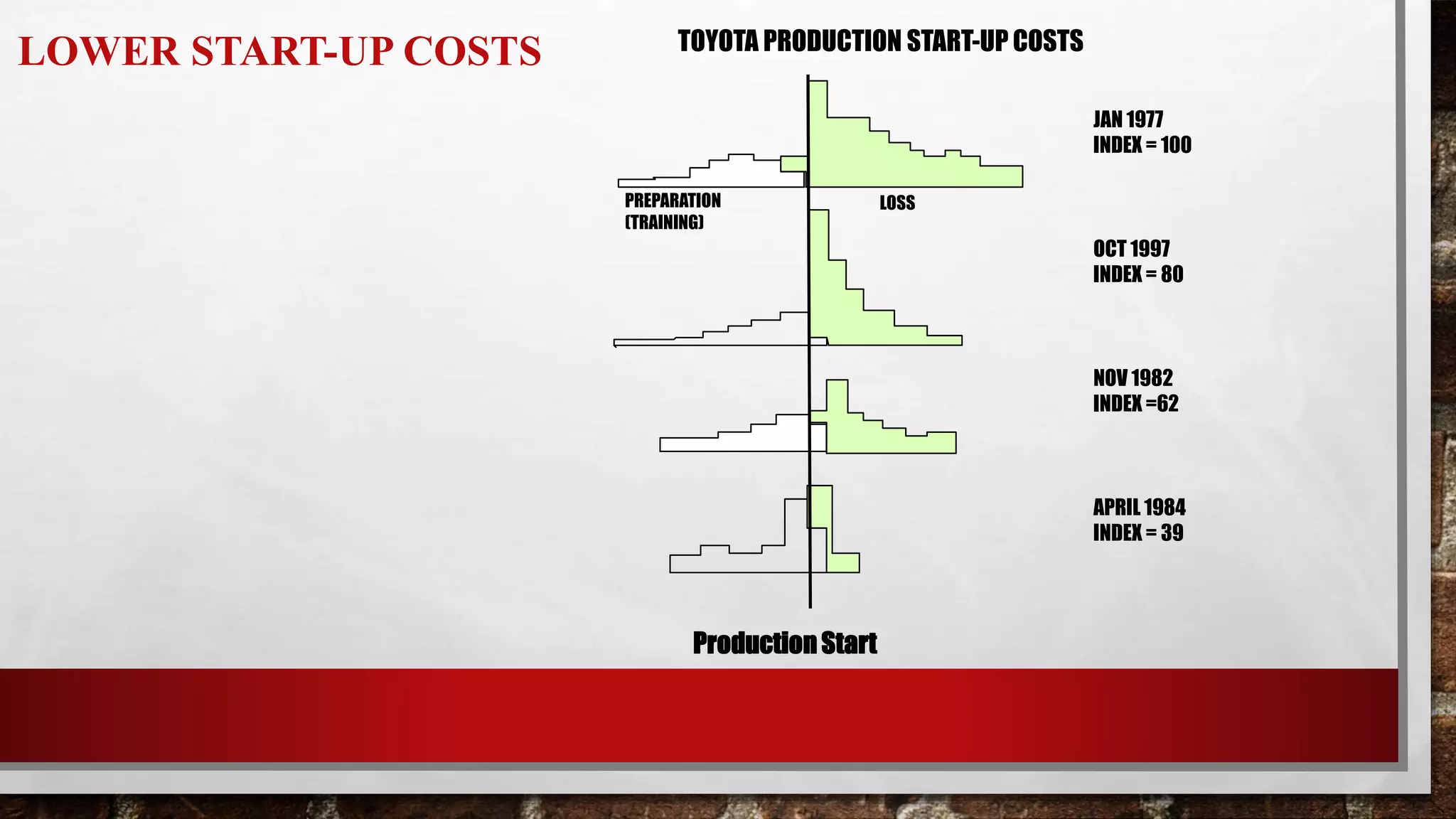
LOWER START-UP COSTS TOYOTA PRODUCTION START-UP COSTS
JAN 1977
INDEX = 100
OCT 1997
INDEX = 80
NOV 1982
INDEX =62
APRIL 1984
INDEX = 39
LOSSPREPARATION
(TRAINING)
ProductionStart
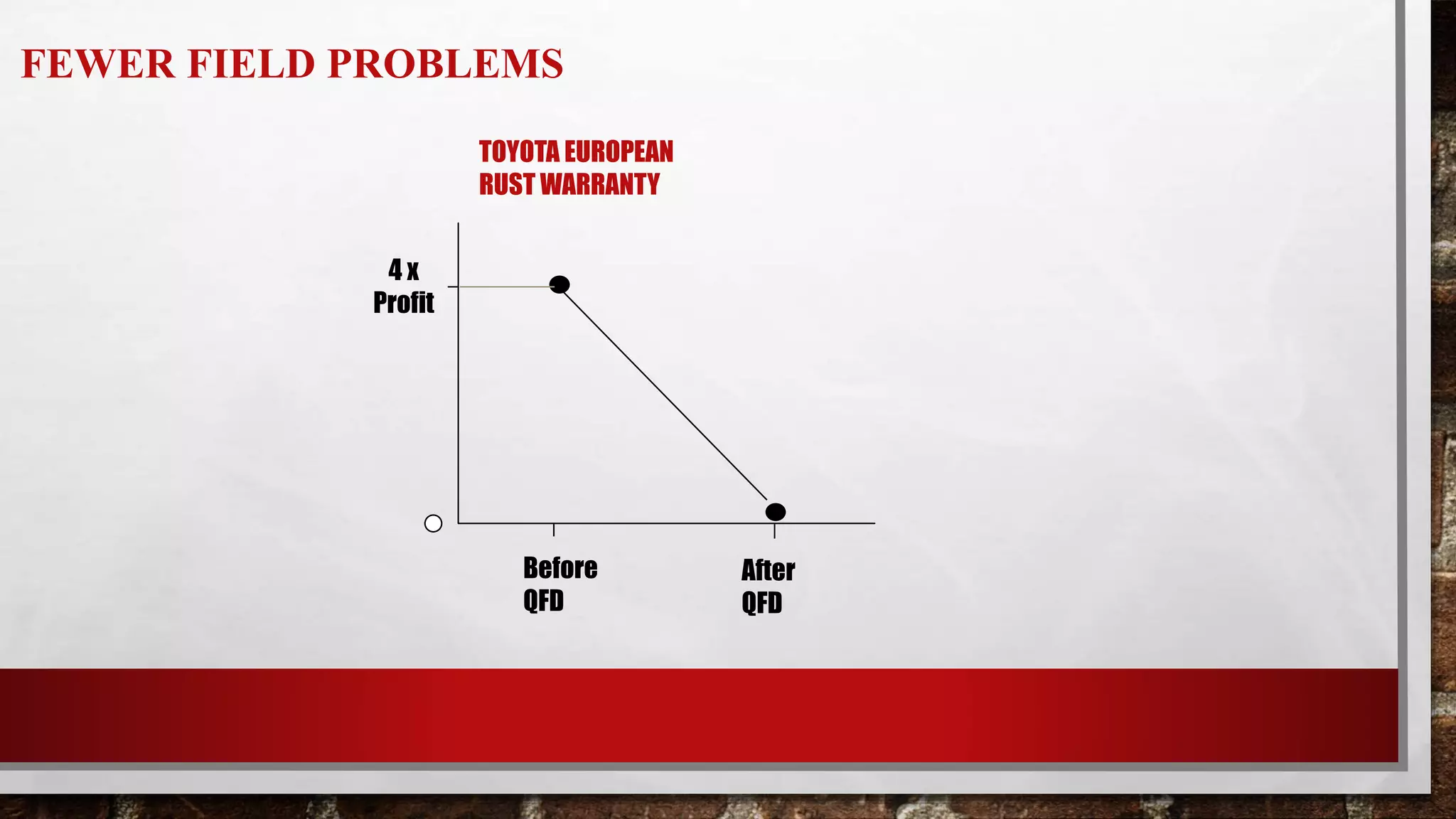
TOYOTA EUROPEAN
RUST WARRANTY
FEWER FIELD PROBLEMS
Before
QFD
After
QFD
4 x
Profit
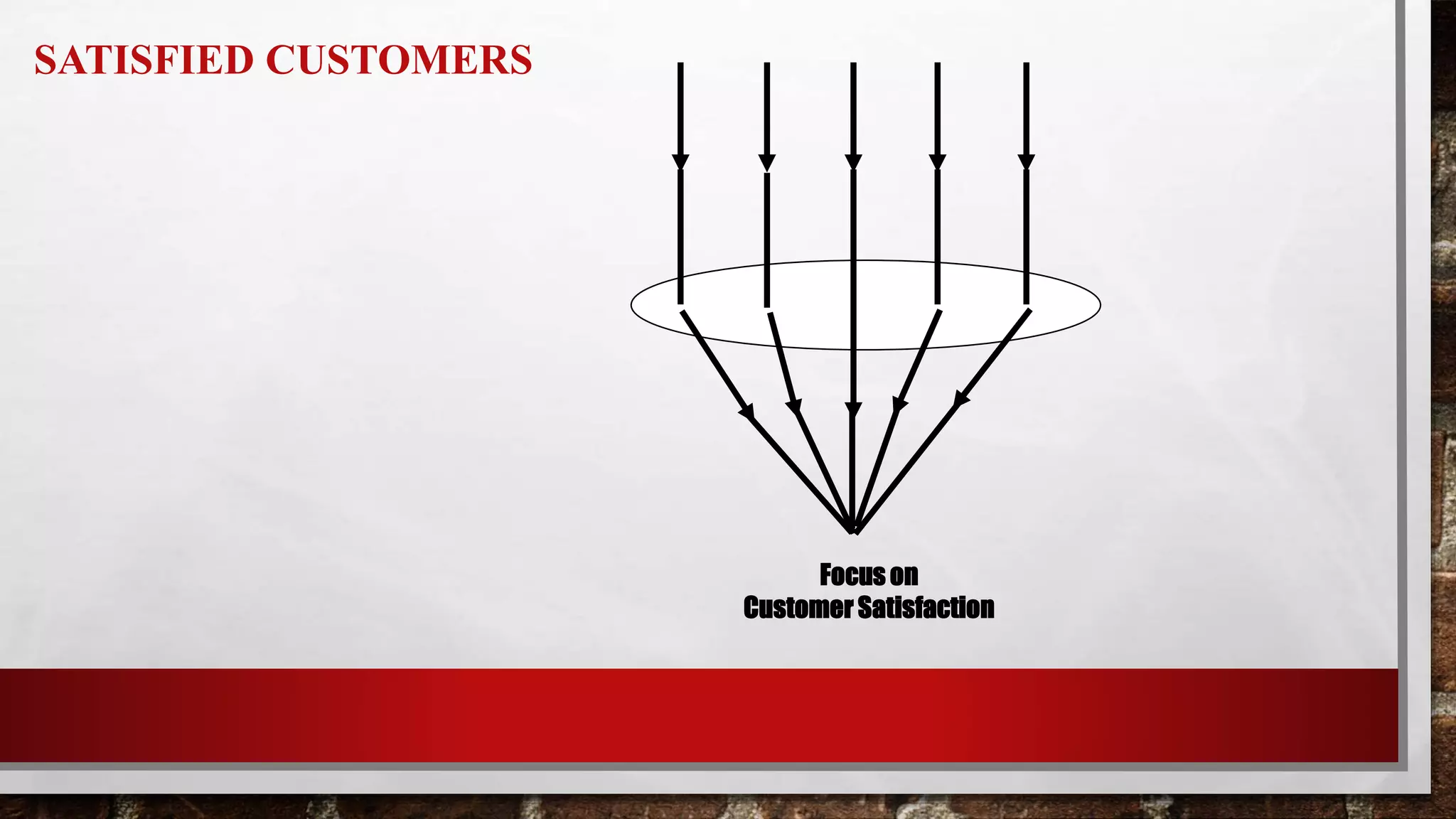
SATISFIED CUSTOMERS
Focus on
Customer Satisfaction
TANGIBLE BENEFITS
• Elimination of late engineering changes.
• Early identification of high risk areas.
• Up-front determination of product process requirements.
• Significant reduction in development time upto 50%.
• Efficient allocation of resources.
• Significant reduction in operation costs.
INTANGIBLE BENEFITS
• Improves customer satisfaction.
• Facilitates multidisciplinary teamwork.
• Establishes and maintains documentation.
• Strengthens relationship between company and the
customers.
• Provides basis for improving planning.

Quality function deployment (qfd)

  • 2.
    INTRODUCTION • Quality -Meeting Customer Requirements • Function - What Must Be Done ? • Deployment - Who Will Do It? , When ?
  • 3.
    DEFINITION QFD may bedefined as “A system for translating customer requirements into appropriate company requirements at each stage from research and product development to engineering and manufacturing to marketing/sales and distribution”. “Customer Driven Product / Process Development”
  • 4.
    TIMELINE OF QFD •1966-Developmentof QFD by DR. YOJI AKAO. •1972-First application of QFD by Mitsubishi, Heavy Industries Ltd, Japan. •1976-QFD implementation in production of mini vans by Toyota, Japan.
  • 5.
    CUSTOMER REQUIREMENTS • Inorder to understand the area of customer requirements we must understand three distinct factors: •The Customer Chain • Obtaining Customer Requirements • Organising of Customer Requirements
  • 6.
    THE CUSTOMER CHAIN •Asupply chain is a system of organizations, people, activities, information, and resources involved in moving a product or service from supplier to customer. Customer chain is the sequence of customers. • Example, Manufacturer’s Product -Breakfast Cereal Customers-Supermarket - Parent who buys - Child who eats
  • 7.
    OBTAINING CUSTOMER REQUIREMENTS •Thevarious sources of obtaining the customer requirements are: •Customer Survey. •Focus Groups. •Direct discussions or Interviews. •Market Survey.
  • 8.
    ORGANISING CUSTOMER REQUIREMENTS •Thecustomer research techniques may not highlight all the customer needs but the common needs of the customers. • To simplify the sampling the raw customer data is organised into groups of associated data. •The process of organising the data allows the QFD team to reach a common understanding of customer needs.
  • 9.
    CUSTOMER SATISFACTION MODEL Excitement Needs Performance Needs Basic Needs Satisfied Customer Dissatisfied Customer Don’tHave Don’t Do Included Do Well   Excitement Needs Performance Needs Basic Needs Satisfied Customer Dissatisfied Customer Don’t Have Don’t Do Included Do Well  
  • 10.
    ORGANISING CUSTOMER REQUIREMENTS •In organising the customer requirements there are three categories into which they can be put. These are: • Primary: Category of the product. • Secondary: General specifications. •Tertiary : Detailed specifications. Eg: Mobile Phone
  • 11.
    Technical Descriptors (Voice ofthe organization) Prioritized Technical Descriptors Interrelationship between Technical Descriptors Customer Requirements (Voiceofthe Customer) Prioritized Customer Requirements Relationship between Requirements and Descriptors HOUSE OF QUALITY  It is the primary planning tool used in QFD .  It converts voice of customer into product design  It is also called as Quality tables.
  • 12.
  • 13.
    Proactive Company Reactive Company Time- 14 Months 90% Complete Production Start FEWER AND EARLIER CHANGES
  • 14.
    LESS TIME INDEVELOPMENT PRODUCT DEVELOPMENT CYCLE TIME REDUCTION 1/3 TO 1/2
  • 15.
    FEWER START-UP PROBLEMS -5-4 -3 -2 -1 0 1 2 3 4 5 6 Before QFD After QFD Production Start Months TOYOTA PRODUCTION START UP PROBLEMS
  • 16.
    LOWER START-UP COSTSTOYOTA PRODUCTION START-UP COSTS JAN 1977 INDEX = 100 OCT 1997 INDEX = 80 NOV 1982 INDEX =62 APRIL 1984 INDEX = 39 LOSSPREPARATION (TRAINING) ProductionStart
  • 17.
    TOYOTA EUROPEAN RUST WARRANTY FEWERFIELD PROBLEMS Before QFD After QFD 4 x Profit
  • 18.
  • 19.
    TANGIBLE BENEFITS • Eliminationof late engineering changes. • Early identification of high risk areas. • Up-front determination of product process requirements. • Significant reduction in development time upto 50%. • Efficient allocation of resources. • Significant reduction in operation costs.
  • 20.
    INTANGIBLE BENEFITS • Improvescustomer satisfaction. • Facilitates multidisciplinary teamwork. • Establishes and maintains documentation. • Strengthens relationship between company and the customers. • Provides basis for improving planning.