Situating Net neutrality in its broader context

    Towards an analytical framework for the distribution of content on the
    Internet


    Leo Van Audenhove (IBBT-SMIT)
    Luciano Morganti (IBBT-SMIT)


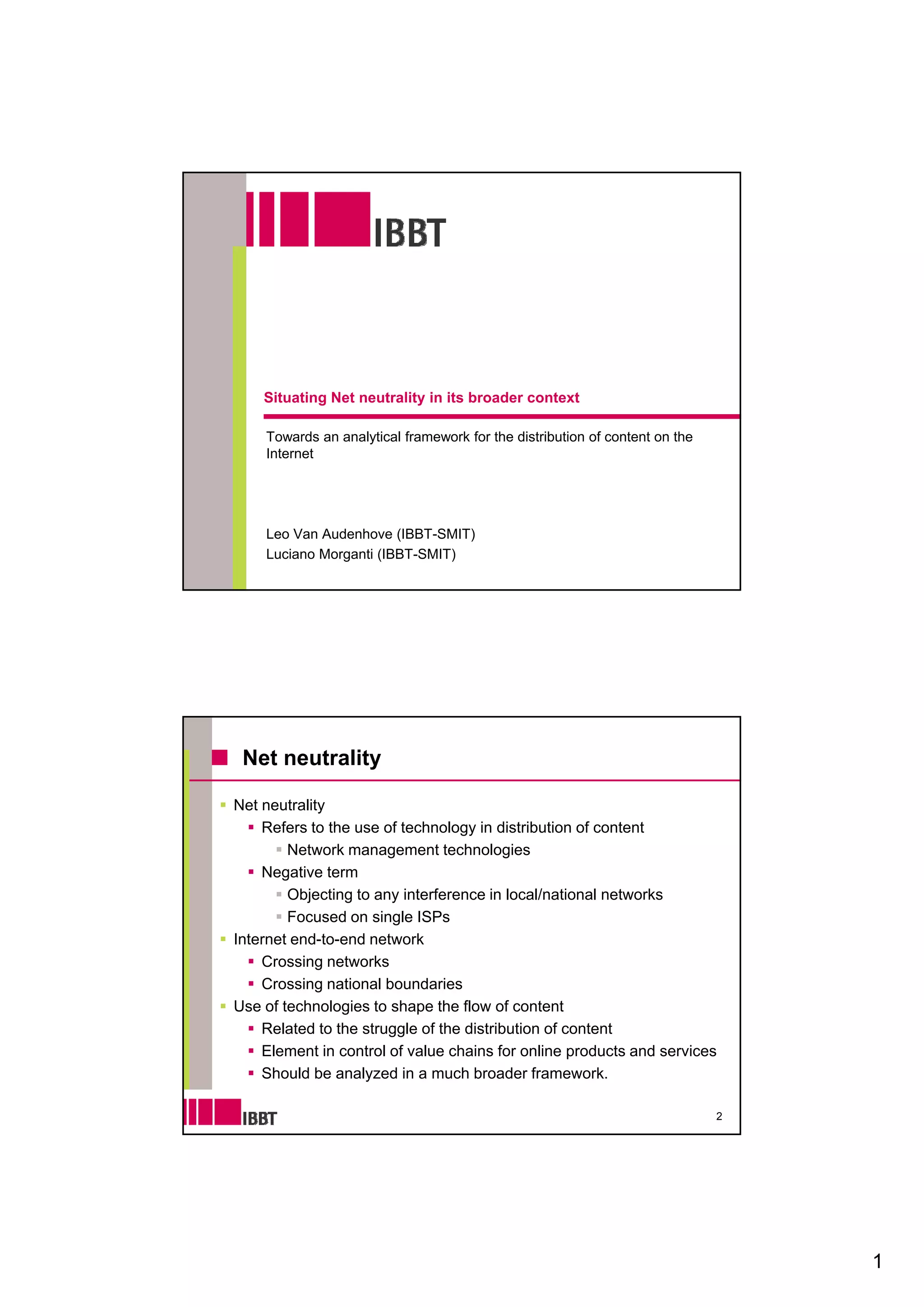
 Net neutrality

Net neutrality
    Refers to the use of technology in distribution of content
        Network management technologies
                       g                  g
    Negative term
        Objecting to any interference in local/national networks
        Focused on single ISPs
Internet end-to-end network
    Crossing networks
    Crossing national boundaries
Use of technologies to shape the flow of content
    Related to the struggle of the distribution of content
    Element in control of value chains for online products and services
    Should be analyzed in a much broader framework.

                                                                             2


                                                                                 1
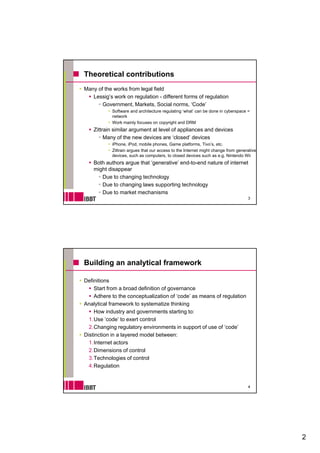
Theoretical contributions
Many of the works from legal field
   Lessig’s work on regulation - different forms of regulation
       Government, Markets, Social norms, ‘Code’
            Software and architecture regulating ‘what’ can be done in cyberspace =
            network
            Work mainly focuses on copyright and DRM
    Zittrain similar argument at level of appliances and devices
         Many of the new devices are ‘closed’ devices
            iPhone, iPod, mobile phones, Game platforms, Tivo’s, etc.
            Zittrain argues that our access to the Internet might change from generative
            devices,
            devices such as computers to closed devices such as e g Nintendo Wii
                              computers,                             e.g.
    Both authors argue that ‘generative’ end-to-end nature of internet
    might disappear
       Due to changing technology
       Due to changing laws supporting technology
       Due to market mechanisms
                                                                                   3


Building an analytical framework

Definitions
    Start from a broad definition of governance
    Adhere to the conceptualization of ‘code’ as means of regulation
                                         code
Analytical framework to systematize thinking
    How industry and governments starting to:
  1.Use ‘code’ to exert control
  2.Changing regulatory environments in support of use of ‘code’
Distinction in a layered model between:
  1.Internet actors
  2.Dimensions of control
  3.Technologies of control
  4.Regulation


                                                                                   4


                                                                                           2
Building an analytical framework
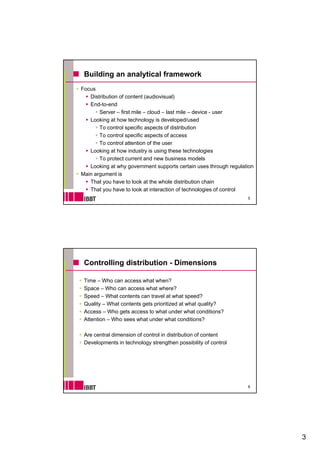
Focus
   Distribution of content (audiovisual)
   End-to-end
       Server – first mile – cloud – last mile – device - user
   Looking at how technology is developed/used
       To control specific aspects of distribution
       To control specific aspects of access
       To control attention of the user
   Looking at how industry is using these technologies
       To protect current and new business models
   Looking at why government supports certain uses through regulation
Main argument is
   That you have to look at the whole distribution chain
   That you have to look at interaction of technologies of control
                                                                     5


 Controlling distribution - Dimensions

 Time – Who can access what when?
 Space – Who can access what where?
 Speed – What contents can travel at what speed?
 Quality – What contents gets prioritized at what quality?
 Access – Who gets access to what under what conditions?
 Attention – Who sees what under what conditions?

 Are central dimension of control in distribution of content
 Developments in technology strengthen p
       p                   gy       g       possibility of control
                                                      y


                                                                     6


                                                                         3
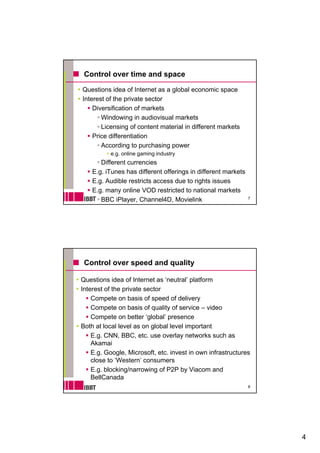
Control over time and space

Questions idea of Internet as a global economic space
Interest of the private sector
    Diversification of markets
       Windowing in audiovisual markets
       Licensing of content material in different markets
    Price differentiation
       According to purchasing power
          e.g. online g
            g         gaming industry
                           g        y
       Different currencies
    E.g. iTunes has different offerings in different markets
    E.g. Audible restricts access due to rights issues
    E.g. many online VOD restricted to national markets
                                                               7
       BBC iPlayer, Channel4D, Movielink


 Control over speed and quality

Questions idea of Internet as ‘neutral’ platform
Interest of the private sector
    Compete on b i of speed of d li
    C       t     basis f      d f delivery
    Compete on basis of quality of service – video
    Compete on better ‘global’ presence
Both at local level as on global level important
    E.g. CNN, BBC, etc. use overlay networks such as
    Akamai
    E.g. Google, Microsoft, etc. invest in own infrastructures
    close to ‘Western’ consumers
    E.g. blocking/narrowing of P2P by Viacom and
    BellCanada
                                                               8


                                                                   4
Control over access and attention

Questions internet as an ‘open/unmediated’ space
  Interest of private sector (positive)
      Competition on prime content
      Guide towards prime content
      Adapt offering according to taste and place
      E.g. research results of search/websites
  Interest of private sector (negative)
      Filter out illegal or unwanted content
           E.g. wikipedia blocks certain content related to child foto’s
   Interest of government
      Prohibition to access harmful content
           Hate speech, decency, etc.
           Political content                                               9


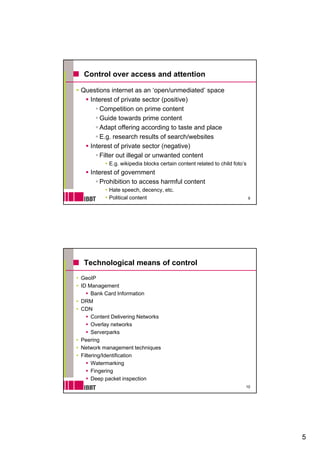
 Technological means of control
GeoIP
ID Management
     Bank Card Information
DRM
CDN
     Content Delivering Networks
     Overlay networks
     Serverparks
Peering
Network management techniques
Filtering/Identification
     Watermarking
     Fingering
     Deep packet inspection
                                                                       10


                                                                               5
Introducing a model


                                          11


Video industry: control and instruments


                                          12


                                               6
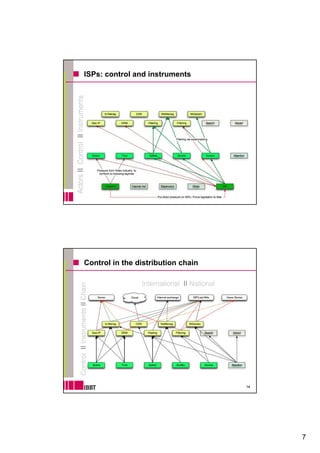
ISPs: control and instruments


                                    13


Control in the distribution chain


                                    14


                                         7
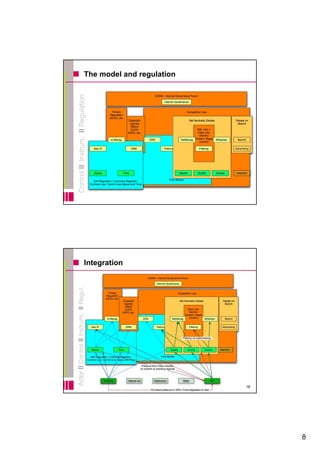
The model and regulation


                           15


Integration


                           16


                                8
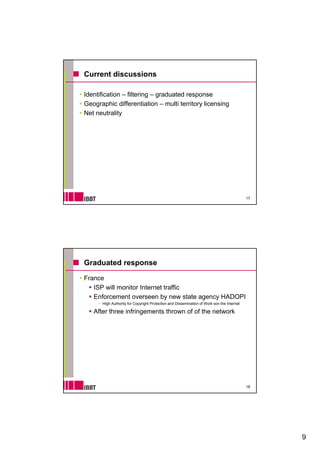
Current discussions

Identification – filtering – graduated response
Geographic differentiation – multi territory licensing
Net neutrality


                                                                                           17


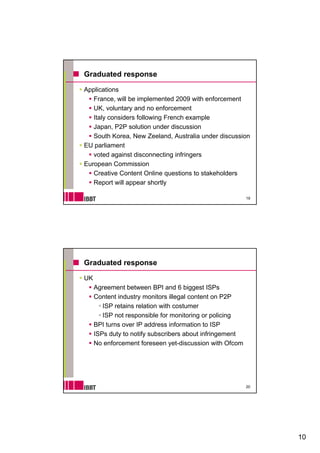
Graduated response

France
   ISP will monitor Internet traffic
   Enforcement overseen by new state agency HADOPI
      High Authority for Copyright Protection and Dissemination of Work son the Internet

   After three infringements thrown of of the network


                                                                                           18


                                                                                                9
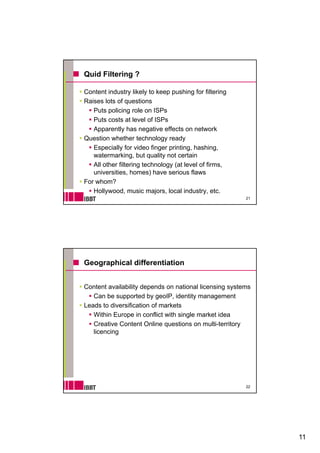
Graduated response

Applications
   France, will be implemented 2009 with enforcement
   UK,
   UK voluntary and no enforcement
   Italy considers following French example
   Japan, P2P solution under discussion
   South Korea, New Zeeland, Australia under discussion
EU parliament
   voted against disconnecting infringers
European Commission
   Creative Content Online questions to stakeholders
   Report will appear shortly

                                                          19


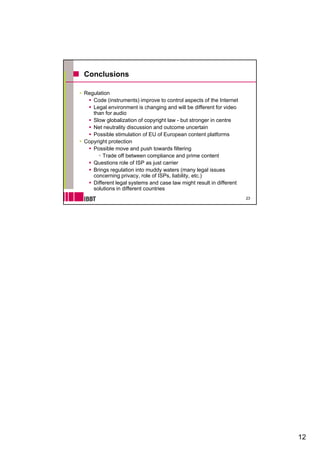
Graduated response

UK
     Agreement between BPI and 6 biggest ISPs
     Content industry monitors illegal content on P2P
        ISP retains relation with costumer
        ISP not responsible for monitoring or policing
     BPI turns over IP address information to ISP
     ISPs duty to notify subscribers about infringement
     No enforcement foreseen yet-discussion with Ofcom
                                yet discussion


                                                          20


                                                               10
Quid Filtering ?

Content industry likely to keep pushing for filtering
Raises lots of questions
   Puts policing role on ISP
   P       li i      l     ISPs
   Puts costs at level of ISPs
   Apparently has negative effects on network
Question whether technology ready
   Especially for video finger printing, hashing,
   watermarking,
   watermarking but quality not certain
   All other filtering technology (at level of firms,
   universities, homes) have serious flaws
For whom?
   Hollywood, music majors, local industry, etc.
                                                        21


Geographical differentiation


Content availability depends on national licensing systems
   Can be supported by geoIP identity management
                          geoIP,
Leads to diversification of markets
   Within Europe in conflict with single market idea
   Creative Content Online questions on multi-territory
   licencing


                                                        22


                                                             11
Conclusions

Regulation
   Code (instruments) improve to control aspects of the Internet
   Legal environment is changing and will be different for video
   than for audio
   Slow globalization of copyright law - but stronger in centre
   Net neutrality discussion and outcome uncertain
   Possible stimulation of EU of European content platforms
Copyright protection
   Possible move and push towards filtering
       Trade off between compliance and prime content
   Questions role of ISP as just carrier
   Brings regulation into muddy waters (many legal issues
   concerning privacy, role of ISPs, liability, etc.)
   Different legal systems and case law might result in different
   solutions in different countries
                                                                    23


                                                                         12

Qo E E2 E4 Net Neutrality Leo Van Audenhove

  • 1.
    Situating Net neutralityin its broader context Towards an analytical framework for the distribution of content on the Internet Leo Van Audenhove (IBBT-SMIT) Luciano Morganti (IBBT-SMIT) Net neutrality Net neutrality Refers to the use of technology in distribution of content Network management technologies g g Negative term Objecting to any interference in local/national networks Focused on single ISPs Internet end-to-end network Crossing networks Crossing national boundaries Use of technologies to shape the flow of content Related to the struggle of the distribution of content Element in control of value chains for online products and services Should be analyzed in a much broader framework. 2 1
  • 2.
    Theoretical contributions Many ofthe works from legal field Lessig’s work on regulation - different forms of regulation Government, Markets, Social norms, ‘Code’ Software and architecture regulating ‘what’ can be done in cyberspace = network Work mainly focuses on copyright and DRM Zittrain similar argument at level of appliances and devices Many of the new devices are ‘closed’ devices iPhone, iPod, mobile phones, Game platforms, Tivo’s, etc. Zittrain argues that our access to the Internet might change from generative devices, devices such as computers to closed devices such as e g Nintendo Wii computers, e.g. Both authors argue that ‘generative’ end-to-end nature of internet might disappear Due to changing technology Due to changing laws supporting technology Due to market mechanisms 3 Building an analytical framework Definitions Start from a broad definition of governance Adhere to the conceptualization of ‘code’ as means of regulation code Analytical framework to systematize thinking How industry and governments starting to: 1.Use ‘code’ to exert control 2.Changing regulatory environments in support of use of ‘code’ Distinction in a layered model between: 1.Internet actors 2.Dimensions of control 3.Technologies of control 4.Regulation 4 2
  • 3.
    Building an analyticalframework Focus Distribution of content (audiovisual) End-to-end Server – first mile – cloud – last mile – device - user Looking at how technology is developed/used To control specific aspects of distribution To control specific aspects of access To control attention of the user Looking at how industry is using these technologies To protect current and new business models Looking at why government supports certain uses through regulation Main argument is That you have to look at the whole distribution chain That you have to look at interaction of technologies of control 5 Controlling distribution - Dimensions Time – Who can access what when? Space – Who can access what where? Speed – What contents can travel at what speed? Quality – What contents gets prioritized at what quality? Access – Who gets access to what under what conditions? Attention – Who sees what under what conditions? Are central dimension of control in distribution of content Developments in technology strengthen p p gy g possibility of control y 6 3
  • 4.
    Control over timeand space Questions idea of Internet as a global economic space Interest of the private sector Diversification of markets Windowing in audiovisual markets Licensing of content material in different markets Price differentiation According to purchasing power e.g. online g g gaming industry g y Different currencies E.g. iTunes has different offerings in different markets E.g. Audible restricts access due to rights issues E.g. many online VOD restricted to national markets 7 BBC iPlayer, Channel4D, Movielink Control over speed and quality Questions idea of Internet as ‘neutral’ platform Interest of the private sector Compete on b i of speed of d li C t basis f d f delivery Compete on basis of quality of service – video Compete on better ‘global’ presence Both at local level as on global level important E.g. CNN, BBC, etc. use overlay networks such as Akamai E.g. Google, Microsoft, etc. invest in own infrastructures close to ‘Western’ consumers E.g. blocking/narrowing of P2P by Viacom and BellCanada 8 4
  • 5.
    Control over accessand attention Questions internet as an ‘open/unmediated’ space Interest of private sector (positive) Competition on prime content Guide towards prime content Adapt offering according to taste and place E.g. research results of search/websites Interest of private sector (negative) Filter out illegal or unwanted content E.g. wikipedia blocks certain content related to child foto’s Interest of government Prohibition to access harmful content Hate speech, decency, etc. Political content 9 Technological means of control GeoIP ID Management Bank Card Information DRM CDN Content Delivering Networks Overlay networks Serverparks Peering Network management techniques Filtering/Identification Watermarking Fingering Deep packet inspection 10 5
  • 6.
    Introducing a model 11 Video industry: control and instruments 12 6
  • 7.
    ISPs: control andinstruments 13 Control in the distribution chain 14 7
  • 8.
    The model andregulation 15 Integration 16 8
  • 9.
    Current discussions Identification –filtering – graduated response Geographic differentiation – multi territory licensing Net neutrality 17 Graduated response France ISP will monitor Internet traffic Enforcement overseen by new state agency HADOPI High Authority for Copyright Protection and Dissemination of Work son the Internet After three infringements thrown of of the network 18 9
  • 10.
    Graduated response Applications France, will be implemented 2009 with enforcement UK, UK voluntary and no enforcement Italy considers following French example Japan, P2P solution under discussion South Korea, New Zeeland, Australia under discussion EU parliament voted against disconnecting infringers European Commission Creative Content Online questions to stakeholders Report will appear shortly 19 Graduated response UK Agreement between BPI and 6 biggest ISPs Content industry monitors illegal content on P2P ISP retains relation with costumer ISP not responsible for monitoring or policing BPI turns over IP address information to ISP ISPs duty to notify subscribers about infringement No enforcement foreseen yet-discussion with Ofcom yet discussion 20 10
  • 11.
    Quid Filtering ? Contentindustry likely to keep pushing for filtering Raises lots of questions Puts policing role on ISP P li i l ISPs Puts costs at level of ISPs Apparently has negative effects on network Question whether technology ready Especially for video finger printing, hashing, watermarking, watermarking but quality not certain All other filtering technology (at level of firms, universities, homes) have serious flaws For whom? Hollywood, music majors, local industry, etc. 21 Geographical differentiation Content availability depends on national licensing systems Can be supported by geoIP identity management geoIP, Leads to diversification of markets Within Europe in conflict with single market idea Creative Content Online questions on multi-territory licencing 22 11
  • 12.
    Conclusions Regulation Code (instruments) improve to control aspects of the Internet Legal environment is changing and will be different for video than for audio Slow globalization of copyright law - but stronger in centre Net neutrality discussion and outcome uncertain Possible stimulation of EU of European content platforms Copyright protection Possible move and push towards filtering Trade off between compliance and prime content Questions role of ISP as just carrier Brings regulation into muddy waters (many legal issues concerning privacy, role of ISPs, liability, etc.) Different legal systems and case law might result in different solutions in different countries 23 12