Quality Improvement
Principles
Methods & Tools
By
Dr. Maged Shaheen
Principles of Quality Improvement
“Quality is never an accident; it is always the result
of high intention, sincere effort, intelligent direction
and skillful execution; it represents the wise choice
of many alternatives.”
William Foster
(many variations attributed to others)
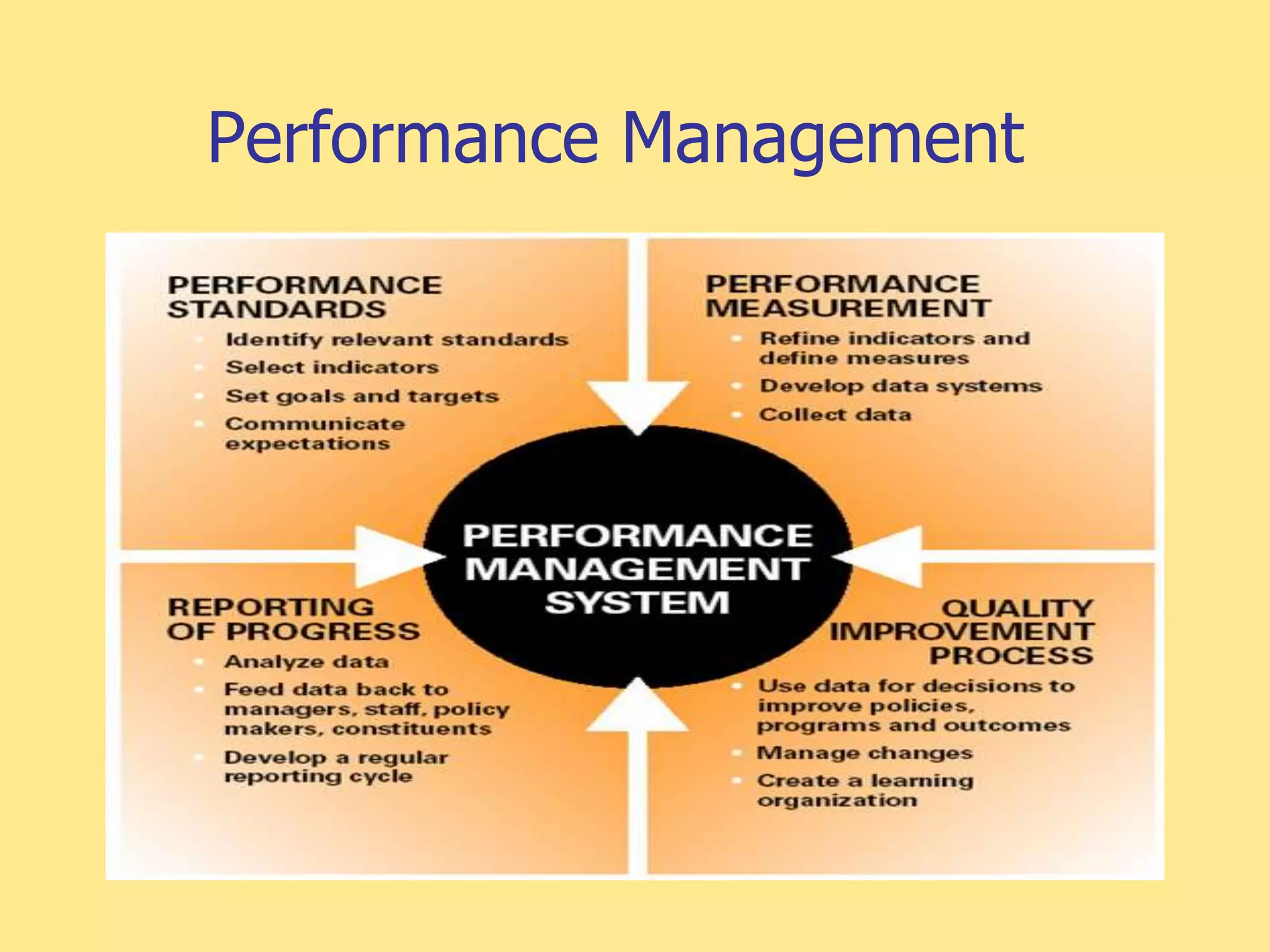
Performance Management
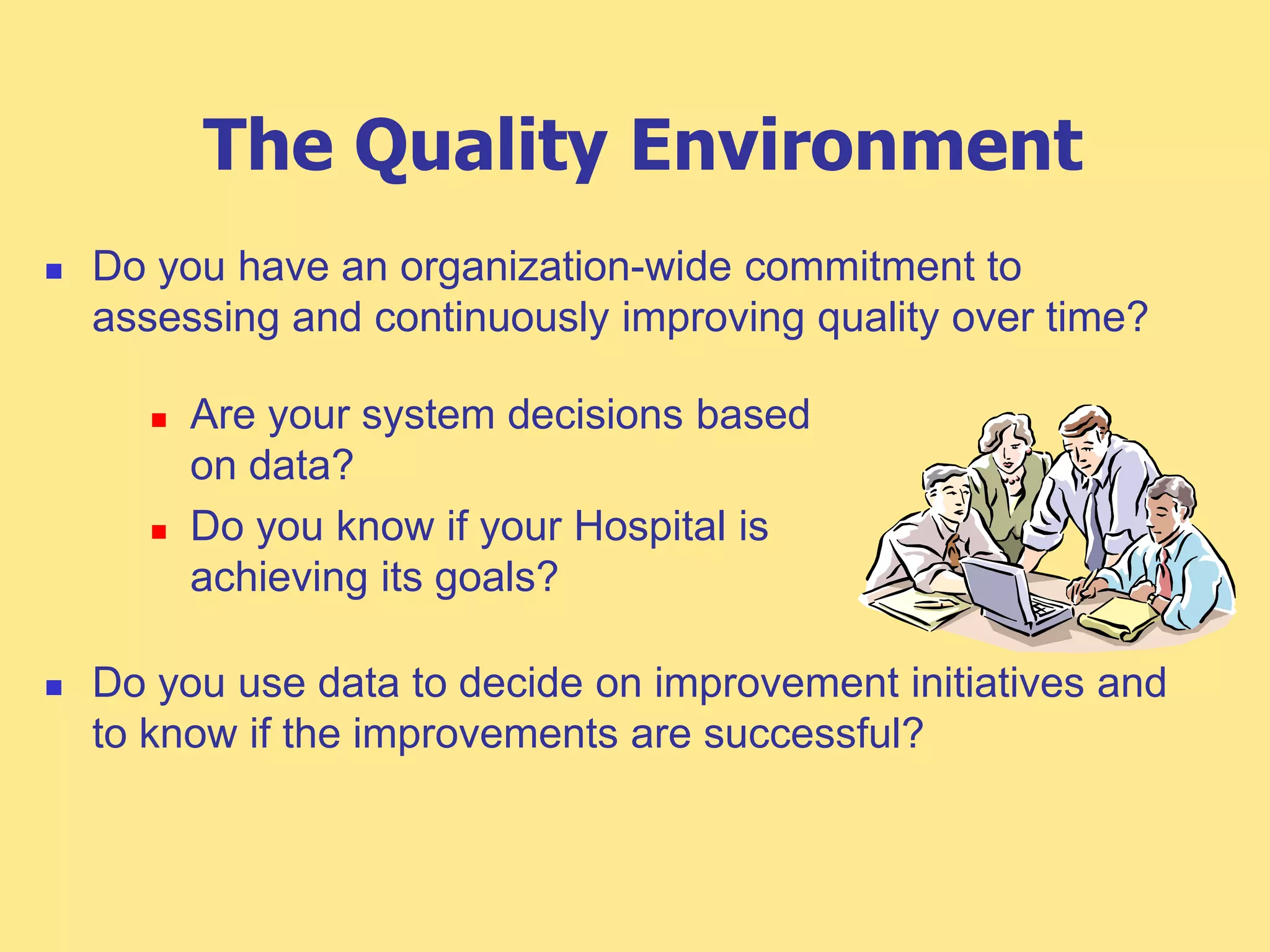
The Quality Environment
 Do you have an organization-wide commitment to
assessing and continuously improving quality over time?
 Do you use data to decide on improvement initiatives and
to know if the improvements are successful?
 Are your system decisions based
on data?
 Do you know if your Hospital is
achieving its goals?
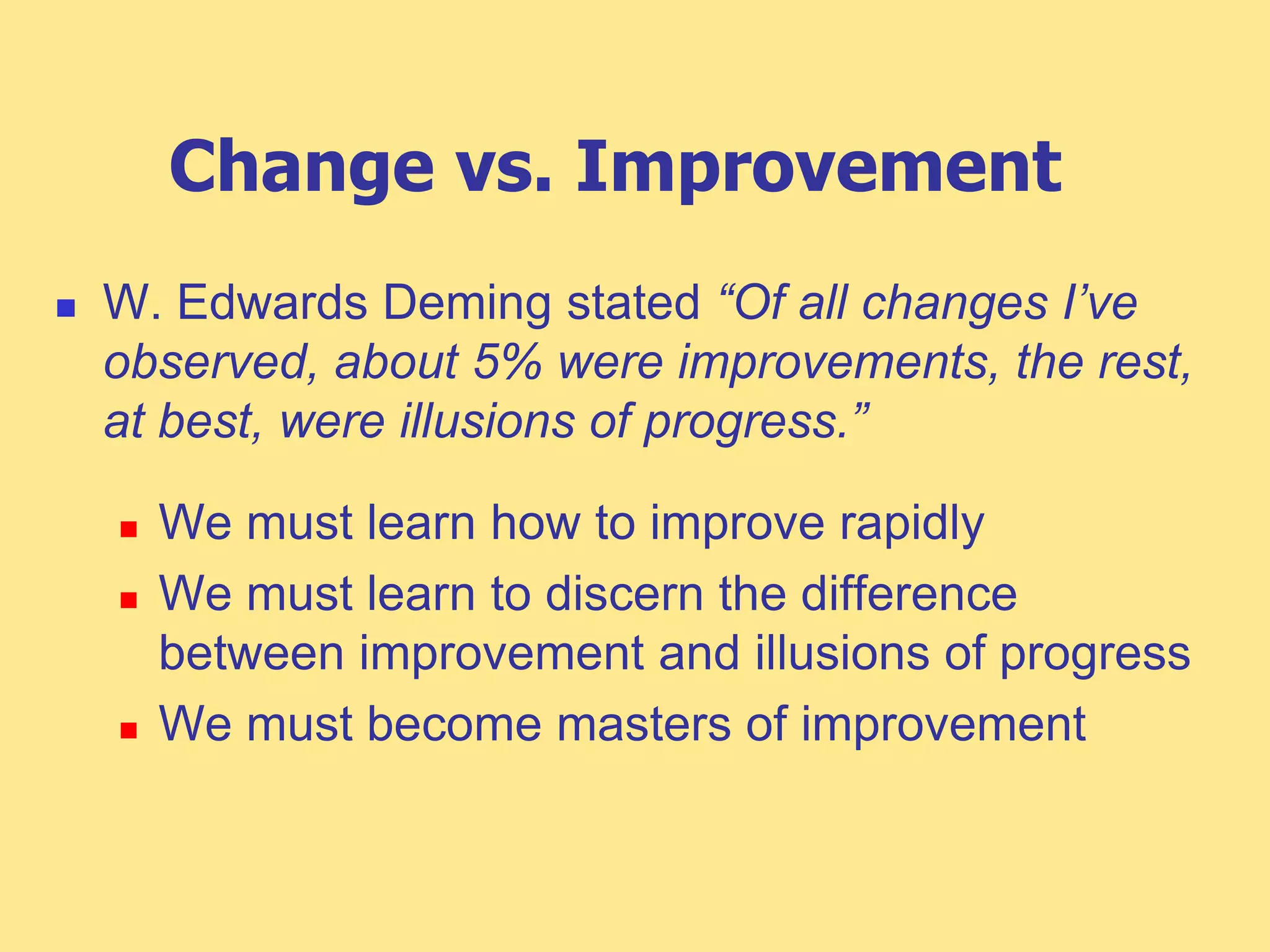
Change vs. Improvement
 W. Edwards Deming stated “Of all changes I’ve
observed, about 5% were improvements, the rest,
at best, were illusions of progress.”
 We must learn how to improve rapidly
 We must learn to discern the difference
between improvement and illusions of progress
 We must become masters of improvement
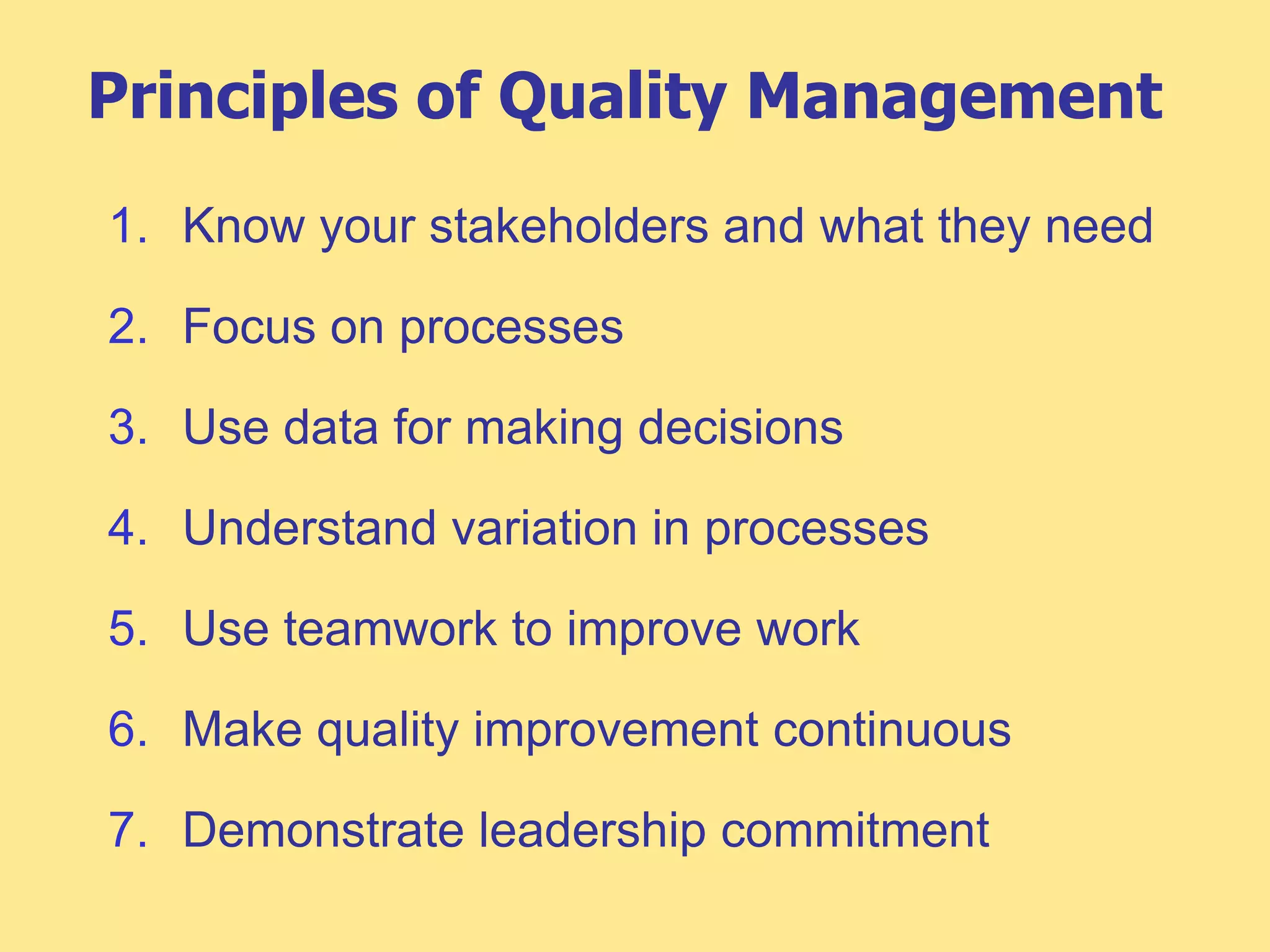
Principles of Quality Management
1. Know your stakeholders and what they need
2. Focus on processes
3. Use data for making decisions
4. Understand variation in processes
5. Use teamwork to improve work
6. Make quality improvement continuous
7. Demonstrate leadership commitment
What questions do you have?
METHODOLOGY
1. Proactive Method
FMEA
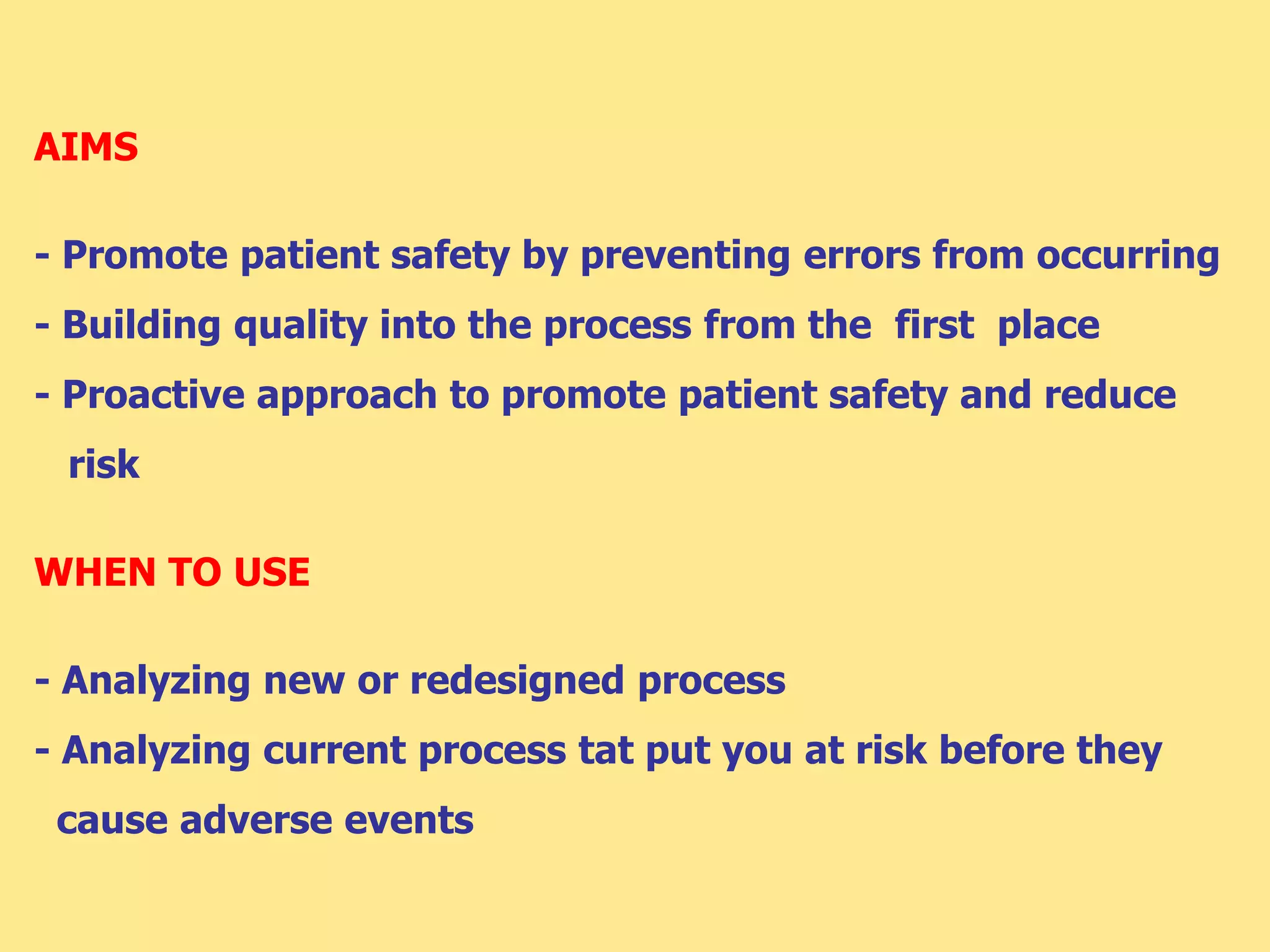
AIMS
- Promote patient safety by preventing errors from occurring
- Building quality into the process from the first place
- Proactive approach to promote patient safety and reduce
risk
WHEN TO USE
- Analyzing new or redesigned process
- Analyzing current process tat put you at risk before they
cause adverse events
F failure the condition or fact of not achieving the desired end
M failure mode different ways that a process fails to function i.e.
undesirable variation of the process
E effect the adverse consequences of failure mode that the patient
or other customers might experiences
A analysis i.e. find the causes, hazard, frequency of occurrence,
severity, detectability, critically index risk priority number, and
control measures
2- Concurrent method
LEAN thinking approach
A look back and a look
forward
AIMS
- Eliminating and preventing waste
- Reducing process lead time
- Just in time efficient delivery of services
- Improving quality and reducing costs
L look for the value the customer wants.
All of actions required from start to finish in responding to a
customer need plus the information controlling this actions
that means entire flow and all of the steps and costs
E eliminate the unneeded steps
Strive continuously to reduce the number of steps to make
the flow value stream
A accelerate the process
Make the remaining process steps as rapid as possible
by reducing the amount of time , and amount of
information needed of each step to the necessary
N needs of the customer to be fulfilled
Meet the customer needs and expectations
3-Reactive method
Improvement projects
(Problem Solving)
F = Find an opportunity for improvement.
- Select the process of interest.
- Define preliminary process boundaries.
- Decide if the selected process is the best one to improve.
O = Organize a team
- Identify the team leader/ process owner.
- Assign a facilitator/ coach who will guide the team.
- Select team members from appropriate levels.
C = Clarify the current process
- Flow chart the process.
- Make simple improvements to define the best process.
- Identify suppliers and customers.
U = Understand
- The sources of the problem and the process variation,
- Investigate special causes and seek to stabilize the process.
S = Select the improvement (a change)
- Identify improvement alternatives that will contribute the
most to improving the process.
- Reduce common cause variation
P = Plan the improvement
- Plan how the improvement identified in the "s" phase.
- An action plan is used to describe proposed improvement
efforts.
D = Do the improvement
- Implement the plan.
- Describe what was used to implement the plan.
- Collect data.
C = Ceck the results (is the change an improvement?)
- Analyze data to evaluate the improvement.
- Compare data with process capability and baseline data.
A = Act to hold the gain
- What steps will be taken next?
- The PDCA cycle can be repeated again and again,
attempting to refine the improvement.
STEPS
1. Nominate the problems
2. Select the project
3. Verify the project
4. Problem statement
5. mission statement
6. flow chart
7. Project team
8. Operational definitions
9. Measure the symptoms
10. Confirmed and modified mission statement
11. Brain storming
12. Affinity diagram
13. Cause – effect diagram
14. Weighted Multivoting
15. Remedies suggested
16. Evaluate the remedy
17. Action plan
18. Control spread sheet
19. Approval
SELECT THE
PROJECT
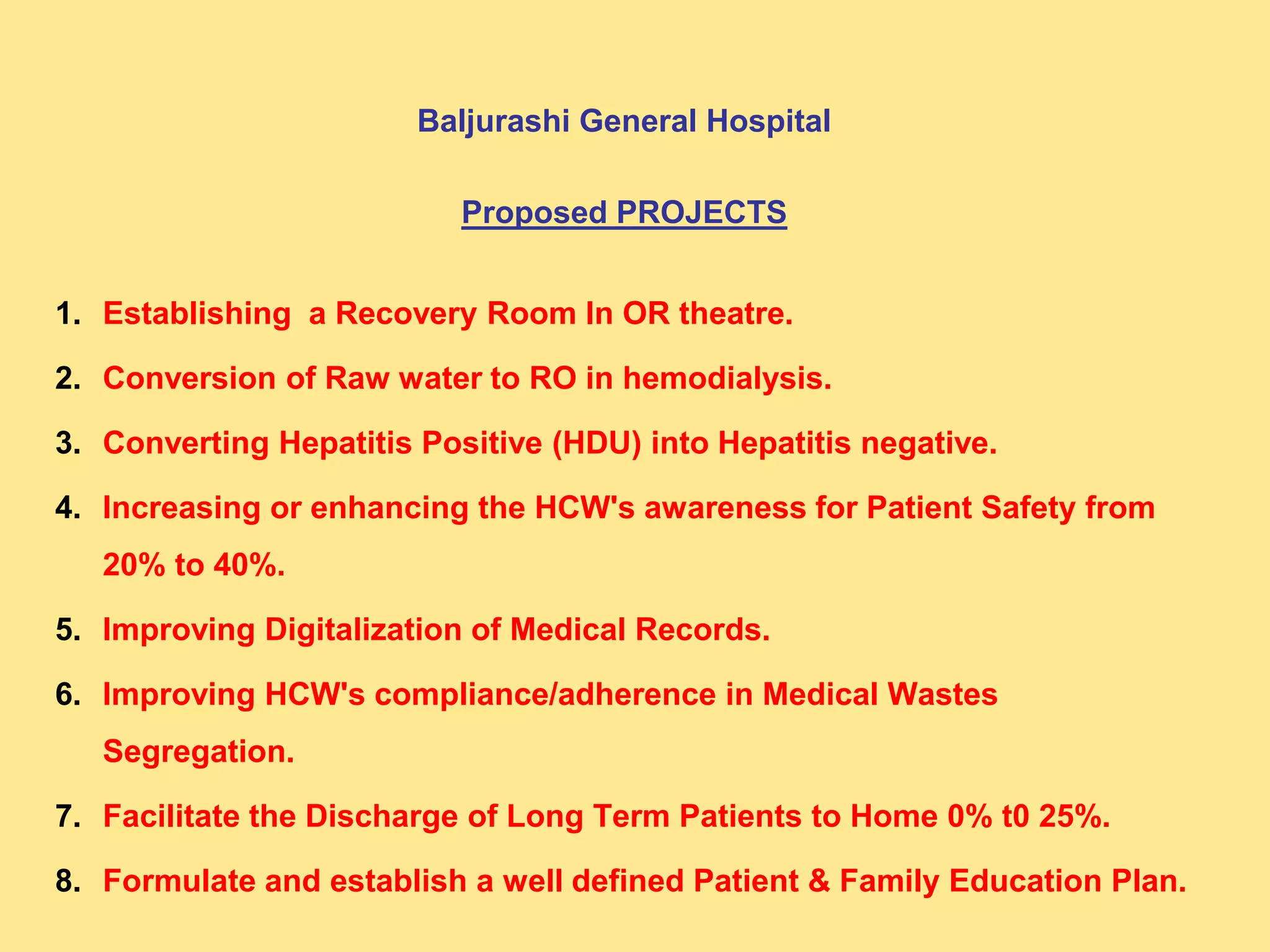
Baljurashi General Hospital
Proposed PROJECTS
1. Establishing a Recovery Room In OR theatre.
2. Conversion of Raw water to RO in hemodialysis.
3. Converting Hepatitis Positive (HDU) into Hepatitis negative.
4. Increasing or enhancing the HCW's awareness for Patient Safety from
20% to 40%.
5. Improving Digitalization of Medical Records.
6. Improving HCW's compliance/adherence in Medical Wastes
Segregation.
7. Facilitate the Discharge of Long Term Patients to Home 0% t0 25%.
8. Formulate and establish a well defined Patient & Family Education Plan.
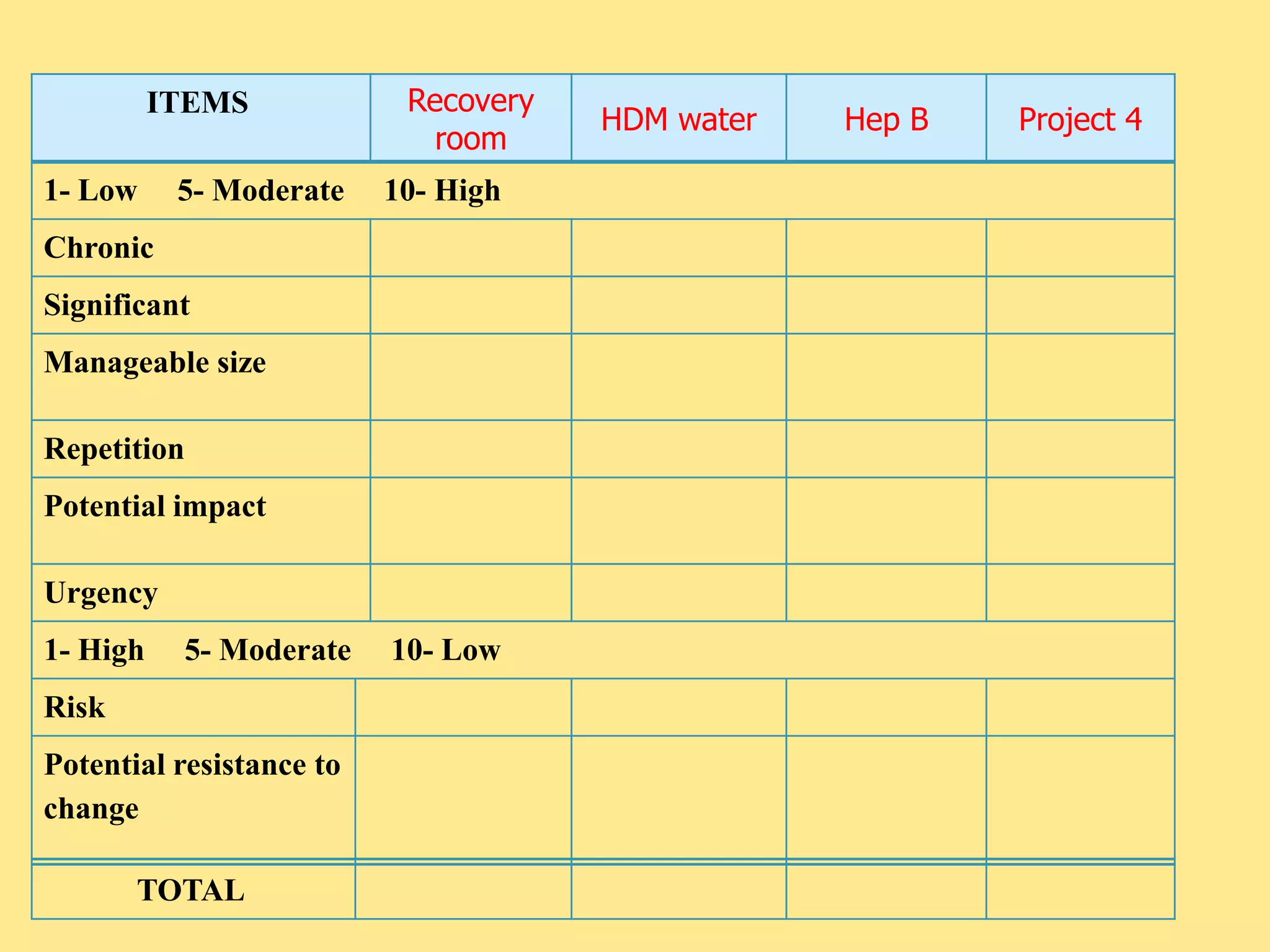
ITEMS Recovery
room
HDM water Hep B Project 4
1- Low 5- Moderate 10- High
Chronic
Significant
Manageable size
Repetition
Potential impact
Urgency
1- High 5- Moderate 10- Low
Risk
Potential resistance to
change
TOTAL
ESTABLISH THE
PROJECT
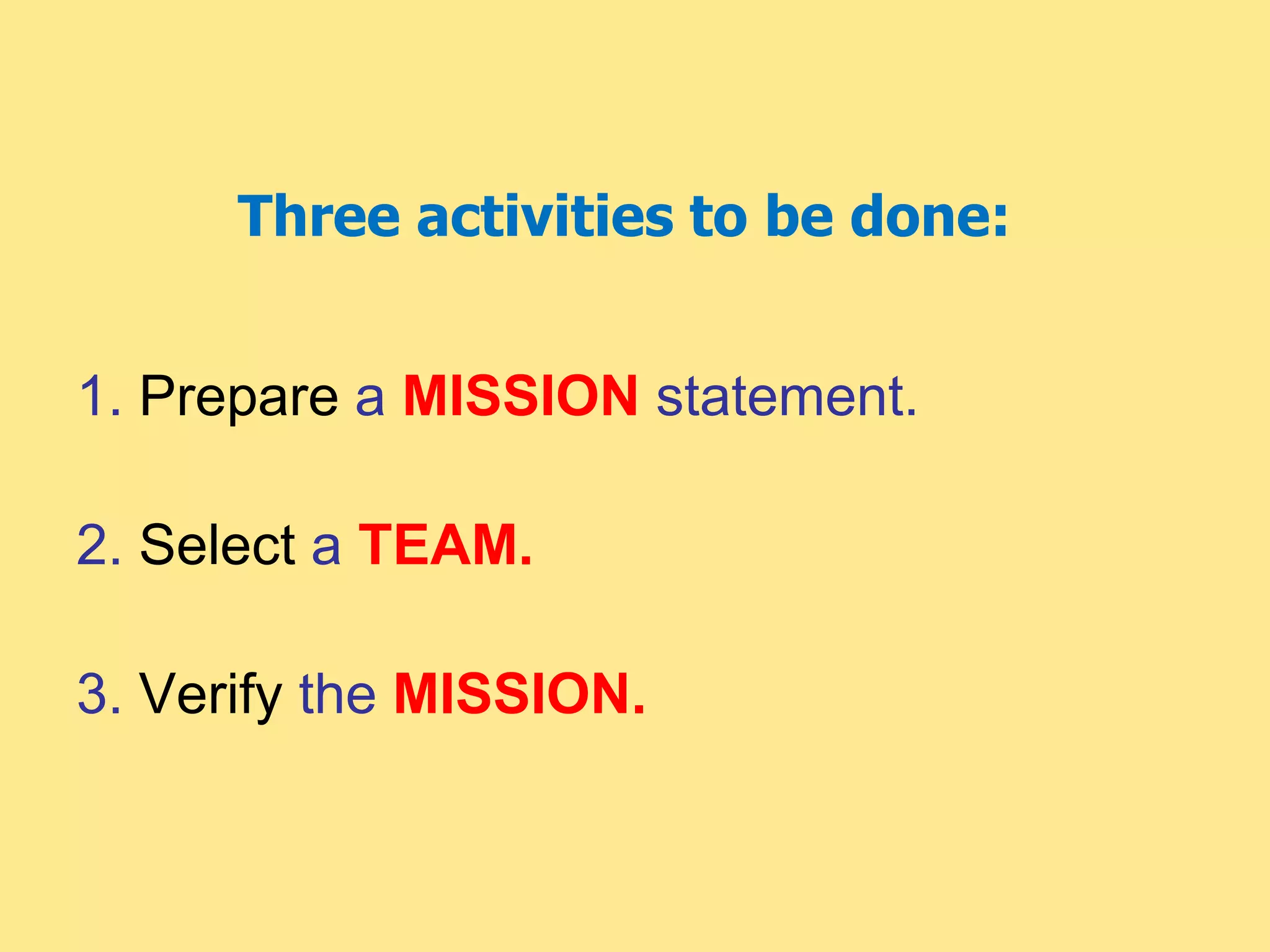
Three activities to be done:
1. Prepare a MISSION statement.
2. Select a TEAM.
3. Verify the MISSION.
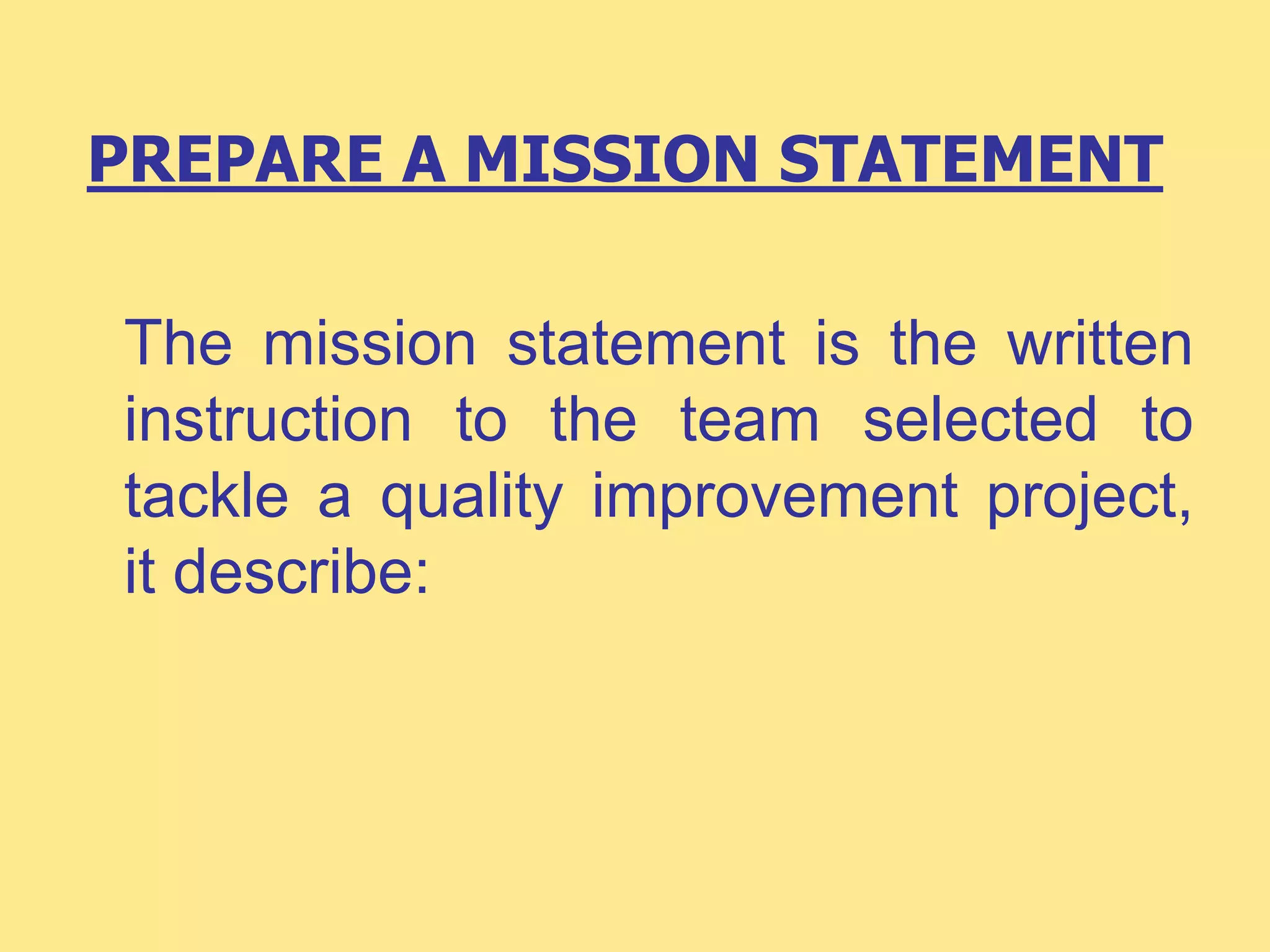
PREPARE A MISSION STATEMENT
The mission statement is the written
instruction to the team selected to
tackle a quality improvement project,
it describe:
PREPARE A MISSION STATEMENT
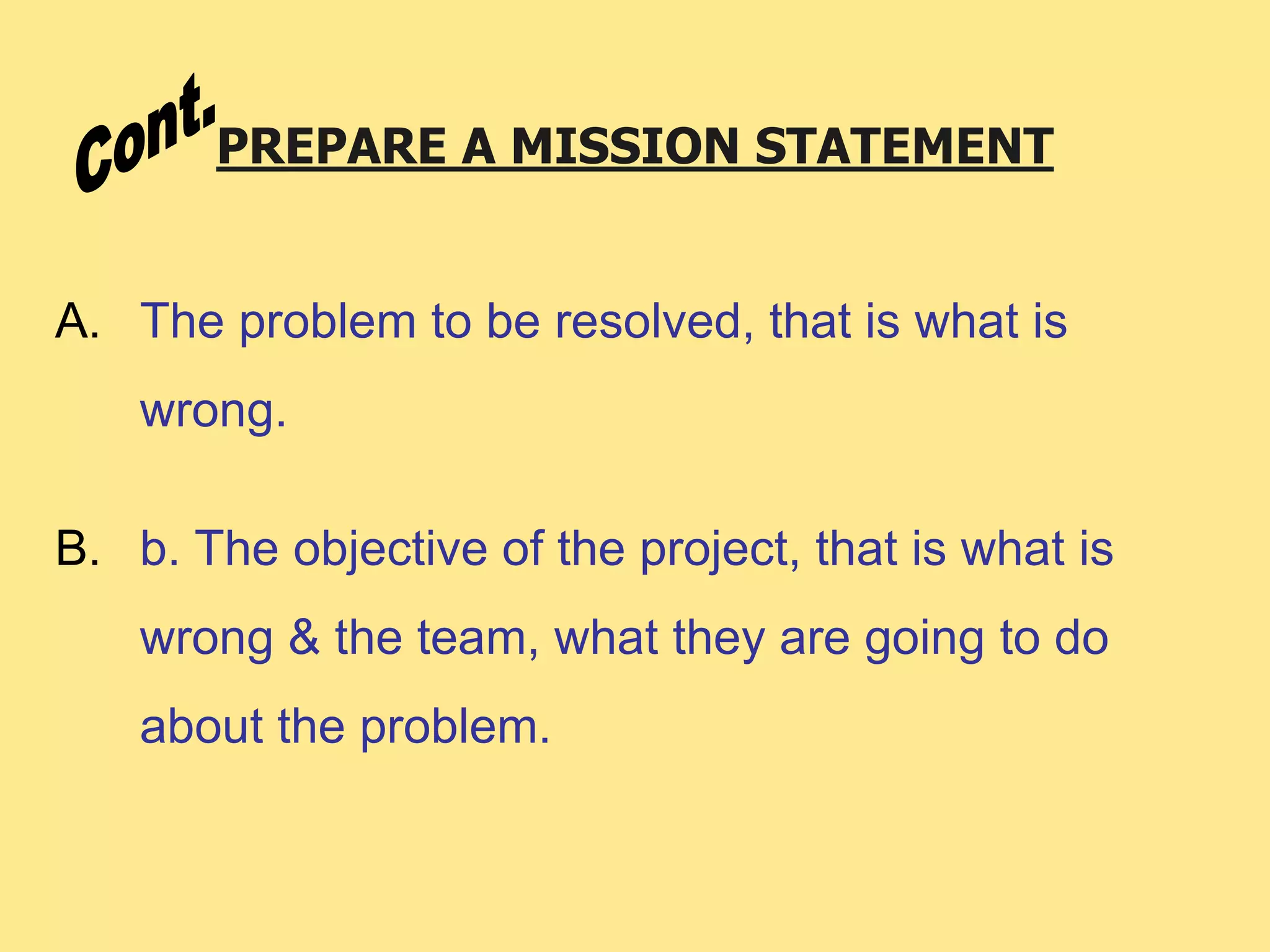
A. The problem to be resolved, that is what is
wrong.
B. b. The objective of the project, that is what is
wrong & the team, what they are going to do
about the problem.
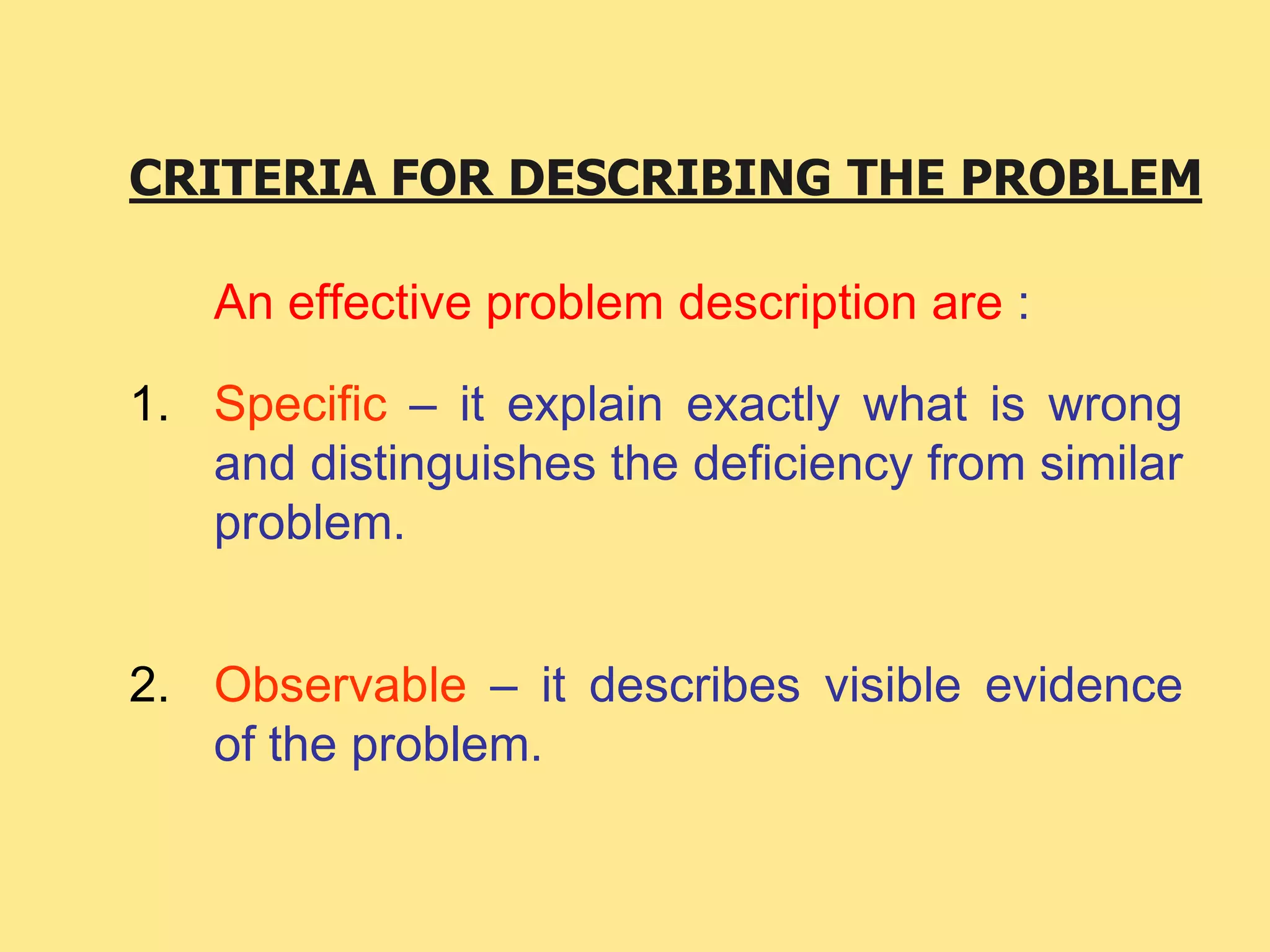
CRITERIA FOR DESCRIBING THE PROBLEM
An effective problem description are :
1. Specific – it explain exactly what is wrong
and distinguishes the deficiency from similar
problem.
2. Observable – it describes visible evidence
of the problem.
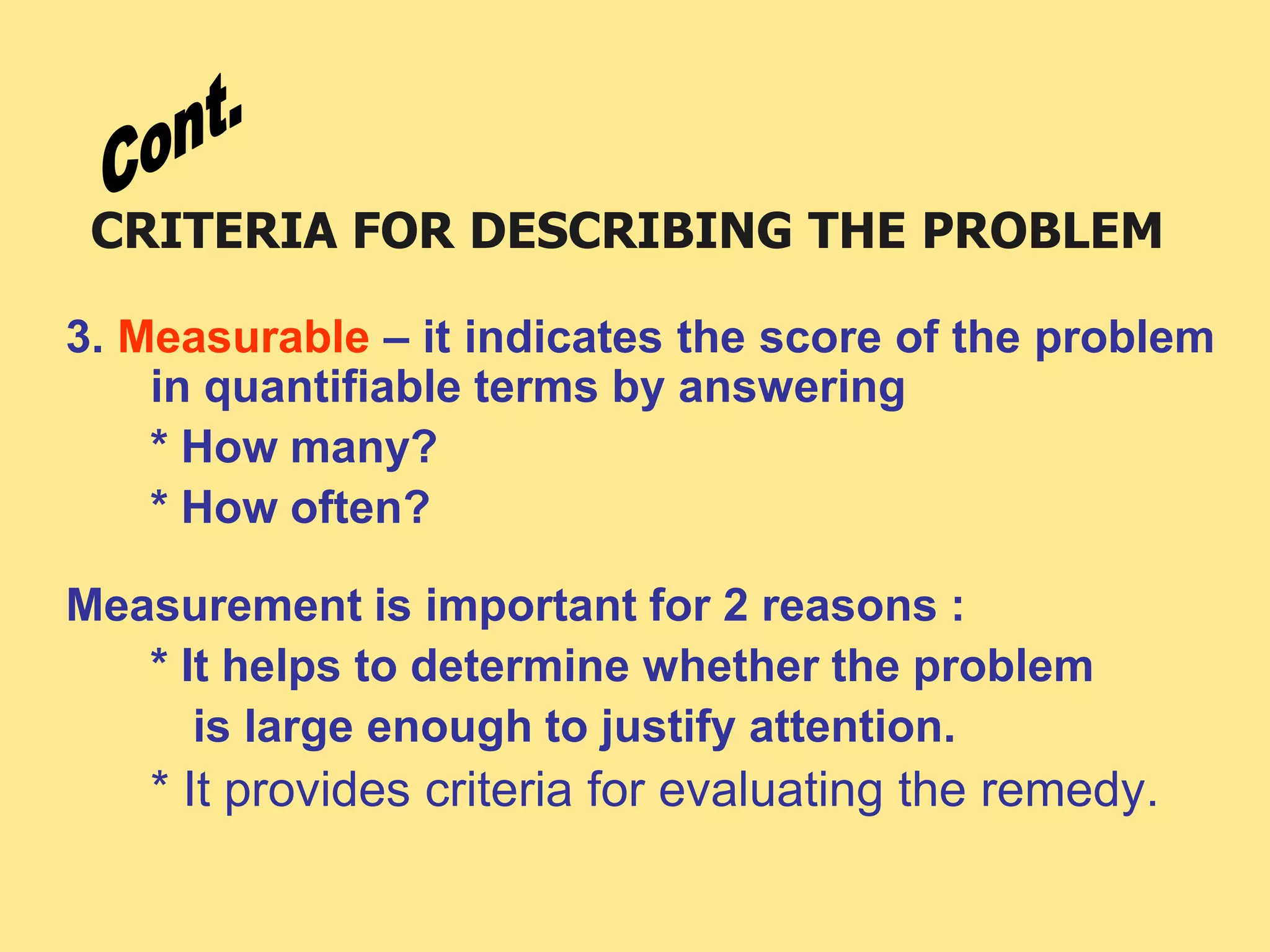
CRITERIA FOR DESCRIBING THE PROBLEM
3. Measurable – it indicates the score of the problem
in quantifiable terms by answering
* How many?
* How often?
Measurement is important for 2 reasons :
* It helps to determine whether the problem
is large enough to justify attention.
* It provides criteria for evaluating the remedy.
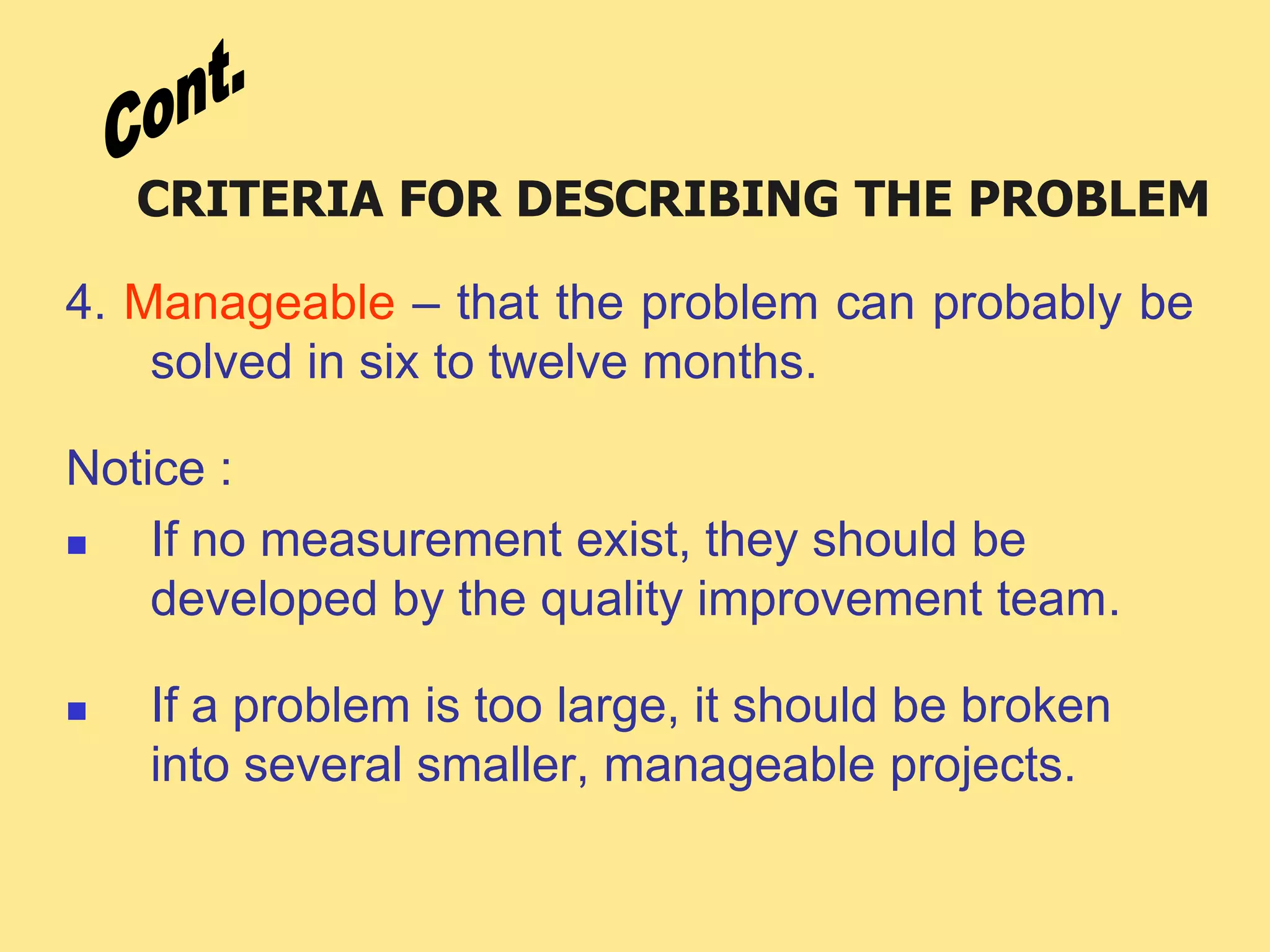
CRITERIA FOR DESCRIBING THE PROBLEM
4. Manageable – that the problem can probably be
solved in six to twelve months.
Notice :
 If no measurement exist, they should be
developed by the quality improvement team.
 If a problem is too large, it should be broken
into several smaller, manageable projects.
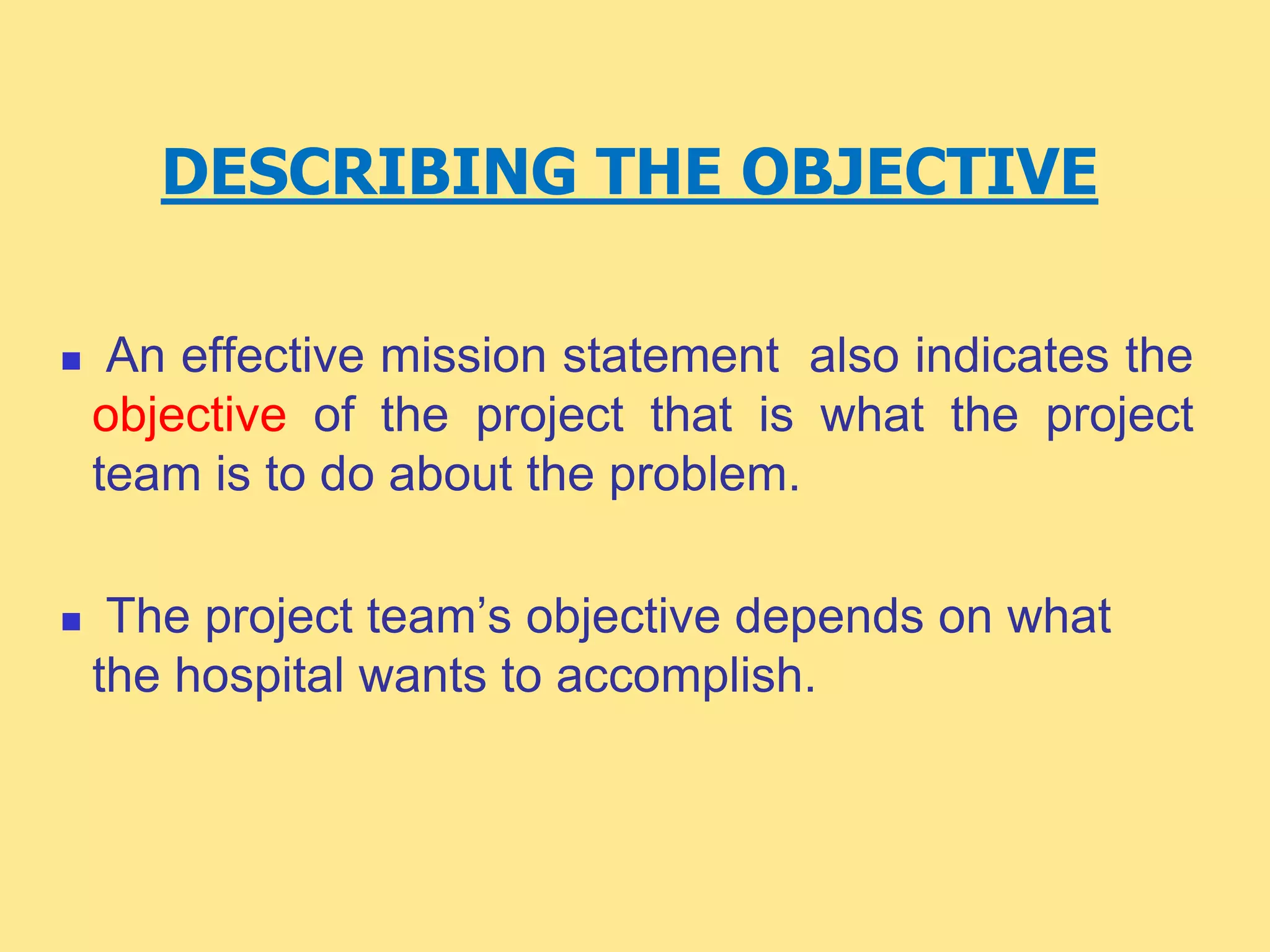
DESCRIBING THE OBJECTIVE
 An effective mission statement also indicates the
objective of the project that is what the project
team is to do about the problem.
 The project team’s objective depends on what
the hospital wants to accomplish.
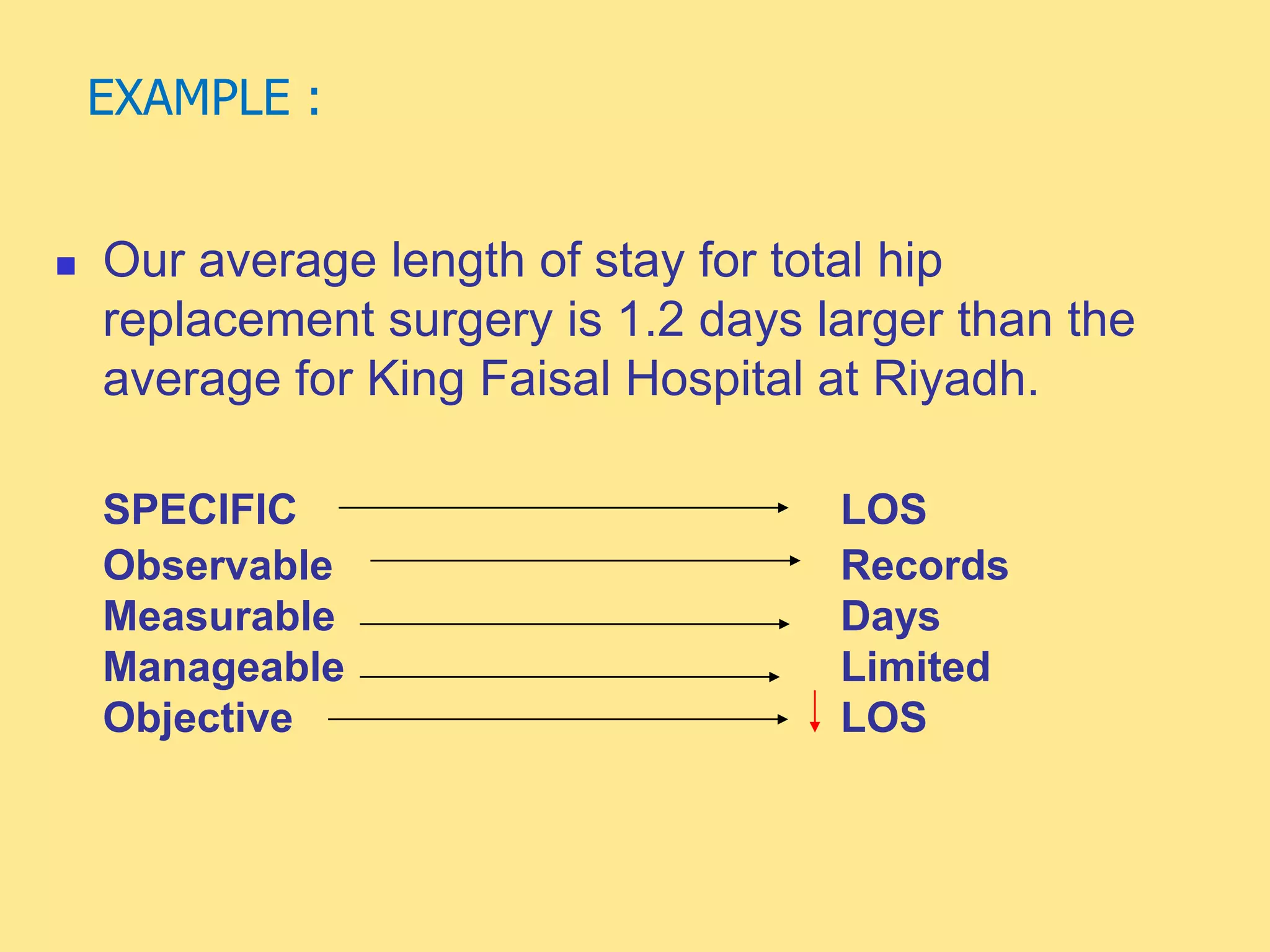
EXAMPLE :
 Our average length of stay for total hip
replacement surgery is 1.2 days larger than the
average for King Faisal Hospital at Riyadh.
SPECIFIC LOS
Observable Records
Measurable Days
Manageable Limited
Objective LOS
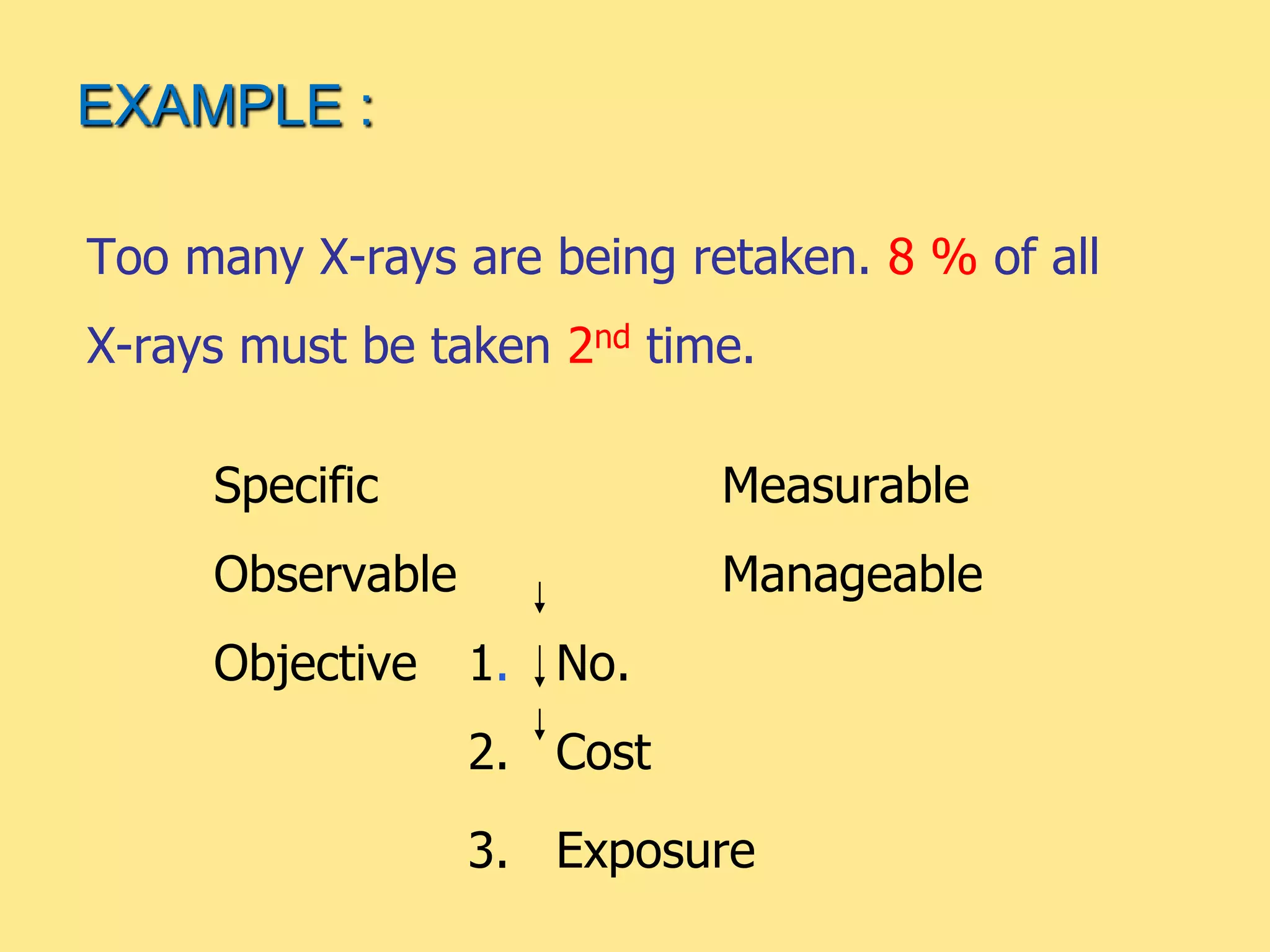
Too many X-rays are being retaken. 8 % of all
X-rays must be taken 2nd time.
Specific Measurable
Observable Manageable
Objective 1. No.
2. Cost
3. Exposure
EXAMPLE :
A mission statement should not :
 Imply a cause
 Suggest a remedy
 Assign blame
Our average LOS for total hip replacement
surgery is 1.2 days longer than average in King
Faisal Hospital in Riyadh, eliminate the
postponement of scheduled hip replacement
surgeries that leads to longer length of stay.
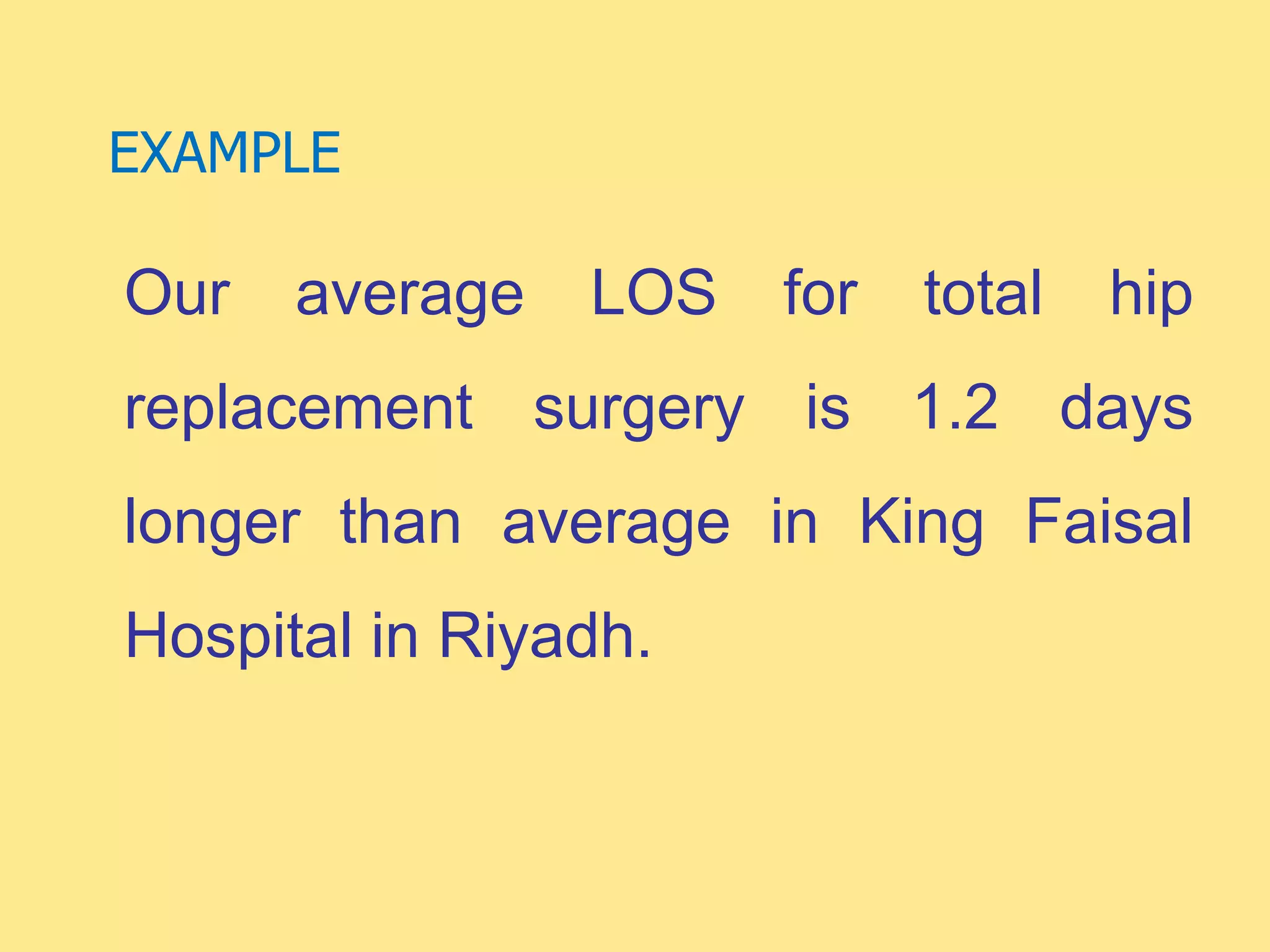
EXAMPLE
EXAMPLE
Our average LOS for total hip
replacement surgery is 1.2 days
longer than average in King Faisal
Hospital in Riyadh.
The surgeons must improve their procedure
technique in total hip replacement to reduce
LOS to be same as King Faisal Hospital in
Riyadh.
EXAMPLE
Patient transfer from Wards to Radiology
Department takes too long time up to 1
hour. We need to improve the scheduling
and assignment of transport personnel to
reduce transport time.
EXAMPLE
SELECT A PROJECT TEAM
Quality improving team for project should be
selected from :
 Where the problem is observed.
 Where sources or causes of the problem might be found.
 Among those with special knowledge, information or skills
in uncovering the root cause of the problem.
 In areas that can be helpful in implementing the remedy.
THE TEAM CHARACTER
a. The team is expected to apply the steps of the quality
improvement process throughout the project.
b. The team is authorized to collect relevant data, discuss
the problem with those involved within it.
c. The team members are asked to spend a specific
amount of time on the project each week (at least 4
hours).
d. The team has access to the resources it needs to carry
out the mission.
WE NEED TEAM TO :
 Exchange of experience
 To have all practical information about the problem.
 Complete understanding of each step and changes
needed.
 We ensure that the remedy shall be practical.
VERIFY THE MISSION
 It should be done once team meets
 It requires that the team: -
VERIFY THE MISSION
 Evaluate the problem description and mission
description to make sure they meet the criteria
for an effective mission statement.
 Verify that problem exists.
 Identify any aspects of the project that needs
clarification.
VERIFY THE MISSION
 Verify that team members represent the
appropriate departments.
 Obtain clarification and agreement from the
quality committee on any needed changes to
mission statement or team membership.
10 Questions to be answered
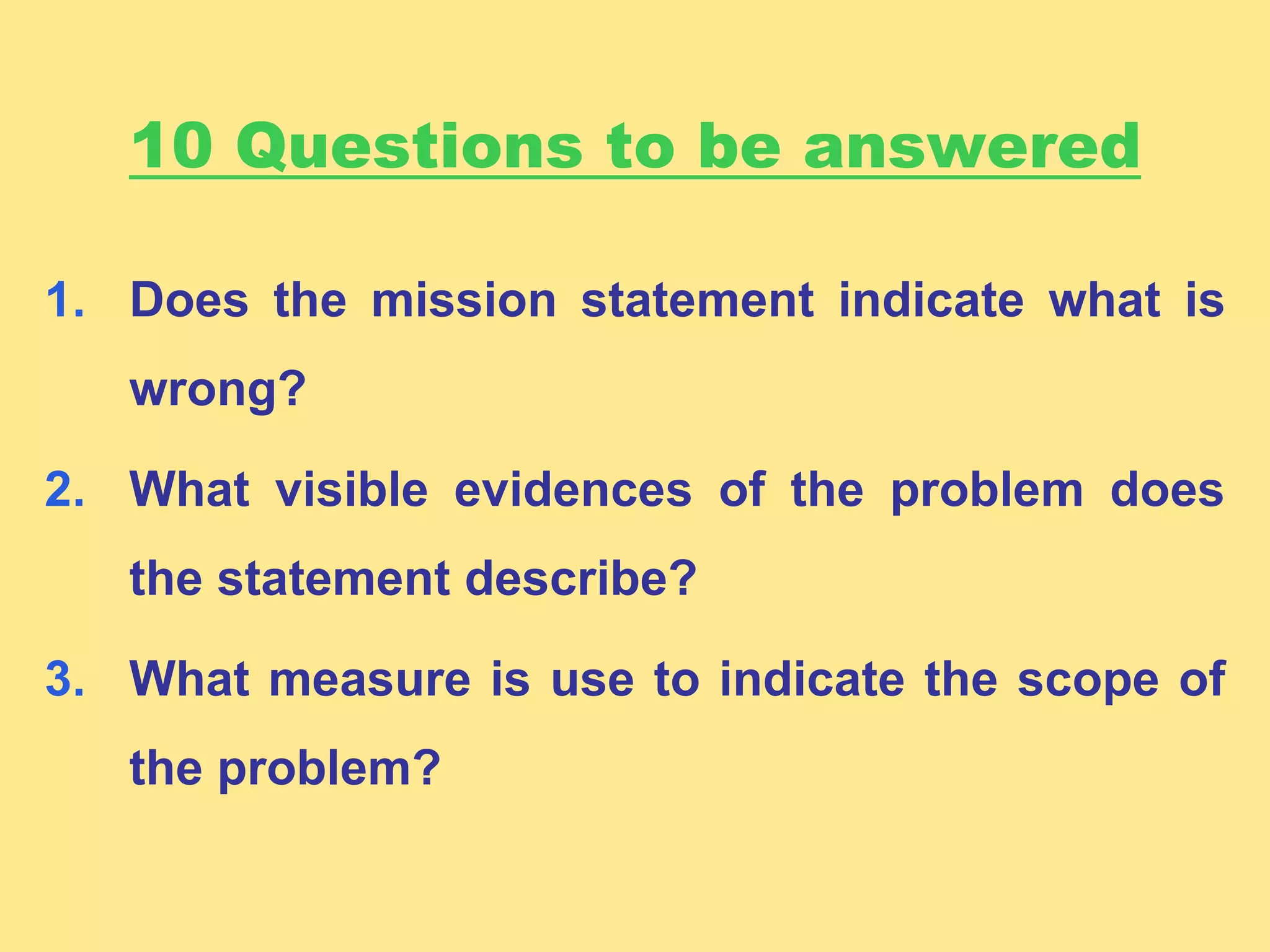
1. Does the mission statement indicate what is
wrong?
2. What visible evidences of the problem does
the statement describe?
3. What measure is use to indicate the scope of
the problem?
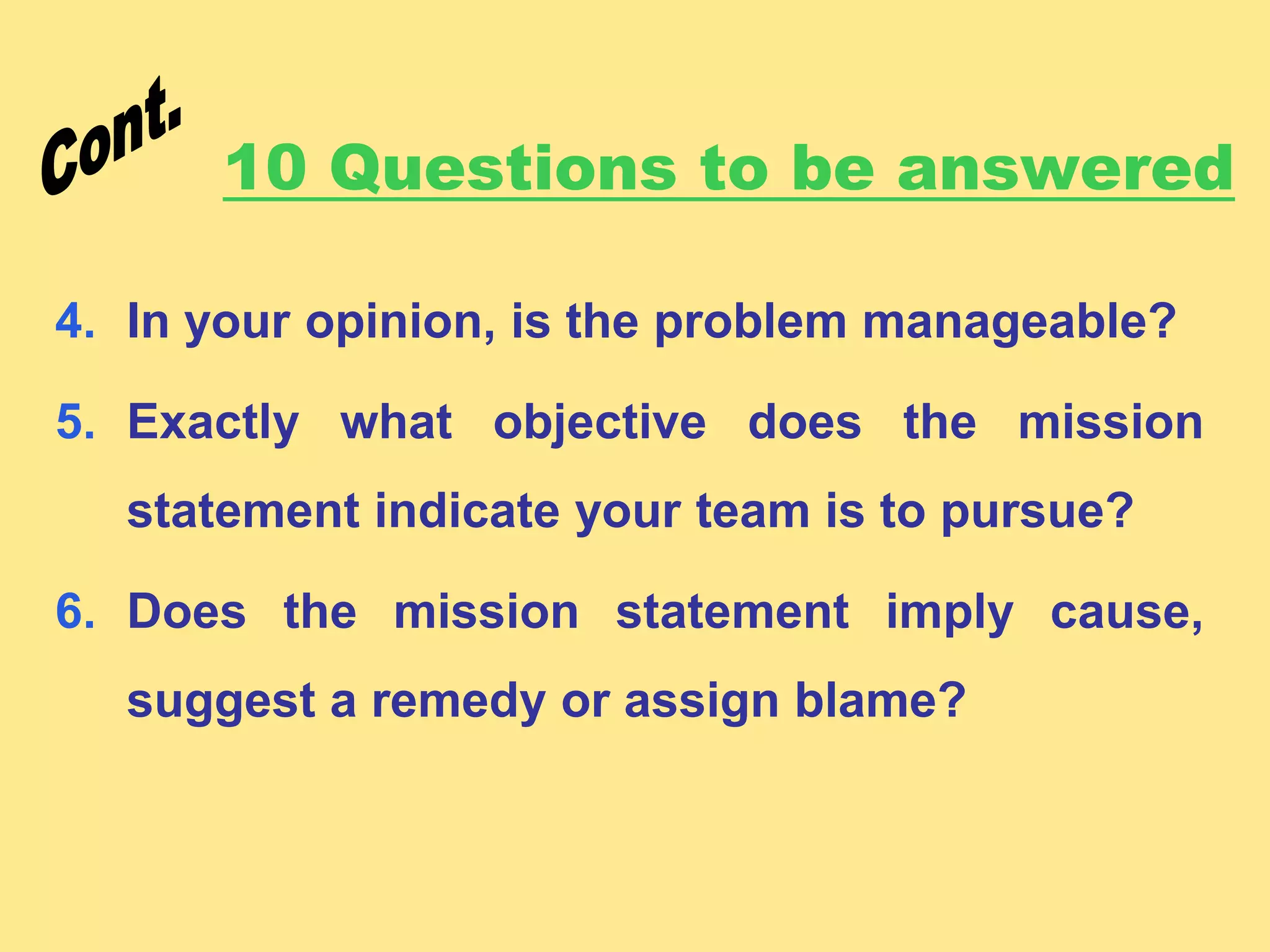
10 Questions to be answered
4. In your opinion, is the problem manageable?
5. Exactly what objective does the mission
statement indicate your team is to pursue?
6. Does the mission statement imply cause,
suggest a remedy or assign blame?
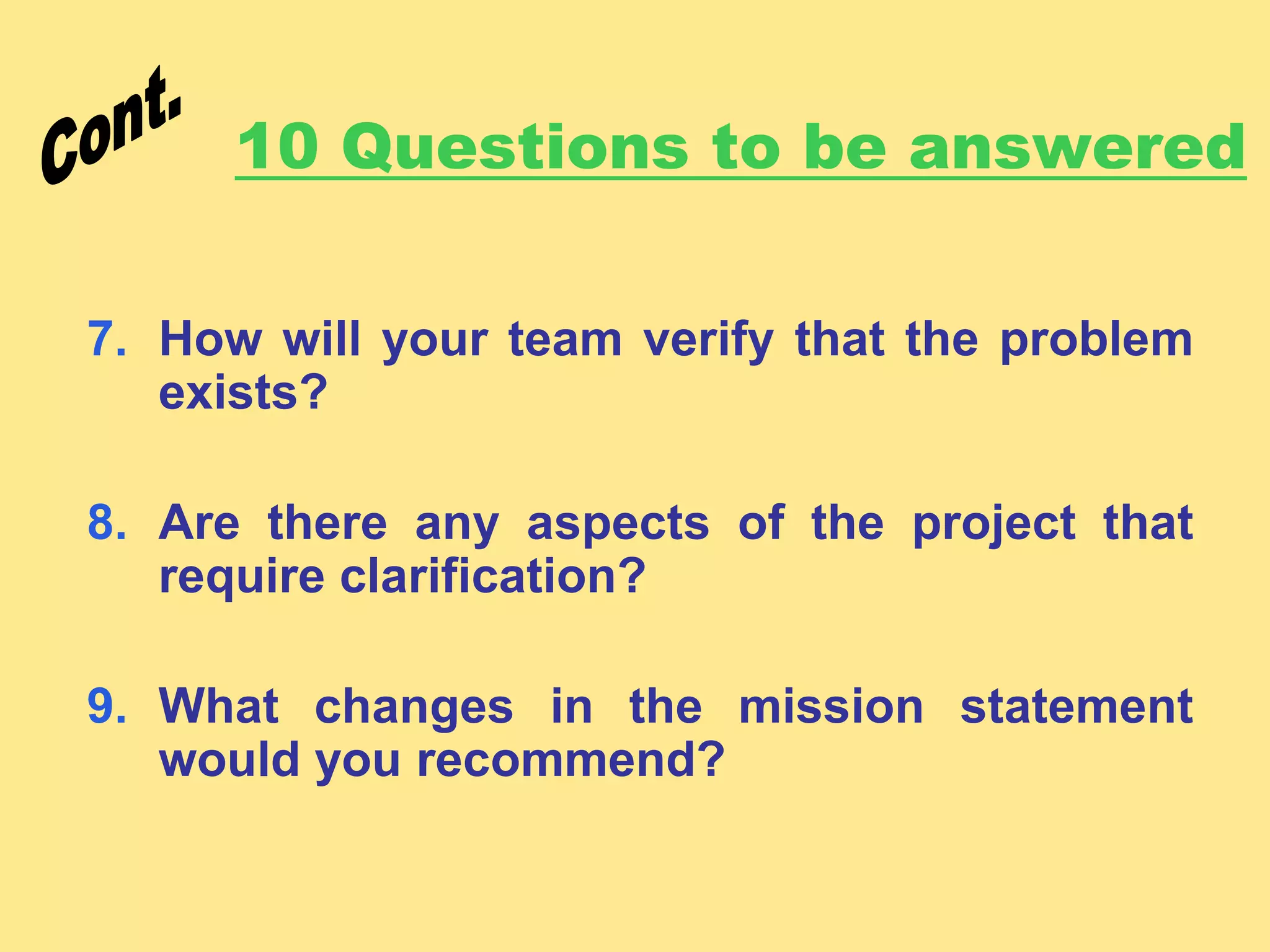
10 Questions to be answered
7. How will your team verify that the problem
exists?
8. Are there any aspects of the project that
require clarification?
9. What changes in the mission statement
would you recommend?
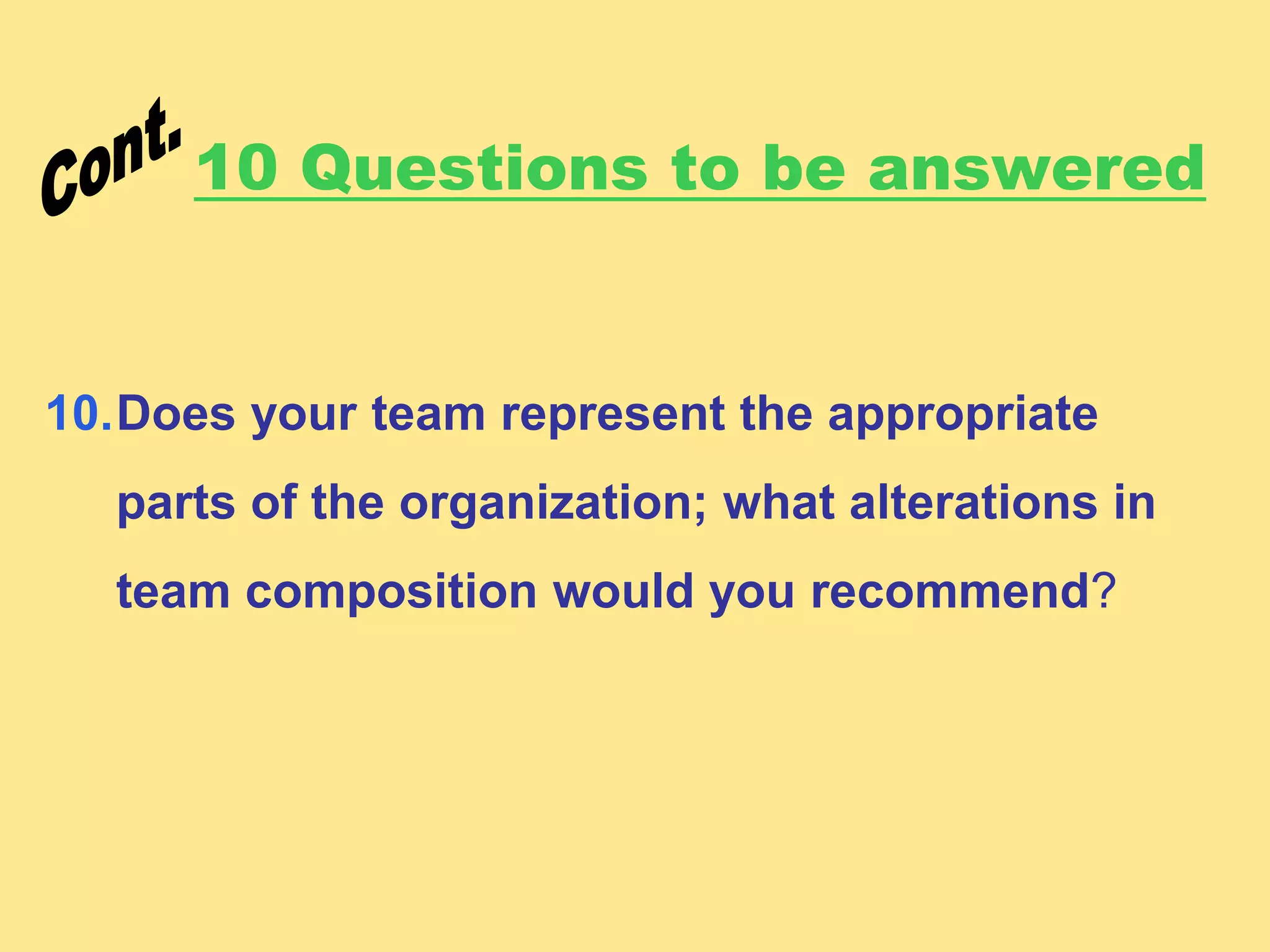
10 Questions to be answered
10.Does your team represent the appropriate
parts of the organization; what alterations in
team composition would you recommend?
What questions do you have?
THANK YOU!!!
Metohod for Quality Imrovement Project

Metohod for Quality Imrovement Project

  • 1.
  • 2.
  • 3.
    Principles of QualityImprovement “Quality is never an accident; it is always the result of high intention, sincere effort, intelligent direction and skillful execution; it represents the wise choice of many alternatives.” William Foster (many variations attributed to others)
  • 4.
  • 5.
    The Quality Environment Do you have an organization-wide commitment to assessing and continuously improving quality over time?  Do you use data to decide on improvement initiatives and to know if the improvements are successful?  Are your system decisions based on data?  Do you know if your Hospital is achieving its goals?
  • 6.
    Change vs. Improvement W. Edwards Deming stated “Of all changes I’ve observed, about 5% were improvements, the rest, at best, were illusions of progress.”  We must learn how to improve rapidly  We must learn to discern the difference between improvement and illusions of progress  We must become masters of improvement
  • 7.
    Principles of QualityManagement 1. Know your stakeholders and what they need 2. Focus on processes 3. Use data for making decisions 4. Understand variation in processes 5. Use teamwork to improve work 6. Make quality improvement continuous 7. Demonstrate leadership commitment
  • 8.
  • 9.
  • 10.
  • 11.
    AIMS - Promote patientsafety by preventing errors from occurring - Building quality into the process from the first place - Proactive approach to promote patient safety and reduce risk WHEN TO USE - Analyzing new or redesigned process - Analyzing current process tat put you at risk before they cause adverse events
  • 12.
    F failure thecondition or fact of not achieving the desired end M failure mode different ways that a process fails to function i.e. undesirable variation of the process E effect the adverse consequences of failure mode that the patient or other customers might experiences A analysis i.e. find the causes, hazard, frequency of occurrence, severity, detectability, critically index risk priority number, and control measures
  • 13.
    2- Concurrent method LEANthinking approach A look back and a look forward
  • 14.
    AIMS - Eliminating andpreventing waste - Reducing process lead time - Just in time efficient delivery of services - Improving quality and reducing costs
  • 15.
    L look forthe value the customer wants. All of actions required from start to finish in responding to a customer need plus the information controlling this actions that means entire flow and all of the steps and costs E eliminate the unneeded steps Strive continuously to reduce the number of steps to make the flow value stream
  • 16.
    A accelerate theprocess Make the remaining process steps as rapid as possible by reducing the amount of time , and amount of information needed of each step to the necessary N needs of the customer to be fulfilled Meet the customer needs and expectations
  • 17.
  • 18.
    F = Findan opportunity for improvement. - Select the process of interest. - Define preliminary process boundaries. - Decide if the selected process is the best one to improve. O = Organize a team - Identify the team leader/ process owner. - Assign a facilitator/ coach who will guide the team. - Select team members from appropriate levels.
  • 19.
    C = Clarifythe current process - Flow chart the process. - Make simple improvements to define the best process. - Identify suppliers and customers. U = Understand - The sources of the problem and the process variation, - Investigate special causes and seek to stabilize the process. S = Select the improvement (a change) - Identify improvement alternatives that will contribute the most to improving the process. - Reduce common cause variation
  • 20.
    P = Planthe improvement - Plan how the improvement identified in the "s" phase. - An action plan is used to describe proposed improvement efforts. D = Do the improvement - Implement the plan. - Describe what was used to implement the plan. - Collect data.
  • 21.
    C = Ceckthe results (is the change an improvement?) - Analyze data to evaluate the improvement. - Compare data with process capability and baseline data. A = Act to hold the gain - What steps will be taken next? - The PDCA cycle can be repeated again and again, attempting to refine the improvement.
  • 22.
  • 23.
    1. Nominate theproblems 2. Select the project 3. Verify the project 4. Problem statement 5. mission statement 6. flow chart 7. Project team 8. Operational definitions 9. Measure the symptoms
  • 24.
    10. Confirmed andmodified mission statement 11. Brain storming 12. Affinity diagram 13. Cause – effect diagram 14. Weighted Multivoting 15. Remedies suggested 16. Evaluate the remedy 17. Action plan 18. Control spread sheet 19. Approval
  • 25.
  • 26.
    Baljurashi General Hospital ProposedPROJECTS 1. Establishing a Recovery Room In OR theatre. 2. Conversion of Raw water to RO in hemodialysis. 3. Converting Hepatitis Positive (HDU) into Hepatitis negative. 4. Increasing or enhancing the HCW's awareness for Patient Safety from 20% to 40%. 5. Improving Digitalization of Medical Records. 6. Improving HCW's compliance/adherence in Medical Wastes Segregation. 7. Facilitate the Discharge of Long Term Patients to Home 0% t0 25%. 8. Formulate and establish a well defined Patient & Family Education Plan.
  • 27.
    ITEMS Recovery room HDM waterHep B Project 4 1- Low 5- Moderate 10- High Chronic Significant Manageable size Repetition Potential impact Urgency 1- High 5- Moderate 10- Low Risk Potential resistance to change TOTAL
  • 28.
  • 29.
    Three activities tobe done: 1. Prepare a MISSION statement. 2. Select a TEAM. 3. Verify the MISSION.
  • 30.
    PREPARE A MISSIONSTATEMENT The mission statement is the written instruction to the team selected to tackle a quality improvement project, it describe:
  • 31.
    PREPARE A MISSIONSTATEMENT A. The problem to be resolved, that is what is wrong. B. b. The objective of the project, that is what is wrong & the team, what they are going to do about the problem.
  • 32.
    CRITERIA FOR DESCRIBINGTHE PROBLEM An effective problem description are : 1. Specific – it explain exactly what is wrong and distinguishes the deficiency from similar problem. 2. Observable – it describes visible evidence of the problem.
  • 33.
    CRITERIA FOR DESCRIBINGTHE PROBLEM 3. Measurable – it indicates the score of the problem in quantifiable terms by answering * How many? * How often? Measurement is important for 2 reasons : * It helps to determine whether the problem is large enough to justify attention. * It provides criteria for evaluating the remedy.
  • 34.
    CRITERIA FOR DESCRIBINGTHE PROBLEM 4. Manageable – that the problem can probably be solved in six to twelve months. Notice :  If no measurement exist, they should be developed by the quality improvement team.  If a problem is too large, it should be broken into several smaller, manageable projects.
  • 35.
    DESCRIBING THE OBJECTIVE An effective mission statement also indicates the objective of the project that is what the project team is to do about the problem.  The project team’s objective depends on what the hospital wants to accomplish.
  • 36.
    EXAMPLE :  Ouraverage length of stay for total hip replacement surgery is 1.2 days larger than the average for King Faisal Hospital at Riyadh. SPECIFIC LOS Observable Records Measurable Days Manageable Limited Objective LOS
  • 37.
    Too many X-raysare being retaken. 8 % of all X-rays must be taken 2nd time. Specific Measurable Observable Manageable Objective 1. No. 2. Cost 3. Exposure EXAMPLE :
  • 38.
    A mission statementshould not :  Imply a cause  Suggest a remedy  Assign blame
  • 39.
    Our average LOSfor total hip replacement surgery is 1.2 days longer than average in King Faisal Hospital in Riyadh, eliminate the postponement of scheduled hip replacement surgeries that leads to longer length of stay. EXAMPLE
  • 40.
    EXAMPLE Our average LOSfor total hip replacement surgery is 1.2 days longer than average in King Faisal Hospital in Riyadh.
  • 41.
    The surgeons mustimprove their procedure technique in total hip replacement to reduce LOS to be same as King Faisal Hospital in Riyadh. EXAMPLE
  • 42.
    Patient transfer fromWards to Radiology Department takes too long time up to 1 hour. We need to improve the scheduling and assignment of transport personnel to reduce transport time. EXAMPLE
  • 43.
    SELECT A PROJECTTEAM Quality improving team for project should be selected from :  Where the problem is observed.  Where sources or causes of the problem might be found.  Among those with special knowledge, information or skills in uncovering the root cause of the problem.  In areas that can be helpful in implementing the remedy.
  • 44.
    THE TEAM CHARACTER a.The team is expected to apply the steps of the quality improvement process throughout the project. b. The team is authorized to collect relevant data, discuss the problem with those involved within it. c. The team members are asked to spend a specific amount of time on the project each week (at least 4 hours). d. The team has access to the resources it needs to carry out the mission.
  • 45.
    WE NEED TEAMTO :  Exchange of experience  To have all practical information about the problem.  Complete understanding of each step and changes needed.  We ensure that the remedy shall be practical.
  • 46.
    VERIFY THE MISSION It should be done once team meets  It requires that the team: -
  • 47.
    VERIFY THE MISSION Evaluate the problem description and mission description to make sure they meet the criteria for an effective mission statement.  Verify that problem exists.  Identify any aspects of the project that needs clarification.
  • 48.
    VERIFY THE MISSION Verify that team members represent the appropriate departments.  Obtain clarification and agreement from the quality committee on any needed changes to mission statement or team membership.
  • 49.
    10 Questions tobe answered 1. Does the mission statement indicate what is wrong? 2. What visible evidences of the problem does the statement describe? 3. What measure is use to indicate the scope of the problem?
  • 50.
    10 Questions tobe answered 4. In your opinion, is the problem manageable? 5. Exactly what objective does the mission statement indicate your team is to pursue? 6. Does the mission statement imply cause, suggest a remedy or assign blame?
  • 51.
    10 Questions tobe answered 7. How will your team verify that the problem exists? 8. Are there any aspects of the project that require clarification? 9. What changes in the mission statement would you recommend?
  • 52.
    10 Questions tobe answered 10.Does your team represent the appropriate parts of the organization; what alterations in team composition would you recommend?
  • 53.
  • 54.