


![© SkillBrew http://skillbrew.com
Examples of iterable objects
>>> for i in [1, 2, 3, 4]:
... print i,
...
1 2 3 4
>>> for c in "python":
... print c,
...
p y t h o n
>>> for k in {"x": 1, "y": 2}:
... print k,
...
y x](https://image.slidesharecdn.com/pythonprogrammingessentials-m35-iteratorsgenerators-140819043229-phpapp02/85/Python-Programming-Essentials-M35-Iterators-Generators-4-320.jpg)
![© SkillBrew http://skillbrew.com
Many functions consume iterables
>>> ",".join(["a", "b", "c"])
'a,b,c'
>>> ",".join({"x": 1, "y": 2})
'y,x'
>>> list("python")
['p', 'y', 't', 'h', 'o', 'n']
>>> list({"x": 1, "y": 2}) ['y', 'x']](https://image.slidesharecdn.com/pythonprogrammingessentials-m35-iteratorsgenerators-140819043229-phpapp02/85/Python-Programming-Essentials-M35-Iterators-Generators-5-320.jpg)
![© SkillBrew http://skillbrew.com
iter function example
>>> x = iter([1, 2])
>>> x <listiterator object at 0x1004ca850>
>>> x.next()
1
>>> x.next()
2
>>> x.next()
Traceback (most recent call last): File
"<stdin>", line 1, in <module>
StopIteration](https://image.slidesharecdn.com/pythonprogrammingessentials-m35-iteratorsgenerators-140819043229-phpapp02/85/Python-Programming-Essentials-M35-Iterators-Generators-7-320.jpg)




![© SkillBrew http://skillbrew.com
Generator Expressions
>>> a = [x*x for x in range(10)]
>>> a
[0, 1, 4, 9, 16, 25, 36, 49, 64, 81]
>>> b = (x*x for x in xrange(10))
>>> b
>>> <generator object <genexpr> at
0x1c46410>
>>> list(b)
[0, 1, 4, 9, 16, 25, 36, 49, 64, 81]](https://image.slidesharecdn.com/pythonprogrammingessentials-m35-iteratorsgenerators-140819043229-phpapp02/85/Python-Programming-Essentials-M35-Iterators-Generators-18-320.jpg)


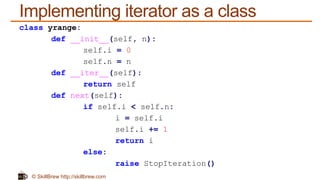
The document discusses iterators and generators in Python. It explains that iterators are objects that can be used in for loops over iterable objects like lists, strings, and dictionaries. Generators are functions that produce a sequence of results using yield statements, making them iterators as well. The document provides examples of using built-in iterators, implementing custom iterators as classes, and creating generator functions and expressions.


