Python in aNutshell, 4th Edition Alex Martelli
install download
https://ebookmeta.com/product/python-in-a-nutshell-4th-edition-
alex-martelli/
Download more ebook from https://ebookmeta.com
2.
We believe theseproducts will be a great fit for you. Click
the link to download now, or visit ebookmeta.com
to discover even more!
Python in a Nutshell 1st Edition Alex Martelli
https://ebookmeta.com/product/python-in-a-nutshell-1st-edition-
alex-martelli/
Python in a Nutshell 4th Edition Second Early Release
Alex Martelli Anna Martelli Ravenscroft Steve Holden
Paul Mcguire
https://ebookmeta.com/product/python-in-a-nutshell-4th-edition-
second-early-release-alex-martelli-anna-martelli-ravenscroft-
steve-holden-paul-mcguire/
SQL in a Nutshell, 4th Edition Kevin Kline
https://ebookmeta.com/product/sql-in-a-nutshell-4th-edition-
kevin-kline/
Metaphysics, 5th Edition Peter Van Inwagen
https://ebookmeta.com/product/metaphysics-5th-edition-peter-van-
inwagen/
3.
World and Hourin Roman Minds. Exploratory Essays 1st
Edition Richard J. A. Talbert
https://ebookmeta.com/product/world-and-hour-in-roman-minds-
exploratory-essays-1st-edition-richard-j-a-talbert/
All Boys Aren t Blue A Memoir Manifesto 1st Edition
George M Johnson
https://ebookmeta.com/product/all-boys-aren-t-blue-a-memoir-
manifesto-1st-edition-george-m-johnson/
Everyday Data Cultures 1st Edition Jean Burgess
https://ebookmeta.com/product/everyday-data-cultures-1st-edition-
jean-burgess/
The Palgrave Handbook of the History of Human Sciences
1st Edition David Mccallum
https://ebookmeta.com/product/the-palgrave-handbook-of-the-
history-of-human-sciences-1st-edition-david-mccallum/
Our Battle for the Human Spirit Scientific Knowing
Technical Doing and Daily Living 1st Edition Willem H
Vanderburg
https://ebookmeta.com/product/our-battle-for-the-human-spirit-
scientific-knowing-technical-doing-and-daily-living-1st-edition-
willem-h-vanderburg/
4.
The Wives ofCrimson Avenue DI Vincent Sullivan 1 1st
Edition Sadie Ryan
https://ebookmeta.com/product/the-wives-of-crimson-avenue-di-
vincent-sullivan-1-1st-edition-sadie-ryan/
5.
Alex Martelli,
Anna MartelliRavenscroft,
Steve Holden & Paul McGuire
Python
in a Nutshell
A Desktop Quick Reference
4
t
h
E
d
i
t
i
o
n
C
o
v
e
r
s
P
y
t
h
o
n
3
.
7
t
h
r
o
u
g
h
3
.
1
1
6.
PROGRAMMING
Python in aNutshell
US $89.99 CAN $112.99
ISBN: 978-1-098-11355-1
Python was recently ranked as today’s most
popular programming language on the TIOBE
index, thanks, especially, to its broad applicability
to design, prototyping, testing, deployment, and
maintenance. With this updated fourth edition,
you’ll learn how to get the most out of Python,
whether you’re a professional programmer or
someone who needs this language to solve
problems in a particular field.
Carefully curated by recognized experts in Python,
this new edition focuses on version 3.10, bringing
this seminal work on the Python language fully up
to date on five version releases, including coverage
of recently released Python 3.11.
This handy guide will help you:
• Learn how Python represents data and
program as objects
• Understand the value and uses of type
annotations
• Examine which language features appeared
in which recent versions
• Discover how to use modern Python
idiomatically
• Learn ways to structure Python projects
appropriately
• Understand how to test, debug, and
optimize Python code
The authors are four PSF Fellows,
three of whom are Frank Willison
Award recipients, recognized
for numerous contributions to
Python and its community. Their
collective experience covers
environments and platforms
ranging from academic to startup
to corporate to government.
Together they have compiled an
authoritative reference for Python
language syntax and features,
the Python standard library, and
selected third-party packages.
“Python in depth,
up-to-date,
accessible, and
useful. An excellent
modern reference
with plenty of insight
and advice that will
satisfy everyone from
early intermediates
to experts.”
—Mark Summerfield
Director of Qtrac Ltd.
Twitter: @oreillymedia
linkedin.com/company/oreilly-media
youtube.com/oreillymedia
7.
PYTHON IN A
NUTSHELL
ADesktop Quick Reference
Fourth Edition
Alex Martelli, Anna Martelli Ravenscroft,
Steve Holden, and Paul McGuire
Preface
The Python programminglanguage reconciles many apparent contradictions: ele‐
gant yet pragmatic, simple yet powerful, it’s very high-level yet doesn’t get in your
way when you need to fiddle with bits and bytes, and it’s suitable for novice
programmers and great for experts, too.
This book is intended for programmers with some previous exposure to Python, as
well as experienced programmers coming to Python for the first time from other
languages. It provides a quick reference to Python itself, the most commonly used
parts of its vast standard library, and a few of the most popular and useful third-
party modules and packages. The Python ecosystem has grown so much in richness,
scope, and complexity that a single volume can no longer reasonably hope to be
encyclopedic. Still, the book covers a wide range of application areas, including web
and network programming, XML handling, database interactions, and high-speed
numeric computing. It also explores Python’s cross-platform capabilities and the
basics of extending Python and embedding it in other applications.
How To Use This Book
While you can read this volume linearly from the beginning, we also aim for it to be
a useful reference for the working programmer. You may choose to use the index to
locate items of interest, or to read specific chapters for coverage of their particular
topics. However you use it, we sincerely hope you enjoy reading what represents the
fruit of the best part of a year’s work for the team.
The book has five parts, as follows.
ix
16.
Part I, GettingStarted with Python
Chapter 1, “Introduction to Python”
Covers the general characteristics of the Python language, its implementations,
where to get help and information, how to participate in the Python commu‐
nity, and how to obtain and install Python on your computer(s) or run it in
your browser.
Chapter 2, “The Python Interpreter”
Covers the Python interpreter program, its command-line options, and how
to use it to run Python programs and in interactive sessions. The chapter
mentions text editors for editing Python programs and auxiliary programs
for checking your Python sources, along with some full-fledged integrated
development environments, including IDLE, which comes free with standard
Python. The chapter also covers running Python programs from the command
line.
Part II, Core Python Language and Built-ins
Chapter 3, “The Python Language”
Covers Python syntax, built-in data types, expressions, statements, control flow,
and how to write and call functions.
Chapter 4, “Object-Oriented Python”
Covers object-oriented programming in Python.
Chapter 5, “Type Annotations”
Covers how to add type information to your Python code, to gain type hinting
and autocomplete help from modern code editors and support static type
checking from type checkers and linters.
Chapter 6, “Exceptions”
Covers how to use exceptions for errors and special situations, logging, and
how to write code to automatically clean up when exceptions occur.
Chapter 7, “Modules and Packages”
Covers how Python lets you group code into modules and packages, how to
define and import modules, and how to install third-party Python packages.
This chapter also covers working with virtual environments to isolate project
dependencies.
Chapter 8, “Core Built-ins and Standard Library Modules”
Covers built-in data types and functions, and some of the most fundamental
modules in the Python standard library (roughly speaking, the set of modules
supplying functionality that, in some other languages, is built into the language
itself).
Chapter 9, “Strings and Things”
Covers Python’s facilities for processing strings, including Unicode strings,
bytestrings, and string literals.
x | Preface
17.
1 The separatechapter on asynchronous programming in the third edition has been dropped in
this edition, deferring to more thorough coverage of this growing topic in references found in
Chapter 15.
Chapter 10, “Regular Expressions”
Covers Python’s support for regular expressions.
Part III, Python Library and Extension Modules
Chapter 11, “File and Text Operations”
Covers dealing with files and text with many modules from Python’s standard
library and platform-specific extensions for rich text I/O. This chapter also
covers issues regarding internationalization and localization.
Chapter 12, “Persistence and Databases”
Covers Python’s serialization and persistence mechanisms and its interfaces to
DBM databases and relational (SQL-based) databases, particularly the handy
SQLite that comes with Python’s standard library.
Chapter 13, “Time Operations”
Covers dealing with times and dates in Python, with the standard library and
third-party extensions.
Chapter 14, “Customizing Execution”
Covers ways to achieve advanced execution control in Python, including exe‐
cution of dynamically generated code and control of garbage collection. This
chapter also covers some Python internal types, and the specific issue of regis‐
tering “cleanup” functions to execute at program termination time.
Chapter 15, “Concurrency: Threads and Processes”
Covers Python’s functionality for concurrent execution, both via multiple
threads running within one process and via multiple processes running on
a single machine.1
This chapter also covers how to access the process’s environ‐
ment, and how to access files via memory-mapping mechanisms.
Chapter 16, “Numeric Processing”
Covers Python’s features for numeric computations, both in standard library
modules and in third-party extension packages; in particular, how to use deci‐
mal numbers or fractions instead of the default binary floating-point numbers.
This chapter also covers how to get and use pseudorandom and truly random
numbers, and how to speedily process whole arrays (and matrices) of numbers.
Chapter 17, “Testing, Debugging, and Optimizing”
Covers Python tools and approaches that help you make sure that your pro‐
grams are correct (i.e., that they do what they’re meant to do), find and fix
errors in your programs, and check and enhance your programs’ performance.
This chapter also covers the concept of warnings and the Python library mod‐
ule that deals with them.
Preface
|
xi
18.
Part IV, Networkand Web Programming
Chapter 18, “Networking Basics”
Covers the basics of networking with Python.
Chapter 19, “Client-Side Network Protocol Modules”
Covers modules in Python’s standard library to write network client programs,
particularly for dealing with various network protocols from the client side,
sending and receiving emails, and handling URLs.
Chapter 20, “Serving HTTP”
Covers how to serve HTTP for web applications in Python, using popular
third-party lightweight Python frameworks leveraging Python’s WSGI standard
interface to web servers.
Chapter 21, “Email, MIME, and Other Network Encodings”
Covers how to process email messages and other network-structured and enco‐
ded documents in Python.
Chapter 22, “Structured Text: HTML”
Covers popular third-party Python extension modules to process, modify, and
generate HTML documents.
Chapter 23, “Structured Text: XML”
Covers Python library modules and popular extensions to process, modify, and
generate XML documents.
Part V, Extending, Distributing, and Version Upgrade and Migration
Chapters 24 and 25 are included in summary form in the print edition of this book.
You will find the full content of these chapters in the supporting online repository,
described in “How to Contact Us” on page xv.
Chapter 24, “Packaging Programs and Extensions”
Covers tools and modules to package and share Python modules and applica‐
tions.
Chapter 25, “Extending and Embedding Classic Python”
Covers how to code Python extension modules using Python’s C API, Cython,
and other tools.
Chapter 26, “v3.7 to v3.n Migration”
Covers topics and best practices for planning and deploying version upgrades
for Python users ranging from individuals to library maintainers to enterprise-
wide deployment and support staff.
Appendix, “New Features and Changes in Python 3.7 Through 3.11”
Provides a detailed list of features and changes in Python language syntax and
the standard library, by version.
xii | Preface
19.
2 For example,to accommodate the widespread changes in Python 3.9 and 3.10 in type annota‐
tions, most of Chapter 5 uses Python 3.10 as the base version for features and examples.
Conventions Used in This Book
The following conventions are used throughout this book.
Reference Conventions
In the function/method reference entries, when feasible, each optional parameter is
shown with a default value using the Python syntax name=value. Built-in functions
need not accept named parameters, so parameter names may not be significant.
Some optional parameters are best explained in terms of their presence or absence,
rather than through default values. In such cases, we indicate that a parameter
is optional by enclosing it in brackets ([]). When more than one argument is
optional, brackets can be nested.
Version Conventions
This book covers changes and features in Python versions 3.7 through 3.11.
Python 3.7 serves as the base version for all tables and code examples, unless
otherwise noted.2
You will see these notations to indicate changes or features added
and removed across the range of covered versions:
• 3.x+ marks a feature introduced in version 3.x, not available in prior versions.
•
• -3.x marks a feature removed in version 3.x, available only in prior versions.
•
Typographic Conventions
Please note that, for display reasons, our code snippets and samples may sometimes
depart from PEP 8. We do not recommend taking such liberties in your code.
Instead, use a utility like black to adopt a canonical layout style.
The following typographical conventions are used in this book:
Italic
Used for file and directory names, program names, URLs, and to introduce
new terms.
Constant width
Used for command-line output and code examples, as well as for code elements
that appear in the text, including methods, functions, classes, and modules.
Constant width italic
Used to show text to be replaced with user-supplied values in code examples
and commands.
Preface
|
xiii
20.
Constant width bold
Usedfor commands to be typed at a system command line and to indicate code
output in Python interpreter session examples. Also used for Python keywords.
This element signifies a tip or suggestion.
This element signifies a general note.
This element indicates a warning or caution.
Using Code Examples
This book is here to help you get your job done. In general, if example code is
offered with this book, you may use it in your programs and documentation. You do
not need to contact us for permission unless you’re reproducing a significant por‐
tion of the code. For example, writing a program that uses several chunks of code
from this book does not require permission. Selling or distributing examples from
O’Reilly books does require permission. Answering a question by citing this book
and quoting example code does not require permission. Incorporating a significant
amount of example code from this book into your product’s documentation does
require permission.
We appreciate, but do not require, attribution. An attribution usually includes the
title, author, publisher, and ISBN. For example: “Python in a Nutshell, 4th ed.,
by Alex Martelli, Anna Martelli Ravenscroft, Steve Holden, and Paul McGuire.
Copyright 2023, 978-1-098-11355-1.”
If you feel your use of code examples falls outside fair use or the permission given
above, feel free to contact us at permissions@oreilly.com.
xiv | Preface
21.
O’Reilly Online Learning
Formore than 40 years, O’Reilly Media has pro‐
vided technology and business training, knowl‐
edge, and insight to help companies succeed.
Our unique network of experts and innovators share their knowledge and expertise
through books, articles, and our online learning platform. O’Reilly’s online learning
platform gives you on-demand access to live training courses, in-depth learning
paths, interactive coding environments, and a vast collection of text and video from
O’Reilly and 200+ other publishers. For more information, visit https://oreilly.com.
How to Contact Us
Please address comments and questions concerning this book to the publisher:
O’Reilly Media, Inc.
1005 Gravenstein Highway North
Sebastopol, CA 95472
800-998-9938 (in the United States or Canada)
707-829-0515 (international or local)
707-829-0104 (fax)
The book has its own GitHub repository, where we list errata, examples, and any
additional information. The repository also contains the full content of Chapters 24
and 25, for which there was insufficient space in the printed volume. You will find it
at https://github.com/pynutshell/pynut4.
We have tested and verified the information in this book to the best of our ability,
but you may find that features have changed (or even that we have made mistakes!).
Please let the publisher know about any errors you find, as well as your suggestions
for future editions.
O’Reilly has a web page for this book, where they list errata, examples, and any addi‐
tional information. You can access this page at https://oreil.ly/python-nutshell-4e.
To comment or ask technical questions about this book, send email to
pynut4@gmail.com.
For news and information about our books and courses, visit https://oreilly.com.
Find us on LinkedIn: https://linkedin.com/company/oreilly-media.
Follow us on Twitter: https://twitter.com/oreillymedia.
Watch us on YouTube: https://www.youtube.com/oreillymedia.
Preface
|
xv
22.
3 Nor wouldit have so many footnotes!
Acknowledgments
Many thanks to O’Reilly editors and staff Amanda Quinn, Brian Guerin, Zan
McQuade, and Kristen Brown. Special thanks to our editor, Angela Rufino, who
did the heavy lifting to keep us on track to get this book completed on time! Also,
thanks to our excellent copyeditor Rachel Head for helping us to seem more erudite
than we are, and to our production editor, Christopher Faucher, for helping ensure
the book looked its best in both printed and electronic formats.
Thanks to our hardworking tech reviewers, David Mertz, Mark Summerfield, and
Pankaj Gaijar, who read through every explanation and example in the book’s draft.
Without them, this book would not have been as accurate.3
All errors that remain
are entirely our own.
Thanks also to Luciano Ramalho, the whole PyPy team, Sebastián Ramírez, Fabio
Pliger, Miguel Grinberg, and the Python Packaging Authority team for their help
on selected portions of the book, and to Google for its useful Workspace online
collaboration tools, without which our intense communication (and coordination
among authors on different continents!) would have been far less easy and efficient.
Last but by no means least, the authors and all readers of this book owe a huge debt
of thanks to the core developers of the Python language itself, without whose heroic
efforts there would be no need for this book.
xvi | Preface
23.
1 For Android,see https://wiki.python.org/moin/Android, and for iPhone and iPad, see Python for
iOS and iPadOS.
1
Introduction to Python
Python is a well-established general-purpose programming language, first released
by its creator, Guido van Rossum, in 1991. This stable and mature language is
high-level, dynamic, object-oriented, and cross-platform—all very attractive char‐
acteristics. Python runs on macOS, most current Unix variants including Linux,
Windows, and, with some tweaks, mobile platforms.1
Python offers high productivity for all phases of the software life cycle: analysis,
design, prototyping, coding, testing, debugging, tuning, documentation, and, of
course, maintenance. The language’s popularity has seen steadily increasing growth
for many years, becoming the TIOBE index leader in October 2021. Today, familiar‐
ity with Python is a plus for every programmer: it has snuck into most niches, with
useful roles to play in any software solution.
Python provides a unique mix of elegance, simplicity, practicality, and sheer power.
You’ll quickly become productive with Python, thanks to its consistency and regu‐
larity, its rich standard library, and the many third-party packages and tools that are
readily available for it. Python is easy to learn, so it is quite suitable if you are new to
programming, yet is also powerful enough for the most sophisticated expert.
The Python Language
The Python language, while not minimalist, is spare, for good pragmatic reasons.
Once a language offers one good way to express a design, adding other ways has,
at best, modest benefits; the cost of language complexity, though, grows more than
linearly with the number of features. A complicated language is harder to learn and
1
24.
master (and toimplement efficiently and without bugs) than a simpler one. Com‐
plications and quirks in a language hamper productivity in software development,
particularly in large projects, where many developers cooperate and, often, maintain
code originally written by others.
Python is fairly simple, but not simplistic. It adheres to the idea that, if a language
behaves a certain way in some contexts, it should ideally work similarly in all
contexts. Python follows the principle that a language should not have “convenient”
shortcuts, special cases, ad hoc exceptions, overly subtle distinctions, or mysterious
and tricky under-the-covers optimizations. A good language, like any other well-
designed artifact, must balance general principles with taste, common sense, and a
lot of practicality.
Python is a general-purpose programming language: its traits are useful in almost
any area of software development. There is no area where Python cannot be part
of a solution. “Part” is important here; while many developers find that Python fills
all of their needs, it does not have to stand alone. Python programs can cooperate
with a variety of other software components, making it the right language for gluing
together components in other languages. A design goal of the language is, and has
long been, to “play well with others.”
Python is a very high-level language (VHLL). This means that it uses a higher
level of abstraction, conceptually further away from the underlying machine, than
classic compiled languages such as C, C++, and Rust, traditionally called “high-level
languages.” Python is simpler, faster to process (both for humans and for tools),
and more regular than classic high-level languages. This affords high programmer
productivity, making Python a strong development tool. Good compilers for classic
compiled languages can generate binary code that runs faster than Python. In most
cases, however, the performance of Python-coded applications is sufficient. When it
isn’t, apply the optimization techniques covered in “Optimization” on page 541 to
improve your program’s performance while keeping the benefit of high productivity.
In terms of language level, Python is comparable to other powerful VHLLs like
JavaScript, Ruby, and Perl. The advantages of simplicity and regularity, however,
remain on Python’s side.
Python is an object-oriented programming language, but it lets you program in
both object-oriented and procedural styles, with a touch of functional programming
too, mixing and matching as your application requires. Python’s object-oriented
features are conceptually similar to those of C++ but simpler to use.
The Python Standard Library and Extension Modules
There is more to Python programming than just the language: the standard library
and other extension modules are almost as important for Python use as the lan‐
guage itself. The Python standard library supplies many well-designed, solid Python
modules for convenient reuse. It includes modules for such tasks as representing
data, processing text, interacting with the operating system and filesystem, and web
programming, and works on all platforms supported by Python.
2 | Chapter 1: Introduction to Python
25.
Extension modules, fromthe standard library or elsewhere, let Python code access
functionality supplied by the underlying operating system or other software compo‐
nents, such as graphical user interfaces (GUIs), databases, and networks. Extensions
also afford great speed in computationally intensive tasks such as XML parsing and
numeric array computations. Extension modules that are not coded in Python,
however, do not necessarily enjoy the same cross-platform portability as pure
Python code.
You can write extension modules in lower-level languages to optimize performance
for small, computationally intensive parts that you originally prototyped in Python.
You can also use tools such as Cython, ctypes, and CFFI to wrap existing C/C++
libraries into Python extension modules, as covered in “Extending Python Without
Python’s C API” in Chapter 25 (available online). You can also embed Python in
applications coded in other languages, exposing application functionality to Python
via app-specific Python extension modules.
This book documents many modules, from the standard library and other sources,
for client- and server-side network programming, databases, processing text and
binary files, and interacting with operating systems.
Python Implementations
At the time of this writing, Python has two full production-quality implementations
(CPython and PyPy) and several newer, high-performance ones in somewhat earlier
stages of development, such as Nuitka, RustPython, GraalVM Python, and Pyston,
which we do not cover further. In “Other Developments, Implementations, and
Distributions” on page 5 we also mention some other, even earlier-stage imple‐
mentations.
This book primarily addresses CPython, the most widely used implementation,
which we often call just “Python” for simplicity. However, the distinction between a
language and its implementations is important!
CPython
Classic Python—also known as CPython, often just called Python—is the most
up-to-date, solid, and complete production-quality implementation of Python. It is
the “reference implementation” of the language. CPython is a bytecode compiler,
interpreter, and set of built-in and optional modules, all coded in standard C.
Python Implementations | 3
Introduction
to
Python
26.
2 Python versionsfrom 3.11 use “C11 without optional features” and specify that “the public API
should be compatible with C++.”
CPython can be used on any platform where the C compiler complies with the
ISO/IEC 9899:1990 standard2
(i.e., all modern, popular platforms). In “Installation”
on page 14, we explain how to download and install CPython. All of this book,
except a few sections explicitly marked otherwise, applies to CPython. As of this
writing, CPython’s current version, just released, is 3.11.
PyPy
PyPy is a fast and flexible implementation of Python, coded in a subset of Python
itself, able to target several lower-level languages and virtual machines using
advanced techniques such as type inferencing. PyPy’s greatest strength is its ability
to generate native machine code “just in time” as it runs your Python program; it
has substantial advantages in execution speed. PyPy currently implements 3.8 (with
3.9 in beta).
Choosing Between CPython, PyPy, and Other Implementations
If your platform, as most are, is able to run CPython, PyPy, and several of the other
Python implementations we mention, how do you choose among them? First of
all, don’t choose prematurely: download and install them all. They coexist without
problems, and they’re all free (some of them also offer commercial versions with
added value such as tech support, but the respective free versions are fine, too).
Having them all on your development machine costs only some download time and
a little disk space, and lets you compare them directly. That said, here are a few
general tips.
If you need a custom version of Python, or high performance for long-running pro‐
grams, consider PyPy (or, if you’re OK with versions that are not quite production-
ready yet, one of the others we mention).
To work mostly in a traditional environment, CPython is an excellent fit. If you
don’t have a strong alternative preference, start with the standard CPython refer‐
ence implementation, which is most widely supported by third-party add-ons and
extensions and offers the most up-to-date version.
In other words, to experiment, learn, and try things out, use CPython. To develop
and deploy, your best choice depends on the extension modules you want to use
and how you want to distribute your programs. CPython, by definition, supports
all Python extensions; however, PyPy supports most extensions, and it can often
be faster for long-running programs thanks to just-in-time compilation to machine
code—to check on that, benchmark your CPython code against PyPy (and, to be
sure, other implementations as well).
4 | Chapter 1: Introduction to Python
27.
CPython is mostmature: it has been around longer, while PyPy (and the others) are
newer and less proven in the field. The development of CPython versions proceeds
ahead of that of other implementations.
PyPy, CPython, and other implementations we mention are all good, faithful imple‐
mentations of Python, reasonably close to each other in terms of usability and
performance. It is wise to become familiar with the strengths and weaknesses of
each, and then choose optimally for each development task.
Other Developments, Implementations, and Distributions
Python has become so popular that several groups and individuals have taken an
interest in its development and have provided features and implementations outside
the core development team’s focus.
Nowadays, most Unix-based systems include Python—typically version 3.x for
some value of x—as the “system Python.” To get Python on Windows or macOS,
you usually download and run an installer (see also “macOS” on page 16.) If you
are serious about software development in Python, the first thing you should do
is leave your system-installed Python alone! Quite apart from anything else, Python
is increasingly used by some parts of the operating system itself, so tweaking the
Python installation could lead to trouble.
Thus, even if your system comes with a “system Python,” consider installing one
or more Python implementations to freely use for your development convenience,
safe in the knowledge that nothing you do will affect the operating system. We also
strongly recommend the use of virtual environments (see “Python Environments”
on page 237) to isolate projects from each other, letting them have what might
otherwise be conflicting dependencies (e.g., if two of your projects require different
versions of the same third-party module). Alternatively, it is possible to locally
install multiple Pythons side by side.
Python’s popularity has led to the creation of many active communities, and the
language’s ecosystem is very active. The following sections outline some of the more
interesting developments: note that our failure to include a project here reflects
limitations of space and time, rather than implying any disapproval!
Jython and IronPython
Jython, supporting Python on top of a JVM, and IronPython, supporting Python on
top of .NET, are open source projects that, while offering production-level quality
for the Python versions they support, appear to be “stalled” at the time of this
writing, since the latest versions they support are substantially behind CPython’s.
Any “stalled” open source project could, potentially, come back to life again: all
it takes is one or more enthusiastic, committed developers to devote themselves
to “reviving” it. As an alternative to Jython for the JVM, you might also consider
GraalVM Python, mentioned earlier.
Python Implementations | 5
Introduction
to
Python
28.
3 Which canbe in many programming languages, not just Python.
Numba
Numba is an open source just-in-time (JIT) compiler that translates a subset of
Python and NumPy. Given its strong focus on numeric processing, we mention it
again in Chapter 16.
Pyjion
Pyjion is an open source project, originally started by Microsoft, with the key goal
of adding an API to CPython to manage JIT compilers. Secondary goals include
offering a JIT compiler for Microsoft’s open source CLR environment (which is
part of .NET) and a framework to develop JIT compilers. Pyjion does not replace
CPython; rather, it is a module that you import from CPython (it currently requires
3.10) that lets you translate CPython’s bytecode, “just in time,” into machine code
for several different environments. Integration of Pyjion with CPython is enabled
by PEP 523; however, since building Pyjion requires several tools in addition to a C
compiler (which is all it takes to build CPython), the Python Software Foundation
(PSF) will likely never bundle Pyjion into the CPython releases it distributes.
IPython
IPython enhances CPython’s interactive interpreter to make it more powerful and
convenient. It allows abbreviated function call syntax, and extensible functionality
known as magics introduced by the percent (%) character. It also provides shell
escapes, allowing a Python variable to receive the result of a shell command. You
can use a question mark to query an object’s documentation (or two question marks
for extended documentation); all the standard features of the Python interactive
interpreter are also available.
IPython has made particular strides in the scientific and data-focused world, and
has slowly morphed (through the development of IPython Notebook, now refac‐
tored and renamed Jupyter Notebook, discussed in “Jupyter” on page 31) into
an interactive programming environment that, among snippets of code,3
also lets
you embed commentary in literate programming style (including mathematical
notation) and show the output of executing code, optionally with advanced graphics
produced by such subsystems as matplotlib and bokeh. An example of matplotlib
graphics embedded in a Jupyter Notebook is shown in the bottom half of Figure 1-1.
Jupyter/IPython is one of Python’s prominent success stories.
6 | Chapter 1: Introduction to Python
29.
Figure 1-1. Anexample Jupyter Notebook with embedded matplotlib graph
MicroPython
The continued trend in miniaturization has brought Python well within the range
of the hobbyist. Single-board computers like the Raspberry Pi and Beagle boards let
you run Python in a full Linux environment. Below this level, there is a class of devi‐
ces known as microcontrollers—programmable chips with configurable hardware—
that extend the scope of hobby and professional projects, for example by making
analog and digital sensing easy, enabling such applications as light and temperature
measurements with little additional hardware.
Both hobbyists and professional engineers are making increasing use of these
devices, which appear (and sometimes disappear) all the time. Thanks to the Micro‐
Python project, the rich functionality of many such devices (micro:bit, Arduino,
pyboard, LEGOⓇ
MINDSTORMSⓇ
EV3, HiFive, etc.) can now be programmed
in (limited dialects of) Python. Of note at the time of writing is the introduction
of the Raspberry Pi Pico. Given the success of the Raspberry Pi in the education
world, and Pico’s ability to run MicroPython, it seems that Python is consolidating
its position as the programming language with the broadest range of applications.
Python Implementations | 7
Introduction
to
Python
30.
4 In fact,conda’s capabilities extend to other languages, and Python is simply another dependency.
5 250+ automatically installed with Anaconda, 7,500+ explicitly installable with conda install.
MicroPython is a Python 3.4 implementation (“with selected features from later
versions,” to quote its docs) producing bytecode or executable machine code (many
users will be happily unaware of the latter fact). It fully implements Python 3.4’s
syntax, but lacks most of the standard library. Special hardware driver modules let
you control various parts of built-in hardware; access to Python’s socket library lets
devices interact with network services. External devices and timer events can trigger
code. Thanks to MicroPython, the Python language can fully play in the Internet of
Things.
A device typically offers interpreter access through a USB serial port, or through
a browser using the WebREPL protocol (we aren’t aware of any fully working
ssh implementations yet, though, so, take care to firewall these devices properly:
they should not be directly accessible across the internet without proper, strong precau‐
tions!). You can program the device’s power-on bootstrap sequence in Python by
creating a boot.py file in the device’s memory, and this file can execute arbitrary
MicroPython code of any complexity.
Anaconda and Miniconda
One of the most successful Python distributions4
in recent years is Anaconda. This
open source package comes with a vast number5
of preconfigured and tested exten‐
sion modules in addition to the standard library. In many cases, you might find
that it contains all the necessary dependencies for your work. If your dependencies
aren’t supported, you can also install modules with pip. On Unix-based systems, it
installs very simply in a single directory: to activate it, just add the Anaconda bin
subdirectory at the front of your shell PATH.
Anaconda is based on a packaging technology called conda. A sister implementa‐
tion, Miniconda, gives access to the same extensions but does not come with them
preloaded; it instead downloads them as required, making it a better choice for
creating tailored environments. conda does not use the standard virtual environ‐
ments, but contains equivalent facilities to allow separation of the dependencies for
multiple projects.
pyenv: Simple support for multiple versions
The basic purpose of pyenv is to make it easy to access as many different versions
of Python as you need. It does so by installing so-called shim scripts for each
executable, which dynamically compute the version required by looking at various
sources of information in the following order:
8 | Chapter 1: Introduction to Python
31.
1. The PYENV_VERSIONenvironment variable (if set).
1.
2. The .pyenv_version file in the current directory (if present)—you can set this
2.
with the pyenv local command.
3. The first .pyenv_version file found when climbing the directory tree (if one is
3.
found).
4. The version file in the pyenv installation root directory—you can set this with
4.
the pyenv global command.
pyenv installs its Python interpreters underneath its home directory (normally
~/.pyenv), and, once available, a specific interpreter can be installed as the default
Python in any project directory. Alternatively (e.g., when testing code under multi‐
ple versions), you can use scripting to change the interpreter dynamically as the
script proceeds.
The pyenv install –list command shows an impressive list of over 500 sup‐
ported distributions, including PyPy, Miniconda, MicroPython, and several others,
plus every official CPython implementation from 2.1.3 to (at the time of writing)
3.11.0rc1.
Transcrypt: Convert your Python to JavaScript
Many attempts have been made to make Python into a browser-based language,
but JavaScript’s hold has been tenacious. The Transcrypt system is a pip-installable
Python package to convert Python code (currently, up to version 3.9) into browser-
executable JavaScript. You have full access to the browser’s DOM, allowing your
code to dynamically manipulate window content and use JavaScript libraries.
Although it creates minified code, Transcrypt provides full sourcemaps that allow
you to debug with reference to the Python source rather than the generated Java‐
Script. You can write browser event handlers in Python, mixing it freely with HTML
and JavaScript. Python may never replace JavaScript as the embedded browser
language, but Transcrypt means you might no longer need to worry about that.
Another very active project that lets you script your web pages with Python (up
to 3.10) is Brython, and there are others yet: Skulpt, not quite up to Python 3 yet
but moving in that direction; PyPy.js, ditto; Pyodide, currently supporting Python
3.10 and many scientific extensions, and centered on Wasm; and, most recently,
Anaconda’s PyScript, built on top of Pyodide. We describe several of these projects
in more detail in “Running Python in the Browser” on page 30.
Licensing and Price Issues
CPython is covered by the Python Software Foundation License Version 2, which is
GNU Public License (GPL) compatible but lets you use Python for any proprietary,
free, or other open source software development, similar to BSD/Apache/MIT licen‐
ses. Licenses for PyPy and other implementations are similarly liberal. Anything you
download from the main Python and PyPy sites won’t cost you a penny. Further,
Python Implementations | 9
Introduction
to
Python
32.
6 A popularbusiness model is freemium: releasing both a free version and a commercial “pre‐
mium” version with tech support and, perhaps, extra features.
these licenses do not constrain what licensing and pricing conditions you can use
for software you develop using the tools, libraries, and documentation they cover.
However, not everything Python-related is free from licensing costs or hassles.
Many third-party Python sources, tools, and extension modules that you can freely
download have liberal licenses, similar to that of Python itself. Others are covered
by the GPL or Lesser GPL (LGPL), constraining the licensing conditions you can
place on derived works. Some commercially developed modules and tools may
require you to pay a fee, either unconditionally or if you use them for profit.6
There is no substitute for careful examination of licensing conditions and prices.
Before you invest time and energy into any software tool or component, check that
you can live with its license. Often, especially in a corporate environment, such
legal matters may involve consulting lawyers. Modules and tools covered in this
book, unless we explicitly say otherwise, can be taken to be, at the time of this
writing, freely downloadable, open source, and covered by a liberal license akin to
Python’s. However, we claim no legal expertise, and licenses can change over time,
so double-checking is always prudent.
Python Development and Versions
Python is developed, maintained, and released by a team of core developers led by
Guido van Rossum, Python’s inventor, architect, and now “ex” Benevolent Dictator
for Life (BDFL). This title meant that Guido had the final say on what became part
of the Python language and standard library. Once Guido decided to retire as BDFL,
his decision-making role was taken over by a small “Steering Council,” elected for
yearly terms by PSF members.
Python’s intellectual property is vested in the PSF, a nonprofit corporation devoted
to promoting Python, described in “Python Software Foundation” on page 13.
Many PSF Fellows and members have commit privileges to Python’s reference
source repositories, as documented in the “Python Developer’s Guide”, and most
Python committers are members or Fellows of the PSF.
Proposed changes to Python are detailed in public docs called Python Enhancement
Proposals (PEPs). PEPs are debated by Python developers and the wider Python
community, and finally approved or rejected by the Steering Council. (The Steering
Council may take debates and preliminary votes into account but are not bound
by them.) Hundreds of people contribute to Python development through PEPs,
discussion, bug reports, and patches to Python sources, libraries, and docs.
The Python core team releases minor versions of Python (3.x for growing values of
x), also known as “feature releases,” currently at a pace of once a year.
10 | Chapter 1: Introduction to Python
33.
Each minor release(as opposed to bug-fix microreleases) adds features that make
Python more powerful, but also takes care to maintain backward compatibility.
Python 3.0, which was allowed to break backward compatibility in order to remove
redundant “legacy” features and simplify the language, was first released in Decem‐
ber 2008. Python 3.11 (the most recent stable version at the time of publication) was
first released in October 2022.
Each minor release 3.x is first made available in alpha releases, tagged as 3.xa0,
3.xa1, and so on. After the alphas comes at least one beta release, 3.xb1, and after
the betas, at least one release candidate, 3.xrc1. By the time the final release of
3.x (3.x.0) comes out, it is solid, reliable, and tested on all major platforms. Any
Python programmer can help ensure this by downloading alphas, betas, and release
candidates, trying them out, and filing bug reports for any problems that emerge.
Once a minor release is out, part of the attention of the core team switches to the
next minor release. However, a minor release normally gets successive point releases
(i.e., 3.x.1, 3.x.2, and so on), one every two months, that add no functionality
but can fix errors, address security issues, port Python to new platforms, enhance
documentation, and add tools and (100% backward compatible!) optimizations.
Python’s backward compatibility is fairly good within major releases. You can find
code and documentation online for all old releases of Python, and the Appendix
contains a summary list of changes in each of the releases covered in this book.
Python Resources
The richest Python resource is the web: start at Python’s home page, which is full of
links to explore.
Documentation
Both CPython and PyPy come with good documentation. You can read CPython’s
manuals online (we often refer to these as “the online docs”), and various down‐
loadable formats suitable for offline viewing, searching, and printing are also avail‐
able. The Python documentation page contains additional pointers to a large variety
of other documents. There is also a documentation page for PyPy, and you can find
online FAQs for both Python and PyPy.
Python documentation for nonprogrammers
Most Python documentation (including this book) assumes some software develop‐
ment knowledge. However, Python is quite suitable for first-time programmers, so
there are exceptions to this rule. Good introductory, free online texts for nonprog‐
rammers include:
• Josh Cogliati’s “Non-Programmers Tutorial for Python 3” (currently centered
•
on Python 3.9)
• Alan Gauld’s “Learning to Program” (currently centered on Python 3.6)
•
Python Resources | 11
Introduction
to
Python
34.
• Allen Downey’sThink Python, 2nd edition (centered on an unspecified version
•
of Python 3.x)
An excellent resource for learning Python (for nonprogrammers, and for less expe‐
rienced programmers too) is the “Beginners’ Guide to Python” wiki, which includes
a wealth of links and advice. It’s community curated, so it will stay up-to-date as
available books, courses, tools, and so on keep evolving and improving.
Extension modules and Python sources
A good starting point to explore Python extension binaries and sources is the
Python Package Index (still fondly known to a few of us old-timers as “The Cheese
Shop,” but generally referred to now as PyPI), which at the time of this writing offers
more than 400,000 packages, each with descriptions and pointers.
The standard Python source distribution contains excellent Python source code in
the standard library and in the Tools directory, as well as C source for the many
built-in extension modules. Even if you have no interest in building Python from
source, we suggest you download and unpack the Python source distribution (e.g.,
the latest stable release of Python 3.11) for the sole purpose of studying it; or, if
you so choose, peruse the current bleeding-edge version of Python’s standard library
online.
Many Python modules and tools covered in this book also have dedicated sites. We
include references to such sites in the appropriate chapters.
Books
Although the web is a rich source of information, books still have their place (if you
didn’t agree with us on this, we wouldn’t have written this book, and you wouldn’t
be reading it). Books about Python are numerous. Here are a few we recommend
(some cover older Python 3 versions, rather than current ones):
• If you know some programming but are just starting to learn Python, and you
•
like graphical approaches to instruction, Head First Python, 2nd edition, by
Paul Barry (O’Reilly) may serve you well. Like all the books in the Head First
series, it uses graphics and humor to teach its subject.
• Dive Into Python 3, by Mark Pilgrim (Apress), teaches by example in a fast-
•
paced and thorough way that is quite suitable for people who are already expert
programmers in other languages.
• Beginning Python: From Novice to Professional, by Magnus Lie Hetland (Apr‐
•
ess), teaches both via thorough explanations and by fully developing complete
programs in various application areas.
• Fluent Python, by Luciano Ramalho (O’Reilly), is an excellent book for more
•
experienced developers who want to use more Pythonic idioms and features.
12 | Chapter 1: Introduction to Python
35.
7 The PythonSoftware Foundation runs significant infrastructure to support the Python ecosys‐
tem. Donations to the PSF are always welcome.
Community
One of the greatest strengths of Python is its robust, friendly, welcoming commu‐
nity. Python programmers and contributors meet at conferences, “hackathons”
(often known as sprints in the Python community), and local user groups; actively
discuss shared interests; and help each other on mailing lists and social media. For a
complete list of ways to connect, visit https://www.python.org/community.
Python Software Foundation
Besides holding the intellectual property rights for the Python programming lan‐
guage, the PSF promotes the Python community. It sponsors user groups, conferen‐
ces, and sprints, and provides grants for development, outreach, and education,
among other activities. The PSF has dozens of Fellows (nominated for their con‐
tributions to Python, including all of the Python core team, as well as three of
the authors of this book); hundreds of members who contribute time, work, and
money (including many who’ve earned Community Service Awards); and dozens of
corporate sponsors. Anyone who uses and supports Python can become a member
of the PSF.7
Check out the membership page for information on the various mem‐
bership levels, and on how to become a member of the PSF. If you’re interested in
contributing to Python itself, see the “Python Developer’s Guide”.
Workgroups
Workgroups are committees established by the PSF to do specific, important
projects for Python. Here are some examples of active workgroups at the time
of writing:
• The Python Packaging Authority (PyPA) improves and maintains the Python
•
packaging ecosystem and publishes the “Python Packaging User Guide”.
• The Python Education workgroup promotes education and learning with
•
Python.
• The Diversity and Inclusion workgroup supports and facilitates the growth of a
•
diverse and international community of Python programmers.
Python conferences
There are lots of Python conferences worldwide. General Python conferences
include international and regional ones, such as PyCon and EuroPython, and other
more local ones such as PyOhio and PyCon Italia. Topical conferences include
SciPy and PyData. Conferences are often followed by coding sprints, where Python
contributors get together for several days of coding focused on particular open
source projects and abundant camaraderie. You can find a listing of conferences on
Python Resources | 13
Introduction
to
Python
36.
8 We needto mobilize to get more penguins interested in our language!
the Community Conferences and Workshops page. More than 17,000 videos of talks
about Python, from more than 450 conferences, are available at the PyVideo site.
User groups and organizations
The Python community has local user groups on every continent except Antarc‐
tica8
—more than 1,600 of them, according to the list on the LocalUserGroups
wiki. There are Python meetups around the world. PyLadies is an international
mentorship group, with local chapters, to promote women in Python; anyone with
an interest in Python is welcome. NumFOCUS, a nonprofit charity promoting
open practices in research, data, and scientific computing, sponsors the PyData
conference and other projects.
Mailing lists
The Community Mailing Lists page has links to several Python-related mailing lists
(and some Usenet groups, for those of us old enough to remember Usenet!). Alter‐
natively, search Mailman to find active mailing lists covering a wide variety of inter‐
ests. Python-related official announcements are posted to the python-announce
list. To ask for help with specific problems, write to help@python.org. For help
learning or teaching Python, write to tutor@python.org, or, better yet, join the list.
For a useful weekly roundup of Python-related news and articles, subscribe to
Python Weekly. You can also follow Python Weekly at @python_discussions@masto‐
don.social.
Social media
For an RSS feed of Python-related blogs, see Planet Python. If you’re interested
in tracking language developments, check out discuss.python.org—it sends useful
summaries if you don’t visit regularly. On Twitter, follow @ThePSF. Libera.Chat
on IRC hosts several Python-related channels: the main one is #python. LinkedIn
has many Python groups, including Python Web Developers. On Slack, join the
PySlackers community. On Discord, check out Python Discord. Technical questions
and answers about Python programming can also be found and followed on Stack
Overflow under a variety of tags, including [python]. Python is currently the most
active programming language on Stack Overflow, and many useful answers with
illuminating discussions can be found there. If you like podcasts, check out Python
podcasts, such as Python Bytes.
Installation
You can install the classic (CPython) and PyPy versions of Python on most plat‐
forms. With a suitable development system (C for CPython; PyPy, coded in Python
itself, only needs CPython installed first), you can install Python versions from
14 | Chapter 1: Introduction to Python
37.
the respective sourcecode distributions. On popular platforms, you also have the
recommended alternative of installing prebuilt binary distributions.
Installing Python if It Comes Preinstalled
If your platform comes with a preinstalled version of Python,
you’re still best advised to install a separate up-to-date version
for your own code development. When you do, do not remove
or overwrite your platform’s original version: rather, install
the new version alongside the first one. This way, you won’t
disturb any other software that is part of your platform: such
software might rely on the specific Python version that came
with the platform itself.
Installing CPython from a binary distribution is faster, saves you substantial work
on some platforms, and is the only possibility if you have no suitable C compiler.
Installing from source code gives you more control and flexibility, and is a must if
you can’t find a suitable prebuilt binary distribution for your platform. Even if you
install from binaries, it’s best to also download the source distribution, since it can
include examples, demos, and tools that are usually missing from prebuilt binaries.
We’ll look at how to do both next.
Installing Python from Binaries
If your platform is popular and current, you’ll easily find prebuilt, packaged
binary versions of Python ready for installation. Binary packages are typically self-
installing, either directly as executable programs or via appropriate system tools,
such as the Red Hat Package Manager (RPM) on some versions of Linux, and the
Microsoft Installer (MSI) on Windows. After downloading a package, install it by
running the program and choosing installation parameters, such as the directory
where Python is to be installed. In Windows, select the option labeled “Add Python
3.10 to PATH” to have the installer add the install location into the PATH in order
to easily use Python at a command prompt (see “The python Program” on page
21).
You can get the “official” binaries from the Downloads page on the Python website:
click the button labeled “Download Python 3.11.x” to download the most recent
binary suitable for your browser’s platform.
Many third parties supply free binary Python installers for other platforms. Instal‐
lers exist for Linux distributions, whether your distribution is RPM-based (Red Hat,
Fedora, Mandriva, SUSE, etc.) or Debian-based (including Ubuntu, probably the
most popular Linux distribution at the time of this writing). The Other Platforms
page provides links to binary distributions for now somewhat exotic platforms such
as AIX, OS/2, RISC OS, IBM AS/400, Solaris, HP-UX, and so forth (often not the
latest Python versions, given the now “quaint” nature of such platforms), as well as
one for the very current iOS platform, the operating system of the popular iPhone
and iPad devices.
Installing Python from Binaries | 15
Introduction
to
Python
38.
9 Or, inmodern Windows versions, the vastly preferable Windows Terminal.
Anaconda, mentioned earlier in this chapter, is a binary distribution including
Python, plus the conda package manager, plus hundreds of third-party extensions,
particularly for science, math, engineering, and data analysis. It’s available for Linux,
Windows, and macOS. Miniconda, also mentioned earlier in this chapter, is the
same package but without all of those extensions; you can selectively install subsets
of them with conda.
macOS
The popular third-party macOS open source package man‐
ager Homebrew offers, among many other open source
packages, excellent versions of Python. conda, mentioned in
“Anaconda and Miniconda” on page 8, also works well in
macOS.
Installing Python from Source Code
To install CPython from source code, you need a platform with an ISO-compliant C
compiler and tools such as make. On Windows, the normal way to build Python is
with Visual Studio (ideally VS 2022, currently available to developers for free).
To download the Python source code, visit the Python Source Releases page (on the
Python website, hover over Downloads in the menu bar and select “Source code”)
and choose your version.
The file under the link labeled “Gzipped source tarball” has a .tgz file extension; this
is equivalent to .tar.gz (i.e., a tar archive of files, compressed by the popular gzip
compressor). Alternatively, you can use the link labeled “XZ compressed source
tarball” to get a version with an extension of .tar.xz instead of .tgz, compressed with
the even more powerful xz compressor, if you have all the needed tools to deal with
XZ compression.
Microsoft Windows
On Windows, installing Python from source code can be a chore unless you are
familiar with Visual Studio and used to working in the text-oriented window known
as the command prompt9
—most Windows users prefer to simply download the
prebuilt Python from the Microsoft Store.
If the following instructions give you any trouble, stick with installing Python from
binaries, as described in the previous section. It’s best to do a separate installation
from binaries anyway, even if you also install from source. If you notice anything
strange while using the version you installed from source, double-check with the
installation from binaries. If the strangeness goes away, it must be due to some quirk
in your installation from source, so you know you must double-check the details of
how you chose to build the latter.
16 | Chapter 1: Introduction to Python
39.
10 Most problemswith source installations concern the absence of various supporting libraries,
which may cause some features to be missing from the built interpreter. The “Python Developers’
Guide” explains how to handle dependencies on various platforms. build-python-from-source.com
is a helpful site that shows you all the commands necessary to download, build, and install
a specific version of Python, plus most of the needed supporting libraries on several Linux
platforms.
In the following sections, for clarity, we assume you have made a new folder called
%USERPROFILE%py (e.g., c:userstimpy), which you can do, for example, by
typing the mkdir command in any command window. Download the source .tgz
file—for example, Python-3.11.0.tgz—to that folder. Of course, you can name and
place the folder as it best suits you: our name choice is just for expository purposes.
Uncompressing and unpacking the Python source code
You can uncompress and unpack a .tgz or .tar.xz file with, for example, the
free program 7-Zip. Download the appropriate version from the Download
page, install it, and run it on the .tgz file (e.g., c:usersalexpyPython-3.11.0.tgz)
that you downloaded from the Python website. Assuming you downloaded this
file into your %USERPROFILE%py folder (or moved it there from %USERPRO‐
FILE%downloads, if necessary), you will now have a folder called %USERPRO‐
FILE%pyPython-3.11.0 or similar, depending on the version you downloaded.
This is the root of a tree that contains the entire standard Python distribution in
source form.
Building the Python source code
Open the readme.txt file located in the PCBuild subdirectory of this root folder with
any text editor, and follow the detailed instructions found there.
Unix-Like Platforms
On Unix-like platforms, installing Python from source code is generally simple.10
In the following sections, for clarity, we assume you have created a new directory
named ~/py and downloaded the source .tgz file—for example, Python-3.11.0.tgz—
to that directory. Of course, you can name and place the directory as it best suits
you: our name choice is just for expository purposes.
Uncompressing and unpacking the Python source code
You can uncompress and unpack a .tgz or .tar.xz file with the popular GNU version
of tar. Just type the following at a shell prompt:
$ cd ~/py && tar xzf Python-3.11.0.tgz
You now have a directory called ~/py/Python-3.11.0 or similar, depending on the
version you downloaded. This is the root of a tree that contains the entire standard
Python distribution in source form.
Installing Python from Source Code | 17
Introduction
to
Python
40.
Configuring, building, andtesting
You’ll find detailed notes in the README file inside this directory, under the
heading “Build instructions,” and we recommend you study those notes. In the
simplest case, however, all you need may be to give the following commands at a
shell prompt:
$ cd ~/py/Python-3.11/0
$ ./configure
[configure writes much information, snipped here]
$ make
[make takes quite a while and emits much information, snipped here]
If you run make without first running ./configure, make implicitly runs ./config
ure. When make finishes, check that the Python you have just built works as
expected:
$ make test
[takes quite a while, emits much information, snipped here]
Usually, make test confirms that your build is working, but also informs you that
some tests have been skipped because optional modules were missing.
Some of the modules are platform-specific (e.g., some may work only on machines
running SGI’s ancient IRIX operating system); you don’t need to worry about them.
However, other modules may be skipped because they depend on other open source
packages that are currently not installed on your machine. For example, on Unix,
the module _tkinter—needed to run the Tkinter GUI package and the IDLE
integrated development environment, which come with Python—can be built only
if ./configure can find an installation of Tcl/Tk 8.0 or later on your machine. See
the README file for more details and specific caveats about different Unix and
Unix-like platforms.
Building from source code lets you tweak your configuration in several ways. For
example, you can build Python in a special way that helps you debug memory leaks
when you develop C-coded Python extensions, covered in “Building and Installing
C-Coded Python Extensions” in Chapter 25. ./configure --help is a good source
of information about the configuration options you can use.
Installing after the build
By default, ./configure prepares Python for installation in /usr/local/bin and /usr/
local/lib. You can change these settings by running ./configure with the option
--prefix before running make. For example, if you want a private installation of
Python in the subdirectory py311 of your home directory, run:
$ cd ~/py/Python-3.11.0
$ ./configure --prefix=~/py311
18 | Chapter 1: Introduction to Python
41.
11 Or makealtinstall, if you want to avoid creating links to the Python executable and manual
pages.
and continue with make as in the previous section. Once you’re done building and
testing Python, to perform the actual installation of all files, run the following
command:11
$ make install
The user running make install must have write permissions on the target direc‐
tories. Depending on your choice of target directories, and the permissions on
those directories, you may need to su to root, bin, or some other user when you
run make install. The common idiom for this purpose is sudo make install:
if sudo prompts for a password, enter your current user’s password, not root’s. An
alternative, and recommended, approach is to install into a virtual environment, as
covered in “Python Environments” on page 237.
Installing Python from Source Code | 19
Introduction
to
Python
43.
1 This mayinvolve using quotes if the pathname contains spaces—again, this depends on your
operating system.
2
The Python Interpreter
To develop software systems in Python, you usually write text files that contain
Python source code. You can do this using any text editor, including those we list
in “Python Development Environments” on page 27. Then you process the source
files with the Python compiler and interpreter. You can do this directly, within an
integrated development environment (IDE), or via another program that embeds
Python. The Python interpreter also lets you execute Python code interactively, as
do IDEs.
The python Program
The Python interpreter program is run as python (it’s named python.exe on Win‐
dows). The program includes both the interpreter itself and the Python compiler,
which is implicitly invoked as needed on imported modules. Depending on your
system, the program may have to be in a directory listed in your PATH environment
variable. Alternatively, as with any other program, you can provide its complete
pathname at a command (shell) prompt or in the shell script (or shortcut target,
etc.) that runs it.1
On Windows, press the Windows key and start typing python. “Python 3.x” (the
command-line version) appears, along with other choices, such as “IDLE” (the
Python GUI).
21
44.
Environment Variables
Besides PATH,other environment variables affect the python program. Some of these
have the same effects as options passed to python on the command line, as we show
in the next section, but several environment variables provide settings not available
via command-line options. The following list introduces some frequently used ones;
for complete details, see the online docs:
PYTHONHOME
The Python installation directory. A lib subdirectory, containing the Python
standard library, must be under this directory. On Unix-like systems, standard
library modules should be in lib/python-3.x for Python 3.x, where x is the
minor Python version. If PYTHONHOME is not set, Python makes an informed
guess about the installation directory.
PYTHONPATH
A list of directories, separated by colons on Unix-like systems and by semico‐
lons on Windows, from which Python can import modules. This list extends
the initial value for Python’s sys.path variable. We cover modules, importing,
and sys.path in Chapter 7.
PYTHONSTARTUP
The name of a Python source file to run each time an interactive interpreter
session starts. No such file runs if you don’t set this variable, or set it to the path
of a file that is not found. The PYTHONSTARTUP file does not run when you run a
Python script; it runs only when you start an interactive session.
How to set and examine environment variables depends on your operating system.
In Unix, use shell commands, often within startup shell scripts. On Windows, press
the Windows key and start typing environment var, and a couple of shortcuts
appear: one for user environment variables, the other for system ones. On a Mac,
you can work just as on other Unix-like systems, but you have more options,
including a MacPython-specific IDE. For more information about Python on the
Mac, see “Using Python on a Mac” in the online docs.
Command-Line Syntax and Options
The Python interpreter’s command-line syntax can be summarized as follows:
[path]python {options} [-c command | -m module | file | -] {args}
Brackets ([]) enclose what’s optional, braces ({}) enclose items of which zero or
more may be present, and bars (|) mean a choice among alternatives. Python uses a
slash (/) for filepaths, as in Unix.
Running a Python script at a command line can be as simple as:
$ python hello.py
Hello World
22 | Chapter 2: The Python Interpreter
45.
You can alsoexplicitly provide the path to the script:
$ python ./hello/hello.py
Hello World
The filename of the script can be an absolute or relative filepath, and need not have
any specific extension (although it is conventional to use a .py extension).
options are case-sensitive short strings, starting with a hyphen, that ask python
for nondefault behavior. python accepts only options that start with a hyphen (-).
The most frequently used options are listed in Table 2-1. Each option’s description
gives the environment variable (if any) that, when set, requests that behavior. Many
options have longer versions, starting with two hyphens, as shown by python -h.
For full details, see the online docs.
Table 2-1. Frequently used python command-line options
Option Meaning (and corresponding environment variable, if any)
-B Don’t save bytecode files to disk (PYTHONDONTWRITEBYTECODE)
-c Gives Python statements within the command line
-E Ignores all environment variables
-h Shows the full list of options, then terminates
-i Runs an interactive session after the file or command runs (PYTHONINSPECT)
-m Specifies a Python module to run as the main script
-O Optimizes bytecode (PYTHONOPTIMIZE)—note that this is an uppercase letter O, not the digit 0
-OO Like -O, but also removes docstrings from the bytecode
-S Omits the implicit import site on startup (covered in “Per-Site Customization” on page 429)
-t, -tt Issues warnings about inconsistent tab usage (-tt issues errors, rather than just warnings, for the
same issues)
-u Uses unbuffered binary files for standard output and standard error (PYTHONUNBUFFERED)
-v Verbosely traces module import and cleanup actions (PYTHONVERBOSE)
-V Prints the Python version number, then terminates
-W arg Adds an entry to the warnings filter (see “The warnings Module” on page 538)
-x Excludes (skips) the first line of the script’s source
Use -i when you want to get an interactive session immediately after running some
script, with top-level variables still intact and available for inspection. You do not
need -i for normal interactive sessions, though it does no harm.
The python Program | 23
The
Python
Interpreter
46.
2 This mayaffect code that parses docstrings for meaningful purposes; we suggest you avoid
writing such code.
-O and -OO yield small savings of time and space in bytecode generated for modules
you import, turning assert statements into no-operations, as covered in “The
assert Statement” on page 219. -OO also discards documentation strings.2
After the options, if any, tell Python which script to run by adding the filepath to
that script. Instead of a filepath, you can use -c command to execute a Python code
string command. A command normally contains spaces, so you’ll need to add quotes
around it to satisfy your operating system’s shell or command-line processor. Some
shells (e.g., bash) let you enter multiple lines as a single argument, so that command
can be a series of Python statements. Other shells (e.g., Windows shells) limit you
to a single line; command can then be one or more simple statements separated by
semicolons (;), as we discuss in “Statements” on page 39.
Another way to specify which Python script to run is with -m module. This option
tells Python to load and run a module named module (or the __main__.py member
of a package or ZIP file named module) from some directory that is part of Python’s
sys.path; this is useful with several modules from Python’s standard library. For
example, as covered in “The timeit module” on page 552, -m timeit is often the
best way to perform micro-benchmarking of Python statements.
A hyphen (-), or the lack of any token in this position, tells the interpreter to
read the program source from standard input—normally, an interactive session.
You need a hyphen only if further arguments follow. args are arbitrary strings; the
Python you run can access these strings as items of the list sys.argv.
For example, enter the following at a command prompt to have Python show the
current date and time:
$ python -c "import time; print(time.asctime())"
You can start the command with just python (you do not have to specify the
full path to Python) if the directory of the Python executable is in your PATH
environment variable. (If you have multiple versions of Python installed, you can
specify the version with, for example, python3 or python3.10, as appropriate; then,
the version used if you just say python is the one you installed most recently.)
The Windows py Launcher
On Windows, Python provides the py launcher to install and run multiple Python
versions on a machine. At the bottom of the installer, you’ll find an option to install
the launcher for all users (it’s checked by default). When you have multiple versions,
you can select a specific version using py followed by a version option instead of the
plain python command. Common py command options are listed in Table 2-2 (use
py -h to see all the options).
24 | Chapter 2: The Python Interpreter
47.
Table 2-2. Frequentlyused py command-line options
Option Meaning
-2 Run the latest installed Python 2 version.
-3 Run the latest installed Python 3 version.
-3.x or
-3.x-nn
Run a specific Python 3 version. When referenced as just -3.10, uses the 64-bit version, or
the 32-bit version if no 64-bit version is available. -3.10-32 or -3.10-64 picks a specific
build when both are installed.
-0 or --list List all installed Python versions, including an indication of whether a build is 32- or 64-bit,
such as 3.10-64.
-h List all py command options, followed by standard Python help.
If no version option is given, py runs the latest installed Python.
For example, to show the local time using the installed Python 3.9 64-bit version,
you can run this command:
C:> py -3.9 -c "import time; print(time.asctime())"
(Typically, there is no need to give a path to py, since installing Python adds py to
the system PATH.)
The PyPy Interpreter
PyPy, written in Python, implements its own compiler to generate LLVM intermedi‐
ate code to run on an LLVM backend. The PyPy project offers some improvements
over standard CPython, most notably in the areas of performance and multithread‐
ing. (At this writing, PyPy is up-to-date with Python 3.9.)
pypy may be run similarly to python:
[path]pypy {options} [-c command | file | - ] {args}
See the PyPy home page for installation instructions and complete up-to-date
information.
Interactive Sessions
When you run python without a script argument, Python starts an interactive
session and prompts you to enter Python statements or expressions. Interactive
sessions are useful to explore, to check things out, and to use Python as a powerful,
extensible interactive calculator. (Jupyter Notebook, discussed briefly at the end of
this chapter, is like a “Python on steroids” specifically for interactive session usage.)
This mode is often referred to as a REPL, or read–evaluate–print loop, since that’s
pretty much what the interpreter then does.
The python Program | 25
The
Python
Interpreter
48.
When you entera complete statement, Python executes it. When you enter a com‐
plete expression, Python evaluates it. If the expression has a result, Python outputs
a string representing the result and also assigns the result to the variable named _
(a single underscore) so that you can immediately use that result in another expres‐
sion. The prompt string is >>> when Python expects a statement or expression,
and ... when a statement or expression has been started but not completed. In
particular, Python prompts with ... when you have opened a parenthesis, bracket,
or brace on a previous line and haven’t closed it yet.
While working in the interactive Python environment, you can use the built-in
help() function to drop into a help utility that offers useful information about
Python’s keywords and operators, installed modules, and general topics. When
paging through a long help description, press q to return to the help> prompt. To
exit the utility and return to the Python >>> prompt, type quit. You can also get
help on specific objects at the Python prompt without entering the help utility by
typing help(obj), where obj is the program object you want more help with.
There are several ways you can end an interactive session. The most common are:
• Enter the end-of-file keystroke for your OS (Ctrl-Z on Windows, Ctrl-D on
•
Unix-like systems).
• Execute either of the built-in functions quit or exit, using the form quit()
•
or exit(). (Omitting the trailing () will display a message like “Use quit() or
Ctrl-D (i.e., EOF) to exit,” but will still leave you in the interpreter.)
• Execute the statement raise SystemExit, or call sys.exit() (we cover System
•
Exit and raise in Chapter 6, and the sys module in Chapter 8).
Use the Python Interactive Interpreter to Experiment
Trying out Python statements in the interactive interpreter is
a quick way to experiment with Python and immediately see
the results. For example, here is a simple use of the built-in
enumerate function:
>>> print(list(enumerate("abc")))
[(0, 'a'), (1, 'b'), (2, 'c')]
The interactive interpreter is a good introductory platform to
learn core Python syntax and features. (Experienced Python
developers often open a Python interpreter to quickly check
out an infrequently used command or function.)
Line-editing and history facilities depend in part on how Python was built: if
the readline module was included, all features of the GNU readline library are
available. Windows has a simple but usable history facility for interactive text mode
programs like python.
26 | Chapter 2: The Python Interpreter
49.
In addition tothe built-in Python interactive environment, and those offered as
part of richer development environments covered in the next section, you can
freely download other powerful interactive environments. The most popular one is
IPython, covered in “IPython” on page 6, which offers a dazzling wealth of features.
A simpler, lighter weight, but still quite handy alternative read-line interpreter is
bpython.
Python Development Environments
The Python interpreter’s built-in interactive mode is the simplest development
environment for Python. It is primitive, but it’s lightweight, has a small footprint,
and starts fast. Together with a good text editor (as discussed in “Free Text Editors
with Python Support” on page 28) and line-editing and history facilities, the
interactive interpreter (or, alternatively, the much more powerful IPython/Jupyter
command-line interpreter) is a usable development environment. However, there
are several other development environments you can use.
IDLE
Python’s Integrated Development and Learning Environment (IDLE) comes with
standard Python distributions on most platforms. IDLE is a cross-platform, 100%
pure Python application based on the Tkinter GUI. It offers a Python shell similar
to the interactive Python interpreter, but richer. It also includes a text editor opti‐
mized to edit Python source code, an integrated interactive debugger, and several
specialized browsers/viewers.
For more functionality in IDLE, install IdleX, a substantial collection of free third-
party extensions.
To install and use IDLE on macOS, follow the specific instructions on the Python
website.
Other Python IDEs
IDLE is mature, stable, easy, fairly rich, and extensible. There are, however, many
other IDEs: cross-platform or platform specific, free or commercial (including
commercial IDEs with free offerings, especially if you’re developing open source
software), standalone or add-ons to other IDEs.
Some of these IDEs sport features such as static analysis, GUI builders, debuggers,
and so on. Python’s IDE wiki page lists over 30, and points to many other URLs with
reviews and comparisons. If you’re an IDE collector, happy hunting!
We can’t do justice to even a tiny subset of all the available IDEs. The free third-
party plug-in PyDev for the popular cross-platform, cross-language modular IDE
Eclipse has excellent Python support. Steve is a longtime user of Wing by Archaeop‐
teryx, the most venerable Python-specific IDE. Paul’s IDE of choice, and perhaps
the single most popular third-party Python IDE today, is PyCharm by JetBrains.
Thonny is a popular beginner’s IDE, lightweight but full featured and easily installed
Python Development Environments | 27
The
Python
Interpreter
This ebook isfor the use of anyone anywhere in the United States
and most other parts of the world at no cost and with almost no
restrictions whatsoever. You may copy it, give it away or re-use it
under the terms of the Project Gutenberg License included with this
ebook or online at www.gutenberg.org. If you are not located in the
United States, you will have to check the laws of the country where
you are located before using this eBook.
Title: The Rock Ahead: A Novel. (Vol. 1)
Author: Edmund Yates
Release date: July 15, 2019 [eBook #59911]
Language: English
Credits: Produced by Charles Bowen
*** START OF THE PROJECT GUTENBERG EBOOK THE ROCK
AHEAD: A NOVEL. (VOL. 1) ***
56.
Transcriber's Notes:
1. PageScan Source:
https://books.google.com/books?id=kbZMAAAAcAAJ
(the Bavarian State Library)
THE ROCK AHEAD.
A NOVEL.
BY
EDMUND YATES,
AUTHOR OF "LAND AT LAST," ETC.
COPYRIGHT EDITION.
IN TWO VOLUMES.
VOL. II.
57.
LEIPZIG
BERNHARD TAUCHNITZ.
1868.
The Rightof Translation is reserved.
To M. E--d. Forgues.
My dear Sir,
Although I have not the pleasure of your personal acquaintance, I
venture to ask you to accept the dedication of this book, in slight
acknowledgment of the admirable manner in which you have
reproduced two of my previous stories (Broken to Harness and The
Forlorn Hope) in the pages of the Revue des Deux Mondes, and of
the flattering way in which you have frequently referred to my
writings in that excellent periodical.
Faithfully yours,
58.
EDMUND YATES.
London, April1868.
CONTENTS OF VOLUME I.
PROLOGUE.
CHAPTER
I. Whispered.
II. Pondered.
III. Proposed.
IV. Settled.
BOOK THE FIRST.
I. Rowley Court.
II. In Possession.
III. Carabas House.
IV. Breaking Cover.
V. Memory-haunted.
VI. Lloyd's Luck.
59.
VII. The Linnet'sCage.
VIII. The Linnet's first Flight.
IX. Soaring.
BOOK THE SECOND.
I. Progress.
II. Integratio Amoris.
III. At the Crystal Palace.
THE ROCK AHEAD.
PROLOGUE.
CHAPTER I.
60.
Whispered.
Hot in Brighton,very hot. The August sun reflected off white-chalk
cliff and red-brick pavement, and the sea shining and sparkling like a
sapphire; the statue of George the Fourth, in its robe of verdigris,
looking on in blighted perspiration at the cabmen at its base, as
though imploring a drink; the cabmen lolling undemonstratively on
the boxes of their vehicles, not seeking for employment, and--partly
by reason of the heat, but more, perhaps in consequence of the
money received recently at the races--rather annoyed than
otherwise when their services were called into requisition. For the
Brighton races had just taken place, and the town, always so full,
had been more crammed than ever. All the grand hotels had been
filled with the upper ten thousand, who moved easily over from
Chichester and Worthing and Bognor, where they had been staying
for Goodwood, which immediately precedes Brighton; and all the
lodgings had been taken by the betting-men and the turfites,--the
"professionals," with whom the whole affair is the strictest matter of
business, and to whom it is of no interest whether the race is run at
Torquay or Wolverhampton, in blazing sunshine or pouring hailstorm,
so long as the right thing "comes off," and they "land the winner."
It was all right for the bookmakers this time at Brighton: the
favourites, against which so much money had been staked, had
been beaten, and "dark" horses, scarcely heard of, and backed for
nothing, had carried off the principal prizes. So it followed that most
of the gentry of the betting-ring, instead of hurrying off to the scene
of their next trials of fortune, finding themselves with plenty of
money in their pockets, at a pleasant place in lovely weather, made
up their minds to remain there during the intervening Saturday and
Sunday, and to drop business so far as possible until the Monday
morning, when they would speed away by the early express-trains.
61.
So far aspossible, but not entirely. It is impossible for them to
drop business altogether even on this glorious Sunday afternoon,
when the whole face of Nature is blandly smiling. See the broad blue
bosom of the sea smooth and sparkling as glass, dotted here and
there with white-sailed pleasure-boats; see far away, beyond the
encircling belt of brick and stone, the broad shoulder of the bare and
bushless downs, over which the fresh air careering comes away
laden with the delicious scents of trodden turf and wild thyme and
yellow gorse; see the brown beach, where under the lee of the
fishing-smacks, or making a table of the large flukes of rusty
anchors, sit groups of excursionists,--pallid Londoners, exulting in
the unwonted luxury of escaping from the stony streets, and more
excited by the brisk and revivifying sea air than by the contents of
the stone bottle which stands in the midst of each group, and whose
contents are so perpetually going round from hand to hand in the
little footless glass; see the Esplanade thronged with its hundreds of
foot passengers, its scores of flies and carriages; see the Stock
Exchange in all its glory, and the children of Israel gorgeous in long
ringlets, thunder-and-lightning neckties, and shot-silk parasols; and
see the turf-men standing here and there in little knots, trying to be
interested in the scenes passing around them, but ever and again
turning to each other with some question of "odds," for some scrap
of "intelligence."
The ring is strongly represented this Sunday afternoon on Brighton
Parade, both in its highest and its lowest form. The short stout man
in the greasy suit of black, with the satin waistcoat frayed round the
pockets by the rubbing of his silver watch-guard, who is jotting
down memoranda with a fat cedar-pencil in his betting-book, enters
freely into conversation and is on an equality with the gentlemanly-
looking man whose only visible "horseyness" is expressed in his
tightly-cut trousers and his bird's-eye neckerchief with the horseshoe
pin. Patrons of the turf, owners of racehorses, commission-agents,
bookmakers, touts, tipsters, hangers-on of every kind to turf
speculations and turf iniquities, are here at Brighton on this lovely
Sunday afternoon.
62.
There was onegroup, consisting of three people, planted on the
Esplanade, just in front of the Old Ship Hotel, the three component
members of which were recognised and saluted by nearly everyone
who passed. One of them was a short square-built man, with keen
eyes closely set and sunken, small red whiskers, and a sharp-pointed
nose. He was dressed in black, with a wonderfully neatly-tied long
white cravat, folded quite flat, with a dog's tooth set in gold for a
pin; and he wore a low-crowned hat. The other two were young
men, dressed in the best style of what is known as "horsey get-up."
They had been talking and laughing ever since they had taken up
their position, immediately after lunching at the hotel, out of which
they had strolled with cigars in their mouths; and it was obvious that
any respect which the elder man might receive was not paid to him
on account of his age, but rather in acknowledgment of the caustic
remarks with which he amused his companions. These remarks
seemed at last to have come to an end. There had been a long
silence, which was broken by the elder man asking,
"O, seen anything of Gore--Harvey Gore? Has he gone back, or
what?"
"Don't know; haven't seen him since Thursday night," said the
taller of the young men.
"Won a pot of money on the Cup," said the other sententiously;
"regular hatful."
"What did his pal do?" asked the elder man. "Lloyd I mean. Did he
pull through?"
"Dropped his tin, Foxey dear. Held on like grim death to Gaslight,
and was put in the hole like the rest of us. He tells me he has been
hit for--"
"He tells you!" interrupted the elder man; "He tells you! I've
known Gilbert Lloyd for two or three years, and anything he tells me
I should take deuced good care not to believe."
63.
"Very good, Foxeydear! very nice, you sweet old thing! only don't
halloo out quite so loud, because here's G.L. coming across the road
to speak to us, and he mightn't--How do, Lloyd, old fellow?"
The new-comer was a man of about four-and-twenty, a little
above the middle height, and slightly but strongly built. His face
would generally have been considered handsome, though a
physiognomist would have read shiftiness and suspicion in the small
and sunken blue eyes, want of geniality in the tightly-closing mouth
visible under the slight fair moustache, and determination in the jaw.
Though there was a slight trace of the stable in his appearance, he
was decidedly more gentlemanly-looking than his companions,
having a distinct stamp of birth and breeding which they lacked. He
smiled as he approached the group, and waved a small stick which
he carried in a jaunty manner; but Foxey noticed a flushed
appearance round his eyes, an eager worn straining round his
mouth, and said to his friend who had last spoken, "You're right,
Jack; Lloyd has had it hot and strong this time, and no mistake."
The young man had by this time crossed the road and stood
leaning over the railing. In answer to a repetition of their salutes, he
said:
"Not very bright. None of us are always up to the mark, save
Foxey here, who is perennial; and just now I'm worried and
bothered. O, not as you fellows imagine," he said hastily, as he saw
a smile go round; and as he said it his face darkened, and the
clenching of his jaws gave him a very savage expression,--"not from
what I've dropped at this meeting; that's neither here nor there:
lightly come; lightly gone; but the fact is that Gore, who is living
with me over there, is deuced seedy."
"Thought he looked pulled and done on Thursday," said Foxey.
"Didn't know whether it was backing Gaslight that had touched him
up, or--"
64.
"No," interrupted Lloydhurriedly; "a good deal of champagne
under a tremendously hot sun; that's the cause, I believe. Harvey
has a way of turning up his little finger under excitement, and never
will learn to moderate his transports. He's overdone it this time, and
I'm afraid is really bad. I must send for a doctor; and now I'm off to
the telegraph-office, to send a message to my wife. Gore was to
have cleared out of this early this morning, to spend a day or two
with Sandcrack, the vet, at Shoreham; and my proprietress was
coming down here; but there's no room for her now, and I must put
her off."
"Do you think Harvey Gore's really bad?" asked one of the
younger men.
"Well, I think he's got something like sunstroke, and I know he's a
little off his head," responded Lloyd. "He'll pull round, I daresay--I've
no doubt. But still he can't be moved just yet, and a woman would
only be in the way under such circumstances, let alone it's not being
very lively for her; so I'll just send her a message to keep off. Ta-ta!
I shall look into the smoking-room to-night at the Ship, when
Harvey's gone off to sleep." And with a nod and a smile, Gilbert
Lloyd started off.
"Queer customer that, Foxey."
"Queer indeed; which his golden number is Number One!" said
Foxey enigmatically.
"What's his wife like?"
"Never saw her," said Foxey; "but I should think she had a
pleasant time of it with that youth. It will be an awful
disappointment to him, her not coming down, won't it?"
"Foxey, you are an unbeliever of the deepest dye. Domestic
happiness in your eyes is--"
65.
"Bosh! You neversaid a truer word. Now, let's have half-a-
crown's-worth of fly, and go up the cliff."
A short time after Gilbert Lloyd had left the house in which he had
taken lodgings, consisting of the parlour-floor and a bedroom
upstairs, Mrs. Bush, the landlady, whose mind was rather troubled,
partly because the servant, whose "Sunday out" it was, had not yet
returned from the Methodist chapel where she performed her
devotions--a delay which her mistress did not impute entirely to the
blandishments of the preacher--and partly for other reasons, took up
her position in the parlour-window, and began to look up and down
the street. Mrs. Bush was not a landlady of the jolly type; she was
not ruddy of complexion, or thin and trim of ankle, neither did she
adorn herself with numerous ribbons of florid hue. On the contrary,
she was a pale, anxious-faced woman, who looked as if she had had
too much to do, and quite enough to fret about, all her life. And
now, as she stood in the parlour-window on a hot Sunday, and
contemplated the few loungers who straggled through the street on
their way to the seashore, she assumed a piteous expression of
countenance, and shook her head monotonously.
"I wish I hadn't let 'em the rooms, I'm sure," said Mrs. Bush to
herself. "It's like my luck--and in the race-week too. If he's able to be
up and away from this in a day or two, then I know nothing of
sickness; and I've seen a good deal of it too in my time. No sign of
that girl! But who's this?"
Asking this, under the circumstances, unsatisfactory question, Mrs.
Bush drew still closer to the parlour-window, holding the inevitable
red-moreen curtain still farther back, and looked with mingled
curiosity and helplessness at a cab which stopped unmistakably at
the door of her house, and from the window of which a handsome
young female head protruded itself. Mrs. Bush could not doubt that
the intention of the lady in the cab was to get out of it and come
66.
into her house;and that good-for-nothing Betsy had not come in,
and there was nobody to open the door but Mrs. Bush--a thing
which, though a meek-enough woman in general, she did not like
doing. The lady gave her very little time to consider whether she
liked it or not; for she descended rapidly from the cab, took a small
travelling-bag from the hand of the cabman, paid him, mounted the
three steps which led to the door, and knocked and rang with so
determined a purpose of being admitted that Mrs. Bush, without a
moment's hesitation,--but with a muttered "Mercy on us! Suppose
he'd been asleep now!" which seemed to imply that the lady's
vehemence might probably damage somebody's nerves,--crossed
the hall and opened the door.
She found herself confronted by a very young lady, a girl of not
more, and possibly less, than nineteen years, in whose manner there
was a certain confidence strongly suggestive of her entertaining an
idea that the house which she was evidently about to enter was her
own, and not that of the quiet, but not well-pleased, looking person
who asked her civilly enough, yet not with any cordiality of tone,
whom she wished to see.
"Is Mr. Lloyd not at home? This is his address, I know," was the
enigmatical reply of the young lady.
"A Mr. Lloyd is lodging here, miss," returned Mrs. Bush, with a
glance of anything but approbation at her questioner, and planting
herself rather demonstratively in the doorway; "but he isn't in. Did
you wish to see him?"
"I am Mrs. Lloyd," replied the young lady with a frown, and
depositing her little travelling-bag within the threshold; "did you not
know I was coming? Let me in, please."
And the next minute--Mrs. Bush could not tell exactly how it
happened--she found the hall-door shut, and she was standing in
the passage, while the young lady who had announced herself as
67.
Mrs. Lloyd wascalmly walking into the parlour. Mrs. Bush was
confounded by the sudden and unexpected nature of this
occurrence; but the only thing she could do was to follow the
unlooked-for visitor into the parlour, and she did it. The young lady
had already seated herself on a small hard sofa, covered with
crimson moreen to match the window-curtains, had put off her very
becoming and fashionable bonnet, and was then taking off her
gloves. She looked annoyed, but not in the least embarrassed.
"That is Mr. Lloyd's room, I presume?" she said, as she pointed to
the folding-doors which connected the parlours, and which stood
slightly open.
"Yes, m'm; but--"
Mrs. Bush hesitated; but as the young lady rose, took up her bag,
and instantly pushed the door she had indicated quite open, and
walked into the apartment, Mrs. Bush felt that the case was getting
desperate. Though a depressed woman habitually, she was not by
any means a timid one, and had fought many scores of highly
successful battles with lodgers in her time. But this was quite a novel
experience, and Mrs. Bush was greatly at a loss how to act.
Something must be done, that was quite clear. Not so what that
something was to be; and more than ever did Mrs. Bush resent the
tarrying of Betsy's feet on her return from Beulah Chapel.
"She would have shut the door in her face, and kept her out until I
saw how things really were," thought the aggrieved landlady; but
she said boldly enough, as she closely followed the intruder, and
glanced at her left hand, on which the symbol of lawful matrimony
duly shone:
"If you please, m'm, you wasn't expected. Mr. Lloyd nor the other
gentleman never mentioned that there was a lady coming; and I
don't in general let my parlours to ladies."
68.
"Indeed! that isvery awkward," said the young lady, who had
opened her bag, taken out her combs and brushes, and was drawing
a chair to the dressing-table; "but it cannot be helped. Mr. Lloyd
quite expected me, I know; he arranged that I should come down
to-morrow before he left town; but it suited me better to come to-
day. I can't think why he did not tell you."
"I suppose he forgot it, m'm," said Mrs. Bush, utterly regardless of
the uncomplimentary nature of the suggestion, "on account of the
sick gentleman; but it's rather unfortunate, for I never do take in
ladies, not in my parlours; and Mr. Lloyd not having mentioned it, I--
"
"Do you mean to say that I cannot remain here with my
husband?" said the young lady, turning an astonished glance upon
Mrs. Bush.
"Well, m'm," said the nervous landlady, "as it's for a short time
only as Mr. Lloyd has taken the rooms, and as it's Sunday, I shall
see, when he conies in. You see, m'm, I've rather particular people
in my drawing-rooms, and it's different about ladies; and--" Here she
glanced once more at the light girlish figure, in the well-fitting,
fashionable dress, standing before the dressing-table, and at the
white hand adorned with the orthodox ring.
"I think I understand you," said the intruder gravely; "you did not
know Mr. Lloyd was married, and you are not sure that I am his wife.
It is a difficulty, and I really don't see how it is to be gotten over. Will
you take his word?--at all events I may remain here until he comes
in presently?"
Something winning, something convincing, in the tone of her voice
caused a sudden revulsion of feeling in Mrs. Bush. The good woman-
-for she was a good woman in the main--began to feel rather
ashamed of herself, and she commenced a bungling sort of apology.
Of course the lady could stay, but it was awkward Mr. Lloyd not
69.
having told her;and there was but one servant, a good-for-nothing
hussy as ever stepped--and over-staying her time now to that
degree, that she expected the "drawing-rooms" would not have their
dinner till ever so late; but at this point the young lady interrupted
her.
"If I may stay for to-night," she said gently, and with a very frank
smile, which made Mrs. Bush feel indignant with herself, as well as
ashamed, "some other arrangement can be made to-morrow; and I
require no waiting-on. I shall give you no trouble, or as little as
possible."
Mrs. Bush could not hold out any longer. She told the young lady
she could certainly stay for that day and night, and as for to-
morrow, she would "see about it;" and then, at the dreaded
summons of the impatient "drawing-rooms," bustled away, saying
she would return presently, and "see to" the stranger herself.
Pretty girls in pretty dresses are not rarities in the lodging-houses
of Brighton; indeed, it would perhaps be difficult to name any place
where they are to be seen more frequently, or in greater numbers;
but the toilet-glass on the table in the back bedroom of Mrs. Bush's
lodging-house, a heavy article of furniture, with a preponderance of
frame, had probably reflected few such faces as that of the lady
calling herself Mrs. Lloyd, who looked attentively into it when she
found herself alone, and decided that she was not so very dusty,
considering.
She was rather tall, and her figure was slight and girlish, but firm
and well-developed. She carried her head gracefully; and something
in her attitude and air suggested to the beholder that she was not
more commonplace in character than in appearance. Her complexion
was very fair and clear, but not either rosy or milky; very young as
she was, she looked as if she had thought too much and lived too
much to retain the ruddiness and whiteness of colouring which rarely
coexist with intellectual activity or sensitive feelings. Her features
70.
were well-formed; butthe face was one in which a charm existed
different from and superior to any which merely lies in regularity of
feature. It was to be found mainly in the eyes and mouth. The eyes
were brown in colour--the soft rich deep brown in which the pupil
confounds itself with the iris; and the curling lashes harmonised with
both; eyes not widely opened, but yet with nothing sly or hidden in
their semi-veiled habitual look--eyes which, when suddenly lifted up,
and opened in surprise, pleasure, anger, or any other emotion,
instantly convinced the person who received the glance that they
were the most beautiful he had ever seen. The eyebrows were dark
and arched, and the forehead, of that peculiar formation and width
above the brow which phrenologists hold to indicate a talent for
music, was framed in rippling bands of dark chestnut hair.
She was a beautiful and yet more a remarkable-looking young
woman, girlish in some points of her appearance, and in her light
lithe movements, but with something ungirlish, and even hard, in
her expression. This something was in the mouth: not small enough
to be silly, not large enough to be defective in point of proportion;
the line of the lips was sharp, decisive, and cold; richly coloured, as
befitted her youth, they were not young lips--they did not smile
spontaneously, or move above the small white teeth with every
thought and fancy, but moved deliberately, opening and closing at
her will only. What it was in Mrs. Lloyd's face which contradicted the
general expression of youth which it wore, would have been seen at
once if she had placed her hand across her eyes. The beaming
brown eyes, the faintly-tinted rounded cheeks, were the features of
a girl--the forehead and the mouth were the features of a woman
who had left girlhood a good way behind her, and travelled over
some rough roads and winding ways since she had lost sight of it.
When Mrs. Bush returned, she found the stranger in the front
parlour, but not standing at the window, looking out for the return of
her husband; on the contrary, she was seated at the prim round
table, listlessly turning over some newspapers and railway literature
left there by Gilbert Lloyd. Once again Mrs. Bush looked at her with
71.
sharp suspicion; onceagain she was disarmed by her beauty, her
composure, and the sweetness of her smile.
"Mr. Lloyd is not in yet, m'm," began Mrs. Bush, "and you'll be
wanting your lunch."
"No, thank you," said Mrs. Lloyd; "I can wait. I suppose you don't
know when he is likely to be in?"
"He said directly," replied Mrs. Bush; "and I wish he had kept to it,
for I can't think the sick gentleman is any better. I've been to look at
him, and he seems to me a deal worse since morning."
Mrs. Lloyd looked rather vacantly at Mrs. Bush. "Have you a lodger
ill in the house?" she asked. "That makes it still more inconvenient
for you to receive me."
Mrs. Bush felt uncomfortable at this question. How very odd that
Mrs. Lloyd should not know about her husband's friend! They are
evidently queer people, thought the landlady; and she answered
rather stiffly:
"The only lodger ill in the house, m'm, is the gentleman as came
with Mr. Lloyd; and, in my opinion, he's very ill indeed."
"Came with Mr. Lloyd?" said the young lady in a tone of great
surprise. "Do you mean Mr. Gore? Can you possibly mean Mr. Gore?"
"Just him," answered Mrs. Bush succinctly. "Didn't you know he
was here with Mr. Lloyd?"
"I knew he was coming to Brighton with him, certainly," said Mrs.
Lloyd; "but I understood he was to leave immediately after the
races--before I came down. What made him stay?"
Mrs. Bush drew near the table, and, leaning her hands upon it, fell
into an easy tone of confidential chat with Mrs. Lloyd. That lady sat
72.
still, looking thoughtfullybefore her, as the landlady began, but after
a little resting her head on her hand and covering her eyes:
"He stayed, m'm, because he was very ill, uncommon ill to be
sure; I never saw a gentleman iller, nor more stubborn. His
portmanteau was packed and ready when he went to the races, and
he told Betsy he shouldn't be five minutes here when he'd come
back; and Mr. Lloyd said to him in my hearing, 'Gore,' said he, 'how
your digestion stands the tricks you play with it, I can not
understand;' for they'd been breakfasting, and he had eat
unwholesome, I can't say otherwise. But when they come from the
races, they come in a cab, which wasn't usual; and, not to offend
you, m'm, Mr. Lloyd had had quite enough" (here she paused for an
expression of annoyance on the part of her hearer; but no such
manifestation was made); "but Mr. Gore, he was far gone, and a job
we had to get him upstairs without disturbing the drawing-rooms, I
can assure you. And Mr. Lloyd told me he had been very ill all day at
the races, and wouldn't come home or let them fetch a doctor--there
were ever so many there--or anything, but would go on drinking,
and when he put him in the cab, he wanted to take him to a
doctor's, but he wouldn't go; and Mr. Lloyd did say, m'm, begging
your pardon, that Mr. Gore damned the doctors, and said all the
medicine he ever took, or ever would take, was in his portmanteau."
"Was there no doctor sent for, then? Has nothing been done for
him?" asked Mrs. Lloyd, with some uneasiness in her tone, removing
her hand from her eyes and looking full at Mrs. Bush.
"We've done--Betsy and me and Mr. Lloyd; for no one could be
more attentive--all we could; but Mr. Gore was quite sensible, and
have a doctor he would not; and what could we do? We gave him
the medicine out of the case in his portmanteau. I mixed it and all,
and he told me how, quite well; and this morning he was ever so
much better."
"And is he worse now? Who is with him?" asked Mrs. Lloyd, rising.
73.
"Well, m'm, Ithink he looks a deal worse; and I wish Mr. Lloyd
was come in, because I think he ought to send for a doctor; I don't
know what to do."
"Who is with him?" repeated Mrs. Lloyd.
"No one," returned Mrs. Bush. "No one is with him. When Mr.
Lloyd went out, he told me Mr. Gore felt inclined to sleep; he had
had some tea and was better, and I was not to let him be disturbed.
But when I was upstairs just now, I heard him give a moan; and I
knew he was not asleep, so I went in; and he looks very bad, and I
couldn't get a word out of him but 'Where's Lloyd?'"
"Take me to his room at once," said Mrs. Lloyd, "and send for a
doctor instantly. We must not wait for anything."
But the incorrigible Betsy had not yet returned, and Mrs. Bush
explained to the stranger that she had no means of sending for a
doctor until she could send Betsy.
"Let me see Mr. Gore first, for a minute, and then I will fetch the
nearest doctor myself," said Mrs. Lloyd; and passing out of the room
as she spoke, she began to ascend the narrow staircase, followed by
the landlady, instructing her that the room in which the sick man
was to be found was the "two-pair front."
The room in which the sick man lay was airy, and tolerably large.
As Gertrude Lloyd softly turned the handle of the door, and entered,
the breeze, which bore with it a mingled flavour of the sea and the
dust, fluttered the scanty window-curtains of white dimity, and
caused the draperies of the bed to flap dismally. The sun streamed
into the room, but little impeded by the green blinds, which shed a
sickly hue over everything, and lent additional ghastliness to the
face, which was turned away from Gertrude when she entered the
chamber. The bed, a large structure of extraordinary height, stood in
front of one of the windows; the furniture of the room was of the
usual lodging-house quality; an open portmanteau, belching forth
74.
tumbled shirts andrumpled pocket-handkerchiefs, gaped wide upon
the floor; the top of the chest of drawers was covered with bottles,
principally of the soda-water pattern, but of which one contained a
modicum of brandy, and another some fluid magnesia. Everything in
the room was disorderly and uncomfortable; and Gertrude's quick
eye took in all this discomfort and its details in a glance, while she
stepped lightly across the floor and approached the bed.
The sunlight was shining on Harvey Gore's face, and showed her
how worn and livid, how ghastly and distorted, it was. He lay quite
still, and took no notice of her presence. Instantly perceiving the
effect of the green blind, Gertrude went to the window and pulled it
up, then beckoned Mrs. Bush to her side, and once more drew near
the bed.
"Mr. Gore," she said, "Mr. Gore! Do you not know me? Can you not
look at me? Can you not speak to me? I am Mrs. Lloyd."
The sick man answered her only with a groan. His face was an
awful ashen gray; his shoulders were so raised that the head
seemed to be sunken upon the chest; and his body lay upon the bed
with unnatural weight and stillness. One hand was hidden by the
bedclothes, the other clutched a corner of the pillow with cramped
and rigid fingers. The two women exchanged looks of alarm.
"Was he looking like this when you saw him last--since I came?"
said Mrs. Lloyd, speaking in a distinct low tone directed completely
into the ear of the listener.
"No, no; nothing like so bad as he looks now," said Mrs. Bush,
whose distended eyes were fixed upon the patient with an
expression of unmitigated dismay. "Did you ever see anyone die?"
she whispered to Gertrude Lloyd.
"No; never."
"Then you will see it, and soon."
75.
"Do you reallythink he is dying?" and then she leaned over him,
shook him very gently by the shoulder, loosened his hold of the
pillow, and said again,
"Mr. Gore! Mr. Gore! Do you not know me? Can you not speak to
me?"
Again he groaned, and then, feebly opening his eyes, so awfully
glazed and hollow that Gertrude recoiled with an irrepressible start,
made a movement with his head.
"He knows me," whispered Gertrude to Mrs. Bush; "for God's sake
go for a doctor without an instant's delay! I must stay with him."
The landlady, dreadfully frightened, was only too glad to escape
from the room.
For a few moments after she was left alone with the sick man
Gertrude stood beside him quite still and silent; then he moved
uneasily, again groaned, and made an ineffectual attempt to sit up in
his bed. Gertrude tried to assist him; she passed her arms round his
shoulders, and put all her strength to the effort to raise him, but in
vain. The large heavy frame slipped from her hold, and sunk down
again with ominous weight and inertness. Looking around in great
fear, but still preserving her calmness, she perceived the bottle in
which some brandy still remained. In an instant she had filled a
wine-glass with the spirit, lifted the sufferer's feeble head, and
contrived to pour a small quantity down his throat. The stimulant
acted for a little upon the dying man; he looked at her with eyes in
which an intelligent purpose pierced the dull glaze preceding the
fast-coming darkness, stretched his hand out to her, and drew her
nearer, nearer. Gertrude bent over him until her chestnut hair
touched his wan livid temples, and then, when her face was on a
level with his own, he whispered in her ear.
76.
* * ** *
Mrs. Bush had not gone many steps away from her own hall-door
when she met Gilbert Lloyd. He was walking slowly, his hands thrust
deep into his pockets, his head bent, his eyes frowning and
downcast, and his under-lip firmly held by his white, sharp, even
teeth. He did not see Mrs. Bush until she came close up to him, and
exclaimed,
"O, Mr. Lloyd, how thankful I am I've met you! The gentleman is
very bad indeed--just gone, sir,--and I was going for a doctor.
There's not a moment to lose."
Gilbert Lloyd's face turned perfectly white.
"Impossible, Mrs. Bush," he said; "you must be mistaken. He was
much better when I left him; besides, he was not seriously ill at all."
"I don't know about that, sir, and I can't stay to talk about it; I
must get the doctor at once."
"No, no," said Lloyd, rousing himself; "I will do that. Where is the
nearest? Tell me, and do you go back to him."
"First turn to the right, second door on the left," said Mrs. Bush,
with unusual promptitude. "Dr. Muxky's; he isn't long established,
but does a good business."
Gilbert Lloyd hurried away; and Mrs. Bush returned to the house,
thinking only when she had reached it, that she had forgotten to
mention his wife's arrival to Gilbert Lloyd.
* * * * *


![978-1-098-11355-1
[LSI]
Python in a Nutshell
by Alex Martelli, Anna Martelli Ravenscroft, Steve Holden, and Paul McGuire
Copyright © 2023 Alex Martelli, Anna Martelli Ravenscroft, Steve Holden, and Paul McGuire.
All rights reserved.
Printed in the United States of America.
Published by O’Reilly Media, Inc., 1005 Gravenstein Highway North, Sebastopol, CA 95472.
O’Reilly books may be purchased for educational, business, or sales promotional use. Online
editions are also available for most titles (http://oreilly.com). For more information, contact
our corporate/institutional sales department: 800-998-9938 or corporate@oreilly.com.
Acquisitions Editor: Brian Guerin
Development Editor: Angela Rufino
Production Editor: Christopher Faucher
Copyeditor: Rachel Head
Proofreader: Sonia Saruba
Indexer: Judith McConville
Interior Designer: David Futato
Cover Designer: Karen Montgomery
Illustrator: O’Reilly Media, Inc.
March 2003: First Edition
July 2006: Second Edition
April 2017: Third Edition
January 2023: Fourth Edition
Revision History for the Fourth Edition
2023-01-09: First Release
See https://www.oreilly.com/catalog/errata.csp?isbn=0636920602804 for release details.
The O’Reilly logo is a registered trademark of O’Reilly Media, Inc. Python in a Nutshell, the
cover image, and related trade dress are trademarks of O’Reilly Media, Inc.
While the publisher and the authors have used good faith efforts to ensure that the informa‐
tion and instructions contained in this work are accurate, the publisher and the authors
disclaim all responsibility for errors or omissions, including without limitation responsibility
for damages resulting from the use of or reliance on this work. Use of the information and
instructions contained in this work is at your own risk. If any code samples or other tech‐
nology this work contains or describes is subject to open source licenses or the intellectual
property rights of others, it is your responsibility to ensure that your use thereof complies
with such licenses and/or rights.](https://image.slidesharecdn.com/76608-250529001744-9f209e85/85/Python-in-a-Nutshell-4th-Edition-Alex-Martelli-8-320.jpg)

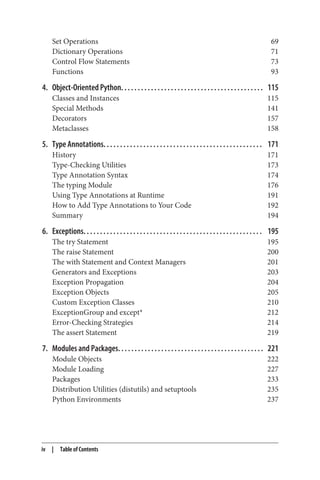
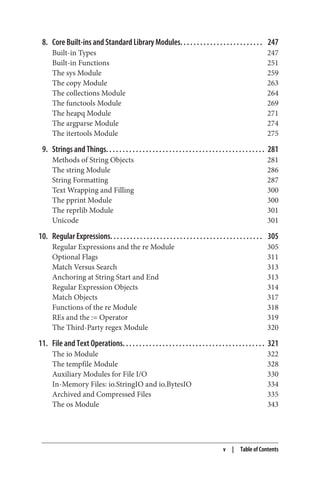



![2 For example, to accommodate the widespread changes in Python 3.9 and 3.10 in type annota‐
tions, most of Chapter 5 uses Python 3.10 as the base version for features and examples.
Conventions Used in This Book
The following conventions are used throughout this book.
Reference Conventions
In the function/method reference entries, when feasible, each optional parameter is
shown with a default value using the Python syntax name=value. Built-in functions
need not accept named parameters, so parameter names may not be significant.
Some optional parameters are best explained in terms of their presence or absence,
rather than through default values. In such cases, we indicate that a parameter
is optional by enclosing it in brackets ([]). When more than one argument is
optional, brackets can be nested.
Version Conventions
This book covers changes and features in Python versions 3.7 through 3.11.
Python 3.7 serves as the base version for all tables and code examples, unless
otherwise noted.2
You will see these notations to indicate changes or features added
and removed across the range of covered versions:
• 3.x+ marks a feature introduced in version 3.x, not available in prior versions.
•
• -3.x marks a feature removed in version 3.x, available only in prior versions.
•
Typographic Conventions
Please note that, for display reasons, our code snippets and samples may sometimes
depart from PEP 8. We do not recommend taking such liberties in your code.
Instead, use a utility like black to adopt a canonical layout style.
The following typographical conventions are used in this book:
Italic
Used for file and directory names, program names, URLs, and to introduce
new terms.
Constant width
Used for command-line output and code examples, as well as for code elements
that appear in the text, including methods, functions, classes, and modules.
Constant width italic
Used to show text to be replaced with user-supplied values in code examples
and commands.
Preface
|
xiii](https://image.slidesharecdn.com/76608-250529001744-9f209e85/85/Python-in-a-Nutshell-4th-Edition-Alex-Martelli-19-320.jpg)


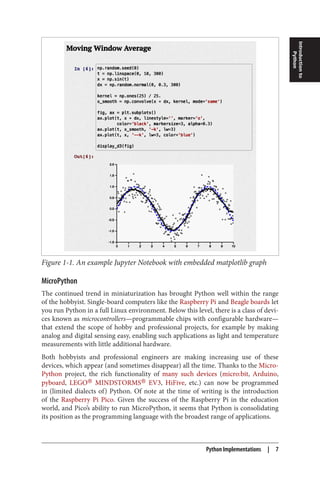


![8 We need to mobilize to get more penguins interested in our language!
the Community Conferences and Workshops page. More than 17,000 videos of talks
about Python, from more than 450 conferences, are available at the PyVideo site.
User groups and organizations
The Python community has local user groups on every continent except Antarc‐
tica8
—more than 1,600 of them, according to the list on the LocalUserGroups
wiki. There are Python meetups around the world. PyLadies is an international
mentorship group, with local chapters, to promote women in Python; anyone with
an interest in Python is welcome. NumFOCUS, a nonprofit charity promoting
open practices in research, data, and scientific computing, sponsors the PyData
conference and other projects.
Mailing lists
The Community Mailing Lists page has links to several Python-related mailing lists
(and some Usenet groups, for those of us old enough to remember Usenet!). Alter‐
natively, search Mailman to find active mailing lists covering a wide variety of inter‐
ests. Python-related official announcements are posted to the python-announce
list. To ask for help with specific problems, write to help@python.org. For help
learning or teaching Python, write to tutor@python.org, or, better yet, join the list.
For a useful weekly roundup of Python-related news and articles, subscribe to
Python Weekly. You can also follow Python Weekly at @python_discussions@masto‐
don.social.
Social media
For an RSS feed of Python-related blogs, see Planet Python. If you’re interested
in tracking language developments, check out discuss.python.org—it sends useful
summaries if you don’t visit regularly. On Twitter, follow @ThePSF. Libera.Chat
on IRC hosts several Python-related channels: the main one is #python. LinkedIn
has many Python groups, including Python Web Developers. On Slack, join the
PySlackers community. On Discord, check out Python Discord. Technical questions
and answers about Python programming can also be found and followed on Stack
Overflow under a variety of tags, including [python]. Python is currently the most
active programming language on Stack Overflow, and many useful answers with
illuminating discussions can be found there. If you like podcasts, check out Python
podcasts, such as Python Bytes.
Installation
You can install the classic (CPython) and PyPy versions of Python on most plat‐
forms. With a suitable development system (C for CPython; PyPy, coded in Python
itself, only needs CPython installed first), you can install Python versions from
14 | Chapter 1: Introduction to Python](https://image.slidesharecdn.com/76608-250529001744-9f209e85/85/Python-in-a-Nutshell-4th-Edition-Alex-Martelli-36-320.jpg)


![Configuring, building, and testing
You’ll find detailed notes in the README file inside this directory, under the
heading “Build instructions,” and we recommend you study those notes. In the
simplest case, however, all you need may be to give the following commands at a
shell prompt:
$ cd ~/py/Python-3.11/0
$ ./configure
[configure writes much information, snipped here]
$ make
[make takes quite a while and emits much information, snipped here]
If you run make without first running ./configure, make implicitly runs ./config
ure. When make finishes, check that the Python you have just built works as
expected:
$ make test
[takes quite a while, emits much information, snipped here]
Usually, make test confirms that your build is working, but also informs you that
some tests have been skipped because optional modules were missing.
Some of the modules are platform-specific (e.g., some may work only on machines
running SGI’s ancient IRIX operating system); you don’t need to worry about them.
However, other modules may be skipped because they depend on other open source
packages that are currently not installed on your machine. For example, on Unix,
the module _tkinter—needed to run the Tkinter GUI package and the IDLE
integrated development environment, which come with Python—can be built only
if ./configure can find an installation of Tcl/Tk 8.0 or later on your machine. See
the README file for more details and specific caveats about different Unix and
Unix-like platforms.
Building from source code lets you tweak your configuration in several ways. For
example, you can build Python in a special way that helps you debug memory leaks
when you develop C-coded Python extensions, covered in “Building and Installing
C-Coded Python Extensions” in Chapter 25. ./configure --help is a good source
of information about the configuration options you can use.
Installing after the build
By default, ./configure prepares Python for installation in /usr/local/bin and /usr/
local/lib. You can change these settings by running ./configure with the option
--prefix before running make. For example, if you want a private installation of
Python in the subdirectory py311 of your home directory, run:
$ cd ~/py/Python-3.11.0
$ ./configure --prefix=~/py311
18 | Chapter 1: Introduction to Python](https://image.slidesharecdn.com/76608-250529001744-9f209e85/85/Python-in-a-Nutshell-4th-Edition-Alex-Martelli-40-320.jpg)


![Environment Variables
Besides PATH, other environment variables affect the python program. Some of these
have the same effects as options passed to python on the command line, as we show
in the next section, but several environment variables provide settings not available
via command-line options. The following list introduces some frequently used ones;
for complete details, see the online docs:
PYTHONHOME
The Python installation directory. A lib subdirectory, containing the Python
standard library, must be under this directory. On Unix-like systems, standard
library modules should be in lib/python-3.x for Python 3.x, where x is the
minor Python version. If PYTHONHOME is not set, Python makes an informed
guess about the installation directory.
PYTHONPATH
A list of directories, separated by colons on Unix-like systems and by semico‐
lons on Windows, from which Python can import modules. This list extends
the initial value for Python’s sys.path variable. We cover modules, importing,
and sys.path in Chapter 7.
PYTHONSTARTUP
The name of a Python source file to run each time an interactive interpreter
session starts. No such file runs if you don’t set this variable, or set it to the path
of a file that is not found. The PYTHONSTARTUP file does not run when you run a
Python script; it runs only when you start an interactive session.
How to set and examine environment variables depends on your operating system.
In Unix, use shell commands, often within startup shell scripts. On Windows, press
the Windows key and start typing environment var, and a couple of shortcuts
appear: one for user environment variables, the other for system ones. On a Mac,
you can work just as on other Unix-like systems, but you have more options,
including a MacPython-specific IDE. For more information about Python on the
Mac, see “Using Python on a Mac” in the online docs.
Command-Line Syntax and Options
The Python interpreter’s command-line syntax can be summarized as follows:
[path]python {options} [-c command | -m module | file | -] {args}
Brackets ([]) enclose what’s optional, braces ({}) enclose items of which zero or
more may be present, and bars (|) mean a choice among alternatives. Python uses a
slash (/) for filepaths, as in Unix.
Running a Python script at a command line can be as simple as:
$ python hello.py
Hello World
22 | Chapter 2: The Python Interpreter](https://image.slidesharecdn.com/76608-250529001744-9f209e85/85/Python-in-a-Nutshell-4th-Edition-Alex-Martelli-44-320.jpg)

![Table 2-2. Frequently used py command-line options
Option Meaning
-2 Run the latest installed Python 2 version.
-3 Run the latest installed Python 3 version.
-3.x or
-3.x-nn
Run a specific Python 3 version. When referenced as just -3.10, uses the 64-bit version, or
the 32-bit version if no 64-bit version is available. -3.10-32 or -3.10-64 picks a specific
build when both are installed.
-0 or --list List all installed Python versions, including an indication of whether a build is 32- or 64-bit,
such as 3.10-64.
-h List all py command options, followed by standard Python help.
If no version option is given, py runs the latest installed Python.
For example, to show the local time using the installed Python 3.9 64-bit version,
you can run this command:
C:> py -3.9 -c "import time; print(time.asctime())"
(Typically, there is no need to give a path to py, since installing Python adds py to
the system PATH.)
The PyPy Interpreter
PyPy, written in Python, implements its own compiler to generate LLVM intermedi‐
ate code to run on an LLVM backend. The PyPy project offers some improvements
over standard CPython, most notably in the areas of performance and multithread‐
ing. (At this writing, PyPy is up-to-date with Python 3.9.)
pypy may be run similarly to python:
[path]pypy {options} [-c command | file | - ] {args}
See the PyPy home page for installation instructions and complete up-to-date
information.
Interactive Sessions
When you run python without a script argument, Python starts an interactive
session and prompts you to enter Python statements or expressions. Interactive
sessions are useful to explore, to check things out, and to use Python as a powerful,
extensible interactive calculator. (Jupyter Notebook, discussed briefly at the end of
this chapter, is like a “Python on steroids” specifically for interactive session usage.)
This mode is often referred to as a REPL, or read–evaluate–print loop, since that’s
pretty much what the interpreter then does.
The python Program | 25
The
Python
Interpreter](https://image.slidesharecdn.com/76608-250529001744-9f209e85/85/Python-in-a-Nutshell-4th-Edition-Alex-Martelli-47-320.jpg)
![When you enter a complete statement, Python executes it. When you enter a com‐
plete expression, Python evaluates it. If the expression has a result, Python outputs
a string representing the result and also assigns the result to the variable named _
(a single underscore) so that you can immediately use that result in another expres‐
sion. The prompt string is >>> when Python expects a statement or expression,
and ... when a statement or expression has been started but not completed. In
particular, Python prompts with ... when you have opened a parenthesis, bracket,
or brace on a previous line and haven’t closed it yet.
While working in the interactive Python environment, you can use the built-in
help() function to drop into a help utility that offers useful information about
Python’s keywords and operators, installed modules, and general topics. When
paging through a long help description, press q to return to the help> prompt. To
exit the utility and return to the Python >>> prompt, type quit. You can also get
help on specific objects at the Python prompt without entering the help utility by
typing help(obj), where obj is the program object you want more help with.
There are several ways you can end an interactive session. The most common are:
• Enter the end-of-file keystroke for your OS (Ctrl-Z on Windows, Ctrl-D on
•
Unix-like systems).
• Execute either of the built-in functions quit or exit, using the form quit()
•
or exit(). (Omitting the trailing () will display a message like “Use quit() or
Ctrl-D (i.e., EOF) to exit,” but will still leave you in the interpreter.)
• Execute the statement raise SystemExit, or call sys.exit() (we cover System
•
Exit and raise in Chapter 6, and the sys module in Chapter 8).
Use the Python Interactive Interpreter to Experiment
Trying out Python statements in the interactive interpreter is
a quick way to experiment with Python and immediately see
the results. For example, here is a simple use of the built-in
enumerate function:
>>> print(list(enumerate("abc")))
[(0, 'a'), (1, 'b'), (2, 'c')]
The interactive interpreter is a good introductory platform to
learn core Python syntax and features. (Experienced Python
developers often open a Python interpreter to quickly check
out an infrequently used command or function.)
Line-editing and history facilities depend in part on how Python was built: if
the readline module was included, all features of the GNU readline library are
available. Windows has a simple but usable history facility for interactive text mode
programs like python.
26 | Chapter 2: The Python Interpreter](https://image.slidesharecdn.com/76608-250529001744-9f209e85/85/Python-in-a-Nutshell-4th-Edition-Alex-Martelli-48-320.jpg)


![This ebook is for the use of anyone anywhere in the United States
and most other parts of the world at no cost and with almost no
restrictions whatsoever. You may copy it, give it away or re-use it
under the terms of the Project Gutenberg License included with this
ebook or online at www.gutenberg.org. If you are not located in the
United States, you will have to check the laws of the country where
you are located before using this eBook.
Title: The Rock Ahead: A Novel. (Vol. 1)
Author: Edmund Yates
Release date: July 15, 2019 [eBook #59911]
Language: English
Credits: Produced by Charles Bowen
*** START OF THE PROJECT GUTENBERG EBOOK THE ROCK
AHEAD: A NOVEL. (VOL. 1) ***](https://image.slidesharecdn.com/76608-250529001744-9f209e85/85/Python-in-a-Nutshell-4th-Edition-Alex-Martelli-55-320.jpg)