PYTHON
FRAMEWORKS FOR
ENTERPRISE
APPLICATIONS:
EMPOWERING
BUSINESS
SOLUTIONS
By Mindfire Solutions
INTRODUCTION
Python, known for its simplicity, readability,
and extensive library support, has emerged as
a versatile programming language for
developing enterprise applications. With a
wide array of frameworks available,
developers can leverage the power of Python
to build robust and scalable solutions tailored
to meet the specific needs of businesses. In
this presentation, we will explore some of the
best Python frameworks for enterprise
applications, discussing their features,
benefits, and use cases.
2
OVERVIEW
• Introduction to Python frameworks for enterprise
applications
• Importance of selecting the right framework for
business needs
3
DJANGO
Overview of Django framework
• Features: ORM, authentication, admin interface, and caching
• Use cases: Content management systems, e-commerce
platforms
• Advantages: Rapid development, security, scalability
• Example: Instagram, Pinterest
4
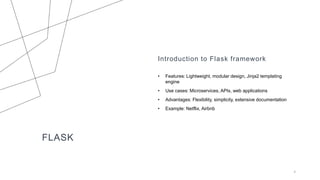
FLASK
Introduction to Flask framework
• Features: Lightweight, modular design, Jinja2 templating
engine
• Use cases: Microservices, APIs, web applications
• Advantages: Flexibility, simplicity, extensive documentation
• Example: Netflix, Airbnb
5
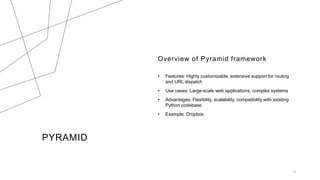
PYRAMID
Overview of Pyramid framework
• Features: Highly customizable, extensive support for routing
and URL dispatch
• Use cases: Large-scale web applications, complex systems
• Advantages: Flexibility, scalability, compatibility with existing
Python codebase
• Example: Dropbox
6
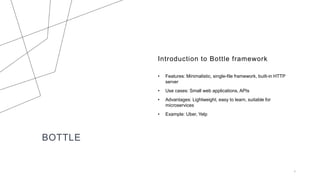
BOTTLE
Introduction to Bottle framework
• Features: Minimalistic, single-file framework, built-in HTTP
server
• Use cases: Small web applications, APIs
• Advantages: Lightweight, easy to learn, suitable for
microservices
• Example: Uber, Yelp
7
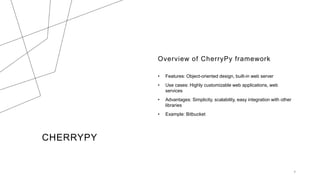
CHERRYPY
Overview of CherryPy framework
• Features: Object-oriented design, built-in web server
• Use cases: Highly customizable web applications, web
services
• Advantages: Simplicity, scalability, easy integration with other
libraries
• Example: Bitbucket
8
TURBOGEARS
Introduction to TurboGears framework
• Features: Full-stack framework, built on top of other popular
libraries
• Use cases: Complex enterprise applications, large-scale
projects
• Advantages: Powerful, flexible, modular architecture
• Example: SourceForge
9
CONCLUSION
Python frameworks offer a multitude of
options for developing enterprise applications,
each with its own set of features, strengths,
and use cases. Whether you require a full-
stack framework like Django or a lightweight
microframework like Bottle, Python has the
tools to meet your business needs. By
selecting the appropriate framework,
developers can leverage the versatility and
efficiency of Python to create scalable and
secure solutions, enabling businesses to
thrive in the digital era.
10

Python Frameworks for Enterprise Applications.pptx

  • 1.
  • 2.
    INTRODUCTION Python, known forits simplicity, readability, and extensive library support, has emerged as a versatile programming language for developing enterprise applications. With a wide array of frameworks available, developers can leverage the power of Python to build robust and scalable solutions tailored to meet the specific needs of businesses. In this presentation, we will explore some of the best Python frameworks for enterprise applications, discussing their features, benefits, and use cases. 2
  • 3.
    OVERVIEW • Introduction toPython frameworks for enterprise applications • Importance of selecting the right framework for business needs 3
  • 4.
    DJANGO Overview of Djangoframework • Features: ORM, authentication, admin interface, and caching • Use cases: Content management systems, e-commerce platforms • Advantages: Rapid development, security, scalability • Example: Instagram, Pinterest 4
  • 5.
    FLASK Introduction to Flaskframework • Features: Lightweight, modular design, Jinja2 templating engine • Use cases: Microservices, APIs, web applications • Advantages: Flexibility, simplicity, extensive documentation • Example: Netflix, Airbnb 5
  • 6.
    PYRAMID Overview of Pyramidframework • Features: Highly customizable, extensive support for routing and URL dispatch • Use cases: Large-scale web applications, complex systems • Advantages: Flexibility, scalability, compatibility with existing Python codebase • Example: Dropbox 6
  • 7.
    BOTTLE Introduction to Bottleframework • Features: Minimalistic, single-file framework, built-in HTTP server • Use cases: Small web applications, APIs • Advantages: Lightweight, easy to learn, suitable for microservices • Example: Uber, Yelp 7
  • 8.
    CHERRYPY Overview of CherryPyframework • Features: Object-oriented design, built-in web server • Use cases: Highly customizable web applications, web services • Advantages: Simplicity, scalability, easy integration with other libraries • Example: Bitbucket 8
  • 9.
    TURBOGEARS Introduction to TurboGearsframework • Features: Full-stack framework, built on top of other popular libraries • Use cases: Complex enterprise applications, large-scale projects • Advantages: Powerful, flexible, modular architecture • Example: SourceForge 9
  • 10.
    CONCLUSION Python frameworks offera multitude of options for developing enterprise applications, each with its own set of features, strengths, and use cases. Whether you require a full- stack framework like Django or a lightweight microframework like Bottle, Python has the tools to meet your business needs. By selecting the appropriate framework, developers can leverage the versatility and efficiency of Python to create scalable and secure solutions, enabling businesses to thrive in the digital era. 10