Visit https://ebookultra.com todownload the full version and
explore more ebooks or textbooks
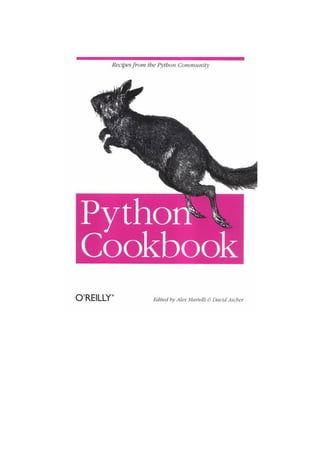
Python Cookbook 1st Edition Alex Martelli
_____ Click the link below to download _____
https://ebookultra.com/download/python-cookbook-1st-edition-
alex-martelli/
Explore and download more ebooks or textbooks at ebookultra.com
2.
Here are somerecommended products that we believe you will be
interested in. You can click the link to download.
Python cookbook Third Edition Beazley
https://ebookultra.com/download/python-cookbook-third-edition-beazley/
Python Cookbook 3rd Edition David Beazley
https://ebookultra.com/download/python-cookbook-3rd-edition-david-
beazley/
Python cookbook 3ed. Edition Beazley D.
https://ebookultra.com/download/python-cookbook-3ed-edition-beazley-d/
High Availability MySQL Cookbook 1st Edition Alex Davies
https://ebookultra.com/download/high-availability-mysql-cookbook-1st-
edition-alex-davies/
3.
Maya Programming withPython Cookbook 1st Edition Herbez
https://ebookultra.com/download/maya-programming-with-python-
cookbook-1st-edition-herbez/
Pentaho Data Integration Cookbook Second Edition Alex
Meadows
https://ebookultra.com/download/pentaho-data-integration-cookbook-
second-edition-alex-meadows/
Python Data Visualization Cookbook 2nd Edition Igor
Milovanovic
https://ebookultra.com/download/python-data-visualization-
cookbook-2nd-edition-igor-milovanovic/
Python data science cookbook over 60 practical recipes to
help you explore Python and its robust data science
capabilities Subramanian
https://ebookultra.com/download/python-data-science-cookbook-
over-60-practical-recipes-to-help-you-explore-python-and-its-robust-
data-science-capabilities-subramanian/
Dead Soil 1st Edition Alex Apostol
https://ebookultra.com/download/dead-soil-1st-edition-alex-apostol/
5.
Python Cookbook 1stEdition Alex Martelli Digital
Instant Download
Author(s): Alex Martelli, David Ascher
ISBN(s): 9780596001674, 0596001673
Edition: 1
File Details: PDF, 1.75 MB
Year: 2002
Language: english
7.
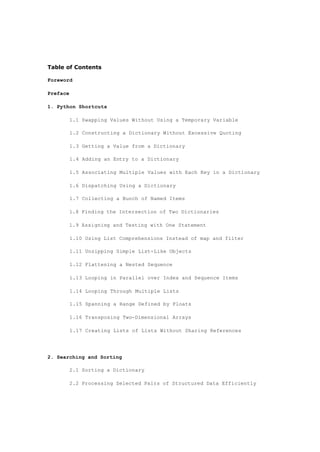
Table of Contents
Foreword
Preface
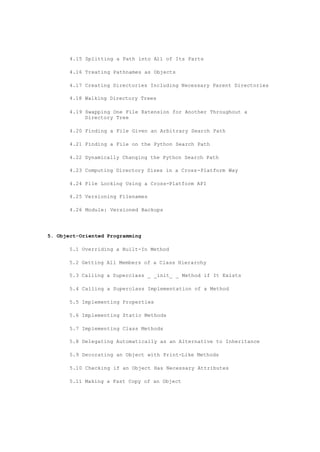
1.Python Shortcuts
1.1 Swapping Values Without Using a Temporary Variable
1.2 Constructing a Dictionary Without Excessive Quoting
1.3 Getting a Value from a Dictionary
1.4 Adding an Entry to a Dictionary
1.5 Associating Multiple Values with Each Key in a Dictionary
1.6 Dispatching Using a Dictionary
1.7 Collecting a Bunch of Named Items
1.8 Finding the Intersection of Two Dictionaries
1.9 Assigning and Testing with One Statement
1.10 Using List Comprehensions Instead of map and filter
1.11 Unzipping Simple List-Like Objects
1.12 Flattening a Nested Sequence
1.13 Looping in Parallel over Index and Sequence Items
1.14 Looping Through Multiple Lists
1.15 Spanning a Range Defined by Floats
1.16 Transposing Two-Dimensional Arrays
1.17 Creating Lists of Lists Without Sharing References
2. Searching and Sorting
2.1 Sorting a Dictionary
2.2 Processing Selected Pairs of Structured Data Efficiently
8.
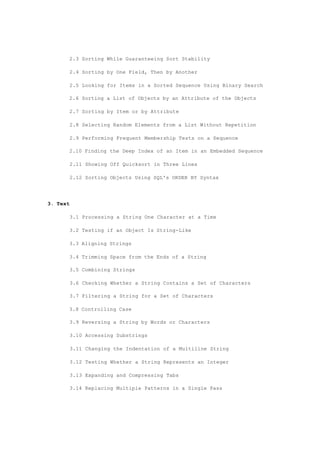
2.3 Sorting WhileGuaranteeing Sort Stability
2.4 Sorting by One Field, Then by Another
2.5 Looking for Items in a Sorted Sequence Using Binary Search
2.6 Sorting a List of Objects by an Attribute of the Objects
2.7 Sorting by Item or by Attribute
2.8 Selecting Random Elements from a List Without Repetition
2.9 Performing Frequent Membership Tests on a Sequence
2.10 Finding the Deep Index of an Item in an Embedded Sequence
2.11 Showing Off Quicksort in Three Lines
2.12 Sorting Objects Using SQL's ORDER BY Syntax
3. Text
3.1 Processing a String One Character at a Time
3.2 Testing if an Object Is String-Like
3.3 Aligning Strings
3.4 Trimming Space from the Ends of a String
3.5 Combining Strings
3.6 Checking Whether a String Contains a Set of Characters
3.7 Filtering a String for a Set of Characters
3.8 Controlling Case
3.9 Reversing a String by Words or Characters
3.10 Accessing Substrings
3.11 Changing the Indentation of a Multiline String
3.12 Testing Whether a String Represents an Integer
3.13 Expanding and Compressing Tabs
3.14 Replacing Multiple Patterns in a Single Pass
9.
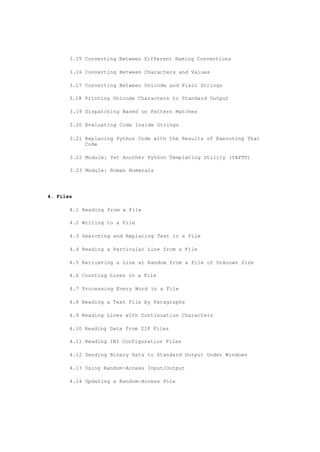
3.15 Converting BetweenDifferent Naming Conventions
3.16 Converting Between Characters and Values
3.17 Converting Between Unicode and Plain Strings
3.18 Printing Unicode Characters to Standard Output
3.19 Dispatching Based on Pattern Matches
3.20 Evaluating Code Inside Strings
3.21 Replacing Python Code with the Results of Executing That
Code
3.22 Module: Yet Another Python Templating Utility (YAPTU)
3.23 Module: Roman Numerals
4. Files
4.1 Reading from a File
4.2 Writing to a File
4.3 Searching and Replacing Text in a File
4.4 Reading a Particular Line from a File
4.5 Retrieving a Line at Random from a File of Unknown Size
4.6 Counting Lines in a File
4.7 Processing Every Word in a File
4.8 Reading a Text File by Paragraphs
4.9 Reading Lines with Continuation Characters
4.10 Reading Data from ZIP Files
4.11 Reading INI Configuration Files
4.12 Sending Binary Data to Standard Output Under Windows
4.13 Using Random-Access Input/Output
4.14 Updating a Random-Access File
10.
4.15 Splitting aPath into All of Its Parts
4.16 Treating Pathnames as Objects
4.17 Creating Directories Including Necessary Parent Directories
4.18 Walking Directory Trees
4.19 Swapping One File Extension for Another Throughout a
Directory Tree
4.20 Finding a File Given an Arbitrary Search Path
4.21 Finding a File on the Python Search Path
4.22 Dynamically Changing the Python Search Path
4.23 Computing Directory Sizes in a Cross-Platform Way
4.24 File Locking Using a Cross-Platform API
4.25 Versioning Filenames
4.26 Module: Versioned Backups
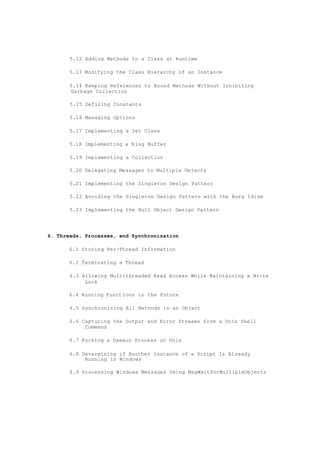
5. Object-Oriented Programming
5.1 Overriding a Built-In Method
5.2 Getting All Members of a Class Hierarchy
5.3 Calling a Superclass _ _init_ _ Method if It Exists
5.4 Calling a Superclass Implementation of a Method
5.5 Implementing Properties
5.6 Implementing Static Methods
5.7 Implementing Class Methods
5.8 Delegating Automatically as an Alternative to Inheritance
5.9 Decorating an Object with Print-Like Methods
5.10 Checking if an Object Has Necessary Attributes
5.11 Making a Fast Copy of an Object
11.
5.12 Adding Methodsto a Class at Runtime
5.13 Modifying the Class Hierarchy of an Instance
5.14 Keeping References to Bound Methods Without Inhibiting
Garbage Collection
5.15 Defining Constants
5.16 Managing Options
5.17 Implementing a Set Class
5.18 Implementing a Ring Buffer
5.19 Implementing a Collection
5.20 Delegating Messages to Multiple Objects
5.21 Implementing the Singleton Design Pattern
5.22 Avoiding the Singleton Design Pattern with the Borg Idiom
5.23 Implementing the Null Object Design Pattern
6. Threads, Processes, and Synchronization
6.1 Storing Per-Thread Information
6.2 Terminating a Thread
6.3 Allowing Multithreaded Read Access While Maintaining a Write
Lock
6.4 Running Functions in the Future
6.5 Synchronizing All Methods in an Object
6.6 Capturing the Output and Error Streams from a Unix Shell
Command
6.7 Forking a Daemon Process on Unix
6.8 Determining if Another Instance of a Script Is Already
Running in Windows
6.9 Processing Windows Messages Using MsgWaitForMultipleObjects
12.
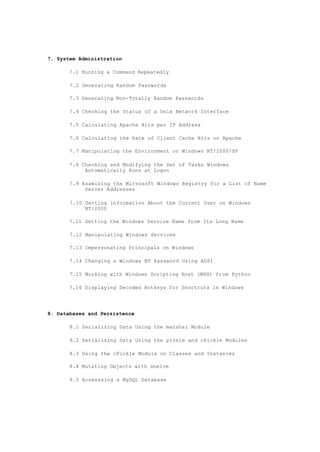
7. System Administration
7.1Running a Command Repeatedly
7.2 Generating Random Passwords
7.3 Generating Non-Totally Random Passwords
7.4 Checking the Status of a Unix Network Interface
7.5 Calculating Apache Hits per IP Address
7.6 Calculating the Rate of Client Cache Hits on Apache
7.7 Manipulating the Environment on Windows NT/2000/XP
7.8 Checking and Modifying the Set of Tasks Windows
Automatically Runs at Logon
7.9 Examining the Microsoft Windows Registry for a List of Name
Server Addresses
7.10 Getting Information About the Current User on Windows
NT/2000
7.11 Getting the Windows Service Name from Its Long Name
7.12 Manipulating Windows Services
7.13 Impersonating Principals on Windows
7.14 Changing a Windows NT Password Using ADSI
7.15 Working with Windows Scripting Host (WSH) from Python
7.16 Displaying Decoded Hotkeys for Shortcuts in Windows
8. Databases and Persistence
8.1 Serializing Data Using the marshal Module
8.2 Serializing Data Using the pickle and cPickle Modules
8.3 Using the cPickle Module on Classes and Instances
8.4 Mutating Objects with shelve
8.5 Accesssing a MySQL Database
13.
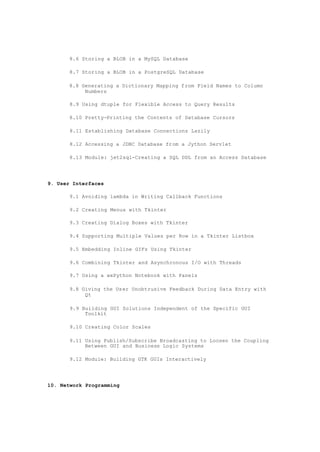
8.6 Storing aBLOB in a MySQL Database
8.7 Storing a BLOB in a PostgreSQL Database
8.8 Generating a Dictionary Mapping from Field Names to Column
Numbers
8.9 Using dtuple for Flexible Access to Query Results
8.10 Pretty-Printing the Contents of Database Cursors
8.11 Establishing Database Connections Lazily
8.12 Accessing a JDBC Database from a Jython Servlet
8.13 Module: jet2sql-Creating a SQL DDL from an Access Database
9. User Interfaces
9.1 Avoiding lambda in Writing Callback Functions
9.2 Creating Menus with Tkinter
9.3 Creating Dialog Boxes with Tkinter
9.4 Supporting Multiple Values per Row in a Tkinter Listbox
9.5 Embedding Inline GIFs Using Tkinter
9.6 Combining Tkinter and Asynchronous I/O with Threads
9.7 Using a wxPython Notebook with Panels
9.8 Giving the User Unobtrusive Feedback During Data Entry with
Qt
9.9 Building GUI Solutions Independent of the Specific GUI
Toolkit
9.10 Creating Color Scales
9.11 Using Publish/Subscribe Broadcasting to Loosen the Coupling
Between GUI and Business Logic Systems
9.12 Module: Building GTK GUIs Interactively
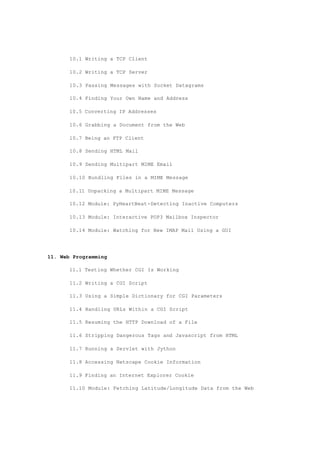
10. Network Programming
14.
10.1 Writing aTCP Client
10.2 Writing a TCP Server
10.3 Passing Messages with Socket Datagrams
10.4 Finding Your Own Name and Address
10.5 Converting IP Addresses
10.6 Grabbing a Document from the Web
10.7 Being an FTP Client
10.8 Sending HTML Mail
10.9 Sending Multipart MIME Email
10.10 Bundling Files in a MIME Message
10.11 Unpacking a Multipart MIME Message
10.12 Module: PyHeartBeat-Detecting Inactive Computers
10.13 Module: Interactive POP3 Mailbox Inspector
10.14 Module: Watching for New IMAP Mail Using a GUI
11. Web Programming
11.1 Testing Whether CGI Is Working
11.2 Writing a CGI Script
11.3 Using a Simple Dictionary for CGI Parameters
11.4 Handling URLs Within a CGI Script
11.5 Resuming the HTTP Download of a File
11.6 Stripping Dangerous Tags and Javascript from HTML
11.7 Running a Servlet with Jython
11.8 Accessing Netscape Cookie Information
11.9 Finding an Internet Explorer Cookie
11.10 Module: Fetching Latitude/Longitude Data from the Web
15.
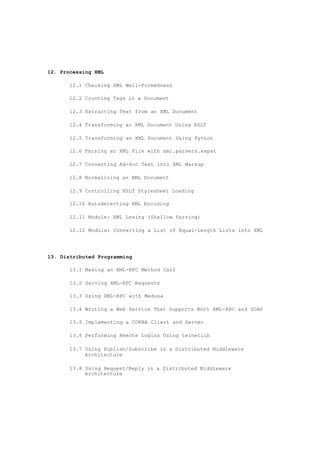
12. Processing XML
12.1Checking XML Well-Formedness
12.2 Counting Tags in a Document
12.3 Extracting Text from an XML Document
12.4 Transforming an XML Document Using XSLT
12.5 Transforming an XML Document Using Python
12.6 Parsing an XML File with xml.parsers.expat
12.7 Converting Ad-Hoc Text into XML Markup
12.8 Normalizing an XML Document
12.9 Controlling XSLT Stylesheet Loading
12.10 Autodetecting XML Encoding
12.11 Module: XML Lexing (Shallow Parsing)
12.12 Module: Converting a List of Equal-Length Lists into XML
13. Distributed Programming
13.1 Making an XML-RPC Method Call
13.2 Serving XML-RPC Requests
13.3 Using XML-RPC with Medusa
13.4 Writing a Web Service That Supports Both XML-RPC and SOAP
13.5 Implementing a CORBA Client and Server
13.6 Performing Remote Logins Using telnetlib
13.7 Using Publish/Subscribe in a Distributed Middleware
Architecture
13.8 Using Request/Reply in a Distributed Middleware
Architecture
16.
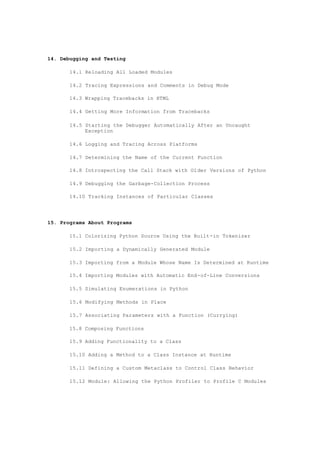
14. Debugging andTesting
14.1 Reloading All Loaded Modules
14.2 Tracing Expressions and Comments in Debug Mode
14.3 Wrapping Tracebacks in HTML
14.4 Getting More Information from Tracebacks
14.5 Starting the Debugger Automatically After an Uncaught
Exception
14.6 Logging and Tracing Across Platforms
14.7 Determining the Name of the Current Function
14.8 Introspecting the Call Stack with Older Versions of Python
14.9 Debugging the Garbage-Collection Process
14.10 Tracking Instances of Particular Classes
15. Programs About Programs
15.1 Colorizing Python Source Using the Built-in Tokenizer
15.2 Importing a Dynamically Generated Module
15.3 Importing from a Module Whose Name Is Determined at Runtime
15.4 Importing Modules with Automatic End-of-Line Conversions
15.5 Simulating Enumerations in Python
15.6 Modifying Methods in Place
15.7 Associating Parameters with a Function (Currying)
15.8 Composing Functions
15.9 Adding Functionality to a Class
15.10 Adding a Method to a Class Instance at Runtime
15.11 Defining a Custom Metaclass to Control Class Behavior
15.12 Module: Allowing the Python Profiler to Profile C Modules
17.
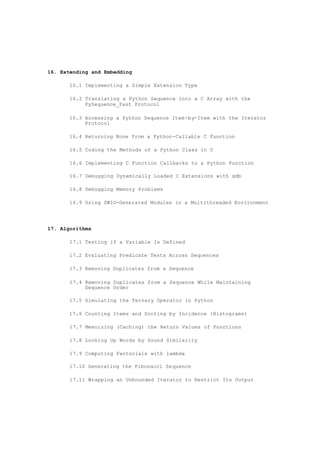
16. Extending andEmbedding
16.1 Implementing a Simple Extension Type
16.2 Translating a Python Sequence into a C Array with the
PySequence_Fast Protocol
16.3 Accessing a Python Sequence Item-by-Item with the Iterator
Protocol
16.4 Returning None from a Python-Callable C Function
16.5 Coding the Methods of a Python Class in C
16.6 Implementing C Function Callbacks to a Python Function
16.7 Debugging Dynamically Loaded C Extensions with gdb
16.8 Debugging Memory Problems
16.9 Using SWIG-Generated Modules in a Multithreaded Environment
17. Algorithms
17.1 Testing if a Variable Is Defined
17.2 Evaluating Predicate Tests Across Sequences
17.3 Removing Duplicates from a Sequence
17.4 Removing Duplicates from a Sequence While Maintaining
Sequence Order
17.5 Simulating the Ternary Operator in Python
17.6 Counting Items and Sorting by Incidence (Histograms)
17.7 Memoizing (Caching) the Return Values of Functions
17.8 Looking Up Words by Sound Similarity
17.9 Computing Factorials with lambda
17.10 Generating the Fibonacci Sequence
17.11 Wrapping an Unbounded Iterator to Restrict Its Output
18.
17.12 Operating onIterators
17.13 Rolling Dice
17.14 Implementing a First-In First-Out Container
17.15 Modeling a Priority Queue
17.16 Converting Numbers to Rationals via Farey Fractions
17.17 Evaluating a Polynomial
17.18 Module: Finding the Convex Hull of a Set of 2D Points
17.19 Module: Parsing a String into a Date/Time Object Portably
19.
Foreword
Forget the jokesabout tasty snake dishes, here's the Python Cookbook! Python's famous comedian
namesakes would have known exactly what to do with this title: recipes for crunchy frog, spring
surprise, and, of course, blancmange (or was that a tennis-playing alien?). The not-quite-so-famous-
yet Python programming community has filled in the details a little differently: we like to have fun
here as much as the next person, but we're not into killing halibuts, especially not if their first name is
Eric.
So what exactly is a Python cookbook? It's a collection of recipes for Python programmers,
contributed by Python community members. The original contributions were made through a web site
set up by ActiveState, from which a selection was made by editors Alex Martelli and David Ascher.
Other Python luminaries such as Fredrik Lundh, Paul Dubois, and Tim Peters were asked to write
chapter introductions.
Few cookbooks teach how to cook, and this one is no exception: we assume that you're familiar with
programming in Python. But most of these recipes don't require that you be an expert programmer,
either, nor an expert in Python (though we've sprinkled a few hard ones throughout just to give the
gurus something to watch for). And while these recipes don't teach Python programming basics, most
were selected because they teach something—for example, performance tips, advanced techniques,
explanations of dark corners of the language, warnings about common pitfalls, and even suggestions
that seem to go against accepted wisdom.
Most recipes are short enough for the attention span of the average Python programmer. For easy
access, they are grouped into chapters, which contain either recipes for a specific application area,
such as network programming or XML, or are about specific programming techniques, such as
searching and sorting or object-oriented programming. While there's some logical progression among
the chapters and among the recipes in a chapter, we expect that most readers will sample the recipes at
random or based on the job at hand (just as you would choose a food recipe based upon your appetite
or the contents of your refrigerator).
All in all, the breadth and depth of this collection are impressive. This is a testimony to Python's wide
range of application areas, but also to its user community. When I created the first version of Python,
more than 12 years ago now, all I wanted was a language that would let me write system-
administration scripts in less time. (Oh, and I wanted it to be elegant, too.) I never could have guessed
most of the application areas where Python is currently the language of choice for many—and that's
not just because the World Wide Web hadn't been invented yet. In many areas, code written by
generous Python users is as important as Python's standard library: think of numeric algorithms,
databases, and user interfaces, in which the number of third-party choices dwarfs Python's standard-
library offerings, despite the language's reputation that it comes with "batteries included."
Python is an evolving language. This cookbook offers some recipes that work only with the latest
Python version, and a few that have been made obsolete by recent Python versions. Don't think this
means that Python has built-in obsolescence! Usually, these obsolete recipes work fine, and the code
that uses them will continue to work in future Python versions. It's just that when you're irked by a
roundabout way of expressing a particular idea in code, there's often a better way available in a newer
Python version, and we'd like you to know about it. On the other hand, it's sometimes useful to know
how to write code that works for several Python versions at once, without explicitly checking version
numbers all the time. Some recipes touch upon this topic, as well.
20.
The increase insize of the community has caused some growing pains. Now that the early adopters
are already using Python, growth must come from luring more conservative users to the language.
This is easy enough, as Python is a very friendly language, but it does present new challenges. For
example, as a special case of Murphy's law, anything that can go wrong during the installation process
will go wrong for someone, somewhere, and they won't be pleased. The new Python users are often
not savvy enough to diagnose and correct problems themselves, so our solution has been to make the
installer even more bulletproof than it already was.
The same holds for almost all aspects of the language: from the documentation and the error messages
to the runtime's behavior in long-running servers, Python gets more user-testing than I ever bargained
for. Of course, we also get more offers to help, so all in all, things are working out very nicely. What
this means is that we've had to change some of our habits. You could say that the Python developer
community is losing some of its innocence: we're no longer improving Python just for our own sake.
Many hundreds of thousands of individual Python users are affected, and an ever-growing number of
companies are using or selling software based on Python. For their benefit, we now issue strictly
backward-compatible bug-fix releases for Python versions up to 2 years old, which are distinct from
the feature-introducing major releases every 6 to 12 months.
Let me end on a different aspect of the community: the Python Software Foundation. After the failed
experiments of the Python Software Activity and the Python Consortium, I believe we have finally
found the proper legal form for a nonprofit organization focused on Python. Keeping a fairly low
profile, the PSF is quietly becoming a safe haven for Python software, where no single individual or
organization can hold a monopoly on Python, and where everybody benefits. The PSF, in turn,
benefits from the sales of this book: a portion of the royalties goes to the PSF, representing the many
Python programmers who contributed one or more recipes to the cookbook project. Long live the
Python community!
—Guido van Rossum
Reston, Virginia
April 2002
21.
Preface
This book isnot a typical O'Reilly book, written as a cohesive manuscript by one or two authors.
Instead, it is a new kind of book—a first, bold attempt at applying some principles of open source
development to book authoring. About 200 members of the Python community contributed recipes to
this book. In this Preface, we, the editors, want to give you, the reader, some background regarding
how this book came about and the processes and people involved, and some thoughts about the
implications of this new form.
22.
The Design ofthe Book
In early 2000, Frank Willison, then Editor-in-Chief of O'Reilly & Associates, Inc., contacted me
(David Ascher) to find out if I wanted to write a book. Frank had been the editor for Learning Python,
which I cowrote with Mark Lutz. Since I had just taken a job at what was then considered a Perl shop
(ActiveState), I didn't have the bandwidth necessary to write another book, and plans for the project
were gently shelved. Periodically, however, Frank would send me an email or chat with me at a
conference regarding some of the book topics we'd discussed. One of Frank's ideas was to create a
Python Cookbook, based on the concept first used by Tom Christiansen and Nathan Torkington with
the Perl Cookbook. Frank wanted to replicate the success of the Perl Cookbook, but he wanted a
broader set of people to provide input. He thought that, much as in a real cookbook, a larger set of
authors would provide for a greater range of tastes. The quality, in his vision, would be ensured by the
oversight of a technical editor, combined with O'Reilly's editorial review process.
Frank and Dick Hardt, ActiveState's CEO, realized that Frank's goal could be combined with
ActiveState's goal of creating a community site for open source programmers, called the ActiveState
Programmer's Network (ASPN). ActiveState had a popular web site, with the infrastructure required
to host a wide variety of content, but it wasn't in the business of creating original content. ActiveState
always felt that the open source communities were the best sources of accurate and up-to-date content,
even if sometimes that content was hard to find.
The O'Reilly and ActiveState teams quickly realized that the two goals were aligned and that a joint
venture would be the best way to achieve the following key objectives:
• Creating an online repository of Python recipes by Python programmers for Python
programmers
• Publishing a book containing the best of those recipes, accompanied by overviews and
background material written by key Python figures
• Learning what it would take to create a book with a different authoring model
At the same time, two other activities were happening. First, I and others at ActiveState, including
Paul Prescod, were actively looking for "stars" to join A
ctiveState's development team. One of the
candidates being recruited was the famous (but unknown) Alex Martelli. Alex was famous because of
his numerous and exhaustive postings on the Python mailing list, where he exhibited an unending
patience for explaining Python's subtleties and joys to the increasing audience of Python programmers.
He was unknown because he lived in Italy and, since he was a relative newcomer to the Python
community, none of the old Python hands had ever met him—their paths had not happened to cross
back when Alex lived in the U.S., when he was working for IBM Research and enthusiastically using
and promoting other high-level languages.
ActiveState wooed Alex, trying to convince him to move to Vancouver. We came quite close, but his
employer put some golden handcuffs on him, and somehow Vancouver's weather couldn't compete
with Italy's. Alex stayed in Italy, much to my disappointment. As it happened, Alex was also at that
time negotiating with O'Reilly about writing a book. Alex wanted to write a cookbook, but O'Reilly
explained that the cookbook was already signed. Later, Alex and O'Reilly signed a contract for Python
in a Nutshell.
The second ongoing activity was the creation of the Python Software Foundation. For a variety of
reasons, best left to discussion over beers at a conference, everyone in the Python community wanted
to create a non-profit organization that would be the holder of Python's intellectual property, to ensure
that Python would be on a legally strong footing. However, such an organization needed both financial
support and buy-in from the Python community to be successful.
23.
Given all theseparameters, the various parties agreed to the following plan:
• ActiveState would build an online cookbook, a mechanism by which anyone could submit a
recipe (i.e., a snippet of Python code addressing a particular problem, accompanied by a
discussion of the recipe, much like a description of why one should use cream of tartar when
whipping egg whites). To foster a community of authors and encourage peer review, the web
site would also let readers of the recipes suggest changes, ask questions, and so on.
• As part of my ActiveState job, I would edit and ensure the quality of the recipes. (Alex
Martelli joined the project as a co-editor as the material was being prepared for publication.)
• O'Reilly would publish the best recipes as the Python Cookbook.
• In lieu of author royalties for the recipes, a portion of the proceeds from the book sales would
be donated to the Python Software Foundation.
24.
The Implementation ofthe Book
The online cookbook (at http://aspn.activestate.com/ASPN/Cookbook/Python/) was the entry point for
the recipes. Users got free accounts, filled in a form, and presto, their recipes became part of the
cookbook. Thousands of people read the recipes, and some added comments, and so, in the publishing
equivalent of peer review, the recipes matured and grew. (The online cookbook is still very much
active and growing.)
Going from the online version to the version you have in front of you was a fairly complex process.
The data was first extracted from Zope and converted into XML. We then categorized the recipes and
selected those recipes that seemed most valuable, distinctive, and original. Then, it was just a matter
of editing the recipes to fit the format of the cookbook, checking the code for correctness (the
PyChecker tool deserves special thanks, as it was quite useful in this regard), adding a few recipes
here and there for completeness of coverage in some areas, and doing a final copyediting pass.
It sounds simple when you write it down in one paragraph. Somehow, we don't remember it as quite
as being simple as that!
25.
A Note AboutLicenses
Software licenses are both the curse and the foundation of the open source movement. Every software
project needs to make careful, deliberate decisions about what kind of license should be used for the
code—who is allowed to use the code, under what conditions, and so on. Given the nature of the
cookbook, we wanted the recipes to be usable under any circumstances where Python could be used.
In other words, we wanted to ensure completely unfettered use, in the same spirit as the Python license.
Unfortunately, the Python license cannot really be used to refer to anything other than Python itself.
As a compromise, we chose to use the modified Berkeley license, which is considered among the most
liberal of licenses. We contacted each of the recipe authors and confirmed that they agreed to publish
these recipes under said license. The license template reads (substitute <OWNER> and
<ORGANIZATION> with the author of each recipe):
Copyright (c) 2001, <OWNER>
All rights reserved.
Redistribution and use in source and binary forms, with or
without
modification, are permitted provided that the following
conditions
are met:
* Redistributions of source code must retain the above
copyright
notice, this list of conditions and the following
disclaimer.
* Redistributions in binary form must reproduce the above
copyright notice, this list of conditions and the
following
disclaimer in the documentation and/or other materials
provided
with the distribution.
* Neither the name of the <ORGANIZATION> nor the names of
its
contributors may be used to endorse or promote products
derived
from this software without specific prior written
permission.
THIS SOFTWARE IS PROVIDED BY THE COPYRIGHT HOLDERS AND
CONTRIBUTORS
"AS IS" AND ANY EXPRESS OR IMPLIED WARRANTIES, INCLUDING, BUT
NOT
LIMITED TO, THE IMPLIED WARRANTIES OF MERCHANTABILITY AND
FITNESS
FOR A PARTICULAR PURPOSE ARE DISCLAIMED. IN NO EVENT SHALL THE
REGENTS
OR CONTRIBUTORS BE LIABLE FOR ANY DIRECT, INDIRECT, INCIDENTAL,
SPECIAL,
EXEMPLARY, OR CONSEQUENTIAL DAMAGES (INCLUDING, BUT NOT
LIMITED TO,
the matter.” Mr.Webber’s father was a prominent contractor in the
50’s, 60’s and 70’s, during which period he erected many public
buildings and business blocks, among which were St. Mary’s
Cathedral, Centenary Church, Masonic Hall, Lester Block and
hundreds of stores, hotels and private dwellings. While carrying on
the contracting business during the period of food shortage,
following the Crimean War, he bought and operated a 200-acre farm
in the county on which the subject of this sketch was born but only
remained during infancy. During the Great War Mr. Webber took an
active part in patriotic, Red Cross and Relief Work, and in his long
connection as director, and for several years in succession President
of the Hamilton Horticultural Society. Has contributed not a little to
the beautifying of home surroundings throughout the city. In his
connection with the Gordon Club and in the eight counties under his
jurisdiction as director of the Ontario Horticultural Society he did
much to stimulate the production of vegetables and other foods
throughout the district during the war. His efforts in the direction
received commendation from the President of the National War
Garden Commissioner, Washington, D.C., for adding to the world’s
supply of food during the war. Mr. Webber lives at 130 Stinson
Street, where he delights in Horticulture.
Irwin, William Nassau (Toronto, Ont.), only son of
Francis Irwin (Irish), for many years Treasurer of the town of
Orangeville, county town of Dufferin, and Jane (Taylor) Irwin
(Canadian). Born at Orangeville, Ontario, on November 14, 1863.
Educated in the Public and High Schools of Orangeville, and Trinity
College, Toronto. Studied law in office of McCarthy and Walsh,
Orangeville, and afterwards with Mowat, Maclennan, Downey and
Langton, and Maclaren, Macdonald, Merritt and Shepley, Toronto,
graduating from Osgoode Hall, and called to the Bar in September,
1886. A member of the legal firm of Henderson, Irwin and Ungaro,
Toronto. Married in September, 1893. His only son, James Carter
Irwin, member of the Princess Patricia Canadian Light Infantry,
28.
wounded in actionin Flanders, died at King George Hospital,
London, England, July 31, 1916, from effects of his wounds, in his
18th year. Mr. Irwin was interested in bicycling, when that sport was
at the height of its popularity, being President of the Athenaeum
Cycling Club, and member of the Canadian Wheelmen’s Executive for
several years. Member of the Church of England and the Orange
Order. Interested in journalism. A Liberal-Conservative.
Sinclair, Robert Victor, K.C., Barrister and Solicitor, the
son of Robert and Elizabeth Morrison (Colville) Sinclair, was born in
Forestville, New York, May 24, 1861, and at an early age came to
Canada with his parents and settled in Ottawa, where he received
his education in the Ottawa Collegiate Institute. He read law with
Stewart, Chrysler & Gormully from 1880 to 1885, and was called to
the bar in the latter year, when he went into partnership with Mr.
Gormully under the title of Gormully & Sinclair, and remained there
until 1894, when he retired to practise alone. In 1900, he formed a
partnership with the late Sir Adolphe Caron, the firm being known as
Caron & Sinclair, and remained there until 1907, when he again
retired to practise alone. In 1908 he was created a K.C. Mr. Sinclair
is recognized in the Ottawa legal fraternity as one of the Capital’s
most successful barristers. In 1907, Mr. Sinclair was elected a
member of the Ottawa Stock Exchange. August, 1887, he married
Daisy King, daughter of James W. King, ex-M.P., Director of
Penitentiaries. He has one son and three daughters. He is a member
of the Rideau Hunt Club, and was a member of the executive
committee in 1907. In religion he is an Anglican, in politics a
Conservative, and he resides at 237 Wilbrod St., Ottawa, Ontario.
Campbell, William Brough. The late W. B. Campbell,
of Toronto, insurance publisher and editor, was of Scottish extraction
and was born in Shannonville, Ontario (then Canada West), on July
17, 1854. He was the eldest of four children who reached maturity.
29.
While he wasstill a child, his parents removed with their family to
Toronto, where he continued to reside until his death. He was
educated in the public schools, and went to work while still only a
lad, serving under his father, who held an administrative position in
the Toronto office of the old Lancashire Fire Insurance Company.
About 1880 he joined his father in the publication of a monthly
insurance journal called “The Budget.” From its first issue the new
paper was independent in policy and aggressive in tone, and its
strictures upon some of the loose practices of insurance companies,
and especially its denunciations of wild-cat concerns carrying on a
business of plunder in the name of insurance, made it a power in its
field. A fairly extensive printing business was developed as a side
line of the business, but ultimately this proved too complex a load
for the periodical to carry. The result was that other people acquired
the rights in “The Budget.” But the Campbells, father and son, at
once came out with a new venture, “The Bulletin,” virtually a
continuation of the old. In 1905, feeling the need of greater freedom
in editorial and business policy than his surroundings permitted, Mr.
Campbell dissociated himself from his father, and began the
publication of “Office and Field,” a weekly—in its time the only
weekly journal in the world wholly devoted to life insurance. The
world-wide upheaval in life insurance business arising from the
investigation by a committee of the legislature of the State of New
York in 1905 threatened the new venture with early extinction, but
by daring and skilful guidance Mr. Campbell brought his craft to
success. He demanded and insisted upon service of the public as the
one justification for life insurance. It was largely through his
influence that the life insurance agents were organized as the Life
Underwriters’ Association of Canada, an institution which, carrying
out the policy which he and other leaders laid down, has achieved a
splendid success. His work, both as editor and propagandist was a
distinct factor in making life insurance in Canada the great financial
and social force it has become. Mr. Campbell was married in
September, 1887, to Jessie G., eldest daughter of the late George
Maclean Rose. Of this union there were born two daughters and a
son. The son, Wilfrid Maclean Campbell answered the call to the
30.
colours, and servedas a private in France and Flanders from
February, 1916, to the end. He was one of the glorious Canadians at
Vimy Ridge, was wounded at Hill 70, but returned to the ranks, and
was among those who marched as victors into Germany. Too great
devotion to business broke down Mr. Campbell’s health, and after a
short illness he died in June, 1914, in his sixtieth year.
Henderson, Alexander, B.A., K.C., is one of the most
prominent members of the British Columbia Bar, and practises at
Vancouver. He was born at Oshawa, Ont., in 1861, the son of
Alexander Henderson, a native of Caithness, Scotland, and Grace
(KilPatrick) Henderson, a native of Paisley, Scotland. His father, after
coming to this country, became mechanical superintendent of one of
Oshawa’s leading industries, and the subject of this sketch was
educated at the public and high schools of his native town and at
the University of Toronto. He graduated from the latter institution in
1884 with the degree of B.A., and subsequently qualified for the law.
He was called to the Bar of Ontario in 1889, and two years later
decided to take up his residence in New Westminster, B.C. He was
called to the British Columbia Bar in 1892, and has ever since
pursued an active legal career. In 1896, he was appointed agent for
the Minister of Justice of Canada on the mainland of British
Columbia. In 1898, he was elected to the Provincial Legislature as
member for the city of New Westminster, and sat for two years. In
1899, he became Attorney-General for British Columbia, and in 1901
was appointed judge of the County Court of Vancouver, an office he
held until 1907, when he was appointed Commissioner of the Yukon
Territory. For four years he lived at Dawson City, and won distinction
by his wise and able administration. In 1911, he resigned, and
resumed the practise of law at Vancouver, where he has a large and
lucrative practice. He has taken an active interest in military affairs,
and was formerly major of the 6th Regiment, Duke of Connaught’s
Rifles, and was placed on the Reserve of Officers in 1907. His
recreation is rifle shooting, and he accompanied the Canadian Bisley
31.
Team to Englandin 1901, acting as adjutant. He is a Presbyterian in
religion, a Liberal in politics, and a member of the Vancouver Club.
On September 14, 1895, he married Susan Crawford, daughter of
William McCraney, of Oakville, Ont., and Vancouver, B.C. The latter
was a very prominent lumberman, and formerly represented Halton
(Ontario) in the House of Commons. Mr. and Mrs. Henderson have
one daughter, Grace Kilpatrick Henderson, and reside at 1424
Burnaby Ave., Vancouver.
Russell, Adam Lothian, of Vancouver, B.C., is one of
the leading commercial figures of the Coast province. Like so many
others who have made their mark in Canada he is a native of
Scotland, and was born at Alexandria, Dumbartonshire, on March 27,
1864, the son of James and Annie (Knox) Russell. He was educated
at Glasgow High School and Glasgow University, and his business
training began in 1882 with the firm of Rutherford Bros., in the
Scottish commercial metropolis. With this firm he remained three
years and in 1885 became Manager of the firm of Taylor Bros., in
Glasgow, in which capacity he remained until 1891. His Glasgow
training had rendered him familiar with international shipping, and in
1891 he decided to come to Canada and establish himself at
Vancouver as a Ship Broker and Commission Agent. In this capacity
he continued until 1901, after which he acquired his present
interests. He is now Vice-President and Managing Director of Evans,
Coleman & Evans, Ltd., Vancouver; and Vice-President of Clayburn,
Ltd., in the same city. His business offices are 301-304 Credit Foncier
Building, Vancouver. He is a member of the following clubs:
Vancouver, Union (Victoria), Jericho Country (Vancouver), British
Columbia Golf, Vancouver Athletic, Shaughnessy Golf Club, and Royal
Vancouver Yacht Club. His favorite recreation is golf; he is a member
of the Masonic Order and a Presbyterian in religion. In 1898 he
married Rosamund Bickford of Newcastle, England, and has one
daughter, Sheila. Mr. and Mrs. Russell reside at 1306 Burnaby St.,
Vancouver.
32.
Shillington, Lieut.-Col. AdamTozeland,
M.D.C.M., M.C.P. & S., F.A.C.S., Surgeon, of Ottawa, was born in
Prospect, Lanark County, Ontario, August 12, 1870. He is the son of
Samuel Kerfort and Ann Eliza (Poole) Shillington, whose ancestors
came to Canada from Ireland in 1812 and settled in Goulbourn,
Carleton County, Ontario. Col. Shillington was educated in the public
and high schools of Kemptville, Ontario, McGill University, Montreal,
where he attained the degrees M.D., C.M., M.C.P.& S., F.A.C.S., Post
Graduate Course, London, England, 1902. Col. Shillington has
practised in Ottawa since 1894, and was appointed to the Medical
Board of St. Luke’s General Hospital in 1901, and gynaecologist in
that hospital in 1913; consulting physician in the Ottawa Maternity
Hospital, a member of the Canadian Medical Association, and was
chairman of legislation at the time the Association was incorporated,
a member of the Ontario Medical Association, and was First Vice-
President in 1913-1914; Association of Officers of the Medical
Service of Canada, of which he was President in 1913; Ottawa
Medical Society, of which he was President in 1903; Ottawa Medico-
Chirurgical Society, of which he was President in 1918; National
Geographical Society; Clinical Congress of the American College of
Surgeons; Fellow, Royal Society of Medicine, London, England;
Fellow, American College of Surgeons, 1914, and a Justice of the
Peace for the County of Carleton. Col. Shillington served as
Lieutenant in the Canadian Army Medical Corps in 1901, as Captain
in 1902, Major in 1904, and as Lieutenant-Colonel in 1911. From
1904 to 1910 he was Officer Commanding No. 2 Field Ambulance;
Administrative Medical Officer, M.D. No. 4, in March and April, 1911;
represented Army Medical Corps of Canada at the Convention of the
Military Surgeons of the United States at Milwaukee in 1911; was
A.D.M.S. at Barriefield Camp in 1913. September 22, 1914, Colonel
Shillington went overseas with the First Canadian Expeditionary
Forces in command of No. 2 Canadian Stationary Hospital, and the
following November (8th) established the First Canadian Military
Hospital to be opened in the war zone. This hospital unit was the
33.
first Canadian unitto reach France. On November 27, 1915, Colonel
Shillington was appointed A.D.M.S., of the Canadians at Bramshott,
England, and in May, 1916, was appointed A.D.M.S., A.M.D.I. to the
D.M.S. office. On October 25, 1916, he was appointed A.D.M.S.,
C.T.D., at Shorncliffe, England, and March, 1917, Officer
Commanding at the Kitchener Military Hospital, Brighton, England.
February 9, 1918, Colonel Shillington, having served overseas for
three years and five months, during which time he was mentioned in
despatches and awarded the “Mons Star,” returned to Canada, and
was transferred to the C.E.F. Reserve of Officers. Colonel Shillington
was married to Ethel Florence Jones, daughter of John Henry Jones,
of Montreal, July 31, 1899, and has two sons and one daughter:
John T., James G. K., and Ethel Maud. Clubs: Rideau, Royal Ottawa
Golf, Wawa Keshi Fish and Game, Army and Navy of London;
Societies: A.F. & A.M. and I.O.O.F. In religion a Methodist, in politics
a Conservative, he resides at the Bedford House, 281 Gilmour Street,
Ottawa, Ont.
White, James, F.R.G.S., F.R.S.C., M. Eng. Inst. Can., E.,
is the Assistant to Chairman and the Deputy Head of the Canadian
Commission of Conservation, with headquarters in the Temple
Building, Metcalfe Street, Ottawa. He is the eldest son of David
White and Christina, daughter of George Hendry, and was born
February 3, 1863. In 1888, he married Rachel, daughter of Thomas
Waddell, and has two daughters. He was educated at the Royal
Military College, Kingston, Ontario. In January, 1884, he was
appointed topographer on the staff of the Geological Survey of
Canada, and made surveys in the Rocky Mountains during 1884-5.
In 1886, he made surveys in the Madoc, Ontario, gold district; in
1887-90, in the Ottawa County, Quebec, phosphate district; and in
1891-93, in the Kingston and Pembroke, Ontario, district, and in the
latter year was employed on the Alaska Boundary Commission. In
1894, he was appointed Geographer and Chief Draughtsman to the
Geological Survey. In 1899, he was appointed Chief Geographer of
34.
the Department ofthe Interior, in which branch he organized the
map work. In 1907 he made investigations respecting fast Atlantic
passenger steamships (the All-Red Line), and in 1909 was appointed
Secretary to the Commission of Conservation and Assistant Chairman
and Deputy Minister in 1913. The following valuable publications are
to his credit: 1901 and 1915, Altitudes in Canada, 1st and 2nd
editions; 1903 and 1916, Dictionary of Altitudes, 1st and 2nd
editions; Maps and Mapmaking in Canada; Derivation of Place-
Names in Northern Canada, of Quebec, of Thousand Islands, of
Rocky Mountains, and of Georgian Bay; Treaties and Boundaries
affecting Canada; Fuels of Western Canada; various other articles,
etc.; 1906, Atlas of Canada. For recreation, Mr. White takes pleasure
in travelling, and he belongs to the Authors and the Rideau Clubs.
He resides at 450 Wilbrod Street, Ottawa, Ontario, Canada.
Dunlop, Edward Arunah, M.P.P. (Pembroke, Ont.),
born at Pembroke, Ont., October 26th, 1876, son of Mary Deacon
and Arunah Dunlop, ex-M.P.P. Began his business career as clerk for
Dunlop & Chapman, hardware merchants, Pembroke, in 1892, and in
1897 took charge of the business, changing the name to Dunlop &
Company. In politics he is a Conservative. Declined nomination to
the Ontario Legislature for North Renfrew in 1899. Was elected at
the by-election December 26, 1903, by a majority of 598, after a
contest of nineteen months, during which time the constituency was
unrepresented in the Ontario Legislature. This is said to be the
longest vacancy in the parliamentary records of Canada. Was re-
elected 1905. Declined nomination in 1908. Re-elected by
acclamation in 1911, and re-elected in 1914. Was a member of the
Town Council of Pembroke from 1908 to 1913 inclusive. Is connected
with many commercial concerns, being President of the Pembroke
Lumber Company, Steel Equipment Co., Ltd., Pembroke Electric Light
Co., Ltd., and MacFarlane Neil Mfg. Co. of Fredericton, N.B.; also a
director of the Pembroke Woollen Mills, Ltd., Massey Lumber Co.,
Ltd., Pembroke Southern Railway, Pembroke Iron Works, Ltd.,
35.
Superior Electrics, Ltd.,Victoria Foundry Co., Ltd., Ottawa, and other
companies. Is First Vice-President of the Canadian Electrical
Association for 1919. He is a member of the Rideau and Country
Clubs of Ottawa and the National and Albany Clubs of Toronto. Is a
member of the Methodist Church. On June 17, 1908, he married
Mabel Ferguson, daughter of Donald Ferguson, of Beamsville, Ont.,
and has three daughters.
Reid, William Brown, President and Managing Director
of United Cigar Stores, Ltd., of Canada, with head office at 284 King
Street West, Toronto, Ont., was born in Rothes, Scotland, April 7,
1866, the son of Alexander and Helen (Simpson) Reid. His father
was an extensive and prosperous farmer, and this afforded the
subject of this sketch the opportunity of exercising in his boyhood
his innate love of horses which he still retains. While afforded, like
other members of his family, all the facilities for pursuing the highest
educational course, he was satisfied with that of the common
schools which have produced so many successful Scotchmen. He
served with the Rothes (Elginshire) Volunteers from 1882 till 1888,
when he came to Canada, and shortly afterwards joined the 48th
Highlanders, serving for five years. After leaving school he pursued
his own inclinations, and before coming to Canada had gained
practical experience in a general way, besides having considerable
knowledge along useful technical lines as a reserve to fall back on.
In 1888, he became connected with the Empire Tobacco Co., with
which he remained as Toronto representative till 1897, when he
established in Toronto the wholesale tobacco and Cigar firm of W. B.
Reid & Co., which was the foundation of the present extensive
corporation of which he was the originator, and has always been the
head and controlling genius. The firm was incorporated as the
United Cigar Stores, Limited, in 1902, with a capital of $20,000, and
opened several cigar stores in Toronto. In May, 1914, the company’s
capital stock was increased to $250,000, and the number of stores
largely increased and extended to outside cities. A year later, United
36.
Cigar Stores, Limited,of Canada was incorporated with a capital of
$3,800,000, with Mr. Reid still in full control. The Company now has
164 stores, extending from Quebec City to Port Arthur, including 39
in Toronto, 13 in Ottawa, 11 in Hamilton, and one or more in almost
every important town in the province. Remarkable as this
achievement is in so short a time, it falls far short of the goal set by
Mr. Reid, who intends to have stores in every city and town of
consequence in the Dominion, and no doubt would have already
made this goal an established fact before now if the war had not put
a temporary stop to further expansion. Besides operating this great
chain of stores, the company has two large cigar factories, and as a
holding company, also controls a chain of Drug Stores with about a
dozen branches, and a constantly and rapidly increasing business.
The annual turnover of the cigar stores and cigar factories is
between $3,000,000 and $4,000,000, all directed by Mr. Reid
personally from the head office. This immense volume of business
enables the company to buy goods in such large quantities that it
obtains better terms than are available by small purchasers, and at
the same time minimizes the percentage of overhead expenses. Mr.
Reid married Edith E. Rogers, daughter of A. C. Rogers, Newmarket,
Ont., November 8, 1896. He is a member of the Toronto and
Montreal Boards of Trade, of the Scarborough Golf Club, Lakeview
Golf, Mississauga Golf and Ontario Clubs; member of the A.F. & A.M.,
a Presbyterian, and independent in politics. His chief recreations are
bowling and golf. He resides at 42 Lakeview Ave., Toronto. Mr. Reid
is genial in manner, a systematic organizer, with sufficient of the
imaginative faculty to prompt enterprise and enough determination
and reserve force to ensure the carrying out of anything to which he
lays his hand. He was the first man in the province of Ontario to
place on the market the product of Canadian grown tobacco, and
the expansion of this business has proven his foresight beyond
question. The great war made heavy drafts on the staff of the
Company, but Mr. Reid is too good a Britisher to complain of that; in
fact, in addition to contributing thousands of dollars to patriotic
purposes, so strong along this line is he that he never has allowed
any foreign element to obtain a footing in his company, which he
37.
says will bestrictly Canadian, without outside influence, so long as
he is at its head—and that means as long as he desires to remain in
active business.
Johnson, Hon. Thomas Herman, B.A., LL.D.,
Attorney-General of Manitoba, is a type of those Icelandic Canadians
who, going into the West in the early days, have done so much for
its development. He was born in Iceland on February 12, 1870, the
son of John and Margaret Johnson. When he was a boy of eight
years old his father resolved to try his fortunes in the virgin country
of Western Canada, and settled in Manitoba as a farmer, bringing his
family with him. The subject of this sketch was from early boyhood
bent on a professional career. He attended the public schools of
Winnipeg, and later took a course at Gustavus Adolphus College,
Minnesota, from which he graduated in 1895 with the degree of B.A.
As a youth he taught school during the summer in the Glenboro
district to secure funds to continue his studies during the winter.
After obtaining his degree he entered the legal offices of Richards
(afterwards Mr. Justice Richards) and Bradshaw, with a view to
qualifying himself for the law. He was admitted to the Manitoba Bar
in 1900, and immediately commenced practice at Winnipeg. His
abilities and knowledge of the different races of Manitoba were such
that in 1901 the Laurier administration appointed him census
commissioner for Manitoba to take the decennial census of that year.
In 1904 he was elected as member of the Winnipeg School Board,
and continued to act until 1907, when he resigned to stand as
Liberal candidate for the Legislature in the riding of West Winnipeg.
He was successful, and was also re-elected in 1910. At the general
elections of 1914 he was Liberal candidate in Centre Winnipeg, and
was again successful. As a prominent member of the opposition, he
took an active part in the campaign which resulted in driving the
Roblin administration from office. In 1915, when the Liberals, under
Hon. Mr. Norris, came into power, he was again elected for Centre
Winnipeg, and on the formation of the Norris government was
38.
offered, and accepted,the post of Minister of Public Works.
Subsequently, he was transferred to the more important portfolio of
Attorney-General. Mr. Johnson is a fine public speaker, and his
shrewdness and judgment on all public questions are highly
esteemed by his fellow citizens and colleagues in the Legislature. He
is a Lutheran in religion, and his chief recreation is golf. On June 21,
1898, he married Aurora, daughter of F. Frederickson, merchant,
Glenboro, Manitoba, and has three children, M. Ethel, Elswood B.,
and Cecil F. Johnson.
Farrow, Robinson Russell, Assistant Commissioner of
Customs, was born at Bluevale, Huron County, Ontario, March 7,
1864, and was educated at the public schools in Huron. He is the
son of Thomas Farrow, (who came to Canada from England in 1849,
and for years was Superintendent of Schools for Wawanosh, Morris
and Turnberry, and who, establishing himself in business, made
progress and prospered as the country advanced in population,
industry and wealth), and Mary Macdonald, of London, Ontario. His
father also became popular in the County of Huron, and at the
general election in 1872 was chosen to represent North Huron in the
House of Commons. He was re-elected at the general election in
1876, and again at the general election in 1882 was the successful
candidate for East Huron. June 1, 1881, Mr. Farrow first entered the
Civil Service of Canada in the Customs Department, and May 8,
1907, was appointed Assistant Commissioner. In lawn bowling and
curling, Mr. Farrow holds a prominent station for competency, and is
ever sought when championship contests are listed. He usually
carries his team to victory. He is honorary President of the Ontario
Lawn Bowling Association; member of the Executive of the Dominion
Lawn Bowling Association; Past President of the Ottawa Lawn
Bowling Club; and a member of the Finance Committee of the
Ottawa Curling Club. In his official capacity as Assistant
Commissioner, he is one of the busiest men in the Civil Service, and
one of the most competent, coupled with which there is an ever
39.
evident promptness inaction and courtesy in manner. January 5,
1887, Mr. Farrow married Miss R. J. Bradley, daughter of Samuel T.
Bradley, a mill owner, and Margaret Alexander, of Huntley, Ontario.
Mr. Farrow has one daughter—Ethel, B.A. (now Mrs. C. H. Bland),
whose son, Corpl. C. H. Bland, B.A., served during the world war in
the 20th Battery, Overseas Forces, and was with the army of
occupation in Germany; and Bombdr. Russell Farrow, who, with the
20th Battery, C.E.S., served in France, Belgium, and with the army of
occupation in Germany. Mr. Farrow belongs to the Laurentian Club,
and is a member of the following societies: Scottish Rite Masons;
A.F. & A.M.; Oddfellows; A.O.U.W.; Canadian Order of Foresters;
Sons of England. He resides at 7 McLeod Street, Ottawa, Ont., and
he attends the Methodist Church.
Veale, Philip Henry, Assessment Commissioner for the
City of Ottawa, was appointed to that position February 5, 1917. He
is well known among Canadian municipal officials and civic
legislators as a reliable authority on assessments, both as to the
application of the Ontario Assessment and Local Improvement Acts,
and as to land values, of which he has been a close student. Prior to
his appointment as Assessment Commissioner, there were, besides
the Commissioner, an Assistant Commissioner; and when Mr. Veale
was appointed the latter position was abolished, the civic
government considering that in the new appointment they had
secured a man who was competent to perform the duties alone,
although the responsibilities and duties of the office had increased
considerably, and were daily increasing. That they were not mistaken
is amply proved by the fact that the affairs of the Assessment
Commissioner’s office were never working in such regular clock-like
form as they are to-day. When Mr. Veale first became an employee
in the Assessment Commissioner’s Office in 1892, the taxable
assessment of the city of Ottawa was but $18,236,160, and the
population only 43,942. In 1919—twenty-seven years later—the
taxable assessment had increased to $114,392,261, and the
40.
population to 104,007;and, strange to say, of all the aldermen who
were in the city council at that time, but one man, Alderman (now
Controller) Napoleon Champagne, is still in civic life, and most of the
others have crossed the line and joined the great majority. Mr. Veale
has contributed largely to newspapers and magazines on
assessment and other like important subjects, and few, if any, are
better able to handle such subjects in newspaper discussion than he.
It was in the re-organization of the civic assessment department in
1892 that Mr. Veale was appointed to a clerkship. It was not long
before he was appointed chief clerk, and then Assistant
Commissioner; and when Mr. William Stewart retired in 1917, Mr.
Veale was called upon to assume the duties and responsibilities of
both offices. Besides being an authority on real estate values, Mr.
Veale is well known in Eastern Ontario as a breeder of White
Wyandotte chickens, as a consistent exhibitor and prize-winner. At
his summer home. River Park, every year he raises hundreds of
thoroughbred fowl. Mr. Veale is the son of Philip Veale, who for many
years was manager of the Dominion Fisheries at Ottawa, and Jane
(Smith) Veale. He was born at Merrickville, Ontario, January 7, 1865,
and was educated in the public school, New Edinburgh, now a
portion of Ottawa. On April 27, 1887, Mr. Veale married Emma M.
Payne, daughter of Abraham Payne, civil servant, Ottawa, resulting
in a fine family of nine children—seven girls and two boys—Ethel
Alberta, Mabel Mildred, Kathleen Gwendeline, Philip McDougal,
Beatrice Jean, Albert Newell, Annie Edna, Lois Evelene, Constance
Winifred. Mr. Veale is a member of the following clubs and societies:
St. George’s, Sons of England, Knight of the Maccabees, and St.
Matthew’s Church Men’s. In religion he is an Anglican, in politics a
Conservative, and his recreations are fishing, and amateur
gardening. His residence is at Woodroffe, Ont.
Finlayson, George Daniel, B.A., A.I.A., is the son of
Edward Finlayson, a farmer who was born at Merigomish, N.S., and
Catherine (Smith) Finlayson, and a brother of Professor J. N.
41.
Finlayson of DalhousieUniversity, Halifax. Mr. Finlayson was born in
Merigomish, Pictou County, Nova Scotia, December 31, 1882, and
received his education in the country school, Merigomish, Pictou
Academy, and Dalhousie University, graduating in 1907 with B.A. and
great distinction. On May 6, 1907, Mr. Finlayson entered upon his
duties in connection with the Dominion Insurance Department, and
at once became a valuable acquisition to the staff of that branch of
the Civil Service. It was not long before his great ability as an
authority on, and his general knowledge of, all phases of insurance
brought him prominently to the notice of the Ottawa authorities and
the heads of insurance companies throughout Canada, and his
promotion, as a consequence, was rapid. Seven years later, from the
time he entered the service on September 1, 1914, and at the early
age of 32 years, he was appointed to the highest position in the
Insurance Department, viz., that of Superintendent, which position
he holds to-day. In the execution of his duties, he is noted for his
courtesy to all who seek information from him. In 1914, Mr.
Finlayson married Isabel M. Grant, daughter of A. M. Grant, of
Moncton, New Brunswick, and has one daughter, Catherine Smith
Finlayson, and one son. Mr. Finlayson is a member of the Canadian,
University, and Riverside Golf clubs. For recreation he indulges in
tennis, golf and walking. He is a Presbyterian in religion, and his
residence is 200 Carling Avenue, Ottawa.
McLean, Angus Alexander, LL.B., K.C., Ex-M.P.,
Controller of the Royal North-West Mounted Police, since 1917, was
born December 17, 1854, at Belfast, Prince Edward Island, and
received his education at the Prince of Wales College, Charlottetown,
P.E.I., and Harvard Law School. He is the son of William and Flora
McLean, both of Prince Edward Island. Having read law in the office
of the late Chief Justice, Hon. Sir William Sullivan, Mr. McLean was
called to the bar in 1876, and became a partner in the law firm of
Sullivan, McLean & Morsen. Afterwards he was senior member of
McLean & McKinnon, barristers and solicitors, Victoria Row,
42.
Charlottetown, P.E.I. InJune, 1894, he was appointed Q.C., and
revising officer for East Queen’s, and was elected President of the
P.E.I. Law Society. For eight years, Mr. McLean was law clerk for the
P.E.I. Legislature, and was Official Assignee under the old Dominion
Insolvent Act for five years. During 1888, 1889 and 1900, Mr.
McLean represented the constituency of Belfast in the P.E.I.
Legislature. He was a candidate at the by-elections of 1902 and
1904 for the House of Commons, and was elected at the General
Election of 1904. In the General Election of 1908 he was defeated,
but in 1911 was elected by a large majority. October 15, 1917, he
was appointed controller of the Royal North-West Mounted Police. In
June 14, 1882, Mr. McLean married Leah Yeo, daughter of the late
John Yeo, of Charlottetown. She died in 1897. In 1898, he married
Frances H. Longworth, daughter of the late Henry Longworth, of
Charlottetown. He has two sons, both of whom served with
distinction in the Overseas forces during the great world war. In
religion Mr. McLean is a Presbyterian, in politics a Liberal-
Conservative, and he is a member of the A.F. & A.M.; the I.O.O.F.;
and the S.O.S. Societies. He resides at 312 Cooper Street, Ottawa,
Ontario.
Robertson, Hon. Gideon Decker, P.C., Federal
Minister of Labor, was the first actual representative of organized
labor to be called to either the Dominion Cabinet or the Senate of
Canada, He was born at Welland, Ont., on August 26, 1874, the son
of Gavin E. Robertson and Laretto Goring, both native Canadians.
His paternal grandfather was a native of Scotland, who became a
member of the bar and later went to Jamaica, where he took an
active part in the agitation for the abolition of slavery, which became
a fully accomplished fact in 1838. In this movement Robertson was
in correspondence with Clarkson, Macaulay (father of Lord
Macaulay), Wilberforce and others active in freeing the British
Empire from this reproach. Later, he came to Canada, where Gavin
Robertson, father of the subject of this sketch, was born, and where
43.
he became afarmer and school teacher on the Niagara peninsula.
Gideon Decker Robertson was educated at the public and high
schools of Welland and as a youth took up telegraphy in connection
with railroad work. A strong believer in trades unionism, he soon
became active in the Order of Railroad Telegraphers, an international
body, of which he was some years ago elected Vice-President, an
office he still holds. His duties brought him in contact with the chiefs
of organized labor on this continent, and he won a high reputation
for clear thinking and executive ability. In 1917, when Sir Robert
Borden decided to abolish party lines and form a Union Government,
he offered Mr. Robertson a position in the Senate and a seat in his
Cabinet. The offer was accepted, and in the autumn of that year he
was sworn in as a member of the Privy Council and a Minister
without Portfolio. In May, 1918, he was appointed Chairman of the
sub-Committee of the Council on Labor Problems, and also Chairman
of the National Registration Board in connection with the war. On
November 7, 1918, he was sworn in as Minister of Labor in
succession to Hon. T. W. Crothers, who had announced his intention
of retiring some months previously. The appointment was made just
at the psychological moment, for the armistice, which had been
signed just one week previously, created a host of labor problems
more serious than Canada had ever previously been called upon to
face; and only a statesman enjoying practical knowledge and the
confidence of organized labor could have dealt with the situation. In
the spring and summer of 1919 he was called upon to combat a
conspiracy affecting all Canada to introduce a modified form of
Russian Bolshevism, fathered by the Industrial Workers of the World,
known as the “One Big Union.” The aim was to unite all existing
labor organizations in one body, and by sympathetic strikes and a
policy of terrorism destroy capitalism, and reduce all other classes to
subjection. This movement came to a head with a general strike
called in Winnipeg early in May, on the pretext of a dispute between
the metal workers and their employers. Winnipeg was chosen as a
strategic point, because of its peculiar geographical position as the
chief divisional point of three transcontinental railways. The aim was
to cut Canada in two in the matter of communications, and then by
44.
broadening the strikeEastward and Westward secure complete
control of Canadian transportation and industry, after which the
movement was to be carried into every section of the United States.
Senator Robertson himself went to the scene of operations, and by
his fearless, though moderate handling of the situation, and his
influence with the saner labor elements, rendered the conspiracy
abortive so far as the rest of Canada was concerned, and fruitless in
Winnipeg. He thus secured a triumph for legitimate trade unionism,
of which he is the chief sponsor in Canada. He is a Freemason, a
Presbyterian, and in politics a member of the Independent Labor
Party. On June 10, 1896, he married Mary Berry Hay, daughter of
Alexander Hay, Watford, Ont., and has six children—Edwin J., John
McElroy, Gain Elliot, Alexander Lorne, Mabel Letitia, and Alma
Lauretta. He formerly resided at Welland but his home is now at
Ottawa.
45.
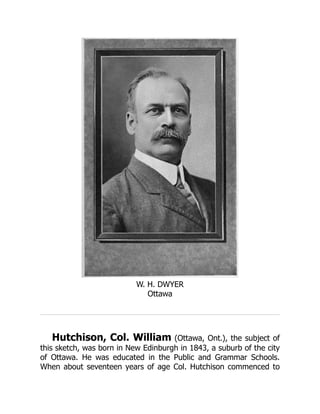
W. H. DWYER
Ottawa
Hutchison,Col. William (Ottawa, Ont.), the subject of
this sketch, was born in New Edinburgh in 1843, a suburb of the city
of Ottawa. He was educated in the Public and Grammar Schools.
When about seventeen years of age Col. Hutchison commenced to
46.
learn the Millingbusiness with his uncle, the late Thos. McKay, who
was then owner of the McKay Mills at the Chaudiere and also a
partner in the New Edinburgh Mills. At the age of twenty Col.
Hutchison left for the United States where he followed the milling
business for several years. On his return he took charge of his
uncle’s business and shortly afterwards was made a partner. In 1885
he was elected to City Council, and served for seven years. It was
during Col. Hutchison’s service in the City Council that the question
of the proper drainage of the city attained its greatest importance,
and it is owing to his keen foresight and wise counsel and
persistence that Ottawa to-day has the excellent drainage system of
which it now boasts, and that is but one of the many happenings for
the benefit, progress and beautification of Ottawa that were brought
into existence through his instrumentality during his term of office in
the City’s Civic affairs. From 1888 to, and including the year 1905, a
period of eighteen years, Col. Hutchison was a member of the Board
of Directors of the Central Canada Exhibition Association, and from
1895 to 1905, 10 years, he was President. On retiring in 1906 he
was elected Honorary President of the Association and has been re-
elected to that position every year since. Col. Hutchison, with the
assistance of Messrs. Ahearn and Topper, was instrumental in
converting the old horse car line to electric, giving Ottawa one of the
best street car services on the continent. He ran for the Dominion
House in 1896, with the result that both he and his French
colleague, Napoleon A. Belcourt, were elected by a sweeping
majority. At the time the Conservatives felt that they had a serious
grievance, but ere long the good-hearted, good-natured and genial
new Member became the friend and companion of both Liberals and
Conservatives in the House of Commons. In 1901, when Sir Wilfrid
Laurier needed a competent man to travel to all parts of the world to
exhibit Canada’s mineral, cereal and industrial resources, Col.
Hutchison was asked to accept the position of Canadian Exhibition
Commissioner. He accepted and since his appointment he has had
charge of Canada’s exhibits at the following times and places:—
1901, Buffalo, U.S.A.; 1902, Osaka, Japan; 1903-04 St. Louis,
U.S.A.; 1905, Liege, Belgium; 1906, Milan, Italy; 1907, Dublin,
47.
Ireland; 1908, ShepherdsBush, London, England; 1909, Seattle,
U.S.A.; 1910, Brussels, Belgium; 1911-12, Crystal Palace, London,
England; 1913, Ghent, Belgium; 1914-15, San Francisco, U.S.A.;
1916-17, San Diego, U.S.A. The great world war has caused a
cessation of the valuable exhibits, but the whole display is located in
commodious quarters on Wellington St. in Ottawa, under Col.
Hutchison’s special care, waiting and ready to be shipped at a
moment’s notice. In 1902 Col. Hutchison was decorated by the
Emperor of Japan with the Order of the Rising Sun (with rank of
Colonel in the Army). In 1905 he was decorated by the late King
Leopold II. of Belgium, with the Order of Leopold, and in 1906 by
the King of Italy with the Order of the Crown of Italy, in 1910 he was
made Commander of the Order of the Crown of Belgium by King
Albert I. Col. William Hutchison is the son of the late Robert
Hutchison of Ayrshire, Scotland, who came to Canada in 1830 and in
New Edinburgh married Mary McKay, niece of the late Hon. Thos.
McKay, who was born in Edinburgh, Scotland. In September, 1874,
he married Electa Blanche, daughter of S. T. Willett of Chambly,
Quebec. Two sons have blessed the union. In religion he is a
Presbyterian, and in politics a high tariff Liberal. He is also a member
of the Rideau Club, Ottawa, and his residence is 443 Albert St.,
Ottawa.
Gibson, Brigadier-General Sir John Morison,
K.C.M.G., M.A., LL.D., K.C., born January 1, 1842, township of
Toronto, in the County of Peel, and is therefore a “Peel Old Boy.” His
father, William Gibson, a farmer, came from Glamis, Forfarshire,
Scotland, in 1827. His mother, Mary Sinclair, was born in Scotland.
Her people had settled in the township of Nelson, in the County of
Halton. The family removed from Toronto township when the subject
of this sketch was only eight or nine years of age to the County of
Haldimand, where he had some experience in the Log School House
education of the primitive settlements of that County in the early
50’s. He afterwards went to the Central School in Hamilton, the late
48.
Welcome to ourwebsite – the ideal destination for book lovers and
knowledge seekers. With a mission to inspire endlessly, we offer a
vast collection of books, ranging from classic literary works to
specialized publications, self-development books, and children's
literature. Each book is a new journey of discovery, expanding
knowledge and enriching the soul of the reade
Our website is not just a platform for buying books, but a bridge
connecting readers to the timeless values of culture and wisdom. With
an elegant, user-friendly interface and an intelligent search system,
we are committed to providing a quick and convenient shopping
experience. Additionally, our special promotions and home delivery
services ensure that you save time and fully enjoy the joy of reading.
Let us accompany you on the journey of exploring knowledge and
personal growth!
ebookultra.com