Home About Content Others
PROGRAMMING
PROGRAMMING
PROGRAMMING
Home About Content Others
Thynk Unlimited
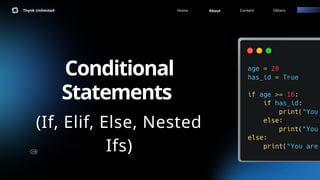
Conditional
Statements
(If, Elif, Else, Nested
Ifs)
In Python, conditional statements are used
to execute a specific block of code only if a
certain condition is met. They enable your
program to make decisions, control its flow,
and respond dynamically to different inputs
and data.
Home About Content Others
What are conditional Statements?
Thynk Unlimited Home About Content Others
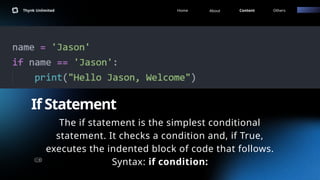
If Statement
The if statement is the simplest conditional
statement. It checks a condition and, if True,
executes the indented block of code that follows.
Syntax: if condition:
Thynk Unlimited Home About Content Others
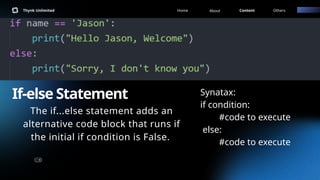
If-else Statement
The if...else statement adds an
alternative code block that runs if
the initial if condition is False.
Synatax:
if condition:
#code to execute
else:
#code to execute
Thynk Unlimited Home About Content Others
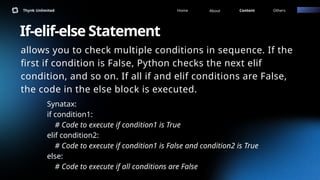
If-elif-else Statement
allows you to check multiple conditions in sequence. If the
first if condition is False, Python checks the next elif
condition, and so on. If all if and elif conditions are False,
the code in the else block is executed.
Synatax:
if condition1:
# Code to execute if condition1 is True
elif condition2:
# Code to execute if condition1 is False and condition2 is True
else:
# Code to execute if all conditions are False
Thynk Unlimited Home About Content Others
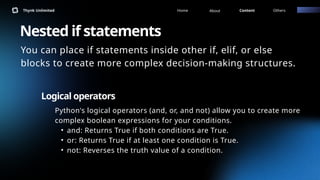
Nested if statements
You can place if statements inside other if, elif, or else
blocks to create more complex decision-making structures.
Logical operators
Python's logical operators (and, or, and not) allow you to create more
complex boolean expressions for your conditions.
• and: Returns True if both conditions are True.
• or: Returns True if at least one condition is True.
• not: Reverses the truth value of a condition.
Thynk Unlimited Home About Content Others
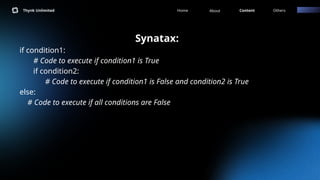
Synatax:
if condition1:
# Code to execute if condition1 is True
if condition2:
# Code to execute if condition1 is False and condition2 is True
else:
# Code to execute if all conditions are False
Thynk Unlimited Home About Content Others
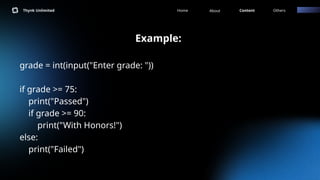
Example:
grade = int(input("Enter grade: "))
if grade >= 75:
print("Passed")
if grade >= 90:
print("With Honors!")
else:
print("Failed")
Thynk Unlimited Home About Content Others
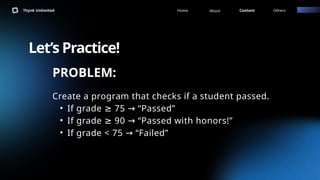
Let’s Practice!
Create a program that checks if a student passed.
• If grade 75 “Passed”
≥ →
• If grade 90 “Passed with honors!”
≥ →
• If grade < 75 “Failed”
→
PROBLEM:
Home About Content Others
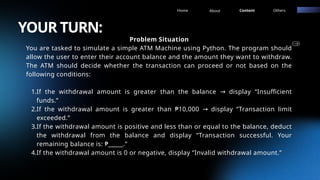
YOUR TURN:
Problem Situation
You are tasked to simulate a simple ATM Machine using Python. The program should
allow the user to enter their account balance and the amount they want to withdraw.
The ATM should decide whether the transaction can proceed or not based on the
following conditions:
1.If the withdrawal amount is greater than the balance display “Insufficient
→
funds.”
2.If the withdrawal amount is greater than ₱10,000 display “Transaction limit
→
exceeded.”
3.If the withdrawal amount is positive and less than or equal to the balance, deduct
the withdrawal from the balance and display “Transaction successful. Your
remaining balance is: ₱_____.”
4.If the withdrawal amount is 0 or negative, display “Invalid withdrawal amount.”
Thynk Unlimited Home About Content Others
THANK YOU
THANK YOU
THANK YOU
www.reallygreatsite.com

Python Conditional Statements in programming

  • 1.
    Home About ContentOthers PROGRAMMING PROGRAMMING PROGRAMMING
  • 2.
    Home About ContentOthers Thynk Unlimited Conditional Statements (If, Elif, Else, Nested Ifs)
  • 3.
    In Python, conditionalstatements are used to execute a specific block of code only if a certain condition is met. They enable your program to make decisions, control its flow, and respond dynamically to different inputs and data. Home About Content Others What are conditional Statements?
  • 4.
    Thynk Unlimited HomeAbout Content Others If Statement The if statement is the simplest conditional statement. It checks a condition and, if True, executes the indented block of code that follows. Syntax: if condition:
  • 5.
    Thynk Unlimited HomeAbout Content Others If-else Statement The if...else statement adds an alternative code block that runs if the initial if condition is False. Synatax: if condition: #code to execute else: #code to execute
  • 6.
    Thynk Unlimited HomeAbout Content Others If-elif-else Statement allows you to check multiple conditions in sequence. If the first if condition is False, Python checks the next elif condition, and so on. If all if and elif conditions are False, the code in the else block is executed. Synatax: if condition1: # Code to execute if condition1 is True elif condition2: # Code to execute if condition1 is False and condition2 is True else: # Code to execute if all conditions are False
  • 7.
    Thynk Unlimited HomeAbout Content Others Nested if statements You can place if statements inside other if, elif, or else blocks to create more complex decision-making structures. Logical operators Python's logical operators (and, or, and not) allow you to create more complex boolean expressions for your conditions. • and: Returns True if both conditions are True. • or: Returns True if at least one condition is True. • not: Reverses the truth value of a condition.
  • 8.
    Thynk Unlimited HomeAbout Content Others Synatax: if condition1: # Code to execute if condition1 is True if condition2: # Code to execute if condition1 is False and condition2 is True else: # Code to execute if all conditions are False
  • 9.
    Thynk Unlimited HomeAbout Content Others Example: grade = int(input("Enter grade: ")) if grade >= 75: print("Passed") if grade >= 90: print("With Honors!") else: print("Failed")
  • 10.
    Thynk Unlimited HomeAbout Content Others Let’s Practice! Create a program that checks if a student passed. • If grade 75 “Passed” ≥ → • If grade 90 “Passed with honors!” ≥ → • If grade < 75 “Failed” → PROBLEM:
  • 11.
    Home About ContentOthers YOUR TURN: Problem Situation You are tasked to simulate a simple ATM Machine using Python. The program should allow the user to enter their account balance and the amount they want to withdraw. The ATM should decide whether the transaction can proceed or not based on the following conditions: 1.If the withdrawal amount is greater than the balance display “Insufficient → funds.” 2.If the withdrawal amount is greater than ₱10,000 display “Transaction limit → exceeded.” 3.If the withdrawal amount is positive and less than or equal to the balance, deduct the withdrawal from the balance and display “Transaction successful. Your remaining balance is: ₱_____.” 4.If the withdrawal amount is 0 or negative, display “Invalid withdrawal amount.”
  • 12.
    Thynk Unlimited HomeAbout Content Others THANK YOU THANK YOU THANK YOU www.reallygreatsite.com