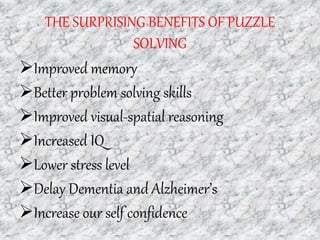
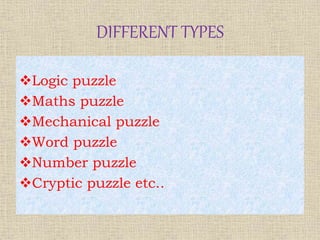
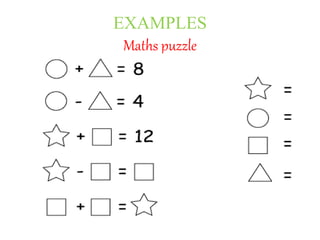
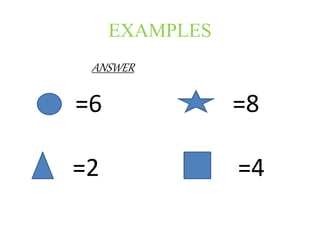
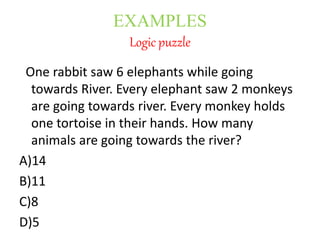
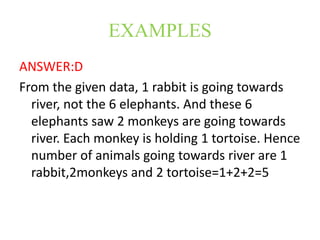
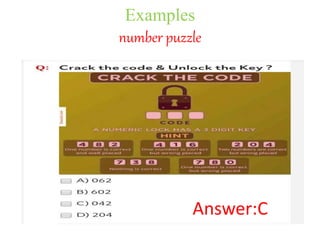
The document discusses different types of puzzles and their benefits. It provides examples of logic, maths, and number puzzles. The key points are:
Puzzles test ingenuity and problem solving skills in a logical way. They can be for entertainment or solve serious problems. Mathematical puzzles involve specific rules without competition. Children who play puzzles perform better on shape rotation and translation tasks. Benefits of puzzle solving include improved memory, problem solving, visual-spatial reasoning, and delayed dementia. Different types of puzzles include logic, math, mechanical, word, number, and cryptic puzzles. Examples of each type of puzzle are provided.