Public Sector Procurement  Edinburgh 10 November 2009
Drivers for Procurement Issues Governance Corporate Social Responsibility Sustainability Supply Chain Integrity Sustainability Risk Management Collaboration Community Benefits in Procurement
Principles of OJEU Directives All potential contracts, the values of which singularly or cumulatively exceed specified financial thresholds, must be advertised throughout the European Union, so that all interested parties in member states have an equal opportunity to submit tenders All enquiries must receive equal treatment in order to eliminate discrimination on the grounds of the nationality of the contractor or the origin of goods / services All tendering and award procedures must involve the application of objective criteria
EU Procurement Directives From 31 January 2006 2004/17 /EEC Water, Energy, Transport and Postal Services Sectors  2004/18/EEC Public Works, Supply and Service Contracts
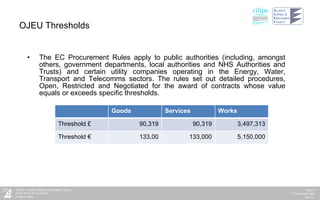
OJEU Thresholds The EC Procurement Rules apply to public authorities (including, amongst others, government departments, local authorities and NHS Authorities and Trusts) and certain utility companies operating in the Energy, Water, Transport and Telecomms sectors. The rules set out detailed procedures, Open, Restricted and Negotiated for the award of contracts whose value equals or exceeds specific thresholds.  Goods Services Works Threshold £ 90,319 90,319 3,497,313 Threshold € 133,00 133,000 5,150,000
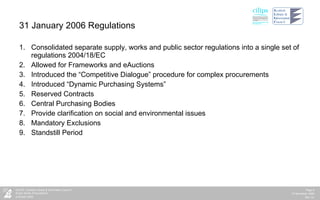
31 January 2006 Regulations  Consolidated separate supply, works and public sector regulations into a single set of regulations 2004/18/EC Allowed for Frameworks and eAuctions Introduced the “Competitive Dialogue” procedure for complex procurements Introduced “Dynamic Purchasing Systems” Reserved Contracts Central Purchasing Bodies Provide clarification on social and environmental issues Mandatory Exclusions Standstill Period
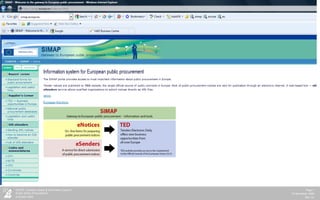
SIMAP
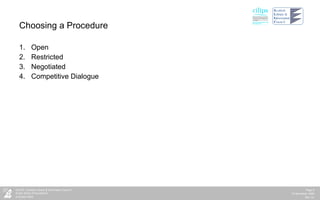
Choosing a Procedure Open  Restricted  Negotiated  Competitive Dialogue
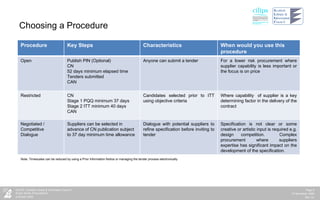
Choosing a Procedure Note: Timescales can be reduced by using a Prior Information Notice or managing the tender process electronically Procedure Key Steps Characteristics When would you use this procedure Open Publish PIN (Optional) CN 52 days minimum elapsed time Tenders submitted CAN Anyone can submit a tender For a lower risk procurement where supplier capability is less important or the focus is on price  Restricted CN Stage 1 PQQ minimum 37 days Stage 2 ITT minimum 40 days CAN Candidates selected prior to ITT using objective criteria Where capability  of supplier is a key determining factor in the delivery of the contract Negotiated / Competitive Dialogue Suppliers can be selected in advance of CN publication subject to 37 day minimum time allowance Dialogue with potential suppliers to refine specification before inviting to tender Specification is not clear or some creative or artistic input is required e.g. design competition .  Complex procurement where suppliers expertise has significant impact on the development of the specification.
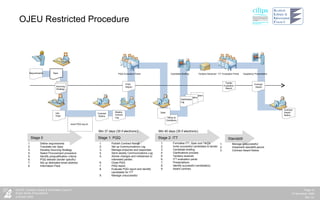
OJEU Restricted Procedure Clarification Log Clarification Log Sourcing Strategy Spec Requirements Info  Pack www.PQQ.org.uk Contract Notice Weekly Comms Log PQQ Report PQQ Evaluation Panel Terms & Conditions Candidate Briefing ITT Evaluation Panel Supplier(s) Presentation Contract  Award  Notice Tender Evaluation Report Clarification Log Spec Tenders Received Stage 1: PQQ Stage 2: ITT Stage 0 Standstill Contract  Award Min 37 days (30 if electronic) Min 40 days (35 if electronic) Define requirements Translate into Spec Develop Sourcing Strategy Select Procurement procedure Identify prequalification criteria PQQ website (tender specific) Set up dedicated email address Information Pack Publish Contract Notice Set up Communications Log Manage enquiries and responses Send weekly Communications Log Advise changes and milestones to interested parties Close PQQ PQQ report Evaluate PQQ report and identify candidates for ITT Manage unsuccessful Formalise ITT, Spec and T&C’s Invite successful candidates to tender Candidate briefing Clarifications process Tenders received ITT evaluation panel Presentations Identify successful candidate(s) Award contract Manage unsuccessful Implement standstill period Contract Award Notice
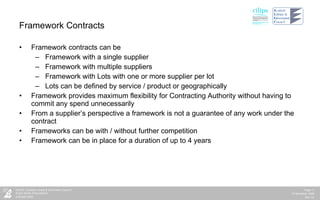
Framework Contracts Framework contracts can be Framework with a single supplier Framework with multiple suppliers Framework with Lots with one or more supplier per lot Lots can be defined by service / product or geographically Framework provides maximum flexibility for Contracting Authority without having to commit any spend unnecessarily  From a supplier’s perspective a framework is not a guarantee of any work under the contract Frameworks can be with / without further competition Framework can be in place for a duration of up to 4 years
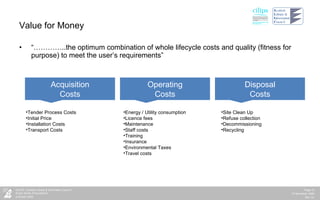
Value for Money “………… ..the optimum combination of whole lifecycle costs and quality (fitness for purpose) to meet the user’s requirements” Acquisition Costs Operating Costs Disposal Costs Tender Process Costs Initial Price Installation Costs Transport Costs Energy / Utility consumption Licence fees Maintenance Staff costs Training Insurance Environmental Taxes Travel costs Site Clean Up Refuse collection Decommissioning Recycling
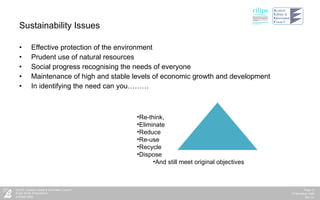
Sustainability Issues Effective protection of the environment Prudent use of natural resources Social progress recognising the needs of everyone Maintenance of high and stable levels of economic growth and development In identifying the need can you……… Re-think, Eliminate Reduce Re-use Recycle Dispose And still meet original objectives
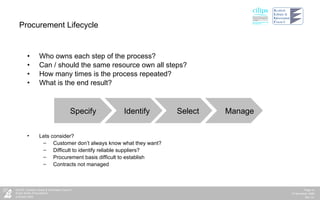
Procurement Lifecycle Who owns each step of the process? Can / should the same resource own all steps? How many times is the process repeated? What is the end result? Specify Identify Select Manage Lets consider? Customer don’t always know what they want? Difficult to identify reliable suppliers? Procurement basis difficult to establish Contracts not managed
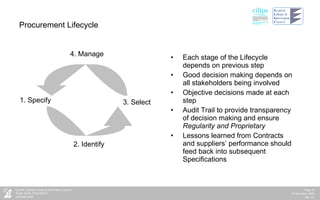
Procurement Lifecycle Each stage of the Lifecycle depends on previous step Good decision making depends on all stakeholders being involved  Objective decisions made at each step Audit Trail to provide transparency of decision making and ensure  Regularity and Proprietary Lessons learned from Contracts and suppliers’ performance should feed back into subsequent Specifications 1. Specify 2. Identify 3. Select 4. Manage
Test for Best Practice Procurement Value for Money Ethics Conflict of Interest Openness and Transparency Objective Criteria
Prequalification Stage Publish Contract Notice Set up Communications Log Manage enquiries and responses Send weekly Communications Log Advise changes and milestones to interested parties Close PQQ PQQ report Evaluate PQQ report and identify candidates for ITT Manage unsuccessful
Prequalification Mandatory Requirements Minimum Requirements Testing Capability and Capacity
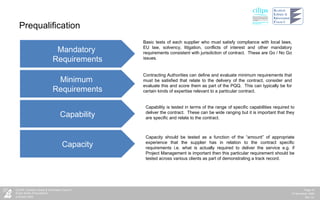
Prequalification Mandatory  Requirements Minimum  Requirements Capability Capacity Basic tests of each supplier who must satisfy compliance with local laws, EU law, solvency, litigation, conflicts of interest and other mandatory requirements consistent with jurisdiction of contract.  These are Go / No Go issues. Contracting Authorities can define and evaluate minimum requirements that must be satisfied that relate to the delivery of the contract, consider and evaluate this and score them as part of the PQQ.  This can typically be for certain kinds of expertise relevant to a particular contract. Capability is tested in terms of the range of specific capabilities required to deliver the contract.  These can be wide ranging but it is important that they are specific and relate to the contract. Capacity should be tested as a function of the “amount” of appropriate experience that the supplier has in relation to the contract specific requirements i.e. what is actually required to deliver the service e.g. if Project Management is important then this particular requirement should be tested across various clients as part of demonstrating a track record.
Other Issues Prequalification must be objective to test capability and capacity To deliver the specific contract being tendered A minimum of five candidates is recommended for the ITT stage subject to common sense around about the cut off point Prequalification criteria must be relevant  To reflect contract specific requirements and objectives
Evaluation Criteria Lowest Price Lowest competent bid wins MEAT Most Economically Advantageous Tender Define balance between “Quality” and Price 80% / 20% for professional service contracts would be typical Tenders must be scored strictly in accordance with defined criteria It is also useful to consider procedure and evaluation criteria
OJEU Challenge Period Unsuccessful bidders have 10 days to challenge Contracting Authority’s decision Freedom of Information (FOI) Act requirements mean that unsuccessful candidates can request and must be provided with full copies of winning bids, including pricing, irrespective of copyright or confidentiality statements Alcatel Ruling The European Court of Justice (ECJ) Alcatel judgement found that all EU national courts must be able to set aside and review award decisions on public contracts.  This was a result of the previous position where the acceptance of a bid immediately created a contractually binding agreement with the only available remedy for aggrieved bidders being damages.  In practical terms the EU Directives means that the contracting authority must allow a 10 day minimum period between notifying their intention to award the contract in writing to all candidates and entering into a contract with the successful candidate.  In addition every unsuccessful candidate is entitled to a debriefing within the mandatory period.
Do the Directives create or limit opportunity? The Directives themselves are just rules If Contracting Authorities manage the process according to the rules they should have no problems? But there is a bigger picture? Is the contract and spend consistent with the Contracting Authorities strategy and objectives The design of the Procurement “competition” and the management of the subsequent contract is more important in terms of delivering best value The Procurement process is only the means to an end

Public Sector Procurement

  • 1.
    Public Sector Procurement Edinburgh 10 November 2009
  • 2.
    Drivers for ProcurementIssues Governance Corporate Social Responsibility Sustainability Supply Chain Integrity Sustainability Risk Management Collaboration Community Benefits in Procurement
  • 3.
    Principles of OJEUDirectives All potential contracts, the values of which singularly or cumulatively exceed specified financial thresholds, must be advertised throughout the European Union, so that all interested parties in member states have an equal opportunity to submit tenders All enquiries must receive equal treatment in order to eliminate discrimination on the grounds of the nationality of the contractor or the origin of goods / services All tendering and award procedures must involve the application of objective criteria
  • 4.
    EU Procurement DirectivesFrom 31 January 2006 2004/17 /EEC Water, Energy, Transport and Postal Services Sectors 2004/18/EEC Public Works, Supply and Service Contracts
  • 5.
    OJEU Thresholds TheEC Procurement Rules apply to public authorities (including, amongst others, government departments, local authorities and NHS Authorities and Trusts) and certain utility companies operating in the Energy, Water, Transport and Telecomms sectors. The rules set out detailed procedures, Open, Restricted and Negotiated for the award of contracts whose value equals or exceeds specific thresholds. Goods Services Works Threshold £ 90,319 90,319 3,497,313 Threshold € 133,00 133,000 5,150,000
  • 6.
    31 January 2006Regulations Consolidated separate supply, works and public sector regulations into a single set of regulations 2004/18/EC Allowed for Frameworks and eAuctions Introduced the “Competitive Dialogue” procedure for complex procurements Introduced “Dynamic Purchasing Systems” Reserved Contracts Central Purchasing Bodies Provide clarification on social and environmental issues Mandatory Exclusions Standstill Period
  • 7.
  • 8.
    Choosing a ProcedureOpen Restricted Negotiated Competitive Dialogue
  • 9.
    Choosing a ProcedureNote: Timescales can be reduced by using a Prior Information Notice or managing the tender process electronically Procedure Key Steps Characteristics When would you use this procedure Open Publish PIN (Optional) CN 52 days minimum elapsed time Tenders submitted CAN Anyone can submit a tender For a lower risk procurement where supplier capability is less important or the focus is on price Restricted CN Stage 1 PQQ minimum 37 days Stage 2 ITT minimum 40 days CAN Candidates selected prior to ITT using objective criteria Where capability of supplier is a key determining factor in the delivery of the contract Negotiated / Competitive Dialogue Suppliers can be selected in advance of CN publication subject to 37 day minimum time allowance Dialogue with potential suppliers to refine specification before inviting to tender Specification is not clear or some creative or artistic input is required e.g. design competition . Complex procurement where suppliers expertise has significant impact on the development of the specification.
  • 10.
    OJEU Restricted ProcedureClarification Log Clarification Log Sourcing Strategy Spec Requirements Info Pack www.PQQ.org.uk Contract Notice Weekly Comms Log PQQ Report PQQ Evaluation Panel Terms & Conditions Candidate Briefing ITT Evaluation Panel Supplier(s) Presentation Contract Award Notice Tender Evaluation Report Clarification Log Spec Tenders Received Stage 1: PQQ Stage 2: ITT Stage 0 Standstill Contract Award Min 37 days (30 if electronic) Min 40 days (35 if electronic) Define requirements Translate into Spec Develop Sourcing Strategy Select Procurement procedure Identify prequalification criteria PQQ website (tender specific) Set up dedicated email address Information Pack Publish Contract Notice Set up Communications Log Manage enquiries and responses Send weekly Communications Log Advise changes and milestones to interested parties Close PQQ PQQ report Evaluate PQQ report and identify candidates for ITT Manage unsuccessful Formalise ITT, Spec and T&C’s Invite successful candidates to tender Candidate briefing Clarifications process Tenders received ITT evaluation panel Presentations Identify successful candidate(s) Award contract Manage unsuccessful Implement standstill period Contract Award Notice
  • 11.
    Framework Contracts Frameworkcontracts can be Framework with a single supplier Framework with multiple suppliers Framework with Lots with one or more supplier per lot Lots can be defined by service / product or geographically Framework provides maximum flexibility for Contracting Authority without having to commit any spend unnecessarily From a supplier’s perspective a framework is not a guarantee of any work under the contract Frameworks can be with / without further competition Framework can be in place for a duration of up to 4 years
  • 12.
    Value for Money“………… ..the optimum combination of whole lifecycle costs and quality (fitness for purpose) to meet the user’s requirements” Acquisition Costs Operating Costs Disposal Costs Tender Process Costs Initial Price Installation Costs Transport Costs Energy / Utility consumption Licence fees Maintenance Staff costs Training Insurance Environmental Taxes Travel costs Site Clean Up Refuse collection Decommissioning Recycling
  • 13.
    Sustainability Issues Effectiveprotection of the environment Prudent use of natural resources Social progress recognising the needs of everyone Maintenance of high and stable levels of economic growth and development In identifying the need can you……… Re-think, Eliminate Reduce Re-use Recycle Dispose And still meet original objectives
  • 14.
    Procurement Lifecycle Whoowns each step of the process? Can / should the same resource own all steps? How many times is the process repeated? What is the end result? Specify Identify Select Manage Lets consider? Customer don’t always know what they want? Difficult to identify reliable suppliers? Procurement basis difficult to establish Contracts not managed
  • 15.
    Procurement Lifecycle Eachstage of the Lifecycle depends on previous step Good decision making depends on all stakeholders being involved Objective decisions made at each step Audit Trail to provide transparency of decision making and ensure Regularity and Proprietary Lessons learned from Contracts and suppliers’ performance should feed back into subsequent Specifications 1. Specify 2. Identify 3. Select 4. Manage
  • 16.
    Test for BestPractice Procurement Value for Money Ethics Conflict of Interest Openness and Transparency Objective Criteria
  • 17.
    Prequalification Stage PublishContract Notice Set up Communications Log Manage enquiries and responses Send weekly Communications Log Advise changes and milestones to interested parties Close PQQ PQQ report Evaluate PQQ report and identify candidates for ITT Manage unsuccessful
  • 18.
    Prequalification Mandatory RequirementsMinimum Requirements Testing Capability and Capacity
  • 19.
    Prequalification Mandatory Requirements Minimum Requirements Capability Capacity Basic tests of each supplier who must satisfy compliance with local laws, EU law, solvency, litigation, conflicts of interest and other mandatory requirements consistent with jurisdiction of contract. These are Go / No Go issues. Contracting Authorities can define and evaluate minimum requirements that must be satisfied that relate to the delivery of the contract, consider and evaluate this and score them as part of the PQQ. This can typically be for certain kinds of expertise relevant to a particular contract. Capability is tested in terms of the range of specific capabilities required to deliver the contract. These can be wide ranging but it is important that they are specific and relate to the contract. Capacity should be tested as a function of the “amount” of appropriate experience that the supplier has in relation to the contract specific requirements i.e. what is actually required to deliver the service e.g. if Project Management is important then this particular requirement should be tested across various clients as part of demonstrating a track record.
  • 20.
    Other Issues Prequalificationmust be objective to test capability and capacity To deliver the specific contract being tendered A minimum of five candidates is recommended for the ITT stage subject to common sense around about the cut off point Prequalification criteria must be relevant To reflect contract specific requirements and objectives
  • 21.
    Evaluation Criteria LowestPrice Lowest competent bid wins MEAT Most Economically Advantageous Tender Define balance between “Quality” and Price 80% / 20% for professional service contracts would be typical Tenders must be scored strictly in accordance with defined criteria It is also useful to consider procedure and evaluation criteria
  • 22.
    OJEU Challenge PeriodUnsuccessful bidders have 10 days to challenge Contracting Authority’s decision Freedom of Information (FOI) Act requirements mean that unsuccessful candidates can request and must be provided with full copies of winning bids, including pricing, irrespective of copyright or confidentiality statements Alcatel Ruling The European Court of Justice (ECJ) Alcatel judgement found that all EU national courts must be able to set aside and review award decisions on public contracts. This was a result of the previous position where the acceptance of a bid immediately created a contractually binding agreement with the only available remedy for aggrieved bidders being damages. In practical terms the EU Directives means that the contracting authority must allow a 10 day minimum period between notifying their intention to award the contract in writing to all candidates and entering into a contract with the successful candidate. In addition every unsuccessful candidate is entitled to a debriefing within the mandatory period.
  • 23.
    Do the Directivescreate or limit opportunity? The Directives themselves are just rules If Contracting Authorities manage the process according to the rules they should have no problems? But there is a bigger picture? Is the contract and spend consistent with the Contracting Authorities strategy and objectives The design of the Procurement “competition” and the management of the subsequent contract is more important in terms of delivering best value The Procurement process is only the means to an end