Psychosexual stages of
     development

           Aarti Sareen
           M.S.P.T. (Honours) final sem.
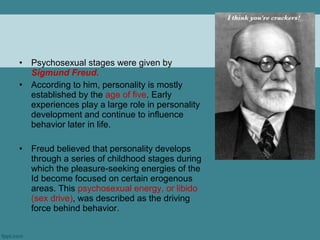
•   Psychosexual stages were given by
    Sigmund Freud.
•   According to him, personality is mostly
    established by the age of five. Early
    experiences play a large role in personality
    development and continue to influence
    behavior later in life.

•   Freud believed that personality develops
    through a series of childhood stages during
    which the pleasure-seeking energies of the
    Id become focused on certain erogenous
    areas. This psychosexual energy, or libido
    (sex drive), was described as the driving
    force behind behavior.
• According to him from birth on, we have an innate
  tendency to seek pleasure, especially through physical
  stimulation and particularly through stimulation of
  parts/zones of the body that are sensitive to touch:
•   The mouth
•   The anus
•   The genitals
Which are referred to as erogenous zones.
• Various body zones are active as per the age and stage
  or there occur shift of dominant erogenous zone from
  one age/ stage to other.
Fixation
• If the child need’s at one of the psychosexual
  stages were either unsatisfied or oversatisfied,
  fixation would take place.

• This means the child would show continued
  attachment to an old stage even after moving on
  to a new one as per his/her age.

• This results into problematic behavior patterns
STAGES
• There are five stages to his theory which
  include
•   The oral stage
•   The anal stage
•   The phallic stage
•   The latent stage
•   The genital stage
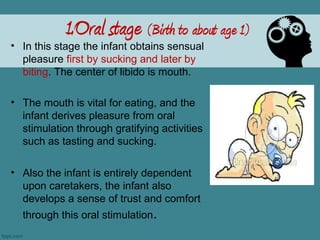
1.Oral stage (Birth to about age 1)
• In this stage the infant obtains sensual
  pleasure first by sucking and later by
  biting. The center of libido is mouth.

• The mouth is vital for eating, and the
  infant derives pleasure from oral
  stimulation through gratifying activities
  such as tasting and sucking.

• Also the infant is entirely dependent
  upon caretakers, the infant also
  develops a sense of trust and comfort
  through this oral stimulation.
• HELPFUL
•   Feeding and contact with the mother.
•   Mouthing new objects.
•   relief of teething pain by biting.
• A conflict at this stage occurs with a child being weaned
  off the mother’s breast
• Signs of Fixation or affects on adult personality in this
  stage are:
    –   Overeating or Pessimism
    –   Smoking
    –   Envy
    –   Gullibility
    –   Suspicion
    –   Dependency
    –   Passivity
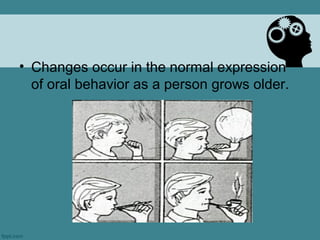
• Changes occur in the normal expression
  of oral behavior as a person grows older.
2. Anal stage (ages 1-3)

•The region around the anus become highly sensitive
  to the stimulation of “holding on” and “letting go”.

 •Freud believed that the primary focus of the libido
 was on controlling bladder and bowel movements.

•The major conflict at this stage is toilet training--the
child has to learn to control his or her bodily needs.

     •Developing this control leads to a sense of
        accomplishment and independence.

•Toilet training is child’s first encounter with authority.
• First part of this stage involves pleasure from
  expulsion of feces; latter part involves pleasure
  from retention.


• Fixation at first stage
•   Messiness
•   Disordered

• Fixation at second stage
•   Excessive compulsiveness
•   Over conformity
•   Exaggerated self control.
• Parenting play a very important role in success of this
  stage and development of personality.

• Parents who utilize praise and rewards for using the
  toilet at the appropriate time encourage positive
  outcomes and help children feel capable and productive.

•    Positive experiences during this stage served as the
    basis for people to become
•   Competent
•   Productive
•   creative
• If parent punish, ridicule or shame a child for accidents
  or other inappropriate parental responses can result in
  negative outcomes.
• If parents take an approach that is too lenient, Freud
  suggested that an anal-expulsive personality could
  develop in which the individual is
•   Messy
•   Wasteful
•   destructive
• If parents are too strict or begin toilet training too early,
  Freud believed that an anal-retentive personality
  develops in which the individual is
•   Stringent
•   Orderly
•   Rigid
•   obsessive
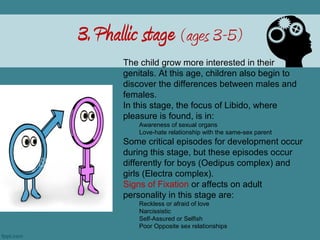
3. Phallic stage (ages 3-5)
       The child grow more interested in their
       genitals. At this age, children also begin to
       discover the differences between males and
       females.
       In this stage, the focus of Libido, where
       pleasure is found, is in:
           Awareness of sexual organs
           Love-hate relationship with the same-sex parent
       Some critical episodes for development occur
       during this stage, but these episodes occur
       differently for boys (Oedipus complex) and
       girls (Electra complex).
       Signs of Fixation or affects on adult
       personality in this stage are:
           Reckless or afraid of love
           Narcissistic
           Self-Assured or Selfish
           Poor Opposite sex relationships
.
                       Phallic stage cont

                     Oedipus complex
• Occurs in boys
• Desire for stimulation or masturbation of his own
  genitals.
• Have sexual/sensual desires for his mother.
• Boys begin to view their fathers as a rival for the
  mother’s affections. The Oedipus complex describes
  these feelings of wanting to possess the mother and the
  desire to replace the father.
• The child also fears that he will be punished by the father
  for these feelings, a fear Freud termed castration
  anxiety.
• Starts identifying with father
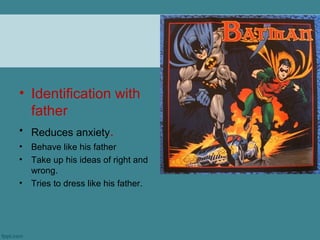
• Identification with
  father
• Reduces anxiety.
•   Behave like his father
•   Take up his ideas of right and
    wrong.
•   Tries to dress like his father.
Phallic stage cont.

                       Electra complex
• Occur in girls.

• Attracted towards their father.

• Notice that she does not have the sex organs like her
  father and brother.

• Feeling of being castrated by her mother which makes
  her angry and she starts devaluating her mother.

• Still identify with her mother with the feeling that by doing
  so she will stand better chance in her own “romantic
  relationship”
• Identification with mother
  in girls being with feeling
  that by doing so she will
  stand better chance in
  her own “romantic
  relationship”.

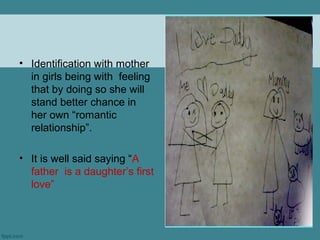
• It is well said saying “A
  father is a daughter’s first
  love”
•
             4.Latency Stage: (age 6 to puberty)
    At this stage, sexual drive lay dormant.
    The stage begins around the time that
    children enter into school and become
    more concerned with peer relationships,
    hobbies and other interests.

•   Sexual energy is still present, but it is
    directed into other areas such as
    intellectual pursuits and social interactions.

•   Child usually has few opposite sex friends.

•   This stage is important in the development
    of social and communication skills and
    self-confidence.

•   A sign of fixation in this stage is a lack of
    close friends
5.Genital Stage (adolescence and beyond)
•   Marked by puberty
•   Mature heterosexual interests appears.
•   A person becomes interested in dating and
    marriage
•   The more libidal energy that a child has at this
    stage, the greater his or her capacity will be to
    develop normal relationships with the opposite
    sex.
•   If the other stages have been completed
    successfully, the individual should now be well-
    balanced, warm and caring. The goal of this
    stage is to establish a balance between the
    various life areas.

•   Signs of fixation in this stage include:
     – Guilt about sexuality
     – Feelings of inadequacy
     – Poor sexual relationships
     – Anxious feelings regarding the opposite sex
Psychosexual development

Psychosexual development

  • 1.
    Psychosexual stages of development Aarti Sareen M.S.P.T. (Honours) final sem.
  • 2.
    Psychosexual stages were given by Sigmund Freud. • According to him, personality is mostly established by the age of five. Early experiences play a large role in personality development and continue to influence behavior later in life. • Freud believed that personality develops through a series of childhood stages during which the pleasure-seeking energies of the Id become focused on certain erogenous areas. This psychosexual energy, or libido (sex drive), was described as the driving force behind behavior.
  • 3.
    • According tohim from birth on, we have an innate tendency to seek pleasure, especially through physical stimulation and particularly through stimulation of parts/zones of the body that are sensitive to touch: • The mouth • The anus • The genitals Which are referred to as erogenous zones. • Various body zones are active as per the age and stage or there occur shift of dominant erogenous zone from one age/ stage to other.
  • 4.
    Fixation • If thechild need’s at one of the psychosexual stages were either unsatisfied or oversatisfied, fixation would take place. • This means the child would show continued attachment to an old stage even after moving on to a new one as per his/her age. • This results into problematic behavior patterns
  • 5.
    STAGES • There arefive stages to his theory which include • The oral stage • The anal stage • The phallic stage • The latent stage • The genital stage
  • 6.
    1.Oral stage (Birthto about age 1) • In this stage the infant obtains sensual pleasure first by sucking and later by biting. The center of libido is mouth. • The mouth is vital for eating, and the infant derives pleasure from oral stimulation through gratifying activities such as tasting and sucking. • Also the infant is entirely dependent upon caretakers, the infant also develops a sense of trust and comfort through this oral stimulation.
  • 7.
    • HELPFUL • Feeding and contact with the mother. • Mouthing new objects. • relief of teething pain by biting. • A conflict at this stage occurs with a child being weaned off the mother’s breast • Signs of Fixation or affects on adult personality in this stage are: – Overeating or Pessimism – Smoking – Envy – Gullibility – Suspicion – Dependency – Passivity
  • 8.
    • Changes occurin the normal expression of oral behavior as a person grows older.
  • 9.
    2. Anal stage(ages 1-3) •The region around the anus become highly sensitive to the stimulation of “holding on” and “letting go”. •Freud believed that the primary focus of the libido was on controlling bladder and bowel movements. •The major conflict at this stage is toilet training--the child has to learn to control his or her bodily needs. •Developing this control leads to a sense of accomplishment and independence. •Toilet training is child’s first encounter with authority.
  • 10.
    • First partof this stage involves pleasure from expulsion of feces; latter part involves pleasure from retention. • Fixation at first stage • Messiness • Disordered • Fixation at second stage • Excessive compulsiveness • Over conformity • Exaggerated self control.
  • 11.
    • Parenting playa very important role in success of this stage and development of personality. • Parents who utilize praise and rewards for using the toilet at the appropriate time encourage positive outcomes and help children feel capable and productive. • Positive experiences during this stage served as the basis for people to become • Competent • Productive • creative
  • 12.
    • If parentpunish, ridicule or shame a child for accidents or other inappropriate parental responses can result in negative outcomes. • If parents take an approach that is too lenient, Freud suggested that an anal-expulsive personality could develop in which the individual is • Messy • Wasteful • destructive • If parents are too strict or begin toilet training too early, Freud believed that an anal-retentive personality develops in which the individual is • Stringent • Orderly • Rigid • obsessive
  • 13.
    3. Phallic stage(ages 3-5) The child grow more interested in their genitals. At this age, children also begin to discover the differences between males and females. In this stage, the focus of Libido, where pleasure is found, is in: Awareness of sexual organs Love-hate relationship with the same-sex parent Some critical episodes for development occur during this stage, but these episodes occur differently for boys (Oedipus complex) and girls (Electra complex). Signs of Fixation or affects on adult personality in this stage are: Reckless or afraid of love Narcissistic Self-Assured or Selfish Poor Opposite sex relationships
  • 14.
    . Phallic stage cont Oedipus complex • Occurs in boys • Desire for stimulation or masturbation of his own genitals. • Have sexual/sensual desires for his mother. • Boys begin to view their fathers as a rival for the mother’s affections. The Oedipus complex describes these feelings of wanting to possess the mother and the desire to replace the father. • The child also fears that he will be punished by the father for these feelings, a fear Freud termed castration anxiety. • Starts identifying with father
  • 15.
    • Identification with father • Reduces anxiety. • Behave like his father • Take up his ideas of right and wrong. • Tries to dress like his father.
  • 16.
    Phallic stage cont. Electra complex • Occur in girls. • Attracted towards their father. • Notice that she does not have the sex organs like her father and brother. • Feeling of being castrated by her mother which makes her angry and she starts devaluating her mother. • Still identify with her mother with the feeling that by doing so she will stand better chance in her own “romantic relationship”
  • 17.
    • Identification withmother in girls being with feeling that by doing so she will stand better chance in her own “romantic relationship”. • It is well said saying “A father is a daughter’s first love”
  • 18.
    4.Latency Stage: (age 6 to puberty) At this stage, sexual drive lay dormant. The stage begins around the time that children enter into school and become more concerned with peer relationships, hobbies and other interests. • Sexual energy is still present, but it is directed into other areas such as intellectual pursuits and social interactions. • Child usually has few opposite sex friends. • This stage is important in the development of social and communication skills and self-confidence. • A sign of fixation in this stage is a lack of close friends
  • 19.
    5.Genital Stage (adolescenceand beyond) • Marked by puberty • Mature heterosexual interests appears. • A person becomes interested in dating and marriage • The more libidal energy that a child has at this stage, the greater his or her capacity will be to develop normal relationships with the opposite sex. • If the other stages have been completed successfully, the individual should now be well- balanced, warm and caring. The goal of this stage is to establish a balance between the various life areas. • Signs of fixation in this stage include: – Guilt about sexuality – Feelings of inadequacy – Poor sexual relationships – Anxious feelings regarding the opposite sex