Topic 7
Using quality-improvement
methods to improve care

Patient Safety Curriculum Guide
1
Learning objectives
 The objectives of this topic are to:
•
•

Describe the basic principles of quality improvement
Introduce students to the methods and tools for improving the
quality of health care

Patient Safety Curriculum Guide
2
Knowledge requirements

 The science of improvement
 Change concepts
 Improvement principles
 Role of measurement in improvement

Patient Safety Curriculum Guide
3
Performance requirement

 Identify the opportunities for using safety science to
analyse errors

 Appreciate the range of improvement methods available
for reducing harm to patients

 Apply at least one improvement tool in a particular
clinical context

 Participate in an improvement activity (if possible)
Patient Safety Curriculum Guide
4
The science of improvement
 Appreciation of a system
 Understanding of variation
 Theory of knowledge
 Psychology

Source: Langley GL

Patient Safety Curriculum Guide
5
Change concepts …
… are general ideas, with proven merit and sound
scientific or logical foundation that can stimulate specific
ideas for changes that lead to improvement.

Source: Nolan TW, 1996

Patient Safety Curriculum Guide
6
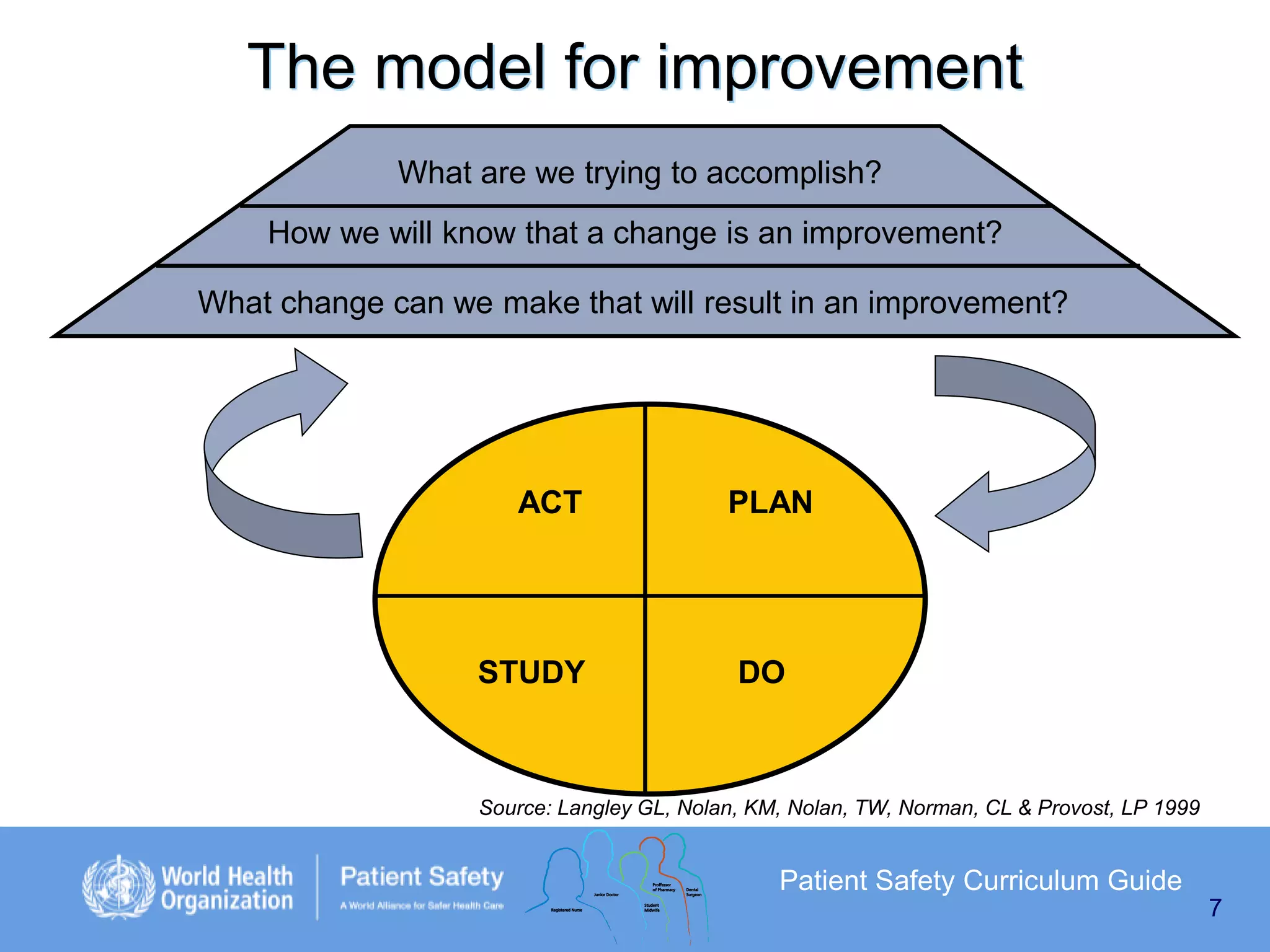
The model for improvement
What are we trying to accomplish?
How we will know that a change is an improvement?
What change can we make that will result in an improvement?

ACT

STUDY

PLAN

DO

Source: Langley GL, Nolan, KM, Nolan, TW, Norman, CL & Provost, LP 1999

Patient Safety Curriculum Guide
7
The quality improvement model:
the PDSA cycle
 What are we trying to accomplish?
 How will we know that a change is an improvement?
 What changes can we make that will result in an
improvement?

Patient Safety Curriculum Guide
8
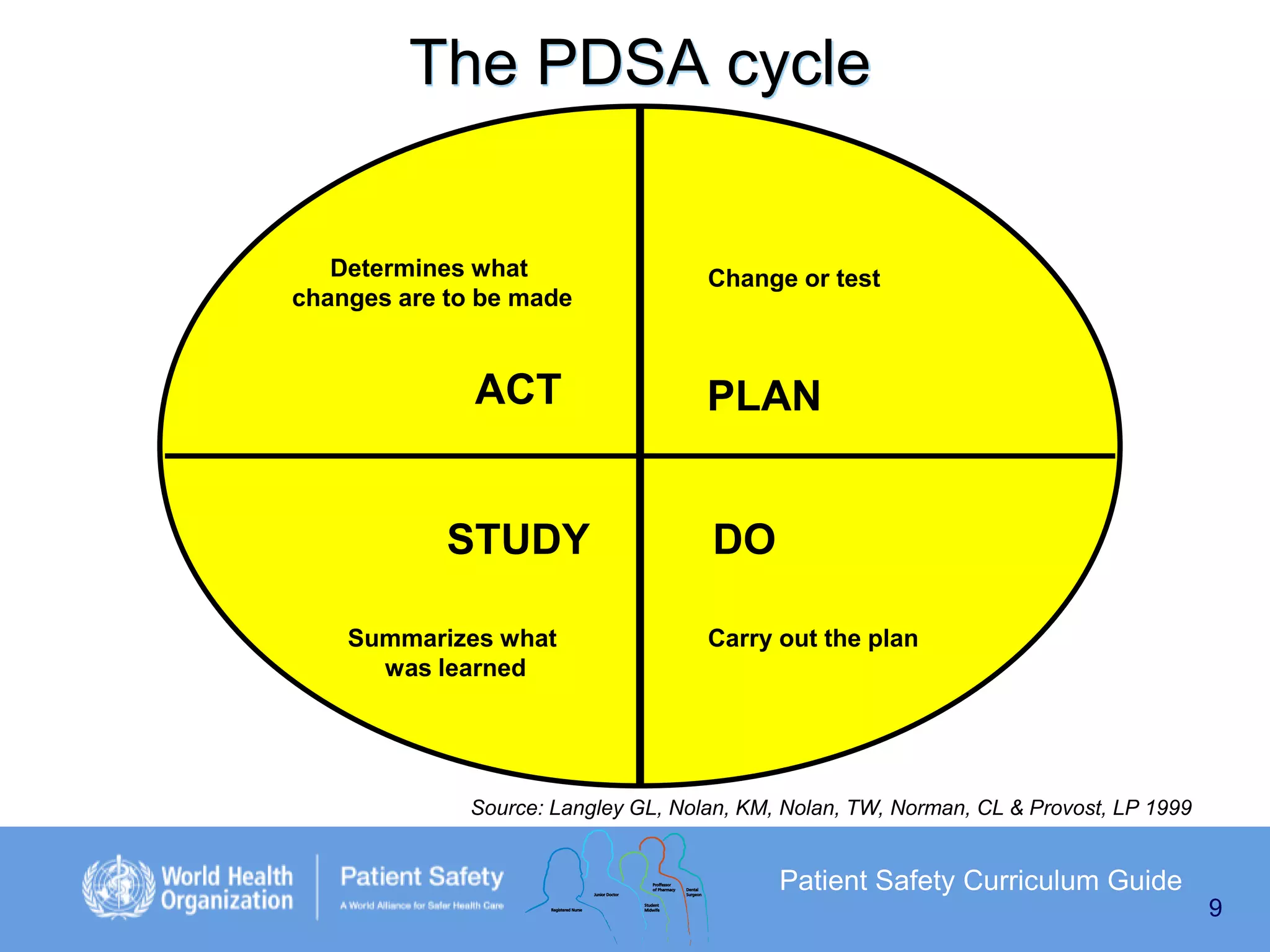
The PDSA cycle

Determines what
changes are to be made

ACT

STUDY
Summarizes what
was learned

Change or test

PLAN
DO
Carry out the plan

Source: Langley GL, Nolan, KM, Nolan, TW, Norman, CL & Provost, LP 1999

Patient Safety Curriculum Guide
9
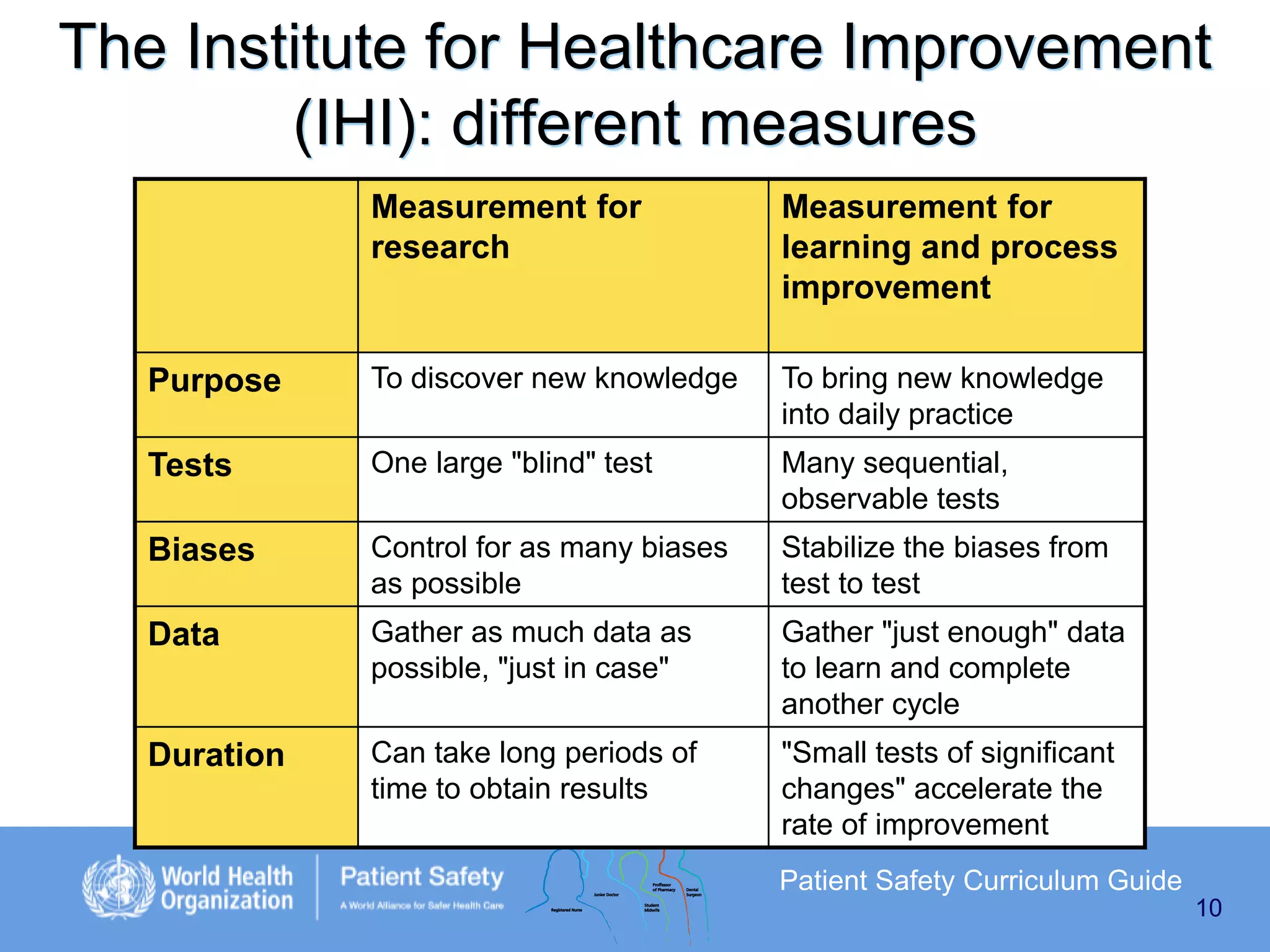
The Institute for Healthcare Improvement
(IHI): different measures
Measurement for
research

Measurement for
learning and process
improvement

Purpose

To discover new knowledge

To bring new knowledge
into daily practice

Tests

One large "blind" test

Many sequential,
observable tests

Biases

Control for as many biases
as possible

Stabilize the biases from
test to test

Data

Gather as much data as
possible, "just in case"

Gather "just enough" data
to learn and complete
another cycle

Duration

Can take long periods of
time to obtain results

"Small tests of significant
changes" accelerate the
rate of improvement
Patient Safety Curriculum Guide
10
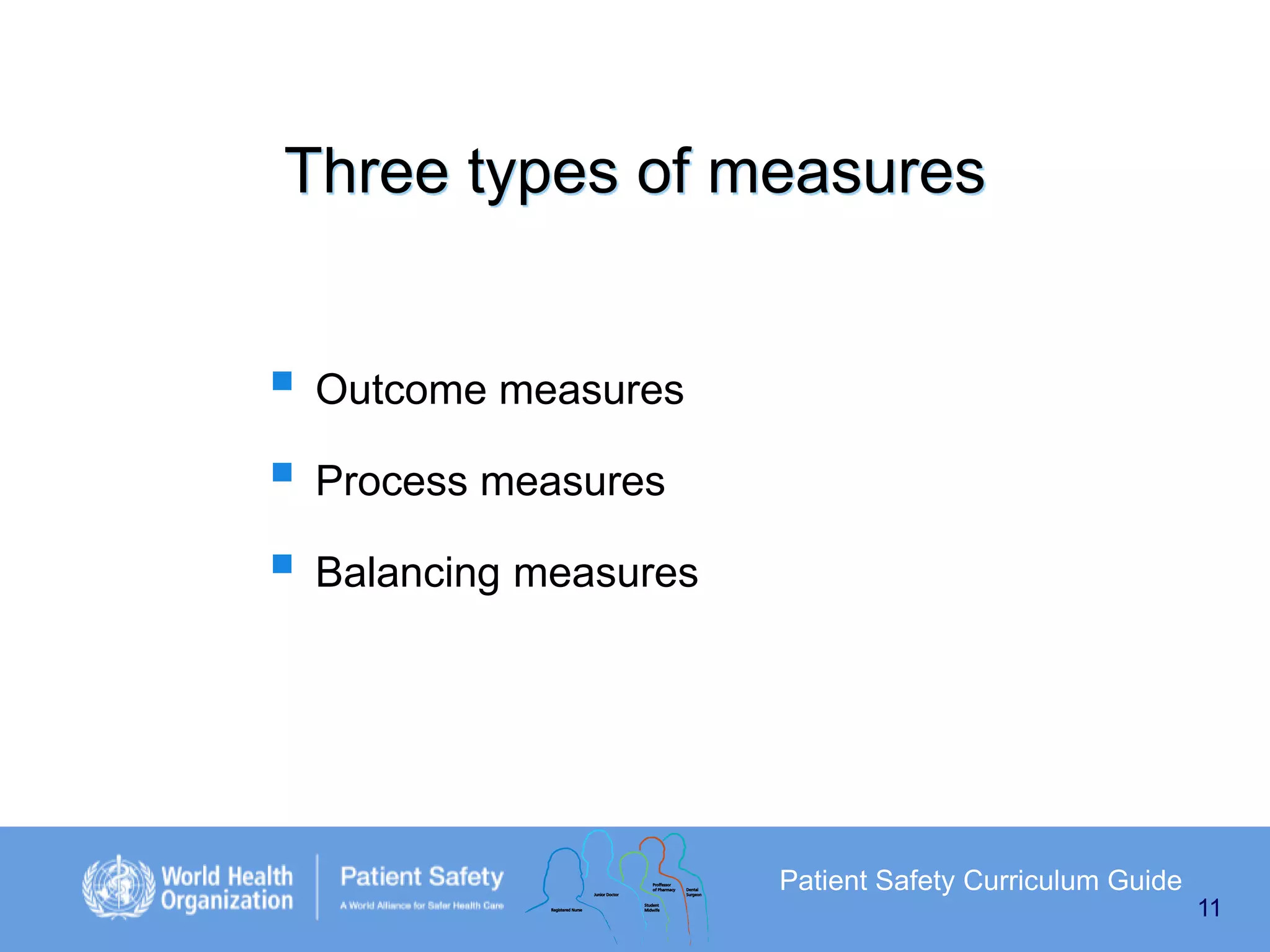
Three types of measures

 Outcome measures
 Process measures
 Balancing measures

Patient Safety Curriculum Guide
11
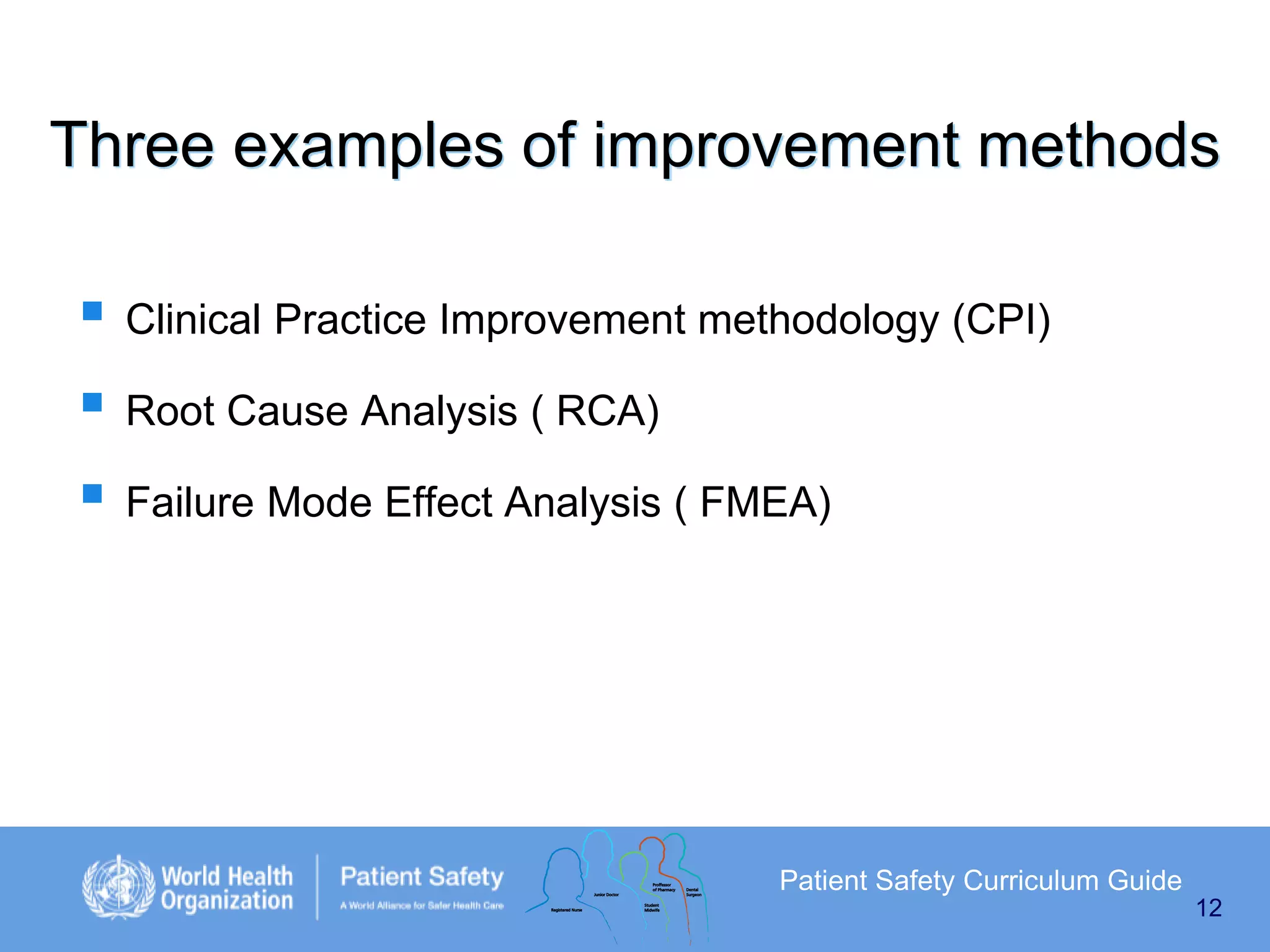
Three examples of improvement methods
 Clinical Practice Improvement methodology (CPI)
 Root Cause Analysis ( RCA)
 Failure Mode Effect Analysis ( FMEA)

Patient Safety Curriculum Guide
12
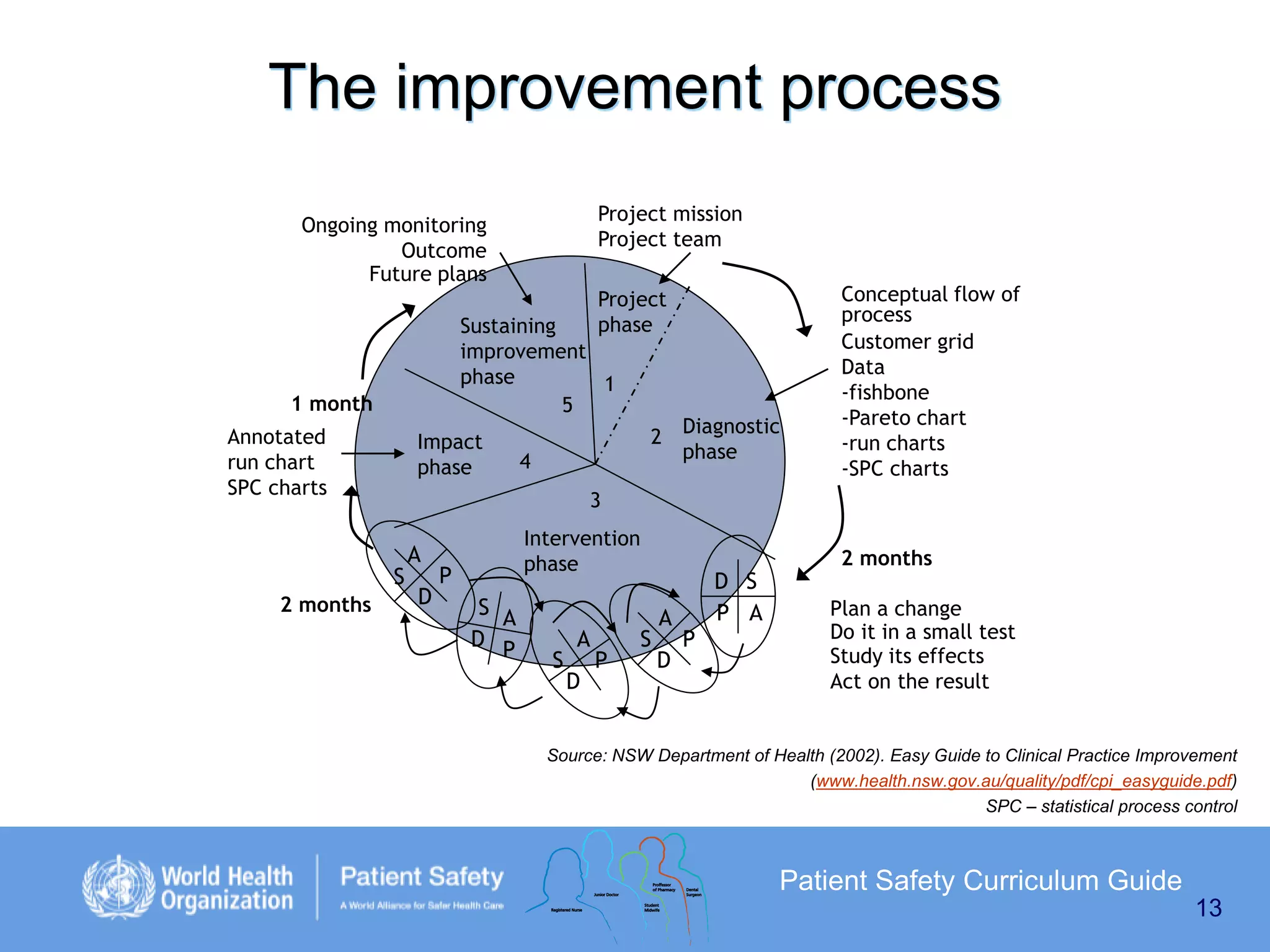
The improvement process
Project mission
Project team

Ongoing monitoring
Outcome
Future plans

Project
phase

Sustaining
improvement
phase
1
5

1 month
Annotated
run chart
SPC charts

Impact
phase

4
3

S
2 months

2 Diagnostic
phase

Conceptual flow of
process
Customer grid
Data
-fishbone
-Pareto chart
-run charts
-SPC charts

A
D

Intervention
phase

P
S A
D P

S

A

D

P

S

A
D

D S
P A
P

2 months
Plan a change
Do it in a small test
Study its effects
Act on the result

Source: NSW Department of Health (2002). Easy Guide to Clinical Practice Improvement
(www.health.nsw.gov.au/quality/pdf/cpi_easyguide.pdf)
SPC – statistical process control

Patient Safety Curriculum Guide
13
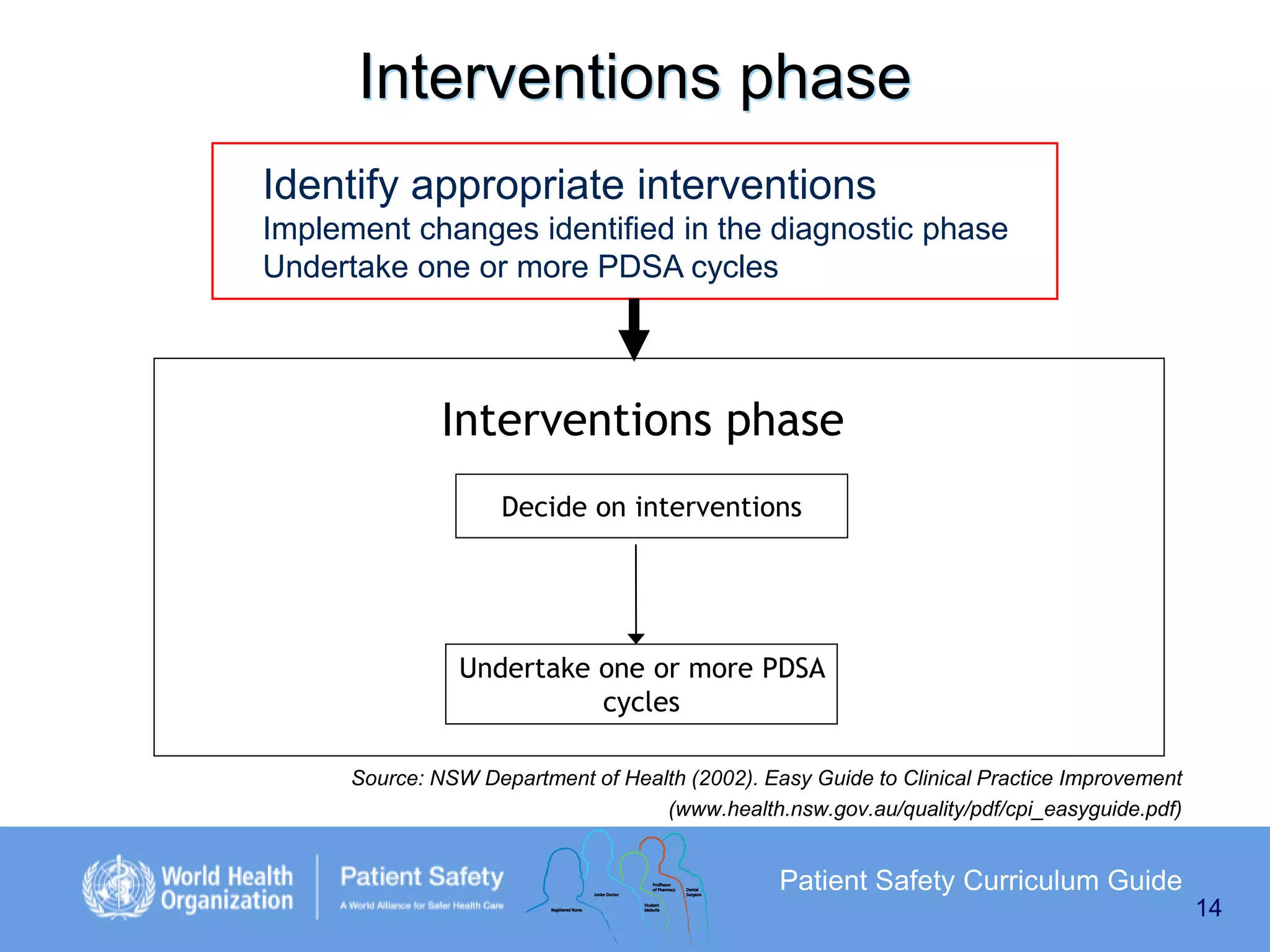
Interventions phase
Identify appropriate interventions
Implement changes identified in the diagnostic phase
Undertake one or more PDSA cycles

Interventions phase
Decide on interventions

Undertake one or more PDSA
cycles
Source: NSW Department of Health (2002). Easy Guide to Clinical Practice Improvement
(www.health.nsw.gov.au/quality/pdf/cpi_easyguide.pdf)

Patient Safety Curriculum Guide
14
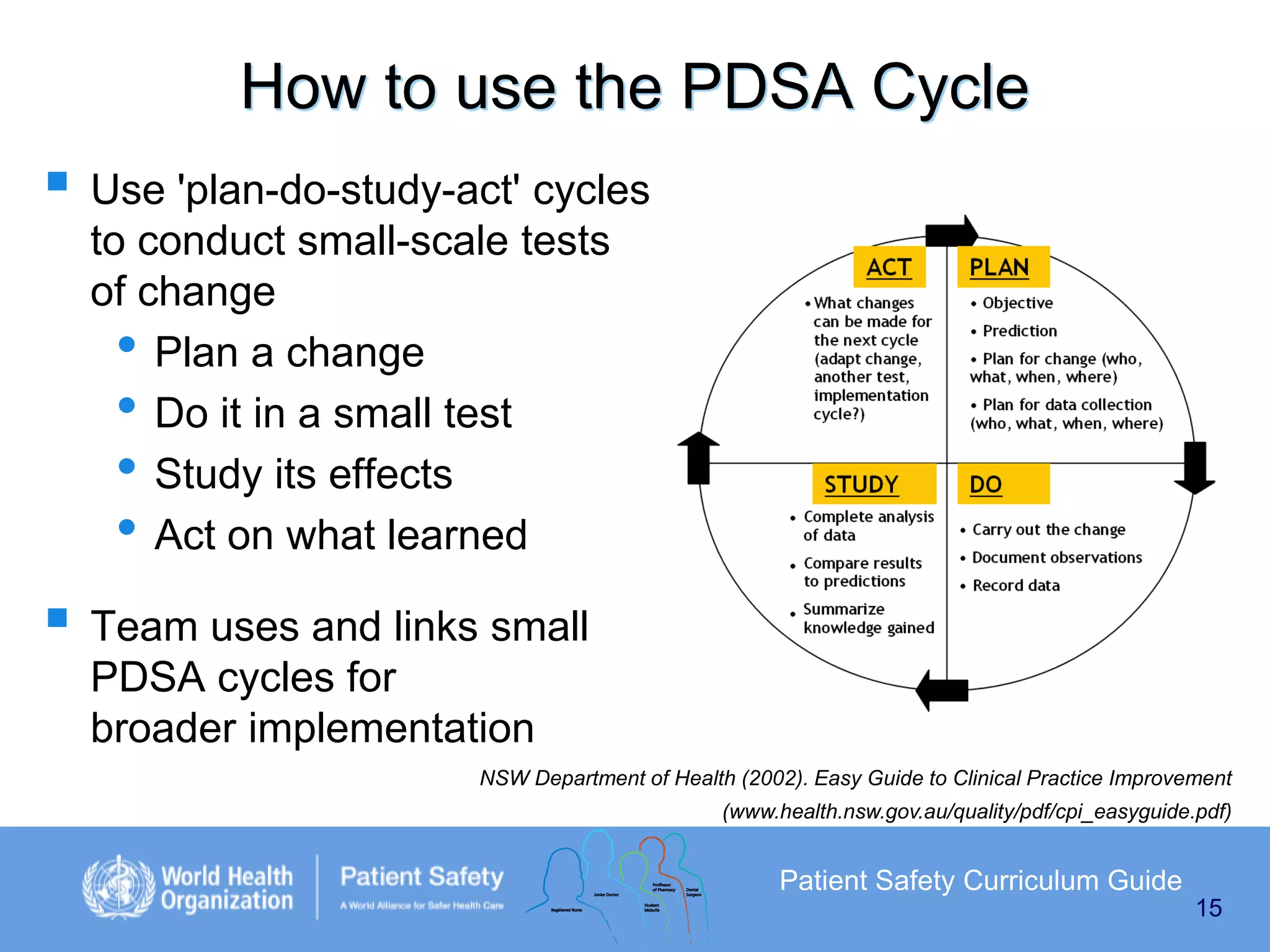
How to use the PDSA Cycle
 Use 'plan-do-study-act' cycles
to conduct small-scale tests
of change
• Plan a change
• Do it in a small test
• Study its effects
• Act on what learned

 Team uses and links small
PDSA cycles for
broader implementation
NSW Department of Health (2002). Easy Guide to Clinical Practice Improvement
(www.health.nsw.gov.au/quality/pdf/cpi_easyguide.pdf)

Patient Safety Curriculum Guide
15
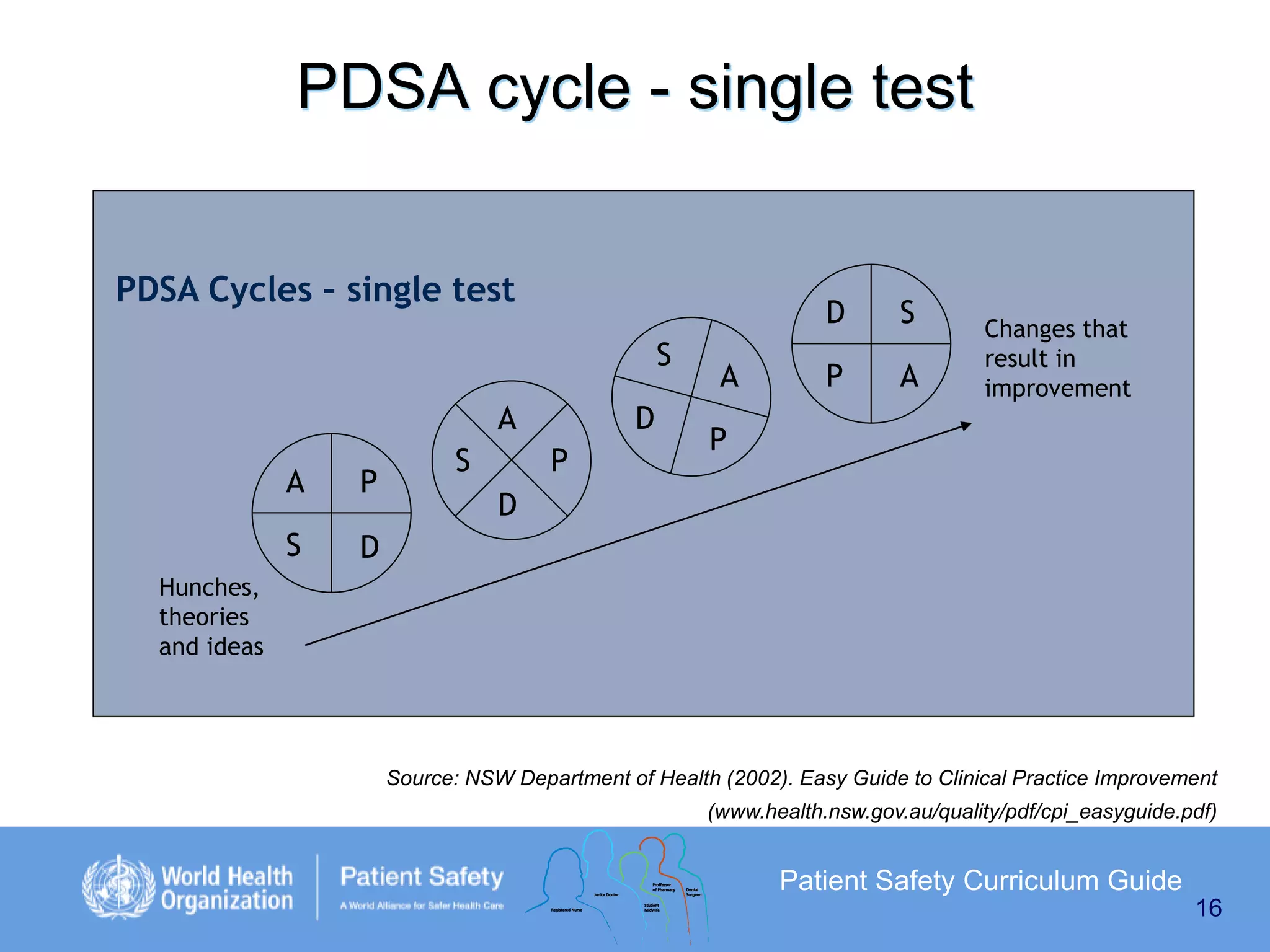
PDSA cycle - single test
PDSA Cycles – single test

D
S

A
A

P

S

S

D
P

A

S

P

A

Changes that
result in
improvement

P

D

D

Hunches,
theories
and ideas

Source: NSW Department of Health (2002). Easy Guide to Clinical Practice Improvement
(www.health.nsw.gov.au/quality/pdf/cpi_easyguide.pdf)

Patient Safety Curriculum Guide
16
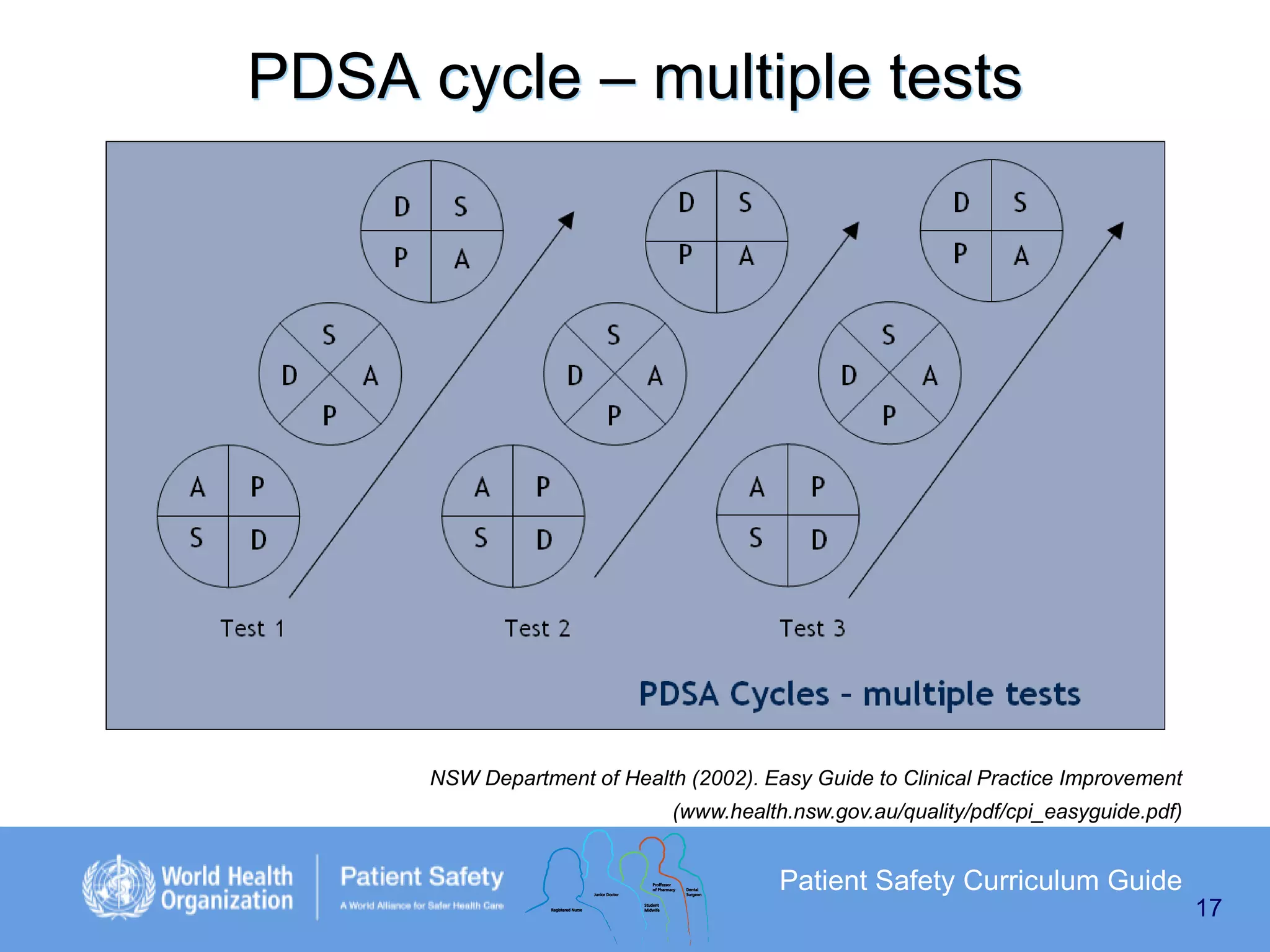
PDSA cycle – multiple tests

NSW Department of Health (2002). Easy Guide to Clinical Practice Improvement
(www.health.nsw.gov.au/quality/pdf/cpi_easyguide.pdf)

Patient Safety Curriculum Guide
17
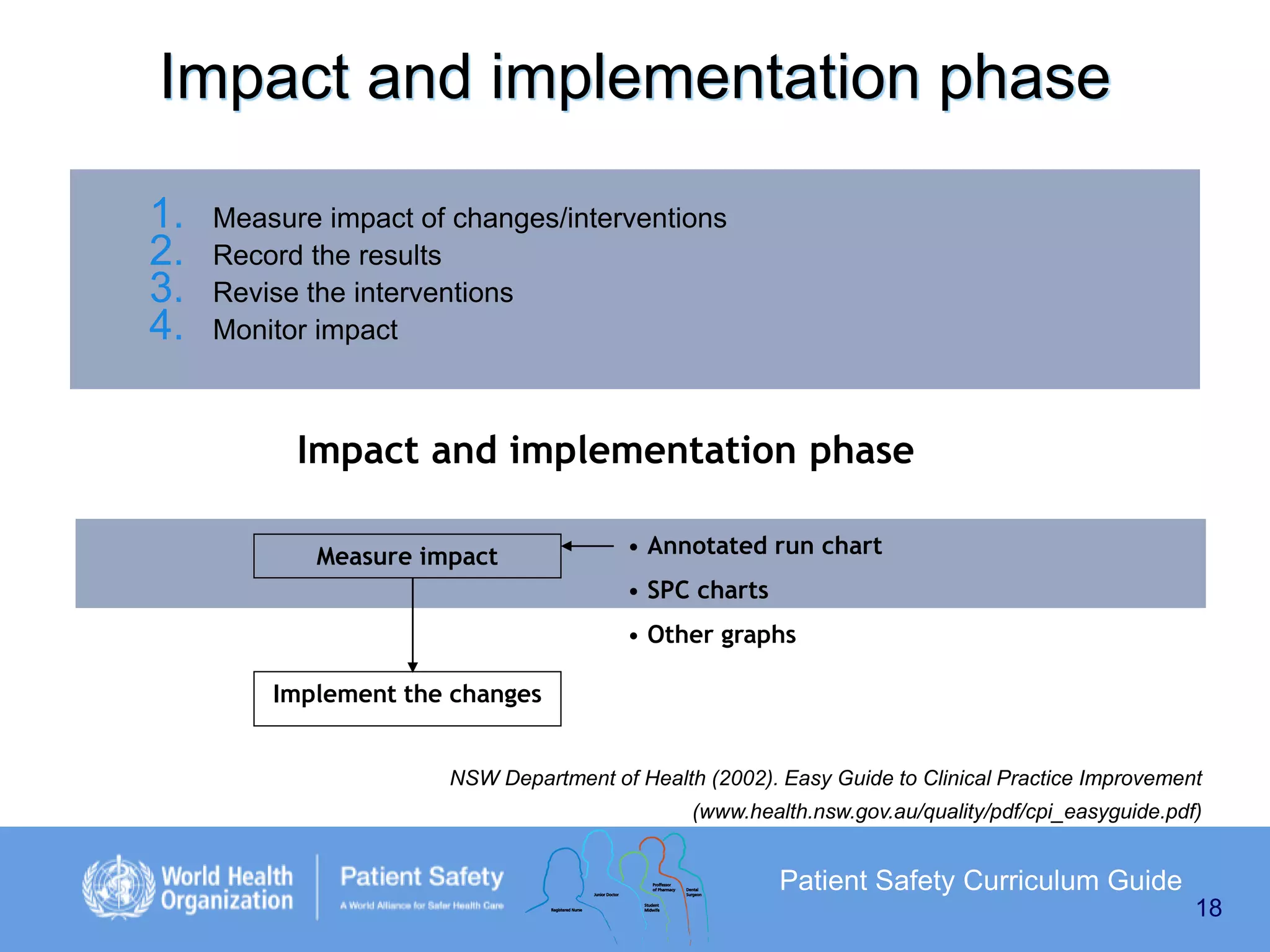
Impact and implementation phase
1.
2.
3.
4.

Measure impact of changes/interventions
Record the results
Revise the interventions
Monitor impact

Impact and implementation phase
Measure impact

• Annotated run chart
• SPC charts
• Other graphs

Implement the changes

NSW Department of Health (2002). Easy Guide to Clinical Practice Improvement
(www.health.nsw.gov.au/quality/pdf/cpi_easyguide.pdf)

Patient Safety Curriculum Guide
18
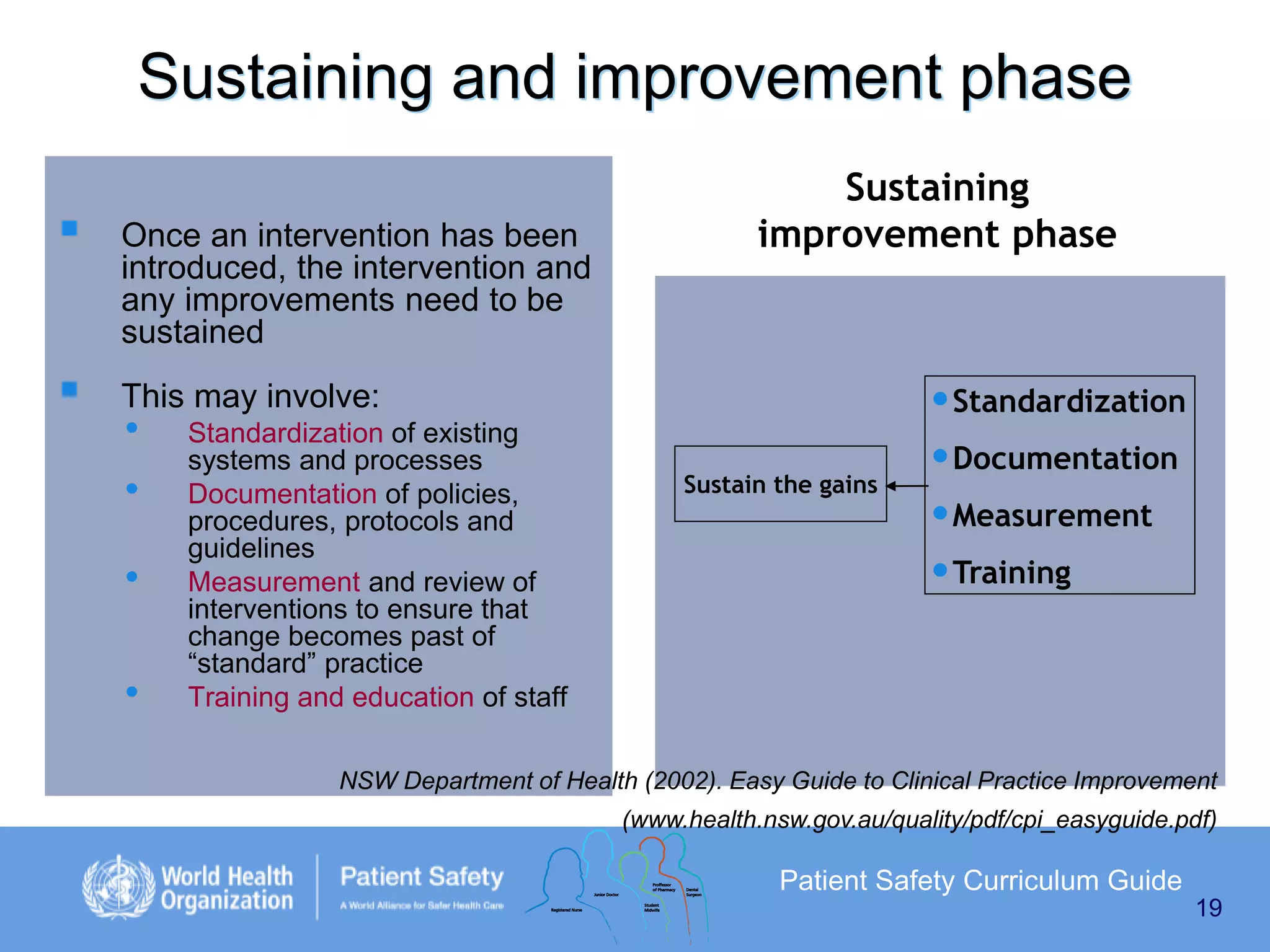
Sustaining and improvement phase




Once an intervention has been
introduced, the intervention and
any improvements need to be
sustained

Sustaining
improvement phase

This may involve:

•
•
•
•

Standardization of existing
systems and processes
Documentation of policies,
procedures, protocols and
guidelines
Measurement and review of
interventions to ensure that
change becomes past of
“standard” practice
Training and education of staff

Sustain the gains

•Standardization
•Documentation
•Measurement
•Training

NSW Department of Health (2002). Easy Guide to Clinical Practice Improvement
(www.health.nsw.gov.au/quality/pdf/cpi_easyguide.pdf)

Patient Safety Curriculum Guide
19
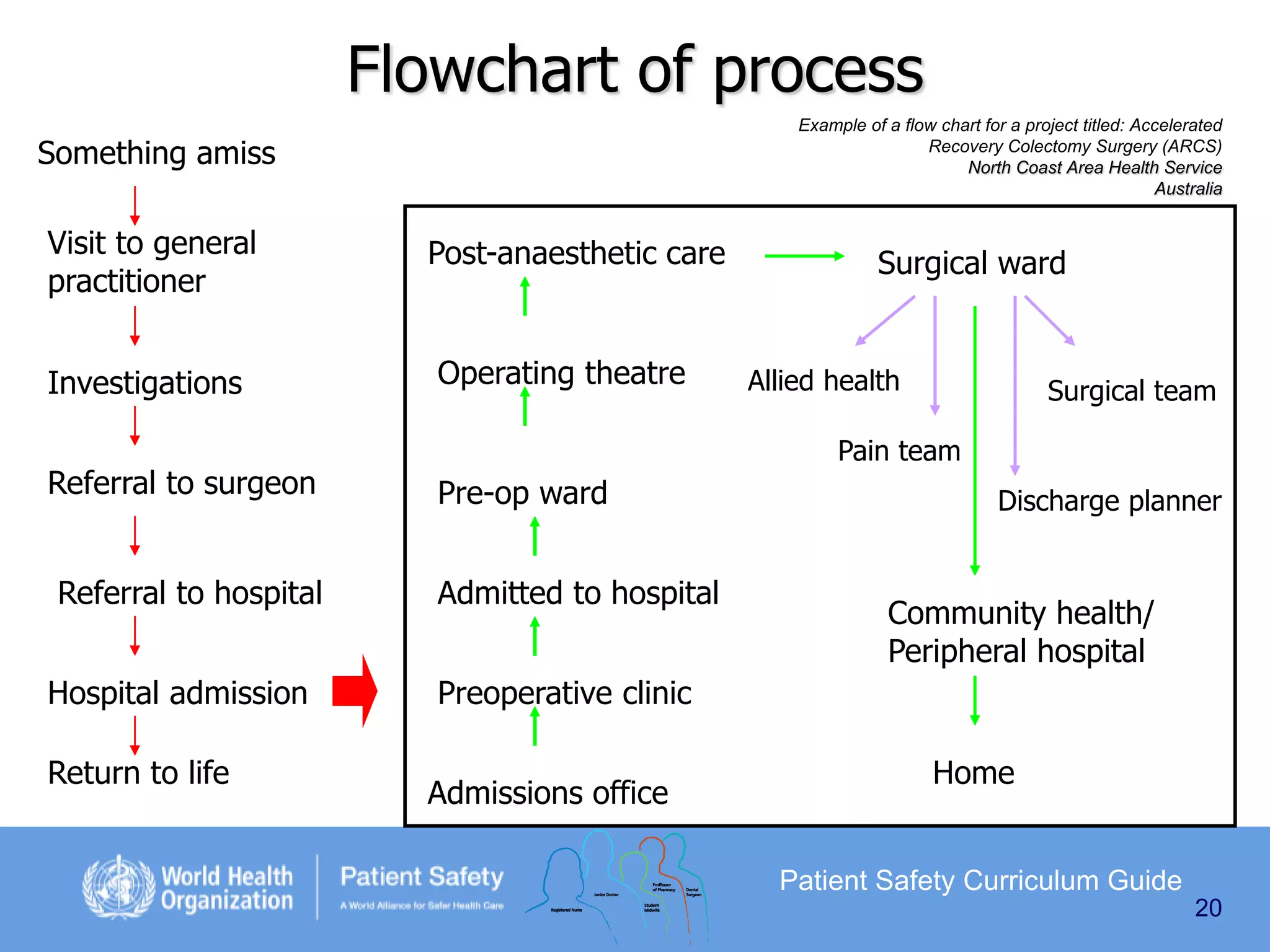
Flowchart of process
Example of a flow chart for a project titled: Accelerated
Recovery Colectomy Surgery (ARCS)
North Coast Area Health Service
Australia

Something amiss
Visit to general
practitioner
Investigations
Referral to surgeon
Referral to hospital
Hospital admission
Return to life

Post-anaesthetic care

Operating theatre

Surgical ward

Allied health

Surgical team

Pain team

Pre-op ward
Admitted to hospital

Discharge planner

Community health/
Peripheral hospital

Preoperative clinic
Admissions office

Home

Patient Safety Curriculum Guide
20
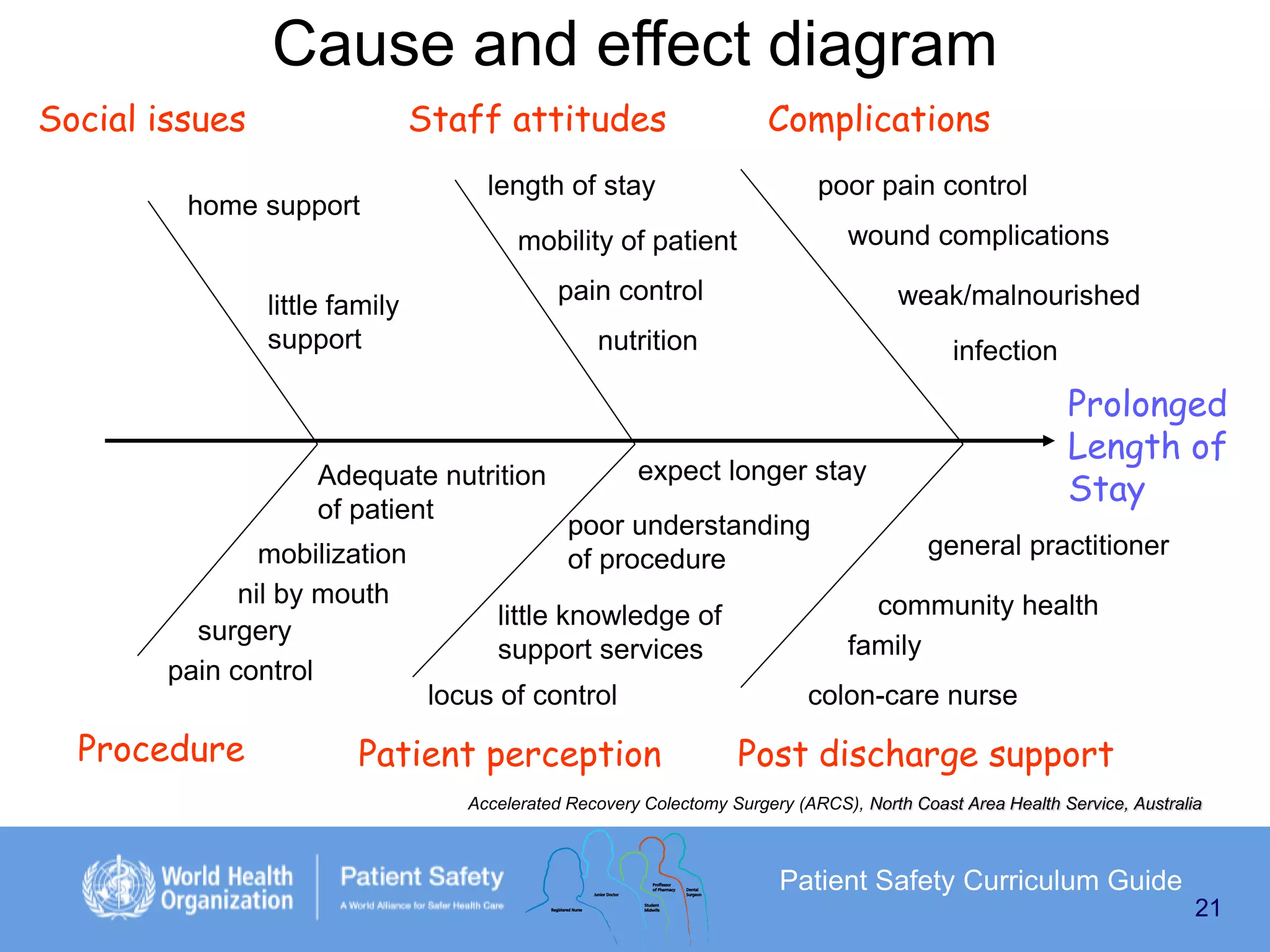
Cause and effect diagram
Social issues

Staff attitudes

home support

Complications

length of stay

poor pain control

wound complications

mobility of patient
pain control

little family
support

nutrition

Adequate nutrition
of patient
mobilization
nil by mouth
surgery
pain control

Procedure

weak/malnourished
infection

Prolonged
Length of
Stay

expect longer stay
poor understanding
of procedure

little knowledge of
support services
locus of control

Patient perception

general practitioner
community health
family

colon-care nurse

Post discharge support

Accelerated Recovery Colectomy Surgery (ARCS), North Coast Area Health Service, Australia

Patient Safety Curriculum Guide
21
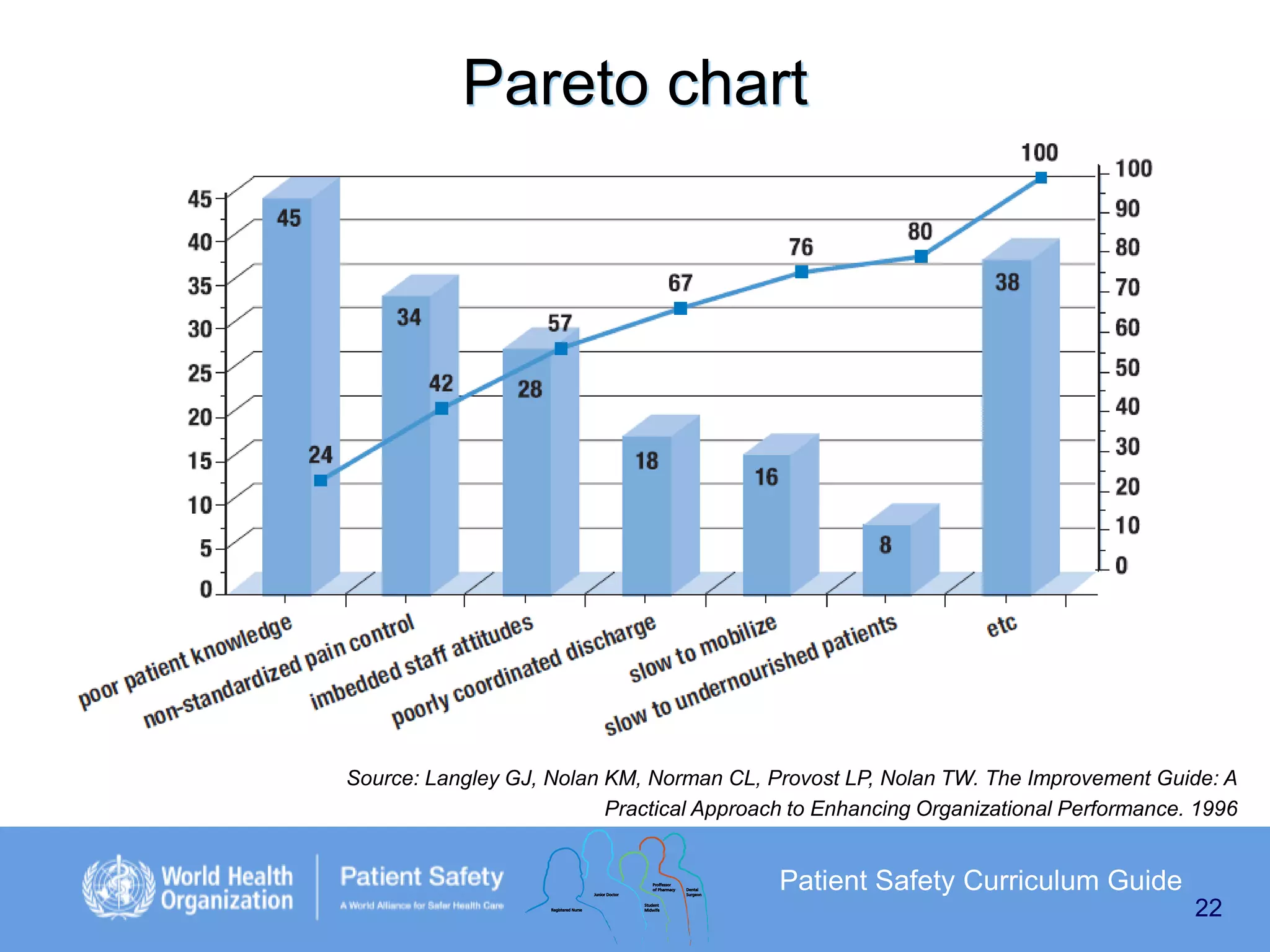
Pareto chart

Source: Langley GJ, Nolan KM, Norman CL, Provost LP, Nolan TW. The Improvement Guide: A
Practical Approach to Enhancing Organizational Performance. 1996

Patient Safety Curriculum Guide
22
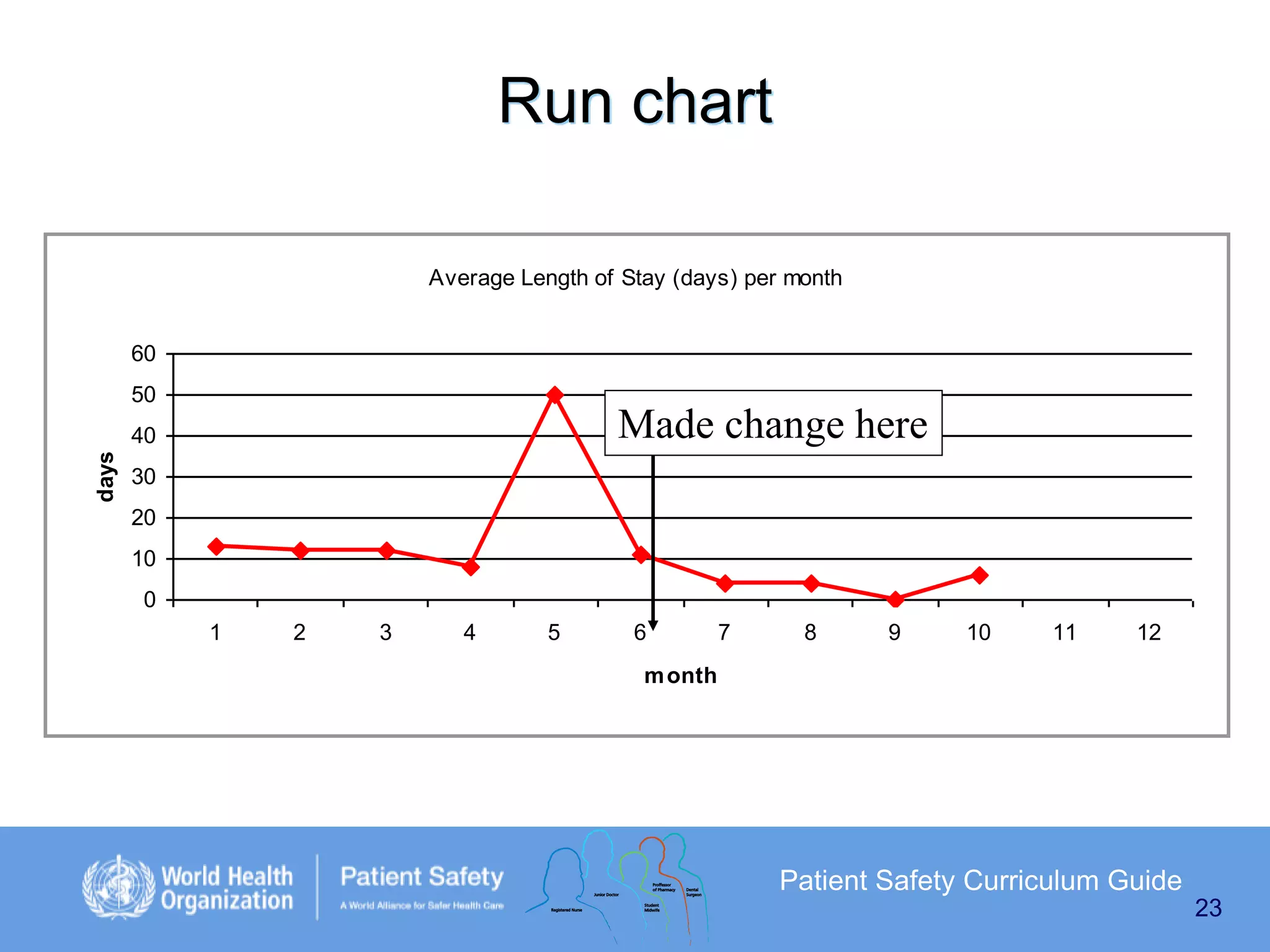
Run chart
Average Length of Stay (days) per month
60
50

Made change here

days

40
30
20
10
0
1

2

3

4

5

6

7

8

9

10

11

12

m onth

Patient Safety Curriculum Guide
23
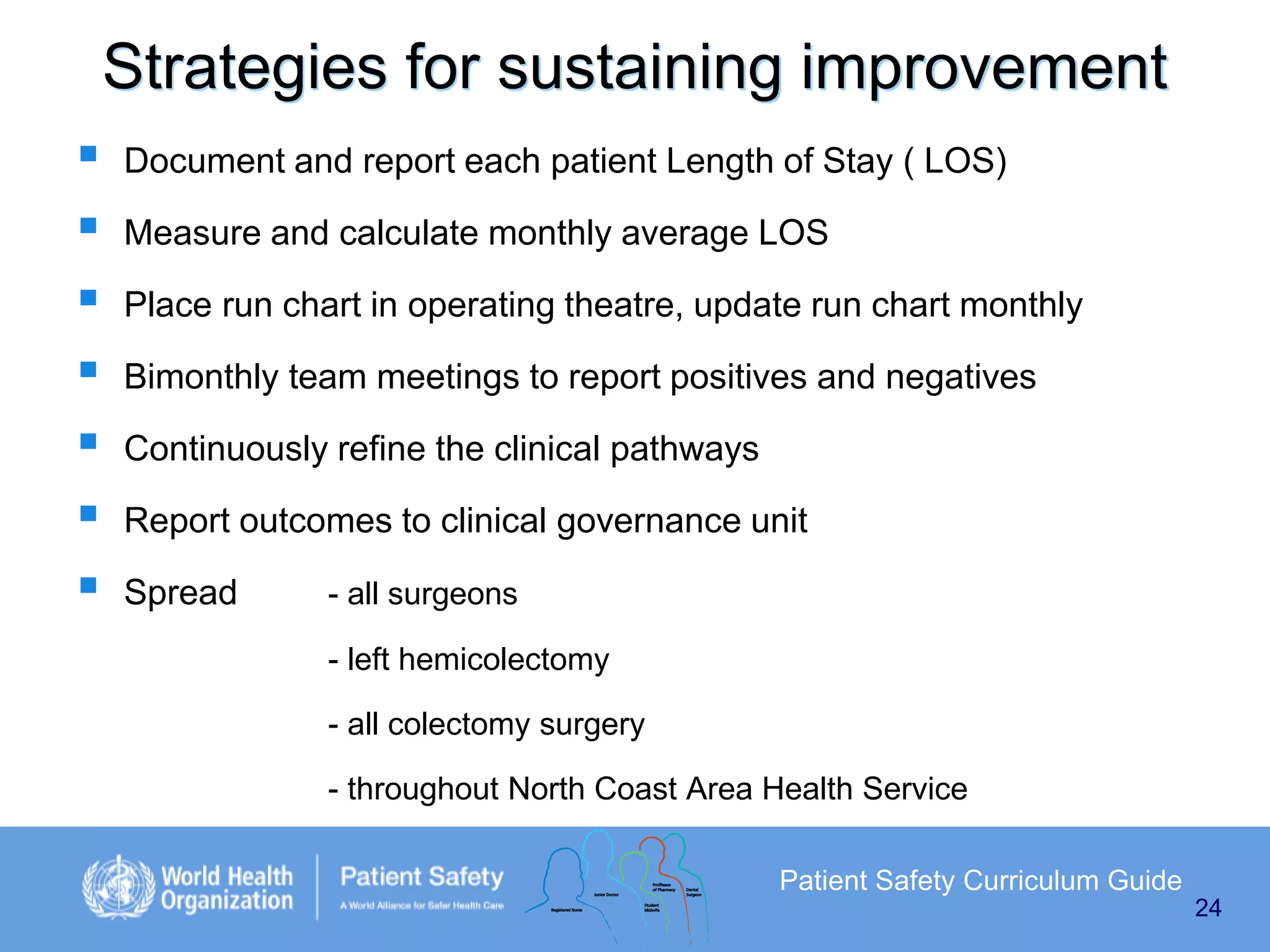
Strategies for sustaining improvement








Document and report each patient Length of Stay ( LOS)
Measure and calculate monthly average LOS
Place run chart in operating theatre, update run chart monthly
Bimonthly team meetings to report positives and negatives
Continuously refine the clinical pathways
Report outcomes to clinical governance unit

Spread

- all surgeons
- left hemicolectomy
- all colectomy surgery

- throughout North Coast Area Health Service
Patient Safety Curriculum Guide
24

Psp mpc topic-07

  • 1.
    Topic 7 Using quality-improvement methodsto improve care Patient Safety Curriculum Guide 1
  • 2.
    Learning objectives  Theobjectives of this topic are to: • • Describe the basic principles of quality improvement Introduce students to the methods and tools for improving the quality of health care Patient Safety Curriculum Guide 2
  • 3.
    Knowledge requirements  Thescience of improvement  Change concepts  Improvement principles  Role of measurement in improvement Patient Safety Curriculum Guide 3
  • 4.
    Performance requirement  Identifythe opportunities for using safety science to analyse errors  Appreciate the range of improvement methods available for reducing harm to patients  Apply at least one improvement tool in a particular clinical context  Participate in an improvement activity (if possible) Patient Safety Curriculum Guide 4
  • 5.
    The science ofimprovement  Appreciation of a system  Understanding of variation  Theory of knowledge  Psychology Source: Langley GL Patient Safety Curriculum Guide 5
  • 6.
    Change concepts … …are general ideas, with proven merit and sound scientific or logical foundation that can stimulate specific ideas for changes that lead to improvement. Source: Nolan TW, 1996 Patient Safety Curriculum Guide 6
  • 7.
    The model forimprovement What are we trying to accomplish? How we will know that a change is an improvement? What change can we make that will result in an improvement? ACT STUDY PLAN DO Source: Langley GL, Nolan, KM, Nolan, TW, Norman, CL & Provost, LP 1999 Patient Safety Curriculum Guide 7
  • 8.
    The quality improvementmodel: the PDSA cycle  What are we trying to accomplish?  How will we know that a change is an improvement?  What changes can we make that will result in an improvement? Patient Safety Curriculum Guide 8
  • 9.
    The PDSA cycle Determineswhat changes are to be made ACT STUDY Summarizes what was learned Change or test PLAN DO Carry out the plan Source: Langley GL, Nolan, KM, Nolan, TW, Norman, CL & Provost, LP 1999 Patient Safety Curriculum Guide 9
  • 10.
    The Institute forHealthcare Improvement (IHI): different measures Measurement for research Measurement for learning and process improvement Purpose To discover new knowledge To bring new knowledge into daily practice Tests One large "blind" test Many sequential, observable tests Biases Control for as many biases as possible Stabilize the biases from test to test Data Gather as much data as possible, "just in case" Gather "just enough" data to learn and complete another cycle Duration Can take long periods of time to obtain results "Small tests of significant changes" accelerate the rate of improvement Patient Safety Curriculum Guide 10
  • 11.
    Three types ofmeasures  Outcome measures  Process measures  Balancing measures Patient Safety Curriculum Guide 11
  • 12.
    Three examples ofimprovement methods  Clinical Practice Improvement methodology (CPI)  Root Cause Analysis ( RCA)  Failure Mode Effect Analysis ( FMEA) Patient Safety Curriculum Guide 12
  • 13.
    The improvement process Projectmission Project team Ongoing monitoring Outcome Future plans Project phase Sustaining improvement phase 1 5 1 month Annotated run chart SPC charts Impact phase 4 3 S 2 months 2 Diagnostic phase Conceptual flow of process Customer grid Data -fishbone -Pareto chart -run charts -SPC charts A D Intervention phase P S A D P S A D P S A D D S P A P 2 months Plan a change Do it in a small test Study its effects Act on the result Source: NSW Department of Health (2002). Easy Guide to Clinical Practice Improvement (www.health.nsw.gov.au/quality/pdf/cpi_easyguide.pdf) SPC – statistical process control Patient Safety Curriculum Guide 13
  • 14.
    Interventions phase Identify appropriateinterventions Implement changes identified in the diagnostic phase Undertake one or more PDSA cycles Interventions phase Decide on interventions Undertake one or more PDSA cycles Source: NSW Department of Health (2002). Easy Guide to Clinical Practice Improvement (www.health.nsw.gov.au/quality/pdf/cpi_easyguide.pdf) Patient Safety Curriculum Guide 14
  • 15.
    How to usethe PDSA Cycle  Use 'plan-do-study-act' cycles to conduct small-scale tests of change • Plan a change • Do it in a small test • Study its effects • Act on what learned  Team uses and links small PDSA cycles for broader implementation NSW Department of Health (2002). Easy Guide to Clinical Practice Improvement (www.health.nsw.gov.au/quality/pdf/cpi_easyguide.pdf) Patient Safety Curriculum Guide 15
  • 16.
    PDSA cycle -single test PDSA Cycles – single test D S A A P S S D P A S P A Changes that result in improvement P D D Hunches, theories and ideas Source: NSW Department of Health (2002). Easy Guide to Clinical Practice Improvement (www.health.nsw.gov.au/quality/pdf/cpi_easyguide.pdf) Patient Safety Curriculum Guide 16
  • 17.
    PDSA cycle –multiple tests NSW Department of Health (2002). Easy Guide to Clinical Practice Improvement (www.health.nsw.gov.au/quality/pdf/cpi_easyguide.pdf) Patient Safety Curriculum Guide 17
  • 18.
    Impact and implementationphase 1. 2. 3. 4. Measure impact of changes/interventions Record the results Revise the interventions Monitor impact Impact and implementation phase Measure impact • Annotated run chart • SPC charts • Other graphs Implement the changes NSW Department of Health (2002). Easy Guide to Clinical Practice Improvement (www.health.nsw.gov.au/quality/pdf/cpi_easyguide.pdf) Patient Safety Curriculum Guide 18
  • 19.
    Sustaining and improvementphase   Once an intervention has been introduced, the intervention and any improvements need to be sustained Sustaining improvement phase This may involve: • • • • Standardization of existing systems and processes Documentation of policies, procedures, protocols and guidelines Measurement and review of interventions to ensure that change becomes past of “standard” practice Training and education of staff Sustain the gains •Standardization •Documentation •Measurement •Training NSW Department of Health (2002). Easy Guide to Clinical Practice Improvement (www.health.nsw.gov.au/quality/pdf/cpi_easyguide.pdf) Patient Safety Curriculum Guide 19
  • 20.
    Flowchart of process Exampleof a flow chart for a project titled: Accelerated Recovery Colectomy Surgery (ARCS) North Coast Area Health Service Australia Something amiss Visit to general practitioner Investigations Referral to surgeon Referral to hospital Hospital admission Return to life Post-anaesthetic care Operating theatre Surgical ward Allied health Surgical team Pain team Pre-op ward Admitted to hospital Discharge planner Community health/ Peripheral hospital Preoperative clinic Admissions office Home Patient Safety Curriculum Guide 20
  • 21.
    Cause and effectdiagram Social issues Staff attitudes home support Complications length of stay poor pain control wound complications mobility of patient pain control little family support nutrition Adequate nutrition of patient mobilization nil by mouth surgery pain control Procedure weak/malnourished infection Prolonged Length of Stay expect longer stay poor understanding of procedure little knowledge of support services locus of control Patient perception general practitioner community health family colon-care nurse Post discharge support Accelerated Recovery Colectomy Surgery (ARCS), North Coast Area Health Service, Australia Patient Safety Curriculum Guide 21
  • 22.
    Pareto chart Source: LangleyGJ, Nolan KM, Norman CL, Provost LP, Nolan TW. The Improvement Guide: A Practical Approach to Enhancing Organizational Performance. 1996 Patient Safety Curriculum Guide 22
  • 23.
    Run chart Average Lengthof Stay (days) per month 60 50 Made change here days 40 30 20 10 0 1 2 3 4 5 6 7 8 9 10 11 12 m onth Patient Safety Curriculum Guide 23
  • 24.
    Strategies for sustainingimprovement        Document and report each patient Length of Stay ( LOS) Measure and calculate monthly average LOS Place run chart in operating theatre, update run chart monthly Bimonthly team meetings to report positives and negatives Continuously refine the clinical pathways Report outcomes to clinical governance unit Spread - all surgeons - left hemicolectomy - all colectomy surgery - throughout North Coast Area Health Service Patient Safety Curriculum Guide 24