© 2014 ISC
Pseudo Random DNS Query
Attacks & Resolver
Mitigation Approaches
APRICOT 2015
© 2014 ISC
The attacks
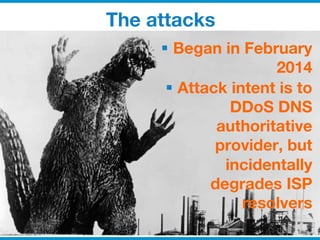
§  Began in February
2014
§  Attack intent is to
DDoS DNS
authoritative
provider, but
incidentally
degrades ISP
resolvers
© 2014 ISC
The parties involved
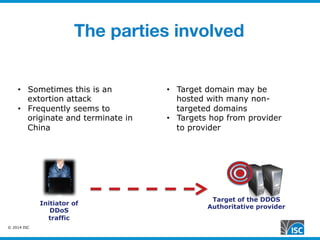
Target of the DDOS
Authoritative provider
Initiator of
DDoS
traffic
•  Sometimes this is an
extortion attack
•  Frequently seems to
originate and terminate in
China
•  Target domain may be
hosted with many non-
targeted domains
•  Targets hop from provider
to provider
© 2014 ISC
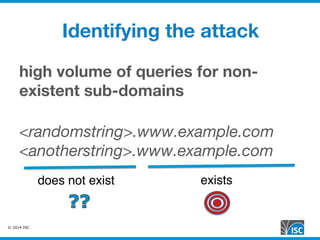
Identifying the attack
high volume of queries for non-
existent sub-domains

<randomstring>.www.example.com

<anotherstring>.www.example.com


exists"does not exist"
© 2014 ISC
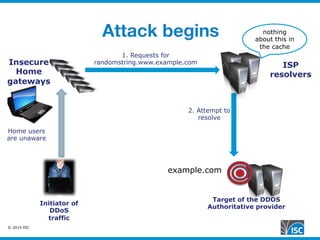
Attack begins
Target of the DDOS
Authoritative provider
ISP
resolvers
Insecure
Home
gateways
Initiator of
DDoS
traffic
2. Attempt to
resolve
1. Requests for
randomstring.www.example.com
Home users
are unaware
example.com
nothing
about this in
the cache
© 2014 ISC
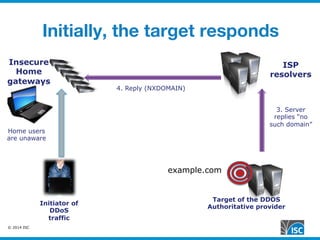
Initially, the target responds
Target of the DDOS
Authoritative provider
ISP
resolvers
Insecure
Home
gateways
Initiator of
DDoS
traffic
3. Server
replies “no
such domain”
Home users
are unaware
4. Reply (NXDOMAIN)
example.com
© 2014 ISC
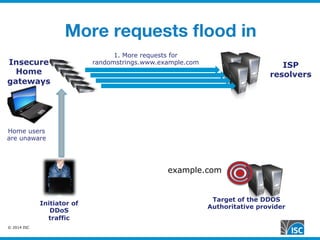
More requests flood in
Target of the DDOS
Authoritative provider
ISP
resolvers
Insecure
Home
gateways
Initiator of
DDoS
traffic
1. More requests for
randomstrings.www.example.com
Home users
are unaware
example.com
© 2014 ISC
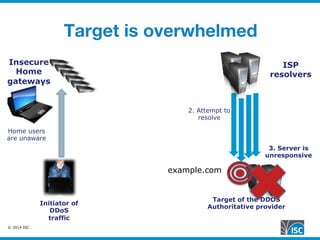
Target is overwhelmed
Target of the DDOS
Authoritative provider
ISP
resolvers
Insecure
Home
gateways
Initiator of
DDoS
traffic
2. Attempt to
resolve
3. Server is
unresponsive
Home users
are unaware
example.com
© 2014 ISC
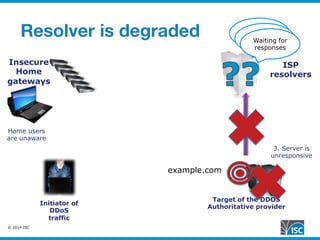
Resolver is degraded
Target of the DDOS
Authoritative provider
ISP
resolvers
Insecure
Home
gateways
Initiator of
DDoS
traffic
3. Server is
unresponsive
Home users
are unaware
example.com
Waiting for
responsesWaiting for
responses
© 2014 ISC
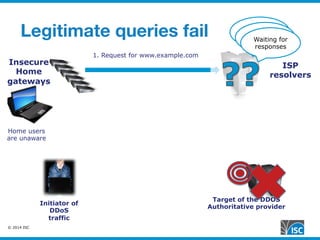
Legitimate queries fail
Target of the DDOS
Authoritative provider
ISP
resolvers
Insecure
Home
gateways
Initiator of
DDoS
traffic
1. Request for www.example.com
Home users
are unaware
Waiting for
responsesWaiting for
responses
© 2014 ISC
© 2014 ISC
MITIGATION TECHNIQUES
What can we do?

What has been tried in production?
© 2014 ISC
Option 1: “hair on fire”
© 2014 ISC
© 2014 ISC
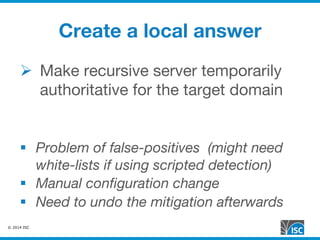
Create a local answer
Ø  Make recursive server temporarily
authoritative for the target domain

§  Problem of false-positives (might need
white-lists if using scripted detection)
§  Manual configuration change
§  Need to undo the mitigation afterwards
© 2014 ISC
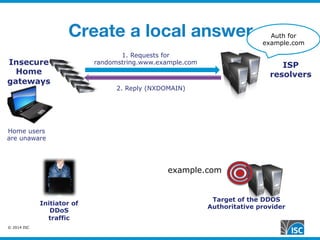
Create a local answer
Target of the DDOS
Authoritative provider
ISP
resolvers
Insecure
Home
gateways
Initiator of
DDoS
traffic
1. Requests for
randomstring.www.example.com
Home users
are unaware
Auth for
example.com
2. Reply (NXDOMAIN)
example.com
© 2014 ISC
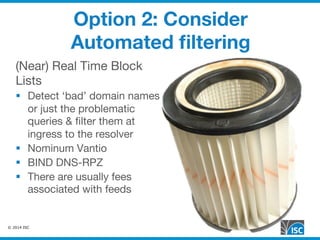
Option 2: Consider
Automated filtering
(Near) Real Time Block
Lists
§  Detect ‘bad’ domain names
or just the problematic
queries & filter them at
ingress to the resolver
§  Nominum Vantio
§  BIND DNS-RPZ
§  There are usually fees
associated with feeds
© 2014 ISC
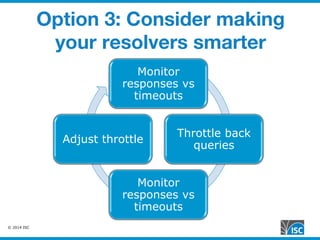
Option 3: Consider making
your resolvers smarter
Monitor
responses vs
timeouts
Throttle back
queries
Monitor
responses vs
timeouts
Adjust throttle
© 2014 ISC
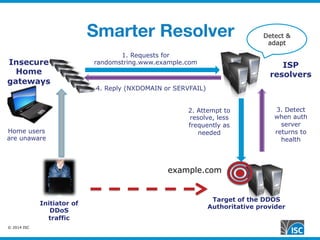
Smarter Resolver
Target of the DDOS
Authoritative provider
ISP
resolvers
Insecure
Home
gateways
Initiator of
DDoS
traffic
2. Attempt to
resolve, less
frequently as
needed
1. Requests for
randomstring.www.example.com
Home users
are unaware
Detect &
adapt
4. Reply (NXDOMAIN or SERVFAIL)
example.com
3. Detect
when auth
server
returns to
health
© 2014 ISC
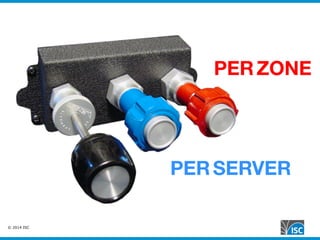
PERSERVER
PERZONE
© 2014 ISC
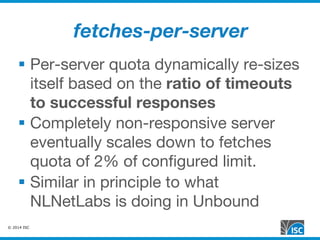
fetches-per-server
§  Per-server quota dynamically re-sizes
itself based on the ratio of timeouts
to successful responses
§  Completely non-responsive server
eventually scales down to fetches
quota of 2% of configured limit.
§  Similar in principle to what
NLNetLabs is doing in Unbound
© 2014 ISC
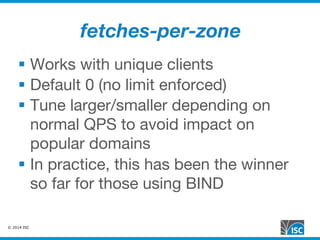
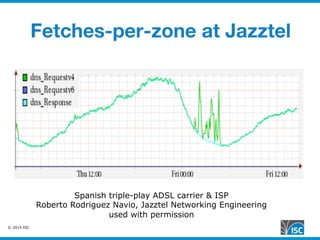
fetches-per-zone
§  Works with unique clients
§  Default 0 (no limit enforced)
§  Tune larger/smaller depending on
normal QPS to avoid impact on
popular domains
§  In practice, this has been the winner
so far for those using BIND
© 2014 ISC
Fetches-per-zone at Jazztel
Spanish triple-play ADSL carrier & ISP
Roberto Rodriguez Navio, Jazztel Networking Engineering
used with permission
© 2014 ISC
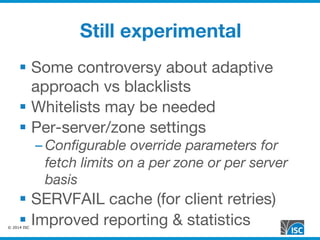
Still experimental
§  Some controversy about adaptive
approach vs blacklists
§  Whitelists may be needed
§  Per-server/zone settings
– Configurable override parameters for
fetch limits on a per zone or per server
basis
§  SERVFAIL cache (for client retries)
§  Improved reporting & statistics
© 2014 ISC
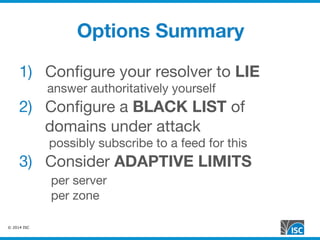
Options Summary
1)  Configure your resolver to LIE
answer authoritatively yourself
2)  Configure a BLACK LIST of
domains under attack
possibly subscribe to a feed for this
3)  Consider ADAPTIVE LIMITS

per server

per zone
© 2014 ISC
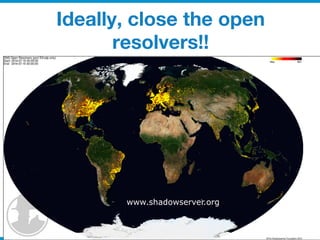
Ideally, close the open
resolvers!!
www.shadowserver.org
© 2014 ISC
GOOD LUCK!

Pseudo Random DNS Query Attacks and Resolver Mitigation Approaches

  • 1.
    © 2014 ISC PseudoRandom DNS Query Attacks & Resolver Mitigation Approaches APRICOT 2015
  • 2.
    © 2014 ISC Theattacks §  Began in February 2014 §  Attack intent is to DDoS DNS authoritative provider, but incidentally degrades ISP resolvers
  • 3.
    © 2014 ISC Theparties involved Target of the DDOS Authoritative provider Initiator of DDoS traffic •  Sometimes this is an extortion attack •  Frequently seems to originate and terminate in China •  Target domain may be hosted with many non- targeted domains •  Targets hop from provider to provider
  • 4.
    © 2014 ISC Identifyingthe attack high volume of queries for non- existent sub-domains <randomstring>.www.example.com
 <anotherstring>.www.example.com
 exists"does not exist"
  • 5.
    © 2014 ISC Attackbegins Target of the DDOS Authoritative provider ISP resolvers Insecure Home gateways Initiator of DDoS traffic 2. Attempt to resolve 1. Requests for randomstring.www.example.com Home users are unaware example.com nothing about this in the cache
  • 6.
    © 2014 ISC Initially,the target responds Target of the DDOS Authoritative provider ISP resolvers Insecure Home gateways Initiator of DDoS traffic 3. Server replies “no such domain” Home users are unaware 4. Reply (NXDOMAIN) example.com
  • 7.
    © 2014 ISC Morerequests flood in Target of the DDOS Authoritative provider ISP resolvers Insecure Home gateways Initiator of DDoS traffic 1. More requests for randomstrings.www.example.com Home users are unaware example.com
  • 8.
    © 2014 ISC Targetis overwhelmed Target of the DDOS Authoritative provider ISP resolvers Insecure Home gateways Initiator of DDoS traffic 2. Attempt to resolve 3. Server is unresponsive Home users are unaware example.com
  • 9.
    © 2014 ISC Resolveris degraded Target of the DDOS Authoritative provider ISP resolvers Insecure Home gateways Initiator of DDoS traffic 3. Server is unresponsive Home users are unaware example.com Waiting for responsesWaiting for responsesWaiting for responses
  • 10.
    © 2014 ISC Legitimatequeries fail Target of the DDOS Authoritative provider ISP resolvers Insecure Home gateways Initiator of DDoS traffic 1. Request for www.example.com Home users are unaware Waiting for responsesWaiting for responsesWaiting for responses
  • 11.
  • 12.
    © 2014 ISC MITIGATIONTECHNIQUES What can we do? What has been tried in production?
  • 13.
    © 2014 ISC Option1: “hair on fire”
  • 14.
  • 15.
    © 2014 ISC Createa local answer Ø  Make recursive server temporarily authoritative for the target domain §  Problem of false-positives (might need white-lists if using scripted detection) §  Manual configuration change §  Need to undo the mitigation afterwards
  • 16.
    © 2014 ISC Createa local answer Target of the DDOS Authoritative provider ISP resolvers Insecure Home gateways Initiator of DDoS traffic 1. Requests for randomstring.www.example.com Home users are unaware Auth for example.com 2. Reply (NXDOMAIN) example.com
  • 17.
    © 2014 ISC Option2: Consider Automated filtering (Near) Real Time Block Lists §  Detect ‘bad’ domain names or just the problematic queries & filter them at ingress to the resolver §  Nominum Vantio §  BIND DNS-RPZ §  There are usually fees associated with feeds
  • 18.
    © 2014 ISC Option3: Consider making your resolvers smarter Monitor responses vs timeouts Throttle back queries Monitor responses vs timeouts Adjust throttle
  • 19.
    © 2014 ISC SmarterResolver Target of the DDOS Authoritative provider ISP resolvers Insecure Home gateways Initiator of DDoS traffic 2. Attempt to resolve, less frequently as needed 1. Requests for randomstring.www.example.com Home users are unaware Detect & adapt 4. Reply (NXDOMAIN or SERVFAIL) example.com 3. Detect when auth server returns to health
  • 20.
  • 21.
    © 2014 ISC fetches-per-server § Per-server quota dynamically re-sizes itself based on the ratio of timeouts to successful responses §  Completely non-responsive server eventually scales down to fetches quota of 2% of configured limit. §  Similar in principle to what NLNetLabs is doing in Unbound
  • 22.
    © 2014 ISC fetches-per-zone § Works with unique clients §  Default 0 (no limit enforced) §  Tune larger/smaller depending on normal QPS to avoid impact on popular domains §  In practice, this has been the winner so far for those using BIND
  • 23.
    © 2014 ISC Fetches-per-zoneat Jazztel Spanish triple-play ADSL carrier & ISP Roberto Rodriguez Navio, Jazztel Networking Engineering used with permission
  • 24.
    © 2014 ISC Stillexperimental §  Some controversy about adaptive approach vs blacklists §  Whitelists may be needed §  Per-server/zone settings – Configurable override parameters for fetch limits on a per zone or per server basis §  SERVFAIL cache (for client retries) §  Improved reporting & statistics
  • 25.
    © 2014 ISC OptionsSummary 1)  Configure your resolver to LIE answer authoritatively yourself 2)  Configure a BLACK LIST of domains under attack possibly subscribe to a feed for this 3)  Consider ADAPTIVE LIMITS per server per zone
  • 26.
    © 2014 ISC Ideally,close the open resolvers!! www.shadowserver.org
  • 27.