galder@jboss.org | twitter.com/galderz | zamarreno.com
Thursday, October 7, 2010
Keeping Infinispan In Shape:
                                    Highly-Precise, Scalable
                                                 Data Eviction

                            Galder Zamarreño & Vladimir Blagojevic
                            Senior Engineer, Red Hat
                            7th October 2010, JUDCon - Berlin


                                                          galder@jboss.org | twitter.com/galderz | zamarreno.com
Thursday, October 7, 2010
Who is Galder?

                            • R&D engineer (Red Hat Inc):
                              • Infinispan developer
                              • JBoss Cache developer
                            • Contributor and committer:
                              • JBoss AS, Hibernate, JGroups, JBoss Portal,...etc
                            • Blog: zamarreno.com
                            • Twitter: @galderz


                                                          galder@jboss.org | twitter.com/galderz | zamarreno.com
Thursday, October 7, 2010
Agenda

                            • Eviction in:
                              • Java Collections Framework
                              • JBoss Cache
                              • Infinispan 4.0
                            • New in Infinispan 4.1:
                              • LIRS
                              • Batching Updates


                                                         galder@jboss.org | twitter.com/galderz | zamarreno.com
Thursday, October 7, 2010
Java Collections Framework


                            • Key building block of any Java app
                            • Introduced in Java 1.2
                            • Extended with concurrent collections in Java 1.5
                            • Collection element eviction ??


                                                           galder@jboss.org | twitter.com/galderz | zamarreno.com
Thursday, October 7, 2010
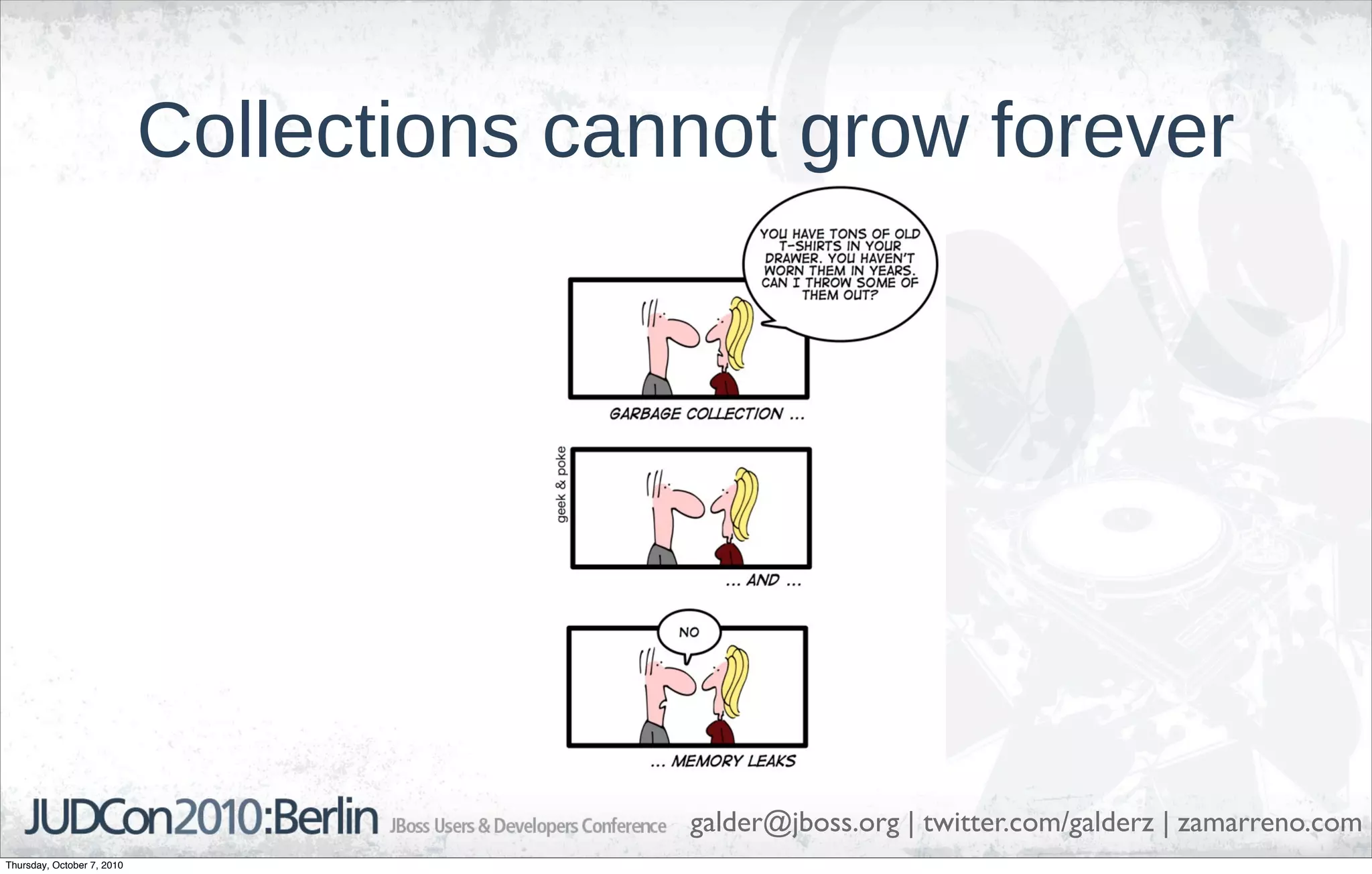
Collections cannot grow forever


                                           galder@jboss.org | twitter.com/galderz | zamarreno.com
Thursday, October 7, 2010
If using a collection as cache


                            • Forces clients to either:
                             • Remove elements proactively
                             • Or run a periodic cleanup process
                            • Which can be a PITA...


                                                          galder@jboss.org | twitter.com/galderz | zamarreno.com
Thursday, October 7, 2010
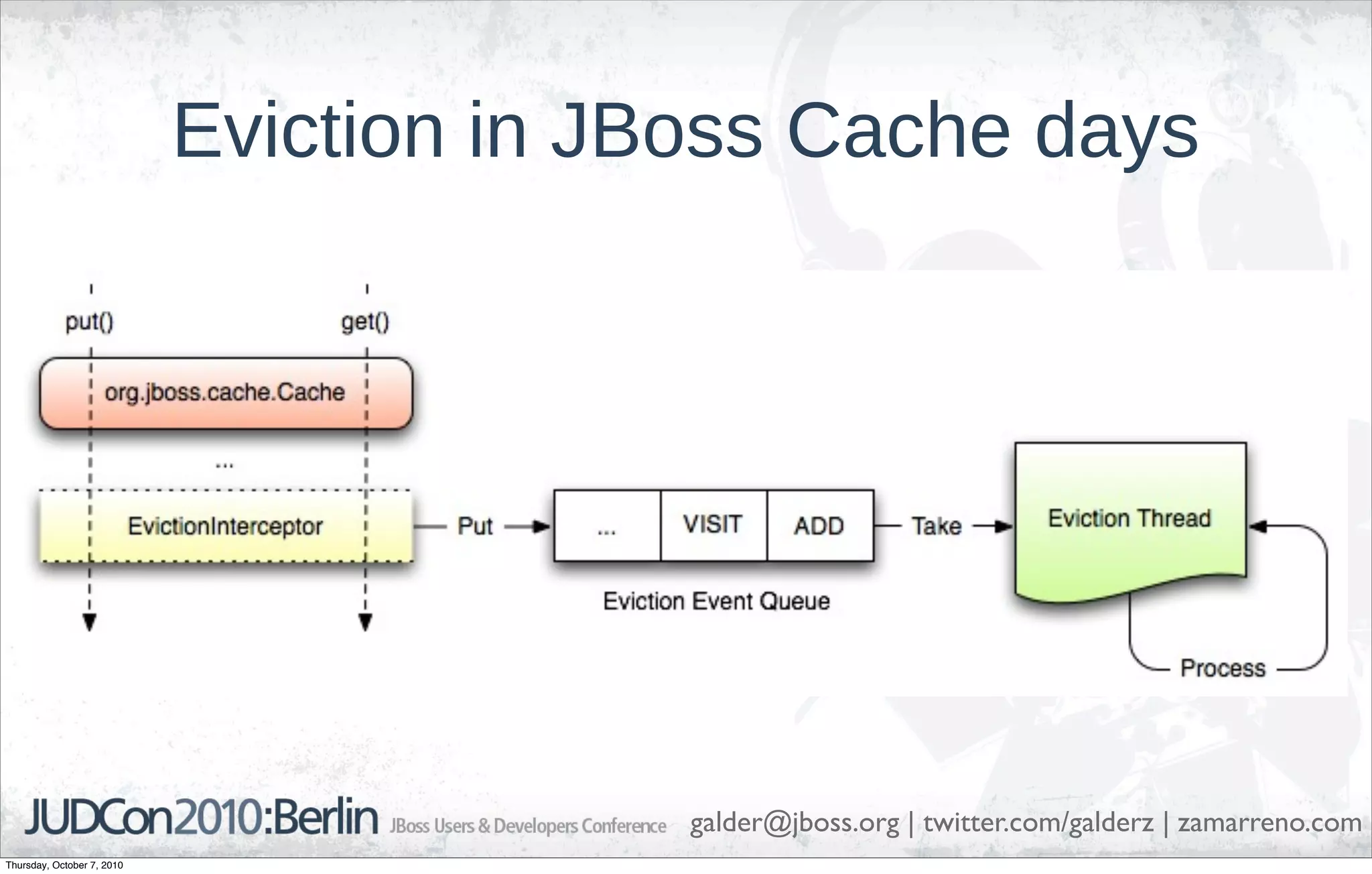
Eviction in JBoss Cache days


                                          galder@jboss.org | twitter.com/galderz | zamarreno.com
Thursday, October 7, 2010
JBoss Cache eviction issues


                            • Under heavy load, eviction queues could fill up - bottleneck
                             • Possibly a side effect of MVCC’s non-blocking reads
                            • Separating data into regions could alleviate the issue
                             • But it’s really a hack!


                                                           galder@jboss.org | twitter.com/galderz | zamarreno.com
Thursday, October 7, 2010
Original Infinispan 4.0 eviction

                            • Tried a different approach:
                            • Avoid using queues to hold events
                            • Taking advantage of tree to map change:
                             • Attempt to maintain map ordered as per eviction rules
                             • Could we use ConcurrentSkipListMap ?
                               • No. O(1) desired for all map operations


                                                            galder@jboss.org | twitter.com/galderz | zamarreno.com
Thursday, October 7, 2010
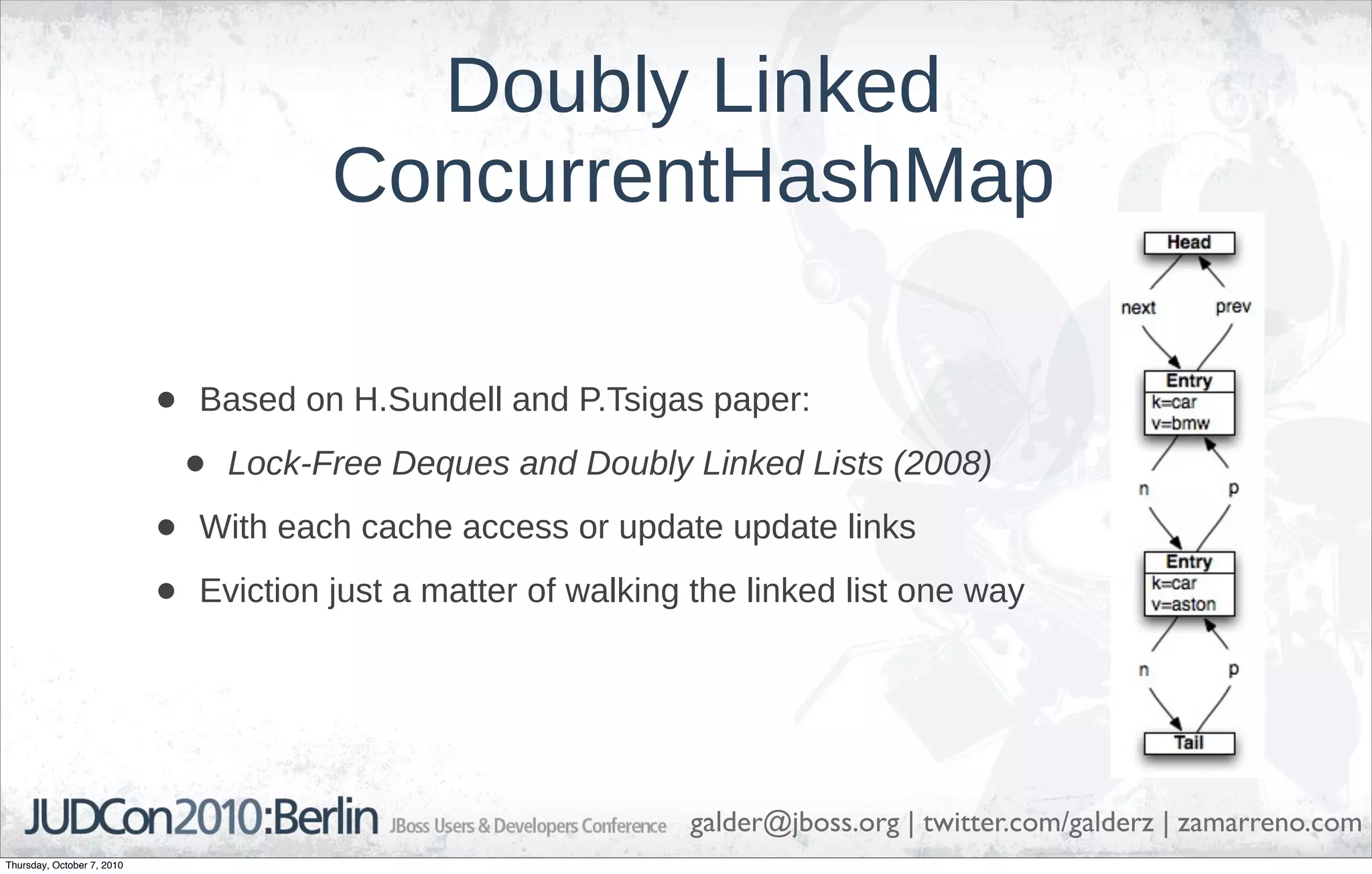
Doubly Linked
                                          ConcurrentHashMap

                            •   Based on H.Sundell and P.Tsigas paper:

                                •   Lock-Free Deques and Doubly Linked Lists (2008)

                            •   With each cache access or update update links

                            •   Eviction just a matter of walking the linked list one way


                                                                 galder@jboss.org | twitter.com/galderz | zamarreno.com
Thursday, October 7, 2010
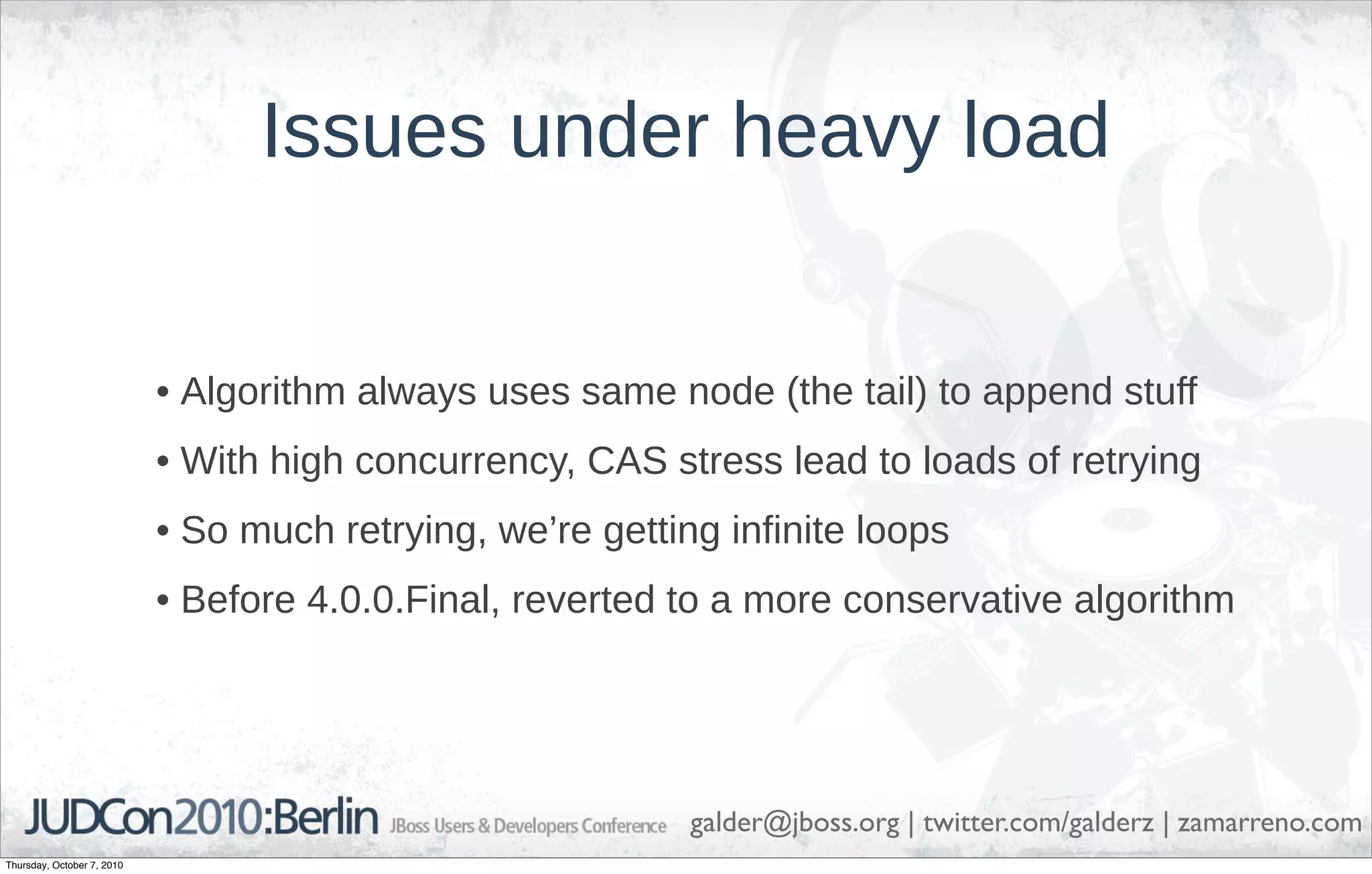
Issues under heavy load


                            • Algorithm always uses same node (the tail) to append stuff
                            • With high concurrency, CAS stress lead to loads of retrying
                            • So much retrying, we’re getting infinite loops
                            • Before 4.0.0.Final, reverted to a more conservative algorithm


                                                            galder@jboss.org | twitter.com/galderz | zamarreno.com
Thursday, October 7, 2010
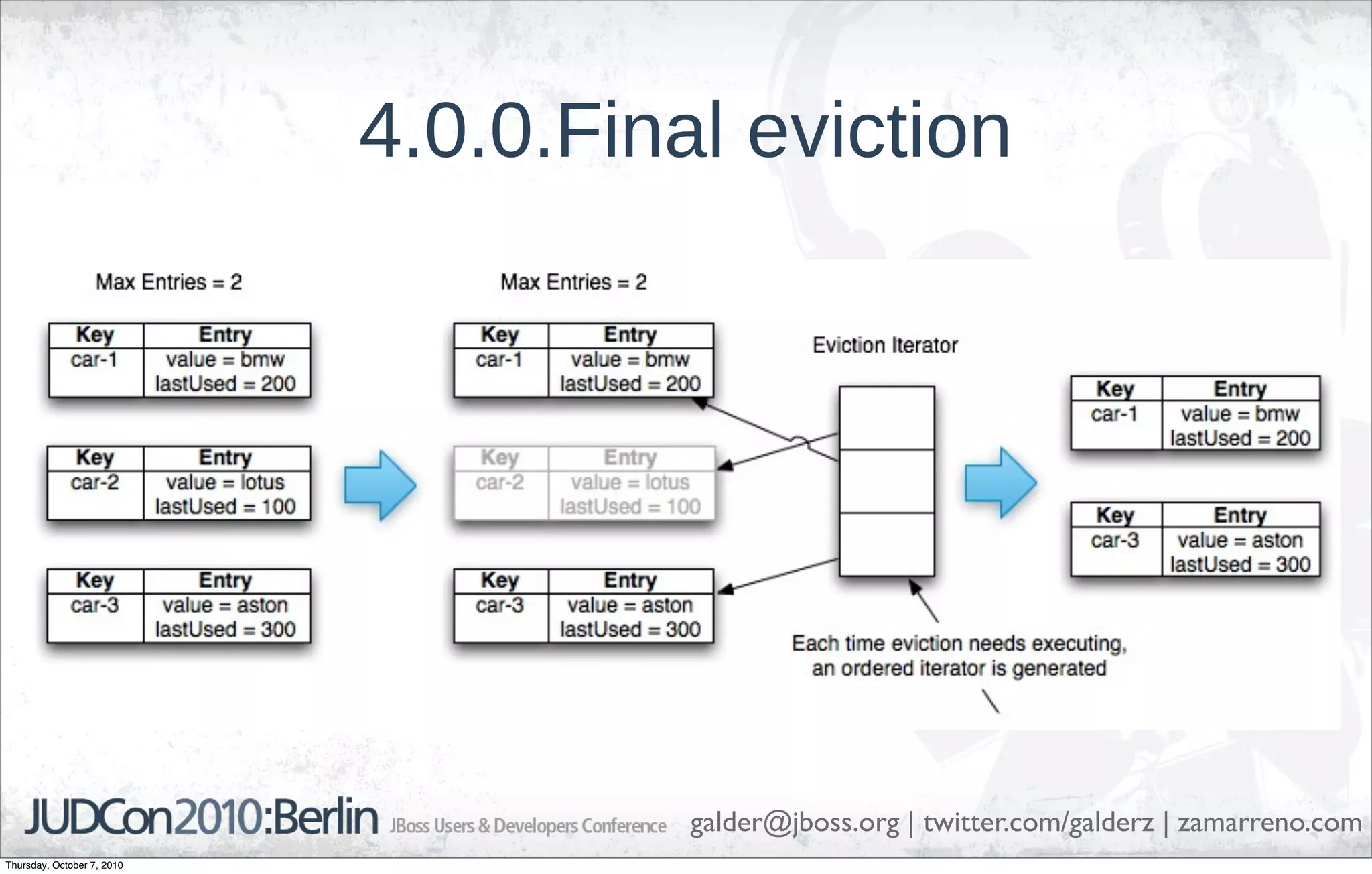
4.0.0.Final eviction


                                      galder@jboss.org | twitter.com/galderz | zamarreno.com
Thursday, October 7, 2010
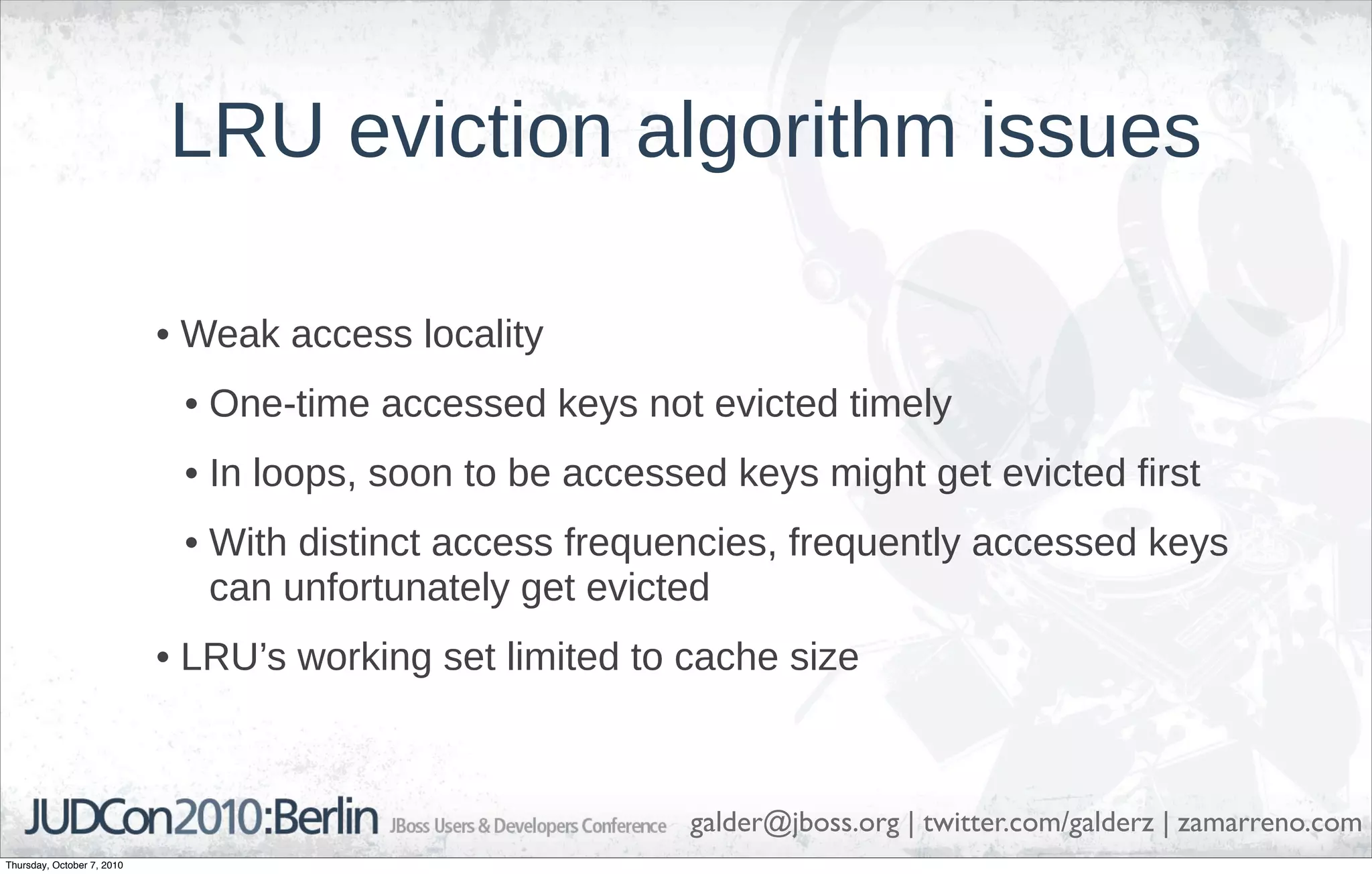
LRU eviction algorithm issues

                            • Weak access locality
                             • One-time accessed keys not evicted timely
                             • In loops, soon to be accessed keys might get evicted first
                             • With distinct access frequencies, frequently accessed keys
                               can unfortunately get evicted
                            • LRU’s working set limited to cache size


                                                           galder@jboss.org | twitter.com/galderz | zamarreno.com
Thursday, October 7, 2010
Enter the room... LIRS

                            • Eviction algorithm that can cope with weak access locality
                            • Based on S.Jiang and X.Zhang’s 2002 paper:
                             • LIRS: An efficient low inter-reference recency set
                               replacement policy to improve buffer cache performance
                            • LIRS based around two concepts: IRR and Recency


                                                         galder@jboss.org | twitter.com/galderz | zamarreno.com
Thursday, October 7, 2010
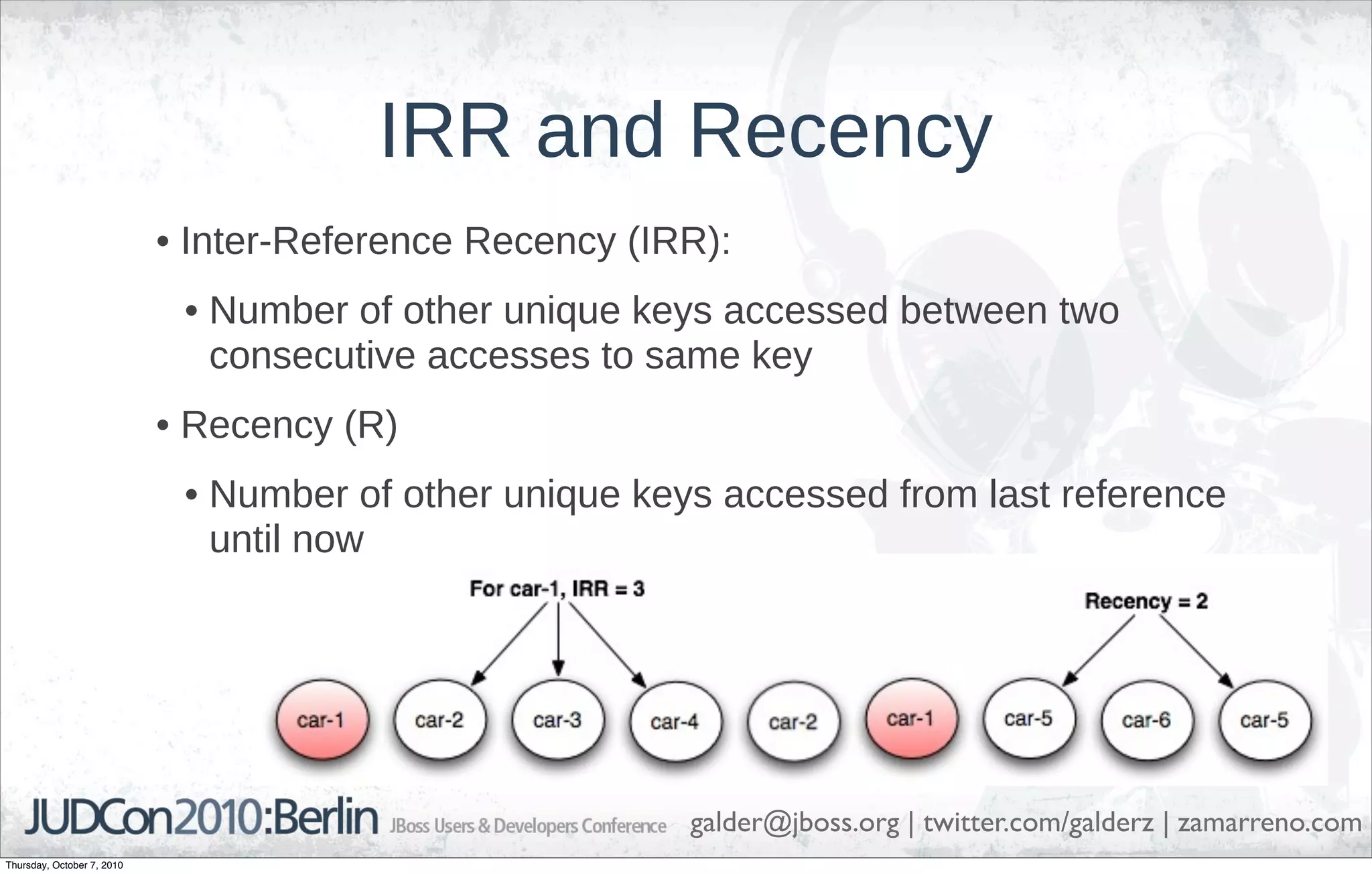
IRR and Recency
                            • Inter-Reference Recency (IRR):
                             • Number of other unique keys accessed between two
                               consecutive accesses to same key
                            • Recency (R)
                             • Number of other unique keys accessed from last reference
                               until now


                                                         galder@jboss.org | twitter.com/galderz | zamarreno.com
Thursday, October 7, 2010
How does LIRS work?


                            • If key has a high IRR, it’s next IRR is likely to be high again
                             • Keys with highest IRR are considered for eviction
                            • Once IRR is out of date, we start relying on Recency
                            • LIRS = Low Inter-reference Recency Set


                                                             galder@jboss.org | twitter.com/galderz | zamarreno.com
Thursday, October 7, 2010
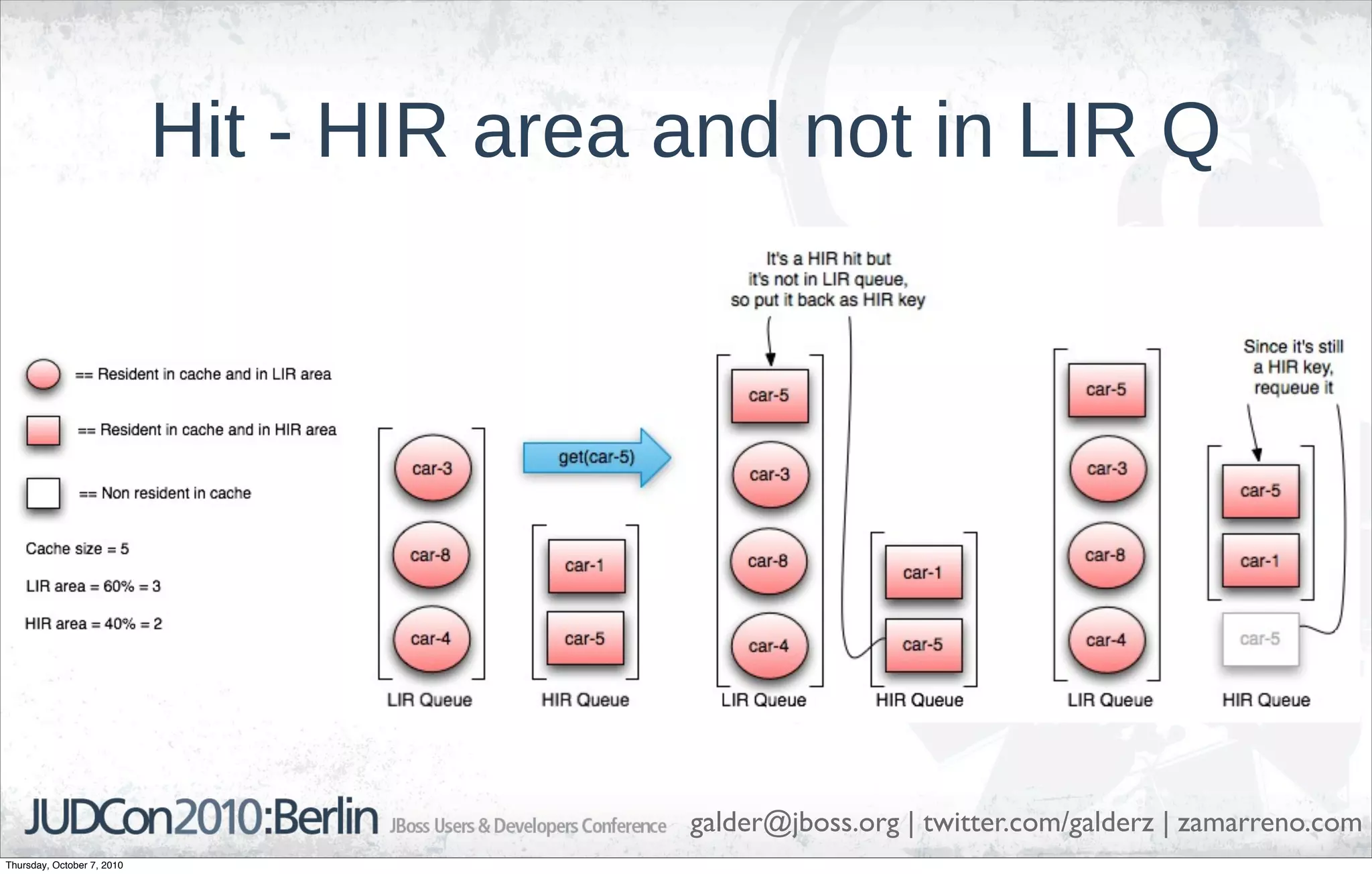
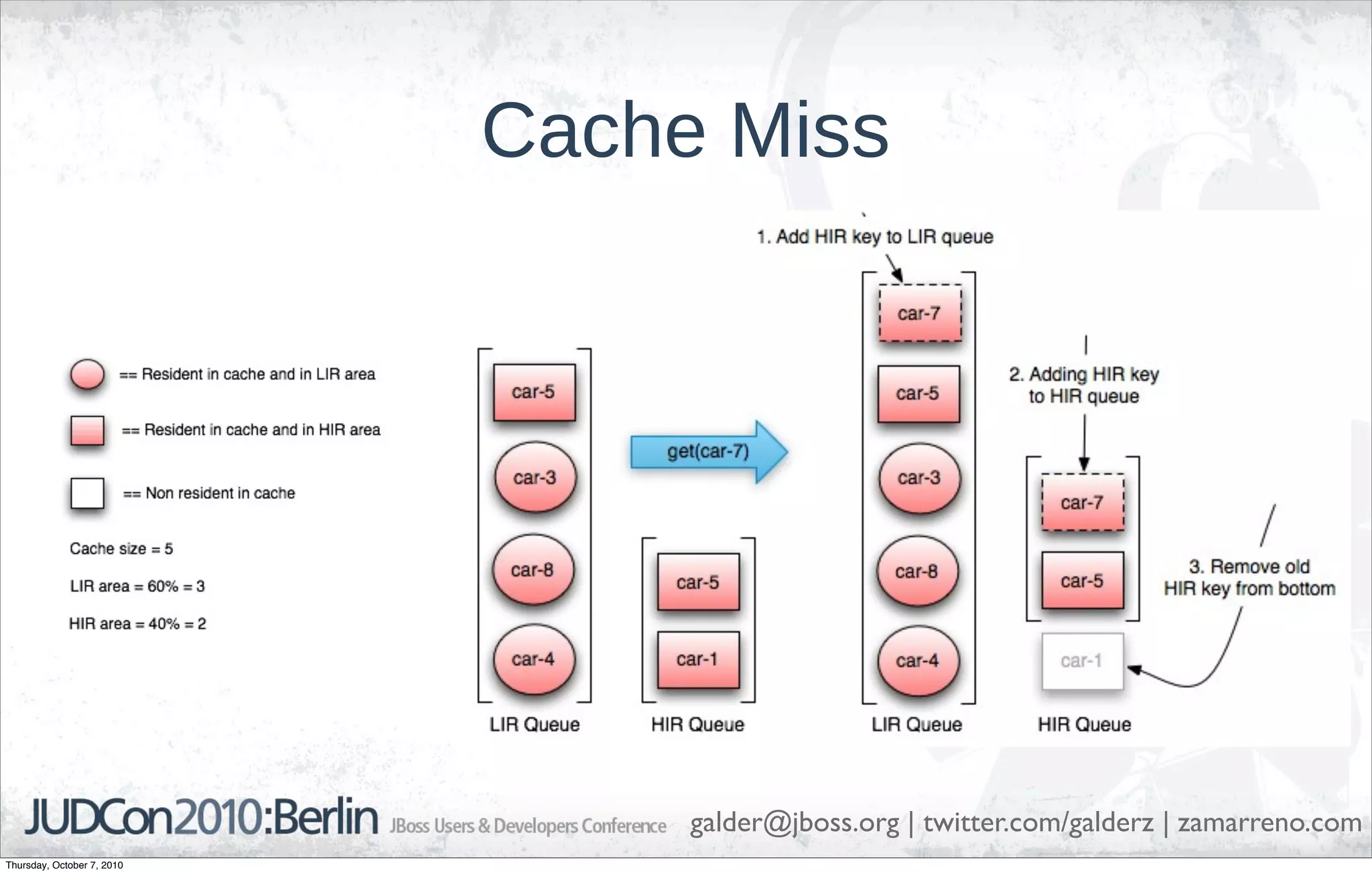
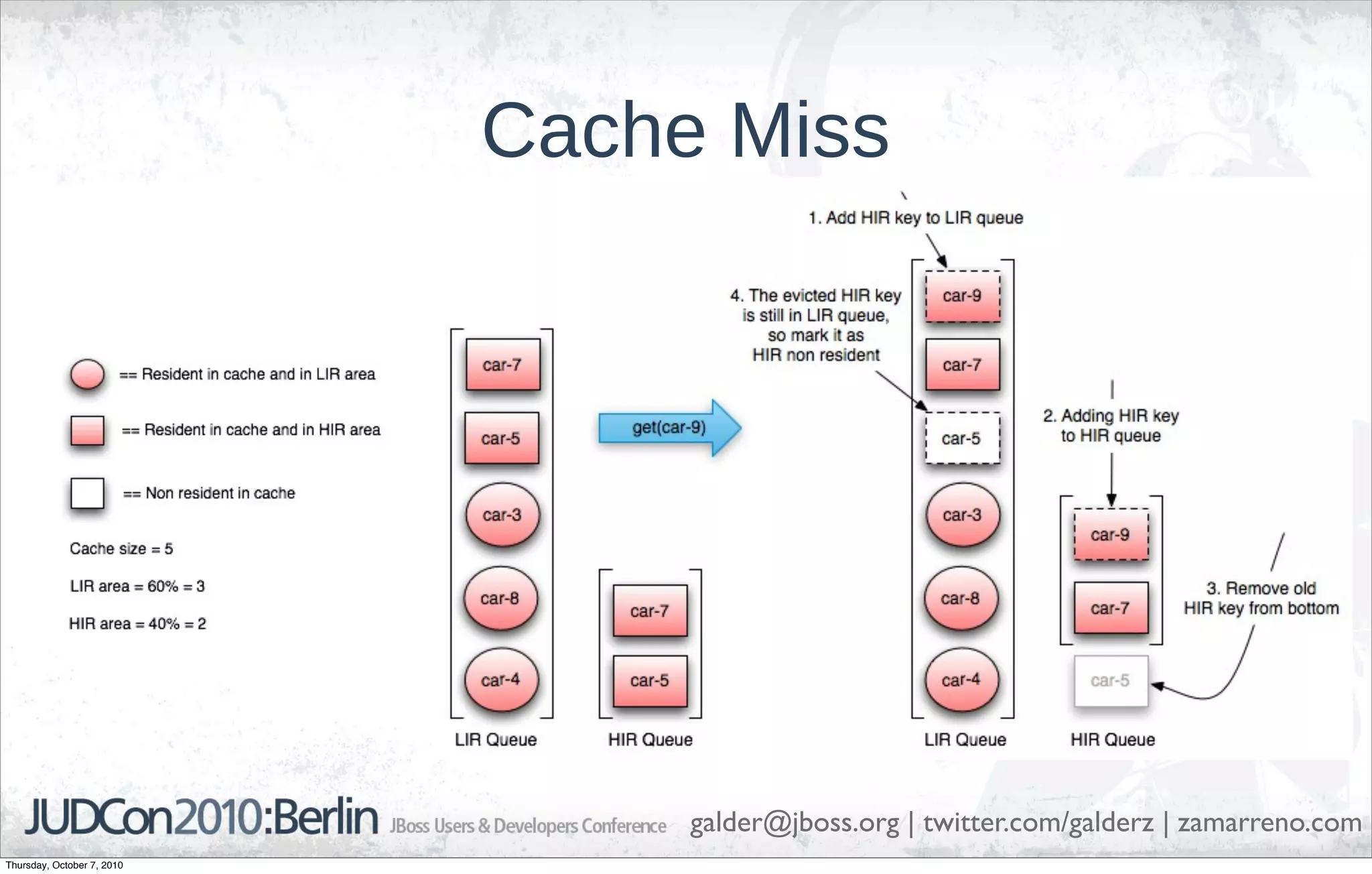
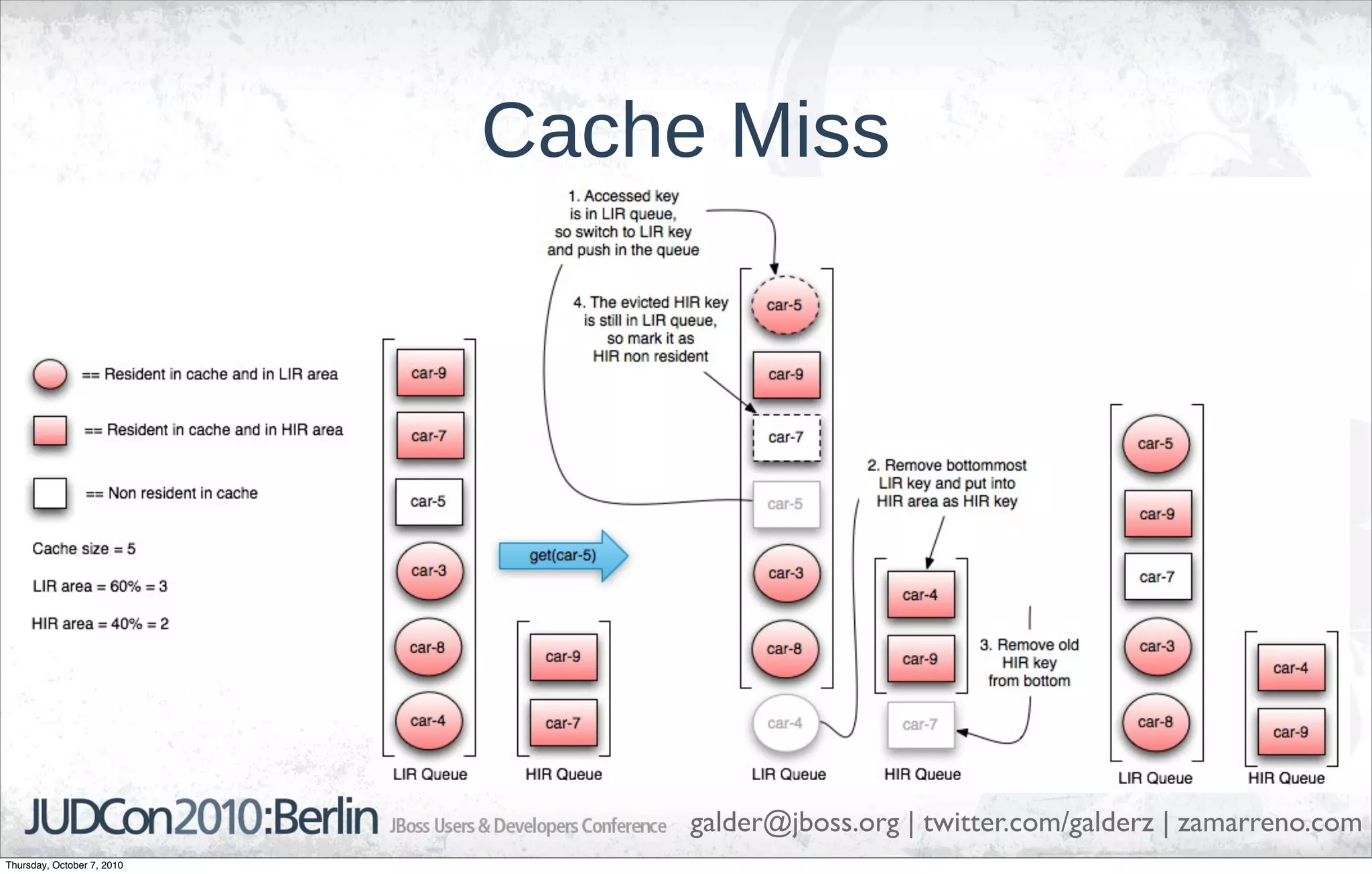
How is LIRS implemented?

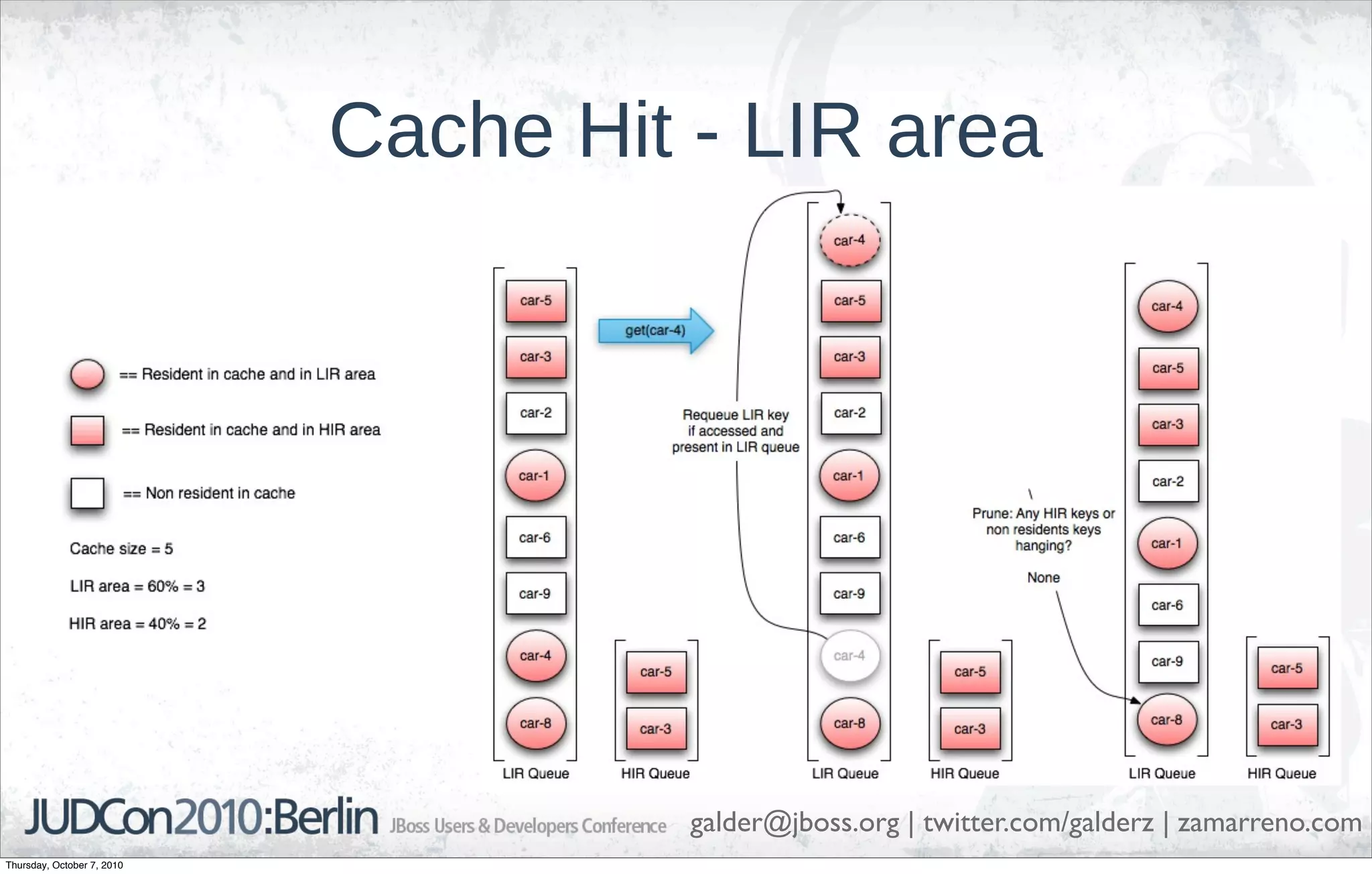
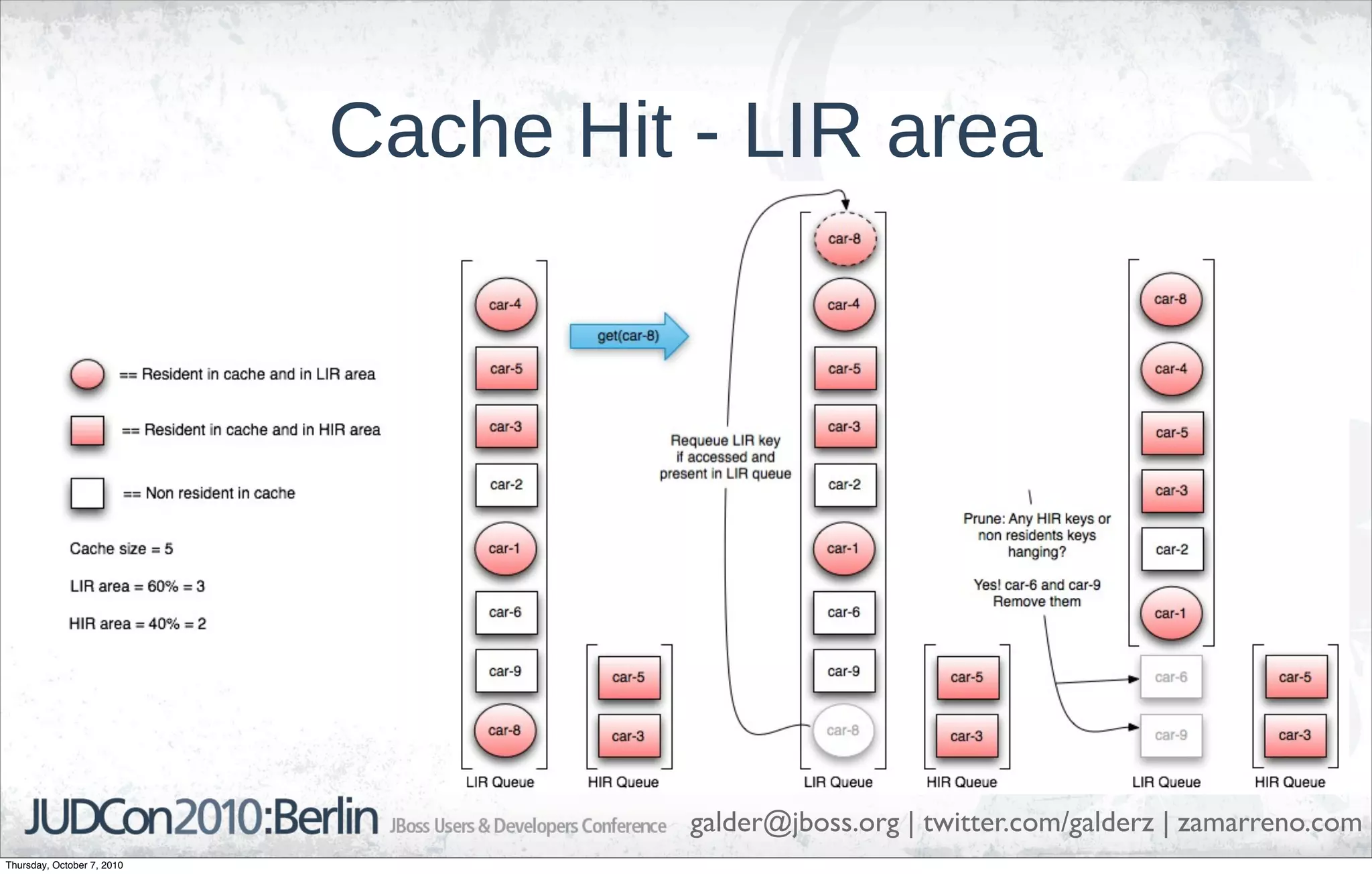
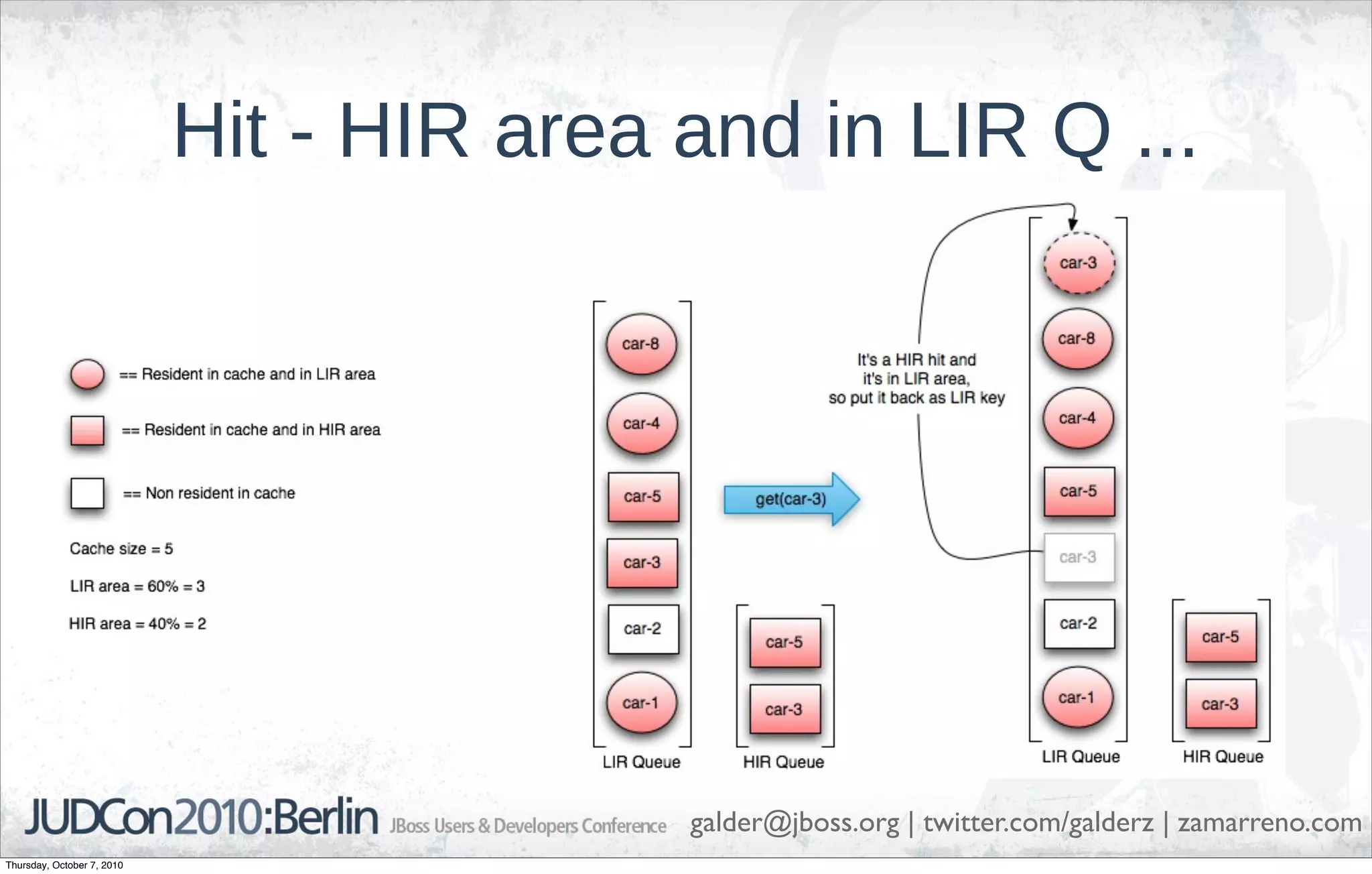
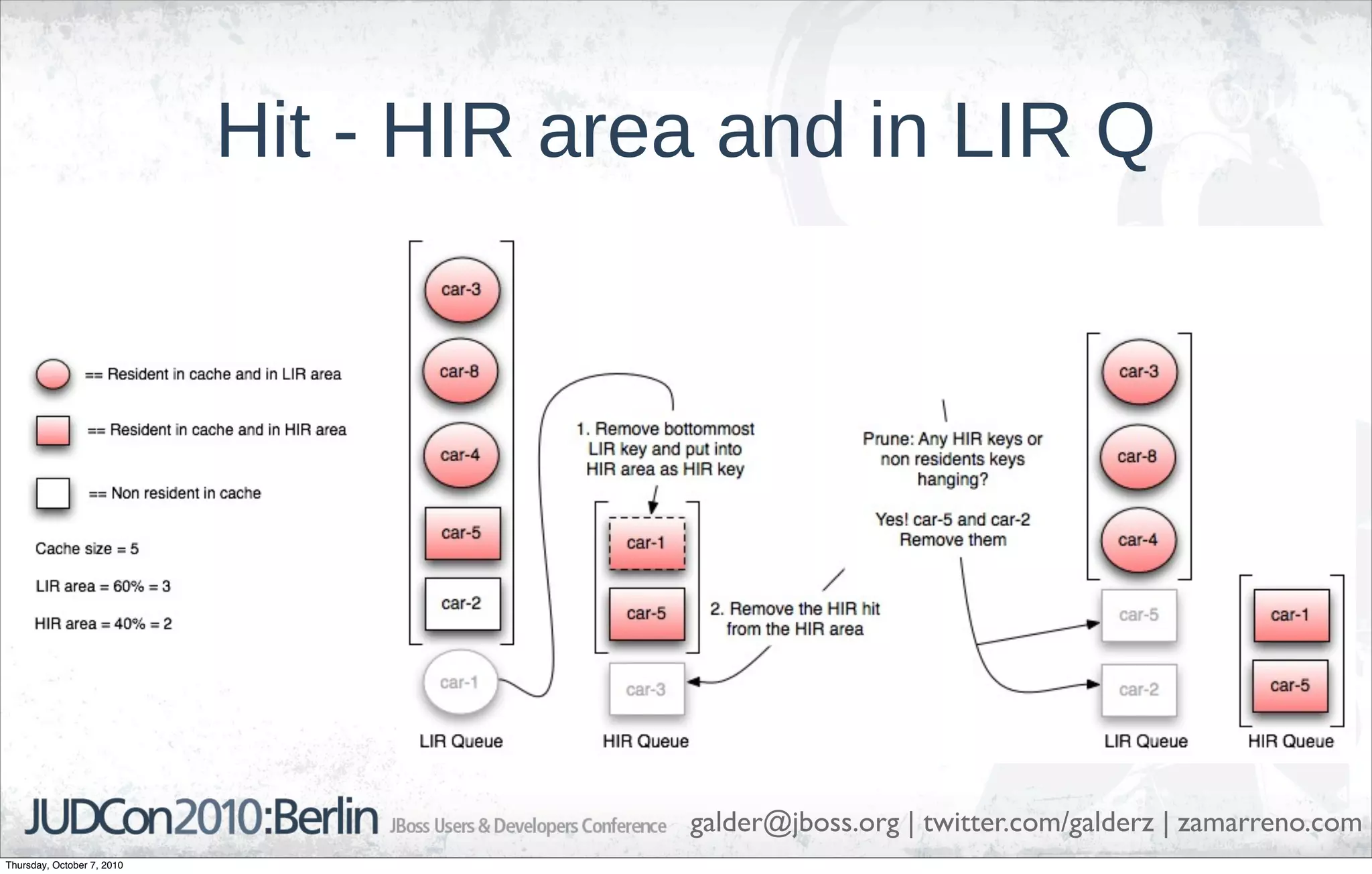
                            • Low IRR (LIR) area
                             • Holds hot keys!
                            • High IRR (HIR) area
                             • Holds recently accessed keys
                             • Keys here might get promoted to LIR area


                                                         galder@jboss.org | twitter.com/galderz | zamarreno.com
Thursday, October 7, 2010
Cache Hit - LIR area


                                      galder@jboss.org | twitter.com/galderz | zamarreno.com
Thursday, October 7, 2010
Cache Hit - LIR area


                                      galder@jboss.org | twitter.com/galderz | zamarreno.com
Thursday, October 7, 2010
Hit - HIR area and in LIR Q ...


                                           galder@jboss.org | twitter.com/galderz | zamarreno.com
Thursday, October 7, 2010
Hit - HIR area and in LIR Q


                                         galder@jboss.org | twitter.com/galderz | zamarreno.com
Thursday, October 7, 2010
Hit - HIR area and not in LIR Q


                                           galder@jboss.org | twitter.com/galderz | zamarreno.com
Thursday, October 7, 2010
Cache Miss


                                 galder@jboss.org | twitter.com/galderz | zamarreno.com
Thursday, October 7, 2010
Cache Miss


                                 galder@jboss.org | twitter.com/galderz | zamarreno.com
Thursday, October 7, 2010
Cache Miss


                                 galder@jboss.org | twitter.com/galderz | zamarreno.com
Thursday, October 7, 2010
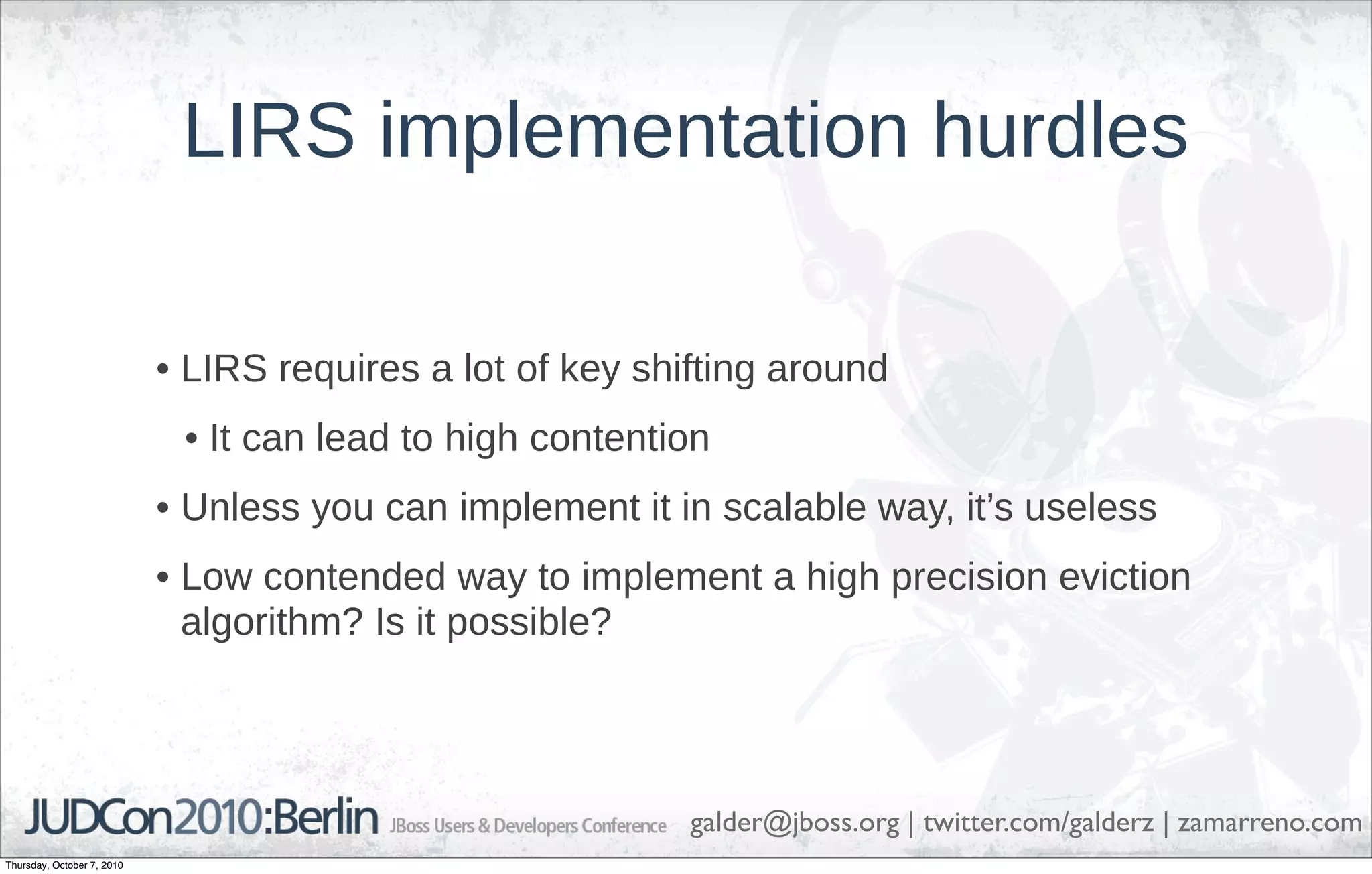
LIRS implementation hurdles

                            • LIRS requires a lot of key shifting around
                             • It can lead to high contention
                            • Unless you can implement it in scalable way, it’s useless
                            • Low contended way to implement a high precision eviction
                              algorithm? Is it possible?


                                                            galder@jboss.org | twitter.com/galderz | zamarreno.com
Thursday, October 7, 2010
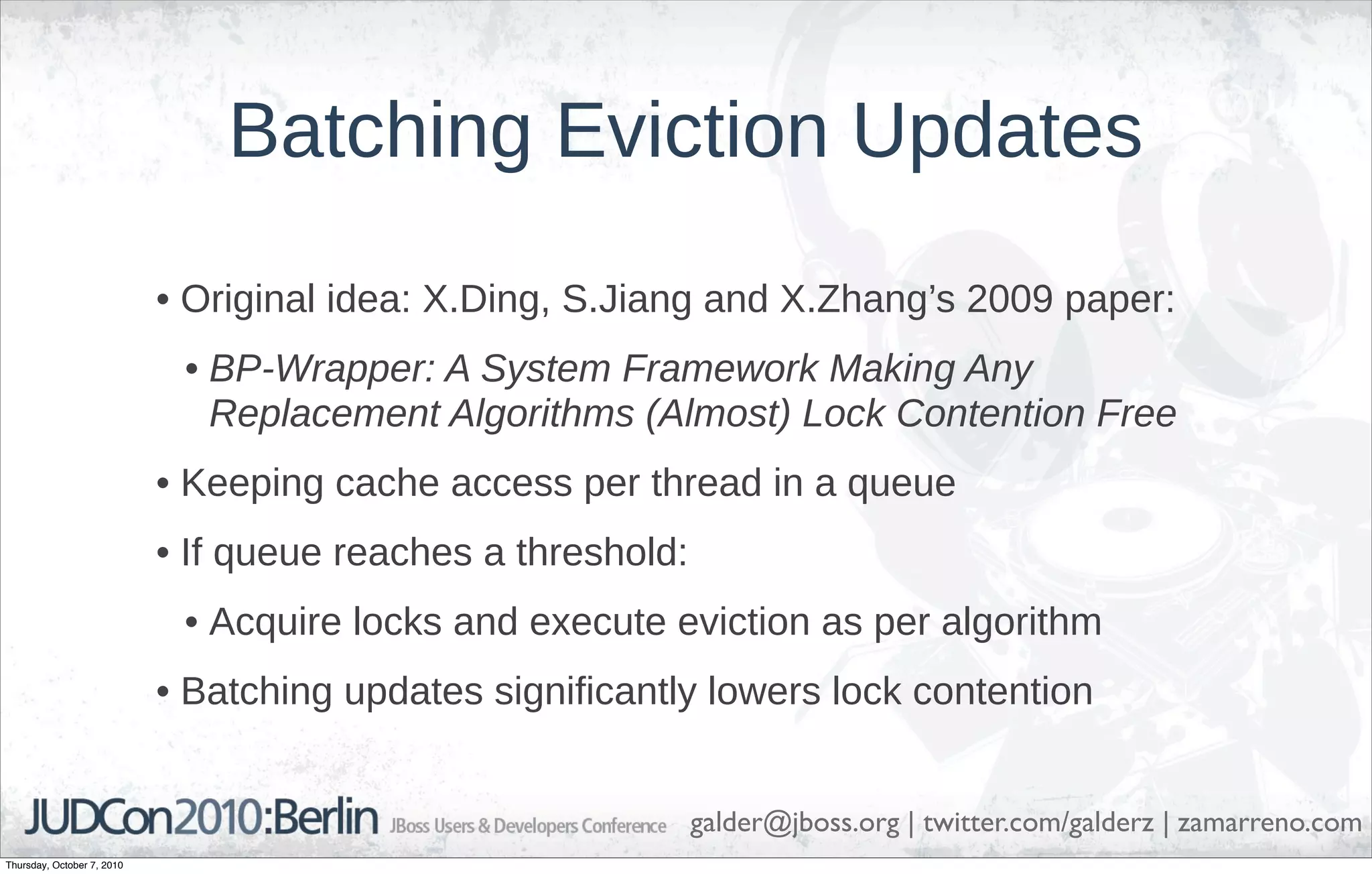
Batching Eviction Updates
                            • Original idea: X.Ding, S.Jiang and X.Zhang’s 2009 paper:
                             • BP-Wrapper: A System Framework Making Any
                               Replacement Algorithms (Almost) Lock Contention Free
                            • Keeping cache access per thread in a queue
                            • If queue reaches a threshold:
                             • Acquire locks and execute eviction as per algorithm
                            • Batching updates significantly lowers lock contention


                                                              galder@jboss.org | twitter.com/galderz | zamarreno.com
Thursday, October 7, 2010
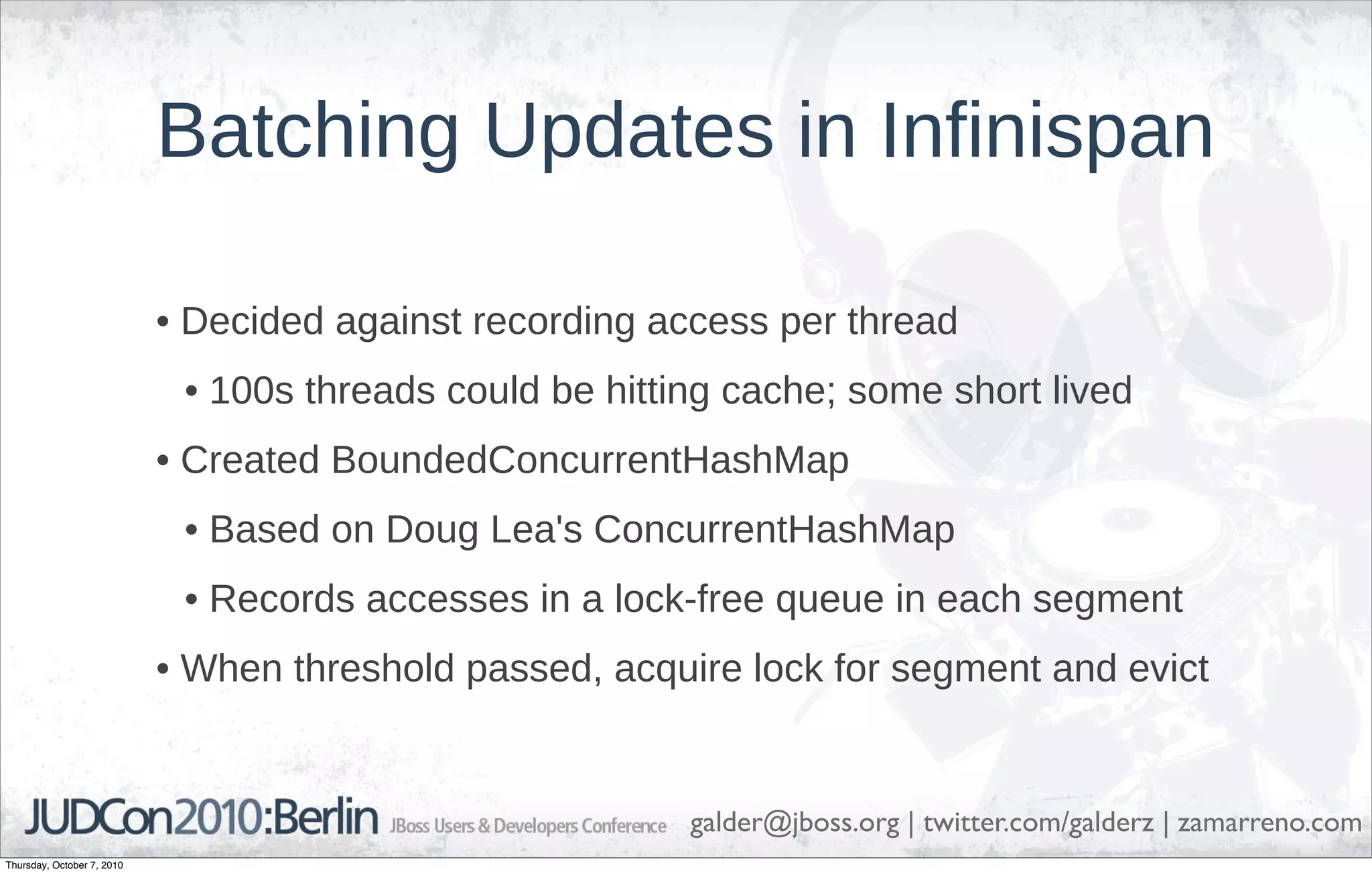
Batching Updates in Infinispan

                            • Decided against recording access per thread
                             • 100s threads could be hitting cache; some short lived
                            • Created BoundedConcurrentHashMap
                             • Based on Doug Lea's ConcurrentHashMap
                             • Records accesses in a lock-free queue in each segment
                            • When threshold passed, acquire lock for segment and evict


                                                          galder@jboss.org | twitter.com/galderz | zamarreno.com
Thursday, October 7, 2010
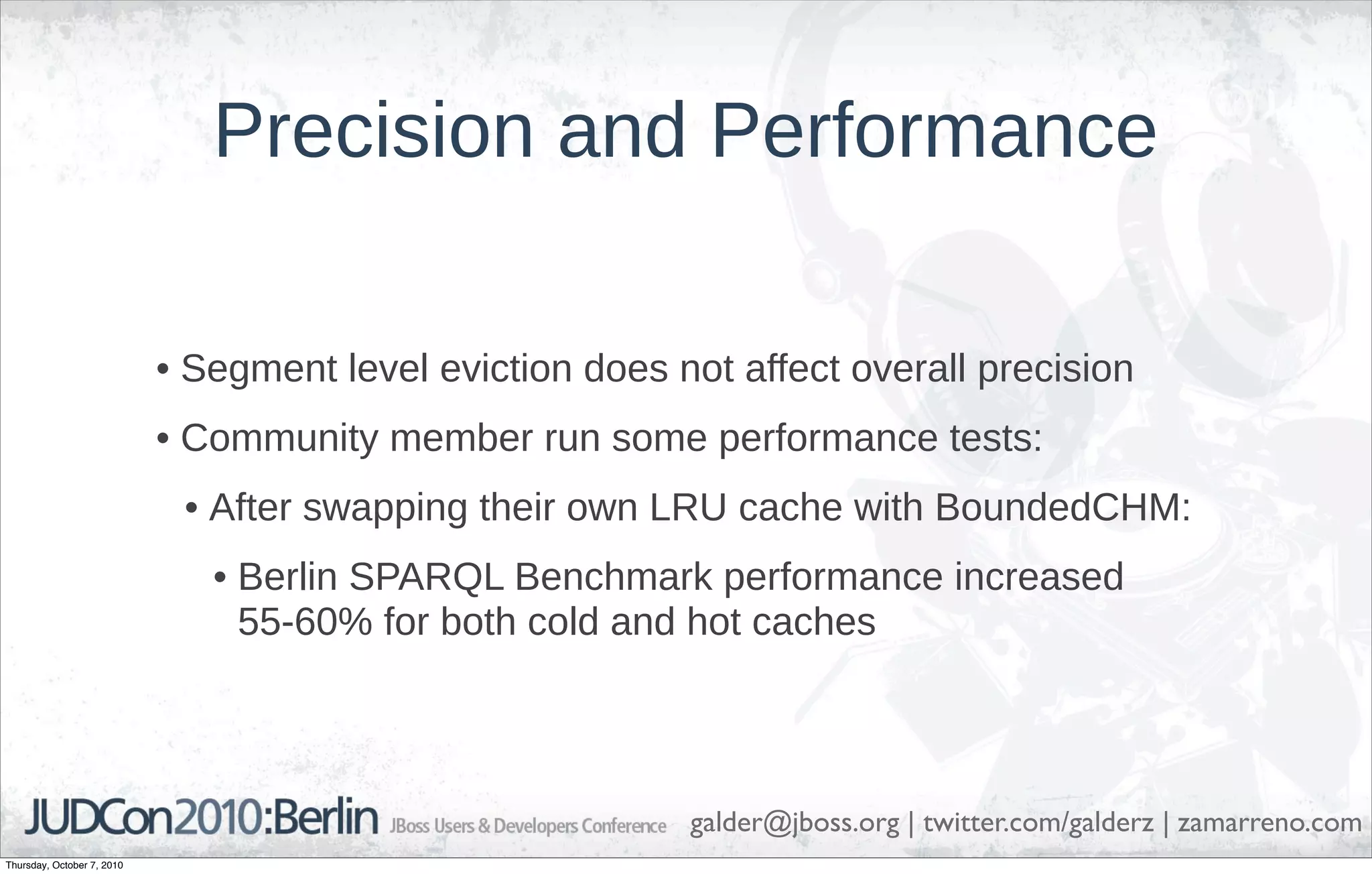
Precision and Performance

                            • Segment level eviction does not affect overall precision
                            • Community member run some performance tests:
                             • After swapping their own LRU cache with BoundedCHM:
                               • Berlin SPARQL Benchmark performance increased
                                 55-60% for both cold and hot caches


                                                           galder@jboss.org | twitter.com/galderz | zamarreno.com
Thursday, October 7, 2010
Summary

                            • In JBoss Cache, eviction can become a bottleneck
                            • Infinispan 4.0 uses conservative eviction
                            • Infinispan 4.1 has more precise eviction algorithm (LIRS)
                            • Batching updates, present in 4.1, significantly lowers lock
                              contention
                            • Result = Highly-concurrent, highly-precise implicit eviction


                                                            galder@jboss.org | twitter.com/galderz | zamarreno.com
Thursday, October 7, 2010
Questions?

                            infinispan.org
                            blog.infinispan.org
                            twitter.com/infinispan
                               #infinispan
                               #judcon

                                                     galder@jboss.org | twitter.com/galderz | zamarreno.com
Thursday, October 7, 2010

Keeping Infinispan In Shape: Highly-Precise, Scalable Data Eviction

  • 1.
    galder@jboss.org | twitter.com/galderz| zamarreno.com Thursday, October 7, 2010
  • 2.
    Keeping Infinispan InShape: Highly-Precise, Scalable Data Eviction Galder Zamarreño & Vladimir Blagojevic Senior Engineer, Red Hat 7th October 2010, JUDCon - Berlin galder@jboss.org | twitter.com/galderz | zamarreno.com Thursday, October 7, 2010
  • 3.
    Who is Galder? • R&D engineer (Red Hat Inc): • Infinispan developer • JBoss Cache developer • Contributor and committer: • JBoss AS, Hibernate, JGroups, JBoss Portal,...etc • Blog: zamarreno.com • Twitter: @galderz galder@jboss.org | twitter.com/galderz | zamarreno.com Thursday, October 7, 2010
  • 4.
    Agenda • Eviction in: • Java Collections Framework • JBoss Cache • Infinispan 4.0 • New in Infinispan 4.1: • LIRS • Batching Updates galder@jboss.org | twitter.com/galderz | zamarreno.com Thursday, October 7, 2010
  • 5.
    Java Collections Framework • Key building block of any Java app • Introduced in Java 1.2 • Extended with concurrent collections in Java 1.5 • Collection element eviction ?? galder@jboss.org | twitter.com/galderz | zamarreno.com Thursday, October 7, 2010
  • 6.
    Collections cannot growforever galder@jboss.org | twitter.com/galderz | zamarreno.com Thursday, October 7, 2010
  • 7.
    If using acollection as cache • Forces clients to either: • Remove elements proactively • Or run a periodic cleanup process • Which can be a PITA... galder@jboss.org | twitter.com/galderz | zamarreno.com Thursday, October 7, 2010
  • 8.
    Eviction in JBossCache days galder@jboss.org | twitter.com/galderz | zamarreno.com Thursday, October 7, 2010
  • 9.
    JBoss Cache evictionissues • Under heavy load, eviction queues could fill up - bottleneck • Possibly a side effect of MVCC’s non-blocking reads • Separating data into regions could alleviate the issue • But it’s really a hack! galder@jboss.org | twitter.com/galderz | zamarreno.com Thursday, October 7, 2010
  • 10.
    Original Infinispan 4.0eviction • Tried a different approach: • Avoid using queues to hold events • Taking advantage of tree to map change: • Attempt to maintain map ordered as per eviction rules • Could we use ConcurrentSkipListMap ? • No. O(1) desired for all map operations galder@jboss.org | twitter.com/galderz | zamarreno.com Thursday, October 7, 2010
  • 11.
    Doubly Linked ConcurrentHashMap • Based on H.Sundell and P.Tsigas paper: • Lock-Free Deques and Doubly Linked Lists (2008) • With each cache access or update update links • Eviction just a matter of walking the linked list one way galder@jboss.org | twitter.com/galderz | zamarreno.com Thursday, October 7, 2010
  • 12.
    Issues under heavyload • Algorithm always uses same node (the tail) to append stuff • With high concurrency, CAS stress lead to loads of retrying • So much retrying, we’re getting infinite loops • Before 4.0.0.Final, reverted to a more conservative algorithm galder@jboss.org | twitter.com/galderz | zamarreno.com Thursday, October 7, 2010
  • 13.
    4.0.0.Final eviction galder@jboss.org | twitter.com/galderz | zamarreno.com Thursday, October 7, 2010
  • 14.
    LRU eviction algorithmissues • Weak access locality • One-time accessed keys not evicted timely • In loops, soon to be accessed keys might get evicted first • With distinct access frequencies, frequently accessed keys can unfortunately get evicted • LRU’s working set limited to cache size galder@jboss.org | twitter.com/galderz | zamarreno.com Thursday, October 7, 2010
  • 15.
    Enter the room...LIRS • Eviction algorithm that can cope with weak access locality • Based on S.Jiang and X.Zhang’s 2002 paper: • LIRS: An efficient low inter-reference recency set replacement policy to improve buffer cache performance • LIRS based around two concepts: IRR and Recency galder@jboss.org | twitter.com/galderz | zamarreno.com Thursday, October 7, 2010
  • 16.
    IRR and Recency • Inter-Reference Recency (IRR): • Number of other unique keys accessed between two consecutive accesses to same key • Recency (R) • Number of other unique keys accessed from last reference until now galder@jboss.org | twitter.com/galderz | zamarreno.com Thursday, October 7, 2010
  • 17.
    How does LIRSwork? • If key has a high IRR, it’s next IRR is likely to be high again • Keys with highest IRR are considered for eviction • Once IRR is out of date, we start relying on Recency • LIRS = Low Inter-reference Recency Set galder@jboss.org | twitter.com/galderz | zamarreno.com Thursday, October 7, 2010
  • 18.
    How is LIRSimplemented? • Low IRR (LIR) area • Holds hot keys! • High IRR (HIR) area • Holds recently accessed keys • Keys here might get promoted to LIR area galder@jboss.org | twitter.com/galderz | zamarreno.com Thursday, October 7, 2010
  • 19.
    Cache Hit -LIR area galder@jboss.org | twitter.com/galderz | zamarreno.com Thursday, October 7, 2010
  • 20.
    Cache Hit -LIR area galder@jboss.org | twitter.com/galderz | zamarreno.com Thursday, October 7, 2010
  • 21.
    Hit - HIRarea and in LIR Q ... galder@jboss.org | twitter.com/galderz | zamarreno.com Thursday, October 7, 2010
  • 22.
    Hit - HIRarea and in LIR Q galder@jboss.org | twitter.com/galderz | zamarreno.com Thursday, October 7, 2010
  • 23.
    Hit - HIRarea and not in LIR Q galder@jboss.org | twitter.com/galderz | zamarreno.com Thursday, October 7, 2010
  • 24.
    Cache Miss galder@jboss.org | twitter.com/galderz | zamarreno.com Thursday, October 7, 2010
  • 25.
    Cache Miss galder@jboss.org | twitter.com/galderz | zamarreno.com Thursday, October 7, 2010
  • 26.
    Cache Miss galder@jboss.org | twitter.com/galderz | zamarreno.com Thursday, October 7, 2010
  • 27.
    LIRS implementation hurdles • LIRS requires a lot of key shifting around • It can lead to high contention • Unless you can implement it in scalable way, it’s useless • Low contended way to implement a high precision eviction algorithm? Is it possible? galder@jboss.org | twitter.com/galderz | zamarreno.com Thursday, October 7, 2010
  • 28.
    Batching Eviction Updates • Original idea: X.Ding, S.Jiang and X.Zhang’s 2009 paper: • BP-Wrapper: A System Framework Making Any Replacement Algorithms (Almost) Lock Contention Free • Keeping cache access per thread in a queue • If queue reaches a threshold: • Acquire locks and execute eviction as per algorithm • Batching updates significantly lowers lock contention galder@jboss.org | twitter.com/galderz | zamarreno.com Thursday, October 7, 2010
  • 29.
    Batching Updates inInfinispan • Decided against recording access per thread • 100s threads could be hitting cache; some short lived • Created BoundedConcurrentHashMap • Based on Doug Lea's ConcurrentHashMap • Records accesses in a lock-free queue in each segment • When threshold passed, acquire lock for segment and evict galder@jboss.org | twitter.com/galderz | zamarreno.com Thursday, October 7, 2010
  • 30.
    Precision and Performance • Segment level eviction does not affect overall precision • Community member run some performance tests: • After swapping their own LRU cache with BoundedCHM: • Berlin SPARQL Benchmark performance increased 55-60% for both cold and hot caches galder@jboss.org | twitter.com/galderz | zamarreno.com Thursday, October 7, 2010
  • 31.
    Summary • In JBoss Cache, eviction can become a bottleneck • Infinispan 4.0 uses conservative eviction • Infinispan 4.1 has more precise eviction algorithm (LIRS) • Batching updates, present in 4.1, significantly lowers lock contention • Result = Highly-concurrent, highly-precise implicit eviction galder@jboss.org | twitter.com/galderz | zamarreno.com Thursday, October 7, 2010
  • 32.
    Questions? infinispan.org blog.infinispan.org twitter.com/infinispan #infinispan #judcon galder@jboss.org | twitter.com/galderz | zamarreno.com Thursday, October 7, 2010