




WHAT   IT  IS  ????
INFORMATION AND COMMUNICATION TECHNOLOGY (ICT) FORM 4Topic		3.0	Computer Network And Communication	 Sub Topic	3.1	Basic Concepts Of Computer Networks	And Communications
NETWORK  STANDARDS   & PROTOCOLSLESSON OBJECTIVES
NETWORK STANDARDS
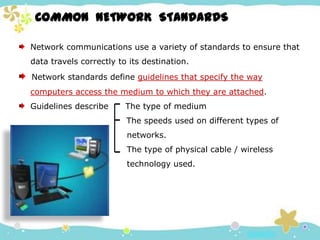
COMMON  NETWORK  STANDARDSNetwork communications use a variety of standards to ensure that data travels correctly to its destination.Network standards define guidelines that specify the waycomputers access the medium to which they are attached. Guidelines describe      The type of mediumThe speeds used on different types of  networks.  The type of physical cable / wireless    technology used.
COMMON  NETWORK  STANDARDS  The well-known standards adopted by theInstitute of Electrical and Electronic     Engineers (IEEE) are the 802 standards.   Requirements for physical cabling    and specify the way data is    transmitted.The ones we will get to know here are :802.3 (Ethernet LAN)802.7 (Broadband LAN)802.8 (Fiber-Optic LAN And MAN)802.11 (WIRELESS LAN)
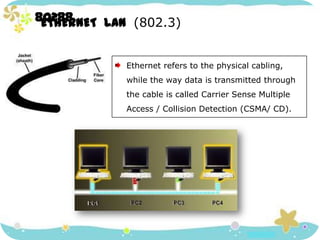
80288ETHERNET  LAN  (802.3)  Ethernet refers to the physical cabling,while the way data is transmitted through     the cable is called Carrier Sense Multiple    Access / Collision Detection (CSMA/ CD).
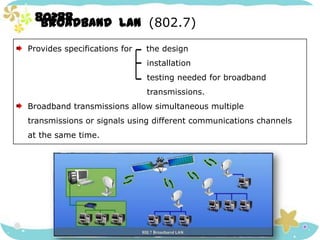
80288BROADBAND  LAN  (802.7)  Provides specifications for     the design                                              installation                                             testing needed for broadband                                              transmissions.  Broadband transmissions allow simultaneous multiple     transmissions or signals using different communications channels   at the same time.
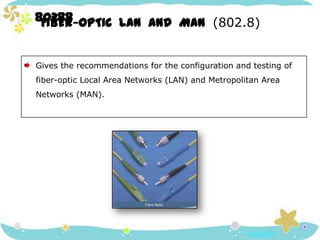
80288FIBER-OPTIC  LAN  AND  MAN(802.8) Gives the recommendations for the configuration and testing of   fiber-optic Local Area Networks (LAN) and Metropolitan Area    Networks (MAN).
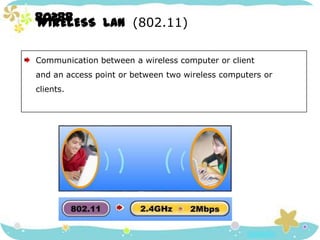
80288WIRELESS  LAN  (802.11)  Communication between a wireless computer or client     and an access point or between two wireless computers orclients.
80288BRAIN TEST !!!!What is Networks Standards ?There are four (4) types of Networks Standards.Network Standards is guidelines that specify the waycomputers access the medium to which they are attached.Ethernet LAN (802.3)Broadband LAN (802.7)Fiber-Optic LAN & MAN (802.8)WIreless LAN (802.11)
PROTOCOLS
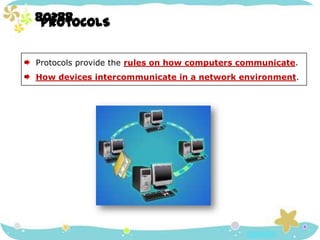
80288PROTOCOLS Protocols provide the rules on how computers communicate.How devices intercommunicate in a network environment.
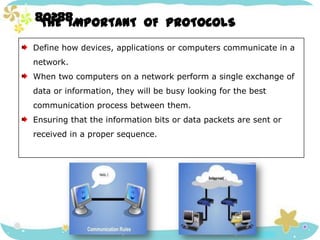
80288THE  IMPORTANT  OF  PROTOCOLS Define how devices, applications or computers communicate in a   network.  When two computers on a network perform a single exchange ofdata or information, they will be busy looking for the best    communication process between them.  Ensuring that the information bits or data packets are sent or    received in a proper sequence.
80288TYPES   OF  PROTOCOLSHypertext Transfer Protocol (HTTP)  Simple Mail Transfer Protocol (SMTP)  File Transfer Protocol (FTP)  Transmission Control Protocol (TCP)  Internet Protocol (IP)
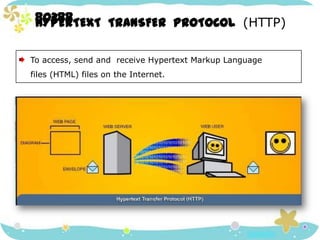
80288HYPERTEXT  TRANSFER  PROTOCOL  (HTTP)     To access, send and  receive Hypertext Markup Languagefiles (HTML) files on the Internet.
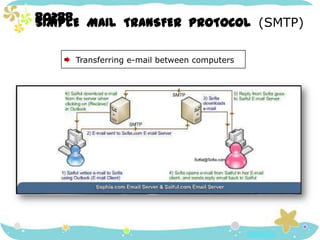
80288SIMPLE  MAIL  TRANSFER  PROTOCOL  (SMTP)     Transferring e-mail between computers
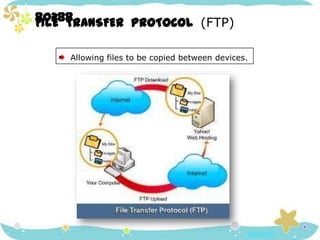
80288FILE  TRANSFER  PROTOCOL  (FTP)     Allowing files to be copied between devices.
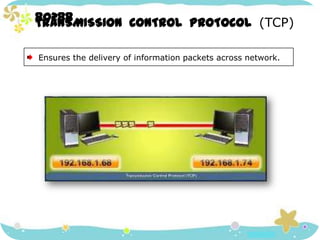
80288TRANSMISSION  CONTROL  PROTOCOL  (TCP)      Ensures the delivery of information packets across network.
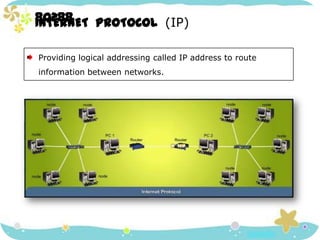
80288INTERNET  PROTOCOL  (IP)      Providing logical addressing called IP address to route   information between networks.
GROUP ACTIVITY
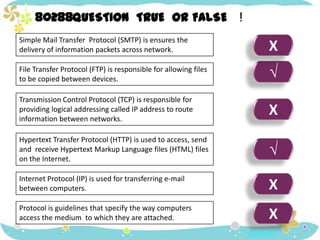
80288QUESTION  TRUE  OR FALSE   !    Simple Mail Transfer  Protocol (SMTP) is ensures the delivery of information packets across network. X√File Transfer Protocol (FTP) is responsible for allowing files to be copied between devices. Transmission Control Protocol (TCP) is responsible for providing logical addressing called IP address to route information between networks. XHypertext Transfer Protocol (HTTP) is used to access, send and  receive Hypertext Markup Language files (HTML) files on the Internet. √Internet Protocol (IP) is used for transferring e-mail between computers. XProtocol is guidelines that specify the way computers access the medium  to which they are attached. X
SUMMARY
SUMMARY
THANK YOU!!

Protocol

  • 1.
    WHAT IT IS ????
  • 2.
    INFORMATION AND COMMUNICATIONTECHNOLOGY (ICT) FORM 4Topic 3.0 Computer Network And Communication Sub Topic 3.1 Basic Concepts Of Computer Networks And Communications
  • 3.
    NETWORK STANDARDS & PROTOCOLSLESSON OBJECTIVES
  • 4.
  • 5.
    COMMON NETWORK STANDARDSNetwork communications use a variety of standards to ensure that data travels correctly to its destination.Network standards define guidelines that specify the waycomputers access the medium to which they are attached. Guidelines describe The type of mediumThe speeds used on different types of networks. The type of physical cable / wireless technology used.
  • 6.
    COMMON NETWORK STANDARDS The well-known standards adopted by theInstitute of Electrical and Electronic Engineers (IEEE) are the 802 standards. Requirements for physical cabling and specify the way data is transmitted.The ones we will get to know here are :802.3 (Ethernet LAN)802.7 (Broadband LAN)802.8 (Fiber-Optic LAN And MAN)802.11 (WIRELESS LAN)
  • 7.
    80288ETHERNET LAN (802.3) Ethernet refers to the physical cabling,while the way data is transmitted through the cable is called Carrier Sense Multiple Access / Collision Detection (CSMA/ CD).
  • 8.
    80288BROADBAND LAN (802.7) Provides specifications for the design installation testing needed for broadband transmissions. Broadband transmissions allow simultaneous multiple transmissions or signals using different communications channels at the same time.
  • 9.
    80288FIBER-OPTIC LAN AND MAN(802.8) Gives the recommendations for the configuration and testing of fiber-optic Local Area Networks (LAN) and Metropolitan Area Networks (MAN).
  • 10.
    80288WIRELESS LAN (802.11) Communication between a wireless computer or client and an access point or between two wireless computers orclients.
  • 11.
    80288BRAIN TEST !!!!Whatis Networks Standards ?There are four (4) types of Networks Standards.Network Standards is guidelines that specify the waycomputers access the medium to which they are attached.Ethernet LAN (802.3)Broadband LAN (802.7)Fiber-Optic LAN & MAN (802.8)WIreless LAN (802.11)
  • 12.
  • 13.
    80288PROTOCOLS Protocols providethe rules on how computers communicate.How devices intercommunicate in a network environment.
  • 14.
    80288THE IMPORTANT OF PROTOCOLS Define how devices, applications or computers communicate in a network. When two computers on a network perform a single exchange ofdata or information, they will be busy looking for the best communication process between them. Ensuring that the information bits or data packets are sent or received in a proper sequence.
  • 15.
    80288TYPES OF PROTOCOLSHypertext Transfer Protocol (HTTP) Simple Mail Transfer Protocol (SMTP) File Transfer Protocol (FTP) Transmission Control Protocol (TCP) Internet Protocol (IP)
  • 16.
    80288HYPERTEXT TRANSFER PROTOCOL (HTTP) To access, send and receive Hypertext Markup Languagefiles (HTML) files on the Internet.
  • 17.
    80288SIMPLE MAIL TRANSFER PROTOCOL (SMTP) Transferring e-mail between computers
  • 18.
    80288FILE TRANSFER PROTOCOL (FTP) Allowing files to be copied between devices.
  • 19.
    80288TRANSMISSION CONTROL PROTOCOL (TCP) Ensures the delivery of information packets across network.
  • 20.
    80288INTERNET PROTOCOL (IP) Providing logical addressing called IP address to route information between networks.
  • 21.
  • 22.
    80288QUESTION TRUE OR FALSE ! Simple Mail Transfer Protocol (SMTP) is ensures the delivery of information packets across network. X√File Transfer Protocol (FTP) is responsible for allowing files to be copied between devices. Transmission Control Protocol (TCP) is responsible for providing logical addressing called IP address to route information between networks. XHypertext Transfer Protocol (HTTP) is used to access, send and receive Hypertext Markup Language files (HTML) files on the Internet. √Internet Protocol (IP) is used for transferring e-mail between computers. XProtocol is guidelines that specify the way computers access the medium to which they are attached. X
  • 23.
  • 24.
  • 25.