Definition of Proposition….P
•A proposition is a statement that is either true or false, but not both
simultaneously.
• It is the basic unit of propositional logic, representing a claim or
assertion that can be evaluated for its either truth or false value.
• A proposition must have the structure of a complete sentence and must
make a distinct assertion or denial ‘’
3.
EXAMPLES
• Joan issitting in the chair is a proposition because it is a complete sentence that makes an assertion.
• I did not take the pen is a proposition because it is a complete sentence that makes a denial.
• Are you going to the store? is not a proposition because it is a question. It does not assert or deny anything.
• Three miles south of here is not a proposition because it does not make any claim and is not a complete
sentence.
• 7 + 9 = 2 is a proposition, even though it is false. It can be read as a complete sentence, and it makes a distinct
claim.
4.
Symbolization:
• Propositions areoften represented by variables such as p, q, r, etc.
• These variables stand for entire statements.
• Examples:
• p: "It is raining."
• q: "The sun is shining."
• r: "John is tall."
5.
Characteristics of Propositions:
•Must have a clear truth value (true or false).
• Can be simple or compound.
Examples:
• "The sky is blue." (True)
• "2 + 2 = 5." (False)
6.
Importance:
• Propositions formthe basis for logical reasoning and argumentation.
• They help in evaluating the truth or falsity of statements, leading to
sound conclusions.
7.
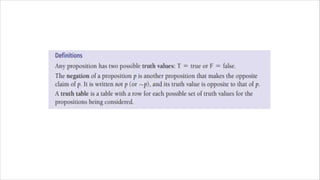
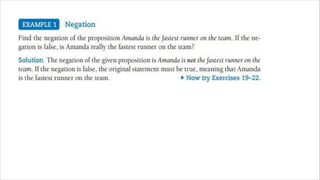
Negation (Opposites)…..not p……~p
• The logical opposite of a proposition is called its negation.
• Negations are also propositions, because they have the structure of a complete sentence and may be either true
or false.
• If we represent a proposition with a letter such as p, then its negation is not p (sometimes written ~ p).
Examples
• For example, the negation of Joan is sitting in the chair is Joan is not sitting in the chair
• and the negation of 7 + 9 = 2 is 7 + 9 2.
8.
Definition of anArgument:
• An argument is a set of propositions where one proposition (the
conclusion) is claimed to follow from the others (the premises).
• It aims to provide support or evidence for the truth of its conclusion.
9.
• Validity ofArguments:
• An argument is valid if the conclusion logically follows from the premises.
• Validity is not about the truth of the premises or conclusion but about the
structure of the argument.
• Identifying Valid and Invalid Arguments:
• Valid Argument: If the conclusion must be true whenever the premises are
true.
• Invalid Argument: If it is possible for the conclusion to be false even when the
premises are true.
10.
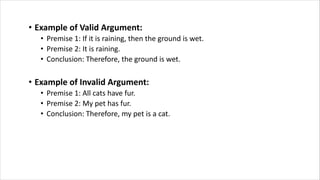
• Example ofValid Argument:
• Premise 1: If it is raining, then the ground is wet.
• Premise 2: It is raining.
• Conclusion: Therefore, the ground is wet.
• Example of Invalid Argument:
• Premise 1: All cats have fur.
• Premise 2: My pet has fur.
• Conclusion: Therefore, my pet is a cat.
11.
Truth Tables forLogical Connectives:
• Truth tables are used to determine the truth value of compound
propositions based on the truth values of their components.
• Each row in the truth table represents a possible combination of truth
values for the component propositions.
• Columns represent the component propositions and the compound
proposition.
12.
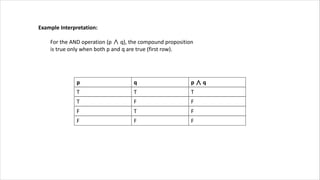
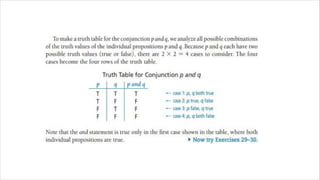
p q p∧ q
T T T
T F F
F T F
F F F
Example Interpretation:
For the AND operation (p ∧ q), the compound proposition
is true only when both p and q are true (first row).
13.
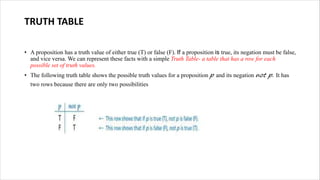
TRUTH TABLE
• Aproposition has a truth value of either true (T) or false (F). If a proposition is true, its negation must be false,
and vice versa. We can represent these facts with a simple Truth Table- a table that has a row for each
possible set of truth values.
• The following truth table shows the possible truth values for a proposition p and its negation not p. It has
two rows because there are only two possibilities
16.
• Importance ofTruth Tables:
• Truth tables provide a systematic method for evaluating the truth values of
compound propositions.
• They help in understanding the logical relationships between propositions.
• Visual Representation:
• Diagram or illustration showing the structure of a truth table with example entries.
• Applications of Truth Tables:
• Used in logic design, computer science, and philosophy for analyzing logical
statements and circuits.
• Essential for verifying the validity of arguments and evaluating logical expressions.
17.
Definition of LogicalConnectives:
• Logical connectives are symbols or words used to combine
propositions to form compound propositions.
• They help in expressing relationships between propositions and
constructing more complex statements.
18.
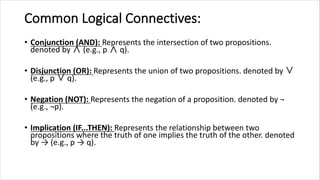
Common Logical Connectives:
•Conjunction (AND): Represents the intersection of two propositions.
denoted by ∧ (e.g., p ∧ q).
• Disjunction (OR): Represents the union of two propositions. denoted by ∨
(e.g., p ∨ q).
• Negation (NOT): Represents the negation of a proposition. denoted by ¬
(e.g., ¬p).
• Implication (IF...THEN): Represents the relationship between two
propositions where the truth of one implies the truth of the other. denoted
by → (e.g., p → q).
19.
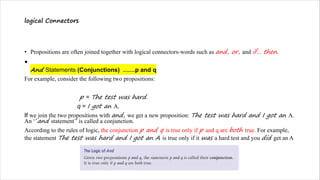
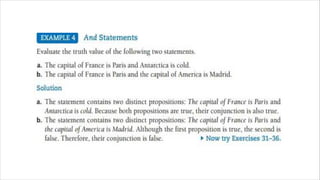
logical Connectors
• Propositionsare often joined together with logical connectors-words such as and, or, and if... then.
•
And Statements (Conjunctions) ……p and q
For example, consider the following two propositions:
p = The test was hard.
q = I got an A.
If we join the two propositions with and, we get a new proposition: The test was hard and I got an A.
An ‘’and statement’’ is called a conjunction.
According to the rules of logic, the conjunction p and q is true only if p and q are both true. For example,
the statement The test was hard and I got an A is true only if it was a hard test and you did get an A
22.
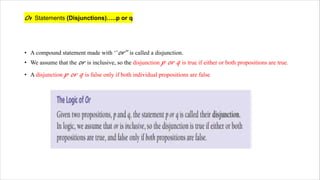
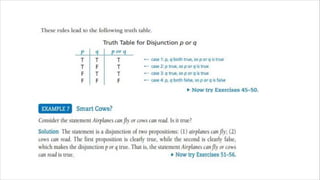
Or Statements (Disjunctions)…..por q
• A compound statement made with ‘’or’’ is called a disjunction.
• We assume that the or is inclusive, so the disjunction p or q is true if either or both propositions are true.
• A disjunction p or q is false only if both individual propositions are false
24.
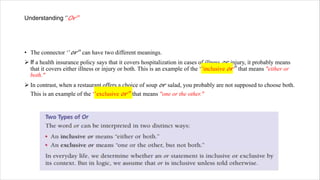
Understanding ‘’Or’’
• Theconnector ‘’or’’ can have two different meanings.
Ø If a health insurance policy says that it covers hospitalization in cases of illness or injury, it probably means
that it covers either illness or injury or both. This is an example of the ‘’inclusive or’’ that means "either or
both."
Ø In contrast, when a restaurant offers a choice of soup or salad, you probably are not supposed to choose both.
This is an example of the ‘’exclusive or’’ that means "one or the other."
26.
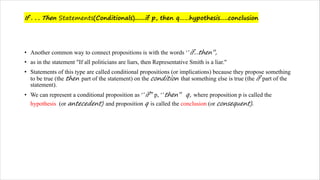
If . .. Then Statements(Conditionals).......if p, then q……hypothesis…..conclusion
• Another common way to connect propositions is with the words ‘’if...then’’,
• as in the statement "If all politicians are liars, then Representative Smith is a liar."
• Statements of this type are called conditional propositions (or implications) because they propose something
to be true (the then part of the statement) on the condition that something else is true (the if part of the
statement).
• We can represent a conditional proposition as ‘’if’’ p, ‘’then’’ q, where proposition p is called the
hypothesis (or antecedent) and proposition q is called the conclusion (or consequent).
27.
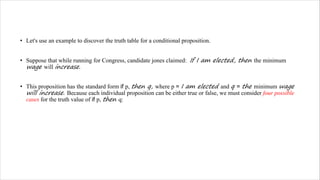
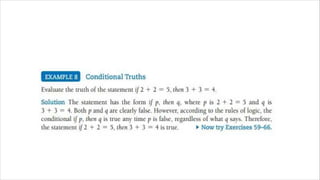
• Let's usean example to discover the truth table for a conditional proposition.
• Suppose that while running for Congress, candidate jones claimed: If I am elected, then the minimum
wage will increase.
• This proposition has the standard form if p, then q, where p = I am elected and q = the minimum wage
will increase. Because each individual proposition can be either true or false, we must consider four possible
cases for the truth value of if p, then q:
28.
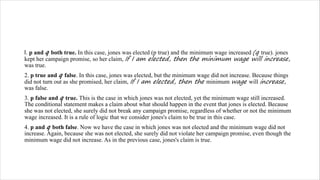
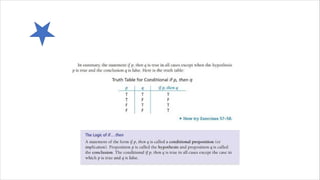
l. p andq both true. In this case, jones was elected (p true) and the minimum wage increased (q true). jones
kept her campaign promise, so her claim, If I am elected, then the minimum wage will increase,
was true.
2. p true and q false. In this case, jones was elected, but the minimum wage did not increase. Because things
did not turn out as she promised, her claim, If I am elected, then the minimum wage will increase,
was false.
3. p false and q true. This is the case in which jones was not elected, yet the minimum wage still increased.
The conditional statement makes a claim about what should happen in the event that jones is elected. Because
she was not elected, she surely did not break any campaign promise, regardless of whether or not the minimum
wage increased. It is a rule of logic that we consider jones's claim to be true in this case.
4. p and q both false. Now we have the case in which jones was not elected and the minimum wage did not
increase. Again, because she was not elected, she surely did not violate her campaign promise, even though the
minimum wage did not increase. As in the previous case, jones's claim is true.
31.
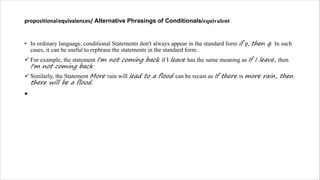
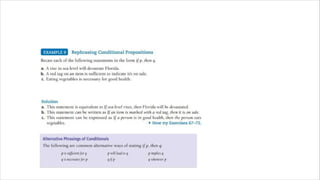
propositionalequivalences/ Alternative Phrasingsof Conditionals/equivalent
• In ordinary language, conditional Statements don't always appear in the standard form if p, then q. In such
cases, it can be useful to rephrase the statements in the standard form.
ü For example, the statement I'm not coming back if I leave has the same meaning as If I leave, then
I'm not coming back
ü Similarly, the Statement More rain will lead to a flood can be recast as If there is more rain, then
there will be a flood.
•
32.
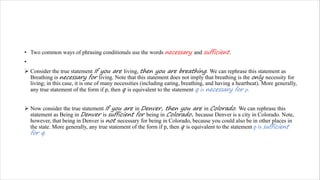
• Two commonways of phrasing conditionals use the words necessary and sufficient.
•
Ø Consider the true statement If you are living, then you are breathing. We can rephrase this statement as
Breathing is necessary for living. Note that this statement does not imply that breathing is the only necessity for
living; in this case, it is one of many necessities (including eating, breathing, and having a heartbeat). More generally,
any true statement of the form if p, then q is equivalent to the statement q is necessary for p.
Ø Now consider the true statement If you are in Denver, then you are in Colorado. We can rephrase this
statement as Being in Denver is sufficient for being in Colorado, because Denver is a city in Colorado. Note,
however, that being in Denver is not necessary for being in Colorado, because you could also be in other places in
the state. More generally, any true statement of the form if p, then q is equivalent to the statement p is sufficient
for q.



![Hypothetical%20proposition classpresentation[1]](https://cdn.slidesharecdn.com/ss_thumbnails/hypothetical20propositionclasspresentation1-100804123424-phpapp02-thumbnail.jpg?width=640&height=640&fit=bounds)


